2017 AUDI TT ROADSTER warning light
[x] Cancel search: warning lightPage 200 of 314
Airbag system
Standard 208 with which the Advanced Airbag
System in your vehicle was cert ified has been in
stalled on the front passenger seat. For a listing
of the child restraints that were used to certify
compliance with the US Safety Standard
¢page 220.
The PASSENGER AIR BAG OFF~; light in the
headliner tells you when the front Advanced Air
bag on the passenger side has been turned off by
the electronic control unit.
Each t ime you turn on the ignition, the
PASSEN·
GER AIR BAG OFF,-;; ON ~
light will come on
for a few seconds and:
- PASSENGER AIR BAG OFF~; will come on if
the front passenger seat is not occupied,
- PASSENGER AIR BAG OFF ~; will come on if
the e lectrical capacitance measured by the ca
pacitive passenger detection system for the
front passenger seat equals the combined ca pacitance of an infant up to about one year of
age and one of the rearward-facing or forward
facing child restraints listed in Federal Motor
Vehicle Safety Standard 208 with which the Ad
vanced Airbag System in your vehicle was certi
fied. For a listing of the child restraints that
were used to certify your vehicle's compliance
with the U.S. Safety Standard¢
page 220.
-PASSENGER AIR BAG OFF ~; will come on if
there is a small child or chi ld restraint on the
front passenger seat,
- PASSENGER AIR BAG ON @will go off if the
front passenger seat is occupied by an adult as
registered by the capacitive passenger detec
tion system ¢
page 20 7, Monitoring the Ad
vanced Airbag System.
The PASSENGER AIR BAG OFF~; light comes on
when electrical capacitance registered on the
front passenger seat is equa l to or less than the
comb ined capacitance of a typ ica l 1 year-old in
fant and one of the rearward-fac ing or forward
facing ch ild restraints listed in Federal Motor Ve
h icle Safety Standard 208 with wh ich the Ad
vanced Ai rbag System in your vehicle was cert i
fied.
If the total electrical capac itance registered on
the front passenger seat is more than that of a
198
typical 1 year -old chi ld but less than the weight
of a sma ll adult, the front airbag on the passen
ger side can deploy (the
PASSENGER AIR BAG
OFF ~;
light does not come on).
If the
PASSENGER AIR BAG OFF~; light does
not come on, the front airbag on the passenger
s ide has not been turned off by the e lectron ic
contro l unit and can deploy if the control unit
senses an impact that meets the conditions stor
ed in its memory .
For example, the airbag may deploy if :
-a small child that is heav ier than a typical 1
year -old child is on the front passenger seat
(regard less of whether the child is in one of the
child safety seats listed¢
page 220), or
- a child who has outgrown child restraints is on
the front passenger seat.
If the front passenger airbag is turned off, the
PASSENGER AIR BAG OFF,-;; light comes on in
the headliner and stays on .
If the front passenger airbag deploys, the Feder
al Standard requ ires the airbag to meet the " low
risk" deployment criteria to reduce the risk of in
jur y through interaction with the airbag. "Low
risk" deployment occurs in those crashes that
take place at lower decelerations as defined in
the electronic control unit¢
page 208, PASSEN
GER AIR BAG OFF~; ON~ light.
Always remember, a child seat or infant carrier
installed on the front seat may be struck and
knocked out of posit ion by the rapidly inflating
passenger's airbag in a frontal collision. The a ir
bag could greatly reduce the effectiveness of the
ch ild restraint and even ser iously injure the child
during inflation.
.&, WARNING
-
A child in a rearward-facing child seat instal
l ed on the front passenger seat will be seri
ously injured and can be killed if the front air
bag inflates - even with an Advanced Airbag
System.
- The inflating airbag will hit the ch ild seat or
infant carrier with great force and will .,.
Page 201 of 314
co
co
.... N
" N .... 0
" "' c:o
smash the child seat and child against the
backrest, center armrest, door or roof.
- Forward-facing child seats installed on the
front passenger's seat may interfere with
the deployment of the airbag and cause se
rious personal injury to the child.
A WARNING
If, in exceptional circumstances, you must in
stall a forward-facing child restraint on the
front passenger's seat:
- Always make sure the forward-facing seat
has been designed and certified by its man
ufacturer for use on a front seat with a pas
senger front and side airbag.
- Never put the forward-facing child restraint
up against or very near the instrument pan
el.
- Always move the front passenger seat to
the highest position in the up and down ad
justment range and move it back to the
rearmost position in the seat's fore and aft
adjustment range, as far away from the air
bag as possible, before installing the for·
ward-facing child restraint.
- Always make sure that the safety belt upper
anchorage is behind the child restraint and
not next to or in front of the child restraint
so that the safety belt will be properly posi
tioned.
- Make sure that the
PASSENGER AIR BAG
OFF~;
light comes on and stays on all the
time whenever the ignition is switched on.
A WARNING
To reduce the risk of serious injury, make sure
that the
PASSENGER AIR BAG OFF~; light
will be displayed whenever a child restraint is
installed on the front passenger seat and the
ignition is switched on.
- If the PASSENGER AIR BAG OFF~; light
does not stay on, perform the checks descri
bed
Q page 20 7, Monitoring the Advanced
Airbag System.
- Have the airbag system inspected by your
Audi dealer immediately.
Airbag system
-Always carefully follow instructions from
child restraint manufacturers when instal
ling child restraints.
A WARNING
If, in exceptional circumstances, you must in
stall a forward or rearward-facing child re
straint on the front passenger's seat:
- Improper installation of child restraints can
reduce their effectiveness or even prevent
them from providing any protection.
- An improperly installed child restraint can
interfere with the airbag as it deploys and
seriously injure or even kill the child -even
with an Advanced Airbag System.
- Always carefully follow the manufacturer's
instructions provided with the child seat or
earner.
-Always make sure that there is nothing on
the front passenger seat that will cause the
capacitive passenger detection system in
the seat to signal to the Airbag System that
the seat is occupied by a person when it is
not, or to signal that it is occupied by some ·
one who is heavier than the person actually
sitting on the seat. The presence of addi
tional objects could cause the passenger
front airbag to be turned on when it should
be off, or could cause the airbag to work in a
way that is different from the way it would have worked without the object on the seat.
199
Page 204 of 314
Airbag syste m
of the rear -facing or forward-facing infant re
straints (listed in Federal Motor Vehicle Safety
Standard 208 with wh ich the Advanced Airbag
System in your vehicle was certified), the front a irbag on the passenger side may or may not
deploy .
The
P A SSENGER AIR BAG OFF ~ ; light comes on
when the e lectron ic control un it detects a total
electrical capacitance on the front passenger seat
that requires the front airbag to be turned off. If
the
PASSEN GER AIR BA G OFF ~; light does not
come on, the front airbag on the passenger side has not been turned off by the control u nit and
can dep loy if t he con trol unit senses an impact
that meets the conditions stored in its memory.
If the tota l electrical capac itance registered on
the front passenger seat is more than that of a
typical 1 year-old, but less than the weigh t of a
small adu lt, the front airbag on the passenger
side may deploy (the
PASSENGER AIR BAG OFF
~ ; light does not come on) .
For example, the airbag may deploy if :
- a small child that is heavier than a typical 1
year-old ch ild is on the front passe nger seat
( r ega rdless of whether the child is in one of the
c hi ld se ats l isted
q page 220),
- a chi ld who has outg rown child restraints is on
t h e front passenger seat.
If the front passenger airbag is turned off, the
PASSENGER A IR BA G OFF ~; light in the head
line r will come on and stay on .
If the front passenger airbag deploys, the Feder
al Standard requires the airbag to meet the "low
risk " deployment criteria to help reduce the risk
of injury through inte raction with the airbag.
" Low risk" deployment occu rs in those c rashes
t hat take place at lower dece le rations as defined
in the electronic control unit
q page 207.
Alway s rememb er: Please be su re to read the im
portant information in the sections that follow
and be sure to heed all of t he WARNINGS.
A WARNING
To red uce the risk of inj ury when an airbag in
flates, a lways wear safety belts properly .
202
-If you are un restrained, leaning forward, sit
ting sideways or out of position in any way,
your risk of injury is much higher.
- You will a lso receive ser ious injuries and
could even be killed if you are up against the
airbag or too close to it when it inflates -
even with an Advanced Airbag
¢ page 196 .
A WARNING
A child in a rearward -facing child seat instal
led on the front passenger seat will be seri
ously injured and can be killed if the front air
bag inflates -even with an Advanced Airbag
Sys tem.
- Although the Advanced Airbag System in
your veh icle is designed to turn off the front
airbag when a rearwar d-fac ing ch ild re
straint has been installed on the front pas
senger seat, nobody can absolutely guaran
tee that dep loyment is impossib le in all con
ceivab le situat ions that may happen du ring
the useful life of your vehicle.
- The inflating airbag will h it the ch ild seat or
infant carrier with great force and will
smash the child seat and child against the
backrest, center armrest, doo r, or roof .
- If you must install a rearward facing child
safety seat on the front passenger seat be
cause of excep tional circumstances and the
PASSENGER AIR BAG OFF~; light does not
come on and stay on have the a irbag system
inspected by your Audi dealer.
A WARNING
I f, in ex ceptional ci rcums tances, you must in
stall a forward-facing child restraint on the
front passenger's seat:
- Always make sure the forward-facing sea t
has been des igned and certified by its man
ufacturer for use on a front seat with a pas
senger front and side airbag.
- Never put the forward -facing child restraint
up against or very nea r the instrument pan
el.
- Always move the front passenger seat to
the highest position in the up and down ad
justment range and move it back to the
Page 205 of 314
co
co
.... N
" N .... 0
" "' c:o
rearmost position in the seat's fore and aft
adjustment range, as far away from the air
bag as possible, before insta lling the for
ward-facing child restra int.
- lways make sure that the safety belt upper
anchorage is beh ind the child restraint and
not next to or in front of the child restraint
so that the safety belt will be properly pos i
tioned.
-Always make sure that there is nothing on the front passenger seat that w ill cause the
c apacit ive passenger detection system in
the seat to signa l to the Airbag Sys tem tha t
the seat is occupied by a person when it is
not, or to signa l that it is occ upied by some
one who is heavier than the person actua lly
sitting on the seat . The p resence of addi
t ional objects could cause the passenger
front airbag to be turned on when it shou ld
be off, or could cause the airbag to work in a
way that is different from the way it would
have worked witho ut the object on the seat.
- Make sure that the
PASSENGER AIR BAG
OFF ~;
light comes on and stays on a ll the
t ime whenever the ignition is switched on.
Advanced Airbag System components
The front passenger seat in yo ur vehicle has a lot
of
very important parts of the Advanced Airbag
Sys tem in it . These pa rts in cl ude the capacitive
passenger detection system, w iring, brackets,
and mo re. The control un it monitors the system
on the front passenger seat when the ign ition is
switched on and turns the airbag indicator light
on when a malfunct ion in the one of the system
components is detected
c::> page 208 . Because
the fro nt passenger seat contains important
pa rts of the Advanced Airbag System, you must
take ca re to preven t it from being damaged.
D amage to the seat may p revent the Advanced
Ai rbag System for the front passenger seat from
doi ng its job i n a crash.
The front Advanced Airbag System consists
of the follow ing :
- C rash sensors in the front of the vehicle that
measure vehicle accelerat ion/dece leration to
Airb ag sys tem
provide information to the Advanced A irbag
System about the severity of the cras h.
- An elect ronic contro l unit, with integrated
cras h sensors for front and side impacts . The
control un it "decides" whether to fire the front
airbags based on the information rece ived from
the crash sensors . The control unit also "de
cides" whether the safety belt pretensioners
should be activated.
- An Advanced A irbag w ith gas generator for the
driver inside the steeri ng wheel hub .
- An Advanced A irbag w ith gas generator inside
the instrument panel for the front passenger.
-A capacit ive passenger detection system under
neath the front passenger seat
cover. This sys
tem measures the e lectr ica l capacitance of the
person in the seat. The information registered
is sent continuously to the elect ronic contro l
un it to reg ulate dep loyment of the front Ad
vanced Airbag on the p assenger side.
- An airbag monitoring system and indicator
light
El in the inst rument cl uste r.
- A sensor in each front seat registe rs the d is
t ance betwee n the respective seat and the
steer ing whee l o r ins trumen t pa nel. The infor
mat ion registered is sent con tinuous ly to the
electronic contro l unit to regu late dep loyment
of the front Advanced Airbags .
- The
PASSENGER AIR BAG OFF~; lig ht comes
on and stays on in the headliner
c::> poge 208,
fig. 166 and tells you when the front Advanced
Airbag on the passenger side has been turned off.
- A sensor in the safety belt latch for the driver
and for the front seat passenger that senses
whether that safety be lt is latched or not and
transmits this information to t he electronic
cont rol un it .
A WARNING
Damage to the front passenge r seat can pre
vent the front airbag from working prope rly.
- Imp roper repair or d isassembly of the front
passenger and driver seat will p revent the
Advanced Airbag Sys tem from f unct ion ing
p roper ly. ...,
203
Page 206 of 314

Airbag syste m
-Repairs to the front passenger seat must be
performed by qua lified and properly trained
workshop personnel.
- Never remove the front passenger or driver
seat from the vehicle.
- Never remove the upholstery from the front
passenger seat.
- Never disassemble or remove parts from the
seat or disconnect wires from it.
- Never carry sharp objects in your pockets or
put them on the seat . The capacitive pas
senger detection mat in the front passenger
seat will not function properly if it is punc
tured.
- Never carry things on your lap or carry ob
jects on the front passenger seat. Such ob
jects can influence the capac itance regis
tered by the capac itive passenger detection
system, so that incorrect information is pro
vided to the airbag control unit.
- Never store items under the front passenger
seat. Parts of the Advanced Airbag System
under the passenger sea t could be dam
aged, preven ting them and the airbag sys
tem from working properly.
- Never place seat covers o r rep lacemen t up
holstery that have not been spec ifically ap
proved by Audi on the front seats.
- Seat covers can prevent the Advanced Air
bag System from recogn izing child re
straints or occupants on the front passenge r
seat and prevent the side airbag in the seat
backrest from dep loying proper ly.
- If a seat heater has been retrofitted or oth
erwise added to the front passenger seat,
never install any ch ild restraint system on
this seat.
- Never use cush ions, pillows, blankets, or
similar items on the front passenger seat.
The add itiona l layers prevent the capacitive
passenge r detection system from accurate ly
measuring the capac itance of the ch ild safe
ty seat and/or the pe rson on the seat and
t hu s keep the Advanced Airbag System from
wor king p roperly.
- Never place o r use any electrical device
(s uch as a laptop, CD player, elec tronic
games dev ice, power inverte r or seat he ater
204
for child seats) on the front passenger seat
if the device is connected to the 12-volt
socket or the cigarette lighter socket. Such
dev ices can influence the capac itance regis
tered by the capacitive passenger detection
system, so that incorrect informat ion is pro
vided to the airbag cont ro l unit.
- If you must use a child restra int on the front
passenger seat and the child restra int man
ufacturer's instructions requ ire t he use of a
towel, foam c ushion or someth ing else to
proper ly posit ion the child restra int, make
certa in that the
PASSENGER AIR BAG OFF
,; ; light comes on and stays on whenever
the child restraint is insta lled on the front
passenger seat.
- If the
PASSENGER AIR BAG OFF,;, light
does not come on and stay on, have the air bag system inspected by your Audi dealer.
A WARNING
If the front passenger seat gets wet, dry it immediately .
- If liq uid soaks into the front passenger seat,
this can keep the airbag system from work
ing proper ly and may, for instance, deacti
vate the passenger frontal airbag. If this
happens, the
PASSENGER AIR BAG OFF,;,
light will come on and stay on together w ith
t he airbag indica to r li gh t
min the instru
ment cluster.
'
- I f liq uid is pooled on the seat, but has not
soaked in, th is may also keep the airbag sys
tem from working p roperly and cause the
passenger fronta l airbag to be enabled
(turned on), even though there is a properly
installed child restraint system on the seat.
Wet towels or other wet things on the seat
cushion can have the same effect. If the
front passenger frontal airbag is turned o n,
the
PASSENGER AIR B AG OFF ,;, light light
w ill go out.
How the Advanced Airbag System
components work together
The front Advanced Airbag System and the side
airbags supp lement the protection offered by the .,,.
Page 207 of 314
CD
CD
.... N
" N ...... 0 r--. V, co
front three-point safety belts with pretensioners
and load limiters to help reduce the risk of in jury
in a wide range of accident and crash situations .
Be sure to read the important information about
safety and heed the WARNINGS in this chapter.
Dep loyment of the Advanced Airbag System and
the act ivat ion of the safety belt pretensioners de
pend on the deceleration measured by the crash
sensors and registered by the electronic control
un it . Crash severity depends on speed and decel
eration as wel l as the mass and stiffness of the
vehicle or object invo lved in the c rash .
On the passenger side, regardless of safety belt
use, the front passenger frontal airbag w ill be
turned off if the electrical capac itance measured
by the capacit ive passenger detection system on
the fro nt passenger seat is less than the amount
p rogr ammed in the elect ronic control uni t. The
front passenger fronta l airbag will also be turned
off if the capacitance measured by the system for
the front passenger seat equals that of an infant
of about one year of age in one of the child seats
that was used to certify the Advanced Airbag Sys
tem under Federal Motor Veh icle Safety Standard
208. The
PA SSENGER AIR BAG OFF,;; light
comes on and stays on to tell you when the front
Advanced Airbag System on the passenger side has been turned off
Q page 208.
& WARNING
T o red uce the risk of i njury when an a irbag in
flates, a lways wear safety belts proper ly .
- If you are unrestrained, lean ing fo rw ar d, s it
t ing s idew ays or o ut o f pos ition in any way,
your risk of i nju ry is much higher.
- Yo u w ill also re ceive se rious injur ies and
cou ld even be killed if you are up aga inst the
airbag or too close to it when it inf lates -
even with an Advanced Airbag
~page 196.
Airb ag sys tem
More important things to know about front
airbags
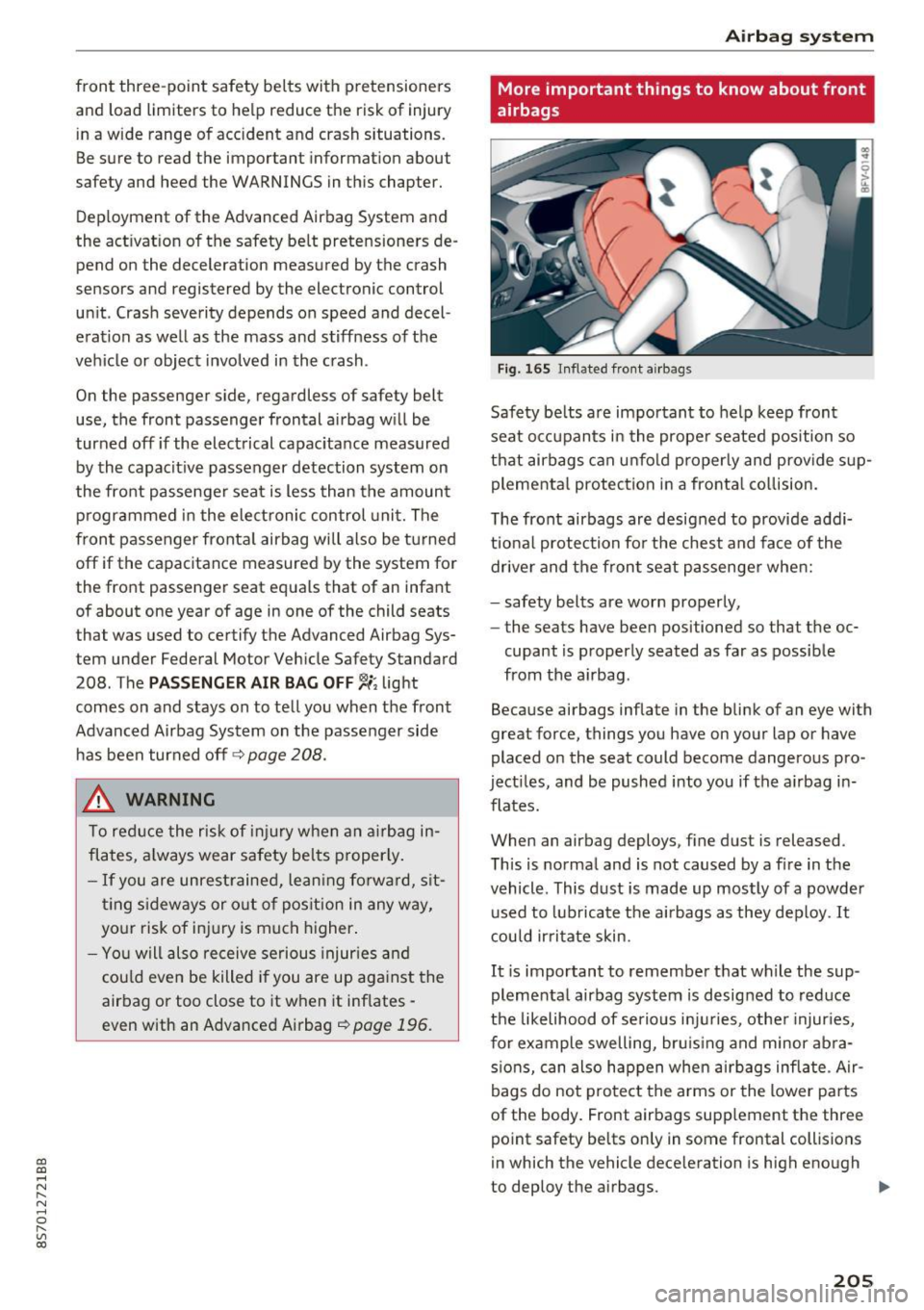
Fig. 165 I nflated fro nt ai rbags
Safety be lts are impo rtan t to he lp keep front
seat oc cupants in the proper seated position so
that airbags can unfo ld properly and prov ide s up
pleme nta l protection i n a fronta l co llision .
The front airbags are designed to provide addi
t iona l protec tion fo r the chest and face of the
driver and the fron t seat passenger whe n:
- safety belts are worn properly,
- the seats have been positioned so that t he oc-
cupant is properly seated as far as possible
from the a irbag .
Because airbags inflate in the blink of an eye with
great force, things you have on your lap or have
placed on the seat could become dangerous pro
ject iles, and be pushed into you if the a irbag i n
flates.
When an airbag deploys, fine dust is released.
This is norma l and is not caused by a fire in the
vehicle . This dust is made up mostly of a powder
used to lub rica te t he a irbags as they deploy.
It
cou ld irritate skin.
It is important to remembe r that wh ile the sup
pleme nta l airbag system is designed to reduce
the likelihood of serio us inj uries, othe r injuries,
for example swelling, bru is ing and minor abra
s ions, can also happen when a irbags inflate . Air
bags do not prote ct the arms or the lower p arts
of the body. Front airbags supp lement the three
point safety belts on ly in some frontal collisions
in which the vehicle dece leration is high enough
to deploy the airbags.
II>
205
Page 208 of 314
Airbag syste m
Front airbag s will not deploy:
- if the ignit ion is switched off when a crash oc -
curs,
- in s ide collisions,
- in rear-end collisions,
- in rollovers,
- when the crash deceleration measured by the
airbag system is less than the minimum thresh
old needed for airbag deployment as registered
by the electronic contro l unit.
Th e front p asse nger airb ag w ill also not
depl oy:
- when the front passenger seat is not occupied,
- when the electrical capacitance measured by
the capacitive passenger detect ion system for
the front passenger seat indicates that the pas
senger side frontal airbag must be switched off
by the electronic contro l unit (the
PASSENGER
AIR B AG OFF ~;
light~ page 208 and how
they work comes on and stays on) .
A WARNING
Sitting in the wrong position can increase the
risk of serious injury in crashes.
- To reduce the risk of injury when the airbags inflate, the driver and passengers must al
ways sit in an upright position, must not
lean against or place any part of their body
too close to the area where the airbags are
located.
- Occupants who are unbelted, out of position
or too close to the a irbag can be seriously
injured by an airbag as it unfolds with great
force in the blin k of an eye~
page 197.
A WARNING
A child in a rearward-facing chi ld seat insta l
led on the front passenger seat will be ser i
ously inju red and can be killed if the front air
bag inf lates - even with an Advanced Airbag
System.
- T he inflating a irbag w il l hit the child seat or
infant carrier with great force and will
smash the chi ld seat and child against the
backrest, center armrest, door or roof.
206
-
- Never install a rearward facing chi ld safety
seat on the front passenger seat unless the
PAS SEN GER AIR BA G OFF ~; light comes
on and stays on . If the
PA SSE NGER AIR
BAG OFF~;
light does not come on and stay
on, the inflat ing airbag will hit the chi ld
safety seat or infant carrie r with great force
and will smash the child safety seat and
child against the bac krest, door or roof.
Have the airbag system inspected immedi
ately by your authorized Audi dealer .
A WARNING
Objects between you and the airbag will in
crease the risk of injury in a crash by interfer
ing with the way the airbag unfolds or by be
ing pushed into you as the airbag inflates.
- Never hold things in your hands or on your
lap when the vehicle is in use.
- Never transport items on or in the area of
the front passenger seat. Objects could
move into the area of the front airbags dur
ing braking or other sudden maneuver and
become dangerous projectiles that can
cause serious persona l injury if the airbags
inflate.
- Never place or attach accessories o r other
objects (such as cup holders, telephone
brackets, large, heavy or bulky objects) on
the doo rs, ove r or near the area ma rked
"AIRBAG" on the steering wheel, instru
ment panel, seat backrests or between
those areas and yourself. These objects
could cause injury in a crash, especially
when the a irbags inf late.
- Never recline the front passenger's seat to
transport objects. Items can also move into
the area of the side a irbag or the front air
bag during brak ing or in a sudden maneu
ver . Objects near the airbags can become
projecti les and cause injury, part icularly
when the seat is reclined.
- Never p lace or t ransport objects on the
-
front passenger sea t. Objects on the front
p assenger sea t could ca use the capaci tive
sensor in the seat to signal to ai rbag system
that the seat is occ upied by a person when it ..,
Page 209 of 314
co
co
.... N
" N .... 0
" "' c:o
in fact is not, or that the person on the seat
is heavier than he or she actually is. The
change in electric capacitance because of
such objects can cause the passenger front
airbag to be turned on when it should be
off, or can cause the a irbag to work in a way
that is diffe rent from the way it would have
wor ked witho ut objects on the seat.
- Always make sure that there is nothing on
the front passenger seat that w ill cause the
capacit ive passenger detection system in
the seat to signa l to the Airbag System that
the seat is occupied by a person when it is
not, or to signa l that it is occupied by some
one who is heavier than the person actua lly
sitting on the seat. The presence of an ob
ject could cause the passenger front a irbag
to be t urned on when it should be off, or
cou ld cause the ai rbag to work in a way that
is d ifferent from the way it wou ld have
wor ked witho ut the ob je ct on the seat.
A WARNING
The fine dust create d when air bags deploy can
cause breathing problems for peop le w ith a
history of asthma or other breathing condi
tions .
- T o reduce the risk of breathing problems,
those with asthma or other respiratory con
ditions should get fresh air right away by
gett ing out of the veh icle or opening w in
dows o r doors.
- If you are in a collision in which airbags de
ploy, wash your hands and face with mild
soap and water before eat ing.
- Be careful not to get the dust into your eyes,
or into any cuts or scratches.
- If the resid ue should get into your eyes,
flush them with water.
Airb ag sys tem
Monitoring the
Advanced Airbag System
Airbag monitoring indicator light
Two separate indicators monitor the function of
the Advanced Airbag System: the
El light and
the
PASSENGER AIR BAG OFF "1; ON @ light.
T he Advanced A irbag System as well as the side
airbags with e jection m itigation features (i nclud
i ng the e lectron ic cont rol unit, senso rs and sys
tem wiring) are all monito red contin uous ly to
make sure that they are functioning properly
whenever the ignition is on. Every t ime you turn
on the ignition, the a irbag system indicator light
El w ill come on for a few seconds (function
check).
The system mu st be in spected wh en the
i ndicator light
E,I:
- does not come on when the ignition is switched
on,
- does not go out a few seconds after you have
sw itched on the ignition, or
- comes on while driv ing.
If an airbag system mal func tion is detected, the
indicator light will come on to serve as a constant
reminder to have the system inspected immedi
ately.
If a ma lfunction occurs that turns the front air
bag on the passenger side off, the
PASSENGER
AIR BAG O FF
"1 ; light will come on and stay on
whenever the ignition is on.
A WARNING
An a irbag system that is not functioning prop
erly cannot prov ide supplemental protect ion
i n a fronta l crash.
- If the airbag ind icator light
~page 14
comes when the veh icle is being used, have
the system inspected immediately by your
author ized Audi dealer.
It is possib le that
the airbag will inflate when i t is not sup
posed to, or w ill not inf late w hen it should.
207