2017 AUDI TT ROADSTER warning light
[x] Cancel search: warning lightPage 245 of 314

co
co
.... N
" N .... 0
" "' c:o
CD Note
-If the brake fluid level is above the MAX
mark ing, brake fluid may leak out over the
edge of the reservoir and result in damage
to the vehicle.
- Do not get any brake f luid on the vehicle
paint, because it will corrode the paint.
Battery
General warnings about batteries
All of the batteries in yo ur vehicle are practically
ma intenance-free and are checked during a ve hi
cle inspection . Because of the complex power
supp ly, all work on batter ies such as d isconnect
ing, replacing, etc. should
o nly be performed by
an author ized Audi dealer or authorized Audi
Service Facility
c> & -
The term "vehicle battery" refers to the 12 Vo lt
battery in your veh icle.
Detailed wa rning s for the vehicle batte ry:
®
Wear eye p rotection.
A
Battery acid is hig hly co rrosive. Wea r pro-
tective g loves and eye pro tect ion.
@
Fire, sparks, open flame and smok ing are
forb idden.
~
A highly exp losive mixtu re of gases can
form when charging batteries.
®
Keep childre n away from battery acid and
batteries.
A WARNING
All work on the battery or electrical system in
your vehicle can result in injuries, chemical
burns, accidents or burns. Because of this, a ll
work m ust be perfo rmed
only by an author
ized Aud i deale r or authorized Audi Serv ice
Facility.
A WARNING
California Proposition 65 Warn ing:
- Battery posts, terminals and re lated acces
sories contain lead and lead compounds,
Ch eck ing and Filling
chemicals known to the State of California
to cause cancer and reproductive problems.
Wash hands after handling.
CD Note
Protect the vehicle battery against freezing if
the veh icle wi ll be parked for long periods of
time so that it is not destroyed by "freezing"
c> page244.
Vehicle battery
The term "vehicle battery" refers to the 12 Volt
battery in your vehicle.
Not running the vehicl e for long periods of
time
If you do not drive your vehicle for severa l days or
weeks, electrical equ ipment is gradua lly scaled
back or sw itched off. Th is reduces energy use and
ensures the vehicle will be ab le to start after long
per iods of time
c> page 93 . Some convenience
func tions, such as i nterio r lighting o r power seat
adjus tme nt, may no t be ava ilab le unde r certain
cir cumstances . These convenience func tions will
be available again once you switch the ignit ion on
and start the engine.
E ven when elec trical equipment is switched off,
the eq uipment can sti ll dr ain the vehicle ba ttery
i f the veh icle is not dr iven for long periods of
t ime . Deep dra ining resu lts in a chemica l reaction
t h at destroys the inside of the vehicle batte ry.
The veh icle battery must be charged every month
to red uce the risk of this happening
c> page 244.
Contact an authorized Aud i dea ler or authorized
Audi Service Facility for more information .
Winter operat ion
Co ld weather places higher demands on the vehi
cle battery. Th is res ults in reduced starting ab ili
ty. Have the vehicle battery checked by an au
thorized Aud i dea ler or authorized Audi Service
Facility before the cold time of year .
243
Page 246 of 314

Checking and Filling
Charging the vehicle battery
Fig. 186 Engine co mpa rtment : connec tors for a c harger
and jump start cab le s
Req uirement: only use chargers with a m aximum
c hargi ng vo lta ge of 30 amp s/14.8 Volt s.
The
vehicle battery cables remain connected .
.,. Read the warnings
c> .&. in General warnings
about batteries on page 243
and c> ,&. .
.,. Switch off the ignition and all electrical equip
ment .
.,. Open the hood ¢
page 236 .
.,. Open the red cover on the positive terminal
c> fig. 186 .
.,. Clamp the charger terminal clamps to the jump
s ta rt pin s
according to the instruct ions
c> fig . 186 .
.,. Now inse rt the powe r cable for the charging de
v ice into the socket and sw itch the device on.
.,. At the end of the charging process, switch the
charger off and pull the powe r cab le out of the
socket .
.,. Remove the charger terminal clamps.
.,. Close the red cover on the positive term inal.
.,. Close the hood¢
page 236.
A WARNING
- A highly explosive mixture of gases can form
when cha rging batter ies. Only charge the
vehicle batte ry in well-vent ilated areas.
- A drai ned battery can freeze at tempera
t ur es a round 32 °F (0 °C) . A frozen or
thawed veh icle battery must not be charged
and must not be used anymore. The batte ry
housing can crac k and battery acid can leak
o ut if ice fo rms, wh ich increases the risk of
an explosion and chemical burns . Contact an
244
author ized Audi dealer or authorized A udi
Service Facility for more information.
- Do not connect or disconnect the charging
cable whi le charging because this increases
the risk of an explos ion.
@ Tips
- Only charge the vehicle battery t hrough the
connect ions in the engine compartme nt.
- Read all of the manufacturer's instructions
for the charger before charging the vehicle
battery.
Windshield washer system
Fi g. 18 7 Engine compar tm ent: washer flui d res ervoir cap
The windshield washer reservoir~ contains the
cleaning so lu ti on for th e windshield and the
headlight washer system*c>
page 237 , fig. 181 .
The reservoir capaci ty is found in c> page 291.
To reduce the risk of lime scale depos its on the
spray nozzles, us e clean water with low amo unts
of calcium . Always add w indow cleaner to the wa
ter . When the ou tside temperatures a re cold , an
anti-freez ing agent should be added to the water
so that it does not freeze .
(D Note
-The concentration of ant i-freez ing agent
must be adjusted to the veh icle operat ing
conditions i n the respective cl imate. A con
cen tration that is too high can lead to vehi-
cle damage.
- Never add radiato r anti-freeze or other addi-
t ives to the washer fluid . ...,
Page 266 of 314

Wheels
installation of replacement or alternate tires or
wheels on the vehicle that prevent the TPMS
from functioning properly. Always check the
TPMS malfunction telltale after replacing one or
more tires or wheels on your vehicle to ensure
that the replacement or alternate tires and
wheels allow the TPMS to continue to function
proper ly .
If the Tire Pressure Monitoring System
indicator appears
The tire pressure indicator in the instrument
cluster informs you if the tire pressure is too low
or if there is a system malfunction.
Using the ABS sensors, the tire pressure monitor
ing system compares the tire tread circumfer
ence and vibration characteristics of the individu
al tires. If the pressure changes in one or more
tires, this is indicated in the Infotainment system
disp lay with an indicator light
RR and a message.
If only one tire is affected , the location of that
tire will be indicated.
The tire pressures must be stored in the Infotain
ment system again each time the pressures
change (switching between partial and full load pressure) or after changing or replacing a tire on
your vehicle ¢
page 265 . The tire pressure moni
toring system only monitors the tire pressure you
have stored. Refer to the tire pressure label for
the recommended tire pressure for your vehicle
¢ page 256, fig.191.
Tire tread circumference and vibration character
istics can change and cause a tire pressure warn
ing if:
- the tire pressure in one or more tires is too low.
- the tire has structural damage .
- the tire was replaced or the tire pressure was
changed and it was not stored¢
page 265.
-the spare tire* is installed.
Indicator lights
RR -Loss of pressure in at least one tire ¢ ,& .
Check the tires and replace o r repair if necessary.
Check/correct the p ressures of a ll four tires and
store the pressure again in the Infotainment sys
tem ¢
page 265.
264
mm (T ire Pressure Monitoring System) Tire
pressure: malfunction! See owner's manual -
If
mm appears after switching on the ignit ion or
while driving and then the indicator light
RR in
the instrument cluster also starts to blink for
about one minute and then stays on permanent ly, there is a system malfunction. Try to store the
correct tire pressures¢
page 265. If the indica
tor light does turn off or turns on again after a
short period of time , drive to an authorized A udi
dealer or authorized Audi Service Facility immedi
ate ly to have the ma lfunction corrected.
_& WARNING
-If the tire pressure indicator appears in the
disp lay, reduce your speed immediately and
avoid any hard steering or brak ing maneu
vers. Stop as soon as poss ible and check the
tires and their pressure .
- The driver is responsible for maintain ing the
correct tire pressures . You must check the
tire pressures regularly .
- Under certain cond it ions (such as a sporty
driving style, w inter condit ions or unpaved
roads), the pressure monitor indicator may
be delayed.
- Do not use run-flat tires on your vehicle . Us
ing them when not perm itted can lead to
vehicle damage or accidents.
(D Tips
- The tire pressure monitoring system can al
so stop working when there is an ESC mal
function.
- Us ing snow chains may result in a system
ma lfunction.
- The tires w ith the identification "AO"
¢
page 253 have been matched w ith your
Audi t ire pressure monitoring system. We
recommend that you use these tires.
Page 268 of 314

Care and cleaning
Care and cleaning
General information
Regular, proper care helps to maintain your vehi
cle's value.
It can also be a requirement when
submitting warranty claims for corrosion damage
and paint defects on the body.
The necessary care products can be obtained
from an authorized Audi dealer or authorized
Audi Service Facility. Read and follow the instruc
tions for use on the packaging.
A WARNING
- Using cleaning and care products incorrectly
can be dangerous to your health .
- Always store cleaning and care products out
of reach of children to reduce the risk of poi
soning .
@ For the sake of the environment
- Preferably purchase environmentally-friend ly cleaning products.
- Do not dispose of leftover cleaning and care
products with household trash.
Car washes
The longer that deposits remain on the vehicle,
the more the surface may be damaged. High
temperatures such as those caused by sunlight
increase the damaging effect.
Before washing, rinse
off heavy deposits with
plenty of water.
Stubborn deposits such as bird droppings or tree
sap are best removed with plenty of water and a microfiber cloth.
Also, wash the underside of your vehicle once
road salt stops being used for the season.
Pressure washers
When washing your vehicles with a pressure
washer, always follow the operating instructions
provided with the pressure washer. This is espe
cially important in regard to the pressure and
spraying distance . Do not direct the stream of
water directly onto seals for the side windows,
266
doors, luggage compartment lid or hood or onto
the tires, rubber hoses, insulating material, sen
sors* or camera lenses*. Keep a distance of at
least 16 in (40 cm).
Do not remove snow and ice with a pressure
washer.
Never use cone nozzles or high pressure nozzles.
The water temperature must not be above 140 °F
(60 °().
Automatic car washes
Spray
off the vehicle before washing.
Make sure that the windows are closed and the
windshield wipers are
off. Follow instructions
from the car wash operator, especially if there
are accessories attached to your vehicle.
If possible, use car washes that do not have
brushes.
Washing
by hand
Clean the vehicle starting from the top and work
ing down using a soft sponge or cleaning brush.
Use solvent-free cleaning products.
Washing vehicles with matte finish paint
by
hand
To avoid damaging the paint when washing, first
remove dust and large particles from your vehi
cle. Insects, grease spots and fingerprints are
best removed with a special cleaner for matte
finish paint .
Apply the product using a microfiber cloth. To
avoid damaging the paint surface, do not use too
much pressure.
Rinse the vehicle thoroughly with water. Then
clean using a neutral shampoo and a soft micro
fiber cloth .
Rinse the vehicle thoroughly again and let it air
dry. Remove any water residue using a chamois .
A WARNING
-
- Only wash the vehicle when the ignition is
off and follow the instructions from the car
Page 271 of 314
co
co
.... N
" N .... 0
" "' c:o
Care and cleaning
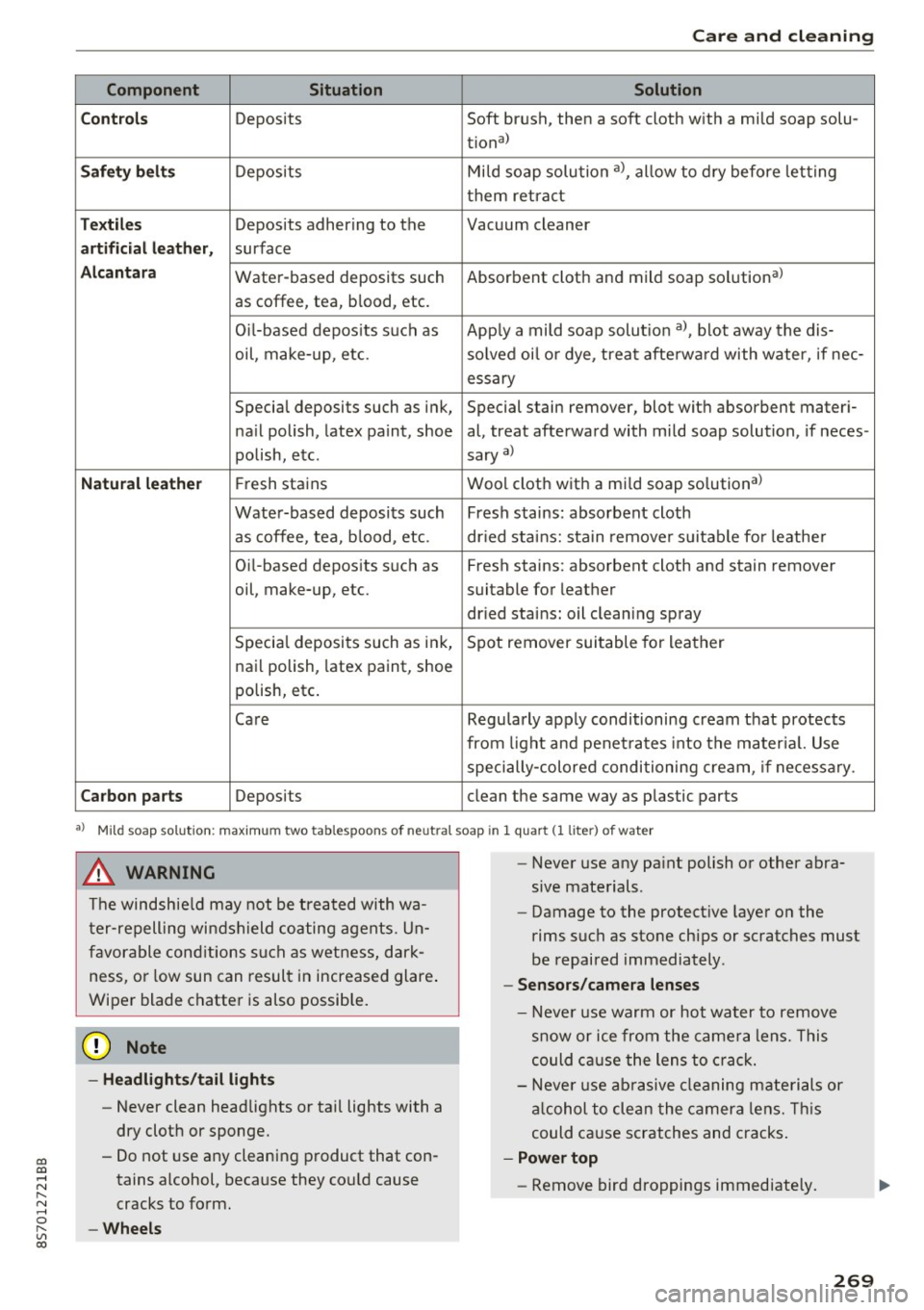
Component Situation Solution
C ont rols
Deposits Soft brush, then a soft cloth with a mild soap solu-
tiona)
Saf ety be lts Deposits Mi
ld soap solution a), allow to dry before letting
them retra ct
T ex til es Deposits adhering to the Vacuum cleaner
artificial l eather, surface
Alcantar a Water-based deposits such Absorbent cloth and mild soap solutiona)
as coffee, tea, blood, etc.
O il-based depos its s uch as App ly a mild soap solut ion a), blot away the dis-
oil, make-up, etc. solved oi l o r dye, treat afterwa rd with water, if nee-
essary
Special deposits such as ink, Special stain remover, blot with absorbent materi-
na il polish, latex paint, shoe al, treat afterward with mild soap solution, if neces-
polish, etc. sary
a)
Natu ral lea the r Fresh stains Wool cloth with a mi
ld soap solutiona >
Water-based deposits such Fresh stains: absorbent cloth
as coffee, tea, b lood, etc. dr ied stains: sta in remove r su itable for leathe r
Oi l-based deposits such as Fresh stains: absorbent cloth and stain remover
oil, make-up, etc. suitable for leather
dr ied stains: oil cleaning spray
Specia l deposits such as ink, Spot remover suitable for leather
nai l polish, latex paint, shoe
polish, etc.
Care Regularly apply conditioning cream that protects
from light and penet ra tes into the mater ial. Use
specially-colored conditioning cream, if necessa ry.
Carbon parts Deposits clean the same way as plastic parts
•> Mild soap solution: maximum two tablespoons of neutral soap in 1 quart (1 liter ) of water
A WARNING
The windshie ld may not be treated with wa
t er-repelling windshield coating agents. Un
favorable cond itions such as wetness, dark
ness, or low sun can result in increased glare .
Wiper blade chatter is also possib le.
{U) Note
- Headligh ts /t ail li ghts
- Never clean headlights or tai l lights with a
dry cloth or sponge.
- Do not use any cleaning product that con
tains alcohol, because they cou ld cause
cracks to form.
-Whe els
-
- Never use any pa int polish or other abra
sive materials.
- Damage to the protect ive layer on the
rims such as stone chips or scratches must
be repaired immediately.
- Sensors /cam era lenses
- Neve r use warm or hot water to remove
s n ow or ice from the came ra lens. This
could ca use the lens to crack.
- Neve r use ab rasive cleaning materials or
a lcohol to clean the camera lens. Th is
could cause scratches and cracks .
-Power top
- Remove bird droppings immediately.
269
Page 278 of 314
Emergency assistance
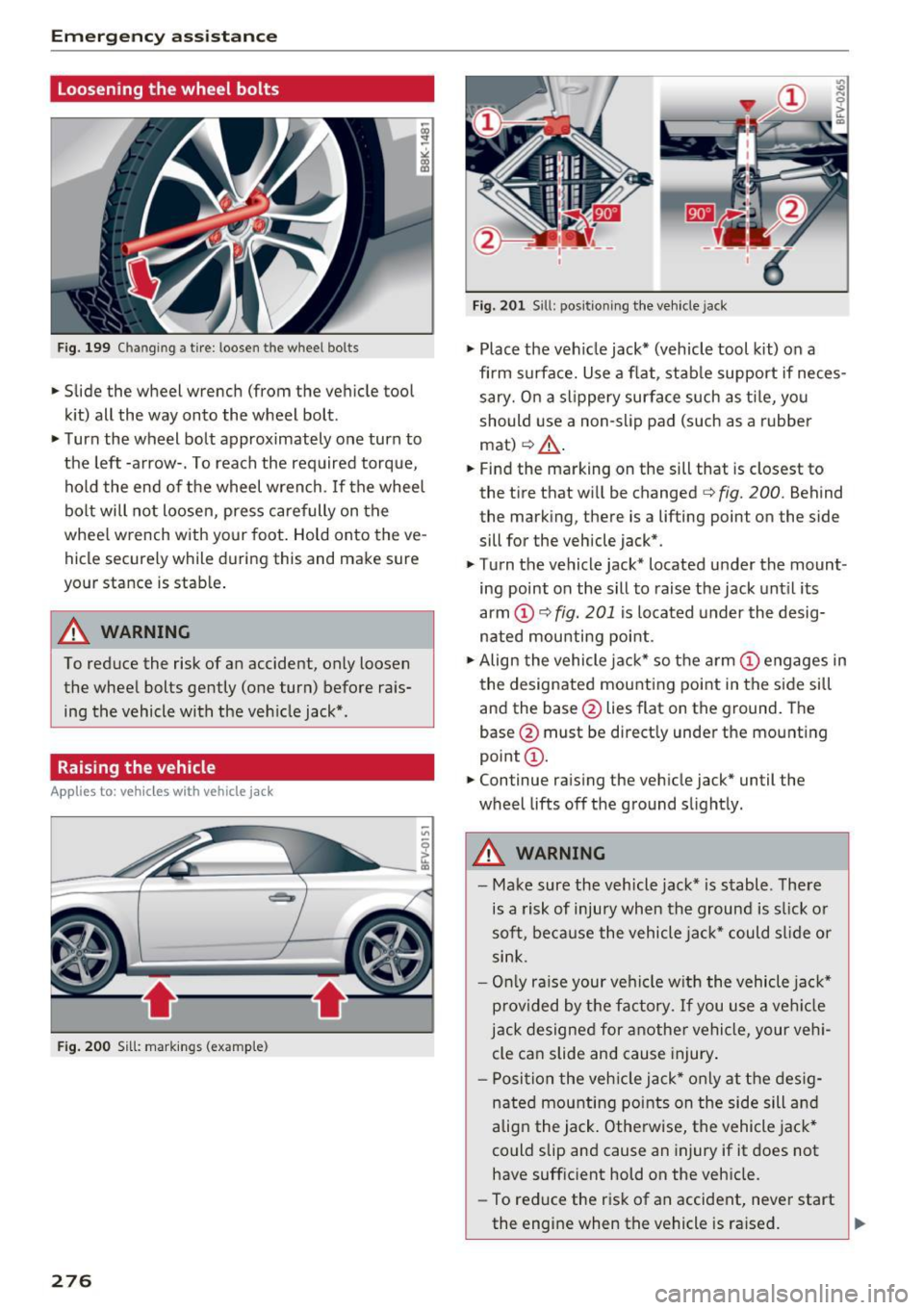
Loosening the wheel bolts
Fig. 199 Changing a tire: loosen the wheel bolts
• Slide the wheel wrench (from the vehicle tool
kit) all the way onto the wheel bolt.
• Turn the wheel bolt approximately one turn to
the left -arrow-. To reach the required torque,
hold the end of the wheel wrench. If the wheel
bolt will not loosen, press carefully on the
whee l wrench with your foot. Hold onto the ve
hicle securely while during this and make sure
your stance is stable .
A WARNING
To reduce the risk of an accident, only loosen
the wheel bolts gently (one turn) before rais
ing the vehicle with the veh icle jack*.
Raising the vehicle
Appl ies to: ve hicles w ith vehicle jack
- ,tr.-----,:
Fig. 200 Sill: markings (examp le)
276
Fig. 201 Sill: positio ning the vehicle jack
• Place the veh icle jack* (vehicle tool kit) on a
firm s urface. Use a flat, stable support if neces
sary. On a slippery surface such as tile, you
should use a non-slip pad (such as a rubber
mat)
c:> & .
• Find the marking on the sill that is closest to
the tire that will be changed
c:> fig. 200. Behind
the marking, there is a lifting point on the side
sill for the vehicle jack*.
• Tu rn the vehicle jack* located u nder the mount
ing point on the sill to raise the jack until its
arm
(D c:> fig. 201 i s located under the desig
nated mou nting point .
• Align the vehicle jack* so the arm @engages in
the designated mounting point in the side sill
and the base @lies flat on the ground. The
base @must be direct ly under the mounting
point @.
• Continue raising the vehicle jack* until the
wheel lifts off the ground slightly.
A WARNING
- Make sure the vehicle jack* is stable. There
is a risk of injury when the ground is slick or
soft, because the vehicle jack* could slide or
sink.
- Only raise your vehicle w ith the vehicle jack*
provided by the factory. If you use a vehicle
jack designed for another vehicle, your vehi
cle can slide and cause injury .
- Pos ition the vehicle jack* only at the desig
nated mounting points on the side sill and
align the jack . Otherwise, the vehicle jack*
co uld slip and cause an injury if it does not
have sufficient hold on the vehicle.
- To reduce the risk of an accident, never start
the engine when the vehicle is raised.
Page 283 of 314

CD
CD
.... N
" N ...... 0 r--. V, co
Fuses and bulbs
Electrical fuses
Replacing fuses
A fuse that has blown will have metal strips tha t
have burned through .
Fig. 206 Steer ing colu mn area : cove r
Fig. 207 Left side of the engin e com partment : fus e cover
The individual circuits are protected by safety
fuses. The fuses are located in the interior and in
the engine compartment.
Fuses in the interior
"S witch the ignition and all electrical equipment
off .
"C heck the following table to see which fuse be
longs to the equipment ¢
page 282.
" Remove the cover ¢ fig. 206.
"Remove the plastic clip from the fuse panel
cover in the engine compartment¢
fig. 207.
"Remove the fuse using the clamp.
" Replace the blown fuse only with an identical
new one .
"Install the cover .
Fuses and bulbs
Fuses in the engine compartment
"S witch the ignition and all electrical equipment
off .
.. Check the following table to see which fuse be
longs to the equipment¢
page 283.
.. Remove the fuse panel cover c::> fig. 207.
" Remove the plastic clip from the fuse panel
cover ¢
fig. 207.
" Remove the fuse using the clamp .
.. Rep lace the blown fuse only with an identical
new one.
Fuse color identification
Color Current rating
in amps
Black
1
Purpl e 3
Light brown 5
Brown 7.5
Red 10
Blue 15
Yellow 20
White or transparent 25
Green 30
Orange 40
&, WARNING
-
Do not repair fuses and never replace a blown
fuse with one that has a higher amp rating.
This can cause damage to the electrica l sys
tem and a fire .
(D Note
If a new fuse burns out again shortly after you
have instal led it, have the electrical system
checked as soon as possible by an authorized
Audi dealer or authorized Audi Service Facili
ty.
© Tips
- Th e following table does not list fuse loca
tions that are not used.
- Some of the equipment listed in the follow
ing tables applies only to certain model ver
sions or certain optional equipment.
281
Page 286 of 314

Emergency situations
Emergency situations
General
This chapter is intended for trained emergency crews and working personnel who have the nec
essary tools and equipment to perform these
operations.
Starting by pushing or
towing
CD Note
Vehicles with an automatic transmission can
not be started by pushing or towing.
Starting with jumper
cables
If necessary, the engine con be started by con
necting it to the battery of another vehicle .
If the engine should fail to start because of a dis
charged or weak battery, the battery can be con
nected to the battery of
another vehicle, using a
pair of jumper cables to start the engine.
Jumper cables
Use only jumper cables of sufficiently large cross
section
to carry the starter current safely. Refer
to the manufacturer's specifications.
Use only jumper cables with
insulated terminal
clamps which are distinctly marked :
plus(+) cable in most cases colored red
minus(-) cable
in most cases colored black .
A WARNING
Batteries contain electricity, acid, and gas.
Any of these can cause very serious or fatal in
jury. Follow the instructions below for safe hand Ling of your vehicle's battery .
-Always shield your eyes and avoid leaning
over the battery whenever possible.
-A discharged battery can freeze at tempera
tures just below 32 °F (0 °C). Before con
necting a jumper cable, you must thaw the
284
frozen battery completely, otherwise it could explode .
- Do not allow battery acid to contact eyes or
skin. Flush any contacted area with water immediately.
- Improper use of a booster battery to start a
vehicle may cause an explosion.
- Vehicle batteries generate explosive gases.
Keep sparks, flame and lighted cigarettes
away from batteries.
- Do not try to jump start any vehicle with a
low acid level in the battery .
- The voltage of the booster battery must also
have a 12-volt rating. The capacity (Ah) of
the booster battery should not be lower
than that of the discharged battery. Use of
batteries of different voltage or substantial
ly different "Ah" rating may cause an explo
sion and personal injury .
- Never charge a frozen battery. Gas trapped in the ice may cause an explosion .
- Never charge or use a battery that has been
frozen . The battery case may have be weak
ened .
- Use of batteries of different voltage or sub stantially different capacity (Ah) rating may
cause an explosion and injury. The capacity
(Ah) of the booster battery should not be
lower than that of the discharged battery.
- Before you check anything in the engine
compartment, always read and heed all
WARNINGS
~page 235.
CD Note
-Applying a higher voltage booster battery
will cause expensive damage to sensitive
electronic components, such as control
units, relays, radio, etc.
- There must be no electrical contact between
the vehicles as otherwise current could al
ready start to flow as soon as the positive
(+) terminals are connected.
@ Tips
The discharged battery must be properly con-
nected to the vehicle's electrical system. .,..