2017 AUDI Q5 belt
[x] Cancel search: beltPage 180 of 296

Child safety
-Never let a child stand or kneel on any seat,
for example the front seat.
- Never let a child ride in the cargo area of
your vehicle.
- Always remember that a child leaning for
ward, sitting sideways or out of position in
any way during an accident can be struck by
a deploying airbag. This will result in serious
personal injury or death.
- If you must install a booster seat on the
front passenger seat because of exceptional
circumstances the
PASSENGER AIR BAG
OFF
light must come on and stay on, when
ever the ignition is switched on.
- If the
PASSENGER AIR BAG OFF light does
not come on and stay on, perform the
checks described
Q page 158, Monitoring
the Advanced Airbag System.
- Take the child restraint off the front passen
ger seat and install it properly at one of the
rear seat positions if the
PASSENGER AIR
BAG OFF
light does not stay on whenever
the ignition is switched on.
-Always read and heed all WARNINGS when
ever using a child restrained in a vehicle is
being used
Q page 140, Safety belts,
Q page 148, Airbag system and
Q page 168, Important information.
Securing child seats
Securing a child safety seat using a safety
belt
Safety belts for the rear seats and the front pas
senger can be locked with the convertible locking
retractor to properly secure child safety seats .
The safety belts emergency locking retractors for
the rear seats safety belts and for the front pas
senger's seat safety belt have a convertible lock
ing retractor for child restraints. The safety belt
must be locked so that belt webbing cannot un
reel. The retractor can be activated to lock the
safety belt and prevent the safety belt webbing
from loosening up during normal driving. A child
safety seat can only be properly installed when
the safety belt is locked so that the child and
child safety seat will stay in place .
178
Always remember: Even though your vehicle is
equipped with an Advanced Airbag system, all
children, especially those 12 years and younger,
should always ride in the back seat properly re
strained for their age and size.
A WARNING
Improperly installed child safety seats in
crease the risk of serious personal injury and
death in a collision.
-
- Always make sure that the safety belt re
tractor is locked when installing a child
safety seat. An unlocked safety belt retrac
tor cannot hold the child safety seat in place
during normal driving or in a crash.
- Always buckle the child safety seat firmly in
place even if a child is not sitting in it. A
loose child safety seat can fly around during
a sudden stop or in a collision.
- Always make sure that the rear seat back
rest to which the center rear safety belt is
attached is securely latched whenever the
rear center safety belt is being used to se
cure a child restraint.
- If the backrest is not securely latched, the
child and the child restraint will be thrown
forward together with the backrest and will strike parts of the vehicle interior. The child
can be seriously injured or killed .
- Never install rear-facing child safety seats
or infant carriers on the front passenger
seat . A child will be seriously injured and
can be killed when the passenger airbag in
flates.
- The inflating airbag will hit the child safety
seat or infant carrier with great force and
will smash the child safety seat and child
against the backrest, center armrest, door
or roof.
- Always install rear-facing child safety seats
or infant carriers on the rear seat.
- Forward-facing child safety seats or infant
carriers installed on the front passenger's
seat may interfere with the deployment of
the airbag and cause serious injury to the
child.
- It is safer to install a forward-facing child
safety seat on the rear seat.
Page 182 of 296

Child safet y
-Make sure that the PAS SENGER AIR BAG
OFF
light comes on and stays on all the time
whenever the ignition is switched on.
- If the
PASS ENGER AIR BAG O FF light does
not come on and stay on, immediately in
stall the rear-fac ing ch ild safety seat in a
rear seat ing position and have the airbag
system inspected by your Aud i dea le r.
Activating the convertible locking retractor
Use the convertible locking retractor to secure a
child restraint.
Always heed the child safety seat manufacturer's
instructions when installing a child restraint in
your veh icle. To activate the convertible locking
retractor:
.. Place the child restraint on a seat, preferab ly
on the rear seat.
.,. Slow ly pull the belt
all the wa y out .
.,. Route it around o r th rough the ch ild restraint
belt path
¢ _& .
.. Push the child safety seat down with your full
weight to get the safety be lt really tight.
.,. Inse rt the bel t tongue into the buckle fo r that
seating position.
.. Guide the safety belt back into the retractor un
ti l the belt lies flat and snug on the child safety
seat.
.,. You should hear a "clicking" no ise as the belt
winds back into the inertia reel. Test the con
vertible locking retractor by pulli ng on the belt .
You should no longer be able to pull the belt
out of the retractor. The conve rtible locking re
tractor is now act ivated .
.,. Make s ure that the red release b utton is fac ing
away from the child restraint so that it can be
u nbuck led quick ly.
.. Pu ll on the be lt to make sure the safety belt is
properly tight and fastened so that the seat
cannot move forward or sideways more than
one inch (2 .5 cm).
A WARNING
Us ing the wrong child restra int or an improp
erly installed ch ild rest raint can cause ser ious
personal in ju ry o r dea th in a cr ash.
180
- Always make sure that the safety be lt re
tractor is locked when installing a ch ild
safety seat. An unlocked safety be lt retrac
tor cannot hold the chi ld safety sea t in place
during normal driving or in a c rash.
- Always buckle the child safety seat firmly in
place even if a ch ild is not sitt ing in it. A
loose child safety seat can fly a round dur ing
a sudden stop or in a c rash.
- Always make sure the seat back rest to which
the child res traint is installed is in an up
right position and securely latched into
place and canno t fold forw ard . Othe rw ise,
the sea tba ck wit h the child safe ty seat at
tached to it could fly forwa rd in the event o f
an accident o r othe r emergency situation.
- Always read and heed all WARNINGS when
eve r us ing a child restrained in a vehicle is
being used
¢page 168. Special precautions
apply when installing a child safety seat on
the front passenger seat
¢ page 149, Child
restraints on the front seat -some impor
tant things to know .
· Deactivating the convertible locking
retractor
The convertible locking retractor for child re
straints will be deactivated automatically when
the bel t is wound all the way back into the re
tra ctor .
.,. Press the red button on the safety belt buckle.
The belt tongue will pop out of the buc kle.
.,. Guide the safety be lt all the way back into i ts
s towed pos it io n .
A lways let the safe ty be lt retract completely into
i ts stowed pos it io n. T he safety be lt ca n now be
u sed as an ord inary safety bel t w ithout t he con
ver tib le locking ret ractor fo r chil d rest raints .
If the conve rtible locking retractor should be ac
tivated inadverte ntly, the safety belt must be un
fastened and guided comp lete ly back i nto its
stowe d position to deac tiva te th is fe ature. If the
convertible locking retractor is no t deactivated,
the safety be lt will gradually become tighter and
u ncomfortab le to wear.
Page 183 of 296

/! WARNING
-
Improperly ins talled chi ld safety seats in
crease the risk of serious personal injury and
death in a collision.
- Never unfasten the safety belt to deactivate
the convertible locking retractor for child re
straints while the vehicle is moving. You
would not be restrained and could be seri ously injured in an accident.
-Always read and heed all WARNINGS when
ever using a child restrained in a vehicle is
being used ¢
page 168. Special precaut ions
apply when installing a child safety seat on
the front passenger seat¢
page 149, Child
restraints on the front seat -some impor
tant things to know .
LATCH system (lower
anchorages and tethers
for children)
Child Restraint System anchors and how
are they related to child safety
T o provide a simpler and more practicable way to
a ttach the child rest raint on the vehicle seat ,
Federal regulat ions require special lower ancho
rages in vehicles and devices on new child re
stra ints to attach to the veh icle anchorages .
In the United States, the combination of the
tether anchorages and the lower anchorages is now generally called the LATC H system for
" L ower Anchorages and Tethers for C hildren ". In
Canada, the terms "top tether " w ith "lower uni
ve rsal anc horages" (or "lower un iversal anchor
age ba rs") are used to describe the system.
In other countr ies the term "ISO FIX " is used to
describe the lowe r anchorages.
Forward-facing child restr aints man ufactured af
ter September 1, 1999 , are required by U.S . fed
eral regulations to comply with new child head movement performance requi rements. These
new perfo rmance requirements make a tethe r
~ necess ary o n most new child seats . ..... N
~ Instal ling a child restraint that requi res a top .....
g tether wi thout one can serio usly impair the pero: co
Ch ild sa fety
formance of the child restraint and its abi lity to
protect the child in a co llision. Installing a child
restra int that requires a top tether without the
top tether may be a violat ion of state law .
Child restraint manufacturers offer LATCH lowe r
anchorag es on th eir child seats with hook-on or
push-on connectors attached to adjustab le
s t raps.
In addition to the LATCH lower anchorages, these
c h ild restraint systems usua lly require th e use of
tether straps to help keep the child restra int
firmly in p lace .
A WARNING
Improper insta llation of child restra ints w ill
in crease the risk of injury and death in a
crash .
- Always follow the instructions prov ided by
the manufactu rer of the ch ild restraint you
inten d to insta ll in your vehicle .
- Never install a chi ld restraint without a
proper ly attached top tether strap if the
chi ld restrain t manufacture r's instructions
require the top te ther s tra p to be used.
- Improper use of chi ld restraint LATCH lower
anchorage poin ts can lead to injury in a coll i
sion . T he LA TC H l ower anchorage poi nts are
des igned to w ithstan d only those loads im
posed by correctly fitted child restrain ts .
- Never mo unt two child res traint sy stems o n
one LA TC H lowe r anchorage po int.
- Never secure or at tach any luggage o r other
item to the LA TC H l owe r an chor ages.
Location
F ig. 177 Sc hemati c overv iew: LATCH ancho rage po in t loca ·
ti on s
~
181
Page 184 of 296

Child safety
The illustration shows the seating locations in
your vehicle which are equipped with the lower
anchorages system.
Description
The lower anchorage positions ore marked for
quick locating.
F ig. 178 Lower anchorages, covers marked
Fig. 179 Rear seats: lower anchorage bracke t locations
Lower anchorages
The lower anchorage attachment points are lo
cated between the rear seatback and rear seat
cushion.
Remove the covers
Q fig. 178 to access the lower
anchorage attachment points.
The lower anchorage attachment points are visi
ble
~fig. 179.
Lower ancho rages secure the child restraint in
the seat without using the vehicle's safety belts.
Anchorages provide a secure and easy-to-use at
tachment and minim ize the possibility of improp
er child restraint installation.
All child restraints manufactured after Septem
ber 1, 2002, must have lower anchorage attach
ments for the
LATCH system.
182
Remember that the lower anchorage points are
on ly inten ded for insta llation and attachment of
ch ild restraints specifically certif ied for use with
LATCH lower anchorages. Child restra ints that
are not equipped with the lower anchorage at
tachments can still be installed in compliance
with the ch ild restraint manufacturer 's in struc
tions on using vehicle safety be lts .
.&_ WARNING
Im proper use of LATCH lower anchorages can
cause serious personal injury in an accident.
- Always carefully follow the child restraints
manufacturer's instructions for proper in
stallat ion of the chi ld restraint and proper
use of the lower anchorages or safety belts
in your vehicle.
- Never secure or attach any luggage or other
items to the
LATCH lower anchorages .
- Always read and heed the important infor
mation about child restraints in this chapter
and WARNINGS
Qpage 168, Child safety.
Installing a child restraint with LATCH
lower anchorages
When ever you install a child restraint always fol
low the child restraint manufacturer's instruc
tions.
Fig. 180 Lower anchorages: proper mount ing
Mounting
.,. Make sure the seatback of the rear seat bench
is in the upright position and securely latched
in place .
.,. Attach both hook-on connectors wit h the spring
catch release on the child safety seat onto the ..,.
Page 185 of 296

a,
a,
..... N
" ('I ..... 0 0
0:
co
LATCH lower anchorage so that the connectors
lock into place
¢ fig. 180 .
.. Pull on the connector attachments to make
sure they are p roperly attached to the LATCH
lower anchorage .
.. Pull straps tight following the child restraint
manufacturer's instructions .
Relea sing
.. Loosen the tension on the straps following the
c hild restra int manufac turer 's ins tructions .
.. Depress the spring catches to release the an
chorage hooks from the lower anchorages .
Remember: Use tether straps to he lp keep the
child rest raint firmly in place .
A WARNING
Improper use of the LATCH system can in
crease the risk of serious pe rsonal injury and
death in an acc ident.
- These anchors were developed only for child safety seats using the "LA TCH" system .
- Never attach other child safety seats, belts
or othe r objects to these anchors .
- Always make sure that you hear a click when
latch ing the seat in place. If you do not hear
a click the seat is not secure and could fly
forward and h it the interior of t he vehicle,
o r be ejected from the vehicle.
A WARNING
Improper installatio n of child rest rai nts will
increase the r is k of injury in an a cc ident.
- Always follow the child restra int system
man ufacturer's inst ru ct ions for proper in
sta llation of the child res tra int system and
pro per use of tether straps as well as the
lower anchorages or safety be lts in your
ve
hicle.
- Always read and heed the important infor
mation and WARNINGS about child safety
and the insta llation of chi ld restraint sys
tems
¢ page 168, Child safety. Ch
ild
sa fety
Tether anchors and tether straps
F ig. 181 Tet her anch ors : attachmen t hook loca tion s be
hin d the rear seatbacks
T he tether anchors for the rea r seating pos itions
are located on the backside of the rear seatbacks
¢ fig . 181 .
A tether is a straight o r V-shaped strap that a t
t a ches the top p art of a ch ild rest raint to spe cial
anchorage points in the ve hicle .
T he purpose of the tether is to reduce the for
ward movement of t he ch ild restrain t in a crash,
in order to help reduce the risk of head inju ry
that co uld be caused by striking the vehicle inte
rior.
Forward facing child restra in ts manufac tured af
ter September 1, 1999, are requ ired by U.S . fed
er al reg ulations to comply with new child head
movement performance req uirements. These
new performance requ irements mak e a t ether
necessary on most new chi ld safety seats.
A WARNING
-
Improper installation of child restra ints w ill
i ncrease the risk of injury and death in a
crash .
- Always follow the instructions prov ided by
the ma nufact urer of the ch ild restraint you
i n tend to install in your Audi .
- Improper use of chi ld restraint anchors ( in
cluding tether anchors) can lead to injury in
a co llision . The anchors are designed to
withstand only those loads imposed by cor
rectly fi tted ch ild rest rain ts.
- Neve r mo unt two child restraint systems o n
one LA TC H lowe r anchor point.
~
183
Page 186 of 296
Child safety
-Never attach two child restraint systems to
one tether strap or tether anchorage.
- Never attach a tether strap to a tie-down
hook in the luggage compartment.
- Never use chil d restraint tether anchorages
to secure safety belts or other kinds of occu
pant restraints.
- Never secure or attach any luggage or other
items to the LATCH lower anchorages or to
the tether anchors.
- If a tether or other strap is used to attach a
child restraint to the front passenger seat,
make sure that it is not so tight, that it
causes the we ight-sens ing mat to measure
more weight than is actually on the seat.
- The heav ier we ight registered can make the
Advanced Airbag System work as though an
adul t were on the seat and deploy the Ad
vanced Airbag when it must be suppressed ca using se rious or even fatal inju ry to the
child.
- If you must install a rearward fac ing ch ild
safety seat on the front passenger seat be
ca use of exceptiona l circumsta nces and the
PAS SENGER AIR BAG OFF light does not
come on and stay on, immediate ly install
the rear-fac ing chi ld safety seat in a rear
seat ing pos ition and have the airbag system
inspected by your Audi dealer.
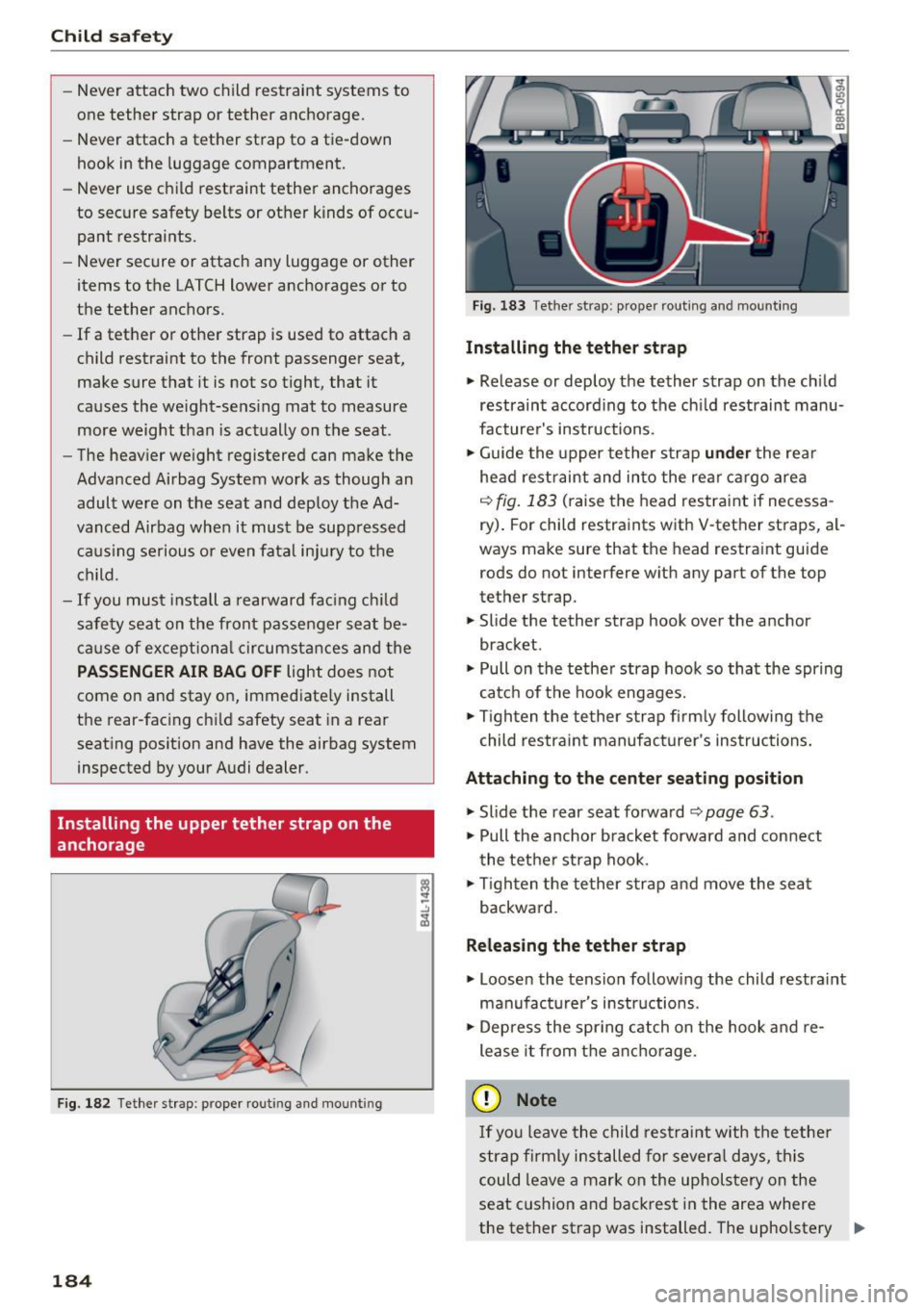
Installing the upper tether strap on the
anchorage
F ig. 18 2 Tether strap : proper routing and mount ing
184
Fig. 1 83 Tether strap: proper routing and mount ing
Installing the tether st rap
~ Release or deploy the tether strap on the ch ild
restraint accord ing to the ch ild restraint manu
facture r's instructions.
~ Guide the upper tether s trap under the rea r
head rest raint and in to the rear cargo area
~ fig. 183 (raise the head restraint if necessa
ry). For child restraints with V -tet her straps, al
ways make sure that the head restra int guide
rods do not interfere with any pa rt of the top
tether strap.
~ Slide the tether strap hook over the anchor
bracket .
~ Pull on the tether strap hook so that the spring
ca tch of the hook engages.
~ Tighten the tether stra p firm ly following the
child restra int manufacturer's instruc tions .
Attaching to the cente r seating position
~ Slide the rear seat forward ~ page 63 .
~ Pull the anchor bracket forward and con nect
the tethe r strap hook.
~ Tigh ten the te ther strap a nd move the seat
backward.
Releasing the tether strap
~ Loosen the tension following the child restra int
manufac turer's instr uctions .
~ Depress the spr ing catch on the hook and re
lease it from t he a nch o rage.
(D Note
If yo u leave the child restraint w ith the tethe r
strap firmly installed for severa l d ays, this
could leave a mark on the upholstery on the
seat cushion and backrest in the area where
the tether strap was installed. The upholstery
IJ>
Page 187 of 296

CD
CD
.... N ,-... N .... 0 0 C<'. 00
would also be permanently stretched around
the tether strap. This applies especially to
leather seats.
Using tether straps on rearward-facing
child restraints
Currently, few rear-facing child restraint systems
come with a tether . Please read and heed the
child restraint system manufacturer's instruc
tions carefully to determine how to properly in
stall the tether.
A WARNING
A child in a rearward-facing child safety seat
installed on the front passenger seat will be
seriously injured and can be killed if the front
airbag inflates -even with an Advanced Airbag
System.
- The inflating airbag will hit the child safety seat or infant carrier with great force and
will smash the child safety seat and child against the backrest, center armrest, or
door .
-A tight tether or other strap on a rearward
facing child restraint attached to the front
passenger seat can put too much pressure
on the weight-mat in the seat and register a
heavier weight in the Advanced Airbag Sys
tem. The heavier weight registered can make the system work as though an adult
were on the seat and deploy the Advanced
Airbag when it must be suppressed causing serious or even fatal injury to the child.
- If you must install a rearward facing child
safety seat on the front passenger seat be
cause of exceptional circumstances and the
PASSENGER AIR BAG OFF light does not
come on and stay on, immediately install
the rear-facing child safety seat in a rear
seating position and have the airbag system
inspected by your Audi dealer.
Child safety
Additional information
Sources of information about child
restraints and their use
There are a number of sources of additional in
formation about child restraint selection, instal
lation and use:
NHTSA advises that the best child safety seat is
the one that fits your child and fits in your vehi
cle, and that you will use correctly and consis
tently.
Try before you buy!
U.S National Highway Traffic Safety Administra
tion
Tel. : 1-888-327-4236 (TTY: 1-800-424-9153)
http://www.nhtsa.gov
http:/ /www.safercar.gov
National SAFE KIDS Campaign
Tel. : (202) 662-0600
http://www.safekids .org
Safety BeltSafe U.S.A
Tel. : (800) 745-SAFE (English)
Tel. : (800) 747-SANO (Spanish)
http://www.carseat.org
Transport Canada Information Centre
Tel. : 1-800-333-0371 or call 1-613-998-8616 if
you are in the Ottawa area
http://www.tc.gc.ca/ eng/roadsafety/men u. htm
Audi Customer Relations
Tel.: (800) 822-2834
185
Page 191 of 296

CD
CD
.... N ,-... N ..... 0 0 C<'. 00
situations, such as an a irbag dep loyment or hit
ting a road obstacle, data that wi ll assist in un
derstanding how a vehicle 's systems performed.
The EDR is designed to record da ta rela ted to ve
hicle dynamics and safety systems for a short pe
riod of time, typically 30 seconds or less . The
E DR in th is veh icle is des igned to record such da
ta as:
- How various systems in your vehicle were oper
at ing;
- Whether o r not the driver and passenger safety
belts were buckled/fastened;
- How far ( if at all) the dr iver was depressing the
acce lerator and/or brake peda l; and,
- How fast the vehicle was trave ling.
These da ta ca n he lp provide a better understand
ing of the ci rcumstances in which crashes and in
juries occur. NO TE: EDR data are reco rded by your
vehicle only if a non-triv ia l crash situation occurs ;
no data are recorded by the EDR under normal
driving conditions and no personal data (e.g., name, gender, age, and crash location) are re
corded . H owever, other parties, such as law en
forcement, could combine the EDR data w ith the
type of personally identify ing dat a routine ly ac
q uir ed dur ing a crash invest iga tion.
To read data reco rded by an EDR, specia l equip
ment is req uired, a nd access to t he veh icle or the
E DR is needed. I n add it io n t o the veh icle ma nu
facture r, ot he r p arties, s uch as law enfor cement,
that have the specia l equipment, can read the in
formation if they have access to the vehicle or the
EDR.
Some state l aws restrict the retr ieval or down
loading of data stored by EDRs insta lled in a vehi
cle for the express purpose of retrieving data af
ter an accident or crash event without the own
er's consent.
Aud i will not access the EDR and/or s imilar data
or give it to others -
- u nless the veh icle owner (or lessee if t he vehi
cl e h as bee n leased) agrees; or
- u pon the officia l request by the po lice; o r
- upon the order of a court of law or a govern-
ment agency; o r
Intelligent Technology
- for the defense of a lawsuit thro ugh the jud ic ia l
discovery process.
- Aud i may a lso use the data for resea rch about
vehicle operation and safety performance or
provide the data to a third party for research
purposes witho ut identify ing the specif ic veh i
cle or information about the ident ity of its own
er or lessee and only after the recorded veh icle
data has been accessed .
Vehicle control modules
You r vehicle is also eq uipped w ith a number of
electronic control modules for various vehicle
systems, such as engine management, emiss ion
contro l, airbags, and safety be lts .
These elect ronic contro l modu les record data
during norma l vehicle operation that may be
needed by trained techn ic ians for diagnostic and
repa ir purposes . The recording capab ility of these
modules is lim ited to data (no sound is record
ed) . Only a sma ll amount of data is actua lly re
corded over a very lim ited period of time, or stor
ed whe n a system fault is de tected by a contro l
module . Some of the da ta s tored may rela te to
vehicle speed, direction, or braking, as well as re
straint system use and performance in the event
of a crash . Stored data can also only be read and
downloaded wit h specia l equipment that is di
rectly connected to the vehicle.
{!) Tips
Your vehicle may be equipped w ith Aud i con
nect. Your use of certain Aud i connect fea
tures requires wire less serv ices that are pro
v ided by a third party wireless telecommuni
cations provider . Fo r details regarding how in
fo rmation ob tained throug h Au di connec t is
colle cted, p ro cessed, tra nsmitted, used, and
s hare d, ple ase see yo ur contra ct with t he
wireless tele commun ications provider and the
"About A udi connect" tab in your vehicle's
MMI:
I MENU ! button > Audi connect > About
Audi connect .
189