2016 NISSAN NOTE cooling
[x] Cancel search: coolingPage 2040 of 3641
REFRIGERATION SYSTEM SYMPTOMSHA-15
< SYMPTOM DIAGNOSIS >
C
DE
F
G H
J
K L
M A
B
HA
N
O P
SYMPTOM DIAGNOSIS
REFRIGERATION SYSTEM SYMPTOMS
Trouble Diagnosis For Unusual PressureINFOID:0000000012431994
Diagnose using a manifold gauge set whenever refrigerant pressures are unusual. The marker above the
gauge scale in the following table indicates the standard (usual) pressure range. Refer to HA-24, "
Inspection".
Symptom TableINFOID:0000000012431995
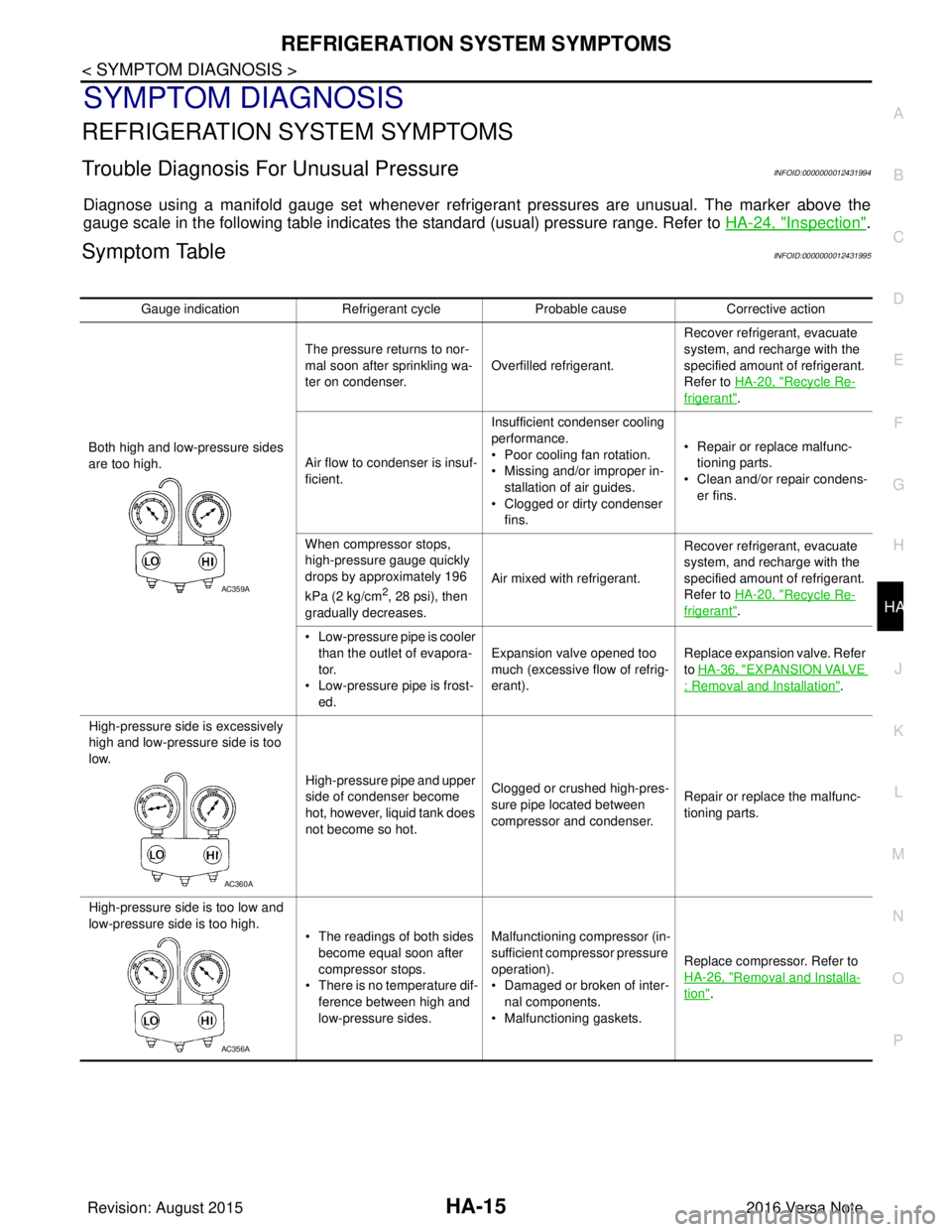
Gauge indicationRefrigerant cycleProbable causeCorrective action
Both high and low-pressure sides
are too high. The pressure returns to nor-
mal soon after sprinkling wa-
ter on condenser.
Overfilled refrigerant. Recover refrigerant, evacuate
system, and recharge with the
specified amount of refrigerant.
Refer to HA-20, "
Recycle Re-
frigerant".
Air flow to condenser is insuf-
ficient. Insufficient condenser cooling
performance.
• Poor cooling fan rotation.
• Missing and/or improper in-
stallation of air guides.
• Clogged or dirty condenser fins. • Repair or replace malfunc-
tioning parts.
• Clean and/or repair condens- er fins.
When compressor stops,
high-pressure gauge quickly
drops by approximately 196
kPa (2 kg/cm
2, 28 psi), then
gradually decreases. Air mixed with refrigerant.
Recover refrigerant, evacuate
system, and recharge with the
specified amount of refrigerant.
Refer to HA-20, "Recycle Re-
frigerant".
• Low-pressure pipe is cooler than the outlet of evapora-
tor.
• Low-pressure pipe is frost- ed. Expansion valve opened too
much (excessive flow of refrig-
erant).
Replace expansion valve. Refer
to
HA-36, "
EXPANSION VALVE
: Removal and Installation".
High-pressure side is excessively
high and low-pressure side is too
low. High-pressure pipe and upper
side of condenser become
hot, however, liquid tank does
not become so hot.Clogged or crushed high-pres-
sure pipe located between
compressor and condenser.
Repair or replace the malfunc-
tioning parts.
High-pressure side is too low and
low-pressure side is too high. • The readings of both sides
become equal soon after
compressor stops.
• There is no temperature dif-
ference between high and
low-pressure sides. Malfunctioning compressor (in-
sufficient compressor pressure
operation).
• Damaged or broken of inter-
nal components.
• Malfunctioning gaskets. Replace compressor. Refer to
HA-26, "
Removal and Installa-
tion".
AC359A
AC360A
AC356A
Revision: August 2015
2016 Versa Note
cardiagn.com
Page 2047 of 3641
HA-22
< PERIODIC MAINTENANCE >
OIL
OIL
DescriptionINFOID:0000000012432001
MAINTENANCE OF OIL LEVEL
The compressor oil circulates in the system together with the refrigerant. It is necessary to add oil to the com-
pressor when replacing A/C system components or when a large amount of refrigerant leaks from the system.
It is important to always maintain oil level within t he specified level. Otherwise, the following conditions may
occur.
• Insufficient oil amount: Stuck compressor
• Excessive oil amount: Insufficient cooling (caused by insufficient heat exchange)
InspectionINFOID:0000000012432002
If a compressor is malfunctioning (internal noise, insufficient cooling), check the compressor oil.
1.COMPRESSOR OIL JUDGMENT
1. Remove the compressor. Refer to HA-26, "
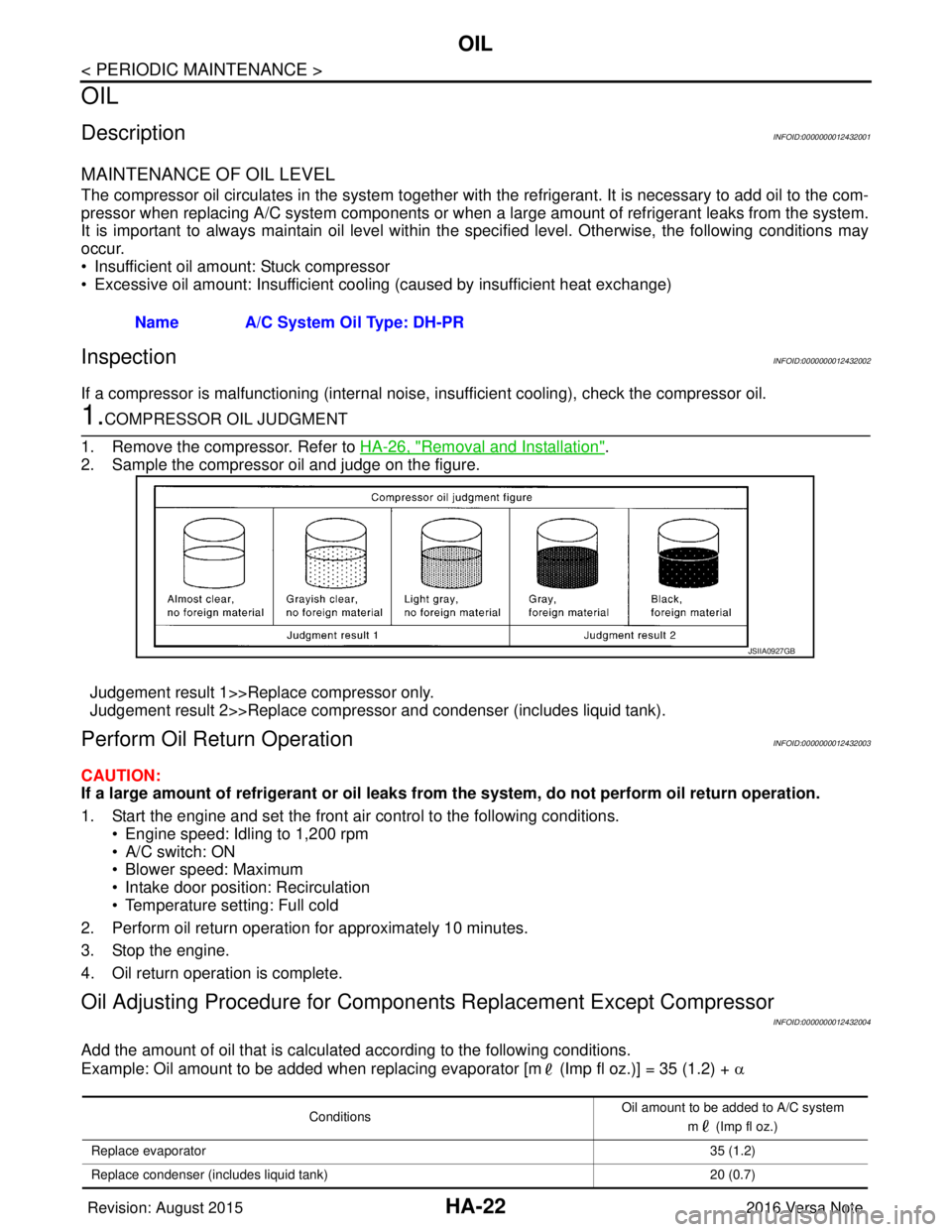
Removal and Installation".
2. Sample the compressor oil and judge on the figure.
Judgement result 1>>Replace compressor only.
Judgement result 2>>Replace compressor and condenser (includes liquid tank).
Perform Oil Retu rn OperationINFOID:0000000012432003
CAUTION:
If a large amount of refrigerant or oil leaks from the system, do not perform oil return operation.
1. Start the engine and set the front air control to the following conditions. • Engine speed: Idling to 1,200 rpm
• A/C switch: ON
• Blower speed: Maximum
• Intake door position: Recirculation
• Temperature setting: Full cold
2. Perform oil return operation for approximately 10 minutes.
3. Stop the engine.
4. Oil return operation is complete.
Oil Adjusting Procedure for Compon ents Replacement Except Compressor
INFOID:0000000012432004
Add the amount of oil that is calculated according to the following conditions.
Example: Oil amount to be added when replacing evaporator [m (Imp fl oz.)] = 35 (1.2) + α
Name A/C System Oil Type: DH-PR
JSIIA0927GB
Conditions
Oil amount to be added to A/C system
m (Imp fl oz.)
Replace evaporator 35 (1.2)
Replace condenser (includes liquid tank) 20 (0.7)
Revision: August 20152016 Versa Note
cardiagn.com
Page 2053 of 3641
HA-28
< REMOVAL AND INSTALLATION >
COOLER PIPE AND HOSE
COOLER PIPE AND HOSE
Exploded ViewINFOID:0000000012432010
LOW-PRESSURE FLEXIBLE HOSE
LOW-PRESSURE FLEXIBLE HOSE : Removal and InstallationINFOID:0000000012432011
CAUTION:
Perform oil return operation before each refrigeration system disassembly. However, if a large
amountof refrigerant or oil is detected, do not perform oil return operation. Refer to HA-22, "
Perform
Oil Return Operation".
REMOVAL
1. Discharge the refrigerant. Refer to HA-20, "Recycle Refrigerant".
2. Disconnect vacuum hose from intake manifold. Refer to BR-33, "
Exploded View".
3. Remove ground wire from engine to radiator core support upper.
4. Remove front grille. Refer to EXT-32, "
Removal and Installation".
5. Remove low-pressure flexible hose nut and bolt, then position lower dash insulator as necessary.
6. Remove bolt and low-pressure flexible hose from expansion valve. CAUTION:
Cap or wrap the joint of the A/C hose and expansion valve with suitable material such as vinyl tape
to avoid the entry of air.
7. Remove bolt and low-pressure flexible hose from compressor.
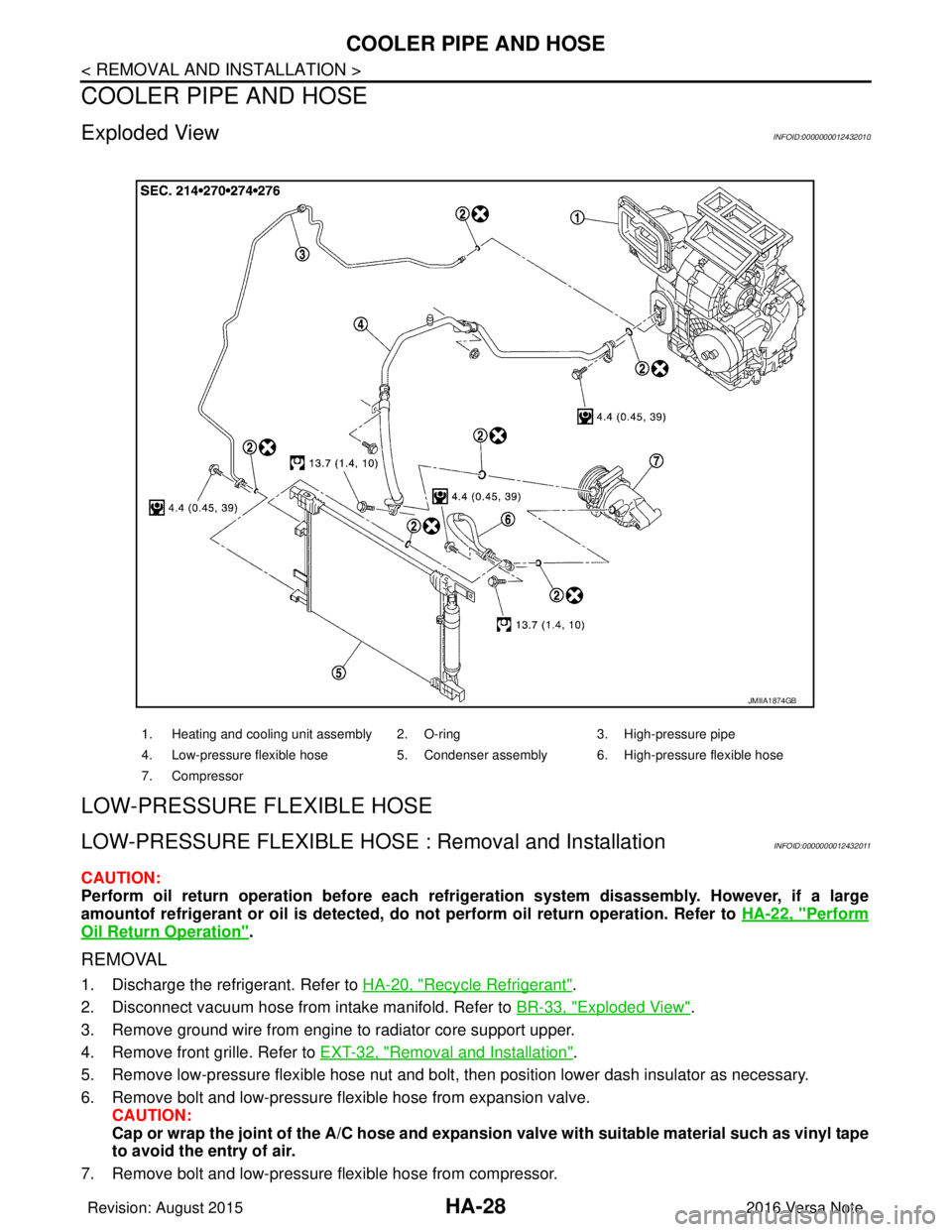
1. Heating and cooling unit assembly 2. O-ring 3. High-pressure pipe
4. Low-pressure flexible hose 5. Condenser assembly 6. High-pressure flexible hose
7. Compressor
JMIIA1874GB
Revision: August 2015 2016 Versa Note
cardiagn.com
Page 2058 of 3641
HEATING AND COOLING UNIT ASSEMBLYHA-33
< REMOVAL AND INSTALLATION >
C
DE
F
G H
J
K L
M A
B
HA
N
O P
HEATING AND COOLING UNIT ASSEMBLY
Exploded ViewINFOID:0000000012432018
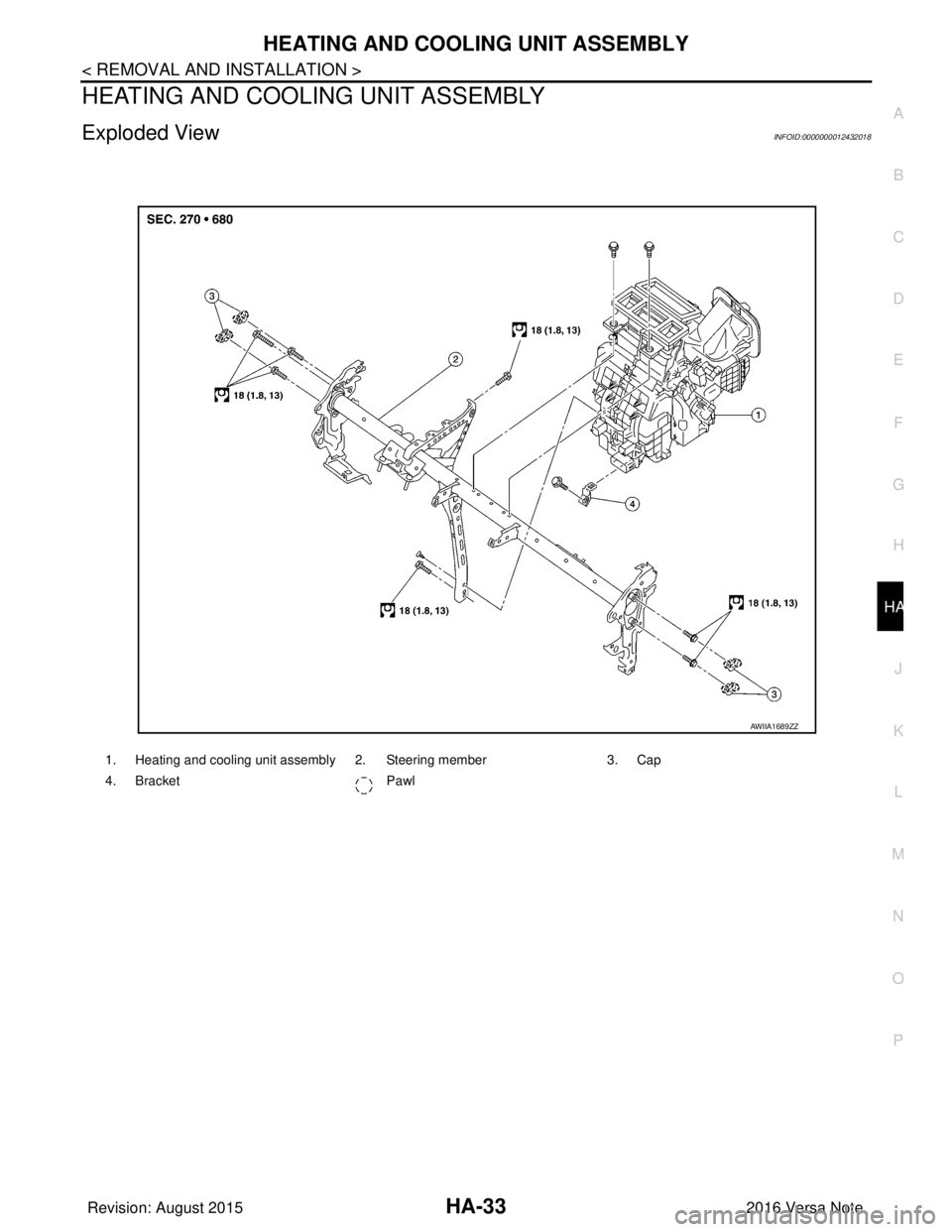
1. Heating and cooling unit assembly 2. Steering member 3. Cap
4. Bracket Pawl
AWIIA1689ZZ
Revision: August 2015 2016 Versa Note
cardiagn.com
Page 2059 of 3641
HA-34
< REMOVAL AND INSTALLATION >
HEATING AND COOLING UNIT ASSEMBLY
HEATING AND COOLING UNIT ASSEMBLY
HEATING AND COOLING UNIT ASSEMBLY : Removal and InstallationINFOID:0000000012432019
CAUTION:
Perform oil return operation before each refrigeration system disassembly. However, if a large
amountof refrigerant or oil is detected, do not perform oil return operation. Refer to HA-22, "
Perform
Oil Return Operation".
REMOVAL
1. Discharge the refrigerant (if equipped). Refer to HA-20, "Recycle Refrigerant".
2. Drain engine coolant. Refer to CO-8, "
Draining Engine Coolant".
3. Disconnect low-pressure flexible hose from expansion valve (if equipped). Refer to HA-28, "
LOW-PRES-
SURE FLEXIBLE HOSE : Removal and Installation".
CAUTION:
Cap or wrap the joint of the A/C hose and expansion valve with suitable material such as vinyl tape
to avoid the entry of air.
4. Disconnect high-pressure pipe from expansion valve (if equipped). Refer to HA-29, "
HIGH-PRESSURE
PIPE : Removal and Installation".
CAUTION:
Cap or wrap the joint of the A/C piping and expans ion valve with suitable material such as vinyl
tape to avoid the entry of air.
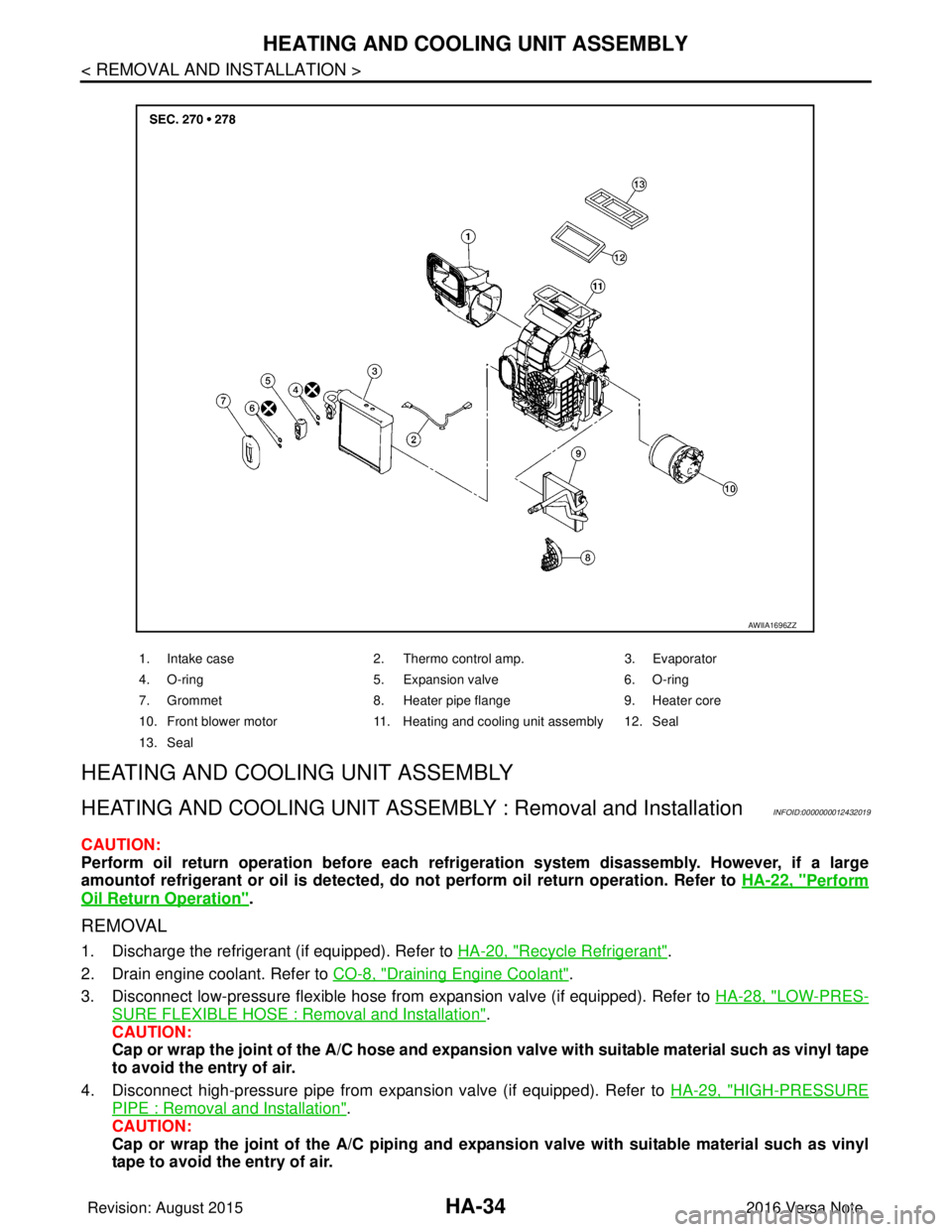
1. Intake case 2. Thermo control amp. 3. Evaporator
4. O-ring 5. Expansion valve 6. O-ring
7. Grommet 8. Heater pipe flange 9. Heater core
10. Front blower motor 11. Heating and cooling unit assembly 12. Seal
13. Seal
AWIIA1696ZZ
Revision: August 2015 2016 Versa Note
cardiagn.com
Page 2060 of 3641
HEATING AND COOLING UNIT ASSEMBLYHA-35
< REMOVAL AND INSTALLATION >
C
DE
F
G H
J
K L
M A
B
HA
N
O P
5. Disconnect heater hoses from heater core.
6. Remove instrument panel assembly. Refer to IP-15, "
Removal and Installation".
7. Disconnect evaporator drain hose from heating and cooling unit assembly.
8. Disconnect harness connectors, grounds, retainers, etc. , and remove bolts required to remove steering
member.
9. Remove steering member and heating and cooling unit assembly.
10. Remove heating and cooling unit assembly from steering member. Refer to HA-33, "
Exploded View".
INSTALLATION
Installation is in the reverse order of removal.
CAUTION:
• Do not reuse O-rings.
• Apply compressor oil to new O-rings of the low-pressure flexible hose and high-pressure pipe for
installation.
• After charging refrigerant, check for leaks. Refer to HA-18, "
Leak Test".
NOTE:
When refilling engine coolant, refer to CO-9, "
Refilling".
HEATER CORE
HEATER CORE : Removal and InstallationINFOID:0000000012432020
REMOVAL
1. Remove the heating and cooling unit assembly. Refer to HA-34, "HEATING AND COOLING UNIT
ASSEMBLY : Removal and Installation".
2. Remove foot duct (LH). Refer to VTL-7, "
FOOT DUCT : Removal and Installation".
3. Remove heater packing.
4. Remove heater pipe flange.
5. Remove heater core.
INSTALLATION
Installation is in the reverse order of removal.
NOTE:
When refilling engine coolant, refer to CO-9, "
Refilling".
EVAPORATOR
EVAPORATOR : Removal and InstallationINFOID:0000000012432021
REMOVAL
1. Remove heating and cooling unit assembly. Refer to HA-34, "HEATING AND COOLING UNIT ASSEM-
BLY : Removal and Installation".
2. Remove foot duct (RH). Refer to VTL-7, "
FOOT DUCT : Removal and Installation".
3. Remove intake case. Refer to HA-33, "
Exploded View".
4. Remove expansion valve. Refer to HA-36, "
EXPANSION VALVE : Removal and Installation".
5. Remove evaporator cover and evaporator assembly.
INSTALLATION
Installation is in the reverse order of removal.
CAUTION:
• Do not reuse O-rings.
• Apply compressor oil to ne w O-rings for installation.
• Perform oil adjusting procedure afte r installing new evaporator. Refer to HA-22, "
Oil Adjusting Pro-
cedure for Components Replacement Except Compressor".
• After charging refrigerant, check for leaks. Refer to HA-18, "
Leak Test".
EXPANSION VALVE
Revision: August 2015 2016 Versa Note
cardiagn.com
Page 2061 of 3641
HA-36
< REMOVAL AND INSTALLATION >
HEATING AND COOLING UNIT ASSEMBLY
EXPANSION VALVE : Removal and Installation
INFOID:0000000012432022
REMOVAL
1. Discharge the refrigerant. Refer to HA-20, "Recycle Refrigerant".
2. Disconnect low-pressure flexible hose from expansion valve. Refer to HA-28, "
LOW-PRESSURE FLEXI-
BLE HOSE : Removal and Installation".
3. Disconnect high-pressure pipe from expansion valve. Refer to HA-29, "
HIGH-PRESSURE PIPE :
Removal and Installation".
4. Remove bolts and expansion valve. CAUTION:
Cap or wrap the joint of the eva porator and expansion valve with su itable material such as vinyl
tape to avoid the entry of air.
INSTALLATION
Installation is in the reverse order of removal.
CAUTION:
• Do not reuse O-rings.
• Apply compressor oil to new O-rings of the low- pressure flexible hose and high-pressure pipe for
installation.
• After charging refrigerant, check for leaks. Refer to HA-18, "
Leak Test".
Revision: August 2015 2016 Versa Note
cardiagn.com
Page 2198 of 3641
![NISSAN NOTE 2016 Service Repair Manual LAN-10
< SYSTEM DESCRIPTION >[CAN FUNDAMENTAL]
TROUBLE DIAGNOSIS
Symptom When Error Occurs in CAN Communication System
INFOID:0000000012433334
In CAN communication system, multiple control units mutu](/manual-img/5/57363/w960_57363-2197.png "NISSAN NOTE 2016 Service Repair Manual LAN-10
< SYSTEM DESCRIPTION >[CAN FUNDAMENTAL]
TROUBLE DIAGNOSIS
Symptom When Error Occurs in CAN Communication System
INFOID:0000000012433334
In CAN communication system, multiple control units mutu")
LAN-10
< SYSTEM DESCRIPTION >[CAN FUNDAMENTAL]
TROUBLE DIAGNOSIS
Symptom When Error Occurs in CAN Communication System
INFOID:0000000012433334
In CAN communication system, multiple control units mutually transmit and receive signals. Each control unit
cannot transmit and receive signals if any error occurs on CAN communication line. Under this condition, mul-
tiple control units related to the root cause malfunction or go into fail-safe mode.
ERROR EXAMPLE
NOTE:
Each vehicle differs in symptom of each control unit under fail-safe mode and CAN communication line wiring.
Example: Main Line Between Data Link Connector and ABS Actuator and Electric Un it (Control Unit) Open Circuit
JSMIA0442GB
Unit name Major symptom
ECM Engine torque limiting is affected, and shift harshness increases.
BCM • Reverse warning buzzer does not sound.
• The front wiper moves under continuous operation mode even though the front wip-
er switch being in the intermittent position.
EPS control unit The steering effort increases.
Combination meter • The shift position indicator and OD OFF indicator turn OFF.
• The speedometer is inoperative.
• The odo/trip meter stops.
ABS actuator and electric unit (control unit) Normal operation.
TCM No impact on operation.
IPDM E/R When the ignition switch is ON,
• The headlamps (Lo) turn ON.
• The cooling fan continues to rotate.
Revision: August 2015
2016 Versa Note
cardiagn.com