2016 NISSAN NOTE cooling
[x] Cancel search: coolingPage 3315 of 3641
![NISSAN NOTE 2016 Service Repair Manual TM-74
< SYSTEM DESCRIPTION >[CVT: RE0F11A]
STRUCTURE AND OPERATION
FLUID COOLER & FL
UID WARMER SYSTEM
FLUID COOLER & FLUID WARMER SYSTEM : System DescriptionINFOID:0000000012431015
CVT FLUID COOLER](/manual-img/5/57363/w960_57363-3314.png "NISSAN NOTE 2016 Service Repair Manual TM-74
< SYSTEM DESCRIPTION >[CVT: RE0F11A]
STRUCTURE AND OPERATION
FLUID COOLER & FL
UID WARMER SYSTEM
FLUID COOLER & FLUID WARMER SYSTEM : System DescriptionINFOID:0000000012431015
CVT FLUID COOLER")
TM-74
< SYSTEM DESCRIPTION >[CVT: RE0F11A]
STRUCTURE AND OPERATION
FLUID COOLER & FL
UID WARMER SYSTEM
FLUID COOLER & FLUID WARMER SYSTEM : System DescriptionINFOID:0000000012431015
CVT FLUID COOLER SCHEMATIC
COMPONENT DESCRIPTION
CVT Oil Warmer
• The CVT oil warmer (1) is installed on the front part of transaxle
assembly.
• When engine is started while engine and CVT are cold, engine coolant temperature rises more quickly than CVT fluid tempera-
ture. CVT oil warmer is provided with two circuits for CVT and
engine coolant respectively so that warmed engine coolant warms
CVT quickly. This helps shorten CVT warming up time, improving
fuel economy.
• A cooling effect is obtained when CVT fluid temperature is high.
CVT Fluid Cooler (Water-cooling)
• The CVT fluid cooler (water-cooling) is installed in the radiator side tank (right side).
• CVT fluid is cooled by engine coolant.
SHIFT LOCK SYSTEM
Manual valve Distributes the clutch and brake operation pressures (pilot pressure) corresponding to
each shift position.
High clutch/reverse brake switching valve Switches the circuit for the high clutch and the reverse brake.
Torque converter clutch control valve It is operated with the torque converter clutch solenoid valve and it adjusts the tighten-
ing pressure and non-tightening pressure of the torque converter clutch piston of the
torque converter.
Primary pressure control valve It is operated with the primary pressure solenoid valve and adjusts the feed pressure to
the primary pulley.
Primary pressure solenoid valve TM-65, "
CVT CONTROL SYSTEM : Primary Pressure Solenoid Valve"
Low brake solenoid valve TM-65, "CVT CONTROL SYSTEM : Low Brake Solenoid Valve"
High clutch & reverse brake solenoid valveTM-66, "CVT CONTROL SYSTEM : High Clutch & Reverse Brake Solenoid Valve"
Torque converter clutch solenoid valve TM-66, "CVT CONTROL SYSTEM : Torque Converter Clutch Solenoid Valve"
Line pressure solenoid valve TM-66, "CVT CONTROL SYSTEM : Line Pressure Solenoid Valve"
Part name Function
JSDIA4074GB
JSDIA2586ZZ
Revision: August 2015 2016 Versa Note
cardiagn.com
Page 3503 of 3641
![NISSAN NOTE 2016 Service Repair Manual TM-262
< UNIT REMOVAL AND INSTALLATION >[CVT: RE0F11A]
TRANSMISSION ASSEMBLY
INSPECTION AFTER INSTALLATION
Check the following items:
• For CVT position, refer to
TM-232, "
Inspection".
• Before](/manual-img/5/57363/w960_57363-3502.png "NISSAN NOTE 2016 Service Repair Manual TM-262
< UNIT REMOVAL AND INSTALLATION >[CVT: RE0F11A]
TRANSMISSION ASSEMBLY
INSPECTION AFTER INSTALLATION
Check the following items:
• For CVT position, refer to
TM-232, \"
Inspection\".
• Before")
TM-262
< UNIT REMOVAL AND INSTALLATION >[CVT: RE0F11A]
TRANSMISSION ASSEMBLY
INSPECTION AFTER INSTALLATION
Check the following items:
• For CVT position, refer to
TM-232, "
Inspection".
• Before starting engine, check oil/fluid levels incl uding engine coolant and engine oil. If less than required
quantity, fill to the specified level. Refer to MA-11, "
Fluids and Lubricants".
• Use procedure below to check for fuel leakage.
• Turn ignition switch ON (with engine stopped). With fuel pressure applied to fuel piping, check for fuel leak-
age at connection points.
• Start engine. With engine speed increased, che ck again for fuel leakage at connection points.
• Run engine to check for unusual noise and vibration. NOTE:
If hydraulic pressure inside timing chain tensioner drops after removal and installation, slack in the guide
may generate a pounding noise during and just after engine start. However, this is normal. Noise will stop
after hydraulic pressure rises.
• Warm up engine thoroughly to make sure there is no leakage of fuel, exhaust gas, or any oils/fluids including engine oil and engine coolant.
• Bleed air from passages in lines and hoses, such as in cooling system.
• After cooling down engine, again check oil/fluid levels including engine oil and engine coolant. Refill to spec- ified level, if necessary.
• Summary of the inspection items:
*Power steering fluid, brake fluid, etc.
ADJUSTMENT AFTER INSTALLATION
• Adjust the CVT fluid level. TM-229, "Adjustment".
• Perform "ADDITIONAL SERVICE WHEN REPL ACING TRANSAXLE ASSEMBLY". Refer to TM-127,
"Description".
ItemBefore starting engine Engine runningAfter engine stopped
Engine coolant LevelLeakage Level
Engine oil LevelLeakage Level
Transmission/
transaxle fluid A/T and CVT Models
LeakageLevel/Leakage Leakage
M/T Models Level/Leakage LeakageLevel/Leakage
Other oils and fluids* LevelLeakage Level
Fuel LeakageLeakageLeakage
Exhaust gas —Leakage —
Revision: August 2015 2016 Versa Note
cardiagn.com
Page 3511 of 3641
DUCT AND GRILLEVTL-5
< REMOVAL AND INSTALLATION >
C
DE
F
G H
J
K L
M A
B
VTL
N
O P
REMOVAL AND INSTALLATION
DUCT AND GRILLE
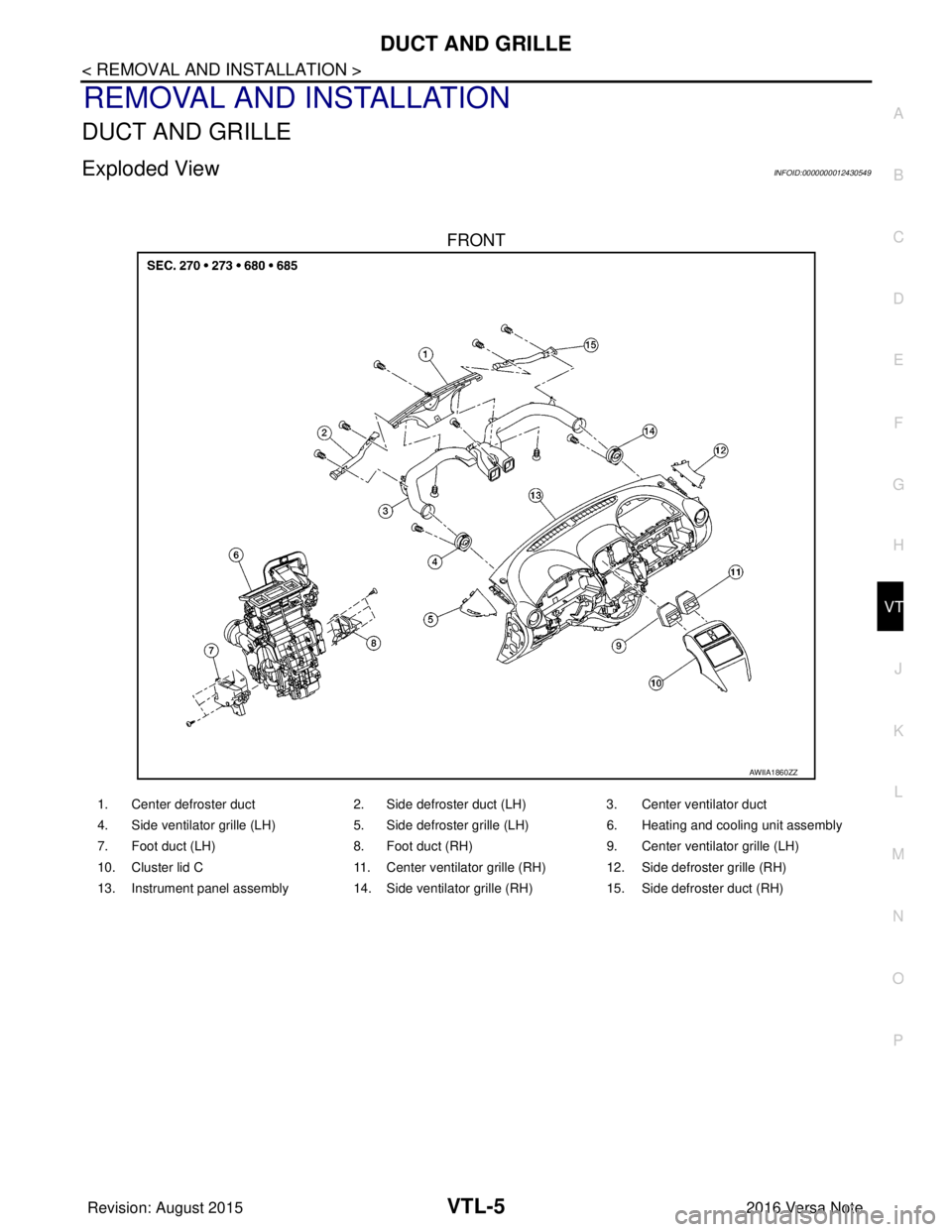
Exploded ViewINFOID:0000000012430549
FRONT
AWIIA1860ZZ
1. Center defroster duct 2. Side defroster duct (LH)3. Center ventilator duct
4. Side ventilator grille (LH) 5. Side defroster grille (LH)6. Heating and cooling unit assembly
7. Foot duct (LH) 8. Foot duct (RH)9. Center ventilator grille (LH)
10. Cluster lid C 11. Center ventilator grille (RH) 12. Side defroster grille (RH)
13. Instrument panel assembly 14. Side ventilator grille (RH) 15. Side defroster duct (RH)
Revision: August 2015 2016 Versa Note
cardiagn.com
Page 3512 of 3641
VTL-6
< REMOVAL AND INSTALLATION >
DUCT AND GRILLE
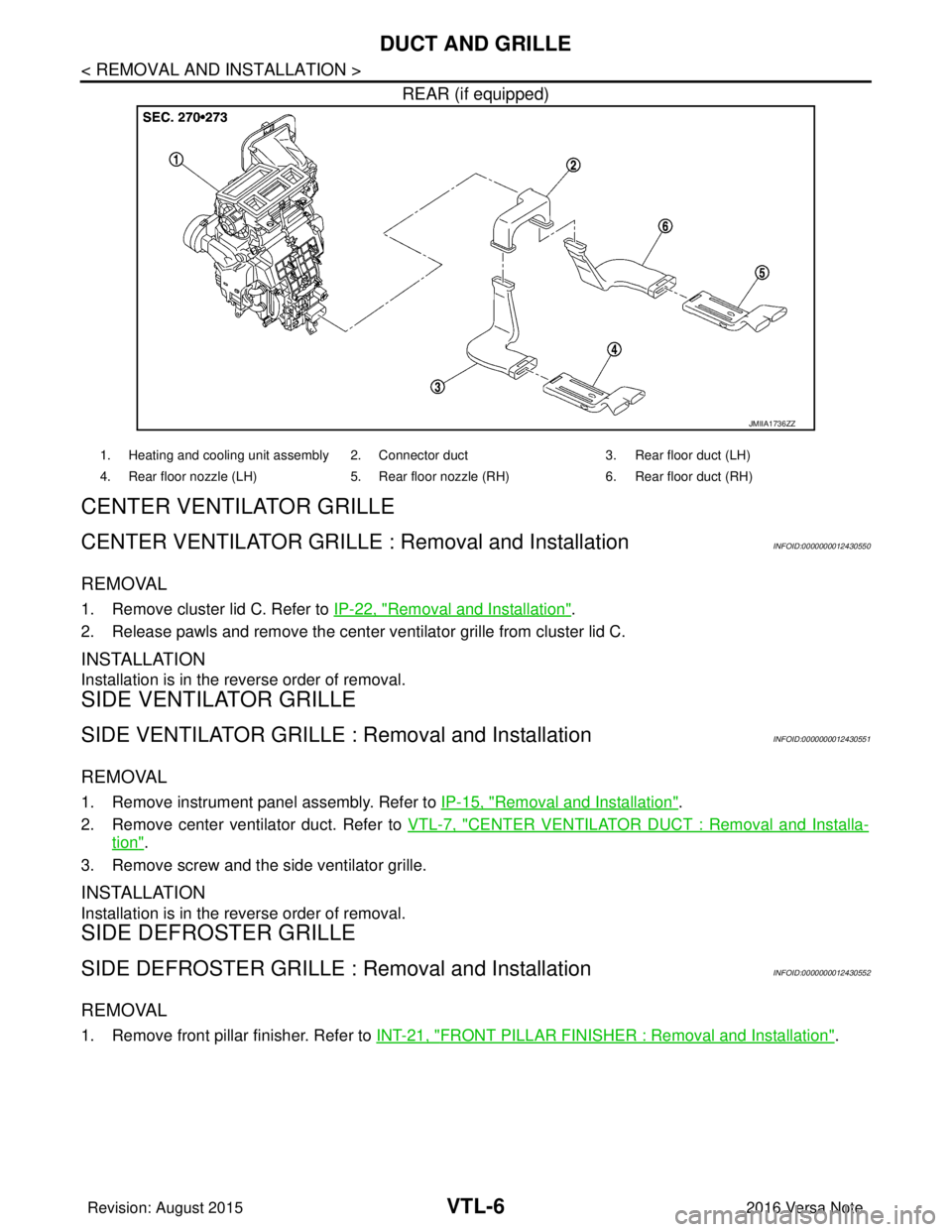
REAR (if equipped)
CENTER VENTILAT O R G R I L L E
CENTER VENTILATOR GRILLE : Removal and InstallationINFOID:0000000012430550
REMOVAL
1. Remove cluster lid C. Refer to IP-22, "Removal and Installation".
2. Release pawls and remove the center ventilator grille from cluster lid C.
INSTALLATION
Installation is in the reverse order of removal.
SIDE VENTILATOR GRILLE
SIDE VENTILATOR GRILLE : Removal and InstallationINFOID:0000000012430551
REMOVAL
1. Remove instrument panel assembly. Refer to IP-15, "Removal and Installation".
2. Remove center ventilator duct. Refer to VTL-7, "
CENTER VENTILATOR DUCT : Removal and Installa-
tion".
3. Remove screw and the side ventilator grille.
INSTALLATION
Installation is in the reverse order of removal.
SIDE DEFROSTER GRILLE
SIDE DEFROSTER GRILLE : Removal and InstallationINFOID:0000000012430552
REMOVAL
1. Remove front pillar finisher. Refer to INT-21, "FRONT PILLAR FINISHER : Removal and Installation".
JMIIA1736ZZ
1. Heating and cooling unit assembly 2. Connector duct 3. Rear floor duct (LH)
4. Rear floor nozzle (LH) 5. Rear floor nozzle (RH) 6. Rear floor duct (RH)
Revision: August 2015 2016 Versa Note
cardiagn.com
Page 3514 of 3641
VTL-8
< REMOVAL AND INSTALLATION >
DUCT AND GRILLE
Removal
1. Remove instrument panel assembly. Refer to IP-15, "Removal and Installation".
2. Remove screws and foot duct (LH/RH) from heating and cooling unit assembly.
Installation
Installation is in the reverse order of removal.
REAR FLOOR DUCT
REAR FLOOR DUCT : Remo val and InstallationINFOID:0000000012430557
REMOVAL
1. Remove driver seat (if necessary). Refer to SE-20, "DRIVER SIDE : Removal and Installation".
2. Remove passenger seat (if necessary). Refer to SE-22, "
PASSENGER SIDE : Removal and Installation".
3. Remove rear seat cushion. Refer to SE-26, "
SEAT CUSHION : Removal and Installation".
4. Remove dash side finisher (LH/RH). Refer to INT-24, "
DASH SIDE FINISHER : Removal and Installation".
5. Remove center pillar lower finisher (LH/RH). Refer to INT-25, "
CENTER PILLAR LOWER FINISHER :
Removal and Installation".
6. Remove center console lower. Refer to IP-20, "
Removal and Installation"
7. Position floor trim and floor insulators aside.
8. Release and remove rear floor ducts.
INSTALLATION
Install in the reverse order of removal.
Revision: August 2015 2016 Versa Note
cardiagn.com
Page 3515 of 3641
FRONT BLOWER MOTORVTL-9
< REMOVAL AND INSTALLATION >
C
DE
F
G H
J
K L
M A
B
VTL
N
O P
FRONT BLOWER MOTOR
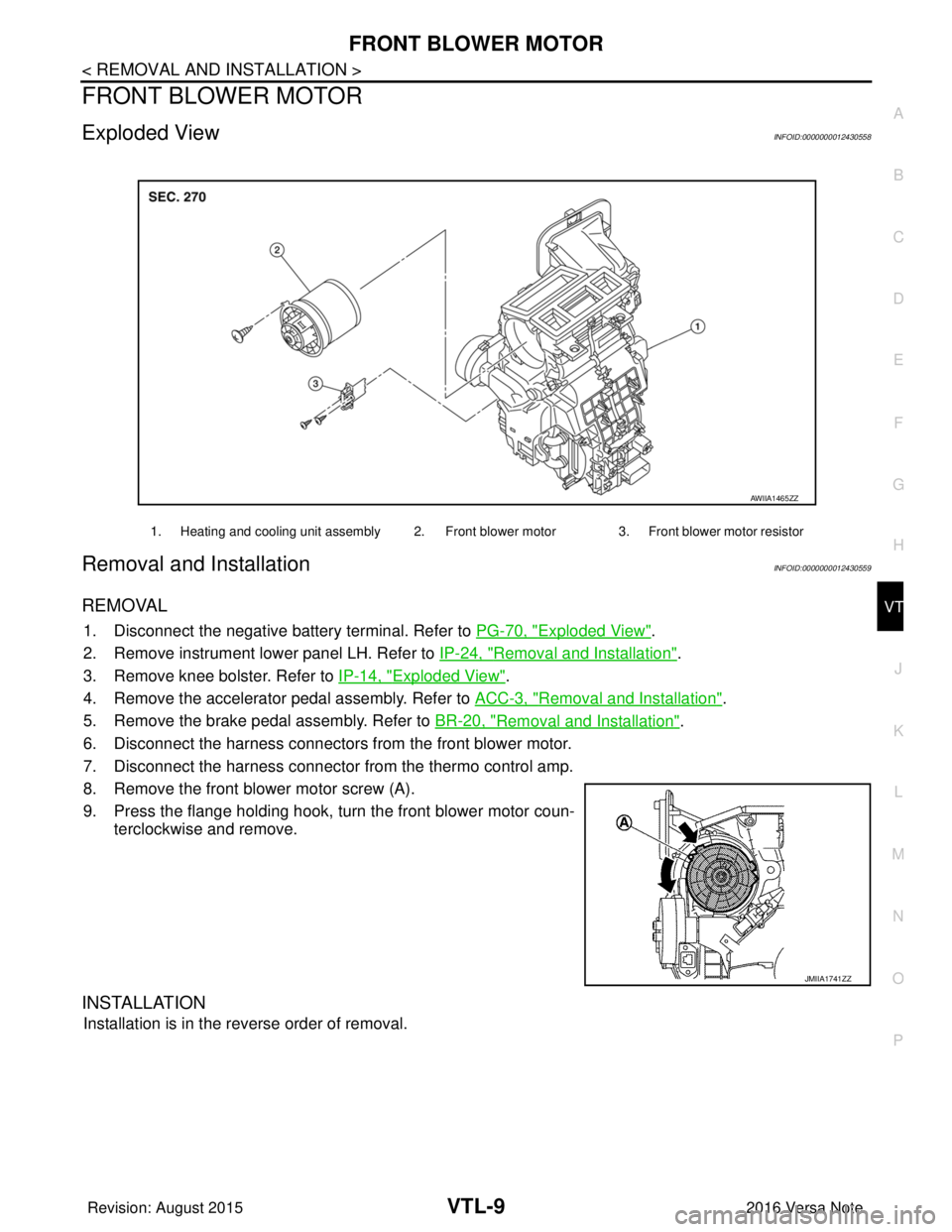
Exploded ViewINFOID:0000000012430558
Removal and InstallationINFOID:0000000012430559
REMOVAL
1. Disconnect the negative battery terminal. Refer to PG-70, "Exploded View".
2. Remove instrument lower panel LH. Refer to IP-24, "
Removal and Installation".
3. Remove knee bolster. Refer to IP-14, "
Exploded View".
4. Remove the accelerator pedal assembly. Refer to ACC-3, "
Removal and Installation".
5. Remove the brake pedal assembly. Refer to BR-20, "
Removal and Installation".
6. Disconnect the harness connectors from the front blower motor.
7. Disconnect the harness connector from the thermo control amp.
8. Remove the front blower motor screw (A).
9. Press the flange holding hook, turn the front blower motor coun- terclockwise and remove.
INSTALLATION
Installation is in the reverse order of removal.
1. Heating and cooling unit assembly 2. Front blower motor 3. Front blower motor resistor
AWIIA1465ZZ
JMIIA1741ZZ
Revision: August 2015 2016 Versa Note
cardiagn.com
Page 3582 of 3641
DIAGNOSIS SYSTEM (IPDM E/R)WW-17
< SYSTEM DESCRIPTION >
C
DE
F
G H
I
J
K
M A
B
WW
N
O P
DIAGNOSIS SYSTEM (IPDM E/R)
Diagnosis DescriptionINFOID:0000000012542540
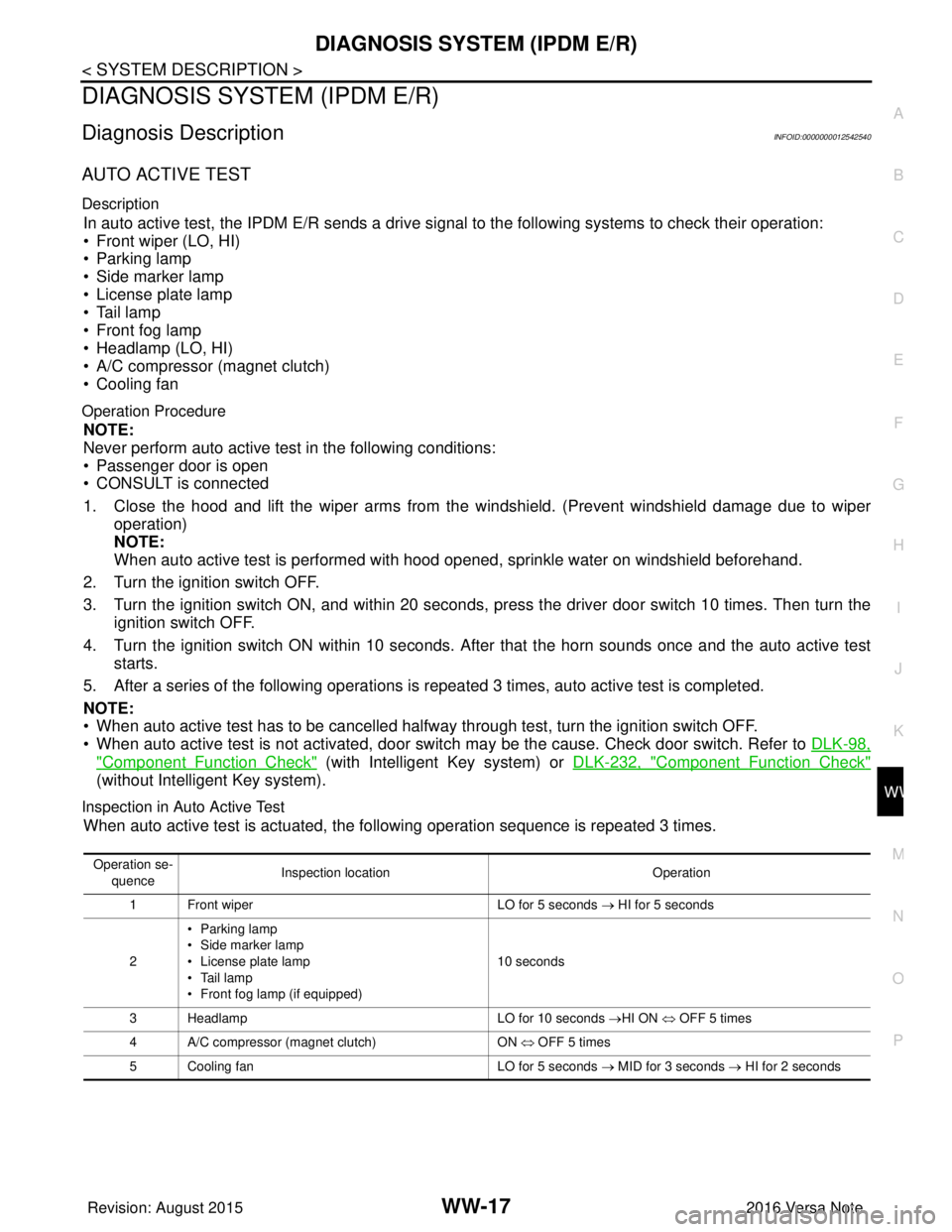
AUTO ACTIVE TEST
Description
In auto active test, the IPDM E/R sends a drive signal to the following systems to check their operation:
• Front wiper (LO, HI)
• Parking lamp
• Side marker lamp
• License plate lamp
• Tail lamp
• Front fog lamp
• Headlamp (LO, HI)
• A/C compressor (magnet clutch)
• Cooling fan
Operation Procedure
NOTE:
Never perform auto active test in the following conditions:
• Passenger door is open
• CONSULT is connected
1. Close the hood and lift the wiper arms from the windshield. (Prevent windshield damage due to wiper
operation)
NOTE:
When auto active test is performed with hood opened, sprinkle water on windshield beforehand.
2. Turn the ignition switch OFF.
3. Turn the ignition switch ON, and within 20 seconds, pr ess the driver door switch 10 times. Then turn the
ignition switch OFF.
4. Turn the ignition switch ON within 10 seconds. Af ter that the horn sounds once and the auto active test
starts.
5. After a series of the following operations is repeated 3 times, auto active test is completed.
NOTE:
• When auto active test has to be cancelled halfw ay through test, turn the ignition switch OFF.
• When auto active test is not activated, door swit ch may be the cause. Check door switch. Refer to DLK-98,
"ComponentFunctionCheck" (with Intelligent Key system) or DLK-232, "ComponentFunctionCheck"
(without Intelligent Key system).
Inspection in Auto Active Test
When auto active test is actuated, the following operation sequence is repeated 3 times.
Operation se-
quence Inspection location
Operation
1 Front wiper LO for 5 seconds → HI for 5 seconds
2 •Parking lamp
• Side marker lamp
• License plate lamp
• Tail lamp
• Front fog lamp (if equipped) 10 seconds
3 Headlamp LO for 10 seconds →HI ON ⇔ OFF 5 times
4 A/C compressor (magnet clutch) ON ⇔ OFF 5 times
5 Cooling fan LO for 5 seconds → MID for 3 seconds → HI for 2 seconds
Revision: August 2015 2016 Versa Note
cardiagn.com
Page 3583 of 3641
WW-18
< SYSTEM DESCRIPTION >
DIAGNOSIS SYSTEM (IPDM E/R)
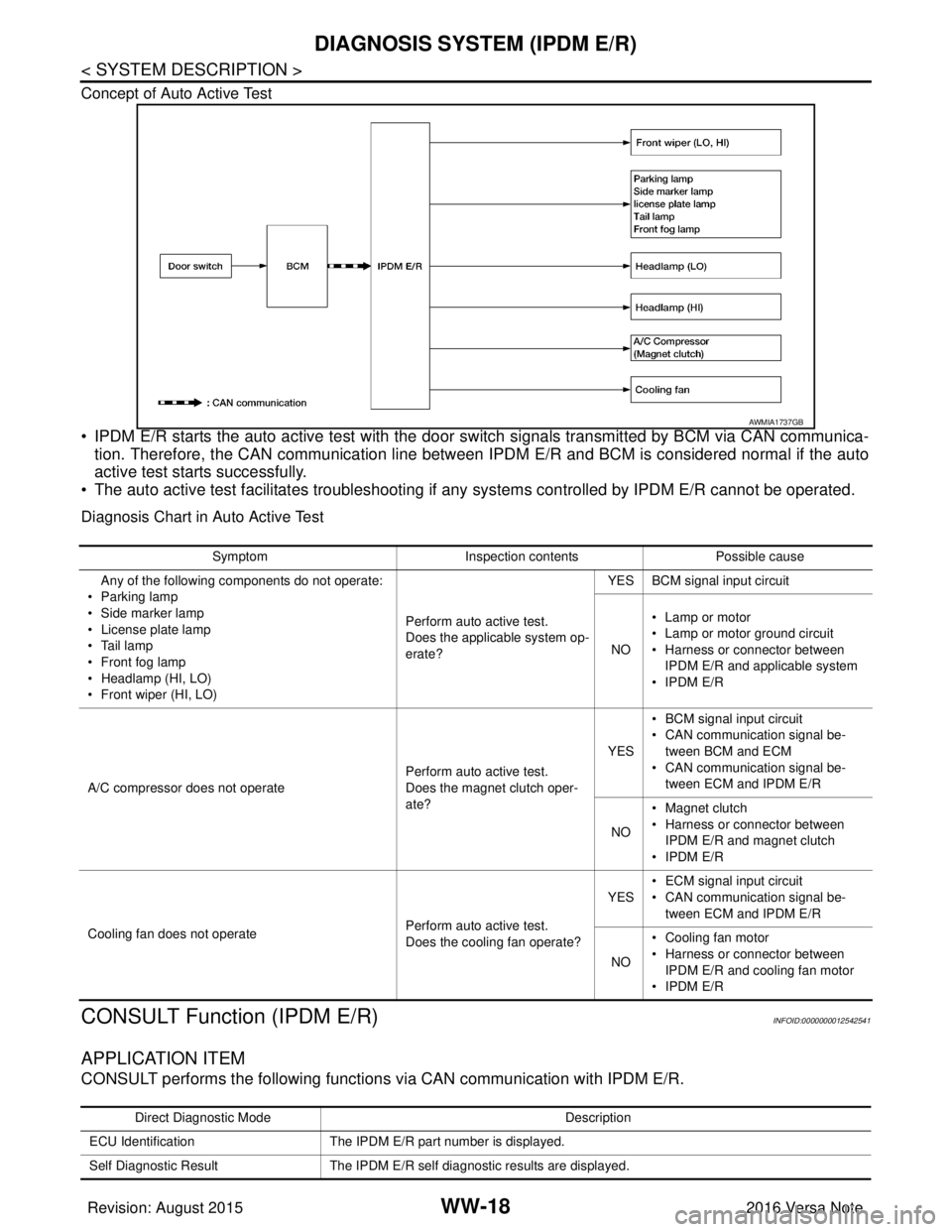
Concept of Auto Active Test
• IPDM E/R starts the auto active test with the door switch signals transmitted by BCM via CAN communica-
tion. Therefore, the CAN communication line between IPDM E/R and BCM is considered normal if the auto
active test starts successfully.
• The auto active test facilitates troubleshooting if any systems controlled by IPDM E/R cannot be operated.
Diagnosis Chart in Auto Active Test
CONSULT Function (IPDM E/R)INFOID:0000000012542541
APPLICATION ITEM
CONSULT performs the following functions via CAN communication with IPDM E/R.
AWMIA1737GB
Symptom Inspection contentsPossible cause
Any of the following components do not operate:
•Parking lamp
• Side marker lamp
• License plate lamp
•Tail lamp
• Front fog lamp
• Headlamp (HI, LO)
• Front wiper (HI, LO) Perform auto active test.
Does the applicable system op-
erate?YES BCM signal input circuit
NO • Lamp or motor
• Lamp or motor ground circuit
• Harness or connector between
IPDM E/R and applicable system
• IPDM E/R
A/C compressor does not operate Perform auto active test.
Does the magnet clutch oper-
ate?YES
• BCM signal input circuit
• CAN communication signal be-
tween BCM and ECM
• CAN communication signal be-
tween ECM and IPDM E/R
NO • Magnet clutch
• Harness or connector between
IPDM E/R and magnet clutch
• IPDM E/R
Cooling fan does not operate Perform auto active test.
Does the cooling fan operate?YES
• ECM signal input circuit
• CAN communication signal be-
tween ECM and IPDM E/R
NO • Cooling fan motor
• Harness or connector between
IPDM E/R and cooling fan motor
• IPDM E/R
Direct Diagnostic Mode Description
ECU Identification The IPDM E/R part number is displayed.
Self Diagnostic Result The IPDM E/R self diagnostic results are displayed.
Revision: August 2015 2016 Versa Note
cardiagn.com