2016 NISSAN NOTE clutch
[x] Cancel search: clutchPage 646 of 3641
CL-20
< UNIT REMOVAL AND INSTALLATION >
CLUTCH DISC AND CLUTCH COVER
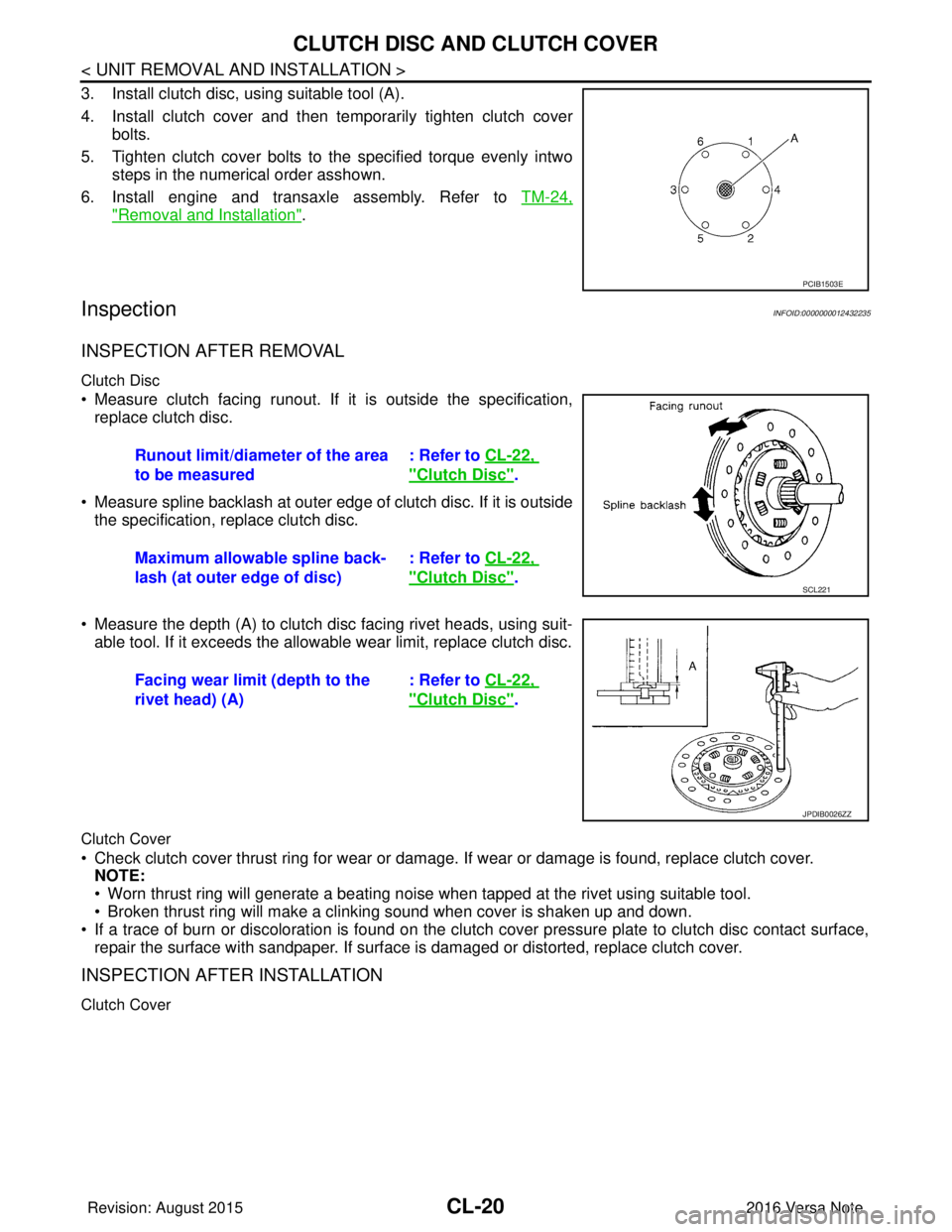
3. Install clutch disc, using suitable tool (A).
4. Install clutch cover and then temporarily tighten clutch coverbolts.
5. Tighten clutch cover bolts to the specified torque evenly intwo steps in the numerical order asshown.
6. Install engine and transaxle assembly. Refer to TM-24,
"Removal and Installation".
InspectionINFOID:0000000012432235
INSPECTION AFTER REMOVAL
Clutch Disc
• Measure clutch facing runout. If it is outside the specification,
replace clutch disc.
• Measure spline backlash at outer edge of clutch disc. If it is outside the specification, replace clutch disc.
• Measure the depth (A) to clutch disc facing rivet heads, using suit- able tool. If it exceeds the allowable wear limit, replace clutch disc.
Clutch Cover
• Check clutch cover thrust ring for wear or damage. If wear or damage is found, replace clutch cover.
NOTE:
• Worn thrust ring will generate a beating noise when tapped at the rivet using suitable tool.
• Broken thrust ring will make a clinking sound when cover is shaken up and down.
• If a trace of burn or discoloration is found on the clutch cover pressure plate to clutch disc contact surface,
repair the surface with sandpaper. If surface is damaged or distorted, replace clutch cover.
INSPECTION AFTER INSTALLATION
Clutch Cover
PCIB1503E
Runout limit/diameter of the area
to be measured : Refer to
CL-22,
"Clutch Disc".
Maximum allowable spline back-
lash (at outer edge of disc) : Refer to
CL-22,
"Clutch Disc".SCL221
Facing wear limit (depth to the
rivet head) (A) : Refer to
CL-22,
"Clutch Disc".
JPDIB0026ZZ
Revision: August 2015 2016 Versa Note
cardiagn.com
Page 647 of 3641
CLUTCH DISC AND CLUTCH COVERCL-21
< UNIT REMOVAL AND INSTALLATION >
CEF
G H
I
J
K L
M A
B
CL
N
O P
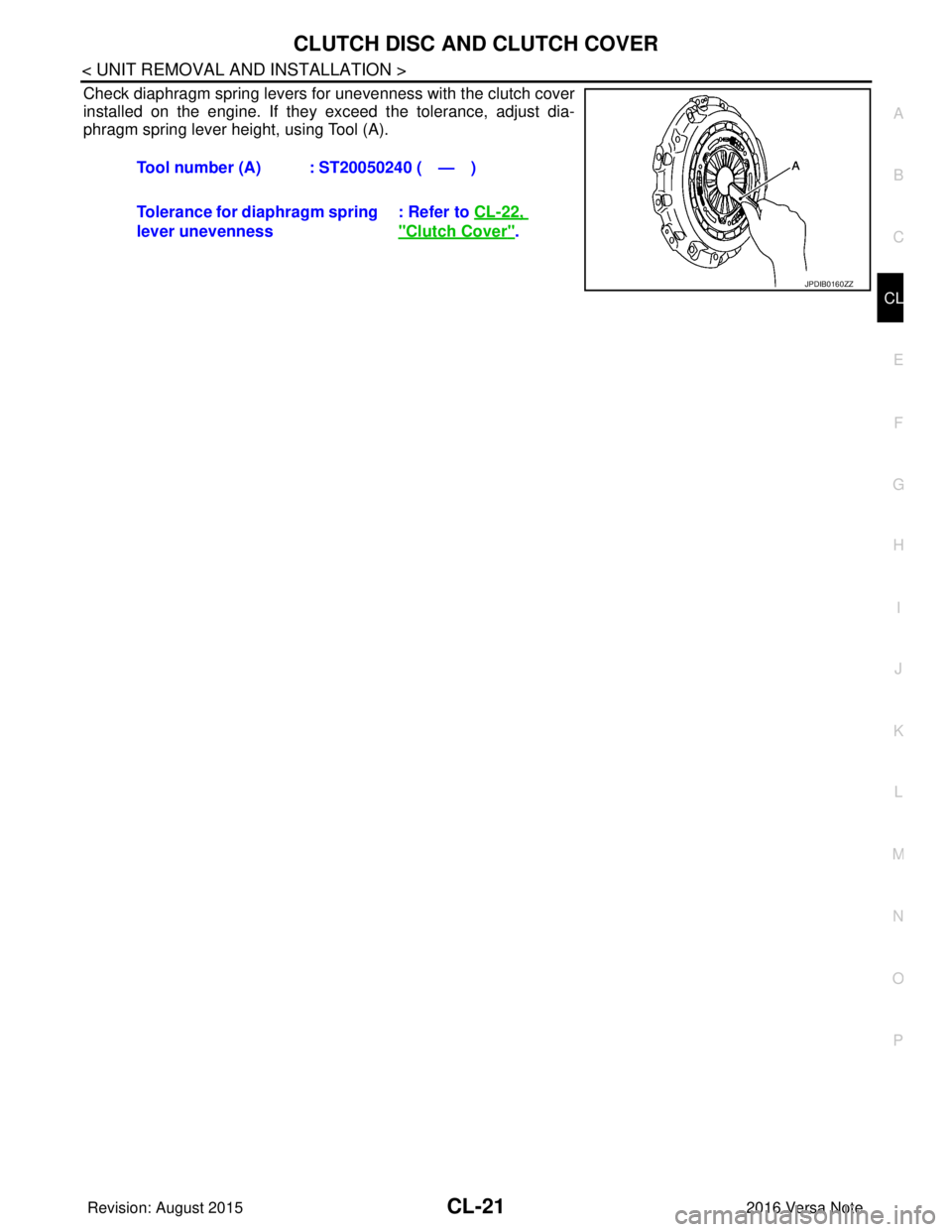
Check diaphragm spring levers for unevenness with the clutch cover
installed on the engine. If they exceed the tolerance, adjust dia-
phragm spring lever height, using Tool (A). Tool number (A) : ST20050240 ( — )
Tolerance for diaphragm spring
lever unevenness : Refer to
CL-22,
"Clutch Cover".
JPDIB0160ZZ
Revision: August 2015 2016 Versa Note
cardiagn.com
Page 648 of 3641
CL-22
< SERVICE DATA AND SPECIFICATIONS (SDS)
SERVICE DATA AND SPECIFICATIONS (SDS)
SERVICE DATA AND SPECIFICATIONS (SDS)
SERVICE DATA AND SPECIFICATIONS (SDS)
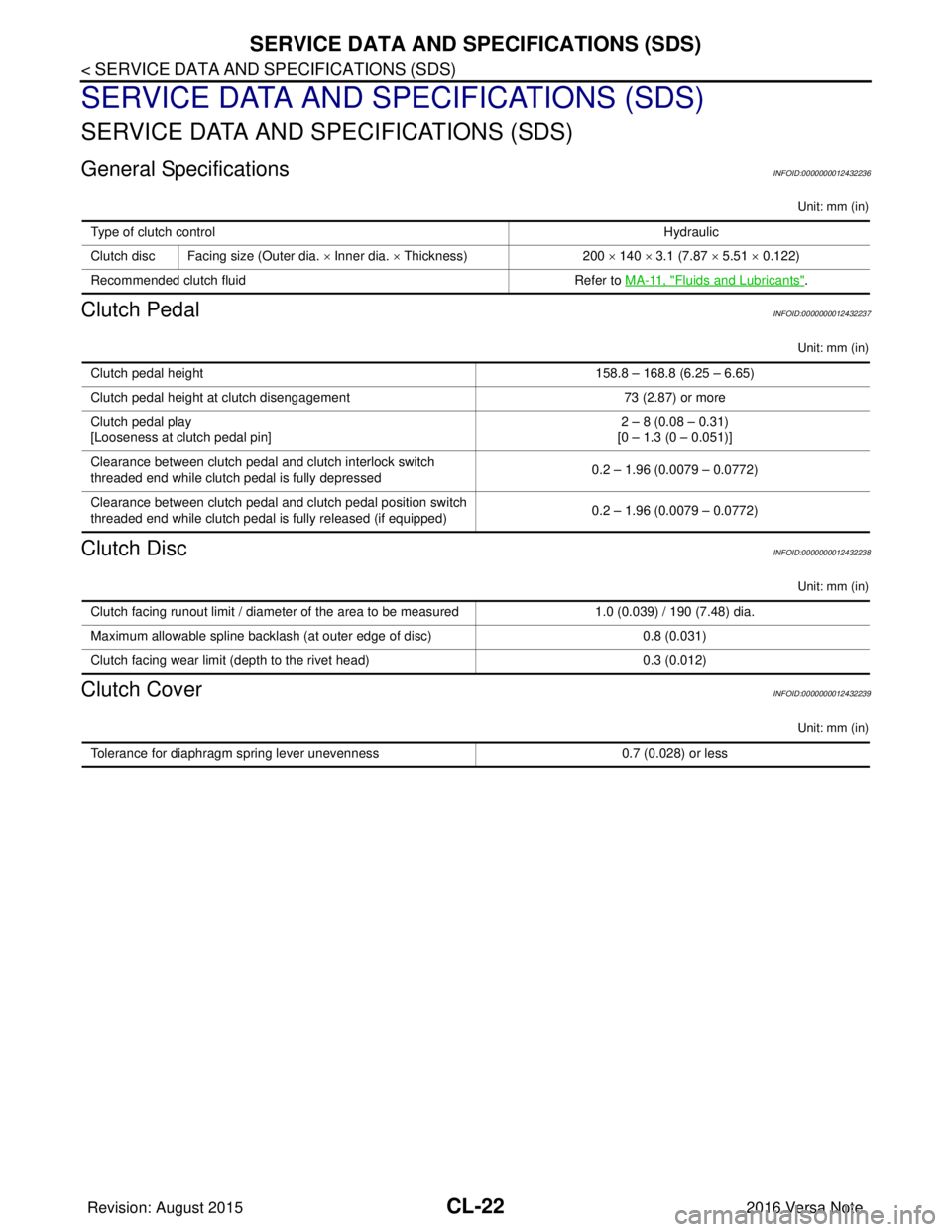
General SpecificationsINFOID:0000000012432236
Unit: mm (in)
Clutch PedalINFOID:0000000012432237
Unit: mm (in)
Clutch DiscINFOID:0000000012432238
Unit: mm (in)
Clutch CoverINFOID:0000000012432239
Unit: mm (in)
Type of clutch controlHydraulic
Clutch disc Facing size (Outer dia. × Inner dia. × Thickness) 200 × 140 × 3.1 (7.87 × 5.51 × 0.122)
Recommended clutch fluid Refer to MA-11, "
Fluids and Lubricants".
Clutch pedal height 158.8 – 168.8 (6.25 – 6.65)
Clutch pedal height at clutch disengagement 73 (2.87) or more
Clutch pedal play
[Looseness at clutch pedal pin] 2 – 8 (0.08 – 0.31)
[0 – 1.3 (0 – 0.051)]
Clearance between clutch pedal and clutch interlock switch
threaded end while clutch pedal is fully depressed 0.2 – 1.96 (0.0079 – 0.0772)
Clearance between clutch pedal and clutch pedal position switch
threaded end while clutch pedal is fully released (if equipped) 0.2 – 1.96 (0.0079 – 0.0772)
Clutch facing runout limit / diameter of the area to be measured
1.0 (0.039) / 190 (7.48) dia.
Maximum allowable spline backlash (at outer edge of disc) 0.8 (0.031)
Clutch facing wear limit (depth to the rivet head) 0.3 (0.012)
Tolerance for diaphragm spring lever unevenness0.7 (0.028) or less
Revision: August 2015 2016 Versa Note
cardiagn.com
Page 721 of 3641
![NISSAN NOTE 2016 Service Repair Manual DLK-32
< SYSTEM DESCRIPTION >[WITH INTELLIGENT KEY SYSTEM]
DIAGNOSIS SYSTEM (BCM)
DATA MONITOR
ACTIVE TEST
Monitor Item [Unit]
Main Description
REQ SW -DR [On/Off] ×Indicates condition of door reques](/manual-img/5/57363/w960_57363-720.png "NISSAN NOTE 2016 Service Repair Manual DLK-32
< SYSTEM DESCRIPTION >[WITH INTELLIGENT KEY SYSTEM]
DIAGNOSIS SYSTEM (BCM)
DATA MONITOR
ACTIVE TEST
Monitor Item [Unit]
Main Description
REQ SW -DR [On/Off] ×Indicates condition of door reques")
DLK-32
< SYSTEM DESCRIPTION >[WITH INTELLIGENT KEY SYSTEM]
DIAGNOSIS SYSTEM (BCM)
DATA MONITOR
ACTIVE TEST
Monitor Item [Unit]
Main Description
REQ SW -DR [On/Off] ×Indicates condition of door request switch LH.
REQ SW -AS [On/Off] ×Indicates condition of door request switch RH.
REQ SW -BD/TR [On/Off] ×Indicates condition of back door request switch.
PUSH SW [On/Off] Indicates condition of push-button ignition switch.
CLUCH SW [On/Off] ×Indicates condition of clutch interlock switch.
BRAKE SW 1 [On/Off] ×Indicates condition of brake switch.
BRAKE SW 2 [On/Off] Indicates condition of brake switch.
DETE/CANCL SW [On/Off] ×Indicates condition of P (park) position.
SFT PN/N SW [On/Off] ×Indicates condition of P (park) or N (neutral) position.
UNLK SEN -DR [On/Off] ×Indicates condition of door unlock sensor.
PUSH SW -IPDM [On/Off] Indicates condition of push-button ignition switch received from IPDM E/R on
CAN communication line.
IGN RLY1 -F/B [On/Off] Indicates condition of ignition relay 1 received from IPDM E/R on CAN commu-
nication line.
DETE SW -IPDM [On/Off] Indicates condition of detent switch received from TCM on CAN communication
line.
SFT PN -IPDM [On/Off] Indicates condition of P (park) or N (neutral) position from TCM on CAN com-
munication line.
SFT P -MET [On/Off] Indicates condition of P (park) position from TCM on CAN communication line.
SFT N -MET [On/Off] Indicates condition of N (neutral) position from IPDM E/R on CAN communica-
tion line.
ENGINE STATE [Stop/Start/Crank/Run] ×Indicates condition of engine state from ECM on CAN communication line.
VEH SPEED 1 [mph/km/h] ×Indicates condition of ve
hicle speed signal receiv ed from ABS on CAN commu-
nication line.
VEH SPEED 2 [mph/km/h] ×Indicates condition of vehicle speed signal received from combination meter on
CAN communication line.
DOOR STAT -DR [LOCK/READY/UNLK] ×Indicates condition of driver side door status.
DOOR STAT -AS [LOCK/READY/UNLK] ×Indicates condition of passenger side door status.
ID OK FLAG [Set/Reset] Indicates condition of Intelligent Key ID.
PRMT ENG STRT [Set/Reset] Indicates condition of engine start possibility.
RKE OPE COUN1 [0-19] ×When remote keyless entry receiver receives the signal transmitted while oper-
ating on Intelligent Key, the numerical value start changing.
RKE OPE COUN2 [0-19] ×When remote keyless entry receiver receives the signal transmitted while oper-
ating on Intelligent Key, the numerical value start changing.
RKE-LOCK [On/Off] Indicates condition of lock signal from Intelligent Key.
RKE-UNLOCK [On/Off] Indicates condition of unlock signal from Intelligent Key.
RKE-PANIC [On/Off] Indicates condition of panic signal from Intelligent Key.
RKE-MODE CHG [On/Off] Indicates condition of mode change signal from Intelligent Key.
Test Item Description
INSIDE BUZZER This test is able to check combination meter warning chime operation [Take Out/Knob/Key/
Off].
LCD This test is able to check combination meter display in
formation [Off/LK WN/OUTKEY/NO
KY/BATT/INSRT/SFT P/ROTAT/ID NG/B&P I/B&P N].
BATTERY SAVER This test is able to check battery saver operation [On/Off].
Revision: August 2015 2016 Versa Note
cardiagn.com
Page 824 of 3641
![NISSAN NOTE 2016 Service Repair Manual SQUEAK AND RATTLE TROUBLE DIAGNOSESDLK-135
< SYMPTOM DIAGNOSIS > [WITH INTELLIGENT KEY SYSTEM]
C
D
E
F
G H
I
J
L
M A
B
DLK
N
O P
If the noise can be duplicated easily during the test drive, to help id](/manual-img/5/57363/w960_57363-823.png "NISSAN NOTE 2016 Service Repair Manual SQUEAK AND RATTLE TROUBLE DIAGNOSESDLK-135
< SYMPTOM DIAGNOSIS > [WITH INTELLIGENT KEY SYSTEM]
C
D
E
F
G H
I
J
L
M A
B
DLK
N
O P
If the noise can be duplicated easily during the test drive, to help id")
SQUEAK AND RATTLE TROUBLE DIAGNOSESDLK-135
< SYMPTOM DIAGNOSIS > [WITH INTELLIGENT KEY SYSTEM]
C
D
E
F
G H
I
J
L
M A
B
DLK
N
O P
If the noise can be duplicated easily during the test drive, to help identify the source of the noise, try to dupli-
cate the noise with the vehicle stopped by doing one or all of the following:
1) Close a door.
2) Tap or push/pull around the area where the noise appears to be coming from.
3) Rev the engine.
4) Use a floor jack to recreate vehicle “twist”.
5) At idle, apply engine load (electrical load, half-clutch on M/T model, drive position on CVT and A/T models).
6) Raise the vehicle on a hoist and hit a tire with a rubber hammer.
• Drive the vehicle and attempt to duplicate the conditions the customer states exist when the noise occurs.
• If it is difficult to duplicate the noise, drive the vehicle slowly on an undulating or rough road to stress the
vehicle body.
CHECK RELATED SERVICE BULLETINS
After verifying the customer concern or symptom, check ASIST for Technical Service Bulletins (TSBs) related
to that concern or symptom.
If a TSB relates to the symptom, follow the procedure to repair the noise.
LOCATE THE NOISE AND IDENTIFY THE ROOT CAUSE
1. Narrow down the noise to a general area. To help pinpoint the source of the noise, use a listening tool (Chassis Ear: J-39570, Engine Ear: J-39565 and mechanic's stethoscope).
2. Narrow down the noise to a more specific area and identify the cause of the noise by: • removing the components in the area that you suspect the noise is coming from.Do not use too much force when removing clips and fasteners, otherwise clips and fasteners can be
broken or lost during the repair, resulting in the creation of new noise.
• tapping or pushing/pulling the component that you suspect is causing the noise.
Do not tap or push/pull the component with excessive force, otherwise the noise will be eliminated only
temporarily.
• feeling for a vibration with your hand by touching the component(s) that you suspect is (are) causing the
noise.
• placing a piece of paper between components that you suspect are causing the noise.
• looking for loose components and contact marks. Refer to DLK-135, "
Generic Squeak and Rattle Troubleshooting".
REPAIR THE CAUSE
• If the cause is a loose component, tighten the component securely.
• If the cause is insufficient clearance between components:
- separate components by repositioning or loos ening and retightening the component, if possible.
- insulate components with a suitable insulator such as urethane pads, foam blocks, felt cloth tape or urethane tape. A NISSAN Squeak and Rattle Kit (J-50397) is available through your authorized NISSAN Parts Depart-
ment.
CAUTION:
Do not use excessive force as many components are constructed of plastic and may be damaged.
NOTE:
• Always check with the Parts Department for the latest parts information.
• The materials contained in the NISSAN Squeak and Rattle Kit (J-50397) are listed on the inside cover of the
kit; and can each be ordered separately as needed.
• The following materials not found in the kit can also be used to repair squeaks and rattles.
- SILICONE GREASE: Use instead of UHMW tape that will be visible or does not fit. The silicone grease will
only last a few months.
- SILICONE SPRAY: Use when grease cannot be applied.
- DUCT TAPE: Use to eliminate movement.
CONFIRM THE REPAIR
Confirm that the cause of a noise is repaired by test driving the vehicle. Operate the vehicle under the same
conditions as when the noise originally occurred. Refer to the notes on the Diagnostic Worksheet.
Generic Squeak and Rattle TroubleshootingINFOID:0000000012430083
Refer to Table of Contents for specific component removal and installation information.
INSTRUMENT PANEL
Most incidents are caused by contact and movement between:
Revision: August 2015 2016 Versa Note
cardiagn.com
Page 952 of 3641
![NISSAN NOTE 2016 Service Repair Manual SQUEAK AND RATTLE TROUBLE DIAGNOSESDLK-263
< SYMPTOM DIAGNOSIS > [WITHOUT INTELLIGENT KEY SYSTEM]
C
D
E
F
G H
I
J
L
M A
B
DLK
N
O P
If the noise can be duplicated easily during the test drive, to help](/manual-img/5/57363/w960_57363-951.png "NISSAN NOTE 2016 Service Repair Manual SQUEAK AND RATTLE TROUBLE DIAGNOSESDLK-263
< SYMPTOM DIAGNOSIS > [WITHOUT INTELLIGENT KEY SYSTEM]
C
D
E
F
G H
I
J
L
M A
B
DLK
N
O P
If the noise can be duplicated easily during the test drive, to help")
SQUEAK AND RATTLE TROUBLE DIAGNOSESDLK-263
< SYMPTOM DIAGNOSIS > [WITHOUT INTELLIGENT KEY SYSTEM]
C
D
E
F
G H
I
J
L
M A
B
DLK
N
O P
If the noise can be duplicated easily during the test drive, to help identify the source of the noise, try to dupli-
cate the noise with the vehicle stopped by doing one or all of the following:
1) Close a door.
2) Tap or push/pull around the area where the noise appears to be coming from.
3) Rev the engine.
4) Use a floor jack to recreate vehicle “twist”.
5) At idle, apply engine load (electrical load, half-clutch on M/T model, drive position on CVT and A/T models).
6) Raise the vehicle on a hoist and hit a tire with a rubber hammer.
• Drive the vehicle and attempt to duplicate the conditions the customer states exist when the noise occurs.
• If it is difficult to duplicate the noise, drive the vehicle slowly on an undulating or rough road to stress the
vehicle body.
CHECK RELATED SERVICE BULLETINS
After verifying the customer concern or symptom, check ASIST for Technical Service Bulletins (TSBs) related
to that concern or symptom.
If a TSB relates to the symptom, follow the procedure to repair the noise.
LOCATE THE NOISE AND IDENTIFY THE ROOT CAUSE
1. Narrow down the noise to a general area. To help pinpoint the source of the noise, use a listening tool (Chassis Ear: J-39570, Engine Ear: J-39565 and mechanic's stethoscope).
2. Narrow down the noise to a more specific area and identify the cause of the noise by: • removing the components in the area that you suspect the noise is coming from.Do not use too much force when removing clips and fasteners, otherwise clips and fasteners can be
broken or lost during the repair, resulting in the creation of new noise.
• tapping or pushing/pulling the component that you suspect is causing the noise.
Do not tap or push/pull the component with excessive force, otherwise the noise will be eliminated only
temporarily.
• feeling for a vibration with your hand by touching the component(s) that you suspect is (are) causing the
noise.
• placing a piece of paper between components that you suspect are causing the noise.
• looking for loose components and contact marks. Refer to DLK-263, "
Generic Squeak and Rattle Troubleshooting".
REPAIR THE CAUSE
• If the cause is a loose component, tighten the component securely.
• If the cause is insufficient clearance between components:
- separate components by repositioning or loos ening and retightening the component, if possible.
- insulate components with a suitable insulator such as urethane pads, foam blocks, felt cloth tape or urethane tape. A NISSAN Squeak and Rattle Kit (J-50397) is available through your authorized NISSAN Parts Depart-
ment.
CAUTION:
Do not use excessive force as many components are constructed of plastic and may be damaged.
NOTE:
• Always check with the Parts Department for the latest parts information.
• The materials contained in the NISSAN Squeak and Rattle Kit (J-50397) are listed on the inside cover of the
kit; and can each be ordered separately as needed.
• The following materials not found in the kit can also be used to repair squeaks and rattles.
- SILICONE GREASE: Use instead of UHMW tape that will be visible or does not fit. The silicone grease will
only last a few months.
- SILICONE SPRAY: Use when grease cannot be applied.
- DUCT TAPE: Use to eliminate movement.
CONFIRM THE REPAIR
Confirm that the cause of a noise is repaired by test driving the vehicle. Operate the vehicle under the same
conditions as when the noise originally occurred. Refer to the notes on the Diagnostic Worksheet.
Generic Squeak and Rattle TroubleshootingINFOID:0000000012430229
Refer to Table of Contents for specific component removal and installation information.
INSTRUMENT PANEL
Most incidents are caused by contact and movement between:
Revision: August 2015 2016 Versa Note
cardiagn.com
Page 1075 of 3641
![NISSAN NOTE 2016 Service Repair Manual EM-74
< REMOVAL AND INSTALLATION >[HR16DE]
OIL SEAL
2. Press in valve oil seal to the height “H” shown with Tool (A).
3. Installation of the remaining components is in the reverse order of removal](/manual-img/5/57363/w960_57363-1074.png "NISSAN NOTE 2016 Service Repair Manual EM-74
< REMOVAL AND INSTALLATION >[HR16DE]
OIL SEAL
2. Press in valve oil seal to the height “H” shown with Tool (A).
3. Installation of the remaining components is in the reverse order of removal")
EM-74
< REMOVAL AND INSTALLATION >[HR16DE]
OIL SEAL
2. Press in valve oil seal to the height “H” shown with Tool (A).
3. Installation of the remaining components is in the reverse order of removal.
FRONT OIL SEAL
FRONT OIL SEAL : Remo
val and InstallationINFOID:0000000012431724
REMOVAL
1. Remove front fender protector (RH). Refer to EXT-38, "Removal and Installation".
2. Remove drive belt. Refer to EM-16, "
Removal and Installation".
3. Remove crankshaft pulley. Refer to EM-51, "
Exploded View".
4. Remove front oil seal using suitable tool. CAUTION:
Be careful not to damage front cover and crankshaft.
5. Installation of the remaining components is in the reverse order of removal.
INSTALLATION
1. Apply new engine oil to new front oil seal joint surface and seal lip.
2. Install front oil seal so that each seal lip is oriented as shown.
• Press-fit front oil seal using a suitable drift.CAUTION:
• Be careful not to damage front cover and crankshaft.
• Press-fit oil seal straight to avoid causing burrs or tilting.
3. Installation of the remaining components is in the reverse order of removal.
REAR OIL SEAL
REAR OIL SEAL : Removal and InstallationINFOID:0000000012431725
REMOVAL
1. Remove engine and transaxle assembly. Refer to TM-24, "Removal and Installation" (M/T models) and
TM-259, "
Removal and Installation" (CVT models).
2. Remove clutch cover and clutch disk (M/T models). Refer to CL-19, "
Removal and Installation".
3. Remove flywheel (M/T models) or drive plate (CVT models). Refer to EM-93, "
Exploded View".
4. Remove rear oil seal using suitable tool. Height “H” : 13.2 - 13.8 mm (0.520 - 0.543 in)
Tool number (A) : KV10115600 (J-38958)
PBIC3211J
(A) : Dust seal lip
(B) : Oil seal lip
: Engine outside
: Engine inside
PBIC3485J
Revision: August 2015 2016 Versa Note
cardiagn.com
Page 1089 of 3641
![NISSAN NOTE 2016 Service Repair Manual EM-88
< UNIT REMOVAL AND INSTALLATION >[HR16DE]
ENGINE ASSEMBLY
• Remove the engine and the transaxle assembly from the vehicle downward. Separate the engine and the
transaxle.
REMOVAL
1. Release fu](/manual-img/5/57363/w960_57363-1088.png "NISSAN NOTE 2016 Service Repair Manual EM-88
< UNIT REMOVAL AND INSTALLATION >[HR16DE]
ENGINE ASSEMBLY
• Remove the engine and the transaxle assembly from the vehicle downward. Separate the engine and the
transaxle.
REMOVAL
1. Release fu")
EM-88
< UNIT REMOVAL AND INSTALLATION >[HR16DE]
ENGINE ASSEMBLY
• Remove the engine and the transaxle assembly from the vehicle downward. Separate the engine and the
transaxle.
REMOVAL
1. Release fuel pressure. Refer to EC-137, "Work Procedure".
2. Drain engine coolant from radiator. Refer to CO-8, "
Draining Engine Coolant".
CAUTION:
• Perform this step when the engine is cold.
• Do not spill engine coolant on drive belts.
3. Remove the following parts: • Front wheels and tires (RH/LH). Refer to WT-48, "
Removal and Installation".
• Front fender protector (RH/LH). Refer to EXT-38, "
Exploded View".
• Drive belt. Refer to EM-16, "
Removal and Installation".
• Battery and battery tray. Refer to PG-70, "
Exploded View".
• Air duct (inlet), air duct, and air cleaner case assembly. Refer to EM-26, "
Removal and Installation".
• Radiator hose (upper and lower). Refer to CO-13, "
Exploded View".
• Exhaust front tube. Refer to EX-5, "
Exploded View".
4. Disconnect engine room harness connector at the ECM and CVT (if equipped). CAUTION:
Protect connectors against foreign materials during the operation by wrapping in a plastic bag.
5. Disconnect heater hoses. Refer to CO-13, "
Exploded View".
6. Disconnect fuel feed hose at engine side. Refer to EM-40, "
Exploded View".
7. Disconnect control linkage cable from transaxle. Refer to TM-20, "
Exploded View" (M/T models) and TM-
234, "Exploded View" (CVT models).
8. Disconnect clutch tube on transaxle side from clutch damper (M/T models). Refer to CL-15, "
Exploded
View".
9. Remove generator. Refer to CHG-29, "
Exploded View".
10. Disconnect vacuum hose at engine side.
11. Remove EVAP hoses at engine side.
12. Remove A/C compressor from the engine with the piping connected. Temporarily position the A/C com-
pressor on the vehicle side with a rope without placing a heavy load on the piping.
13. Remove ground cable at transaxle side.
14. Remove drive shafts (RH/LH). Refer to FAX-19, "
Removal and Installation".
15. Remove rear torque rod (1).
16. When engine can be hoisted, install engine slinger to cylinder head front left side (A) and rear right side (B) and support the
engine position with a suitable tool.
(2) : Rear engine mounting bracket
: Front
JSBIA0643ZZ
: Engine front
Slinger (A) bolts : 65 N·m (6.6 kg-m, 48 ft-lb)
Slinger (B) bolts : 25 N·m (2.6 kg-m, 18 ft-lb)
AWBIA1134GB
Revision: August 2015 2016 Versa Note
cardiagn.com