2016 NISSAN NOTE ignition
[x] Cancel search: ignitionPage 3142 of 3641
SR-26
< REMOVAL AND INSTALLATION >
SATELLITE SENSOR
SATELLITE SENSOR
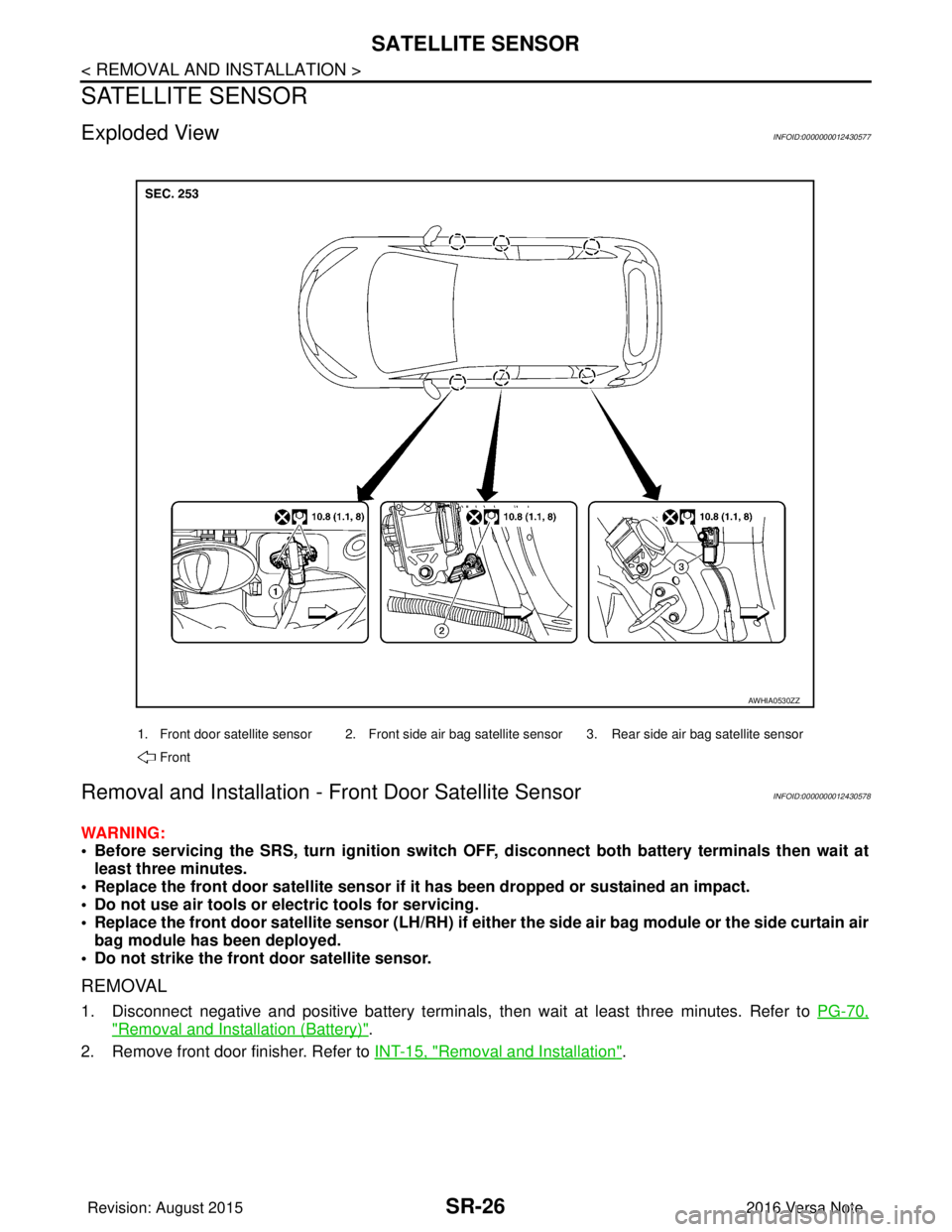
Exploded ViewINFOID:0000000012430577
Removal and Installation - Front Door Satellite SensorINFOID:0000000012430578
WARNING:
• Before servicing the SRS, turn ignition switch OFF, disconnect bot h battery terminals then wait at
least three minutes.
• Replace the front door satellite sensor if it has been dropped or sustained an impact.
• Do not use air tools or el ectric tools for servicing.
• Replace the front door satellite sensor (LH/RH) if either the side air bag module or the side curtain air bag module has been deployed.
• Do not strike the front door satellite sensor.
REMOVAL
1. Disconnect negative and positive battery terminals, then wait at least three minutes. Refer to PG-70,
"Removal and Installation (Battery)".
2. Remove front door finisher. Refer to INT-15, "
Removal and Installation".
1. Front door satellite sensor 2. Front side air bag satellite sensor 3. Rear side air bag satellite sensor
Front
AWHIA0530ZZ
Revision: August 2015 2016 Versa Note
cardiagn.com
Page 3144 of 3641
SR-28
< REMOVAL AND INSTALLATION >
SATELLITE SENSOR
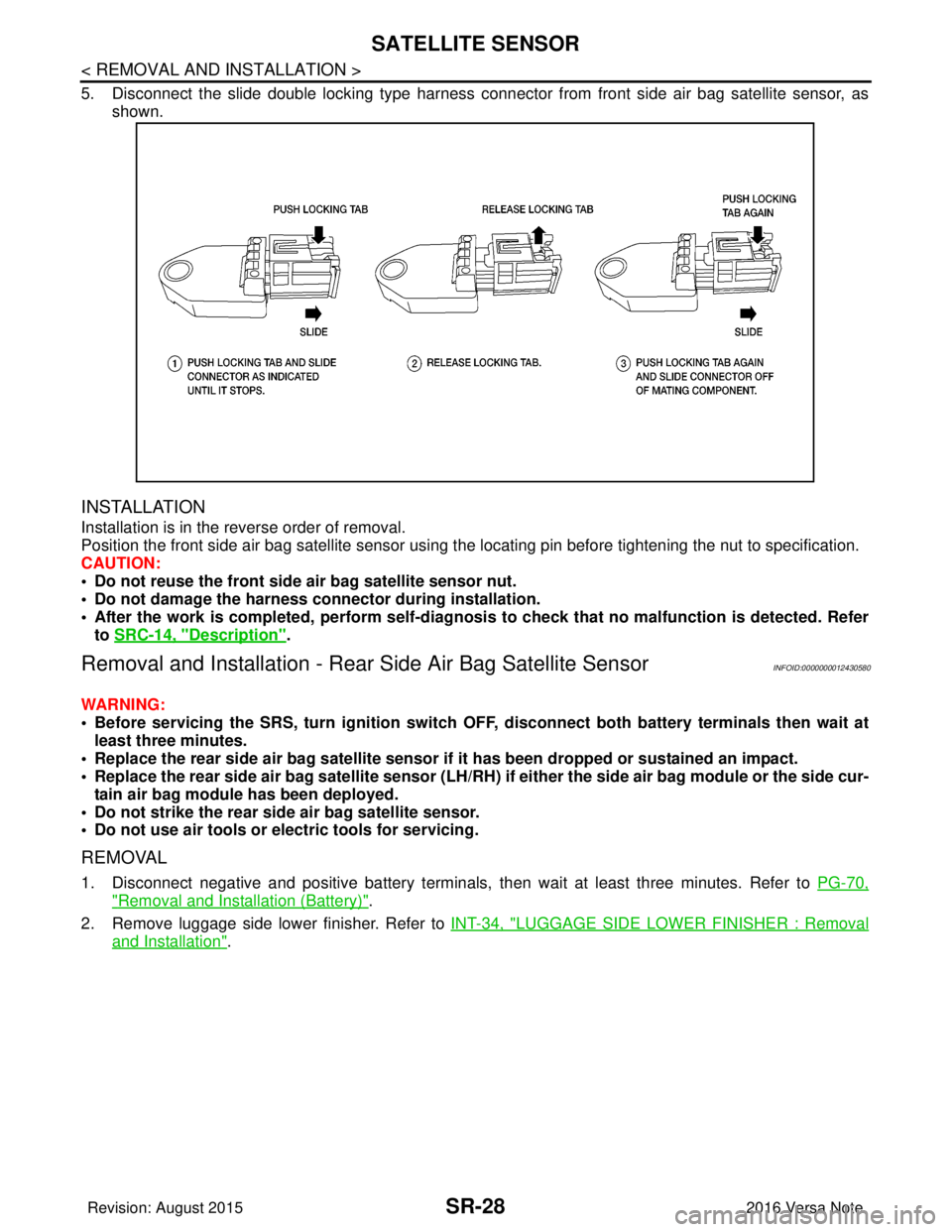
5. Disconnect the slide double locking type harness connector from front side air bag satellite sensor, asshown.
INSTALLATION
Installation is in the reverse order of removal.
Position the front side air bag satellite sensor using t he locating pin before tightening the nut to specification.
CAUTION:
• Do not reuse the front side air bag satellite sensor nut.
• Do not damage the harness connector during installation.
• After the work is completed, perform self-diagnos is to check that no malfunction is detected. Refer
to SRC-14, "
Description".
Removal and Installation - Rear Side Air Bag Satellite SensorINFOID:0000000012430580
WARNING:
• Before servicing the SRS, turn ignition switch OFF, disconnect bot h battery terminals then wait at
least three minutes.
• Replace the rear side air bag satellite sensor if it has been dropped or sustained an impact.
• Replace the rear side air bag satellite sensor (LH/RH) if either the side air bag module or the side cur-
tain air bag module has been deployed.
• Do not strike the rear side air bag satellite sensor.
• Do not use air tools or el ectric tools for servicing.
REMOVAL
1. Disconnect negative and positive battery terminals, then wait at least three minutes. Refer to PG-70,
"Removal and Installation (Battery)".
2. Remove luggage side lower finisher. Refer to INT-34, "
LUGGAGE SIDE LOWER FINISHER : Removal
and Installation".
Revision: August 2015 2016 Versa Note
cardiagn.com
Page 3146 of 3641
SR-30
< REMOVAL AND INSTALLATION >
AIR BAG DIAGNOSIS SENSOR UNIT
AIR BAG DIAGNOSIS SENSOR UNIT
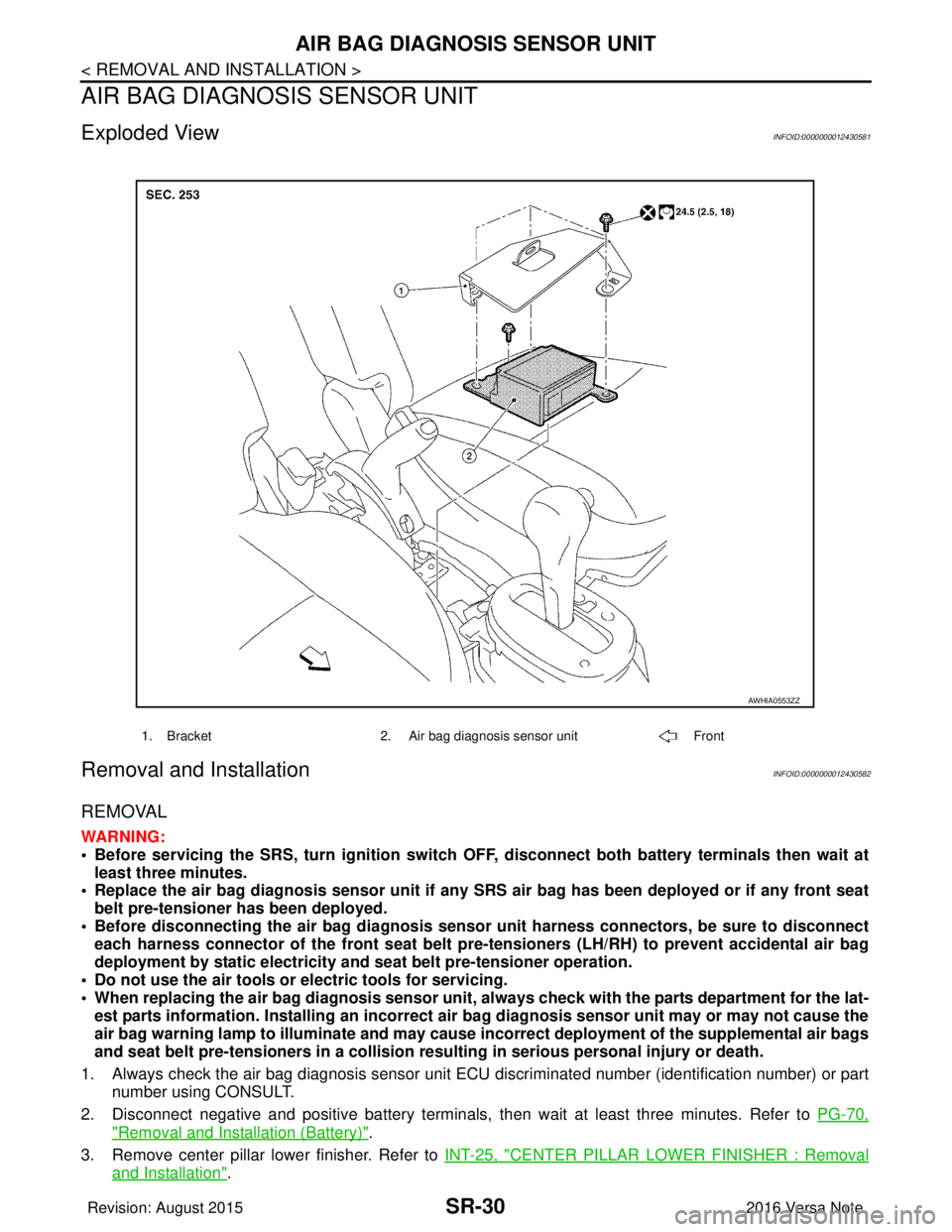
Exploded ViewINFOID:0000000012430581
Removal and InstallationINFOID:0000000012430582
REMOVAL
WARNING:
• Before servicing the SRS, turn ignition switch OFF, disconnect bot h battery terminals then wait at
least three minutes.
• Replace the air bag diagnosis senso r unit if any SRS air bag has been deployed or if any front seat
belt pre-tensioner has been deployed.
• Before disconnecting the air bag diagnosis sensor unit harness conn ectors, be sure to disconnect
each harness connector of the front seat belt pre-tensioners (LH/RH) to prevent accidental air bag
deployment by static electricity and seat belt pre-tensioner operation.
• Do not use the air tools or electric tools for servicing.
• When replacing the air bag diagno sis sensor unit, always check with th e parts department for the lat-
est parts information. Installing an incorrect air bag diagnosis sen sor unit may or may not cause the
air bag warning lamp to illuminate and may cause in correct deployment of the supplemental air bags
and seat belt pre-tensioners in a collision resulting in serious personal injury or death.
1. Always check the air bag diagnosis sensor unit ECU discriminated number (identification number) or part
number using CONSULT.
2. Disconnect negative and positive battery terminals, then wait at least three minutes. Refer to PG-70,
"Removal and Installation (Battery)".
3. Remove center pillar lower finisher. Refer to INT-25, "
CENTER PILLAR LOWER FINISHER : Removal
and Installation".
1. Bracket2. Air bag diagnosis sensor unit Front
AWHIA0553ZZ
Revision: August 2015 2016 Versa Note
cardiagn.com
Page 3148 of 3641
SR-32
< REMOVAL AND INSTALLATION >
OCCUPANT CLASSIFICATION SYSTEM CONTROL UNIT
OCCUPANT CLASSIFICATION SYSTEM CONTROL UNIT
Removal and InstallationINFOID:0000000012430583
OCCUPANT CLASSIFICATION SYSTEM CONTROL UNIT
WARNING:
• Before servicing the SRS, turn ignition switch OFF, disconnect bot h battery terminals then wait at
least three minutes.
• Do not use air tools or el ectric tools for servicing.
Removal
1. Slide front passenger seat to full forward position.
2. Disconnect negative and positive battery terminals, then wait at least three minutes. Refer to PG-70,
"Removal and Installation (Battery)".
3. Release front J-clips, then disconnect harness connector from occupant classification system control unit.
4. Remove screws and occupant classification system control unit. CAUTION:
• Replace the occupant classification control unit if it has been dropped or sustained an impact.
• Do not strike the occupant classification control unit.
Installation
Installation is in the reverse order of removal.
WARNING:
• Zero point reset must be performed every time the occupant classification system control unit is
removed/replaced. Refer to SRC-39, "
ZERO POINT RESET : Description".
CAUTION:
• Do not damage the harness connector during installation.
• After installation is complete, check that no syst em malfunction is detected causing the air bag
warning lamp to illuminate.
• If a malfunction is indicated by the air bag warnin g lamp after repair or replacement of the malfunc-
tioning parts, perform the diagnosis. Refer to SRC-16, "
Trouble Diagnosis with CONSULT".
OCCUPANT CLASSIFICATION SYSTEM SENSORS
WARNING:
• Before servicing the SRS, turn ignition switch OFF, disconnect bot h battery terminals then wait at
least three minutes.
• Do not use air tools or el ectric tools for servicing.
Removal
1. Disconnect negative and positive battery terminals, then wait at least three minutes. Refer to PG-70,
"Removal and Installation (Battery)".
2. Remove front passenger seat. Refer to SE-22, "
PASSENGER SIDE : Removal and Installation".
3. Disconnect harness connectors from occu pant classification system sensors.
4. Remove nuts (LH/RH) and remove seat frame from seat tracks.
5. Remove nuts from occupant classification sensor and remove.
Installation
1. Install occupant classification system sensor to seat track using nuts. CAUTION:
• Do not reuse nuts. Replace with new part during installation.
• Tighten nuts to specification.
2. Install seat frame to seat track using nuts and washer. CAUTION:
Do not reuse nuts or washer. Replace with new part during installation.
Occupant classification
sensor nuts
:22 N·m (2.2 kg-m, 16 ft-lb)
Revision: August 2015
2016 Versa Note
cardiagn.com
Page 3154 of 3641
STR-2
< PRECAUTION >
PRECAUTIONS
PRECAUTION
PRECAUTIONS
Precaution for Supplemental Restraint System (SRS) "AIR BAG" and "SEAT BELT
PRE-TENSIONER"
INFOID:0000000012432057
The Supplemental Restraint System such as “A IR BAG” and “SEAT BELT PRE-TENSIONER”, used along
with a front seat belt, helps to reduce the risk or severity of injury to the driver and front passenger for certain
types of collision. Information necessary to service the system safely is included in the SR and SB section of
this Service Manual.
WARNING:
• To avoid rendering the SRS inopera tive, which could increase the risk of personal injury or death in
the event of a collision which would result in air bag inflation, all maintenance must be performed by
an authorized NISSAN/INFINITI dealer.
• Improper maintenance, including in correct removal and installation of the SRS, can lead to personal
injury caused by unintent ional activation of the system. For re moval of Spiral Cable and Air Bag
Module, see the SR section.
• Do not use electrical test equipmen t on any circuit related to the SRS unless instructed to in this
Service Manual. SRS wiring harn esses can be identified by yellow and/or orange harnesses or har-
ness connectors.
PRECAUTIONS WHEN USING POWER TOOLS (AIR OR ELECTRIC) AND HAMMERS
WARNING:
• When working near the Airbag Diagnosis Sensor Unit or other Airbag System sensors with the Igni-
tion ON or engine running, DO NOT use air or electri c power tools or strike near the sensor(s) with a
hammer. Heavy vibration could activate the sensor( s) and deploy the air bag(s), possibly causing
serious injury.
• When using air or electric power tools or hammers , always switch the Ignition OFF, disconnect the
battery and wait at least three minutes before performing any service.
Revision: August 2015 2016 Versa Note
cardiagn.com
Page 3157 of 3641

COMPONENT PARTSSTR-5
< SYSTEM DESCRIPTION >
C
DE
F
G H
I
J
K L
M A
STR
NP
O
STARTING SYSTEM (WITHOUT INTELL
IGENT KEY) : Component Description
INFOID:0000000012432061
STARTING SYSTEM (WITH INTELLIGENT KEY)
No.Component part Description
1. IPDM E/R CPU inside IPDM E/R operates the starter control relay when
the ignition switch is in the start position.
2. Transmission range switch (CVT Models) Supplies power to the starter co
ntrol relay (inside IPDM E/R)
when the selector lever is shifted into the P or N position.
3. Starter motor The starter motor plunger closes and the motor is supplied
with battery power, which in turn cranks the engine, when the
S terminal is supplied with electric power.
4. Clutch interlock switch (M/T Models) Clutch interlock switch supplies power to the coil side of the
starter control relay when the clutch pedal is depressed to
crank the engine.
Revision: August 2015
2016 Versa Note
cardiagn.com
Page 3178 of 3641
STR-26
< BASIC INSPECTION >
DIAGNOSIS AND REPAIR WORKFLOW
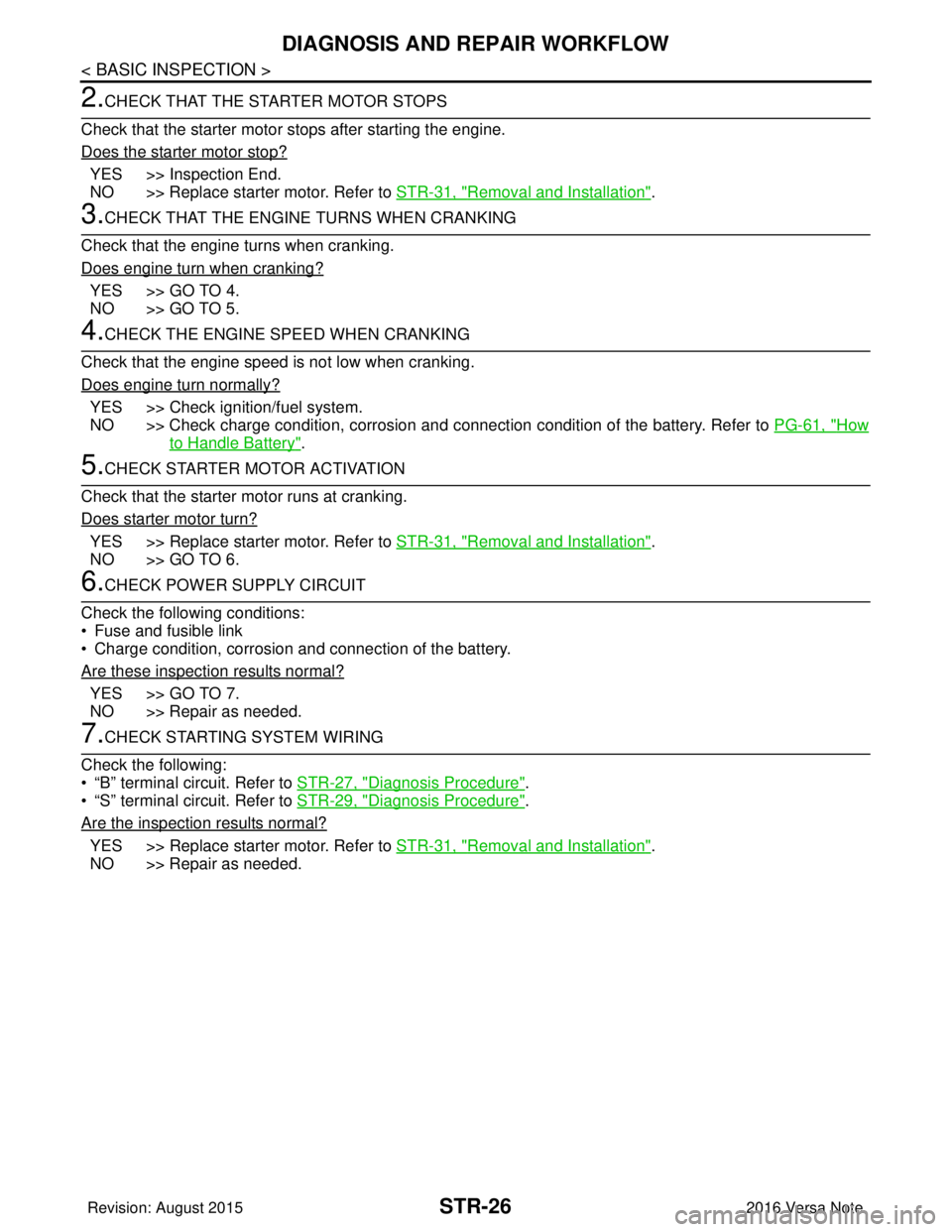
2.CHECK THAT THE STARTER MOTOR STOPS
Check that the starter motor stops after starting the engine.
Does the starter motor stop?
YES >> Inspection End.
NO >> Replace starter motor. Refer to STR-31, "
Removal and Installation".
3.CHECK THAT THE ENGINE TURNS WHEN CRANKING
Check that the engine turns when cranking.
Does engine turn when cranking?
YES >> GO TO 4.
NO >> GO TO 5.
4.CHECK THE ENGINE SPEED WHEN CRANKING
Check that the engine speed is not low when cranking.
Does engine turn normally?
YES >> Check ignition/fuel system.
NO >> Check charge condition, corrosion and connection condition of the battery. Refer to PG-61, "
How
to Handle Battery".
5.CHECK STARTER MOTOR ACTIVATION
Check that the starter motor runs at cranking.
Does starter motor turn?
YES >> Replace starter motor. Refer to STR-31, "Removal and Installation".
NO >> GO TO 6.
6.CHECK POWER SUPPLY CIRCUIT
Check the following conditions:
• Fuse and fusible link
• Charge condition, corrosion and connection of the battery.
Are these inspection results normal?
YES >> GO TO 7.
NO >> Repair as needed.
7.CHECK STARTING SYSTEM WIRING
Check the following:
• “B” terminal circuit. Refer to STR-27, "
Diagnosis Procedure".
• “S” terminal circuit. Refer to STR-29, "
Diagnosis Procedure".
Are the inspection results normal?
YES >> Replace starter motor. Refer to STR-31, "Removal and Installation".
NO >> Repair as needed.
Revision: August 2015 2016 Versa Note
cardiagn.com
Page 3179 of 3641
B TERMINAL CIRCUITSTR-27
< DTC/CIRCUIT DIAGNOSIS >
C
DE
F
G H
I
J
K L
M A
STR
NP
O
DTC/CIRCUIT DIAGNOSIS
B TERMINAL CIRCUIT
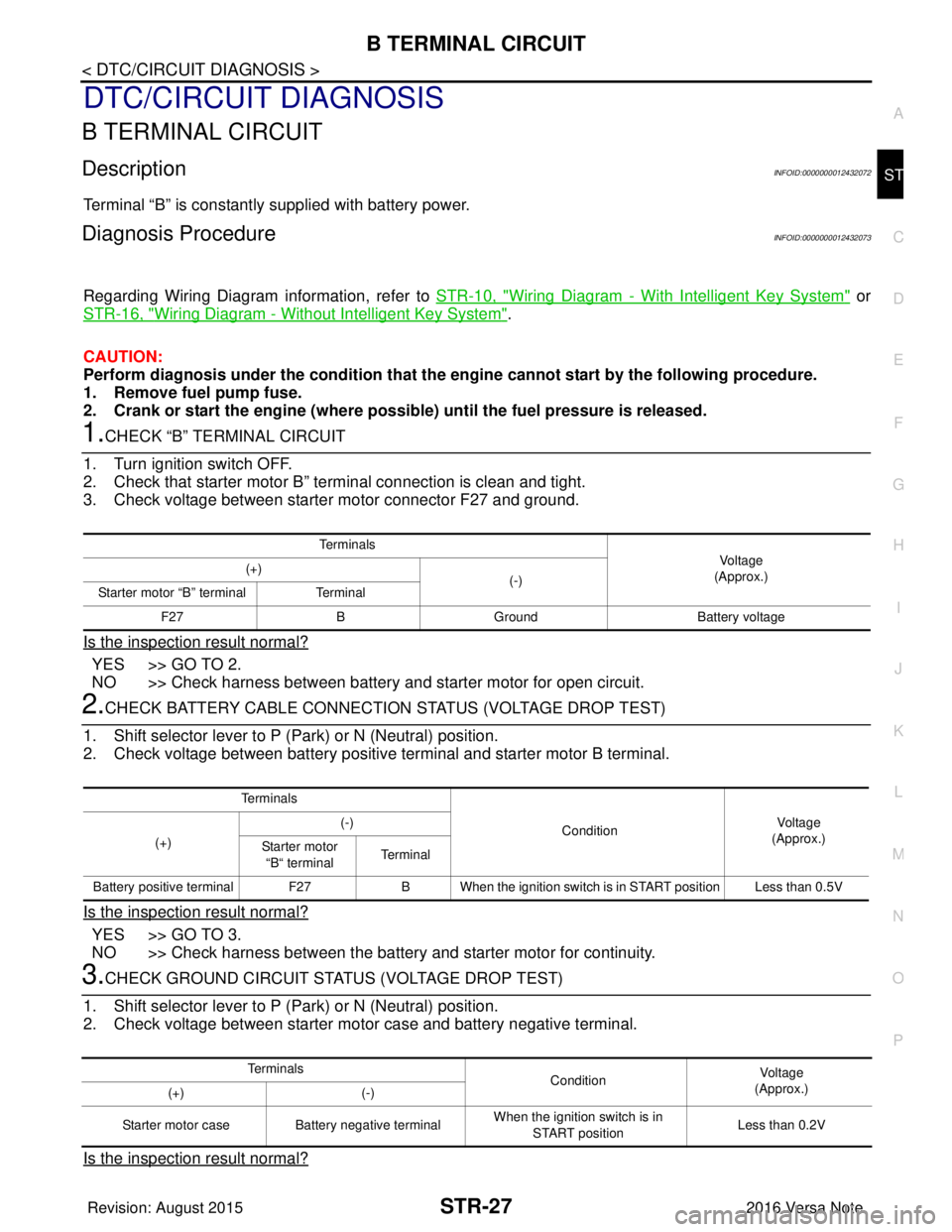
DescriptionINFOID:0000000012432072
Terminal “B” is constantly supplied with battery power.
Diagnosis ProcedureINFOID:0000000012432073
Regarding Wiring Diagram information, refer to
STR-10, "Wiring Diagram - With Intelligent Key System" or
STR-16, "
Wiring Diagram - Without Intelligent Key System".
CAUTION:
Perform diagnosis under the cond ition that the engine cannot start by the following procedure.
1. Remove fuel pump fuse.
2. Crank or start the engine (where possi ble) until the fuel pressure is released.
1.CHECK “B” TERMINAL CIRCUIT
1. Turn ignition switch OFF.
2. Check that starter motor B” terminal connection is clean and tight.
3. Check voltage between starter motor connector F27 and ground.
Is the inspection result normal?
YES >> GO TO 2.
NO >> Check harness between battery and starter motor for open circuit.
2.CHECK BATTERY CABLE CONNECTION STATUS (VOLTAGE DROP TEST)
1. Shift selector lever to P (P ark) or N (Neutral) position.
2. Check voltage between battery positive terminal and starter motor B terminal.
Is the inspection result normal?
YES >> GO TO 3.
NO >> Check harness between the battery and starter motor for continuity.
3.CHECK GROUND CIRCUIT STATUS (VOLTAGE DROP TEST)
1. Shift selector lever to P (P ark) or N (Neutral) position.
2. Check voltage between starter motor case and battery negative terminal.
Is the inspection result normal?
Te r m i n a l s
Voltage
(Approx.)
(+)
(-)
Starter motor “B” terminal Terminal
F27 BGround Battery voltage
Te r m i n a l s
ConditionVoltage
(Approx.)
(+) (-)
Starter motor “B“ terminal Terminal
Battery positive terminal F27 B When the ignition switch is in START position Less than 0.5V
Te r m i n a l s
ConditionVoltage
(Approx.)
(+) (-)
Starter motor case Battery negative terminal When the ignition switch is in
START position Less than 0.2V
Revision: August 2015
2016 Versa Note
cardiagn.com