2016 FORD C MAX ENERGI service
[x] Cancel search: servicePage 109 of 395

ActionMessage
Displays when a MyKey is in use and the MyKey speed limit isreached.Vehicle at Top Speed ofMyKey Setting
Displays when MyKey is active.Check Speed DriveSafely
Displays when a MyKey is in use and Belt-Minder is activated.Buckle Up to UnmuteAudio
Displays when a MyKey is in use and Traction control isactivated.Traction Control On -MyKey Setting
Displays when a MyKey is in use and park aid is activated.MyKey Park Aid Cannotbe Deactivated
Park Aid
ActionMessage
Displays when the system has detected a condition thatrequires service. Contact your authorized dealer. See Prin-ciple of Operation (page 170).
Check Park Aid
Displays the park aid status.Rear Park Aid On Off
Displays when the system has detected a condition thatrequires attention. See Principle of Operation (page 170).Check Rear Park Aid
Displays when the system has detected a condition thatrequires attention. See Principle of Operation (page 170).Check Front Park Aid
Displays when the system has detected a condition thatrequires service. Contact your authorized dealer. See Prin-ciple of Operation (page 170).
Park Aid Fault
Park Brake
ActionMessage
Displays when the parking brake is set, the engine is runningand the vehicle is driven more than 3 mph (5 km/h). If thewarning stays on after the parking brake is released, contactyour authorized dealer.
Park Brake Engaged
106
C-MAX (CCG) Canada/United States of America, enUSA, First Printing
Information Displays
Page 110 of 395

Power Steering
ActionMessage
The power steering system has detected a condition thatrequires service. See your authorized dealer.Steering Fault ServiceNow
The power steering system is not working. Stop the vehicle asafe place. Contact your authorized dealer.Steering Loss StopSafely
Remote Start
ActionMessage
Displayed when the remote start system is active.Remote Start Active
Tire Pressure Monitoring System
ActionMessage
Displays when one or more tires on your vehicle have low tirepressure. See Tire Pressure Monitoring System (page 270).Tire Pressure Low
Displays when the tire pressure monitoring system ismalfunctioning. If the warning stays on or continues to comeon, contact your authorized dealer. See Tire PressureMonitoring System (page 270).
Tire Pressure MonitorFault
Displayed when a tire pressure sensor is malfunctioning, oryour spare tire is in use. See Tire Pressure MonitoringSystem (page 270). If the warning stays on or continues tocome on, contact your authorized dealer as soon as possible.
Tire Pressure SensorFault
Transmission
ActionMessage
Displays as a reminder to shift into park.Transmission Not in Park
107
C-MAX (CCG) Canada/United States of America, enUSA, First Printing
Information Displays
Page 144 of 395

AnswerQuestion
Your vehicle's engine and transmission aredesigned to deliver the power you need atthe most efficient engine speed. This maybe higher than expected during heavyaccelerations, and may fluctuate whendriving at a steady speed. These are charac-teristics of the Atkinson engine cycle andthe transmission technology that helpmaximize your hybrid's fuel economy.
Why does my engine rev up so high some-times when I accelerate?
The fan noise comes from a fan locatednext to the high voltage battery pack. Thisfan turns on when the battery requirescooling air. The fan speed, and associatednoise level, will change according to theamount of cooling required to maintaingood performance. Maintaining the batterytemperature at optimal conditions alsoprolongs the useful life of the battery andhelps to achieve better fuel economy.
What is the fan noise I hear from the rearof my hybrid?
Change the engine oil every 10000 miles(16000 kilometers) or once per year undernormal operating conditions.
What is the engine oil change serviceinterval?
Your hybrid vehicle can use E15 (15%ethanol, 85% gasoline) fuel, but you maynotice slightly reduced fuel economybecause ethanol contains less energy pergallon than gasoline. Your hybrid vehicle isnot designed to use E85 (85% ethanol).
Can I put E15 or E85 in my vehicle, and howwill it affect my fuel economy?
The high voltage battery system is designedto last the life of the vehicle and requiresno maintenance.
How long will my high voltage battery last?Does it need maintenance?
There are no provisions for charging thehigh voltage battery from a power supplyexternal to the vehicle. (For C-MAX Energivehicles, the vehicle can be plugged into a110-volt outlet with charge cord provided.)
Can you charge the battery with a plug intoan A/C outlet?
Yes. Your hybrid vehicle can be flat towedwithout modification. See Towing (page190).
Can I tow the hybrid behind my motor homewith all four wheels down?
141
C-MAX (CCG) Canada/United States of America, enUSA, First Printing
Unique Driving Characteristics
Page 150 of 395
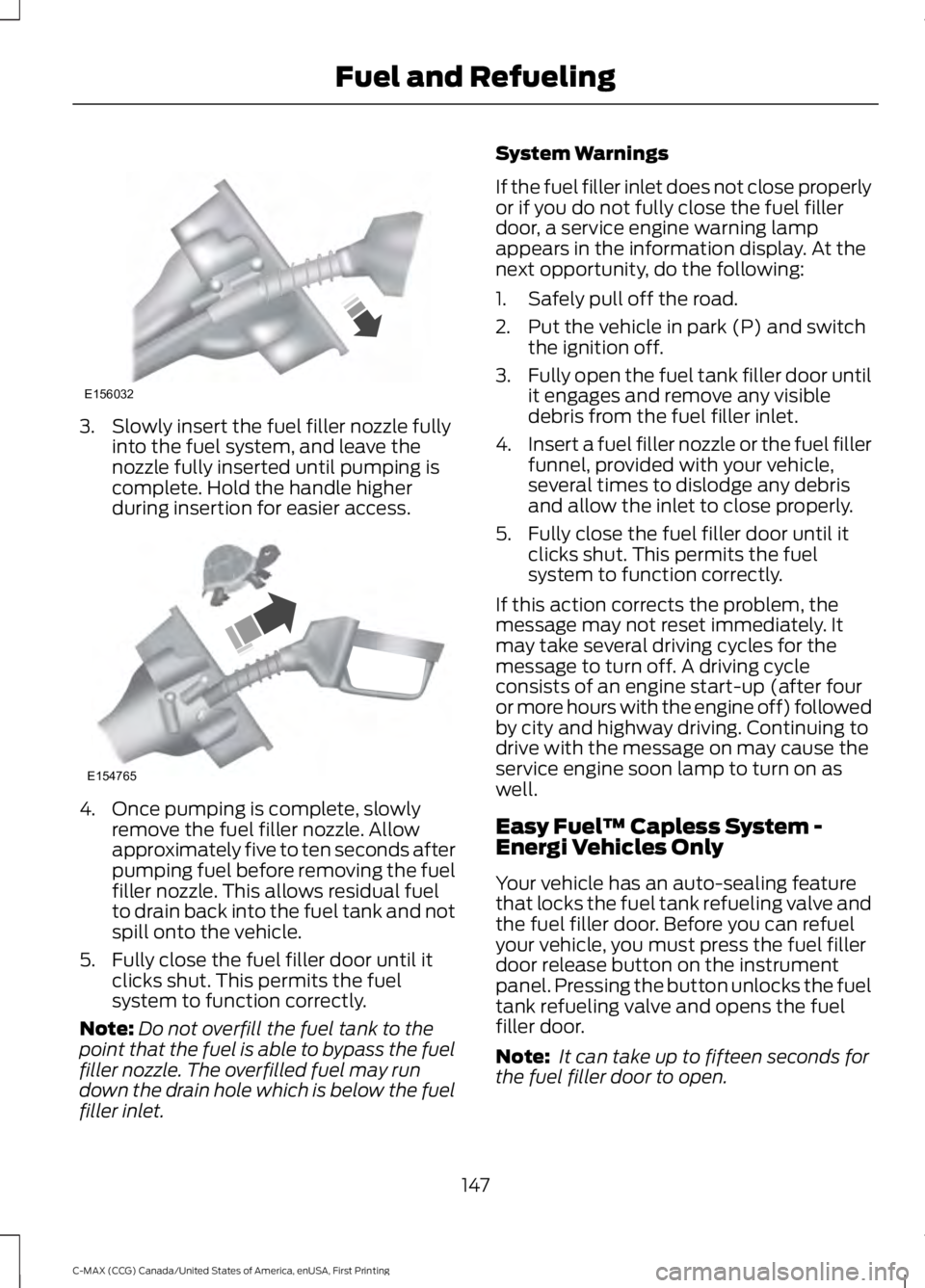
3. Slowly insert the fuel filler nozzle fullyinto the fuel system, and leave thenozzle fully inserted until pumping iscomplete. Hold the handle higherduring insertion for easier access.
4. Once pumping is complete, slowlyremove the fuel filler nozzle. Allowapproximately five to ten seconds afterpumping fuel before removing the fuelfiller nozzle. This allows residual fuelto drain back into the fuel tank and notspill onto the vehicle.
5. Fully close the fuel filler door until itclicks shut. This permits the fuelsystem to function correctly.
Note:Do not overfill the fuel tank to thepoint that the fuel is able to bypass the fuelfiller nozzle. The overfilled fuel may rundown the drain hole which is below the fuelfiller inlet.
System Warnings
If the fuel filler inlet does not close properlyor if you do not fully close the fuel fillerdoor, a service engine warning lampappears in the information display. At thenext opportunity, do the following:
1. Safely pull off the road.
2. Put the vehicle in park (P) and switchthe ignition off.
3.Fully open the fuel tank filler door untilit engages and remove any visibledebris from the fuel filler inlet.
4.Insert a fuel filler nozzle or the fuel fillerfunnel, provided with your vehicle,several times to dislodge any debrisand allow the inlet to close properly.
5. Fully close the fuel filler door until itclicks shut. This permits the fuelsystem to function correctly.
If this action corrects the problem, themessage may not reset immediately. Itmay take several driving cycles for themessage to turn off. A driving cycleconsists of an engine start-up (after fouror more hours with the engine off) followedby city and highway driving. Continuing todrive with the message on may cause theservice engine soon lamp to turn on aswell.
Easy Fuel™ Capless System -Energi Vehicles Only
Your vehicle has an auto-sealing featurethat locks the fuel tank refueling valve andthe fuel filler door. Before you can refuelyour vehicle, you must press the fuel fillerdoor release button on the instrumentpanel. Pressing the button unlocks the fueltank refueling valve and opens the fuelfiller door.
Note: It can take up to fifteen seconds forthe fuel filler door to open.
147
C-MAX (CCG) Canada/United States of America, enUSA, First Printing
Fuel and RefuelingE156032 E154765
Page 152 of 395

System Warnings
If the fuel filler inlet does not close properlyor if you do not fully close the fuel fillerdoor, a service engine warning lampappears in the information display. At thenext opportunity, do the following:
1. Safely pull off the road.
2. When your vehicle has stopped, shiftinto park (P) and switch the ignitionoff.
3.Press the refueling button on the centerconsole.
4.Fully open the fuel tank filler door untilit engages and remove any visibledebris from the fuel filler inlet.
5.Insert a fuel filler nozzle or the fuel fillerfunnel, provided with your vehicle,several times to dislodge any debrisand allow the inlet to close properly.
6. Fully close the fuel filler door until itclicks shut. This permits the fuelsystem to function correctly.
If this action corrects the problem, themessage may not reset immediately. Itmay take several driving cycles for themessage to turn off. A driving cycleconsists of an engine start-up (after fouror more hours with the engine off) followedby city and highway driving. Continuing todrive with the message on may cause theservice engine soon lamp to turn on aswell.
Using the Manual Fuel Filler DoorRelease Lever
The manual fuel filler door release lever isin the luggage compartment on the rightside behind a panel.
When using the manual fuel filler doorrelease lever to access the fuel filler inlet,do the following:
1. When your vehicle has stopped, shiftinto park (P) and switch the ignition on.
2. Remove the panel located in luggagecompartment on the right side.
3. Locate the manual fuel filler doorrelease lever.
4. Pull the manual fuel filler door releaselever.
149
C-MAX (CCG) Canada/United States of America, enUSA, First Printing
Fuel and RefuelingE162486 E154767 E162484
Page 154 of 395

WARNINGS
Exhaust leaks may result in entry ofharmful and potentially lethal fumesinto the passenger compartment. Ifyou smell exhaust fumes inside yourvehicle, have your dealer inspect yourvehicle immediately. Do not drive if yousmell exhaust fumes.
Your vehicle is equipped with variousemission control components and acatalytic converter that will enable yourvehicle to comply with applicable exhaustemission standards.
To make sure that the catalytic converterand other emission control componentscontinue to work properly:
•Use only the specified fuel listed.
•Avoid running out of fuel.
•Do not turn off the ignition while yourvehicle is moving, especially at highspeeds.
•Have the items listed in scheduledmaintenance information performedaccording to the specified schedule.
The scheduled maintenance items listedin scheduled maintenance information areessential to the life and performance ofyour vehicle and to its emissions system.
If you use anything other than Ford,Motorcraft or Ford-authorized parts formaintenance replacements or for serviceof components affecting emission control,such non-Ford parts should be equivalentto genuine Ford Motor Company parts inperformance and durability.
Illumination of the service engine soonindicator, charging system warning light orthe temperature warning light, fluid leaks,strange odors, smoke or loss of enginepower could indicate that the emissioncontrol system is not working properly.
An improperly operating or damagedexhaust system may allow exhaust toenter the vehicle. Have a damaged orimproperly operating exhaust systeminspected and repaired immediately.
Do not make any unauthorized changes toyour vehicle or engine. By law, vehicleowners and anyone who manufactures,repairs, services, sells, leases, tradesvehicles, or supervises a fleet of vehiclesare not permitted to intentionally removean emission control device or prevent itfrom working. Information about yourvehicle’s emission system is on the VehicleEmission Control Information Decallocated on or near the engine. This decalalso lists engine displacement.
Please consult your warranty informationfor complete details.
On-Board Diagnostics (OBD-II)
Your vehicle has a computer known as theon-board diagnostics system (OBD-II) thatmonitors the engine’s emission controlsystem. The system protects theenvironment by making sure that yourvehicle continues to meet governmentemission standards. The OBD-II systemalso assists a service technician in properlyservicing your vehicle.
When the service engine soonindicator illuminates, the OBD-IIsystem has detected amalfunction. Temporary malfunctions maycause the service engine soon indicator toilluminate. Examples are:
1. Your vehicle has run out of fuel—theengine may misfire or run poorly.
2. Poor fuel quality or water in thefuel—the engine may misfire or runpoorly.
3. The fuel fill inlet may not have closedproperly. See Refueling (page 146).
151
C-MAX (CCG) Canada/United States of America, enUSA, First Printing
Fuel and Refueling
Page 155 of 395

4. Driving through deep water—theelectrical system may be wet.
You can correct these temporarymalfunctions by filling the fuel tank withgood quality fuel, properly closing the fuelfill inlet or letting the electrical system dryout. After three driving cycles without theseor any other temporary malfunctionspresent, the service engine soon indicatorshould stay off the next time you start theengine. A driving cycle consists of a coldengine startup followed by mixed city andhighway driving. No additional vehicleservice is required.
If the service engine soon indicator remainson, have your vehicle serviced at the firstavailable opportunity. Although somemalfunctions detected by the OBD-II maynot have symptoms that are apparent,continued driving with the service enginesoon indicator on can result in increasedemissions, lower fuel economy, reducedengine and transmission smoothness andlead to more costly repairs.
Readiness for Inspection andMaintenance (I/M) Testing
Some state and provincial and localgovernments may haveInspection/Maintenance (I/M) programsto inspect the emission control equipmenton your vehicle. Failure to pass thisinspection could prevent you from gettinga vehicle registration.
If the service engine soonindicator is on or the bulb doesnot work, your vehicle may needservice. See On-Board Diagnostics.
Your vehicle may not pass the I/M test ifthe service engine soon indicator is on ornot working properly (bulb is burned out),or if the OBD-II system has determinedthat some of the emission control systemshave not been properly checked. In thiscase, the vehicle is not ready for I/Mtesting.
If the vehicle’s engine or transmission hasjust been serviced, or the battery hasrecently run down or been replaced, theOBD-II system may indicate that thevehicle is not ready for I/M testing. Todetermine if the vehicle is ready for I/Mtesting, turn the ignition key to the onposition for 15 seconds without crankingthe engine. If the service engine soonindicator blinks eight times, it means thatthe vehicle is not ready for I/M testing; ifthe service engine soon indicator stays onsolid, it means that your vehicle is readyfor I/M testing.
The OBD-II system checks the emissioncontrol system during normal driving. Acomplete check may take several days.
If the vehicle is not ready for I/M testing,you can perform the following driving cycleconsisting of mixed city and highwaydriving:
1. 15 minutes of steady driving on anexpressway or highway followed by 20minutes of stop-and-go driving with atleast four 30-second idle periods.
2. Allow your vehicle to sit for at leasteight hours with the ignition off. Then,start the vehicle and complete theabove driving cycle. The vehicle mustwarm up to its normal operatingtemperature. Once started, do not turnoff the vehicle until the above drivingcycle is complete.
If the vehicle is still not ready for I/Mtesting, you need to repeat the abovedriving cycle.
152
C-MAX (CCG) Canada/United States of America, enUSA, First Printing
Fuel and Refueling
Page 156 of 395

GENERAL INFORMATION
WARNING
Have the battery pack serviced onlyby an authorized electric vehicletechnician. Improper handling canresult in personal injury or death.
Note:The high-voltage battery does notrequire regular service maintenance.
Your vehicle consists of varioushigh-voltage components and wiring. Allof the high-voltage power flows throughspecific wiring assemblies labeled as suchor covered with a solid orange convolute,orange striped tape or both. Do not comein contact with these components.
The high-voltage battery system is ahigh-voltage, lithium-ion battery system.The pack is located in the rear cargo area.The high-voltage battery system uses anair cooled system to regulate thehigh-voltage battery temperature and helpmaximize high-voltage battery life.
Note:The high-voltage battery is equippedwith air vents in the package tray that helpto regulate its temperature. It is importantto keep these openings free of obstructions.Do not block the flow of cabin air to thisarea.
HIGH-VOLTAGE SERVICEDISCONNECT
The high-voltage service disconnect turnsoff power from the high-voltage battery.
Note:There is a disconnect circuit in yourvehicle. Disconnecting the circuit willautomatically disable the high-voltagebattery.
To disable the battery and stop allhigh-voltage electric activity in the vehicleyou can access high-voltage disconnectcircuit. To do this, you must unplug thecircuit from the circuit port connected tothe battery.
153
C-MAX (CCG) Canada/United States of America, enUSA, First Printing
High Voltage BatteryE163462