2016 Citroen C4 PICASSO light
[x] Cancel search: lightPage 221 of 527

219
C4-Picasso-II_en_Chap05_eclairage-visibilite_ed01-2016
Rear wiper
Park.
If
a
significant
accumulation
of
snow
or
i
ce is present, deactivate the automatic
rear
wiper. Intermittent
wipe.
Wash-wipe
(set duration).
Rear
wiper selection ring:
Reverse gear
When reverse gear is engaged, the rear wiper w
ill come into operation if the windscreen
wipers
are operating.
This function can be deactivated in the Driving
menu.
Select the " Settings" tab, then " Driving aids"
and " Rear wiper in reverse ".
5
Lighting and visibility
Page 222 of 527
220
C4-Picasso-II_en_Chap05_eclairage-visibilite_ed01-2016
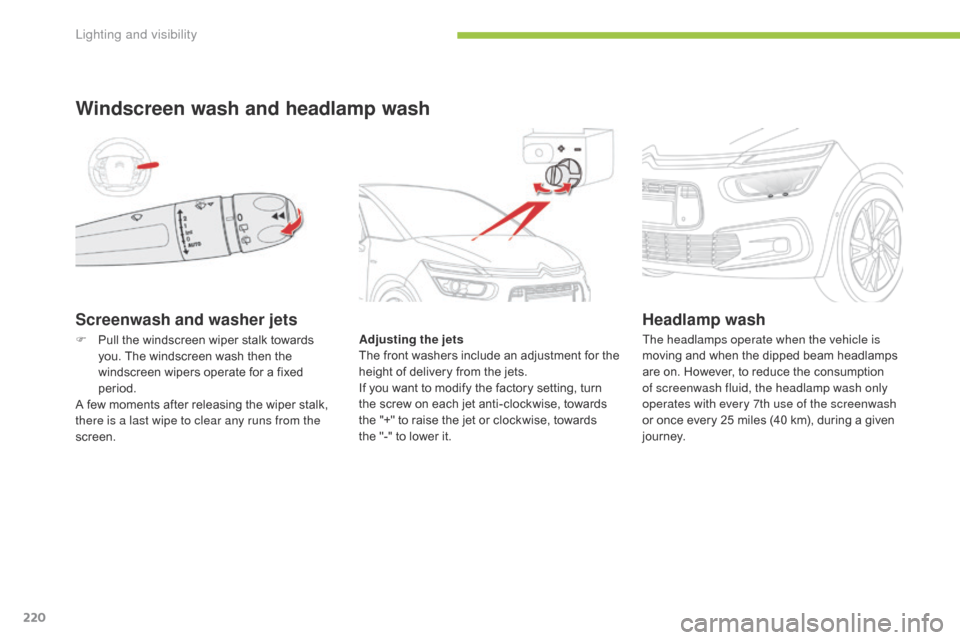
Screenwash and washer jets
Windscreen wash and headlamp wash
Adjusting the jets
The f ront w ashers i nclude a n a djustment f or t he
h
eight of delivery from the jets.
If
you want to modify the factory setting, turn
t
he screw on each jet anti-clockwise, towards
t
he "+" to raise the jet or clockwise, towards
t
he "-" to lower it.
Headlamp wash
F Pull the windscreen wiper stalk towards y
ou. The windscreen wash then the
w
indscreen wipers operate for a fixed
p
eriod.
A
few moments after releasing the wiper stalk,
t
here is a last wipe to clear any runs from the
screen. The headlamps operate when the vehicle is
moving
and when the dipped beam headlamps
a
re on. However, to reduce the consumption
o
f screenwash fluid, the headlamp wash only
operates with every 7th use of the screenwash
or
once every 25 miles (40 km), during a given
j
o u r n ey.
Lighting and visibility
Page 223 of 527

221
C4-Picasso-II_en_Chap05_eclairage-visibilite_ed01-2016
Do not cover the rain sensor, linked with the sunshine sensor and located in the
centre of the windscreen behind the rear
view
mirror.
Switch off the automatic rain sensitive
wipers
when using an automatic car wash.
In winter, it is advisable to wait until the
windscreen is completely clear of ice
before
activating the automatic rain
sen
sitive
w
ipers.
Operating fault
If a fault occurs with the automatic rain
sensitive wipers, the wipers will operate in
intermittent mode.
Have
it checked by CITROËN dealer or a
q
ualified
w
orkshop.
The windscreen wipers operate automatically, without any action on the part of the driver, if rain is
detected
(sensor
behind
the
rear
view
mirror),
adapting
their
speed
to
the
intensity
of
the
rainfall.
Switching on Switching off
The automatic rain sensitive windscreen
wipers
must be reactivated by pushing
t
he control stalk downwards, if the
i
gnition has been off for more than
o
ne minute.
Briefly
push
the
control
stalk
d
ownwards.
A
wiping
cycle
confirms
that
the
i
nstruction
has
been
accepted.
This
warning
lamp
comes
on
in
the
i
nstrument
panel
and
a
message
is
d
isplayed. Briefly
push the control stalk
d
ownwards again, or place
t
he control stalk in another
p
osition (Int, 1 or 2).
Automatic rain sensitive windscreen wipers
This warning lamp goes off in the instrument p
anel and a message is displayed.
5
Lighting and visibility
Page 224 of 527

222
C4-Picasso-II_en_Chap05_eclairage-visibilite_ed01-2016
Special position of the windscreen wipers
To maintain the effectiveness of the
"flat-blade" type of wiper blades, it is
advisable
t
o:
-
h
andle them with care,
-
c
lean them regularly using soapy
w
ater,
-
a
void using them to retain
c
ardboard on the windscreen,
-
r
eplace them at the first signs of
w
e a r.
This position permits release of the windscreen
wiper
blades.
It
is
used
for
cleaning
or
replacement
of
the
w
iper
blades.
It
can
also
be
useful,
in
winter,
to
d
etach
the
wiper
blades
from
the
windscreen.
On
switching
off
the
ignition:
F
a
ny
action
on
the
wiper
stalk
in
the
minute
a
fter
switching
off
the
ignition
places
the
w
iper
blades
vertically
on
the
screen.
When
the
system
is
no
longer
powered
-
at
l
east
one
minute
after
switching
off
the
i
gnition -
it
is
possible
to
move
the
arms
m
anually.
F
T
o
park
the
blades
again,
switch
on
the
i
gnition
and
operate
the
wiper
stalk. Replacement of the arms must only
be done by a CITROËN dealer or a
qualified
w
orkshop.
Lighting and visibility
Page 225 of 527
223
C4-Picasso-II_en_Chap05_eclairage-visibilite_ed01-2016
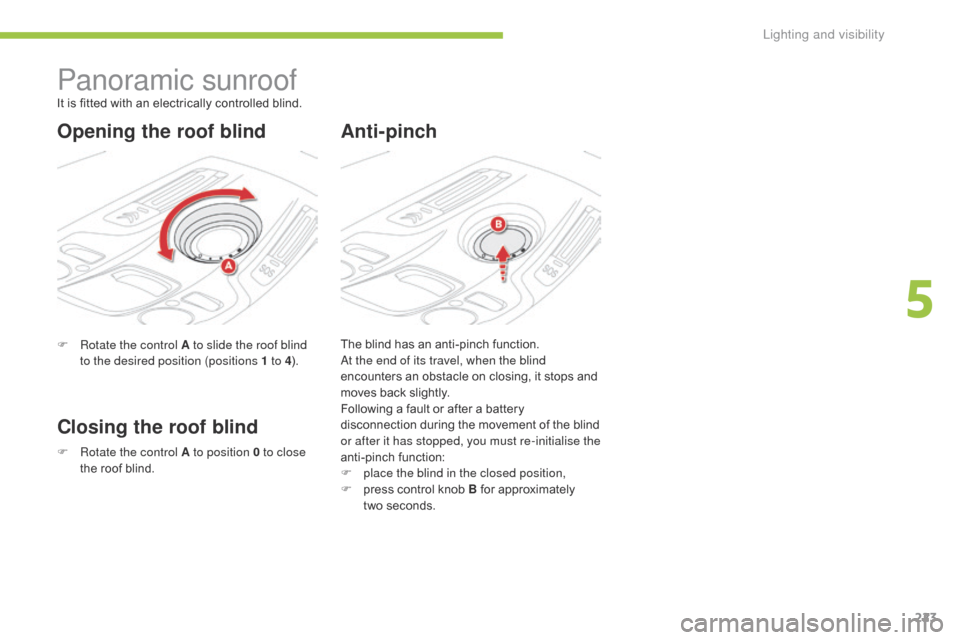
Panoramic sunroof
F Rotate the control A to slide the roof blind to the desired position (positions 1 to 4 ).
Closing the roof blindAnti-pinch
It is fitted with an electrically controlled blind.
Opening the roof blind
F Rotate the control A to position 0 to close
the roof blind. The
blind has an anti-pinch function.
At the end of its travel, when the blind
encounters an obstacle on closing, it stops and
m
oves back slightly.
Following a fault or after a battery
d
isconnection during the movement of the blind o
r after it has stopped, you must re-initialise the
anti-pinch f unction:
F
p
lace the blind in the closed position,
F
p
ress control knob B for approximately
t
wo seconds.
5
Lighting and visibility
Page 228 of 527

226
C4-Picasso-II_en_Chap06_securite_ed01-2016
Intelligent traction control
system ("Snow motion")
When this warning lamp comes on, coupled with the STOP and ABS warning
l
amps, accompanied by an audible signal
a
nd a message, it indicates that there
i
s a fault with the electronic brake force
di
stribution
(
EBFD).
Anti-lock braking system (ABS) and electronic brake force
distribution (EBFD)
The fixed illumination of this warning lamp indicates that there is a fault
with
the ABS. Depending
on version, your vehicle has a s
ystem to help driving on snow: intelligent
traction control.
This system detects situations of difficult
sur face
adhesion that could make it difficult to
m
ove off or make progress on deep fresh snow
o
r compacted snow.
In these situations, the intelligent traction
control limits the amount of wheel slip to
provide
the best traction and trajectory control
f
or your vehicle.
The
use of snow tyres is strongly
r
ecommended on sur faces offering low levels
o
f adhesion.
When
changing wheels (tyres and
r
ims), ensure that these are approved
for
your vehicle.
Normal
operation of the ABS may make
i
tself felt by slight vibrations of the brake
ped
al.
In emergency braking, press ver y
firmly and maintain this pressure.
You must stop as soon as it is safe to do so.
In
both
cases, have the system checked by a
C
ITROËN dealer or a qualified workshop as
s
oon
as
possible.
The
vehicle retains conventional braking. Drive
c
arefully
at moderate speed.
Safety
Page 234 of 527

232
C4-Picasso-II_en_Chap06_securite_ed01-2016
The driver must ensure that passengers use the seat belts correctly and that they are all
fastened
before setting off.
Wherever you are seated in the vehicle,
always fasten your seat belt, even for short
journeys.
Do
not interchange the seat belt buckles as
t
hey will not fulfill their role fully.
The seat belts are fitted with an inertia reel
permitting
automatic adjustment of the
l
ength of the strap to your size. The seat belt
i
s stowed automatically when not in use.
Before and after use, ensure that the seat
belt
is reeled in correctly.
The lower part of the strap must be
positioned
as low as possible on the pelvis.
The upper part must be positioned in the
hollow
of the shoulder.
The inertia reels are fitted with an automatic
locking
device which comes into operation in
t
he event of a collision, emergency braking
o
r if the vehicle rolls over. You can release
t
he device by pulling the strap firmly and
t
hen releasing it so that it reels in slightly.Recommendations for children
Use a suitable child seat if the passenger is less than 12 years old or shorter than one
and
a half metres.
Never use the same seat belt to secure more
than
one person.
Never
allow a child to travel on your lap.
For more information on Child seats , refer
to
the corresponding section.
In
order
to
be
effective,
a
seat
belt
must:
-
b
e
tightened
as
close
to
the
body
as
p
ossible,
-
b
e pulled in front of you with a smooth
movement,
checking
that
it
does
not
t
wist,
-
b
e used to restrain only one person,
-
n
ot
bear
any
trace
of
cuts
or
fraying,
-
n
ot be converted or modified to avoid
affecting
it
s
p
erformance.
In the event of an impact
Depending on the nature and
seriousness of the impact , the
pretensioning
device may be deployed
b
efore and independently of the airbags.
D
eployment of the pretensioners is
accompanied
by a slight discharge of
h
armless smoke and a noise, due to the
a
ctivation of the pyrotechnic cartridge
i
ncorporated in the system.
In
all cases, the airbag warning lamp comes
o
n.
Following
an impact, have the seat belts
s
ystem checked, and if necessary replaced,
b
y a CITROËN dealer or a qualified
workshop.
In accordance with current safety
regulations,
for
all
repairs
on
your
vehicle's
s
eat
belts,
go
to
a
qualified
workshop
with
t
he
skills
and
equipment
needed,
which
a
C
ITROËN
dealer
is
able
to
provide.
Have
your
seat
belts
checked
regularly
by
a
CITROËN
dealer
or
a
qualified
workshop,
p
articularly
if
the
straps
show
signs
of
d
amage.
Clean the seat belt straps with soapy
water
or
a
textile
cleaning
product,
sold
by
C
ITROËN
dealers.
After
folding
or
moving
a
seat
or
rear
bench
s
eat, ensure that the seat belt is positioned
and
reeled
in
correctly.
Advice
Safety
Page 235 of 527
233
C4-Picasso-II_en_Chap06_securite_ed01-2016
Airbags
System designed to contribute towards improving the safety of the occupants (with
t
he exception of the rear centre passenger)
i
n the event of violent collisions. The airbags
s
upplement the action of the force-limiting
s
eat belts (with the exception of the rear centre
p
assenger).
If a collision occurs, the electronic detectors
record and analyse the front and side impacts
sustained
in the impact detection zones:
-
i
n the case of a serious impact, the airbags
a
re deployed instantly and contribute
towards better protection of the occupants
of
the vehicle (with the exception of the
r
ear centre passenger); immediately after
t
he impact, the airbags deflate rapidly so
t
hat they do not hinder visibility or the exit
o
f the occupants,
-
i
n the case of a minor or rear impact or in
certain
roll-over conditions, the airbags
m
ay not be deployed; the seat belt
a
lone contributes towards ensuring your
p
rotection in these situations.
The airbags do not operate when the
ignition is switched off.
This
equipment will only deploy once.
I
f a second impact occurs (during the
s
ame or a subsequent accident), the
airbag
will not be deployed again. Deployment of one or more of the
airbags
is accompanied by a slight
e
mission of smoke and a noise, due
t
o the activation of the pyrotechnic
cartridge
incorporated in the system.
This
smoke is not harmful, but sensitive
i
ndividuals may experience slight
ir
ritation.
The noise of detonation related to the
deployment
of one or more airbags may
r
esult in a slight loss of hearing for a
s
hort time.
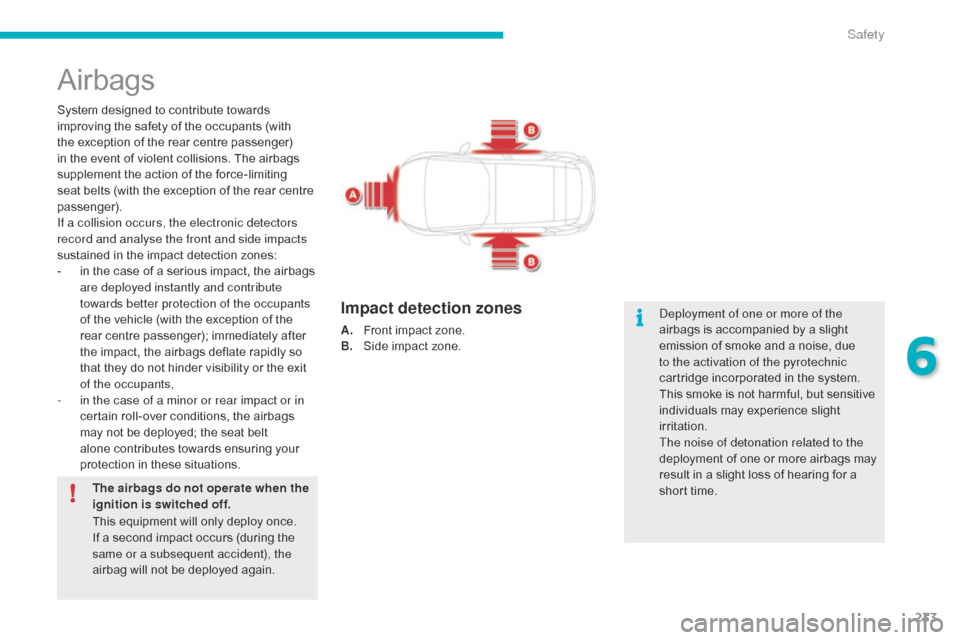
Impact detection zones
A. Front impact zone.
B. S ide impact zone.
6
Safety