2016 AUDI RS7 SPORTBACK ignition
[x] Cancel search: ignitionPage 170 of 282

Child safety
seating position on the rear seat and have
the airbag system inspected by your author
ized Audi dealer.
- Take the child restraint off the front passen
ger seat and install it properly at one of the
rear seat positions if the
P A SSEN GER AIR
BAG OFF
light does not stay on whenever
the ignition is switched on.
Booster seats and safety belts
Properly used booster sea ts can help protect
children weighing between about 40 lbs . and 80
lbs . (18 kg and 36 kg) who are less than
4 ft. 9
in . (57 inches/1.45 meters) tall .
Fig . 1 68 Rea r seat : chi ld proper ly restrain ed in a booster
seat
The vehicle's safety belts alone will not fit most
chi ldren until they are at least 4 ft. 9 in . (57 in
ches/1.45 meters) tall and weigh about 80 lbs.
(36 kg). Booster seats raise these chi ldren up so
that the safety belt will pass properly over the
stronge r parts of their bodies and the safety belt
can help protect them in a crash.
• Do no t use the conve rtible locking retractor
whe n using the vehicle's safety belt to restrain
a chi ld on a booster seat.
• The shoulder be lt must lie as close to the cen
ter of the child's collar bone as possible and
must lie flat and snug on the upper body. It
must never lie across the throat or neck. The
lap belt must lie across the pelv is and never
across the stomach or abdomen . Make sure the
belt lies flat and snug. Pull on the belt to tight
en if necessa ry .
• If you must transpo rt an older chi ld in a boos
ter seat on the front passenger seat , you can
168
use the safety belt height adjustment to help
adjust the shoulder portion properly.
• Secure unused safety belts on the rear seat
c::, page 164.
Children up to at least 8 years o ld (over 40 lbs or
18 kg) are best protected in child safety seats de
signed for their age and weight. Experts say that
the skeletal structure, part icularly the pelvis, of
these children is not fully developed, and they
must not use the vehicle safety belts without a
su itable child restraint .
It is usually best to put these children in appro
priate booster seats . Be sure the booster seat
meets all applicable safety sta ndards .
Booster seats raise the seating position of the
ch ild and reposition both the lap and shoulder
parts of the safety belt so that they pass across
the child's body in the right places. The routing of
the be lt over the ch ild's body is very important
fo r the ch ild's protect ion, whet her or not a boos
te r seat is used. C hildren age 12 a nd under m ust
always ride in the re ar seat.
Children who a re at least 4 ft. 9 in . (5 7 inches/
1.45 meters) tal l can generally use t he vehicle's
th ree poin t lap a nd shoulder belts . Never use the
l ap belt portion of the veh icle's safety bel t alone
to restrain any chi ld, regard less o f how big the
ch ild is. Always remember that children do not
have the pronounced pelvic structure required for
the proper function of lap be lt portion of the ve
hicle's three point lap and shoulder belts. The
c hi ld's safety absolutely requ ires that a lap belt
portion of the safety belt be fastened snugly and
as low as possib le around the pe lvis . Never le t
the lap belt po rtion of the safety be lt pass ove r
the child's stomach or abdomen.
In a crash, airbags must inflate w ithi n a blink of
an eye and with considerab le force. In order to do
i ts job, the airbag needs room to inflate so that i t
will be there to protect the occup ant as the occ u
pan t moves forw ard in to the airbag.
A vehicle occupan t who is out of pos it ion and too
cl ose to the a irbag gets in the way of an inflating
airbag. When an occupant is too close, he or she
will be struck vio lent ly and w ill rece ive serio us or
possib ly even fatal injury.
II>
Page 171 of 282

In o rder for the airbag to offer protection, it is
important that all vehicle occupants, especia lly
any children, who must be in the front seat be
cause of exceptional circumstances, be properly restrained and as far away from the airbag as
possible . By keeping room between the child's
body and the front of the passenger compart
ment, the airbag can inflate comp letely and pro
vide supp lemental protect ion in certain frontal
coll is ions.
A WARNING
Not using a booster seat, using the booster
seat improperly, incorrectly insta lling a boos
ter seat or using the vehicle safety belt im
properly increases the risk of serious personal
injury and death in a collision or other emer
gency situat ion. To help reduce the risk of se
r ious personal injury and/or death:
- The shoulder belt must lie as close to the
center of the child's collar bone as possible
and must lie flat and snug on the upper
body .
It must neve r lie across the throat or
neck. The lap belt must lie across the pelv is
and never across the stomac h or abdomen.
Make sure tha t the belt lies fla t and sn ug.
Pull on the belt to tighten if necessary.
- Failure to p roperly route safety belts over a
child 's body will cause severe injuries in an
accident or other emergency situation
¢ page 127.
-The rear side of the child sa fety seat should
be pos itioned as close as possible to the
backrest on the vehicle seat .
- For adjustable head restraints: adjust or re
move the rear seat head restraint if it is dif
ficult to install the child seat with the head
restra int in place ¢
page 56. Install the
head restraint again immediately once the
child seat is removed. Driving w ithout head
restra ints or w ith head restraints that are
not properly adjusted increases the risk of
serious o r fa ta l neck injury d ramatically.
- Children on the front seat of any car, even
with Advanced Ai rbags, can be se riously in
jured or even killed when a n ai rbag inflates.
- Never let a child stand or knee l on any seat,
for example the front seat.
-
Ch ild safety
-Never let a chi ld ride in the cargo area of
your veh icle.
- Always remember that a chi ld leaning for
ward, sitting sideways or out of position in any way du ring an accident can be struck by
a dep loying airbag. Th is w ill result in serious
personal injury or death .
- If you must install a booster seat on the
front passenger seat because of exceptiona l
circumstances the
PASSENGE R AIR BAG
OFF
li ght must come on and stay on, when
eve r the ignit ion is switched on.
- If the PASSENGER AIR BAG OFF light does
not come on and stay on, perfo rm the
checks desc ribed ¢
page 146, Monitoring
the Advanced Airbag System.
- Take the child restra int off the front passen
ge r seat an d install it prope rly at one of the
rear seat positions if the
PASSENGER AIR
BAG OFF
light does not stay on whenever
the ignition is switched on .
- Always read and heed all WARNINGS when
ever using a chi ld restrained in a vehicle is
be ing used
¢ page 12 7, Safety belts,
¢ page 135, Airbag system and
¢ page 159, Important information.
Securing child seats
Securing a child safety seat using a safety
belt
Safety belts for the rear seats and the front pas
senger can be locked with the convertible locking
retractor to properly secure child safety seats .
The safety belts emergen cy loc king retractors for
the rear seats safety be lts and fo r th e front pas
senger's sea t sa fe ty be lt have a conve rtible lock
ing retractor for child restraints . The safety be lt
must be locked so that be lt webbing cannot un
ree l. The retractor can be activated to lock the
safety belt and prevent the safety belt webbing
from loosening up dur ing norma l driving. A ch ild
safety seat can on ly be properly installed when
the safety belt is locked so that the ch ild and
child safety seat will stay in place.
Always remember : Even though your veh icle is
equipped with an Advanced Airbag system, all
169
Page 172 of 282

Child safety
children, especially those 12 years and younger,
should always ride in the back seat properly re
strained for their age and size.
.&_ WARNING
-
Improperly installed child safety seats in
crease the risk of serious personal injury and
death in a collision.
- Always make sure that the safety belt re
tractor is locked when installing a child
safety seat . An unlocked safety belt retrac
tor cannot hold the child safety seat in place during normal driving or in a crash.
-Always buckle the child safety seat firmly in
place even if a child is not sitting in it . A
loose child safety seat can fly around during
a sudden stop or in a collision.
- If the rear set backrest is not securely latch
ed, the child and the child restraint will be
thrown forward together with the backrest and will strike parts of the vehicle interior.
The child can be seriously injured or killed.
- Never install rear-facing child safety seats
or infant carriers on the front passenger
seat. A child will be seriously injured and
can be killed when the passenger airbag in
flates.
- The inflating airbag will hit the child safety
seat or infant carrier with great force and
will smash the child safety seat and child against the backrest, center armrest, door
or roof .
- Always install rear-facing child safety seats
or infant carriers on the rear seat.
- Forward-facing child safety seats or infant
carriers installed on the front passenger's
seat may interfere with the deployment of
the airbag and cause serious injury to the child.
- It is safer to install a forward-facing child
safety seat on the rear seat .
- Always read and heed all WARNINGS when
ever using a child restrained in a vehicle is
being used~
page 159. Special precautions
apply when installing a child safety seat on
the front passenger seat~
page 136, Child
restraints on the front seat -some impor
tant things to know.
170
.&_ WARNING , .
Always take special precautions if you must
install a forward or rearward-facing child re
straint on the front passenger's seat in excep
tional situations:
- Whenever a forward or rearward-facing child restraint is installed on the front pas
senger seat, the
PASSENGER AIR BAG OFF
light must come on and stay on whenever
the ignition is switched on.
- If the PASSENGER AIR BAG OFF light does
not come on and stay on, perform the
checks described
~ page 146, Monitoring
the Advanced Airbag System.
- Take the child restraint off the front passen
ger seat and install it properly at one of the
rear seat positions if the
PASSENGER AIR
BAG OFF
light does not stay on whenever
the ignition is switched on.
- Improper installation of child restraints can
reduce their effectiveness or even prevent
them from providing any protection.
- An improperly installed child restraint can
interfere with the airbag as it deploys and
seriously injure or even kill the child.
- Always carefully follow the manufacturer's
instructions provided with the child safety
seat or carrier .
- After checking to make sure that the child
restraint is properly installed, make certain
that the child restraint is correctly recog nized by the capacitive passenger detection
system in the front passenger seat and that
the
PASSENGER AIR BAG OFF light signals
the correct front passenger frontal airbag
status.
.&_ WARNING
Forward-facing child restraints:
- Always make sure the forward-facing seat
has been designed and certified by its man
ufacturer for use on a front seat with a pas
senger front and side airbag.
- Never put the forward-facing child restraint
up, against or very near the instrument pan-
-
el. .... ....._ ______________ _J~
Page 173 of 282

-Always move the passenger seat into its
rearmost position in the seat's fore and aft
adjustment range, as far away from the air
bag as possible before installing the for
ward-facing child restra int. The backrest
must be adjusted to an upright posit ion.
- Make sure that the
PA SSEN GER AIR BAG
OFF
light comes on and stays on all the time
whenever the ignition is switched on.
A WARNING
Rearwa rd-facing child restra ints:
- A ch ild in a rearward-facing child safety seat
installed on the front passenger seat wi ll be
seriously injured and can be killed if the
front airbag inflates - even with an Ad
vanced Airbag System .
- The inflating a irbag w ill hit the child safety
seat or infant carrier with great force and
will smash the chi ld safety seat and chi ld
against the backrest, center armrest, door
or roof.
- Always be especially careful if you must in
stall a rearward facing child safety seat on
the front passenger seat in exceptional c ir
cumstances.
- Make sure that the
PAS SENGER AIR BA G
OFF
light comes on and stays on all the time
whenever the ignition is switched on.
- If the
PASSENGER AIR BAG OFF light does
not come on and stay on, immediately in
stall the rear-facing ch ild safety seat in a
rear seat ing pos ition and have the airbag
system inspected by your Aud i dealer .
Activating the convertible locking retractor
Use the convertible locking retractor to secure a
child restraint.
Always heed the child safety seat manufacturer's
instructions when installing a child restraint in
your vehicle. To act ivate the convertible locking
retractor:
.. Place the child restraint on a seat, preferab ly
on the rear seat.
.. Slowly pull the belt all the way out .
Child safety
.. Route it around or through the child restraint
be lt path ¢
A.
.. Push the ch ild safety seat down with your full
weight to get the safety belt really tight.
.. Insert the belt tongue into the buckle for that
seating position .
.. Guide the safety belt back into the retractor un
til the belt lies flat and snug on the child safety
seat .
.. You shou ld hear a "cl icking" noise as the belt
winds back into the inertia reel. Test the con
vertible locking retractor by pulling on the belt.
You shou ld no longer be able to pull the belt
out of the retractor. The convertib le locking re
tractor is now activated.
.. Make sure that the red release button is facing
away from the child restraint so that it can be
unbuckled quickly .
.. Pull on the belt to make sure the safety belt is
properly t ight and fastened so that the seat
canno t move fo rwa rd or s ideways mo re than
one inch (2.S cm).
A WARNING .......... -
Using the wrong ch ild restraint or an improp
erly installed child restraint can cause serious
personal injury or death in a crash.
- Always make sure that the safety belt re-
tractor is locked when installing a child
safety seat. An unlocked safety be lt retrac
tor cannot hold the ch ild safety seat in place
during normal driving or in a crash .
- Always buckle the child safety seat firmly in
place even if a ch ild is not sitt ing in it. A
loose child safety seat can fly around dur ing
a sudden stop or in a crash .
- Always make sure the seat backrest to which
the child restraint is installed is in an up
right position and securely latched into
place and cannot fo ld forward. Othe rw ise,
the seatback with the child safety seat at
tached to it could fly forward in the event of
an accident or other emergency situation.
- Always read and heed all WARNINGS when
ever using a child restrained in a vehicle is
being used ¢
page 159. Special precautions
apply when instal ling a child safety seat on
the front passenger seat
¢page 136, Child II>
171
Page 192 of 282

Driving and th e en vironm ent
- Do not drive until the fuel tank becomes
complete ly empty . The engine cou ld mis
fire . Unburned fuel could also get into the
exhaust system and this cou ld cause the
catalytic converter to overheat.
- Do not sw itch off the ignition while the vehi
cle is moving.
- Do not continue to operate your vehicle un
der these cond itions, as otherwise fuel can
reach the catalytic converter. This could re
sult in overheating of the converter, requ ir
i ng its replacement.
- To assure efficient operation of the Emis
sion Control System :
- Have your veh icle maintained properly and
in accordance with the service recommen
dations in your Warranty
& Maintenance
book let.
- Lack of proper maintenance as well as im
proper use of the vehicle will impair the
function of the emission control system and could lead to damage.
@ For the sake of the environment
Even when the Emission Control System is op
erating properly, the exhaust gas can have a
sulfur-like exhaust gas smell under some op
erating states. This depends on the sulfur
content of the fuel be ing used . Using a differ
ent brand of fuel may help, or filling the tank
w ith lead-free super grade gasoline.
Placing your vehicle out
of service
If you would like to take your vehicle out of serv
ice for a longer time, contact your authorized
Audi dealer or authorized Audi Service Facility.
They will advise you of important measures, such
as corrosion protection, maintenance and stor
age procedures. Also follow the information
about the battery
c:> page 212.
190
Economical and environ
mentally-friendly driving
General
Your personal style of driving will determine the
economy of your vehicle, as well as exhaust and
noise levels.
Fuel economy, env ironmental impact, and wear
on your engine, brakes and tires large ly depend
on three factors:
- your personal driving style
- operating conditions
- technical limitations
If you anticipate what you need to do next and
drive economically, you can easily cut your fuel
consumption by 10-15 percent. This section will
give you some tips on how you can help the envi
ronment and your pocketbook.
(j) Tips
The consumption estimates as published by
ENVIRONMENTAL PROTECTION AGENCY
(EPA) and Transport Canada may not corre
spond to your actual consumption on the road, which will vary depending upon vehicle
l oad and speed, road and weather conditions,
trip length, etc.
Drive smoothly and keep a lookout ahead
Vehicles use the most fuel when they are acceler
ating.
~ Avoid unnecessary accelerat ing and braking .
Vehicles use the most fuel when they are acceler ating. If you anticipate what is going to happen
next, you will need to brake less and, thus, accel
erate less . Let the vehicle coast whenever possi
ble -for example when you see that the next traf
fic light is red.
Page 193 of 282

Avoid full throttle
Driving at moderate speeds saves fuel and im
proves your mileage.
11-Try and keep well below your car's maximum
speed.
Accelerating gently reduces fuel consumption, engine wear, and does not disturb the environment.
Fuel consumption, exhaust emissions and engine
noise increase disproportionately at high speeds.
If you drive at approximately three quarters of
top speed, fuel consumption will be reduced by
one half. Never drive faster than the posted
speed limit and weather conditions permit.
Reducing unnecessary idling
Even when your car is just idling i t burns up fuel.
11-Shut the engine off when you are not driving
the vehicle.
11-Do not warm up the vehicle by letting the en-
gine run at idle .
It makes sense to shut off the engine in traffic
jams, when waiting for trains to pass at railroad crossings, or at traffic lights that have long waits
on red . Turning the engine off for just 30-40 sec
onds saves more fuel than is burned starting the
. . engine again.
It takes a long time for the engine to warm up
fully when it is running at idle. However, wear
and noxious emissions are especially high when
the eng ine is warm ing up. So you should drive
away as soon as you start the engine and avoid
running at high rpms while the engine is still
warming up.
CD Note
Do not leave engine idling unattended after
starting.
If warning lights should come on to
indicate improper operation, they would go
unheeded. Extended idling also produces
heat, which could result in overheating or
other damage to the vehicle or other proper
ty.
Driving and the environment
Regular maintenance
A badly tuned engine unnecessarily wastes a lot of fuel .
11-Have your vehicle serviced at regular intervals.
By having your vehicle regularly serviced by an
Audi dealer helps to ensure that it runs properly and economically. The condition of your vehicle
not only affects its safety and ability to hold its
value, it also affects
fuel consumption .
Check your oil each time you fill your tank.
The amount of oil used is related to engine load
and speed.
It is normal for the oil consumption of a new en
gine to reach its lowest value after a certain mile
age has been driven.
You must drive your vehicle about 3,000 miles (5,000 kilometers) before you can properly as
sess oil consumpt ion.
This also applies to fuel consumption and eng ine
output .
CD Note
-Have your vehicle maintained properly and
in accordance with the service recommenda
tions in your Warranty
& Maintenance book
let. Lack of proper maintenance as wel l as
improper use of the vehicle w ill impair the
function of the emission control system and
could lead to damage.
- Do not alter or remove any component of
the Emission Control System unless ap
proved by the manufacturer .
- Do not alter or remove any device, such as
heat shields, switches, ignition wires,
valves, which are designed to protect your
vehicle's Emission Control System and other important vehicle components.
Fewer short trips
Fuel consumption will always be relatively high
on short trips .
11-Try to avoid driving short distances with a cold
engine. .,.
191
Page 196 of 282

Care and cleaning
Rinse the vehicle thoroughly again and let it air
dry. Remove any water residue using a leather
cloth .
_& WARNING
- Only wash the vehicle when the ignition is
off and follow the instructions from the car
wash operator to reduce the risk of acci
dents .
- To reduce the risk of cuts, protect yourself
from sharp metal components when wash
ing the underbody or the inside of the wheel
housings .
- After was hing the vehicle, the bra kin g effect
may be delayed due to mo isture on the
bra ke rotors or ice in the winte r. The bra kes
must be d ried first w ith a few careful b rake
applica tions .
(D Note
-If you wash t he ve hicle in an automatic car
wash, you m ust retract the rear spoiler if
ne cessary, and fold the e xte rior mi rrors in
to reduce the risk of damage. Power fo ld ing
-
exterior mirrors* must only be fo lded in and
o ut using the power folding f unction .
- T o prevent pa int damage, do not wash the
vehicle in direct sunlight .
- T o red uce the risk of damage to the s urf ac e,
do not use insect removing sponges, k itchen
sponges o r similar items .
- Mat te finish painted vehicle components:
- To reduce the r isk of damage to the sur-
face, do not use polis hing agents or hard
wax.
- Never use protective wax. It can destroy
the matte finish effect.
- Do not place any stickers or magnetic
signs on vehicle parts painted with matte
finish paint. The paint could be damaged
when the stickers or magne ts are re
moved .
@) For the sake of the environment
Only wash the ve hicle in facilities spec ially de
signed for that pu rpose . This will reduce the
r isk of dirty wate r contaminated with o il from
entering the sewe r system.
Cleaning and care information
When clean ing and caring for individua l vehicle
components, refer to the following tables . The
i n formation contained there is simply recom
mendations. Fo r questions or for components that are
not listed, cons ult an autho rized Aud i
dealer or au thori zed A udi Se rvice Fac ility. Also
f o llow the information fo und in¢&. .
Ext eri or cleaning
Component Situation Solution
Windshield wiper
Deposits ¢ page 50, Cleaning windshield wiper blades
blades
Headlights /
Deposits Soft sponge with a m ild soap solution3
)
Tail light s
S en sors /
Deposits Sensors: soft cloth with solvent-free cleaning solut ion
cam era lens es Camera lenses: soft cloth w ith alcohol -free cleaning solu -
tion
Snow/ice Hand brush/solvent-free de-icing spray
Wheels Road salt Water
Bra ke dust Acid-free special cleaning solution
Exhaust tail pipes Road salt
Water, clean ing solution su itab le for stainless stee l, if nee-
essa ry
194
...
Page 202 of 282
Fuel and Refueling
(D Note
Never drive your vehicle until the fuel tank is
completely empty. The irregular supply of
fuel can cause misfiring. Gasoline could enter
the exhaust system and damage the catalytic
converter .
Refuelling
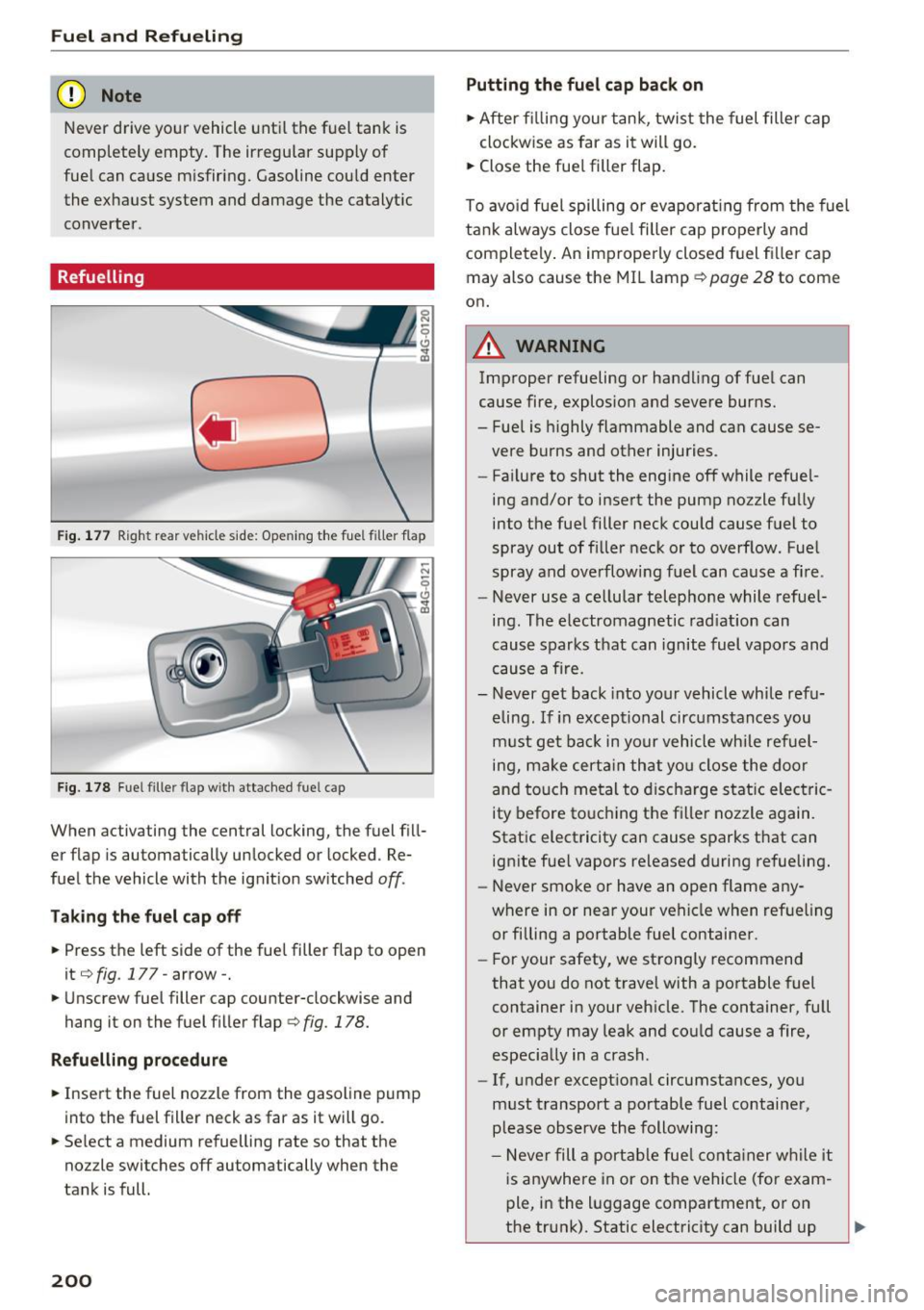
Fig. 177 Right rear vehicle side: Opening the fuel filler flap
Fig. 178 Fuel filler flap w ith attached fuel cap
When activating the central locking, the fuel fill
er flap is automatically unlocked or locked. Re
fuel the vehicle with the ignition switched
off.
Taking the fuel cap off
.. Press the left side of the fuel filler flap to open
it
9 fig. 177-arrow- .
.. Unscrew fuel filler cap counter-clockwise and
hang it on the fuel filler flap¢
fig. 178.
Refuelling procedure
.. Insert the fuel nozzle from the gasoline pump
into the fuel filler neck as far as it will go.
.. Select a medium refuelling rate so that the
nozzle switches off automatically when the
tank is full.
200
Putting the fuel cap back on
.. After filling your tank, twist the fuel filler cap
clockwise as far as it will go.
.. Close the fuel filler flap.
To avoid fuel spilling or evaporating from the fuel
tank always close fuel filler cap properly and
completely. An improperly closed fuel filler cap
may also cause the MIL lamp ¢
page 28 to come
on.
A WARNING
Improper refueling or handling of fuel can
cause fire, explosion and severe burns. -
- Fuel is highly flammable and can cause se
vere burns and other injuries .
- Failure to shut the engine off while refuel
ing and/or to insert the pump nozzle fully
into the fuel filler neck could cause fuel to
spray out of filler neck or to overflow. Fuel
spray and overflowing fuel can cause a fire.
- Never use a cellular telephone while refuel
ing. The electromagnetic radiation can
cause sparks that can ignite fuel vapors and
cause a fire.
- Never get back into your vehicle while refu
eling.
If in exceptional circumstances you
must get back in your vehicle while refuel
ing, make certain that you close the door
and touch metal to discharge static electric
ity before touching the filler nozzle again.
Static electricity can cause sparks that can
ignite fuel vapors released during refueling.
- Never smoke or have an open flame any
where in or near your vehicle when refueling
or filling a portable fuel container .
- For your safety, we strongly recommend
that you do not travel with a portable fuel
container in your vehicle. The container, full
or empty may leak and could cause a fire,
especially in a crash .
- If, under exceptional circumstances, you
must transport a portable fuel container,
please observe the following:
- Never fill a portable fuel container while it
is anywhere in or on the vehicle (for exam
ple, in the luggage compartment, or on
the trunk). Static electricity can build up
Ii>-