2016 AUDI RS7 SPORTBACK ignition
[x] Cancel search: ignitionPage 239 of 282

The specified tire pressure is the last tire pres
sure that was stored
¢ page 2 3 7 .
Note that the tire p ressure also depends on the
temperature of the t ire . Every 10 °C increase in
tire temperature results in the tire pressure in
creasing by approximate ly 0 .1 bar. The tire pres
sure increases as the eng ine becomes warmer
while driving.
A WARNING
Read and follow the important information
and notes <=>
page 236.
@ Tips
The tire pressure or temperature are not dis played in adaptation mode. Dashes ··.·· are
shown in place of the pressure and tempera
ture .
(D Tire pressure loss
Fig. 194 Display : indic ato r light with a message
If the [IJ indicator light turns on, the pressure in
at least one t ire is too low or new sensors were
not adapted :
rt] indicator lights turns on after turning the
ignition on
The tire pressure is too low compared to the
specified pressure.
"' Check and store the tire pressure{s) the next
time it is possible<=>
page 237.
rt] indicator light turns on while driving
Wheels with new senso rs were not adapted or
the tire pressure has reached a critical leve l com
pared to the specified pressure.
Wheels
"' Avoid unnecessary steering and braking maneu-
vers .
"' Adapt your dr iving sty le to the situation .
"' Stop as soon as possible and check the tire(s).
"' If it is possib le to continue driving, see an au-
thorized Audi dealer or authorized A udi Service
Facility immediately and have your tire(s) re
pa ired or rep laced.
A WARNING
Read and follow the important i nformation
and notes
¢page 236.
Storing new tire pressures
Correctly stored tire pressure specifications are
necessary for reliable tire pressure monitoring.
"' Check the tire pressures in all wheels .
..
"'Cor rect the tire pressure if necessa ry. Refer to
the tire pressure label for the re commended
t ire pressure for your vehicle
c> page 228,
-
fig. 193 . Only correct the pressure in tires
whose temperature is approximately the same
as the ambient temperature. If the tempera
ture of the tire is higher than ambient tempera
ture, the tire pressure must be increased ap
proximately 0 .2 bar above the value on the
sticker .
"' Switch the ignition on .
"' Select:
!CAR ! function button> Car systems>
Tire pressure monitor > Store tire pressures .
After storing, the tire pressure monitoring sys
tem measures the current tire pressures and
stores them as the new specified pressures .
"'If the changed tire pressures are not displayed
in the Infotainment system, drive the vehicle
for approximately 10 minutes so that the sen
sor signal from the wheels is received again .
During this adaptation phase, ··.·· is displayed
for the pressure and temperature and the tire
pressure monitoring system is only partially
available .
It only prov ides a warning if one or
more tire pressures is below the minimum per
mitted spec ified pressu re. If this is the case, the
[IJ indic ator light appea rs with a message . ""
237
Page 240 of 282

Wheels
_& WARNING
Read and follow the important information
and notes¢
page 236.
Malfunctions
Fig . 195 D isp lay: indicator lig ht w ith a message
If the tire p ressure mon itoring system is not
ava ilable,
the m indic a tor light appea rs i n the
d river information system. The
RI] ind icato r light
also blinks for approximately one minutes each
time the ignition is switched on . The tire pressure
monitoring system cannot be selected in the In
fotainment system. The malfunction could be
caused by the following examples:
- If the message appears at the end of the adap
tation phase, the system cannot detect the
whee ls installed on the vehicle. This may result
from one o r more wheels being installed with
out wheel sensors or with incompatible wheel
senso rs.
- A wheel senso r or anot her component has
failed .
- Using snow cha ins can affect the function of
the system because of the shie ld ing effect of
the cha ins.
- The t ire pressure monitoring system is not
available due to a malfunction .
- Transmitters with the same frequency, such as
headphones or remote-controlled devices, may
ca use a temporary system malfu nction due to
the strong e lec trom agne tic field.
The
ffim i ndicator light turns off once the tire
pressure mon itor ing system is available aga in . If
you cannot correct the malfunction and
the m
in dicator light stays on, drive to an author ized
238
Audi dealer or authorized Audi Service Facility to
have the malfunction corrected.
Page 244 of 282

Emergency assistance
Inflating tire
.,. Move the switch@¢ fig. 200 on the e lectric air
pump
ll to position I. After S minutes, tire
pressure must have reached at least 1.8 bar.
.,. Switch the electric air pump off- switch in posi
tion
0. If the required tire pressure of at least
1.8 bar has not been reached, follow the in
structions in the section
Re-inflating tire.
Re-inflating tire
.,. Remove the hose from the va lve and pu ll the
plug out of the socket.
.,. Drive the vehicle slowly 33 feet (10 meters)
backward or forward . This helps to distribute
the sealant better .
.,. Remove the empty inflation bottle and screw
the hose ®~
fig. 199 from the electric pump
directly onto the
valve.
.,. Inse rt the plug ©~ fig. 199 into the socket for
the cigarette lighter.
.,. Switch on the ignition .
.,. Move the switch @¢
fig. 200 on the electric air
pump
ll to posit ion I. After S minutes, tire
pressure must have reached at least 1.8 bar.
.,. Switch the electric air pump off- switch in posi
tion
0. If the required tire pressure of at least
1.8 bar has not been reached, it is not possible
to make a repair with the tire sea lant . Seek p ro
fessional assistance.
Disassembling Tire Mobility System
.,. Remove the hose from the valve and pull the
plug out of the socket .
.,. Screw the dust cap onto the
valve.
.,. Place the empty sealant bottle back in the orig
inal packaging and clip it in place under the
floor so that no tire sealant can ru n out into the
vehicle.
.,. Place the electric air pump in the luggage com
partment for the time being.
.,. Start driving right away so that the sealant is
distributed in the tire.
l ) The electric air pu m p sho uld never r un for lo ng er than 6
m in ute s.
242
A WARNING ,_ -
- Follow the manufacturer's safety instruc
tions on the decal for the air pump and the
sealant bottle .
- If a tire pressure of 1.8 bar cannot beach
ieved after pumping for S minutes, the tire
is too severely damaged . Do not continue to
drive .
- Seek professional assistance if it is not pos
sible to repair the tire with the tire sealant .
(D Tips
-Do not operate the e lectr ic air pump for
more than 6 minutes without stopping, oth
erwise it can overheat . When the air pump
has cooled down, you can continue to use it.
- If sealant has escaped, allow it to dry, then
you can peel it off .
· Final check
After driving for a short distance , tire
pressure must be checked
.,. After driving for about 10 minutes, stop and
check the tire pressure.
.,. If tire pressure is sti ll at least 1.3 bar, inflate
the t ire to specified pressure (see drivers side
B-pillar), drive to the next repair shop and have
the tire and the sealant bottle replaced.
.,. If tire pressure is less than 1.3 bar, the tire is
too severely damaged . Do not continue to
drive . Seek profess ional assistance .
A WARNING
If tir e pressure is less than 1.3 bar after driv
in g for 10 minutes, the tire is too severely
damaged. Do not continue to drive. Seek pro
fessional assistance.
(D Tips
After a tire repair , have the sealant bottle re
placed at a dealership. This restores full func
tionality to the Tire Mobility System.
Page 251 of 282

Fuses
Replacing fuses
A fuse that has blown will have metal strips that have burned through.
Fig. 208 Drive r's side cockpit : cover
The fuses are located on front left and right of
the cockpit and behind the trim on the right side
of the luggage compartment.
.,. Switch the ignition and all electrical equipment
off .
.,. Check the following table to see which fuse be
longs to the equipment .
.,. Remove the appropriate cover.
.,. Remove the colored p lastic clip from the fuse
panel, if necessary ~
page 250, fig. 209. You
can dispose of the plastic clip .
.,. Remove the clamp from the rear side of the
cover
c> fig . 208 .
.,. Remove the fuse using the clamp .
.,. Replace the b lown fuse only with an identical
new one .
.,. Install the cover.
Fuse color identification
Color Current rating
in amps
Black 1
Purple 3
Light brown s
Brown 7.5
Red 10
Blue 15
Yellow 20
White or transparent 25
Fuses
Color Current rating
in amps
green 30
orange 40
,&_ WARNING
= -Do not repair fuses and never replace a blown
fuse with one that has a higher amp rating.
This can cause damage to the electr ical sys
tem and a fire.
(D Note
If a new fuse burns out again shortly after you
have installed it, have the electrical system
checked as soon as poss ible by an authorized
Audi dealer or authorized Audi Service Facili
ty .
Ci) Tips
-The following table does not list fuse loca
tions that are not used .
- Some of the equipment listed in the follow
ing tables applies only to certain model ver
sions or certa in optional equipment.
249
Page 261 of 282

Technical data
Vehicle identification
F ig . 2 21 Vehi cle Ident if icatio n Number (VlN) plate : loca·
t ion on dr iver 's side dash pane l
XXXXX XX -X -XX XX X XX XX
CD+ ~t :1 :: xxxxxxxx xx x x x xxx xxx
T VP /fffl XXX XXX
XX XXXXXXX XX X X XX
XXX
K W XXX
®i ~:J ·f lfils~~ XXXX XXX XXX
®-+ ~N:a=i~l xxxx ; xxxx xx x ; xx
II. · AUSS, I OPTIONS
E0 A
7D5 4UB 6
XM 5SG 5R W
2EH J0Z lLB l
A S lB A
3FC SM U 7Xl
F 0 A 9G3 0G7 0YH 0JF
TL 6 3KA 8EH UlA X 98 QZ7
l XW 803 908 824 020
7T6 C V7 7 K0 4 X3 2 K2
3L4 4KC 3Y0 413
502
lS A
7GB 01A 4G0
XX. X XX X XX X xxxx
Fig. 222 Th e ve hicle identifica tion label- inside the lug
gage compartment
Veh icle Identification Number (VlN )
The Vehicle Identific ation N umbe r is locate d in
d if f eren t places:
- u nder the w indshield on the dr iver's side
¢ fig . 22 1.
- in the M MI: Select: Funct ion button ICAR I >
(Car) * systems > Servicing & check s > VIN
;:::J numb er.
(3 -on the vehicle identification label.
'
Technical data
Vehicle identification label
T he veh icle identification label is lo cate d in the
l uggage compa rtment in the spare whee l we ll.
T he labe l¢
fig. 222 shows the fo llowing vehicle
da ta:
(D Vehicle Identification Number (VIN)
@ Vehicle type, eng ine ou tput, transm ission
@ Engine and transmission code
@ Paint numbe r and interior
® Optional equipment numbers
T he information of the veh icle identification label
c a n al so be fo und in your Warran ty
& M ainte
nance booklet.
Safety compliance sticker
The safety compliance st icker is yo ur ass urance
that your new vehi cle complies w ith all applicable
Federal Motor Vehicle Safety Standards which
we re in effect at the time the vehicle w as m anu
fac tured. Yo u ca n fi nd this sticker on the door
jamb on the driver 's side. It shows the month and
year of production and t he ve hicle identification
number of your ve hicle (perforation) as well as
the Gross Vehicle Weight Rat ing (GVWR) and the
G ross A xle We ight Rati ng (GAWR).
H igh vo ltage warning label
T he high voltage warning label is located in the
engine compa rtment next to the engine hood re
lease. The spark ignition system complies with
t h e Canadian standard ICES-002.
Weights
Gross Vehicle Weight Rating
The Gross Vehicle Weight Rating (GVWR), and
t h e Gross Axle Weight Rating (GAWR) for front
and rear are listed on a sticker on the door jamb
o n the dr iver 's side.
The Gross Vehicle Weight Rating includes the
weight of the basic vehicle plus fu ll fuel tank, oil
and coolant, p lus maxim um load, which includes
passenger weight (150 lbs/68 kg per des ignated
seat ing pos ition) and luggage weight
c:> .&, . .,.
259
Page 265 of 282

scope of maintenance and repairs which can be
carried out by vehicle owners.
Also, safet y and
en vir onm enta l
concerns place very strict limits
on the nature of repairs and adjustments to en
g ine and transm ission parts wh ich an owner c an
perform .
Maintenance, adjustments and repairs usually re
qu ire special tools, test ing devices and other
equ ipment available to specially trained work
shop perso nnel i n order to assure proper per
forma nce, re liability and safety of the ve hicle and
i ts many systems.
Improper maintenance, adjustments and repairs
can impair the operation and reliability of your
vehicle and even void your veh icle warranty.
Therefore, proof of se rvicing in accordance with
the ma intenance sc hedule may be a condition for
upho ld ing a possib le wa rranty claim made wi thin
the warranty pe riod.
Above all , operational safety can be adversely af
fected, creating unnecessa ry risks fo r you and
your p assengers.
If in doubt about any se rvicing, have it done by
your author ized Audi dealer or any other properly
eq uipped and qua lified workshop. We strongly
urge yo u to g ive your author ized Audi dealer the
opport unity to perform a ll scheduled ma inte
nance and necessary repairs . Your dealer has the
facilities, origina l parts and trained specialists to
keep your veh icle running properly .
Performing limited maintenance yourself
The follow ing pages des cribe a lim ited number of
p rocedures w hich can be per formed o n your veh i
cle with ordinary tools, should the need arise and
trained personnel be unavailable . Before per
forming any of these procedures, always thor
ough ly read a ll of the app licab le text and carefu l
ly follow the instructions g iven . Always rigorously
observe the
WARNING S provided .
Before you check anything in the engine com ·
partment , always read and heed all WARNINGS
c:> &. and c:> &. in Working in the engine compart
ment on page 203.
Con sumer inf ormation
A WARNING
- Ser ious personal in jury may occur as a result
of improperly performed maintenance, ad
justments or re pairs .
- Always be extremely careful when work ing
on the vehicle. Always follow commonly ac
cepted safety practices and general com mo n sense. Never risk pe rsonal injury.
- Do not attempt any of the mai ntenance,
checks or repairs described on t he following
pages if you are not fu lly familiar wi th these
or other proce dures with respect to the ve
h icle, o r are uncerta in how to pro ceed.
- Do not do a ny work withou t the prope r tools
a nd eq uipment. H ave the necessary wo rk
done by your au thorized Audi dealer or an
other proper ly equipped and qualified work
shop.
- The engine compa rtment of any motor ve hi
cle is a potent ially hazardous area . Never
reach into the area around or touch the radi
ator fan.
It is temperature controlled and
can switch o n suddenly - even when the en
g ine is off . The radiato r fan switches on au
tomatically when the coolan t reaches a cer
tain tempe ra ture and w ill cont inue to run
until the coolant temperature d rops.
- Always sw itch off the ignition before anyone
gets under the vehicle .
- Always support your veh icle with safety
s tands if it is necessary to work underneat h
the vehicle . The jack supp lied with t he veh i
cle is no t adequ ate for t his pu rpose and
could collapse ca us ing serious personal in
jury.
- If you m ust wor k unde rne ath the vehicle
with the wheels on the ground, always make
sure the vehicle is on level ground, that the
wheels a re always sec urely blocked and that
the engine cannot be started.
- Always make sure the transmission se lector
lever (automatic t ransmiss ion) is in P (Park
position) and the pa rk brake is applied .
II>
263
Page 273 of 282
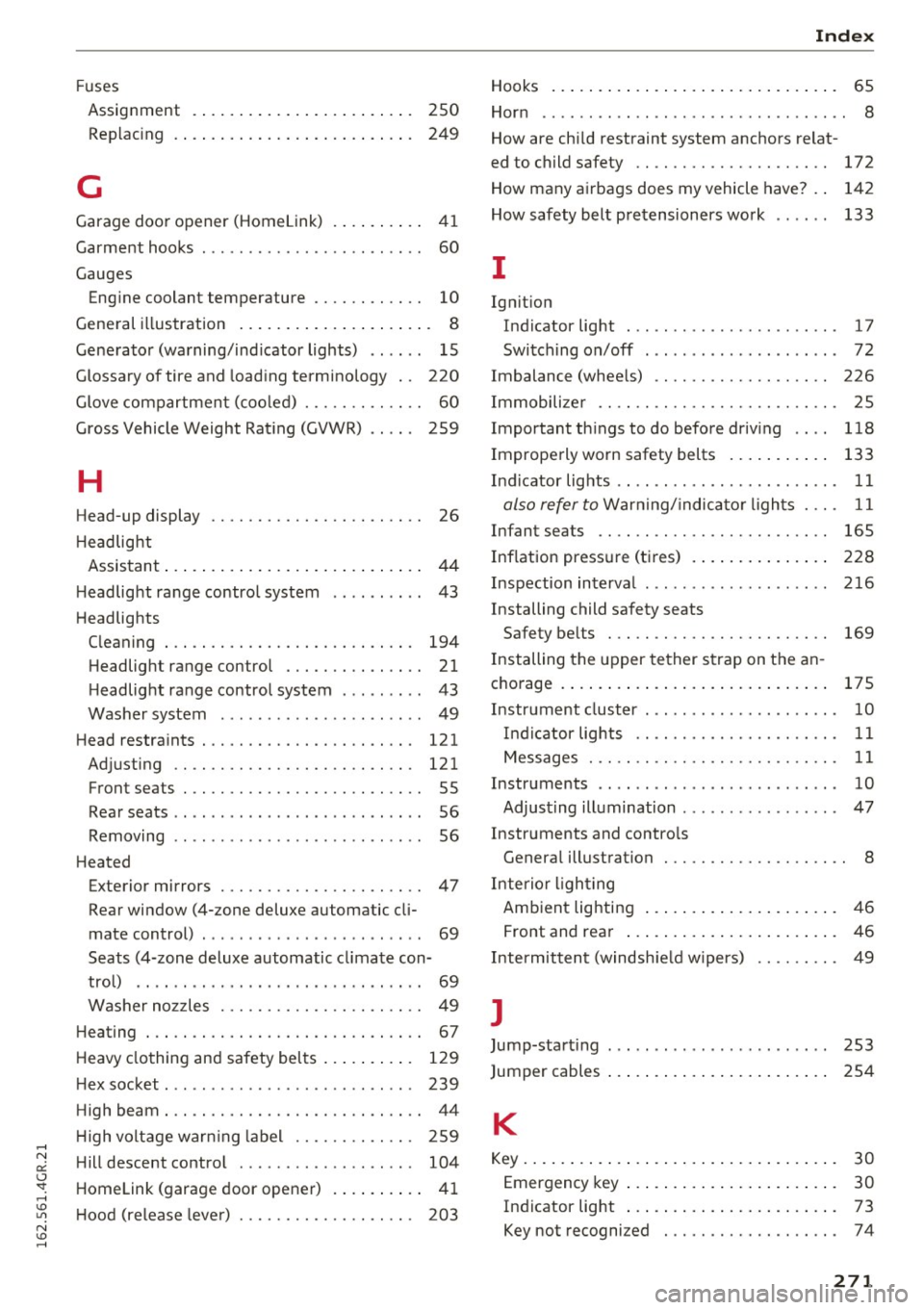
Fuses
Assignment . . . . . . . . . . . . . . . . . . . . . . . . 250
Replac ing . . . . . . . . . . . . . . . . . . . . . . . . . . 249
G
Garage door opener (Homelink) . . . . . . . . . . 41
Garment hooks . . . . . . . . . . . . . . . . . . . . . . . . 60
Gauges Engine coolant temperature . . . . . . . . . . . . 10
General illustration . . . . . . . . . . . . . . . . . . . . . 8
Generator (warning/indicator lights) . . . . . . 15
Glossary of tire and loading terminology . . 220
Glove compartment (cooled) . . . . . . . . . . . . . 60
Gross Vehicle Weight Rating (GVWR) . . . . . 259
H
Head-up display . . . . . . . . . . . . . . . . . . . . . . . 26
H eadlight
Assistant . . . . . . . . . . . . . . . . . . . . . . . . . . . . 44
H eadlight range control system . . . . . . . . . . 43
Headlights Cleaning . . . . . . . . . . . . . . . . . . . . . . . . . . . 194
Headlight range control . . . . . . . . . . . . . . . 21
Headlight range control system . . . . . . . . . 43
Washer system . . . . . . . . . . . . . . . . . . . . . . 49
Head restraints. .. .... ......... .. .. .. . 121
Adjusting . . . . . . . . . . . . . . . . . . . . . . . . . . 121
Front seats . . . . . . . . . . . . . . . . . . . . . . . . . . 55
Rear seats . . . . . . . . . . . . . . . . . . . . . . . . . . . 56
Removing . . . . . . . . . . . . . . . . . . . . . . . . . . . 56
Heated Exterior mirrors . . . . . . . . . . . . . . . . . . . . . . 47
Rear window (4- zone deluxe automatic cli
mate control) . . . . . . . . . . . . . . . . . . . . . . . . 69
Seats (4-zone deluxe automatic climate con-
trol) . . . . . . . . . . . . . . . . . . . . . . . . . . . . . . . 69
Washer nozzles . . . . . . . . . . . . . . . . . . . . . . 49
Heating . . . . . . . . . . . . . . . . . . . . . . . . . . . . . . 67
Heavy clothing and safety belts . . . . . . . . . . 129
Hex socket . . . . . . . . . . . . . . . . . . . . . . . . . . . 239
High beam . . . . . . . . . . . . . . . . . . . . . . . . . . . . 44
High voltage warning label . . . . . . . . . . . . . 259
Hill descent control . . . . . . . . . . . . . . . . . . . 104
Homelink (garage door opener) . . . . . . . . . . 41
H ood (release lever) . . . . . . . . . . . . . . . . . . . 203
Index
Hooks . . . . . . . . . . . . . . . . . . . . . . . . . . . . . . . 65
Horn . . . . . . . . . . . . . . . . . . . . . . . . . . . . . . . . . 8
How a re child restraint system anchors relat -
ed to child safety . . . . . . . . . . . . . . . . . . . . . 172
How many airbags does my vehicle have? . . 142
How safety belt pretensioners work . . . . . . 133
I
Ignition
Indicator light . . . . . . . . . . . . . . . . . . . . . . . 17
Switching on/off . . . . . . . . . . . . . . . . . . . . . 72
Imbalance (wheels) . . . . . . . . . . . . . . . . . . . 226
Immobilizer . . . . . . . . . . . . . . . . . . . . . . . . . . 25
Importantthingstodobeforedriving .. .. 118
Improperly worn safety belts . . . . . . . . . . . 133
Ind icator lights . . . . . . . . . . . . . . . . . . . . . . . . 11
also refer to Warning/indicator lights . . . . 11
Infant seats . . . . . . . . . . . . . . . . . . . . . . . . . 165
Inflation pressure (tires) . . . . . . . . . . . . . . . 228
Inspection interval . . . . . . . . . . . . . . . . . . . . 216
Installing child safety seats Safety belts . . . . . . . . . . . . . . . . . . . . . . . . 169
Installing the upper tether strap on the an
chorage . . . . . . . . . . . . . . . . . . . . . . . . . . . . . 17 5
Instrument cluster . . . . . . . . . . . . . . . . . . . . . 10
Indicator lights . . . . . . . . . . . . . . . . . . . . . . 11
Messages . . . . . . . . . . . . . . . . . . . . . . . . . . . 11
Instruments . . . . . . . . . . . . . . . . . . . . . . . . . . 1 0
Adjusting illumination . . . . . . . . . . . . . . . . . 47
Inst ruments and cont rols
General illustrat ion . . . . . . . . . . . . . . . . . . . . 8
Interior l ighting
Ambient lighting . . . . . . . . . . . . . . . . . . . . . 46
Front and rear . . . . . . . . . . . . . . . . . . . . . . . 46
Intermittent (windshield wipers) . . . . . . . . . 49
]
Jump-starting 253
Jump er cables . . . . . . . . . . . . . . . . . . . . . . . . 254
K
Key............ .... ................ .. 30
Emergency key . . . . . . . . . . . . . . . . . . . . . . . 30
Indicator light . . . . . . . . . . . . . . . . . . . . . . . 73
Key not recognized . . . . . . . . . . . . . . . . . . . 74
271