2015 PEUGEOT 2008 warning
[x] Cancel search: warningPage 149 of 340
147
2008_en_Chap08_securite-enfants_ed01-2015
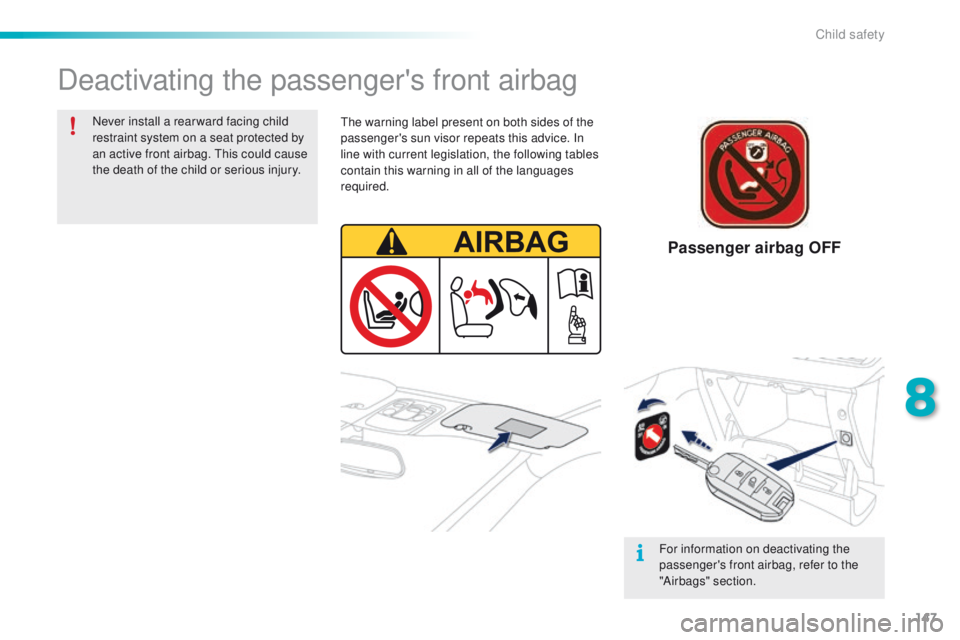
Deactivating the passenger's front airbag
Never install a rear ward facing child
restraint system on a seat protected by
an active front airbag. This could cause
the death of the child or serious injury.
Passenger airbag OFF
The warning label present on both sides of the
passenger's sun visor repeats this advice. In
line with current legislation, the following tables
contain this warning in all of the languages
required.For information on deactivating the
passenger's front airbag, refer to the
"Airbags" section.
8
Child safety
Page 161 of 340
159
2008_en_Chap09_info-pratiques_ed01-2015
Low fuel level
When the fuel tank minimum level is
reached this warning lamp comes on
in the instrument panel. There remains
approximately 5 litres of fuel in the tank.
When the warning lamp flashes there is
ver y little fuel remaining in the tank.
The key cannot be removed from the
lock until the cap is refitted.
Removing the filler cap may cause an
inrush of air. This vacuum is per fectly
normal and results from the sealing of
the system.
Fuel tank
Fuel tank capacity: approximately 50 litres.
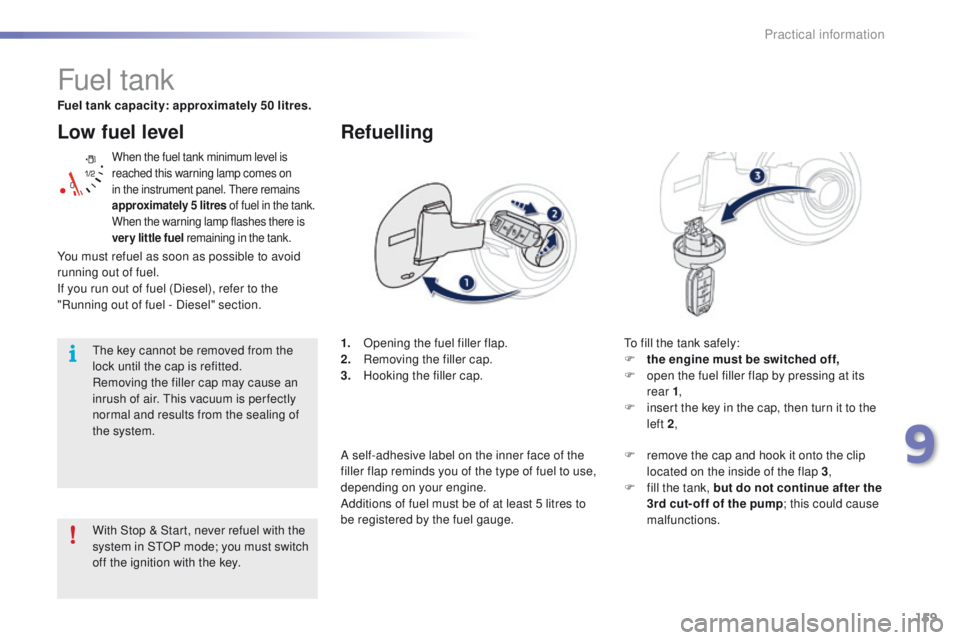
1.
O
pening the fuel filler flap.
2.
R
emoving the filler cap.
3.
H
ooking the filler cap.
Refuelling
To fill the tank safely:
F t he engine must be switched off,
F
o
pen the fuel filler flap by pressing at its
rear 1 ,
F
i
nsert the key in the cap, then turn it to the
left 2 ,
With Stop & Start, never refuel with the
system in STOP mode; you must switch
off the ignition with the key. F
r
emove the cap and hook it onto the clip
located on the inside of the flap 3 ,
F
f
ill the tank, but do not continue after the
3rd cut- off of the pump ; this could cause
malfunctions.
You must refuel as soon as possible to avoid
running out of fuel.
If you run out of fuel (Diesel), refer to the
"Running out of fuel - Diesel" section.
A self-adhesive label on the inner face of the
filler flap reminds you of the type of fuel to use,
depending on your engine.
Additions of fuel must be of at least 5 litres to
be registered by the fuel gauge.
9
Practical information
Page 166 of 340
164
2008_en_Chap09_info-pratiques_ed01-2015
AdBlue® additive and SCR system
for BlueHDi Diesel engines
To assure respect for the environment and
conformity with the new Euro 6 emissions
standard, without adversely affecting the
per formance or fuel consumption of Diesel
engines, PEUGEOT has taken the decision to
equip its vehicles with an effective system that
associates SCR (Selective Catalytic Reduction)
with a particle filter (FAP) for the treatment of
exhaust gases.
Presentation of the SCR system
Using an additive called AdBlue® containing
urea, a catalytic converter turns up to 85%
of nitrous oxides (NOx) into nitrogen and
water, which are harmless to health and the
environment. The AdBlue
® additive is held in a special
tank located under the boot at the rear of
the vehicle. It has a capacity of 17 litres: this
provides a driving range of about 12 500 miles
(20 000 km), after which an alert is triggered
warning you when the reserve remaining is
enough for just 1 500 miles (2 400 km).
During each scheduled service of your vehicle
by a PEUGEOT dealer or a qualified workshop,
the AdBlue
® additive tank is refilled in order to
allow normal operation of the SCR system.
If the estimated mileage between two services
is greater than 12 500 miles (20 000 km), we
recommend that you go to a PEUGEOT dealer
or a qualified workshop to have the necessary
top-up carried out. Once the AdBlue
® tank is empty, a
s
ystem required by regulations prevents
starting of the engine.
If the SCR is faulty, the level of
emissions from your vehicle will no
longer meet the Euro 6 standard: you
vehicle becomes polluting.
In the event of a confirmed fault
with the SCR system, you must go
to a PEUGEOT dealer or a qualified
workshop as soon as possible: after
a running distance of 650 miles
(1
100 km), a system will be triggered
automatically to prevent engine starting.
Practical information
Page 168 of 340
166
2008_en_Chap09_info-pratiques_ed01-2015
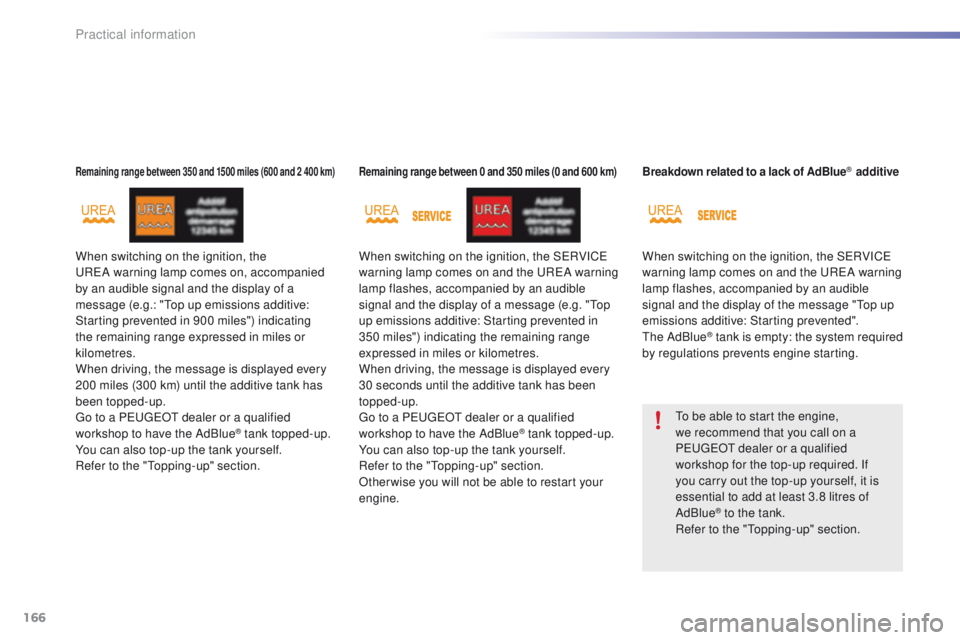
When switching on the ignition, the
UREA warning lamp comes on, accompanied
by an audible signal and the display of a
message (e.g.: "Top up emissions additive:
Starting prevented in 900 miles") indicating
the remaining range expressed in miles or
kilometres.
When driving, the message is displayed every
200 miles (300 km) until the additive tank has
been topped-up.
Go to a PEUGEOT dealer or a qualified
workshop to have the AdBlue
® tank topped-up.
You can also top-up the tank yourself.
Refer to the "Topping-up" section.
Remaining range between 350 and 1500 miles (600 and 2 400 km)Remaining range between 0 and 350 miles (0 and 600 km)Breakdown related to a lack of AdBlue® additive
When switching on the ignition, the SERVICE
warning lamp comes on and the UREA warning
lamp flashes, accompanied by an audible
signal and the display of a message (e.g. "Top
up emissions additive: Starting prevented in
350 miles") indicating the remaining range
expressed in miles or kilometres.
When driving, the message is displayed every
30 seconds until the additive tank has been
topped-up.
Go to a PEUGEOT dealer or a qualified
workshop to have the AdBlue
® tank topped-up.
You can also top-up the tank yourself.
Refer to the "Topping-up" section.
Other wise you will not be able to restart your
engine. To be able to start the engine,
we recommend that you call on a
PEUGEOT dealer or a qualified
workshop for the top-up required. If
you carry out the top-up yourself, it is
essential to add at least 3.8 litres of
AdBlue
® to the tank.
Refer to the "Topping-up" section.
When switching on the ignition, the SERVICE
warning lamp comes on and the UREA warning
lamp flashes, accompanied by an audible
signal and the display of the message "Top up
emissions additive: Starting prevented".
The AdBlue
® tank is empty: the system required
by regulations prevents engine starting.
Practical information
Page 169 of 340
167
2008_en_Chap09_info-pratiques_ed01-2015
In the event of the detection
of a fault
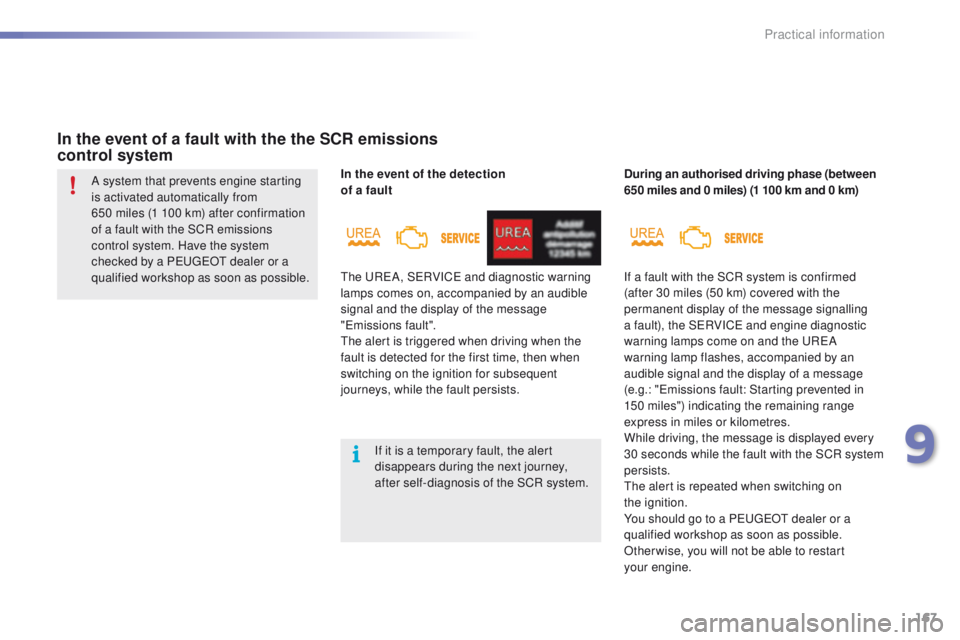
In the event of a fault with the the SCR emissions
control system
During an authorised driving phase (between
650 miles and 0 miles) (1 100 km and 0 km)
A system that prevents engine starting
is activated automatically from
650
miles (1 100 km) after confirmation
of a fault with the SCR emissions
control system. Have the system
checked by a PEUGEOT dealer or a
qualified workshop as soon as possible.
If it is a temporary fault, the alert
disappears during the next journey,
after self-diagnosis of the SCR system.
The UREA, SERVICE and diagnostic warning
lamps comes on, accompanied by an audible
signal and the display of the message
"Emissions fault".
The alert is triggered when driving when the
fault is detected for the first time, then when
switching on the ignition for subsequent
journeys, while the fault persists.
If a fault with the SCR system is confirmed
(after 30 miles (50 km) covered with the
permanent display of the message signalling
a fault), the SERVICE and engine diagnostic
warning lamps come on and the UREA
warning lamp flashes, accompanied by an
audible signal and the display of a message
(e.g.: "Emissions fault: Starting prevented in
150
miles") indicating the remaining range
express in miles or kilometres.
While driving, the message is displayed every
30 seconds while the fault with the SCR system
persists.
The alert is repeated when switching on
the
ignition.
You should go to a PEUGEOT dealer or a
qualified workshop as soon as possible.
Other wise, you will not be able to restart
your
engine.
9
Practical information
Page 170 of 340
168
2008_en_Chap09_info-pratiques_ed01-2015
Starting preventedYou have exceeded the authorised
driving limit: the starting prevention
system inhibits engine starting. Freezing of the AdBlue® additive
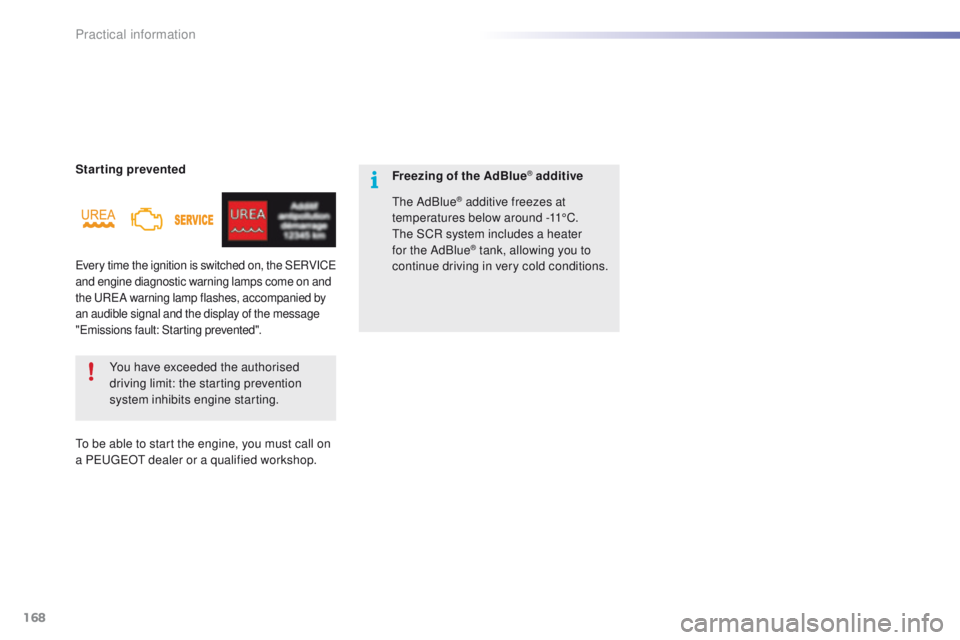
Every time the ignition is switched on, the SERVICE
and engine diagnostic warning lamps come on and
the UREA warning lamp flashes, accompanied by
an audible signal and the display of the message
"Emissions fault: Starting prevented".
To be able to start the engine, you must call on
a PEUGEOT dealer or a qualified workshop. The AdBlue
® additive freezes at
temperatures below around -11°C.
The SCR system includes a heater
for the AdBlue
® tank, allowing you to
continue driving in very cold conditions.
Practical information
Page 171 of 340
169
2008_en_Chap09_info-pratiques_ed01-2015
Topping-up the AdBlue® additive
Filling the AdBlue® tank is an operation
included in every routine service on your
vehicle by a PEUGEOT dealer or a qualified
workshop.
Nevertheless, given the capacity of the tank,
it may be necessary to top-up the additive
between services, more particularly if an alert
(warning lamps and a message) signals the
requirement.
You can got to a PEUGEOT dealer or a
qualified workshop.
If you envisage topping-up yourself, please
read the following warnings carefully.Precautions in use
The AdBlue® additive is an urea-based
solution. This liquid is non-flammable,
colourless and odourless (kept in a cool area).
In the event of contact with the skin, wash
the affected area with soap and water. In the
event of contact with the eyes, wash (irrigate)
the eyes with large amounts of water or with
an eye wash solution for at least 15 minutes.
If a burning sensation or irritation persists, get
medical attention.
If swallowed, immediately wash out the mouth
with clean water and then drink plenty of water.
In certain conditions (high ambient
temperature, for example), the risk of release
of ammonia cannot be excluded: do not inhale
the product. Ammonia vapour has en irritant
effect on mucous membranes (eyes, nose and
throat).
Keep AdBlue
® out of the reach of
children, in its original bottle.
Never transfer AdBlue
® to another
container: it would lose its purity. Never top-up from an AdBlue®
dispenser reserved for heavy goods
vehicles. Never dilute the additive with water.
Never pour the additive into the Diesel
fuel tank.
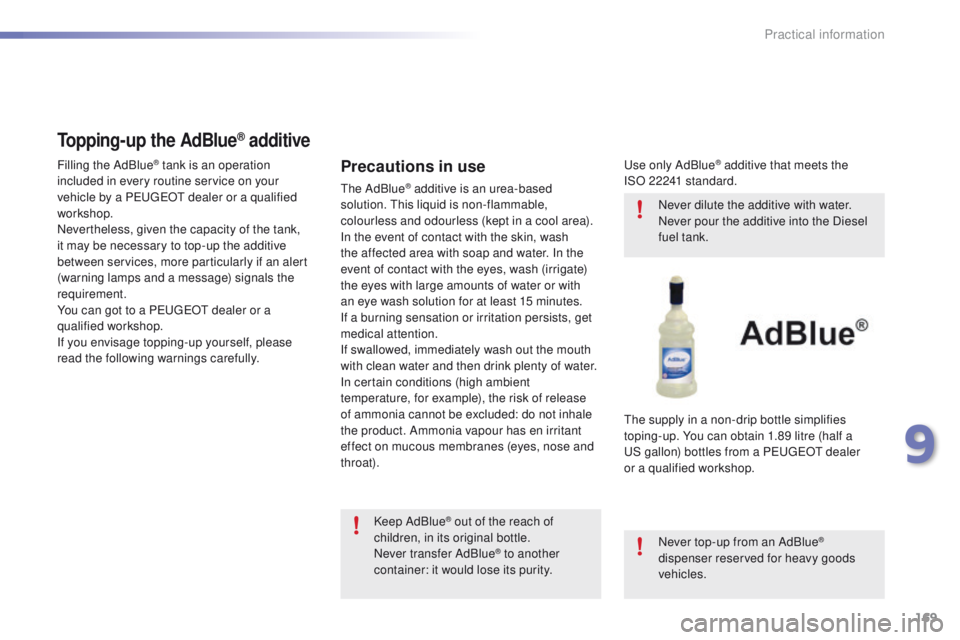
The supply in a non-drip bottle simplifies
toping-up. You can obtain 1.89 litre (half a
US
gallon) bottles from a PEUGEOT
dealer
or a qualified workshop. Use only AdBlue
® additive that meets the
ISO
22241 standard.
9
Practical information
Page 178 of 340
176
2008_en_Chap09_info-pratiques_ed01-2015
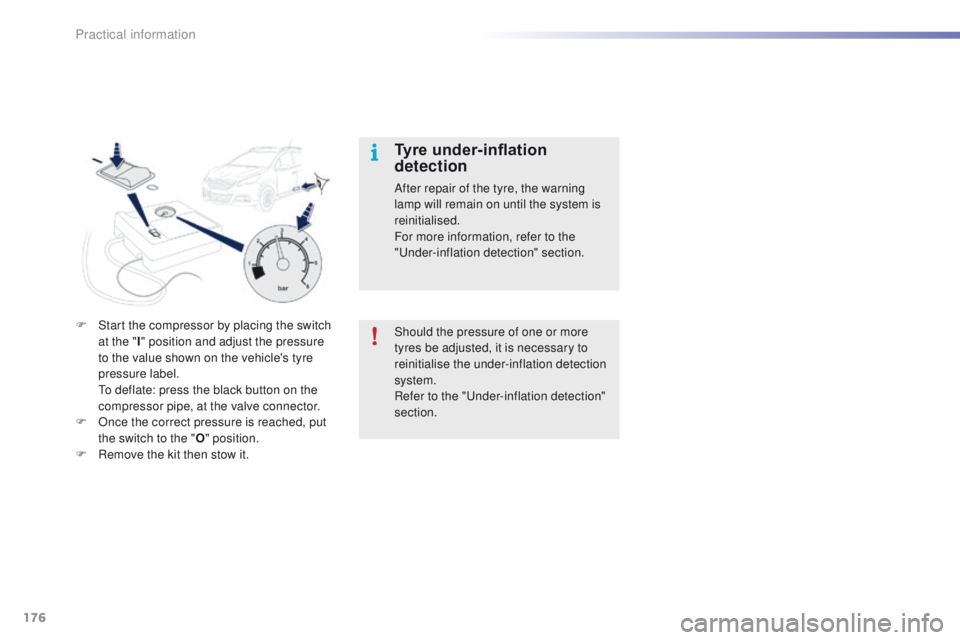
F Start the compressor by placing the switch at the " I" position and adjust the pressure
to the value shown on the vehicle's tyre
pressure label.
T
o deflate: press the black button on the
compressor pipe, at the valve connector.
F
O
nce the correct pressure is reached, put
the switch to the " O" position.
F
R
emove the kit then stow it.
Tyre under-inflation
detection
After repair of the tyre, the warning
lamp will remain on until the system is
reinitialised.
For more information, refer to the
"Under-inflation detection" section.
Should the pressure of one or more
tyres be adjusted, it is necessary to
reinitialise the under-inflation detection
system.
Refer to the "Under-inflation detection"
section.
Practical information