2015 PEUGEOT 2008 tow bar
[x] Cancel search: tow barPage 5 of 340

.
2008_en_Chap00a_sommaire_ed01-2015
Direction indicators 128
Hazard warning lamps 1 28
H or n
129
Emergency or assistance call
1
29
Tyre under-inflation detection
1
30
ESC system
1
33
Grip control
1
36
Front seat belts
1
38
Airbags
1
41
Safety
Fuel tank 159
Misfuel prevention (Diesel) 1 61
Running out of fuel (Diesel)
1
63
AdBlue
® additive and SCR system 1 64
(BlueHDi Diesel) 1 64
Temporary puncture repair kit
1
72
Changing a wheel
1
77
Snow chains
1
84
Changing a bulb
1
85
Changing a fuse
1
92
Battery
198
Electrical energy economy mode
20
1
Changing a wiper blade
2
02
To w i n g
2 0 3
Towing a trailer
2
05
Fitting roof bars
2
07
Advice on care and maintenance
2
07
Accessories
208
Practical information
B o n n e t 2 11
Petrol engines 2 12
Diesel engines
2
13
Checking levels
2
14
C h e c ks
2
17
Checks
General information 219
Petrol engines 2 20
Petrol weights
2
22
Diesel engines
2
24
Diesel weights
2
26
Dimensions
229
Identification markings
2
30
Technical data
Emergency call 2 32
Assistance call 2 33
7-inch touch screen
2
35
Audio system / Bluetooth
2
97
Audio system
3
17
Audio equipment and telematics
Alphabetical index
Child seats 1 45
Deactivating the passenger's front airbag 1 47
ISOFIX child seats
1
54
Child lock
1
58
Child safety
Lighting controls 1 11
Headlamp adjustment 1 18
Cornering lighting
1
19
Wiper controls
1
20
Lighting dimmer
1
24
Courtesy lamps
1
25
Interior mood lighting
1
26
Panoramic glazed sunroof
1
27
Visibility
Contents
Page 6 of 340

4
2008_en_Chap00b_vue-ensemble_ed01-2015
Exterior
Remote control key 42- 46
- locking/unlocking
the vehicle
-
l
ocating the vehicle
-
gu
ide-me-home lighting
-
a
nti-theft protection
-
alarm
-
battery
Starting - Switching off the engine
7
9 - 80 Boot
4
9
-
ope
ning / closing
-
em
ergency release
Temporary puncture repair kit
1
72-176
Wipers
120-123
Changing a wiper blade
1
23, 202
Changing bulbs
1
89-191
-
r
ear lamps
-
3
rd brake lamp
-
n
umber plate lamps
-
foglamp
-
r
eversing lamp
Fuel tank, misfuel prevention
1
59-163
Panoramic glazed sunroof
1
27
Roof bars
2
07
Accessories
208-209
Electronic stability programme (ESC)
1
33 -135
Snow chains
1
84
Tyre pressures
1
75, 230
Changing a wheel
1
77-183
-
tools
-
r
emoving / refitting
L i g h t i n g c o n t r o l s
111
-117
LED lamps
115
Daytime running lamps
1
15
Headlamp beam adjustment
1
18
Cornering lighting
1
19
Changing bulbs
1
85-188
-
f
ront lamps
-
foglamps
-
d
irection indicator repeaters
Door mirrors
5
9
D o o r s
47- 4 8
-
ope
ning / closing
-
em
ergency control
Locking/unlocking from the inside
5
0
Alarm
51-52
Electric windows
5
3 -54 Parking sensors
1
05-106
Park Assist
10
7-110
Towbar
205-206
Towing
20
3-204
Over view
Page 108 of 340

106
2008_en_Chap05_conduite_ed01-2015
In bad weather or in winter, ensure
that the sensors are not covered with
mud, ice or snow. When reverse gear is
engaged, an audible signal (long beep)
indicates that the sensors may be dirty.
Certain sound sources (motorcycle,
lorry, pneumatic drill, etc.) may trigger
the audible signals of the parking
sensor system.In the event of a malfunction of
the system, when reverse gear
is engaged this warning lamp
is displayed in the instrument panel and/or a
message appears in the screen, accompanied
by an audible signal (short beep).
Contact a PEUGEOT dealer or a qualified
workshop.
Operating fault
The function will be deactivated
automatically if a trailer is being towed
or a bicycle carrier is fitted (vehicle
fitted with a towbar or bicycle carrier
recommended by PEUGEOT).
Front parking
sensors*
In addition to the rear parking sensors, the
front parking sensors are triggered when an
obstacle is detected in front and the speed of
the vehicle is still below 6 mph (10 km/h).
The front parking sensors are interrupted if
the vehicle stops for more than three seconds
in for ward gear, if no further obstacles are
detected or when the speed of the vehicle
exceeds 6 mph (10 km/h).
* Available only with the Park Assist system. The sound emitted by the speaker (front or
rear) indicates whether the obstacle is in front
or behind.
Deactivation / Activation of the
front and rear parking sensors
The function is deactivated by pressing this
button. The indicator lamp in the button
comes on.
Pressing this button again reactivates the
function. The indicator lamp in the button
goes off.
Driving
Page 176 of 340
174
2008_en_Chap09_info-pratiques_ed01-2015
Take care, the sealant product
is harmful (e.g. ethylene-glycol,
colophony...) if swallowed and causes
irritation to the eyes.
Keep this product out of the reach of
children.
The use-by date is marked on the
cartridge.
After use, do not discard the
cartridge by the roadside, take it to a
PEUGEOT dealer or an authorised
waste disposal site.
Don't forget to obtain a new sealant
cartridge, available from a PEUGEOT
dealer or a qualified workshop.
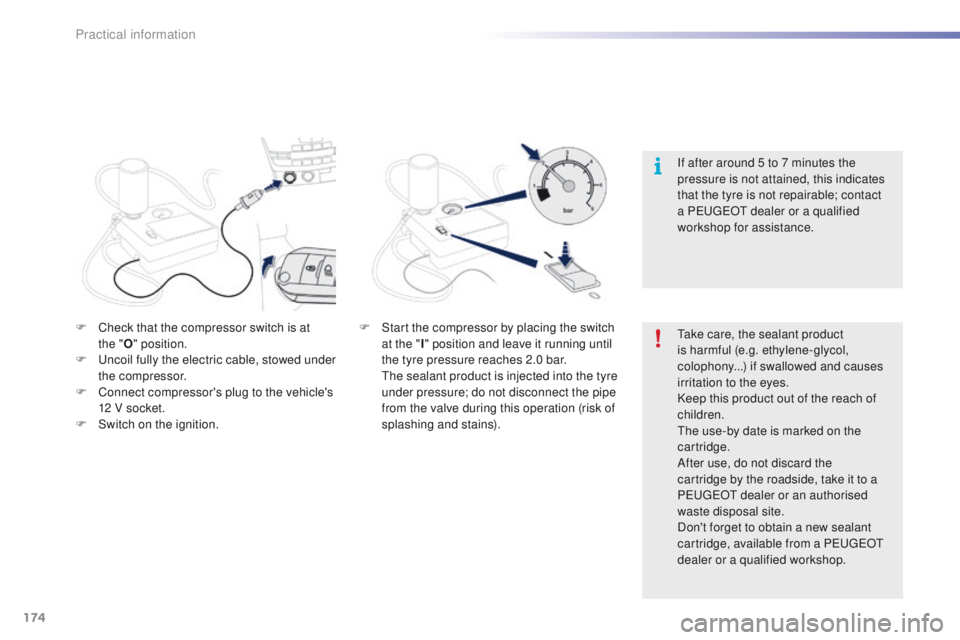
F
C
heck that the compressor switch is at
the
" O " position.
F
U
ncoil fully the electric cable, stowed under
the compressor.
F
C
onnect compressor's plug to the vehicle's
12 V socket.
F
S
witch on the ignition. If after around 5 to 7 minutes the
pressure is not attained, this indicates
that the tyre is not repairable; contact
a PEUGEOT dealer or a qualified
workshop for assistance.
F
S
tart the compressor by placing the switch
at the " I" position and leave it running until
the tyre pressure reaches 2.0 bar.
T
he sealant product is injected into the tyre
under pressure; do not disconnect the pipe
from the valve during this operation (risk of
splashing and stains).
Practical information
Page 207 of 340
205
2008_en_Chap09_info-pratiques_ed01-2015
Towing a trailer
We recommend the use of genuine
PEUGEOT towbars and their harnesses
that have been tested and approved
from the design stage of your vehicle,
and that the fitting of the towbar is
entrusted to a PEUGEOT dealer or a
qualified workshop.
If the towbar is not fitted by a
PEUGEOT dealer, it is imperative that it
is fitted in accordance with the vehicle
manufacturer's instructions.
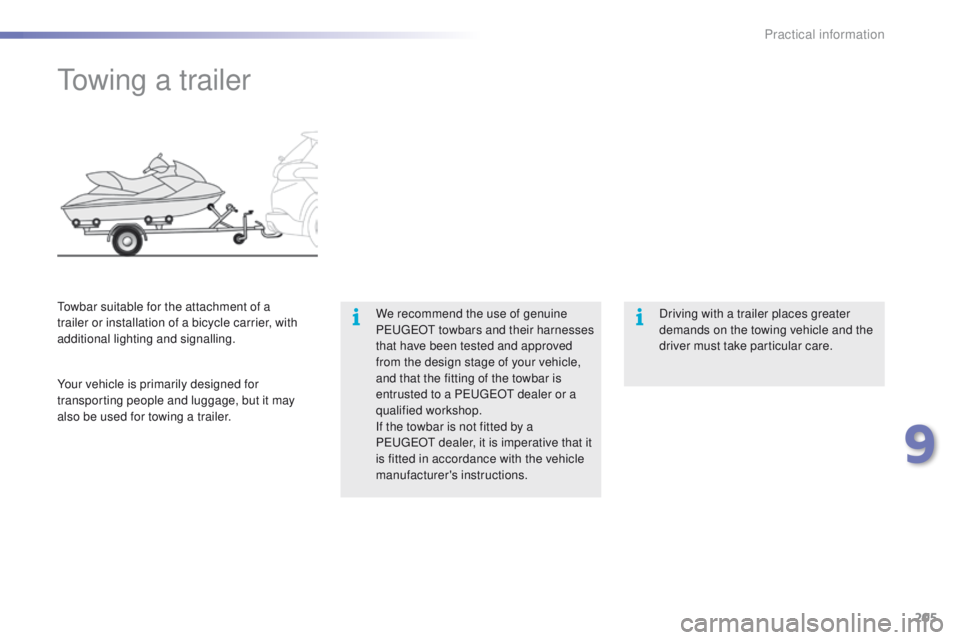
Towbar suitable for the attachment of a
trailer or installation of a bicycle carrier, with
additional lighting and signalling.
Driving with a trailer places greater
demands on the towing vehicle and the
driver must take particular care.
Your vehicle is primarily designed for
transporting people and luggage, but it may
also be used for towing a trailer.
9
Practical information
Page 208 of 340

206
2008_en_Chap09_info-pratiques_ed01-2015
Driving advice
Distribution of loads
F Distribute the load in the trailer so that the heaviest items are as close as possible to
the axle and the nose weight approaches
the maximum permitted without
exceeding
it.
Air density decreases with altitude, thus
reducing engine performance. Above
1
000 metres, the maximum towed load must
be reduced by 10
% for every 1 000 metres of
altitude.
Side wind
F Take into account the increased sensitivity to side wind.
Cooling
Towing a trailer on a slope increases the
temperature of the coolant.
As the fan is electrically controlled, its cooling
capacity is not dependent on the engine speed.
F
T
o lower the engine speed, reduce your
speed.
The maximum towed load on a long incline
depends on the gradient and the ambient
temperature.
In all cases, keep a check on the coolant
temperature.
F
I
f the warning lamp and
the
STOP warning lamp come
on, stop the vehicle and switch
off the engine as soon as
possible.
Braking
Towing a trailer increases the braking distance.
To avoid overheating of the brakes on a long
mountain type of descent, the use of engine
braking is recommended.
Ty r e s
F Check the tyre pressures of the towing vehicle and of the trailer, observing the
recommended pressures.
Lighting
F Check the electrical lighting and signalling on the trailer.
The rear parking sensors will be
deactivated automatically if a genuine
PEUGEOT towbar is used.
Refer to the "Technical data" section for details
of the weights and towed loads which apply to
your vehicle.
Practical information
Page 210 of 340

208
2008_en_Chap09_info-pratiques_ed01-2015
Accessories
A wide range of accessories and genuine parts is available from the PEUGEOT dealer network.
These accessories and parts are all suitable for your vehicle and benefit from PEUGEOT's
recommendation and warranty.
Conversion kits
You can obtain an "Enterprise" kit to convert a
private car into a trade vehicle.
"Comfort":
door deflectors, side blinds and rear blind,
cigarette lighter, boot dividers, coat hanger
fixed to head restraint, front and rear parking
sensors...
"Transport solutions":
boot liner, luggage net, roof bars, bicycle
carrier on roof bars, ski carrier, roof box,
towbars....*
T
o avoid any risk of jamming of the pedals:
-
e
nsure that the mat is positioned and
secured correctly,
-
n
ever fit one mat on top of another.
"Styling":
gear lever knob, spoiler, styling strips, alloy
wheels, trims, chromed mirror shells, mirror
personalisation kits, wheel caps and exterior
stickers.....
"Security":
anti-theft alarm, window engraving, wheel
security bolts, child seats and booster
cushions, breathalyzer, first aid kit, warning
triangle, high visibility jacket, stolen vehicle
tracking system, temporary puncture repair kit,
snow chains, non-slip covers, front foglamps
kit, dog guard...
"Protection":
mats*, seat covers compatible with lateral
airbags, mud flaps, door sill protectors, bumper
protection strips, aluminium foot rest...
The towbar must be fitted by a
PEUGEOT dealer or a qualified
workshop.
Practical information
Page 221 of 340

219
2008_en_Chap11_caracteristiques-techniques_ed01-2015
General information
Towing with a lightly loaded vehicle can
adversely affect roadholding.
Braking distances are increased when
towing a trailer.
The speed of a towing vehicle must not
exceed 60 mph (100 km/h) (comply with
the legislation in force in your country). High ambient temperatures may result
in a reduction in the per formance of the
vehicle to protect the engine; when the
ambient temperature is higher than
37 °C, limit the towed weight.
Engine characteristicsWeights and towed
loads
The engine characteristics (capacity,
maximum power, maximum power speed, fuel,
CO
2 emissions...) for your vehicle are given in
t
he registration document, as well as in sales
brochures.
These characteristics correspond to the
values type-approved on a test bed, under
conditions defined in European legislation
(Directive
1999/99/EC).
For more information, contact a PEUGEOT
dealer or a qualified workshop. The maximum weights and towed loads for your
vehicle are given are given in the registration
document, as well as in sales brochures.
These values are also present on the
manufacturer's plate or label (see the
"Identification markings" section).
For more information, contact a PEUGEOT
dealer or a qualified workshop.
The kerb weight is equal to the unladen
weight
+ driver (75 kg).
The gross train weight and towed load values
indicated apply up to a maximum altitude of
1 000 metres; the towed load mentioned
must be reduced by 10 % for every additional
1
000 metres.
The weight of the braked trailer can be
increased, within the GTW limit, on condition
that the GV W of the towing vehicle is reduced
by the same amount.
The recommended nose weight is the vertical
load on the towbar ball (removable with or
without tools).
GV W:
gross vehicle weight, the maximum authorised vehicle weight.GT W: gross train weight, the maximum authorised weight of vehicle plus trailer.
11
Technical data