2015 AUDI TT ROADSTER seats
[x] Cancel search: seatsPage 104 of 244
102 Safet y belt s
Remember too, that airbags wi ll deploy on ly
once and that your safety belts are always
there to offer protect ion in those accidents in
which airbag s are not suppo sed to deploy or
when they have already deployed . Unbelted
occupants can also be thrown out of the vehi
cle where even more severe o r fatal inju ries
can occu r.
Safety belts protect
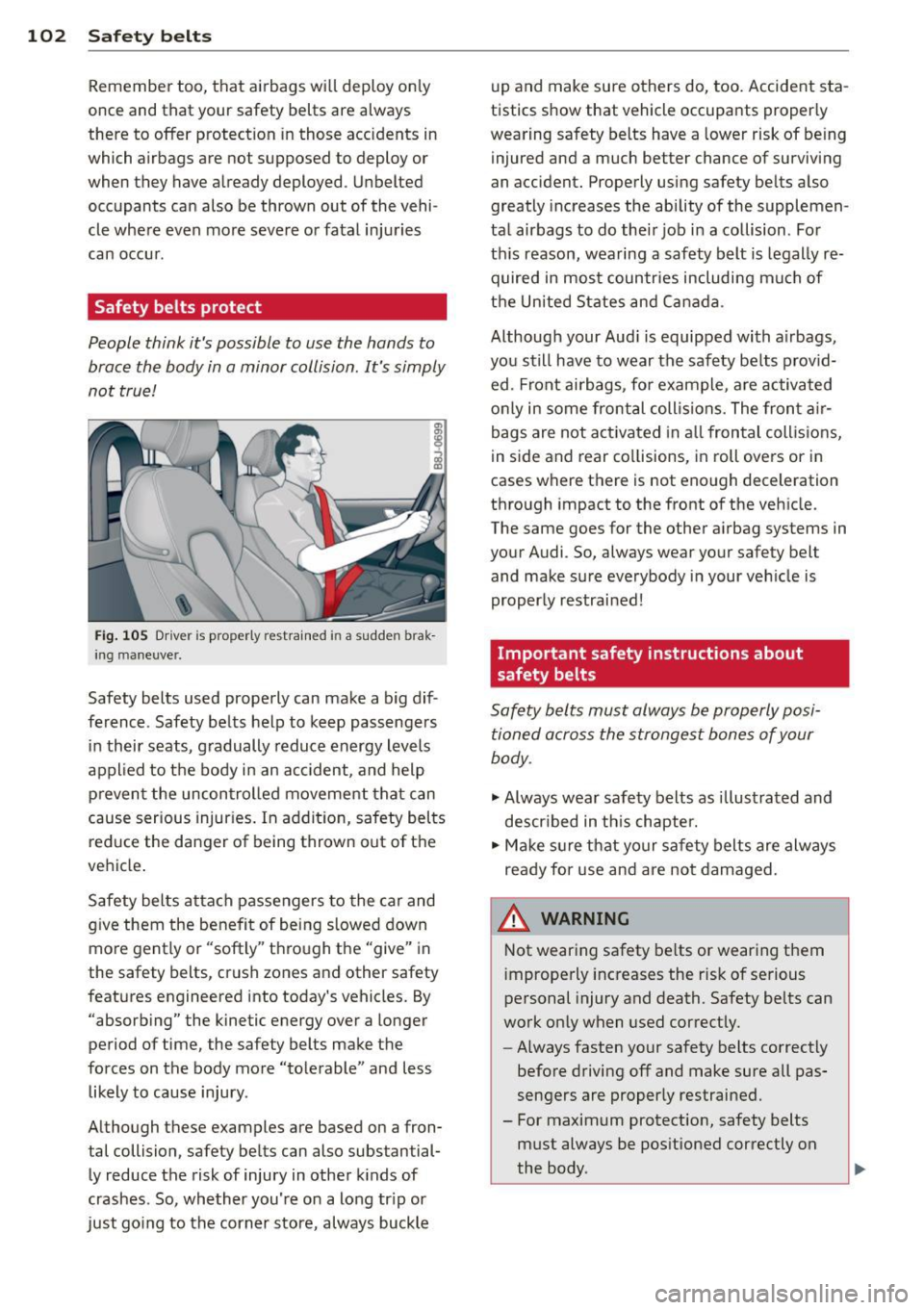
People think it's possible to use the hands to
brace the body in a minor collision. It's simply
not tru e!
Fig . 10 5 Driver is properl y re strain ed in a sudd en br ak
ing man euve r.
Safety belts used properly can make a big dif
ference . Safety be lts help to keep passengers
in their seats , g radually reduce energy levels
applied to the body in an accident, and help
preven t the uncontro lled moveme nt that can
cause serious injur ies . In additio n, safety belts
reduce the danger of being thrown out of the
ve hicle .
Safety belts attach passengers to the car and
g ive them the benefit of being s lowed down
more gently or "softly" t hrough t he "give" in
the safety belts , crush zones and other safety
fe atures engineered into today's vehicles. By
"absorb ing" the kinetic energy over a longer
period of time, the safety belts make the
forces on the body more "to lerable" and less
likely to cause injury .
Although these examples are based on a fron tal collision , safety belts can also subs tan tial
ly reduce the risk of injury in other k inds of
crashes . So, whether you' re on a long tr ip or
just going to the corner store, always buckle u
p and make sure others do, too. Accident sta
tist ics show that veh icle occupants properly
wearing safety belts have a lower risk of be ing
injured and a much better chance of surviving
an accident. Properly using safety belts also
greatly increases the ability of the supplemen
tal airbags to do the ir job i n a collision . Fo r
t hi s reason, wea ring a safety belt is legally re
quired in mos t countr ies includi ng m uch of
t h e Un ited States and Canada .
Although your Aud i is equipped wi th a irbags,
you still have to wear the safety be lts prov id
ed. Front ai rbags , fo r example , a re activated
only in some front al collisions. The fron t air
bags are not act ivated in a ll frontal coll is ions,
in side and rear co llisions, in roll overs or in
cases where there is not eno ugh deceleration
through impact to the front of the veh icle.
The same goes for the other a irbag systems in
your Aud i. So, always wear yo ur safety belt
and make su re everybody in your veh icle is
properly restrai ned!
Important safety instructions about
safety belts
Safety belts must always be properly posi
tioned across the strongest bones of your
body.
" Always wear safety belts as illust rated and
descr ibed in th is chapte r.
" Ma ke su re that yo ur safety belts are always
ready for use and are not damaged.
A WARNING
-
Not wear ing safety be lts or wearing them
i mproperly i ncreases the r is k of se rious
personal injury and death. Safety belts can
work on ly when used correctly.
- Always fasten your safety belts correct ly
befo re driving off and make sure all pas
sengers are properly restrained.
- For maximum protection, safety belts
must always be pos itioned c orrectly on
the body .
Page 106 of 244
104 Safety belts
During normal driving the belt lets you move
freely.
Safety belt pretensioners
The safety belts are equipped with a belt pre
tensioner that helps to tighten the safety belt
and remove slack when the pretensioner is ac
tivated. The function of the pretensioner is
monitored by a warning light
q page 15.
Switchable locking feature
Every safety belt except the one on the driver
seat is equipped with a switchable locking fea
ture that
must be used when the safety belt is
used to attach a child seat. Be sure to read the
important information about this feature
¢ page 137.
.&_ WARNING
Improperly positioned safety belts can
cause serious injury in an accident
¢ page 104, Safety belt position .
-Safety belts offer optimum protection
only when the seatback is upright and
belts are properly positioned on the
body .
-
- Never attach the safety belt to the buck
le for another seat. Attaching the belt to
the wrong buckle will reduce safety belt
effectiveness and can cause serious per
sonal injury.
- A passenger who is not properly restrain
ed can be seriously injured by the safety
belt itself when it moves from the stron-
ger parts of the body into critical areas
like the abdomen.
- Always lock the convertible locking re
t ractor when you are securing a child
seat in the vehicle
q page 139.
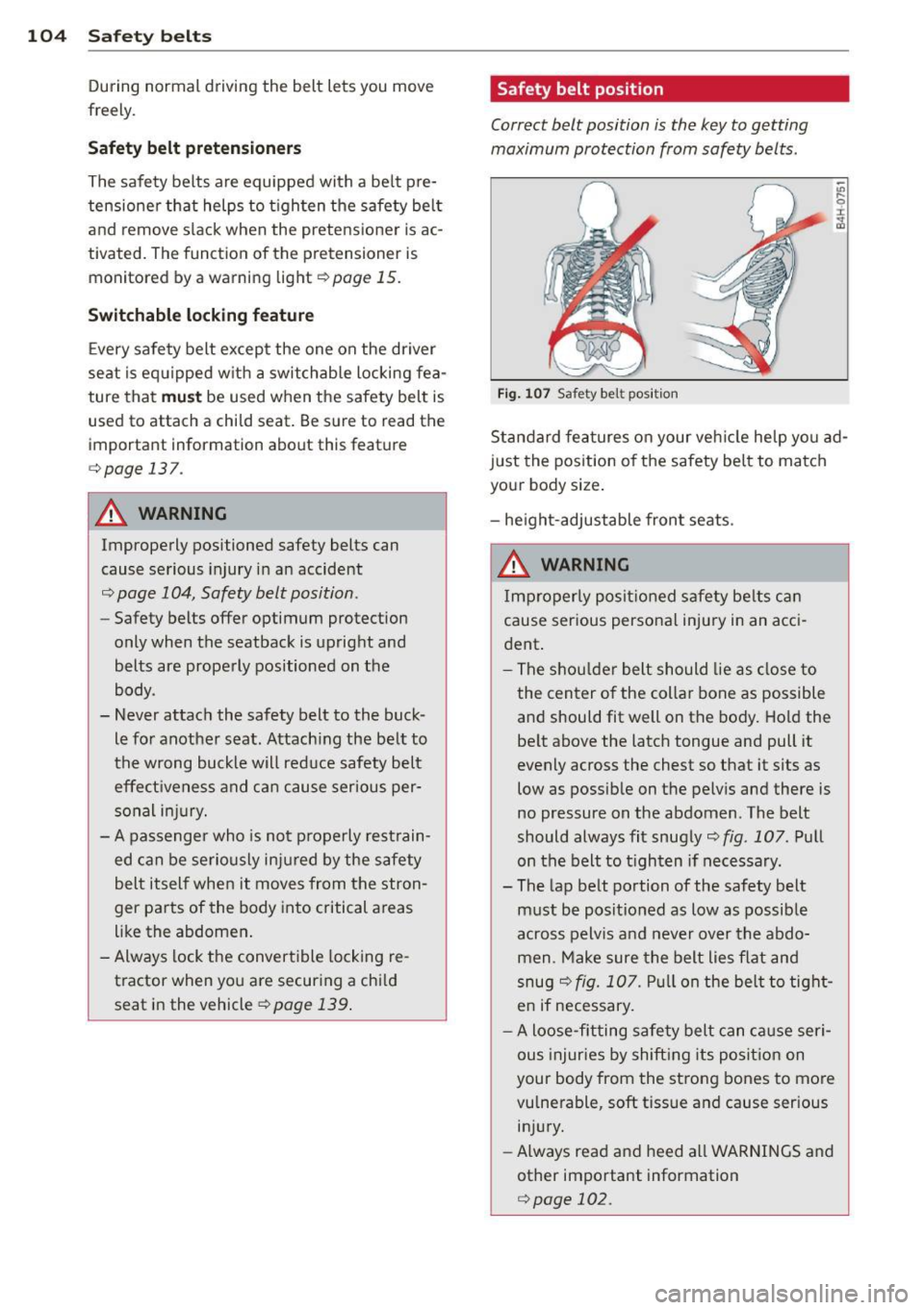
Safety belt position
Correct belt position is the key to getting
maximum protection from safety belts.
Fig. 107 Safety belt position
Standard features on your vehicle help you ad
just the position of the safety belt to match
your body size .
- height-adjustable front seats .
.&_ WARNING
Improperly positioned safety belts can
cause serious personal injury in an acci
dent.
-
- The shoulder belt should lie as close to
the center of the collar bone as possible and should fit well on the body. Hold the
belt above the latch tongue and pull it
evenly across the chest so that it sits as
low as possible on the pelvis and there is
no pressure on the abdomen . The belt
should always fit snugly
¢ fig . 10 7. Pull
on the belt to tighten if necessary .
- The lap belt portion of the safety belt
must be positioned as low as possible
across pelvis and never over the abdo
men . Make sure the belt lies flat and
snug
q fig. 107. Pull on the belt to tight
en if necessary.
- A loose-fitting safety belt can cause seri
ous injuries by shifting its position on
your body from the strong bones to more vulnerable, soft tissue and cause serious
injury.
- Always read and heed all WARNINGS and
other important information
¢page 102.
Page 111 of 244
angle of impact that will always trigger the
airbags, since the circumstances will vary con
siderably between one collision and another.
Important factors include, for example, the nature (hard or soft) of the object which the
car hits, the angle of impact, vehicle speed,
etc. The front airbags will also not inflate in
side or rear collisions, or in ro ll-overs .
A lwa ys
rem ember : Airbags will deploy only
once, and only in certa in kinds of collisions .
Your safety belts are always there to offer pro
tection in those s ituations in which airbags
are not supposed to deploy , or when they have
a lready deployed ; fo r example , when yo ur ve
h icle strikes or is struck by another after the
first collision .
This is just one of the reasons why an a irbag is
a supplementary restra int and is not a s ubst i
tute for a safety belt . The airbag system
works most effectively when used with the
safety belts. Therefore, always properly wear
your safety belts
¢ page 100.
A WARNING
Sitting too close to the steer ing wheel or
instrument panel will decrease the effec
tiveness of the airbags and will increase
the risk of pe rsonal injury in a co llision .
- Never sit closer than 10 inches (25 cm)
to the stee ring wheel or instrument pan
el.
- If you cannot sit more than 10 inches
(25 cm) from the steer ing whee l, investi
gate whether adaptive equipment may
be available to held you reach the pedals
and increase your seating dis tance from
the steering wheel.
- If you are unrestrained, lean ing fo rward,
sitting sideways or out of position in any
way, yo ur risk of inj ury is much highe r.
- You w il l also receive serio us inju ries and
cou ld even be killed if you are up against
the airbag or too close to it when it in
flates -even with an Advanced Airbag.
- To reduce the r isk o f injury when an air
bag inflates, a lways wear safety belts
proper ly ¢
page 103, Safety belts .
Airbag sys tem 109
-If ch ildren are not prope rly restrained,
they may be severely injured or killed
when an airbag inflates.
- Never let ch ildren ride unrestra ined or
improperly restrained in the vehicle. Ad
just the front seats properly.
- Always sit as far as possible from the steer ing whee l or the instrument panel
¢ page 92, Proper occupant seating po
sitions.
- Always sit upright with your back against
the backrest of your seat.
- Never p lace your feet on the instrument
panel or on t he seat. Always keep both
feet on the f loor in front of the seat to
help prevent serious in ju ries to the legs
a nd hips if the airbag inflates.
A WARNING
A irbags that have deployed in a crash must
be replaced.
- Use on ly orig inal equipment airbags ap
proved by Aud i and i nstalled by a trai ned
technician who has the ne cessary too ls
and d iagnost ic equipment to properly re
place any airbag in your vehicle and as
sure system effectiveness in a crash.
- Never perm it salvaged or recycled air
bags to be installed in you r vehicle .
Child restraints on the front seat - some
important things to know
.. Be s ure to read the important in forma tion
and head the WARNINGS for important de
tails about ch ildren and Advanced A irbags
¢ page 129.
The airbag on the passenger side makes the
front seat a pote ntially dange rous place for a
c hi ld to ride . The front seat is not the safest
pla ce for a child in a fo rward-facing child safe
ty seat.
It can be a very d angerous place for a n
infant or a chi ld in a rearwa rd -fa cing seat.
The Advanced A irbag System in you r vehicle
has been ce rtified to comply wit h the Require
ments of United States Fede ral Motor Vehicle
1111>
•
•
Page 112 of 244
110 Airbag sys te m
Safety Standard 208 as applicable at the time
your vehicle was manufactured.
The Standard requires the front a irbag on t he
passenger side to be turned off ("sup
pressed") if a child up to about one year of
age restrained in one of the rear-facing or for
ward -facing infant restra ints listed in Federal
Motor Vehicle Safety Standard 208 with which
the Advanced A irbag System in your vehicle
was certified has been installed on the front passenger seat . For a listing of the child re
straints that were used to certify compliance
with the US Safety Standard¢
page 131.
The PASSENG ER AIR BAG OFF light in the in
strument panel tells you when the front Ad
vanced A irbag on the passenger side has been
turned off by the e lectronic control unit.
Each t ime you turn on the ignition, the
PAS
SENGER AIR BA G OFF
light w ill come on for a
few seconds and:
- will stay on if the front passenger seat is not
occupied,
- will stay on if there is a small child or child
restraint on the front passenger seat,
- wi ll go off if the front passenger seat is oc
cupied by an adult as registered by the
weight-sensing mat
¢ page 118, Monitor
ing the Advanced Airbag System .
The PASSEN GER AIR BAG OFF light comes on
when the control un it detects a total weight
on the front passenger seat that requires the
front airbag to be turned off .
If the tota l weight on the front passenger
seat is more than that of a typical 1 year-old
child but less than the weight of a small
adult, t he front airbag on the passenger s ide
can dep loy (the
PAS SENGER AIR BAG OFF
light does not come o n). If the PASSENGER
AIR BAG OFF
l igh t does not come on , the
front airbag on the passenger side has not
been turned off by the electronic control unit
and can dep loy if the control unit senses an
impact that meets the conditions stored in its
memory .
For example , the airb ag ma y depl oy if :
- a small ch ild tha t is heav ier than a typical 1
year-old chi ld is on the front passenger seat
(regard less of whether the child is in one of
the child safety seats listed
¢ page 131), or
- a child who has outgrown child restraints is
on the front passenger seat.
If the front passenger airbag is turned off, the
PASSENGER AIR BAG OFF light comes on in
t h e instr ument pane l and stays on.
T he front airbag on the passenge r side may
not dep loy (the PASSENGER AIR BAG OFF
li ght does not illum inate and stay lit) even if a
small adult or teenager, or a passenger who is
not sitt ing upright w ith their back against a
non-recl ined backrest w it h their feet on the
vehicle floor in front of the seat is on the front
passenger seat¢
page 92, Proper seating po
sition for the driver .
If the front passenger airbag deploys, the
Federal Standard requ ires the airbag to meet
the "low risk" deployment cr iteria to reduce
the risk of injury th rough interact ion w ith the
airbag. "Low risk" deployment occurs in those
crashes that ta ke pla ce at lower dece le rat io ns
as de fined in t he electronic control uni t
¢ page 119, PASSENGER AIR BAG OFF light.
Always remember, a child safety seat or infant
ca rrier in stalled on the fron t seat may be
stru ck and knoc ked out of posit ion by the rap
idly in flat ing passenger 's airbag in a fronta l
collision. The a irbag co uld great ly red uce the
effectiveness of the ch ild restraint and even
seriously in jure the chi ld during inflation .
A WARNING
-
A child in a rearward-fac ing ch ild safety
seat installed on the front passenger seat
will be serious ly injured and can be killed if
the front airbag inflates -even with an Ad
van ced A irbag System.
- The inflating airbag will h it the ch ild
safety seat or infant carrie r with great
for ce and will smash the child safety seat
a nd child ag ai nst t he backrest, door or
roof.
Page 113 of 244
-Never install a rearward facing child
safety seat on the front passenger seat
unless the
PAS SEN GER AIR BAG OFF
light comes on and stays on. If the PA S
SEN GER AIR BA G OFF
light does not
com e on an d stay on th e inflating airbag
will hit the child safety seat or inf ant ca r
rier with great force and will smash the
child safety seat and child against the
backrest, door or roof . Have the airbag
system inspected immediately by your
authorized Audi dealer .
- Forward-facing chi ld safety seats instal
led on the front passenger's seat may in
terfere with the deployment of the air bag and cause serious personal injury to
the ch ild.
A WARNING
If, in exceptional c ircumstances, you must
install a forward-facing child restra int on
the front passenger's seat:
- Always make sure the forward-fac ing
seat has been des igned and certified by
its manufacturer for use on a front seat
with a passenger front and side airbag.
- Never put the forward-facing child re
straint up aga inst or very near the instru
ment pane l.
- Always move the passenger seat into its
rearmost position in the seat's fore and
aft adjus tment range, as far away from
the a irbag as poss ible be fore installing
the forward -facing child restraint. The
backrest m ust be adjusted to an upright
posit ion.
- Make sure that the
PASSENGER AIR BAG
OFF
light comes on and stays on all the
t ime whenever the ignition is switched
on.
A WARNING
To reduce the risk of serious injury, make sure that the
PASSENGER AIR BAG OFF
light will be d isplayed whenever a ch ild re
st raint is installed on the front passenger
seat and the ig nit io n is switched on.
A irbag system 11 1
-If the PASSENGER AIR BAG OF F light
does not stay on, perform the checks de
scribed
c> page 118, Monitoring the Ad
vanced Airbag System .
-Have the airbag system inspected by
your Aud i dea ler immediately.
-Always carefully follow instructions from
child restraint manufacturers when in
stalling ch ild restra ints .
A WARNING
--=
If, in except ional circumstances, you must
install a forward o r rearward-facing child
restra int on the front passenger's seat:
- Improper installation of ch ild restraints
can reduce their effectiveness or even prevent them from providing any protec
tion.
- An improperly installed ch ild restra int
can interfere with the airbag as it de
ploys and seriously inj ure o r even kill the
child -even with an Advanced Airbag
System.
- Always carefu lly follow the manu fact ur
er 's ins truc tions p rov ided with the chi ld
safety seat or carrier .
- Never p lace ad dition al items on the seat
that can increase the total weight reg is
tered by the weight-sensing mat and can cause injury in a crash.
•
•
Page 114 of 244
112 Airbag system
Front airbags
Description of front airbags
The airbag system can provide supplemental
protection to properly restrained front seat occupants.
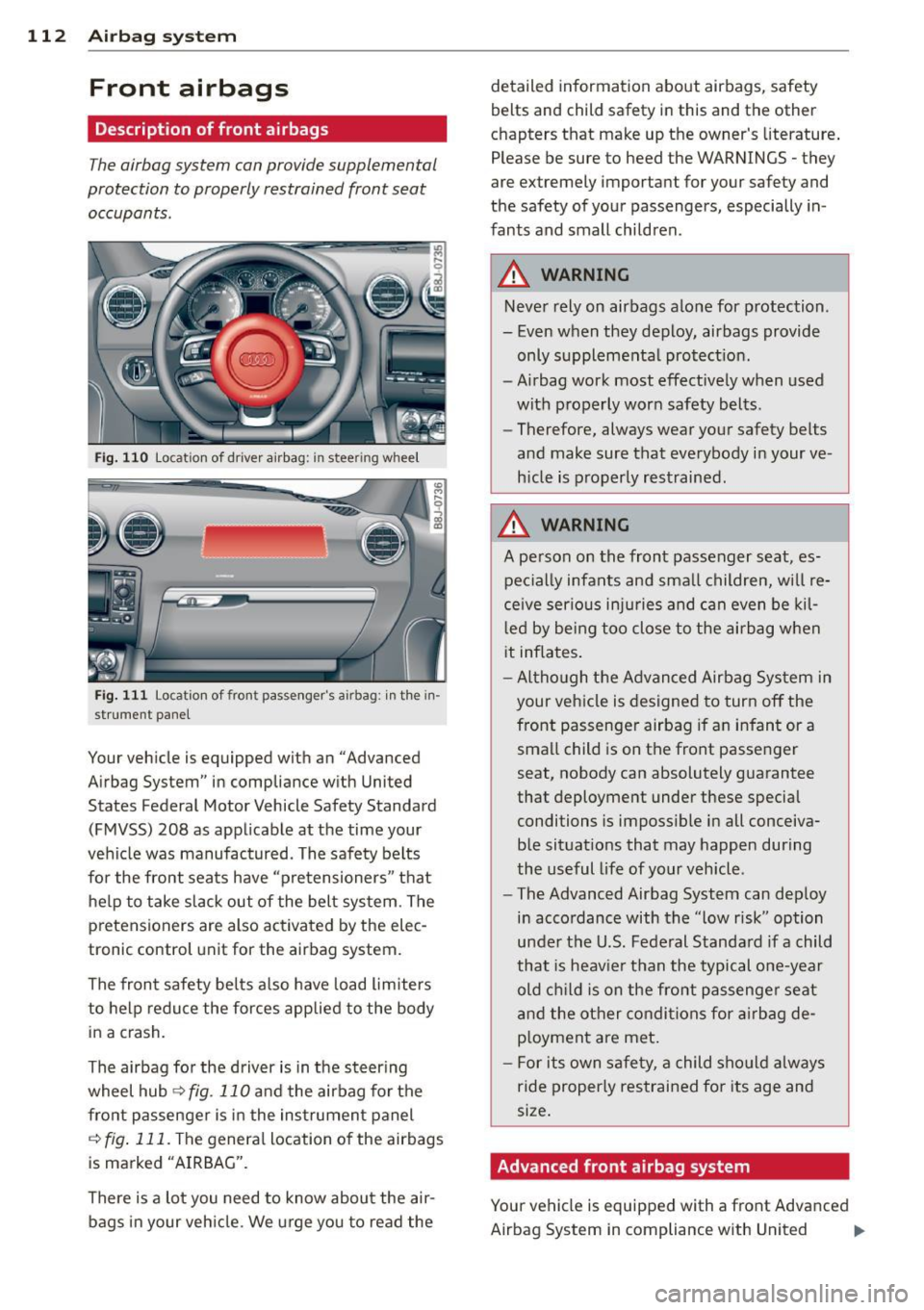
Fig . 110 Locat ion of driver airbag: in steering wheel
Fig. 111 Locatio n of front passenger 's ai rbag: in t he in·
strument panel
Your vehicle is equipped with an "Advanced
Airbag System" in compliance with United
States Federal Motor Vehicle Safety Standard
(FMVSS) 208 as applicable at the time your
vehicle was manufactured . The safety belts
for the front seats have "pretensioners" that
help to take slack out of the belt system. The
pretensioners are also activated by the elec·
tronic control unit for the airbag system.
The front safety belts also have load limiters
to help reduce the forces applied to the body in a crash.
The airbag for the driver is in the steer ing
wheel hub ¢
fig. 110 and the airbag for the
front passenger is in the instrument panel
¢
fig . 111. The general location of the airbags
is marked "AIRBAG".
There is a lot you need to know about the air
bags in your vehicle. We urge you to read the detailed information abo
ut airbags, safety
belts and child safety in this and the other
chapters that make up the owner's literature .
P lease be sure to heed the WARNINGS -they
are extremely important for your safety and
the safety of your passengers, especially in
fants and small children .
A WARNING
Never rely on airbags alone for protection .
- Even when they deploy, airbags provide only supplemental protect ion.
- Airbag work most effective ly when used
with properly worn safety belts.
- Therefore, always wear your safety belts
and make sure that eve rybody in your ve
h icle is p roperly restrained.
A WARNING
A person on the front passenger seat, es
pec ially infants and sma ll children, w ill re
ceive serious injuries and can even be kil
l ed by be ing too close to the airbag when
i t inflates .
- Al tho ugh the Advanced Airbag System in
your veh icle is designed to tur n
off the
front passenger airbag if an infant or a
small child is on the front passenger
seat, nobody can absolutely guarantee
that deployment under these special
conditions is impossible in all conceiva
b le situations that may happen during
the useful life of your vehicle .
- The Advanced Airbag System can dep loy
in accordance with the "low risk" option
under the U.S . Federal Standa rd if a child
that is heav ie r th an the typical one-year
old ch ild is on the front passenger seat
and the other condi tions for a irbag de
p loyment are met .
- F or its own safe ty, a child sho uld always
ride properly restrained for its age and
size .
Advanced front airbag system
-
Your vehicle is equipped with a front Advanced
Airbag System in compliance with United ..,_
Page 115 of 244
States Federal Motor Vehicle Safety Standard
208 as applicable at the time your vehicle was
manufactured.
The front Advanced A irbag System supp le
ments the safety belts to provide additiona l
protection for the driver's and front passeng
er's heads and upper bodies in fronta l crashes.
The airbags inflate only in frontal impacts
when the vehicle deceleration is high enough.
The front Advanced Airbag System for the
front seat occupants is not a substitute for
your safety belts. Rather, it is part of the over all occupant restraint system in your veh icle.
Always remember that the airbag system can
only help to protect you, if you are s itting up
right, wearing your safety belt and wea ring it
prope rly. This is why you and you r passenge rs
must always be properly restr ained , not just
because the law requires yo u to be.
The Advanced Airbag System in your veh icle
h as been certified to meet the "low ris k" re
qu irements for
3 and 6 year-o ld childre n on
the passenger side and very small adu lts on
the driver side. The low risk dep loyment crite
ria are intended to he lp reduce the risk of in
jury through interaction with the front airbag that can occur, for example, by be ing too
close to the steer ing wheel and instrument
panel when the airbag inflates.
In addition, the system has been certif ied to
comply w ith the "suppression" requ irements
of the Safety Standard, to turn
off the front
airbag for infants
12 months old and younger
who are restra ined o n the front passenger
seat in c hild restra ints that a re listed in the
Standa rd
¢page 131, Child restraints and
Advanced Airbags.
"Suppression" requires the front airbag on the passenger side to be turned
off i f:
- a ch ild up to about one year of age is re
stra ined on the front passenger seat in one
of the rear-facing or forward-fac ing infant
rest raints listed in Federa l Motor Veh icle
Safe ty S tanda rd 208 w it h which t he Ad
vanced Airbag System in your vehicle was certified . For a listing of the child rest raints
A irbag system 113
that were used to certify your vehicle's com
pliance with the US Safety Standard
¢ page 131,
-weight less than a thresho ld level stored in
the control unit is detected on the front pas
senger seat.
When a person is detected on the front pas
senger seat, weighing more than the total
weight of a chi ld that is about
1 year old re
stra ined in one of the rear-facing or forward
facing infant restraints (listed in Federal Mo
tor Vehicle Safety Standard 208 w ith which
the Advanced A irbag System in your vehicle
was certified), the front airbag on the passen ger side may or may not deploy.
The
PAS SENGER AIR BAG OFF lig ht comes on
when the electron ic contro l unit detects a to
ta l we ight on the front passenger seat that re
quires the front airbag to be tu rned
off. If the
PASSENGER AIR BAG OFF light does no t
come on, the fron t ai rbag on the passe nger
s ide has not been t urned
off by the contro l
u nit and can dep loy if the control unit senses
an impact that meets the cond itions stored in
its memory.
If the total weight on the front passenge r
seat is more than that of a typical
1 year-o ld,
but less than the we ight of a small ad ult, the
front a irbag on the passenger side may dep loy
(the
PASSENGER AIR BAG OFF light does not
come on) .
For example , the airb ag m ay deploy if:
- a small ch ild that is heav ier t han a typical 1
year -old chi ld is on the front passenger seat
(regard less of whether the child is in one of
the child safety seats listed
¢page 131),
-a child who has outgrown chi ld restraints is
on the front passenger seat .
If the fron t passenger airbag is turned
off, the
PASSENGER AIR BAG OFF light in the cen ter
of the instrument panel will come on and stay
on .
T he front airbag on the passenge r side may
not deploy (the PASSENGER AIR BAG OFF
light does not illuminate and stay lit) i f:
•
•
Page 117 of 244

components is detected . The function of the
airbag indicator light is described in greater
deta il below . Because the front passenger
seat contains important parts of the Ad
vanced Airbag System, you must take care to
prevent it from being damaged. Damage to
the seat may prevent the Advanced A irbag for
the front passenger seat from doing its job in
a crash.
The f ront Ad vanc ed Airb ag S ystem
consists of the following:
- Crash sensors in the front of the veh icle that
measu re ve hicle acceleration/deceleration
to provide information to the Advanced Air
bag System about the severity of the crash.
- An electronic control unit, with integrated
c rash sensors for front and side impacts.
T he contro l unit "decides" whether to fire
the front airbags based on the information
received from the crash sensors . The control
unit also "decides" whether the safety belt
pretensioners should be activated.
- An Advanced Airbag with gas generator for
the driver ins ide the steer ing wheel hub.
- An Advanced Airbag with gas generator in
side the instr ument panel for the front pas
senger.
- A weight-sensing mat under the upholstery
padding of the front passenger seat cushion
that measures the total weight on the seat.
The information registered is sent continu
ously to the electron ic control unit to regu
late dep loyment of the front Advanced Air
bag on the passenger side.
- An a irbag monitoring system and indicator
li ght in the instrument cluster
¢page 118.
-The PASSENGER AIR BAG OFF light comes
on and stays on in the center of the instru
ment pane l
¢page 119, fig. 113 and te lls
you when the front Adv anced Airbag on the
passenge r side has been turned off.
- A senso r below the safety belt latch for the
front seat passenger to me asure the tension
on the safety belt . The tens ion on the safety
belt and the weight registered by the
weight-sensing mat help the control unit
"dec ide" whether the front airbag for the
Airbag system 11 5
front passenger seat should be turned off or
not
¢ page 109, Child restraints on the
front seat -some important things to
know.
- A sensor in the safety belt latch for the driv
er and for the front seat passenger that
senses whether that safety belt is latched or
not and transmits this information to the
electronic control unit .
.&, WARNING
Damage to the front passenger seat can
prevent the front airbag from wor king
properly.
- Improper repai r or d isassembly of the
front passenge r and dr iver seat will pre
vent the Advanced Airbag System from
functioning properly.
- Repairs to the front passenge r seat must
be pe rformed by qualified and p roperly
trained workshop personne l.
- Never remove the front passenger o r
driver seat from the vehicle .
- Never remove the upholstery from the
front passenger seat.
- Neve r d isassemble o r remove parts from
the seat or disconnec t wires from it.
- Never carry sharp objects in you r pockets
or place t hem on the seat. If the weight
sens ing ma t in the passenge r seat is
punctured it cannot work properly .
- Neve r carry things on you r lap or carry
objects on the passenger seat. Such
items can increase the weight registered
by the weight-sensing mat and send the
wrong information to the airbag co ntrol
un it.
- Never store items under the front pas
senger seat. Parts o f the Advanced Air
bag System under the passenger seat
could be damaged, preventing them and
the airbag system from working proper ly.
- Never p lace seat covers or rep lacement
upholstery that have not been specifica l
ly approved by Audi on the front seats.
- Seat covers can prevent the Advanced
Airbag System from recognizing chi ld
Ill>
•
•