2015 AUDI TT ROADSTER seats
[x] Cancel search: seatsPage 118 of 244
116 Airbag sys te m
res traints or occupants on the fr ont pas
senger seat and prevent the sid e airbag
in t he seat backrest from deploying prop
erly.
- Never use cushions, pillows, blankets or
similar items on t he front passenger
seat . The add itional padd ing will prevent
the weight-sensing mat in the seat from
accurately reg istering the ch ild restra int
or person on the seat and prevent the
Advanced Airbag System from function ing properly .
- If you mus t use a child restra int on the
front passenger seat and the ch ild re
straint manufacturer's instructions re
quire the use of a towel, foam cushion or
something else to properly position the
child restraint, make certa in that the
PA SSENGER AIR BAG OFF light comes
on and stays on whenever the child re
st raint is installed on the front passen
ger seat .
- If the
PA SSENGER AIR BAG OFF light
does not come on and stay on, have the
airbag system inspected by your Audi
dealer.
How the Advanced Airbag System
components work together
The front Advanced Airbag System and the
side airbags s upplement the protection of
fered by the front three-point safety be lts
with pretensioners and load limiters and the
adjustab le head restra ints to he lp reduce the
risk of injury in a w ide range of acc ident and
crash situat ions . Be sure to read the impo r
tant information about safety and heed the
WARNINGS i n this chapter .
Deployment of the Advanced Airbag System
and the activat ion of the safety be lt preten
sione rs depend on t he dece le rat ion meas ured
by the c rash senso rs and regis tered by the
e lectronic control un it . Crash severity depends
on speed and dece leration as well as the mass
and stiffness of the vehicle o r object involved
in the crash. When the e
lectronic contro l unit registe rs a
low severity cras h and the safety belt is being
u sed, the airbag will not dep loy.
If the sa fety
belt is not being used, the first stage deploys,
followed by the second stage after a much lat er t ime in t he crash sequence.
If the electron ic contro l unit registers a crash
of medium severity, the first stage of the air
bag deploys followed by the second stage at a
much later time in the crash sequence -re
gardless of whether the safety belt is be ing
u sed or not . In higher sever ity c rashes as reg
i ste red by the elec tronic con tro l un it, bo th the
first and se con d stages dep loy almost at the
same t ime.
On the passeng er side, rega rdless of safety
belt use, t he a irbag w ill be tu rned off if the
we ight on the passenger seat is less th an the
amount programmed in the e lectronic control
u nit . The front airbag on the passenge r side
will a lso be turned off if one of the child safe
ty seats that has been certified under Federal
Motor Vehicle Safety Standard 208 has been
recogni zed on the seat . The
PASSENGER AIR
BAG OFF light comes on and stays on to tell
yo u when the front Advanced A irbag on the
passenge r side has been turned off
¢ page 109, Child restraints on the front seat
- some important things to know .
.&_ WARNING ~
To reduce the risk of in ju ry when an a irba g
inflates , always wear safety be lts p roperly.
- If you are unrestra ined, leaning forw ard ,
sitt ing s ideways or o ut o f position in any
way, your risk of injury is m uch higher.
- You will a lso receive se rious injuries and
could even be killed if you a re up against
the airbag or too close to it when it in
f lates - even with an Advanced A irbag
¢page 108.
Page 119 of 244
More important things to know about
front a irbags
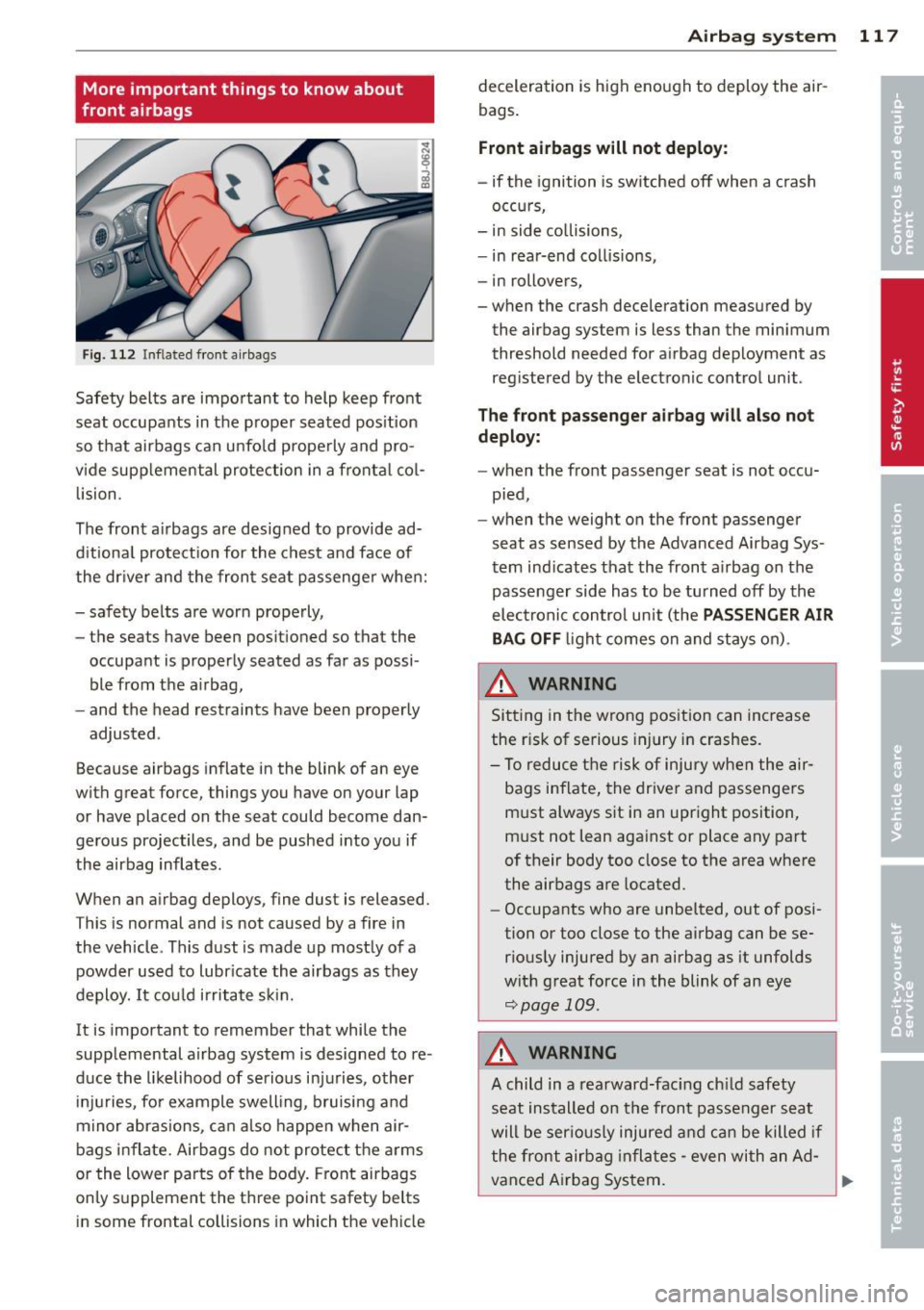
F ig. 112 Inflated front airba gs
Safety belts are important to help keep front
seat occupants in the proper seated pos it ion
so that airbags can u nfold prope rly and pro
v ide supp lemental protection in a fronta l co l
lision .
The front a irbags are designed to provide ad
d itiona l protect io n for the chest and face of
the dr iver and the fron t seat passenger whe n:
- safety belts are wor n prope rly,
- the seats have been posit ioned so tha t the
occupant is proper ly seated as far as possi
ble from the a irbag,
- and the head restraints have been properly
adjusted .
Because airbags inflate in the blink of an eye
with great force, things you have on your lap or have placed on the seat could become dan
gerous projectiles, and be pushed into you if
the airbag inflates .
When an a irbag deploys, fine dust is released.
This is normal and is not caused by a fire in
the vehicle . This dust is made up most ly of a
powder used to lubr icate the airbags as they
deploy. It cou ld i rritate s kin .
It is important to remember that while the
supp lemental airbag system is designed to re
duce the likelihood of serious i njuries, other
inj uries, fo r example swell ing, bru isi ng a nd
minor abrasions, ca n also happen when air
bags inflate. Airbags do not protect the a rms
or the lower pa rts of the body. Front airbags
only s upplement the t hree point safety be lts
in some frontal collisions in which the vehicle
A irba g sy stem 11 7
deceleration is high eno ugh to deploy the air
bags .
Front airbags will not deploy :
-if t he ignition is sw itched off when a crash
occu rs,
- in side co llisions,
- in rear-end co llis ions,
- in rollovers,
- when the crash dece leration measured by
the airbag system is less than the minimum
threshold needed for a irbag deployment as
reg istered by the electronic con tro l unit .
The front pa ssenger airbag will also not
deploy:
- when the front passenge r seat is not occu
pied,
- when the weight on the front passenger
seat as sensed by the Advanced Airbag Sys
tem ind icates that the front a irbag on the
passenger side has to be tu rned off by th e
elec tronic con trol un it (the
PASSENGER AIR
BAG OFF
li ght comes on and st ays o n).
&_ WARNING ~
Si tti ng in the wrong pos ition can inc rease
the r isk of se rious in ju ry in crashes.
- To reduce t he ris k of injury when the air
ba gs inflate, the drive r and passenge rs
must always s it in an upr ight position,
m ust not lean against or place any part
of their body too close to the area whe re
the airbags a re located.
- Occupants who are unbe lted, out of posi
tion or too close to the airbag can be se rious ly injured by an airbag as it unfolds
with g reat force in the blink of an eye
~page 109 .
&_ WARNING
-
A child in a rearwar d-fac ing ch ild safety
seat installed on th e front passe nger seat
will be ser ious ly injured a nd ca n be killed if
the front ai rb ag inflate s - even wi th an Ad-
vanced Ai rbag Sys tem.
Ill-
Page 123 of 244
-If you must install a rearward facing
child safety seat on the front passenger
seat because of exceptional circumstan ces and the
PA SSE NGER AI R BAG OFF
light does not appear and stay on have
the a irbag system inspected by your Audi
dealer.
- A tight tether or other strap on a rear
ward-fac ing child restra int attached to
the front passenger seat can put too much pressure on the weight-sens ing
mat in the seat and register more weight
than is actually on the seat. The heavier
weight registered can make the system
work as though an adu lt were on the seat
and deploy the Advanced Airbag when it
must be suppressed caus ing serious or
even fatal injury to the child .
- If, in exceptional circ umstances, you
must install a forward-facing child re
st raint on the front passenger seat, a l
ways move the seat into its rearmost po
sit ion in the seat's fo re and aft adjust
ment range, as far away from the airb ag
as possib le . The backrest m ust be adjust
ed to an upright position. Make sure that
the
PASSENGER AIR BAG OFF light
comes on and stays on all the t ime when
ever the ignition is switched on.
A WARNING
- If the PASSENGER AIR BAG OFF light
does not go out when an adult is sitting
on the front passenger seat after taking
the steps described above, have the air
bag system inspected by your Aud i deal
er before transporting anyone on the
front passenger seat.
(Di Tips
If the weight-sensing mat in the front pas
senger seat detects an empty seat, the
front airbag on the pa ssenge r side will be
t urned off, and
PASSENGER AIR BAG OFF
w ill stay on .
Airbag system 12 1
Repair, care and disposal of the airbags
Parts of the airbag system are i nstalled at
many diffe rent p laces o n your Aud i. Insta llin g,
removing, servicing or repa iring a part in an
area of the vehicle can damage a part of an
airbag system and prevent that system from
working properly in a coll is ion.
T he re a re some important t hings you have to
know to make sure that the effectiveness o f
the system wi ll not be impaired and that dis
carded components do not cause injury or pol
lute the environment.
A WARNING
Improper care, serv ic ing and repair proce
dures can increase the risk of personal in
jury and death by preventing an a irbag
from deploying when needed or deploying
an a irbag unexpec tedly:
- Never cover, obst ruct, or change the
steer ing whee l horn pad or airbag cover
or the inst rument panel or mod ify them
in any w ay .
- Never attach any objects s uch as c up
holders or telephone mountings to the
surfaces covering the a irbag un its .
- For cleaning the horn pad or instr ument
panel, use only a soft, dry cloth or one
mo istened with pla in water. Solvents or
cleaners could damage the airbag cover
or change the st iffness or strength of the
material so that the airbag cannot de
ploy and protect properly.
- Never repair, adjust, or change any parts
of the a irbag system.
- All work on the steering wheel, instru
ment panel, front seats or e lectr ica l sys
tem (including the installation of audio
equ ipment, cellular telephones and CB
radios, etc.) must be performed by a
qualified technic ian who has the training
and specia l equipment necessary.
- For any work on the airbag system, we
strongly recommend that you see your
author ized Audi dealer or qualified work-
shop.
~
•
•
Page 134 of 244
132 Child Saf ety
Model Manufactured on or
a fter
Cosco Summit Deluxe September 25, 2007
High Back Booster
22-262
Cosco High Back September 2S, 2007
Booster 22-209
Evenflo Tribute V September 2S, 2007
379xxxx
Evenflo Medallion December 1, 1999
2S4
Evenflo Generations September 2S, 2007
3S2xxxx
Graco ComfortSport September 2S, 2007
Graco Toddler Safety September 25, 2007
Seat Step 2
Graco Platinum Cargo September 25, 2007
_& WARNING
To reduce the risk of serious injury, make sure that the
PA SSENGER AIR BAG OFF
light comes on and stays on whenever a
child restraint is installed on the front pas
senger seat and the ignition is switched
on.
- Never install a rearward facing child
safety seat on the front passenger seat
unless the
PASSENGER AIR BAG OFF
light comes on and stays on. If the PA S
SENGER AIR BAG OFF
light does not
come on and stay on the inflating airbag
wi ll hi t the child safety seat o r infant car
rier with great force and will smash the
child safety seat and child against the
backrest, door or roo f. Have the airbag
system inspected immediately by your
Audi dealer.
@ Tips
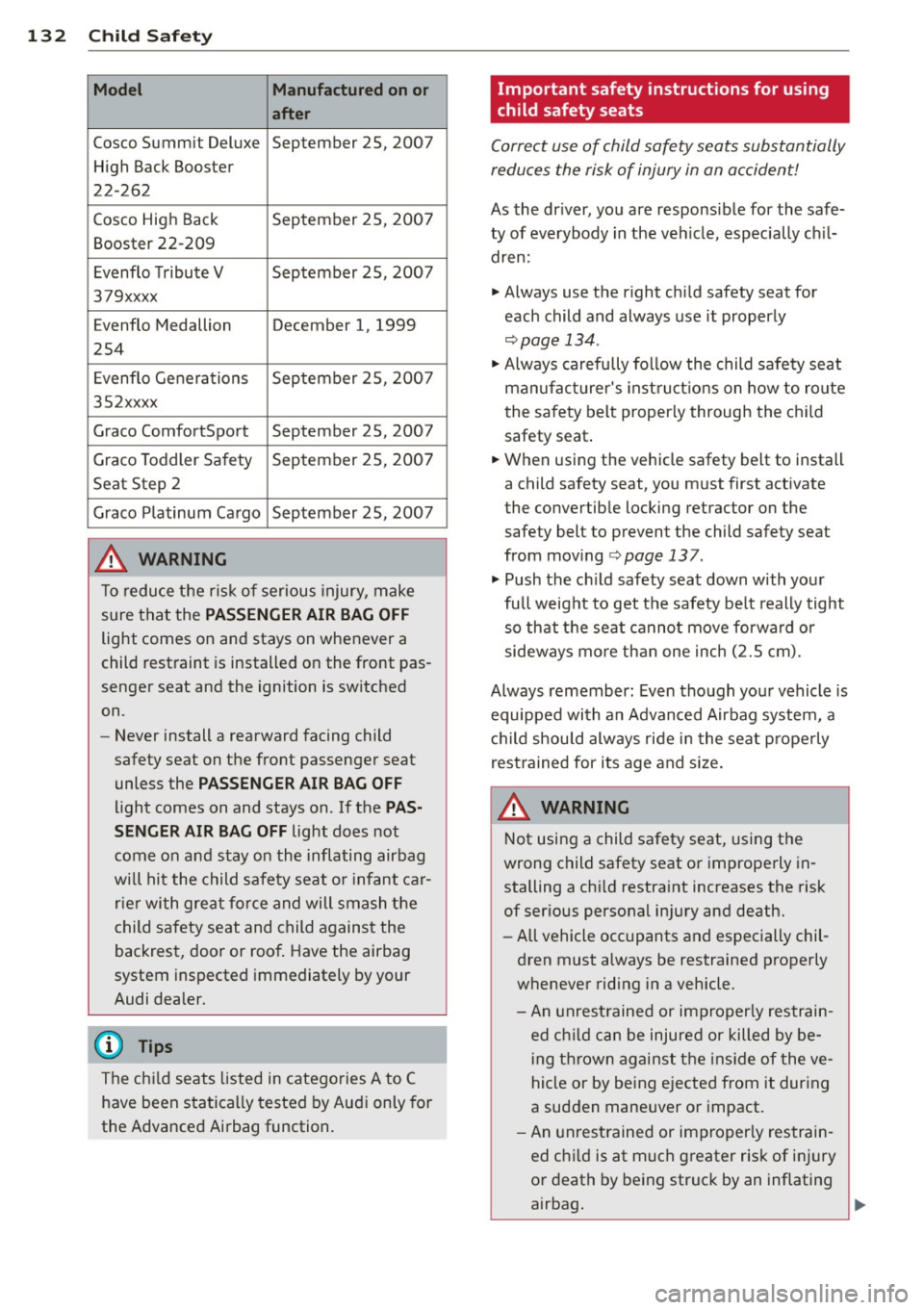
The ch ild seats listed in categories A to C
have been statica lly tested by Aud i only for
the Advanced Airbag function.
Important safety instructions for using
child safety seats
Correct use of child safety seats substantially
reduces the risk of injury in an accident!
As the dr iver, you are respons ible for the safe
ty of everybody in the veh icle, especially ch il
dren:
.,. Always use the right ch ild safety seat for
each child and always use it properly
~page 134.
.,. Always carefully fo llow the child safety seat
manufac turer's inst ruct ions on how to ro ute
the sa fety belt properly through the child
safety seat .
.,. When using the vehicle safety belt to install
a child safety seat, you must first activate
the convertible locking retractor on the
safety belt to prevent the child safety seat
from mov ing
r=> page 137 .
.,. Push the ch ild safety seat down with you r
full weight to get the safety be lt really tight
s o that t he seat canno t move fo rward o r
sideways more th an one inch
(2.5 cm).
Always remember : Even though you r vehicle is
equipped with an Advanced Airbag system, a
c hi ld shou ld always ride i n the seat properly
r estrained for its age and s ize.
_& WARNING ,..___
Not using a child safety seat, using the
wrong child safety seat o r improperly in
stalling a ch ild restra int increases the risk
of ser ious personal in jury and death.
- All vehicle occupants and especially chil
dren must always be restrained properly
whenever rid ing i n a vehicle.
- An un rest rained or imp roperly restrain
ed ch ild ca n be injured or killed by be
ing t hrown agains t th e ins ide of the ve
hicle or by being e jected from it during
a sud den mane uver or impact.
- An unrestrained or improper ly res train
ed ch ild is at much greater risk of injury
or death by be ing struck by an inflating
airbag.
Page 135 of 244
-Commercially available child safety seats
are required to comply with U.S. Federal
Motor Vehicle Safety Standard (FMVSS)
213 (in Canada CMVSS 213).
- When buying a child restraint, select
one that fits your child and the vehicle.
- Only use child restraint systems that
fully contact the flat portion of the
seat cushion. The child restraint must not tip or lean to either side. Audi does
not recommend using child safety
seats that rest on legs or tube-like
frames. They do not provide adequate contact with the seat.
- Always heed all legal requirements per
taining to the installation and use of
child safety seats and carefully follow
the instructions provided by the manu
facturer of the seat you are using .
- Never let more than one child occupy a
child safety seat .
- Never let babies or older children ride in
a vehicle while sitting on the lap of an
other passenger .
- Holding a child in your arms is never a substitute for a child restraint system.
- The strongest person could not hold
the child with the forces that exist in
an accident. The child will strike the in
terior of the vehicle and can also be
struck by the passenger .
- The child and the passenger can also
injure each another in an accident.
- Never install a rearward facing child
safety seat on the front passenger seat
unless the
PASSENGER AIR BAG OFF
light comes on and stays on . If the PAS
SENGER AIR BAG OFF
light does not
come on and stay on the inflating airbag
will hit the child safety seat or infant car
rier with great force and will smash the
child safety seat and child against the
backrest, door or roof. Have the airbag
system inspected immediately by your
Audi dealer.
- Forward-facing child safety seats instal
led on the front passenger's seat can in-
Child Safety 133
terfere with the airbag when it inflates
and cause serious injury to the child.
- If exceptional circumstances require the
use of a forward-facing child restraint on
the front passenger's seat, the child's
safety and well-being require that the
following special precautions be taken:
- Make sure the forward-facing seat has
been designed and certified by its man
ufacturer for use on a front seat with a
passenger front and side airbag.
- Always carefully follow the manufac
turer's instructions provided with the
child safety seat or carrier.
- Always move the front passenger seat
into the rearmost position of the pas
senger seat's fore and aft adjustment range, and as far away from the airbag
as possible before installing the child restraint.
- Always make sure that nothing pre
vents the front passenger's seat from
being moved to the rearmost position
in its fore and aft adjustment range .
- Always make sure that the backrest is
in the upright position .
- Always buckle the child safety seat firmly
in place even if a child is not sitting in it.
A loose child safety seat can fly around
during a sudden stop or in a collision.
- Always read and heed all WARNINGS
whenever using a child restrained in ave hicle is being used<=>
page 100, Safety
belts,
<=> page 108, Airbag system and
<=> page 129, Child Safety.
A WARNING
To reduce the risk of serious injury, make
sure that the
PASSENGER AIR BAG OFF
light comes on and stays on whenever a
child restraint is installed on the front pas
senger seat and the ignition is switched
on .
- Never install a rearward facing child
safety seat on the front passenger seat
unless the
PASSENGER AIR BAG OFF
•
•
Page 136 of 244
134 Child Safe ty
light comes on and stays on. If the PAS·
SEN GER AIR BAG OFF
light does not
come on and stay on the inflating airbag
will hit the child safety seat or infant car
rier with great force and will smash the
child safety seat and child against the
backrest, door or roof. Have the airbag
system inspected immediately by your
Audi dealer .
Child safety seats
Infant seats
Babies and infants up to about one year old
and 20 lbs. or
9 kg need special rearward-fac
ing child restraints that support the back,
neck and head in a crash.
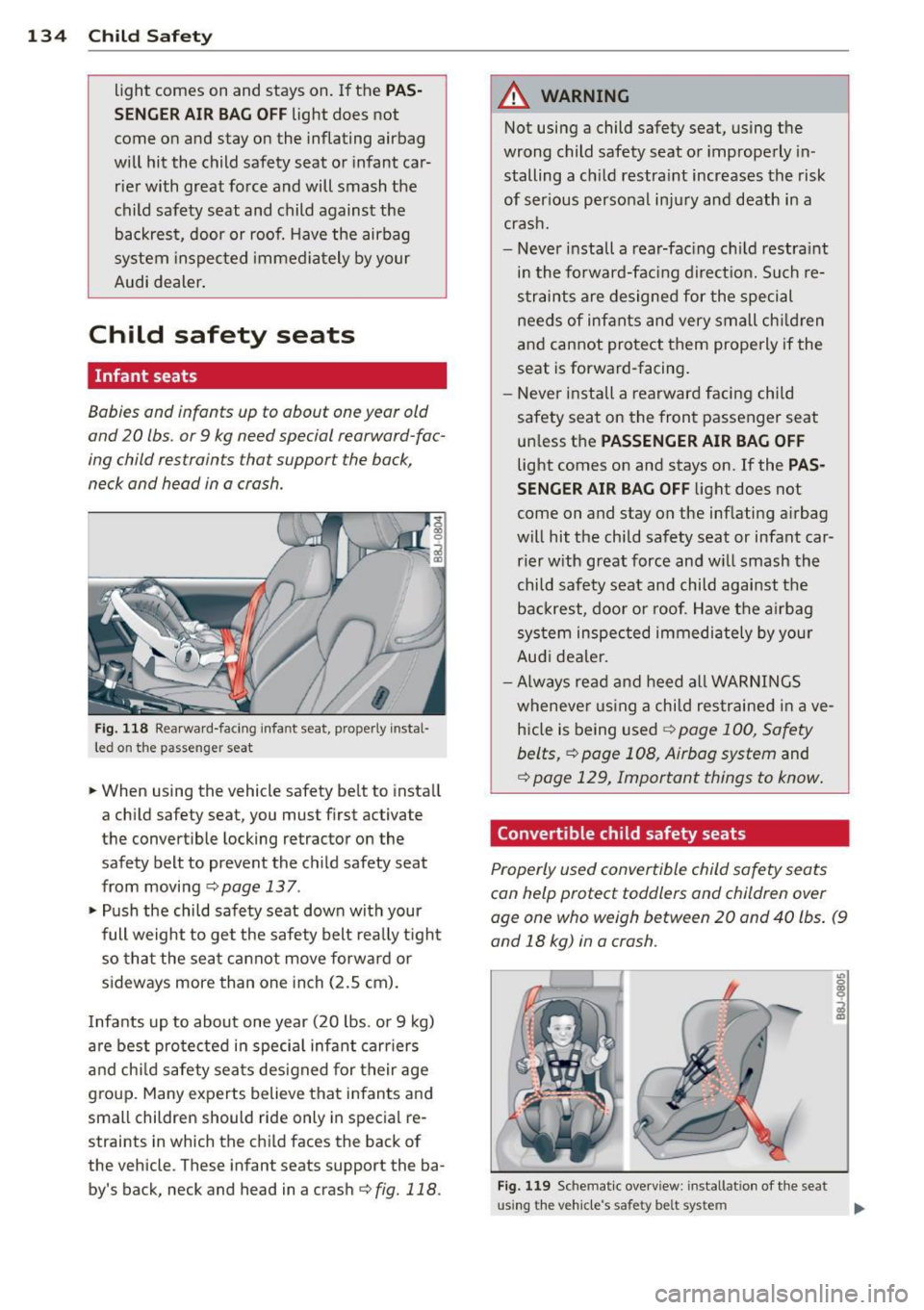
I
Fi g. 118 Rearwa rd-facing infant seat, proper ly insta l·
led on the passenge r seat
~ When using the vehicle safety belt to install
a child safety seat, you must first activate
the convertible locking retractor on the
safety belt to prevent the child safety seat
from moving
c:::;, page 13 7 .
~ Push the child safety seat down with your
full weight to get the safety belt rea lly t ight
so that the seat cannot move forward or
sideways more than one inch (2.5 cm).
I nfants up to about one year (20 lbs . or 9 kg)
are best protected in specia l infant carriers
and chi ld safety seats des igned for their age
group. Many experts believe that infants and
small children should ride only in special re
straints in which the child faces the back of
the vehicle. These infant seats support the ba·
by's back, neck and head in a crash
c:::;, fig. 118 .
A WARNING
-
Not using a child safety seat, using the
wrong child safety seat or improperly in
stalling a ch ild restra int increases the risk
of ser ious personal in jury and death in a
crash.
- Never install a rear-fac ing ch ild restra int
in the forward-fac ing direct ion. Such re
straints are designed for the special
needs of infants and very small ch ildren
and cannot protect them properly if the
seat is forward-facing.
- Neve r install a rearward faci ng ch ild
safety seat on the front passenger seat
un less the
PASSENGER AIR BAG OFF
light comes on and stays on. If the PAS
SENGER AIR BAG OF F
light does not
come on and stay on the inflating airbag
will hit the child safety seat or infant car
rier with great force and w ill smash the
child safety seat and child against the
backrest, door or roof. Have the a irbag
system inspected immediately by your
Aud i dealer.
- Always read and heed all WAR NINGS
wheneve r using a child res trained in ave
hicle is being used
c:::;, page 100, Safety
belts,
c:::;, page 108, Airbag system and
c:::;, page 129, Important things to know .
Convertible child safety seats
Properly used convertible child safety seats
can help protect toddlers and children over
age one who weigh between 20 and 40 lbs . (9
and 18 kg) in a crash .
Fig . 1 19 Schema tic overview: ins tallat ion of the seat
using the vehicle's safety be lt sys te m
Ill>
Page 138 of 244
136 Child Safet y
Booster seats and safety belts
Properly used booster s eats can help protect
children weighing between about 40 lbs . and
80 lbs . (18 kg and 36 kg) who are less than 4
ft. 9 in. (57 inches/1 .45 meters) tall.
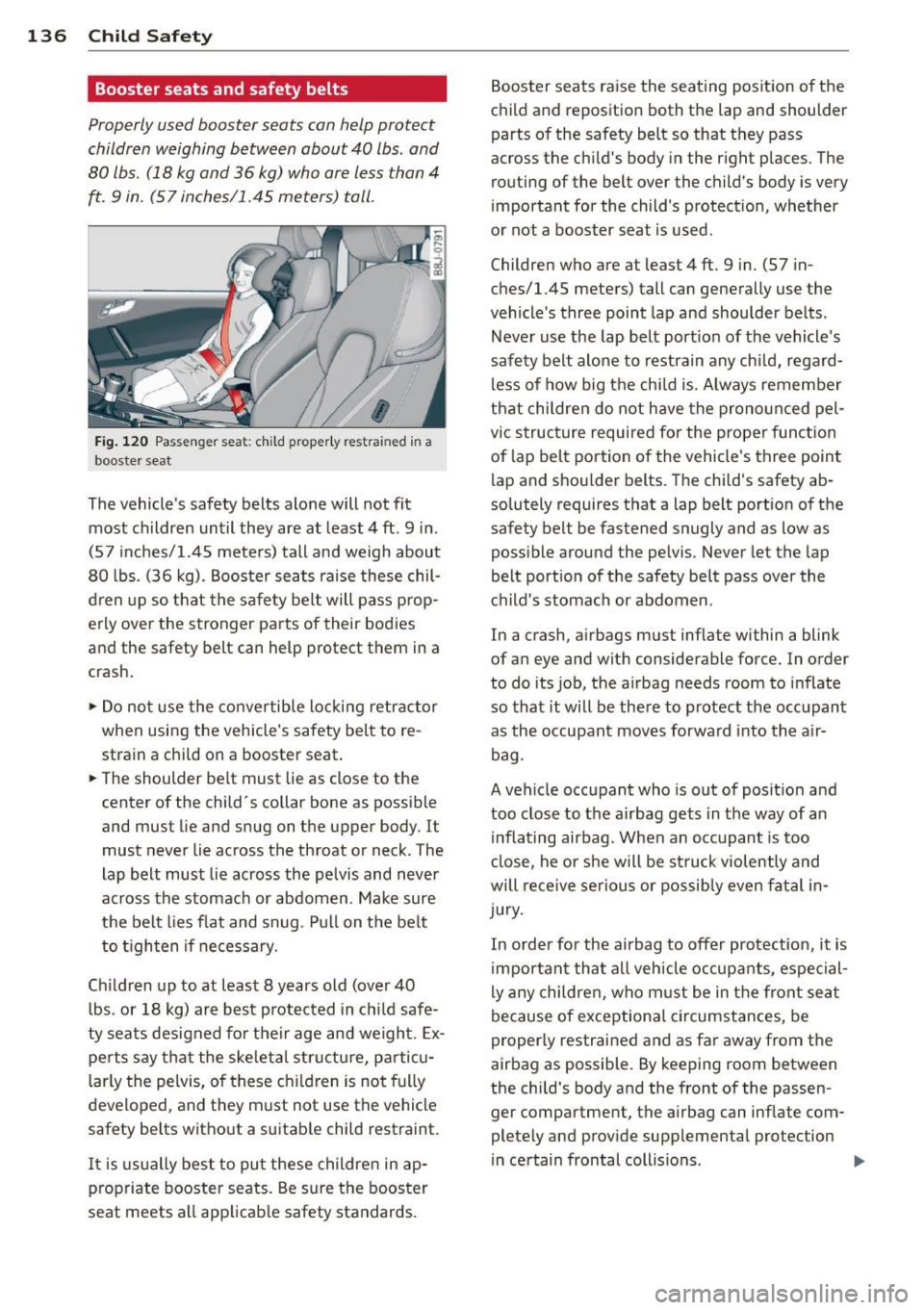
Fig . 120 Passenger seat: child proper ly rest ra in ed in a
booster seat
The vehicle's safety belts alone will not fit
most children until they are at least 4
ft. 9 in .
(57 inches/1.45 mete rs) tall and weigh about
80 lbs . (36 kg). Booster seats ra ise these chil
dren up so that the sa fety belt will pass p rop
erly over the stronger pa rts of their bodies
and the safety belt can help protect them in a
crash.
.. Do no t use the co nvertible locki ng retractor
when using the vehicle's safety belt to re strain a chi ld on a booster seat .
.. The shoulder be lt must lie as close to the
center of the child 's collar bone as possible
and must lie and snug on the upper body. It
must never lie across the throat or neck . The
lap belt must
lie across the pelvis and never
across the stomach or abdomen . Make sure
the belt lies f lat and snug . Pull on the be lt
to t ighten if necessary.
Ch ildren up to at least 8 years old (over 40
l bs. or 18 kg) are best protected in ch ild safe
ty seats designed fo r their age and weight . Ex
pe rts say that the ske leta l structure, pa rticu
larly the pelvis, of these ch ildren is not ful ly
developed , and they m ust not use the vehicle
safety belts without a suitab le child restraint.
It is us ually best to put these childre n in ap
propriate booster seats . Be sure the booster
seat meets all applicab le safety standards. Booster seats raise the seating position of the
c
h ild and reposition both the lap and shoulder
parts of the safety belt so that they pass
across the ch ild's body in the right p laces. The
ro uting of the belt over the child's body is very
important for the child's protect ion, whether
o r not a booster seat is used .
Children who are at least 4
ft. 9 in. (57 in
ches/1.45 meters) tall can generally use the
vehicle's three point lap and shoulder belts .
Never use the lap belt port io n of the vehicle's
safety belt alone to restrain any ch ild, regard
less of how big the chi ld is. A lways remember
that children do not have the prono unced pel
vi c structure required for the proper funct ion
of lap be lt portion of the vehicle's three point
lap and shou lde r belts . T he child 's safety ab
solutely requires that a lap belt port ion of the
safety belt be fastened snugly and as low as
possible around the pelvis. Never let the lap
belt portion of the safety be lt pass over the
c hi ld 's stomach or abdomen.
In a crash, a irbags must inflate within a blink
of a n eye and wi th considerable force. In order
to do its job, the airbag needs room to inflate
so that it will be the re to protect t he occupant
as the occupant moves forwa rd into the a ir
bag .
A vehicle occupant who is out of posit ion and
too close to the a irbag gets in t he way of an
inflating airbag . When an occupant is too
cl ose, he or she w ill be struck v iolently and
will receive serious or possibly even fatal in
Jury .
In order for the airbag to offer prote ction, it is
importan t that a ll vehicle occupa nts, espe cial
ly any childre n, who m ust be in t he front se at
because of exceptiona l circumstances , be
proper ly restrained and as fa r away from the
airbag as possible. By keeping room between
the chi ld's body and the front of the passen
ger compartment, the airbag can inf late com
pletely and prov ide supplemental protection
in certain frontal collisions .
..
Page 139 of 244
A WARNING ,~ ~
Not using a booster seat, us ing the boos
ter seat improperly, incorrectly install ing a
booster seat or using the vehicle safety
belt improperly increases the risk of seri
ous pe rsonal injury and death in a co llision
or other emergency s ituation. To help re
duce t he risk of serious persona l injury
and/or death:
- T he shoulder be lt mus t lie as close to t he
center o f the child's co llar bone as poss i
ble and must lie and snug on the upper
body . It must never lie across the throat
or neck. The lap belt must lie across the
pelvis and never across the stomach or
abdomen. Make sure the belt lies f lat
and snug . Pull on the belt to t ighten if
necessary .
- Failure to properly route safety belts over a ch ild's body will cause severe inju
ries in an acc ident or other emergency
situation
¢ page 100 .
-Children on the front seat of any car ,
even with Adva nced A irbags, can be seri
o usly injured or eve n killed when an a ir
bag inf lates.
- Never let a child stand or knee l on the
sea t.
- Never let a child ride in the ca rgo a rea of
yo ur vehicle .
- Always remember that a ch ild lean ing
forwar d, sit tin g s ideways o r out of posi
tio n in any way during an a ccident ca n be
stru ck by a deploying airbag. This will re
s u lt in serious personal injury or deat h.
- If you mus t inst all a b oos ter sea t on the
front passenger seat because of excep
tional circumstances the
PASSENGER
AIR BAG OFF
light must come on and
stay on, whenever the ignition is switch
ed on.
- If the
PASSENGER AIR BAG O FF light
does not come on and stay on, perform
the checks described
¢page 118, Moni
toring the Advanced Airbag System .
-If the PASSENGER AIR BAG OFF light
does not come on and stay on whenever
Child Sa fet y 137
the ignition is switched on the inflating
airbag w ill hit the child safety seat or in
fant carrier wit h great force and will
smash the child safety seat and child
aga inst the backrest, door o r roof . Have
the airbag system ins pected immed iately
by your Audi dea ler.
- Always read and heed all WAR NINGS
wheneve r us ing a child restrained in ave
hicle is being u sed
¢ page 100, Safety
bel ts,
¢ page 108, Airbag system and
¢ page 129, Important things to know .
Installing a child safety
seat
Securing a child safety seat using a
safety belt
Safety belts for the front passenger can be
Locked with the conver tible Locking retractor
to properly secure child safety seats .
The safety belts eme rgency locking retracto rs
for t he front passenger's seat safety belt h ave
a conver tible locking re trac to r f or c hild re
stra ints. The safety be lt must be locked so
that belt webb ing cannot unree l. The retrac
tor can be act ivated to lock the safety belt and
prevent the safety be lt webb ing from loosen
i ng up duri ng normal dr iv ing . A child safety
seat can only be properly insta lled when the
safe ty belt is locked so that the chi ld and child
safety seat w ill stay in place.
Always remember: Even tho ugh your vehicle is
equipped with an Advanced Airbag system, a
c hi ld should always ride in the seat prope rly
r est rained for its age and s ize .
A WARNING
Im properly installed chi ld safety seats in
cre ase the risk of serious personal injury
and deat h in a co llision.
- Always ma ke sure tha t the safe ty belt re
tr act or is lo cked w hen insta lling a chil d
safety sea t. An unlocke d safety bel t re
tracto r cannot hold the child safety seat
•
•