2015 AUDI S3 SEDAN service
[x] Cancel search: servicePage 200 of 282

Checking and F ill in g
damp cloth and plenty of cold water. If the
AdB lue has already crysta llized, use warm
water and a sponge. AdBl ue res idue that is
not removed will crysta lli ze and can damage
the affected s urface.
- Do not store the ref ill bottle in the vehicle.
If it leaks, the escaping Ad Blue cou ld dam
age the veh icle inter ior.
- Do not allow Ad Blue to come into contact
with clothing. If there is contact with the
flu id, flush immed iate ly w ith plenty of wa
ter .
@ Tips
-You can obtain refill bott les from an author
i zed Audi dealer or authorized Audi Service
Facility .
- Follow the Ad Blue manufacturer 's instruc
tions for use and storage .
Engine compartment
Working in the engine compartment
Special care is required if you are working in the
engine compartment
For work in the engine compartment such as
c h ecking and filling fluid s, there i s a risk of in
jury, scalding , accid ents, and burns. F or thi s
rea son, follow all the following li sted warning s
and general safety precautions. The engine
c ompartment is a dangerous area!
~ &
A WARNING
To reduce the risk of injur ies, complete the
following steps before opening the hood :
- Turn the eng ine off.
- switch the ignit ion off .
- Set the parking b rake.
- Pla ce the sele ctor leve r in the P pos ition.
- Let the engine coo l down .
- Never open the hood when you see that
steam o r coolan t drips from the engine
compartment- there is a da nger of burns!
Wait un til no steam o r coolant flows ou t.
- Keep children away from the engine com
partm ent.
198
-
- Never sp ill fluids on a hot engine . These fl u
ids (such as the freeze protection conta ined
in the coolant) can catch fire.
- Avoid short circ uits in the e lectrica l system,
especially the battery.
- When working in the engine compa rtment,
remember that the radiator fan can switch
on even if the ignition is switched off, wh ich
increases the risk of pe rsonal injury.
- Never open the cap on the coolant expan
si on tank when the engine is warm . The
cooli ng system is under p ress ure .
- To protect yo ur face, hands, and a rms from
hot steam or coolant, cover the cap with a large cloth when o pening.
- Do not remove the engine c over under any
circumstances . T his i ncreases the r isk of
burns.
- If tests need to be per formed with t he en
gine running, there is additional danger due
to mov ing components (such as the rib bed
be lt , a lternator a nd radiator fan) a nd from
the high v olt age ignit io n sy stem.
-Never reac h into the radiato r fan . The e lec
tric aux iliar y fan i s controlled by tempera
ture and can swi tch on sudden ly.
- Pay attention to t he fo llow ing warnings list
ed when w ork on the fue l system o r on the
elec tric al equipmen t is requ ired .
- Always d isconnect the vehicle battery
from the vehicle electrical system
- Do not smo ke
- Never work near open flames
- Always have a work ing fire exting uis her
near by
- To reduce t he risk of e le ct ric shock and in
jury, never touch the following components
when t he engine is running or is bein g start
e d :
- Ign ition cable
- Other components in the electronic h igh
vo ltage ignition system
- If you must check or perform work o n the
e ngine whi le it is running:
- S et t he parki ng bra ke and pla ce the selec
t or lever in the P (park) posi tion first .
Page 203 of 282

....,
N
0 > co
rl I.O
"'
"'
"'
rl
Checking and Filling
Diesel engine compartment overview
The most important check points .
Fig. 158 Typical locat ion of the reservoi r, eng ine oil dipstick, and engine o il filler opening
CD Coolant expansion tank (-L) .....
@
®
©
®
®
(J)
®
Engine oil dipstick ... ...... ... .
Engine oil filler opening (~) .. .
Brake fluid reservoir
(0))
Battery(+) under a cover
Body ground point(-)
Washer fluid reservoir
(O) ..... .
Fuse housing .......... ...... .
206
203
203 207
209
212
248
The engine oil filler opening and the dipstick
(items ® and @)¢
fig . 158 may be located in a
d ifferent area depending on engine version.
A WARNING
-
Read and following the WARNINGS before
checking anything in the engine compartment
¢page 198.
Engine oil
Engine oil specifications
The engine oil used must conform to exact speci
fications.
T he service interval display in the instrument
cluster of your vehicle will inform you when it is
time for an oi l change. We recommend that you
have your oil changed by an authorized Audi Serv
ice Advisor.
If you have to top off the oil between o il changes,
use the Audi oil qua lity standard specified in the
table .
Audi oil quality standard
Gasoline
VW 502 00 or
engine vw 504 00
Diesel VW 507 00
engine
201
Page 204 of 282

Checking and F ill in g
Using the proper engine o il is important for the
functionality and service life of the engine. Your
engine was factory-fi lled w ith a high-quality o il
which can usually be used throughout the ent ire
year.
@) Note
Your L imited New Vehicle Warranty does not
cover damage or malfunctions due to failure
to follow recommended ma intenance and use
requ irements as set forth in the Audi Ow ne r's
Manual and Wa rranty
& Ma intenance booklet .
- Use only a high quality eng ine oil t hat ex-
pressly comp lies w ith the Audi o il quality
standard specified for your vehicle's e ngine .
Using a ny other oil can cause se rious engine
damage.
- Do not mix any lubricants o r othe r addit ives
i nto the engine oil. Doing so can cause en
g ine damage.
(D Tips
If you need to add oil and there is none availa
ble that meets the Audi o il quality standard
y o ur eng ine requires, you m ay add a total of
no more than 0.5 quart/li ter o f a h igh-quali ty
"synthet ic"oil that meets the fo llowing speci
fications .
- V ehicles wi th gasoline engine: AC EA A3 o r
API SM with a viscosity grade of SAE 0W- 30,
SAE SW -30 or SAE SW-40 .
- Vehicles with d iesel engine: ACEA C3 o r
API CF with a viscosity g rade of SAE 0W-30
or SAE SW-30.
- Fo r more information abo ut engine oi l t h at
has been approved for your vehicle, please
contact either your a uthorized Audi dea ler
or Audi Customer Relations at
1 (800) 822-2834 or visit ou r web site at
www.aud iusa.com or www .aud icanada .ca.
Engine oil consumption
The engine in your vehicle depends on an ade
quate amount of oil to lubricate and cool all of
its moving parts .
In order to provide effective lubrication and cool ing of in ternal engine components, all internal
202
combust ion engines consume a certa in amoun t
of oil. Oil consumptio n varies from engine to en
gine and may change sign ificant ly over the li fe of
the engine . Typically, eng ines with a specif ied
break-in period (see
¢ page 70) consume more
o il dur ing the break-in per iod than they consume
after oil consumption has s tabilized .
Under normal cond itions, the rate of oil con
sump tion depends on the quality and viscos ity of
the oil, the RPM (revolutions per minute) at
wh ich the engine is operated, the ambie nt tem
perature and road cond it ions . Furthe r facto rs a re
t h e amo unt of o il di lution from water conde nsa
t ion or fue l residue and the ox idat ion leve l o f the
o il. As any engine is s ubject to wear as mileage
builds up, the oil consumption may increase ove r
time unt il rep lacement of wo rn components may
become necessary.
With a ll these va riab les coming into p lay, no
standard rate of oil consumption can be estab
li shed or spec ified. There is no alte rnative to reg
ul ar and frequent checking o f the oil leve l, see
Note .
If the yellow engine oi l level warning sym bo l Ill
in the instrument cluster lights up, yo u should
check the o il level as soon as possible
¢ page 203. Top off the oil at your earliest con
venience
¢ page 203.
A WARNING
Before you c heck anythi ng in the eng ine com
partment, always read and heed al l WAR N
IN GS ¢page 198.
(D Note
Driving w it h an insufficient o il level is likely to
cause severe damage to the engine.
(D Tips
- The oil pressure warning d isplay. is not
an indicator of the oil level. Do not rely on
it. Instead, check th e oil level in your en
gine at regular intervals, preferably each
time you refuel , and alway s before going
on a long trip.
Page 205 of 282

....,
N
0 > co
rl I.O
"'
"'
"'
rl
-If you have the impression your engine con
sumes excessive amounts of oi l, we recom
mend that you consult an authorized Audi
dealer to have the cause of your concern
properly diagnosed. Keep in mind that the
accurate measurement of oil consumption
requires great care and may take some time.
An authorized Audi dealer has instr uctions
about how to measure oil consumption ac
curately.
Checking the engine oil level
Fig. 159 Gasoline engine oil dipstick: guide for measuring
t h e oil leve l (example)
F ig . 160 Diesel engine oil dipstick : g ui de for measuring the
oil level (example)
Determining the oil level
• Park your vehicle on a level surface.
• Let the engine run in idle briefly while it is at
operating temperature and then shut the en gine off.
• Wait approximately two minutes.
• Remove the oil dipstick. Wipe off the oil dip
stick with a clean cloth and insert it all the way
in again .
• Remove the dipstick again and then read the oil
level¢
fig. 159 or ¢ fig. 160.
Checking and Filling
• Evaluate the oil leve l c;, table on page 203. Add
engine oi l if necessary
¢ page 203.
0 You must add o il. After adding oil, the level
shou ld be in the@ area.
@ You may add oil. After adding oil, the leve l
shou ld be in the@ area.
0 Do not add any oil.
@ Do not add any oil. You may continue driv-
ing.
0 Do not add any oil. Drive to an author ized
A udi dealer or authorized A udi Service Fa-
cility immediately.
Applies to vehicles with diesel engines: if you op
erate your vehicle with biodiesel, fuel may enter
the engine oil. This raises the oi l level in the en
gine. It also decreases the quality of the engine
oil ¢page23.
The oil consumption of the engine may be up to
1/2 quart per 600 mi les (0 .5 liter per 1,000 km),
depending on driving style and cond itions. Con
s umption may be higher during the first
3,000 miles (5,000 km). Because of this, the en
gine oil level must be checked regularly. It would
be best to check each time you refue l your vehicle
and before long drives.
Adding engine oil 't::7:
Fig. 161 Engine compa rtment: e ngine oil fille r opening
cover
• Tur n the engine off .
• Unscrew the engine oil filler opening cap
• Carefully add 0.5 quart (0.S liter) of the appro-
priate oil
c;, page 201. .,..
203
Page 206 of 282

Checking and Filling
"' Check the oil level again after two minutes
¢ page 203 , Checking the engine oil level.
"'Add oil, if necessary.
"'Close the engine oil filler cap and push the dip
stick all the way in.
A WARNING
- When adding oil, do not let oil drip onto hot
engine components. There could be risk of a
fire.
- You must secure the cap on the oil filler
opening correctly so that oil does not leak
out onto the hot engine and exhaust system
when the engine is running, because this is
a fire hazard.
- Always clean skin thoroughly if it comes into
contact with engine oil.
(D Note
- Applies to vehicles with gasoline engines:
the oil level cannot be above the
0 range
¢ page 203, fig. 159, because this can
cause damage to the catalytic converter or
the engine. Contact an authorized Audi
dealer or authorized Audi Service Facility to
have excess oil extracted if necessary.
- Applies to vehicles with diesel engines: the
oil level must not be in the
(v range
¢ page 203, fig. 160 -The oil must not be
extracted, because this can damage the en
gine. Drive to an authorized Audi dealer or
authorized Audi Service Facility immediate ly .
- Do not mix any additional lubricants into
the engine oil. Damage cause by such addi
tives is not covered by the warranty.
@ For the sake of the environment
- Oil should never enter the sewer system or
come into contact with the ground.
- Pay attention to legal requirements when
disposing of empty oil containers .
204
· Changing the engine oil
We recommend that have your oil changed by an
authorized Audi dealer or a qualified service sta tion.
Before you check anything in the engine compart
ment,
always read and heed all WARNINGS
¢ page 198.
The engine oil must be changed according to the
intervals specified in your Warranty & Mainte
nance booklet . This is very important because the
lubricating properties of oil diminish gradually
during normal vehicle use.
Under some circumstances the engine oil should
be changed more frequently. Change oil more of
ten if you drive mostly short distances, operate
the vehicle in dusty areas or under predominantly stop-and-go traffic conditions, or have your vehi
cle where temperatures remain below freezing
for extended periods.
Detergent additives in the oil will make fresh oil
look dark after the engine has been running for a
short time. This is normal and is not a reason to
change the oil more often than recommended.
Because of the problem of proper disposal, along
with the special tools and necessary expertise re
quired, we strongly recommend that you have
your oil changed by an authorized
Audi dealer or
a qualified service station.
If you choose to change your oil yourself , please
note the following important information:
A WARNING
To reduce the risk of personal injury if you
must change the engine oil in your vehicle
yourself:
- Wear eye protection.
-
- To reduce the risk of burns from hot engine
oil, let the engine cool down to the touch.
- When removing the oil drain plug with your
fingers, stay as far away as possible. Always
keep your forearm parallel to the ground to
help prevent hot oil from running down your
arm.
Page 207 of 282

M N
0 > co ,...., \!) ..,.,
..,.,
..,., ,....,
-Drain th e oi l into a container desi gned for
this purpose, one large enough to ho ld at
least the total amount of oil in your engine .
- Engine oil is poisonous . Keep it well out of
the reach of children.
- Continuo us contact with used engine oil is
harmful to your sk in. A lways protect your
sk in by washing oil off thoroughly w ith soap
and water.
(D Note
Never mix oi l addit ives with your engine oi l.
These additives can damage your eng ine and
adversely affect your Audi Limited New Veh i
cle Warranty .
@) For the sake of the environment
-Before changing your oi l, f irst make sure
you know where you can properly dispose of
the used oil.
- Always d ispose of used engine oil proper ly.
Do not dump it on garden soil, wooded
areas, into open streams or down sewage
d rains .
- Recycle used e ngine oi l by taking it to a used
engine oil collection facility in your area, or
contact a service station .
Cooling system
Coolant
The engine coolant performs two functions: it
keeps the engine from overheating and it pro
tects the engine from freezing in the winter.
The cooling system is sea led and generally re
q ui res lit tle atten tion.
The cooling system has been filled at the factory
w ith a pe rma nen t coolan t which does no t need to
be ch anged . T he coolant consists o f a mixture o f
specia lly condit ioned wa ter and the man ufactu r
er's glycol -based coolant additive Gl3 antifreeze
with anticor rosion add itives (SO% for USA mod
e ls · 60% for Canadian models) . Th is m ixture bot h
'
assures the nece ssary fros t protection and p ro-
tects meta l components in the engine 's cooling
Checking and Fillin g
system from corrosion and scaling . It also raises
t h e boiling point of the coo lant .
D o no t redu ce the con cen tra tion of the coolan t in
the summer by ad ding plain water.
The prop or
tion of coolant additive mu st be at least 50%
but not more than 60%
to maintai n antifr eeze
protection and cooling efficiency . If the coo lant
frost pro tec tion is too low, the coo lant co uld
freeze and damage the vehicle heating and en
gine cooling system .
For year- ro und driving, antifreeze is added at the
factory for temperatures down to :
-- 31°F(-3S° C)USA
- -40 °F ( - 40 ° C) C anada.
If you must add coolant, use a mixture of water
and coolant additiv e. Mix ing the coo lant add it ive
with dis tilled wa te r is recommended .
A WARNING
Befo re you c hec k anythi ng i n the engi ne com
partment, always re ad and heed a ll WA RN
IN GS
~page 198.
(D Note
- Befor e wi nter sets in , have the coo la nt
c hecke d to see if the cool an t additive in you r
vehicle is sufficient to meet the climate con
ditions . This is espec ia lly impo rtant if you
live in a region where the winter is extreme
ly cold . If necessary, increase the proportion
of coolant additive to 60%.
- When adding coolant additive to yo ur cool
ing system, remember:
- We recommend us ing o nly coo la nt addi
tive G12 ++ o r G13 ( che ck the label) fo r
your ve hicl e. This coolant addi tive is av ail
a ble at autho rized Aud i dea le rs . Othe r
types of ant ifreeze can significant ly re
d uce corrosion protection. The resulting
corrosion can ca use a loss o f coolant and
serious engine damage.
- Do not add any type of rad iator leak sealant
to y our vehicle's engine coolant. Adding ra
diator repa ir fluid may adversely affect the
function and perfo rmance of your cooling .,,.
205
Page 208 of 282

Checking and Fill in g
system and could result in damage not cov
ered by your New Vehicle Limited Warranty.
Adding coolant
Fig. 162 Eng ine compartment: ma rkings on the coola nt
expans ion tank
Read an d follo wing the WARNINGS before
checking anything in the engine compartment
r::;,page 198.
Checking the engine coolant level
.. Park your vehicle on a level surface.
.. switch the ignition off.
.. Read the coolant level on the coolant expansion
tank
r::;, fig . 162 . The coolant level must be be
tween the mark ings when the engine in cold .
When the engine is warm it can be slightly
above the upper marking .
Adding coolant
Requirement: there must be a residual amount of
coolant in the expans ion tank
c> Q).
.. Let the engine cool down.
.. Place a cloth over the coolant expansion tank
cap and unscrew the cap counterclockwise
<=>& .
.,. Add coolant mixed in the correct ratio
r::;, page 205 up to the upper marking .
.. Make sure that the fluid level rema ins stable.
Add more coolant if necessary.
.. Close the cap secure ly.
A coolant loss s uggests a leak. Immediate ly drive
your veh icle to an authorized A udi dealer or au
thor ized Audi Service Facility and have the cool
ing system inspected.
If the cooling system is not
leaking, a loss can come from the coolant boiling
206
thro ugh ove rheating and being pushed out o f the
cooling system.
A WARNING
The cooling system is pressurized and can be
come very hot. To reduce the risk of burns
from hot coolant:
- Do not open the coolant expansion tank cap
w ith the engine hot. There is a risk of burns .
- Stop the eng ine and a llow it to cool.
- Protect your face, hands and arms from es-
caping coolant and steam by covering the
coo lant tank cap with a large, thick cloth.
- Turn the coolant tank cap counterclockwise
slowly and keep light pressure on the cap.
- To reduce the risk of burns, do not allow any
antifreeze or coolant to drip onto the e x
haust system or hot engine components.
The ethy lene glycol in engine coola nt can
catch fire under certa in circumstances.
- The coolant additive and the coolant can be
dangerous to your health. For this reason,
keep the coolant in the o riginal container
away from ch ildren . The re is a risk of poison
ing .
- W hen working in the engine compartment,
remember that the rad iator fa n can switch
on ev en if the ignition is switched off, wh ich
increases the risk of pe rsonal injury.
@ Note
Do not add coolant if the expans ion tank is
empty . Air cou ld enter the cooling system and
damage the eng ine. If this is the case, do not
continue driving. See an author ized Audi deal
er or a uth ori zed Audi Service Facility for a ssis
ta nce .
. Radiator fan
The radiator fan switches on automatically by it
self
An a uxiliary electric radiato r fan switches on and
off depending on coolan t temperature and other
vehicle ope rat ing cond itions .
After yo u sw itch the engine off, the aux ilia ry fan
can continue running for up to 10 m inutes -even .,,.
Page 210 of 282
Checking and F ill in g
sure you are using the correct brake f luid .
The correct type of brake fluid is also indi
cated on the brake fluid reservoir .
- The brake fluid must be new. Heavy use of
the brakes can cause a vapor lock if the
brake fluid is left in the system too long.
This can ser iously affect the effic iency of
the brakes as well as your safety . This
could res ult in an accident.
(D Note
Brake flu id will damage the paint of your vehi
cle .
@ For the sake of the environment
Because of the problem of proper d isposa l of
brake fluid as well as the spec ia l tools re-
quired and the necessary expertise, we rec
ommend tha t you have the b rake fluid
changed by your author ized Audi dealer.
Battery
General information
The battery in yo ur Audi does not need any ma in
tenance under normal operating conditions. Aud i
recommends having the electro lyte level check by
an author ized Audi dealer or author ized Audi
Service Fac ility when the re a re
high outside tem
pe ratu res or when dr iv ing a ll day. The electroly te
leve l sho uld also be checked ea ch t ime the bat
t ery is charged
9 page 210 .
Have the battery checked when you br ing you r ve
hicle in fo r an inspec tio n. It is a good idea to re
p la ce the batte ry if i t is more than 5 ye ars old .
During certai n types of a irbag dep loyments, the
battery is disconnect ed from the vehicle electr i
cal system fo r safety reasons
9 .&. in Repair, care
and disposal of the airbags on page 163.
Disconnecting the battery terminals
Some veh icle functions (such as power windows)
are not ava ilable when the batte ry is disco nnect
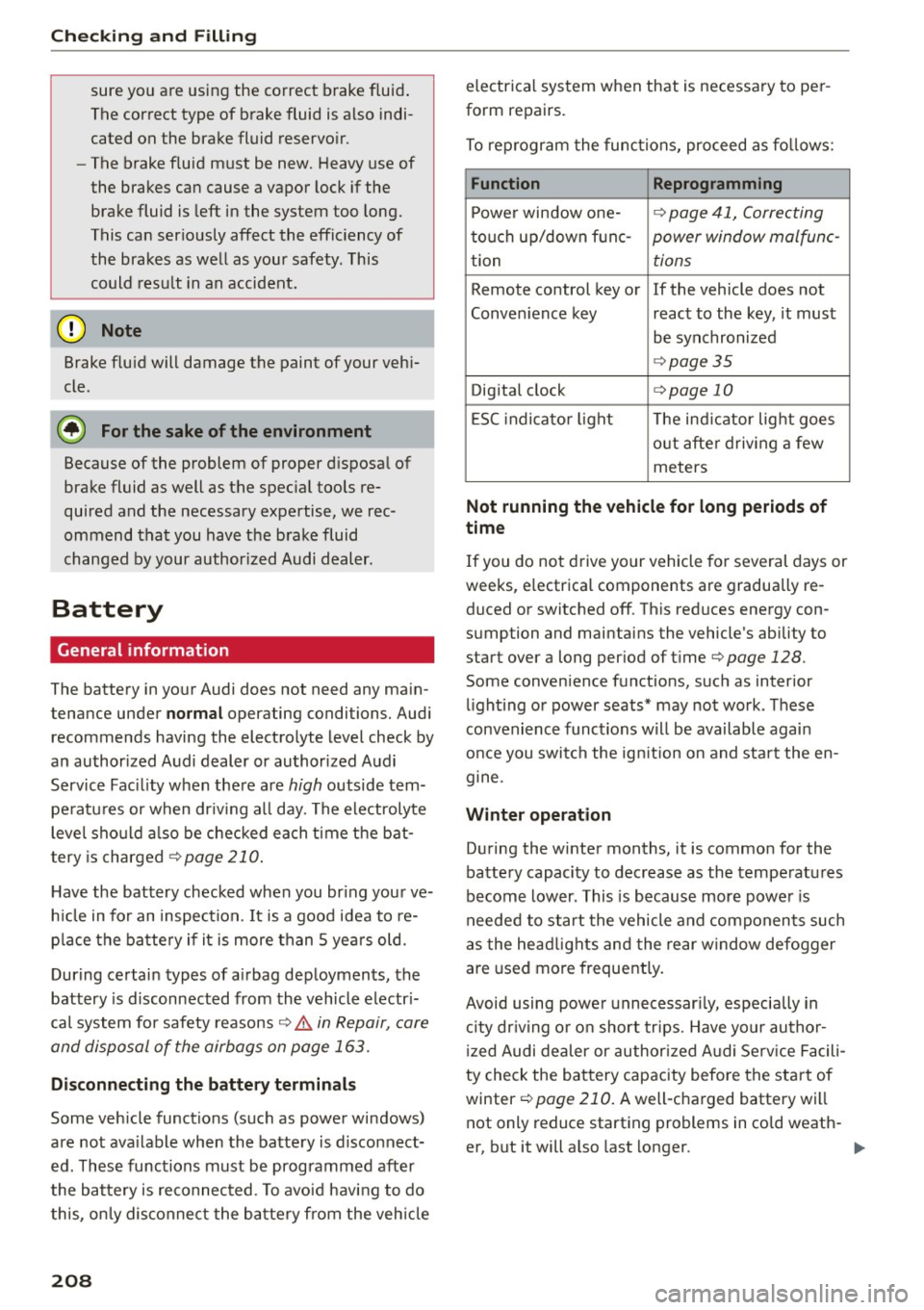
ed. These functions must be programmed after
the ba ttery is reconnec ted. To avoid havi ng to do
t his , on ly disconnect the b attery from the veh icle
208
electrica l sys tem when that is necessa ry to pe r
form repairs.
To reprogram the func tion s, proceed as fo llows:
Function Reprogramming
P owe r window one-
9 page 41, Correcting
to uch up/down f unc-power window malfunc-
tion tions
Remote control key o r If the vehicle does not
Conve nience key reac t to the key , it must
be synchronized
9 page 35
Digita l clock 9 page 10
ESC indi cato r light The ind icator lig ht goes
o ut afte r driving a few
meters
Not running the vehicle for long periods of
time
If you do not d rive yo ur vehicle for several days or
weeks, e lectr ica l components are gradua lly re
duced or switched off. Th is red uces energy con
s u mption and maintains the vehicle's ability to
start over a long per iod of t ime ¢
page 128.
Some conven ience functions , such as inter ior
li ght ing or power seats* may not wo rk . These
convenienc e functions w ill be availabl e agai n
o nce you swi tch the ig nition on and sta rt the en
gine.
Winter operation Du ring the winter months , it is common for the
batte ry capaci ty to dec rease as the tempe rat ur es
become lower . This is because more powe r is
needed to start the vehicle and componen ts such
as the he ad lights and the rear window defogger
are used more frequent ly.
Avoid using powe r unnecessar ily, especially in
c ity dr iv ing o r o n short trips . H ave yo ur au thor
iz ed Audi de aler or author ized A udi Se rv ice Facili
ty check the ba ttery capacity before the start of
winter ¢
page 210. A well-charged battery will
not only reduce starting problems in co ld weath
er, but it will a lso last longer .