2015 AUDI S3 SEDAN service
[x] Cancel search: servicePage 211 of 282

M N
0 > co ,...., \!) er,
er,
er,
,....,
A WARNING ,~
- Work on the battery requires expert knowl
edge. Contact an authorized Aud i dealer or
authorized Audi Service Fac ility for informa
t ion regarding the v ehicl e batte ry. There is a
risk for chemical burns or e xplosions.
- Never open the vehicle battery . Do no t try to
change the batte ry elect ro lyte level. Other
wise ex plosive gas will e scape from the bat
tery and increase the r is k of an explosion.
@ Tips
If your vehicle is not driven for severa l wee ks
in very cold tempe ratu res, remove the battery
and store it in a pla ce where i t will no t freeze.
This preven ts the bat tery from being d am
aged and needing to be replaced .
Working on the battery
Be especially careful when working on or near
the battery.
The bat te ry is loc ated in t he luggage compart
men t under the floor. Before yo u check any thing
i n the l uggage comp artme nt,
read and heed all
WARNINGS
q ,&. .
Always heed the sa fety warning s, when working
on the vehicle battery o r th e veh icle elec trical
sys tem to preven t inju ry.
The following WARNINGS are very important
when work ing on the battery:
Always he ed the following WARNING SYM-
BOLS and safety pre caution s wh en working on
the battery .
®
Always wear eye protect ion.
A
Battery acid contains sulfuric acid. Al ·
ways wear gloves and eye protection.
@
No
• sparks
- flame s
- smok ing.
Checking and Fillin g
&
When a battery is charged, it produce s
-hydrog en gas which i s explo siv e a nd
c ould cau se p ers onal injury.
®
Always keep the battery well out of
reach of children .
A WARNING ..,__ -
Whenever working on the battery or on the
electr ica l system, the re is the risk of in jury,
accident and even fi re. Read and heed the fol
l ow ing WARNI NGS:
- Always wear eye protection. Do not let bat
tery ac id or a ny lead particles get on your
skin o r clothing. Shield yo ur eyes. Exp losive
gases can ca use blindness or o ther in jury.
- Battery acid conta ins sulfuric acid. Sulfuric
acid can ca use b lindness and severe burns.
- Always wear g loves and eye protection. Do
not tilt the battery because ac id could leak
out of the ventilation openings.
- If you get battery ac id in your eyes or on
your s kin, immed iate ly r inse with cold wa
ter fo r several minutes and get medical at
tent ion.
- If you shou ld ingest any battery acid , seek
med ica l attent io n immed iate ly.
- Do not expose the batte ry to an open flame,
electric sparks or an open light.
- Do not smoke.
- Do not interchange the positive and nega-
tive cables .
- When working on the battery , be s ure not to
short-c ircuit the terminals with tools or oth
er metal objects . This would ca use the bat
tery to heat up very quickly , which could
lead to damage or exp losion and perso nal
in jur y.
- When a battery is charged, it produces hy
drogen gas which is e xplos ive and could
cause persona l injury .
- Always keep the battery well out of the
reach of children.
- Before work is done on the electrical sys
tem, disconnect the negat ive g round cab le.
- Before performing any work on t he e lectr i
cal system, sw itch
off the engine and igni-
tion as well as any electrical equ ipme nt. The .,..
209
Page 214 of 282

Checking and Filling
of vehicle batteries improperly is very danger
ous to the environment.
Windshield washer system
F ig . 165 Eng ine compartment: washer fluid reservoir cap
M
"' -')'
"" 00 a,
The washer fluid reservoir O contains the wind
shield washer fluid¢ page 200, fig. 157. Reser
voir capacity¢ page 260.
"' Read and follo w all
WARNINGS before working
in the engine compartment ¢page
198 .
... Open the cap .
... Add the washer f luid and close the cap .
To reduce the risk of lime scale depos its on the
spray nozzles, use clean water with low amounts
of calcium. Always add a window cleaner to th
water. It should contain freeze protection in the
winter.
(D Note
- Never add radiator anti-freeze or other addi
tives to the washer fluid.
- Do not use a glass cleaner that contains
paint solvents, there is a risk of damaging
the pa int.
212
Service interval display
The service interval display detects when your ve
hicle is due for service.
Fig. 166 Instrument cluster: Service interval display (ex·
amp le)
Fig. 167 Display in the MMI panel: service interval display
(example)
l6 M 0 ;:;. co m
The service interval display works in two stages:
-Inspection or oil change reminder: After a cer
tain distance driven, a message appears in the
instrument cluster display each time the igni
tion is switched on or off¢ fig. 166. The re
maining distance or time is disp layed briefly.
- Inspection or oil change due: If your vehicle
has reached an inspection or oi l change interval
or both intervals at the same time, the mes
sage:
Inspection due! or Oil change due! or Oil
change and inspection due!
appears briefly af
ter switching the ignition on/off.
Checking service intervals
You can check the rema ining distance or time un
til the next oil change or next inspection in the
MMI
¢ fig. 167. Select the I MENU I button> Car>
Systems*
control button > Service & control >
Service intervals.
Page 215 of 282

M N
0 > co ,...., \!) 1.1'1
1.1'1
1.1'1
,....,
Resetting the indicator
Your authorized Audi dealer or authorized Audi
Service Facility will reset the service interval dis
play after performing service.
If you perform an oil change yourself to the Audi
specifications, you must reset the service interval
display.
To reset the display, select the
I MENU I button>
Car > Systems* control button > Service & con
trol
> Service intervals > Reset oil change inter
val.
(1) Note
- Only reset the oil change indicator if the oil
was changed.
- Following the service intervals is critical to
maintaining the service life and value of
your vehicle, especially the engine. Even if
the mileage on the vehicle is low, do not ex
ceed the time for the next service.
- Calculating the time to the next oil change
is interrupted when the vehicle battery is
disconnected. If the vehicle is not driven for
a long period of time, check the mainte
nance schedule so that you can follow the
maintenance intervals.
Checking and Filling
213
Page 217 of 282
M N
0 > co ,...., \!) 1.1'1
1.1'1
1.1'1
,....,
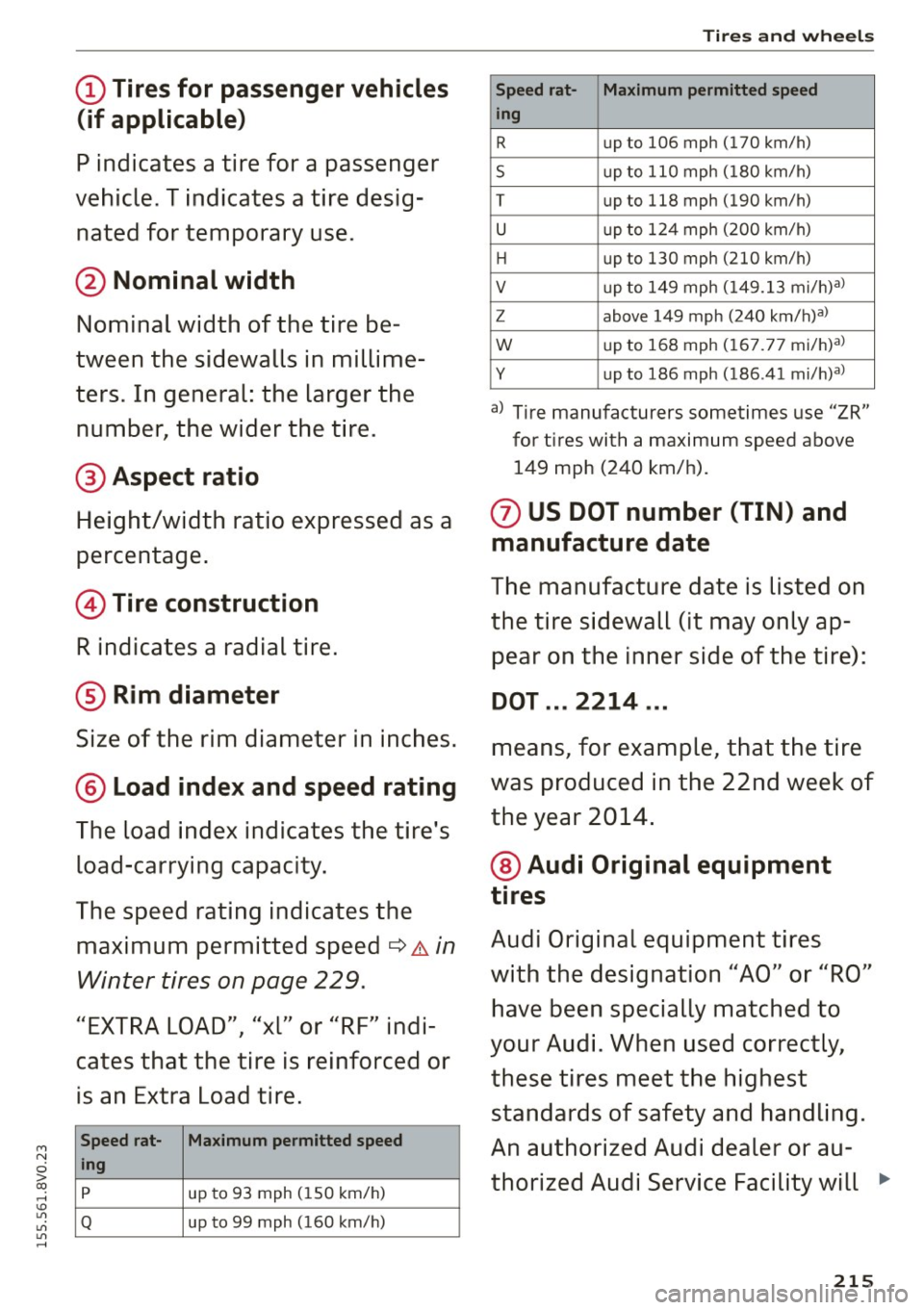
(D Tires for passenger vehicles
(if applicable)
P indicates a tire for a passenger
vehicle. T indicates a tire desig nated for temporary use.
@ Nominal width
Nominal width of the tire be
tween the sidewalls in millime
ters. In general: the larger the number, the wider the tire.
@ Aspect ratio
Height/width ratio expressed as a
percentage.
© Tire construction
R indicates a radial tire.
® Rim diameter
Size of the rim diameter in inches.
@ Load index and speed rating
The load index indicates the tire's
load-carrying capacity .
The speed rating indicates the maximum permitted speed
¢ A in
Winter tires on page
229.
"EXTRA LOAD", "xl" or "RF" indi
cates that the tire is reinforced or
is an Extra Load tire.
Speed rat- Maximum permitted speed
ing
p
up to 93 mph (150 km/h)
Q up to 99 mph (160 km/h)
Tires and wheels
Speed rat- Maximum permitted speed
ing
R up to 106 mph (170 km/h)
s up to 110 mph (180 km/h)
T up to 118 mph (190 km/h)
u up to 124 mph (200 km/h)
H up to 130 mph (210 km/h)
V up to 149 mph (149.13 mi/h)al
z above 149 mph (240 km/h)3l
w up to 168 mph (167.77 mi/h)al
y up to 186 mph (186 .41 mi/h)a)
a) Tire manufacturers sometimes use "ZR"
for tires with a maximum speed above
149 mph (240 km/h).
(j) US DOT number (TIN) and
manufacture date
The manufacture date is listed on
the tire sidewall (it may only ap
pear on the inner side of the tire):
DOT ... 2214 ...
means, for example, that the tire
was produced in the 22nd week of
the year 2014.
@ Audi Original equipment
tires
Audi Original equipment tires
with the designation "AO" or "RO"
have been specially matched to
your Audi. When used correctly,
these tires meet the highest standards of safety and handling.
An authorized Audi dealer or au
thorized Audi Service Facility will
1111-
215
Page 223 of 282
Occupant loading and distri
bution for vehicle normal load
for various designated seating
capacities
Refer to the tire inflation pressure
labe l
c:::> page 224, fig. 171 for
the number of seating positions .
Refer to the table
c:::> table on
page 226
for the number of peo
ple that correspond to the vehicle
normal load.
New tires or wheels
Audi recommends having all work on tires or wheels performed by
an authorized Audi dea ler or au
thorized Audi Service Facility.
These facilities have the proper knowledge and are equ ipped with
the required tools and replace
ment parts .
.,,. New tires do not yet have the
opt imum adhesion properties .
Drive carefully and at moderate
speeds for the first 350 m iles
(500 km) with new tires .
.,,. Use tires of the same construc
tion, size (rolling circumference)
and as close to the same tread pattern as possible on all four
wheels .
Tires a nd whe els
.,,. Do not replace tires individually.
At least replace both tires on the same axle at the same time .
.,,. Audi recommends that you use
Audi Original equipment tires. If
you would like to use different
tires, please note that the tires
may perform different ly even if
they are the same size
c:::> ,& .
.,,. If you would like to equip your
vehicle with a tire/rim combina
tion that is different from what
was installed at the factory, con sult with an authorized Audi
dealer or authorized Audi Service
Facility before making a pur
chase
c:::> ..1,. .
The spare tire* is different from
the regular tires installed on the
vehicle -for example, if winter
tires or wide tires are installed -
then only use the spare tire* tem
porarily in case of emergency and
drive carefully while it is in use. It
should be replaced with a regular
tire as soon as possible.
On
all wheel d riv e vehicles, all
four wheels must be equipped
with tires that are the same brand
and have the same construction
and tread pattern so that the drive system is not damaged by
22 1
Page 225 of 282
"' N
~
-Have an authorized Audi dealer or authorized Audi Service Facili
ty check the wheel alignment if
there is unusual wear.
-Have the wheels rebalanced if an imbalance is causing noticeable
vibration in the steering wheel.
If you do not, the tires and other
vehicle components could wear
more quickly .
Treadwe ar indic ato r
Original equipment tires contain
treadwear indicators in the tread pattern, which are bars that are
1/16 inch (1.6 mm) high and are
spaced even ly around the tire per
pend icular to the running direc
tion
¢ fig. 169. The letters "TW I"
or triangles on the tire sidewall indicate the location of the tread
wear indicators.
The tires have reached the mini mum tread depth
l) when they
have worn down to the treadwear
indicators. Replace the tires with
new ones¢ &.
Whe el rot ation
Rotating the wheels regularly is
recommended to ensure the tires
;;; l) Obey any applicable regu lation s in your ~
~ country . ....
Tires and wheels
wear evenly. To rotate wheels, in
stall the wheels from the rear
axle on the front axle and vice ver
sa. This will allow the tires to
have approximately the same
length of service life.
F or unidirectional tires, make sure
the tires are installed according to
the running direction indicated on
the tire sidewall¢
page 245.
Hidden damage
Damage to tires and rims can of
ten occur in locations that are hid
den. Unusual vibrations in the ve
hicle or pulling to one side may
indicate that there is tire damage .
Reduce your speed immed iately .
Check the tires for damage. If no
damage is visible from the out
side, drive slowly and carefully to
the nearest authorized Audi deal
er or authorized Audi Service Fa
cility to have the vehicle inspect
ed.
A WA RNING
-
Tread that has worn too low or
different tread depths on the
tires can reduce driving safety.
This can especially have a
223
Page 231 of 282

M N
0 > co ,...., \!) 1.1'1
1.1'1
1.1'1
,....,
be five 150 lbs. passengers in
your vehicle, the amount of
available cargo and luggage load capacity is 650 lbs.
(1400-750 (5
X 150) = 650
lbs.)
5. Determine the combined weight of luggage and cargo
being loaded on the vehicle.
That weight may not safely
ex
ceed the available cargo and
luggage load capacity calculat
ed in Step 4.
6. If your vehicle will be towing a trailer, load from your trailer
will be transferred to your vehi
cle. Consult this manual to de
termine how this reduces the available cargo and luggage
load capacity of your vehicle.
.,.Check the tire sidewall
(c> page 214, fig. 168) to deter
mine the designated load rating
for a specific tire.
Wheel bolts and rims
Wheel bolts
Wheel bolts must be clean and loosen/tighten
easily.
Rims
Rims with a bolted rim ring* or with bolted wheel
covers* consis t of mul tiple pieces. These compo
nents were bolted together using special bolts
and a special procedure . You must not repair or
disassemble them
Q ,& .
Tires and wheels
A WARNING
Wheel bolts that are tightened or repaired in
correctly can become loose and result in loss
of vehicle control, which increases the risk of
an accident . For the correct tightening specifi
cation, refer to~
page 242, A~er changing a
wheel.
- Always keep the wheel bolts and the threads
in the wheel hub clean and free of grease.
- Only use wheel bolts that fit the rim.
-Always have damaged rims repaired by an
authorized Audi dealer or authorized Audi
Service Facility. Never repair or disassemble
rims yourself, because this increases the risk
of an accident.
Winter tires
Winter tires significantly improve the vehicle's
handling when driving in winter conditions. Be
cause of their construction (width, compound,
tread pattern), summer tires provide less traction on ice and snow.
.. Use winter tires on all four wheels.
.. Only use winter tires that are approved for your
vehicle .
.. Please note that the maximum permitted
speed may be lower with winter tires
Q _& . An
authorized Audi dealer or authorized Audi Serv
ice Facility can inform you about the maximum
permitted speed for your tires.
.. Check the tire pressure after installing wheels
Qpage 224.
The effectiveness of winter tires is reduced great
ly when the tread is worn down to a depth of
0.157 inch (4 mm). The characteristics of winter
tires also decrease greatly as the tire ages, re
gardless of the remaining tread.
A WARNING
-Never drive faster than the maximum per
mitted speed for your tires. This could cause
the tires to heat up too much. This increases
the risk of an accident because it can cause
the tire to burst.
229
Page 232 of 282
Tires and wheel s
-Always adapt your driving to the road and
traff ic conditions. Dr ive carefully and red uce
yo ur speed on icy or slippery roads. Even
winter tires can lose tract io n on black ice .
@ For the sake of the environment
Reinstall summer tires at the appropriate
time, because they provide better handling
when roads are free of snow a nd ice. Summer
tires cause less road noise, tire wear and fuel
consumptio n.
(D Tips
You can also use all season tires instead of
w inte r tires. Please note that in some coun
t ries w here winter tires are requ ired, on ly win
t er tire s wi th the .& symbol may be pe rm it
t ed.
Snow chains
Snow chains improve traction in the snow .
.,. Only install snow chains on the front wheels.
Th is applies also to veh icles with all wheel
drive* .
.,. Ch eck and correct the seating of th e snow
c h ains if necessa ry afte r dri ving a few feet. Fo l
l ow the ins tructions from the manuf acturer.
.,. Note t he max imum permit ted speed w hen driv
ing with snow chains . Do not exceed 30 mph
(SO km/h).
Snow chains not only improve the
driving in win
ter road conditions, but a lso t he
braking .
Use of s now chai ns is o nly pe rm itted with certa in
r im/t ire comb ina tion s due to techn ica l reason s.
Chec k w ith an au thori zed A udi d ealer or au tho r
ized A udi Service Facility to see if yo u may use
snow cha ins.
Use
fine -mesh snow chain s. They mus t not add
mo re th an 0 .5 3 inch ( 13.S mm) in height, in clu d
ing the chain lock.
You must remove the chai ns when dr iv ing on
roads tha t are
free of snow. W hen r oads are free
of snow, snow chains can imp air handling an d
230
'
damage the tires, and the chains wi ll quick ly be
dest royed.
A WARNING
Using incorrect snow chains o r insta lling snow
cha ins incor rectly can res ult in loss of veh icle
c o ntrol, which increases the risk of an acc i
dent.
(D Note
- Snow chains can damage the rims/wheel
cove rs* if the c hains come into direct c on
tact with them. Remove the wheel covers*
first . Use coa ted snow cha ins.
Low aspect ratio tires
Your A udi is fac to ry-eq uipped w ith low aspect ra
t io t ires. These t ires have been thoroug hly tes ted
a nd been sele cted specifi ca lly f or your mode l for
the ir su perb pe rformance, r oad fee l and h andlin g
u nder a var iety of dr iv ing con ditions. As k your au
t h orized Aud i dea le r fo r more details .
The low aspe ct ratio of these tires is ind icated by
a n umer al of
55 or less in the t ire's s ize design a
tion . The nume ral represents the ratio of the
ti re's si dewall height in relatio n to its tread width
expressed i n pe rcentage. Conventional tires have
a height/width rat io o f 60 o r more .
The performance of low-aspect-ratio tire s is par
ticularly sensitive to imprope r inflation pres
sure. It is therefore important that low aspect ratio tires are inflated to the specified pressure
and that the inflation pressure is regularly
checked and maintained. Tire pressures should be checked at least once a month and always
b efor e a long trip
Q page 224 .
What you can do to avoid tire and rim
damage
Low aspect rat io tires can be damaged mo re eas i
l y by impact w ith potho les, c urbs , g ull ies o r
r idges on t he road, pa rti cularly if th e tire is un
der i nflated.