2014 SUBARU TRIBECA ECU
[x] Cancel search: ECUPage 252 of 426
NOTE
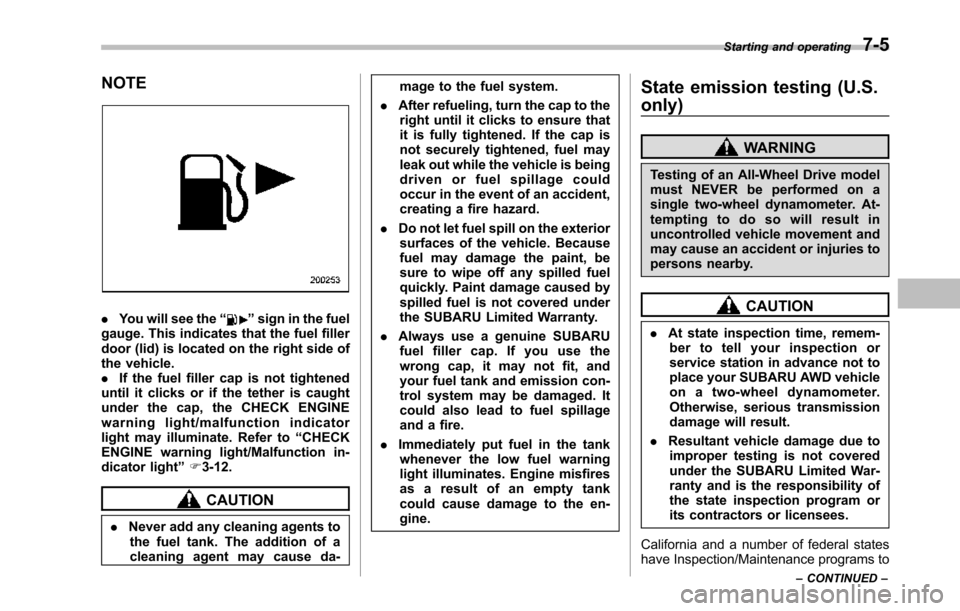
.You will see the“”sign in the fuelgauge. Thisindicates that the fuel fillerdoor (lid) is located on the right side ofthe vehicle..If the fuel filler cap is not tighteneduntil it clicks or if the tether is caughtunder the cap, the CHECK ENGINEwarning light/malfunction indicatorlight may illuminate. Refer to“CHECKENGINE warning light/Malfunction in-dicator light”F3-12.
CAUTION
.Never add any cleaning agents tothe fuel tank. The addition of acleaning agent may cause da-
mage to the fuel system.
.After refueling, turn the cap to theright until it clicks to ensure thatit is fully tightened. If the cap isnot securely tightened, fuel mayleak out while the vehicle is beingdriven or fuel spillage couldoccur in the event of an accident,creating a fire hazard.
.Do not let fuel spill on the exteriorsurfacesof the vehicle. Becausefuel may damage the paint, besure to wipe off any spilled fuelquickly. Paint damage caused byspilled fuel is not covered undertheSUBARU Limited Warranty.
.Always use a genuine SUBARUfuel filler cap. If you use thewrong cap, it may not fit, andyour fuel tank and emission con-trol systemmay be damaged. Itcould also lead to fuel spillageand a fire.
.Immediately put fuel in the tankwhenever the low fuel warninglight illuminates. Engine misfiresas a result of an empty tankcould cause damage to the en-gine.
State emission testing (U.S.
only)
WARNING
Testing of an All-Wheel Drive modelmust NEVER be performed on asingle two-wheel dynamometer. At-tempting to do so will result inuncontrolled vehicle movement andmay cause an accident or injuries topersons nearby.
CAUTION
.At state inspection time, remem-ber to tell your inspection orservice station in advance not toplace your SUBARU AWD vehicleon a two-wheel dynamometer.Otherwise, serious transmissiondamage will result.
.Resultant vehicle damage due toimproper testing is not coveredunderthe SUBARU Limited War-ranty and is the responsibility ofthe state inspection program orits contractors or licensees.
California and a number of federal stateshave Inspection/Maintenance programs to
Starting and operating7-5
–CONTINUED–
Page 256 of 426
&Starting your vehicle
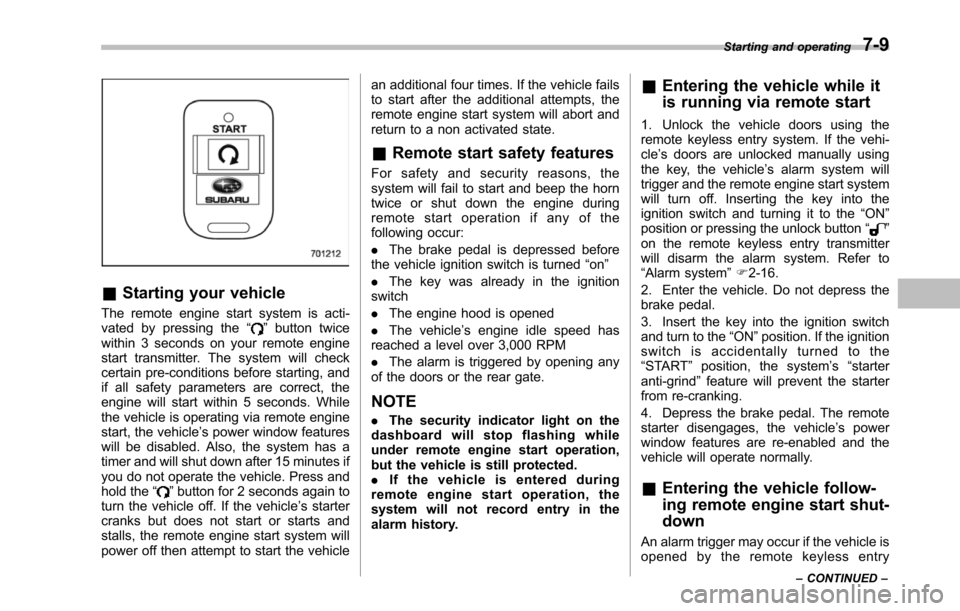
The remote engine start system is acti-vated by pressing the“”button twicewithin 3 seconds on your remote enginestart transmitter. The system will checkcertain pre-conditions before starting, andif all safety parameters are correct, theengine will start within 5 seconds. Whilethe vehicle is operating via remote enginestart, the vehicle’s power window featureswill be disabled. Also, the system has atimer and will shut down after 15 minutes ifyou do not operate the vehicle. Press andhold the“”button for 2 seconds again toturn the vehicle off. If the vehicle’s startercranks but does not start or starts andstalls, the remote engine start system willpower off then attempt to start the vehicle
an additional four times. If the vehicle failsto start after the additional attempts, theremote engine start system will abort andreturn to a non activated state.
&Remote start safety features
For safety and security reasons, thesystem will fail to start and beep the horntwice or shut down the engine duringremote start operation if any of thefollowing occur:
.The brake pedal is depressed beforethe vehicle ignition switch is turned“on”
.The key was already in the ignitionswitch
.The engine hood is opened
.The vehicle’s engine idle speed hasreached a level over 3,000 RPM
.The alarm is triggered by opening anyof the doors or the rear gate.
NOTE
.The security indicator light on thedashboard will stop flashing whileunder remote engine start operation,but the vehicle is still protected..If the vehicle is entered duringremote engine start operation, thesystem will not record entry in thealarm history.
&Entering the vehicle while it
is running via remote start
1. Unlock the vehicle doors using theremote keyless entry system. If the vehi-cle’s doors are unlocked manually usingthe key, the vehicle’s alarm system willtrigger and the remote engine start systemwill turn off. Inserting the key into theignition switch and turning it to the“ON”position or pressing the unlock button“”on the remote keyless entry transmitterwill disarm the alarm system. Refer to“Alarmsystem”F2-16.
2. Enter the vehicle. Do not depress thebrake pedal.
3. Insert the key into the ignition switchand turn to the“ON”position. If the ignitionswitch is accidentally turned to the“START”position, the system’s“starteranti-grind”feature will prevent the starterfrom re-cranking.
4. Depress the brake pedal. The remotestarter disengages, the vehicle’s powerwindow features are re-enabled and thevehicle will operate normally.
&Entering the vehicle follow-
ing remote engine start shut-
down
An alarm trigger may occur if the vehicle isopened by the remote keyless entry
Starting and operating7-9
–CONTINUED–
Page 260 of 426
“R”position or vice versa untilthe vehicle has completelystopped. Such shifting maycause damage to the transmis-sion.
.When parking the vehicle, firstsecurely apply the parking brakeand then place the select lever inthe“P”position. Avoid parkingfor a long time with the selectlever in any other position asdoing so could result in a deadbattery.
NOTE
.When the engine coolant tempera-ture is still low, the automatic transmis-sion will upshift to higher enginespeeds than when the coolant tempera-ture is sufficiently high in order toshorten the warm-up time and improvedriveability. The gearshift timing willautomatically shift to the normal timingafter the engine has warmed up..Immediately after ATF (automatictransmission fluid) is replaced, youmay feel that the automatic transmis-sion operation is somewhat unusual.This results from invalidation of datawhich the on-board computer hascollected and stored in memory to
allow the transmission to shift at themost appropriate times for the currentcondition of your vehicle. Optimizedshifting will be restored as the vehiclecontinues to be driven for a while.
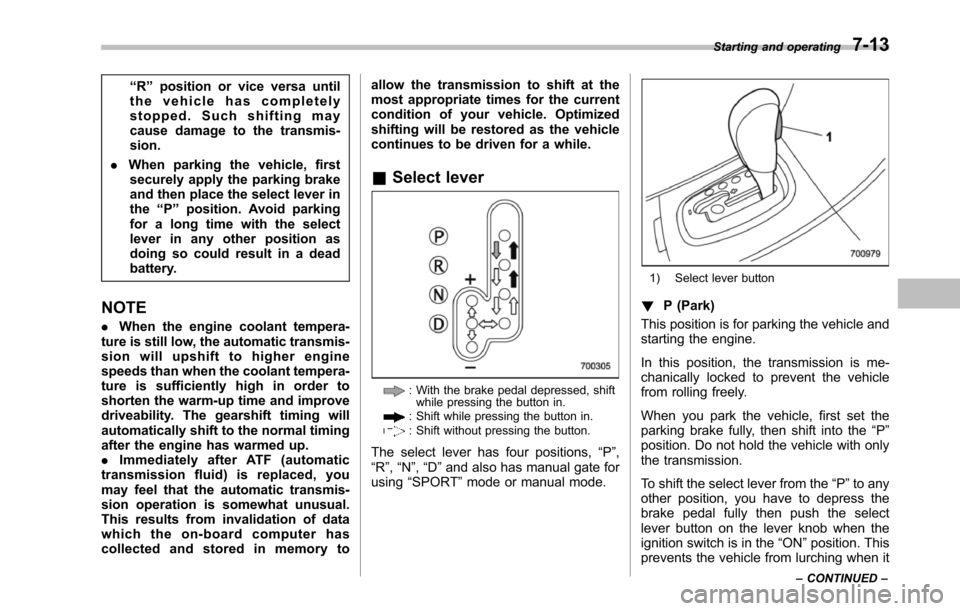
&Select lever
: With the brake pedal depressed, shiftwhile pressingthe button in.: Shift while pressing the button in.: Shift without pressing the button.
The select lever has four positions,“P”,“R”,“N”,“D”and also has manual gate forusing“SPORT”mode or manual mode.
1) Select lever button
!P (Park)
This position is for parking the vehicle andstarting the engine.
In this position, the transmission is me-chanically locked to prevent the vehiclefrom rolling freely.
When you park the vehicle, first set theparking brake fully, then shift into the“P”position. Do not hold the vehicle with onlythe transmission.
To shift the select lever from the“P”to anyother position, you have to depress thebrake pedal fully then push the selectlever button on the lever knob when theignition switch is in the“ON”position. Thisprevents the vehicle from lurching when it
Starting and operating7-13
–CONTINUED–
Page 286 of 426
depth of the water and the bottom of thestream bed for firmness and ensure thatthe bed of the stream is flat. Drive slowlyand completely through the stream. Thewater should be shallow enough that itdoes not reach the vehicle’s undercar-riage. Water entering the engine air intakeor the exhaust pipe or water splashingonto electrical parts may damage yourvehicle and may cause it to stall. Neverattempt to drive through rushing water;regardless of its depth, it can wash awaythe ground from under your tires, resultingin possible loss of traction and evenvehicle rollover.
.Always check your brakes for effec-tiveness immediately after driving in sand,mud or water. Do this by driving slowlyand stepping on the brake pedal. Repeatthat process several times to dry out thebrake discsand brake pads.
.Do not drive or park over or nearflammable materials such as dry grass orfallen leaves,as they may burn easily. Theexhaust system is very hot while theengine is running and right after enginestops. This could create a fire hazard.
.After driving through tall grass, mud,rocks, sand, rivers, etc., check that thereis no grass, bush, paper, rags, stones,sand, etc. adhering to or trapped on theunderbody. Clear off any such matter from
the underbody. If the vehicle is used withthese materials trapped or adhering to theunderbody, a mechanical breakdown orfire could occur.
.Secure all cargo carried inside thevehicle and make certain that it is notpiled higher than the seatbacks. Duringsudden stops or jolts, unsecured cargocould be thrown around in the vehicle andcause injury. Do not pile heavy loads onthe roof. Those loads raise the vehicle’scenter of gravity and make it more proneto tip over.
.If you must rock the vehicle to free itfrom sand or mud, depress the acceleratorpedal slightly andmove the select leverback and forth between“D”and“R”repeatedly. Do not race the engine. Forthe best possible traction, avoid spinningthe wheels when trying to free the vehicle.
.When the road surface is extremelyslippery, you can obtain better traction bystarting the vehicle with the transmissionin 2nd than 1st.
.Never equip your vehicle with tireslarger than thosespecified in this manual.
.Wash the vehicle’s underbody after off-road driving. Suspension components areparticularly prone to dirt buildup, so theyneed to be washed thoroughly.
.Frequent driving of an AWD modelunder hard-driving conditions such as
rough roads or off roads will necessitatemore frequent replacement of engine oil,brake fluid and transmission oil than thatspecified in the maintenance scheduledescribed in the“Warranty and Mainte-nance Booklet”.
Remember that damage done to yourSUBARU while operating it off-road andnot using common sense precautionssuch as those listed above is not eligiblefor warranty coverage.
Driving tips8-7
Page 291 of 426
8-12Driving tips
Loading your vehicle
WARNING
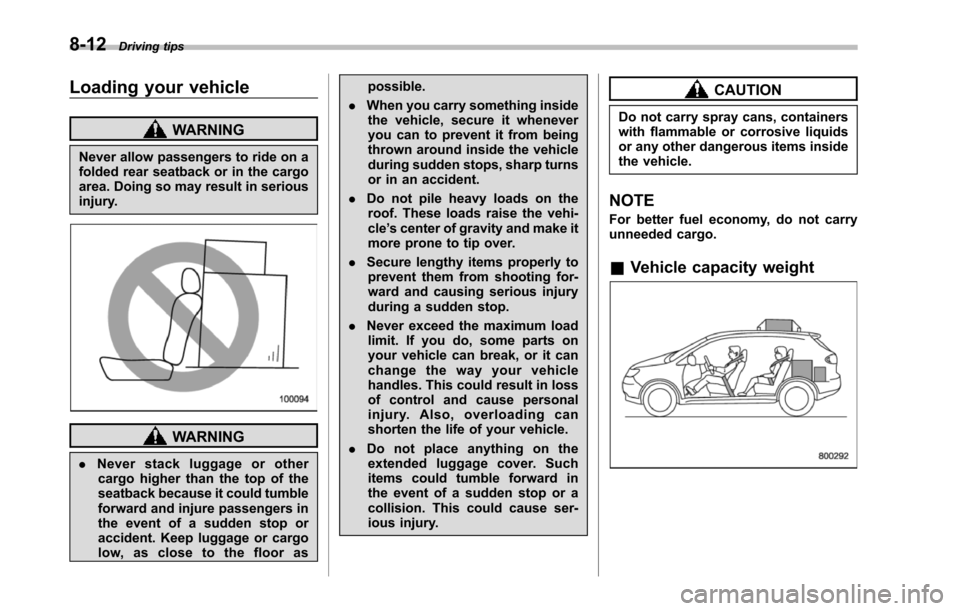
Never allow passengers to ride on afolded rear seatback or in the cargoarea. Doing so may result in seriousinjury.
WARNING
.Never stack luggage or othercargo higher than the top of theseatback because it could tumbleforward and injure passengers inthe event of a sudden stop oraccident. Keep luggage or cargolow, as close to the floor as
possible.
.When you carry something insidethe vehicle, secure it wheneveryou can to prevent it from beingthrown around inside the vehicleduring sudden stops, sharp turnsor in an accident.
.Do not pile heavy loads on theroof. These loads raise the vehi-cle’s center of gravity and make itmore prone to tip over.
.Secure lengthy items properly toprevent them from shooting for-ward and causing serious injuryduring a sudden stop.
.Never exceed the maximum loadlimit. If you do, some parts onyour vehicle can break, or it canchange the way your vehiclehandles. This could result in lossof control and cause personalinjury. Also, overloading canshorten the life of your vehicle.
.Do not place anything on theextended luggage cover. Suchitems could tumble forward inthe event of a sudden stop or acollision. This could cause ser-ious injury.
CAUTION
Do not carry spray cans, containerswith flammable or corrosive liquidsor any other dangerous items insidethe vehicle.
NOTE
For better fueleconomy, do not carryunneeded cargo.
&Vehicle capacity weight
Page 293 of 426
8-14Driving tips
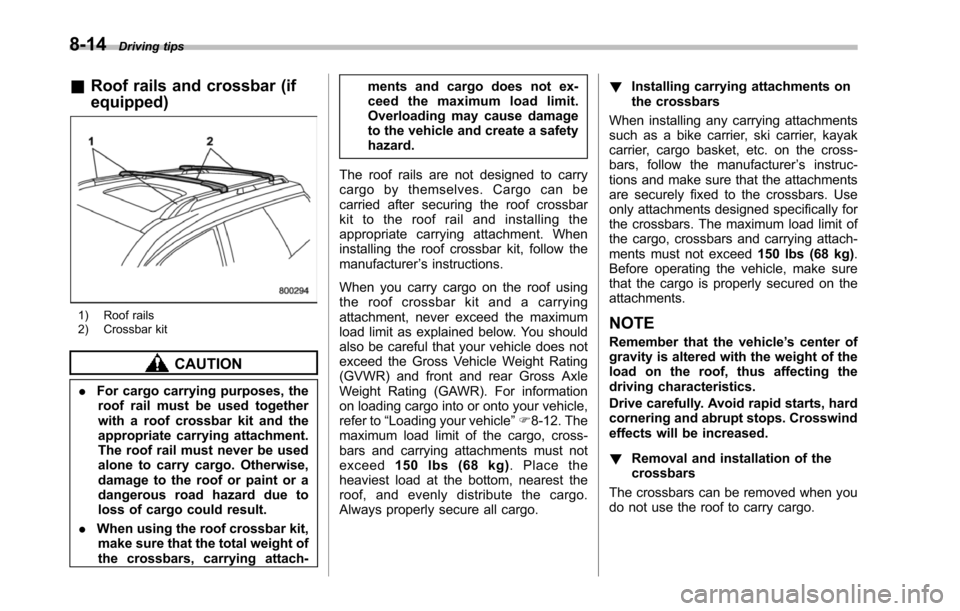
&Roof rails and crossbar (if
equipped)
1) Roof rails2) Crossbar kit
CAUTION
.For cargo carrying purposes, theroof rail must be used togetherwith a roof crossbar kit and theappropriate carrying attachment.The roof rail must never be usedalone to carry cargo. Otherwise,damageto the roof or paint or adangerous road hazard due toloss of cargo could result.
.When using the roof crossbar kit,make sure that the total weight ofthe crossbars,carrying attach-
ments and cargo does not ex-ceed the maximum load limit.Overloading may cause damageto the vehicle and create a safetyhazard.
The roof rails are not designed to carrycargo by themselves. Cargo can becarried after securing the roof crossbarkit to the roof rail and installing theappropriate carrying attachment. Wheninstalling the roof crossbar kit, follow themanufacturer’s instructions.
When you carry cargo on the roof usingthe roof crossbar kit and a carryingattachment, never exceed the maximumload limit as explained below. You shouldalso be careful that your vehicle does notexceed the Gross Vehicle Weight Rating(GVWR) and front and rear Gross AxleWeight Rating (GAWR). For informationon loading cargo into or onto your vehicle,refer to“Loading your vehicle”F8-12. Themaximum load limit of the cargo, cross-bars and carrying attachments must notexceed150 lbs (68 kg).Placetheheaviestload at the bottom, nearest theroof, and evenly distribute the cargo.Always properly secure all cargo.
!Installing carrying attachments onthe crossbars
When installing any carrying attachmentssuch as a bike carrier, ski carrier, kayakcarrier, cargo basket, etc. on the cross-bars, follow the manufacturer’s instruc-tions and make sure that the attachmentsare securely fixed to the crossbars. Useonly attachments designed specifically forthe crossbars. The maximum load limit ofthe cargo, crossbars and carrying attach-ments must not exceed150 lbs (68 kg).Before operating the vehicle, make surethat the cargo is properly secured on theattachments.
NOTE
Remember that the vehicle’s center ofgravity is altered with the weight of theload on the roof, thus affecting thedriving characteristics.
Drive carefully. Avoid rapid starts, hardcornering and abrupt stops. Crosswindeffects will be increased.
!Removal and installation of thecrossbars
The crossbars can be removed when youdo not use the roof to carry cargo.
Page 295 of 426
8-16Driving tips
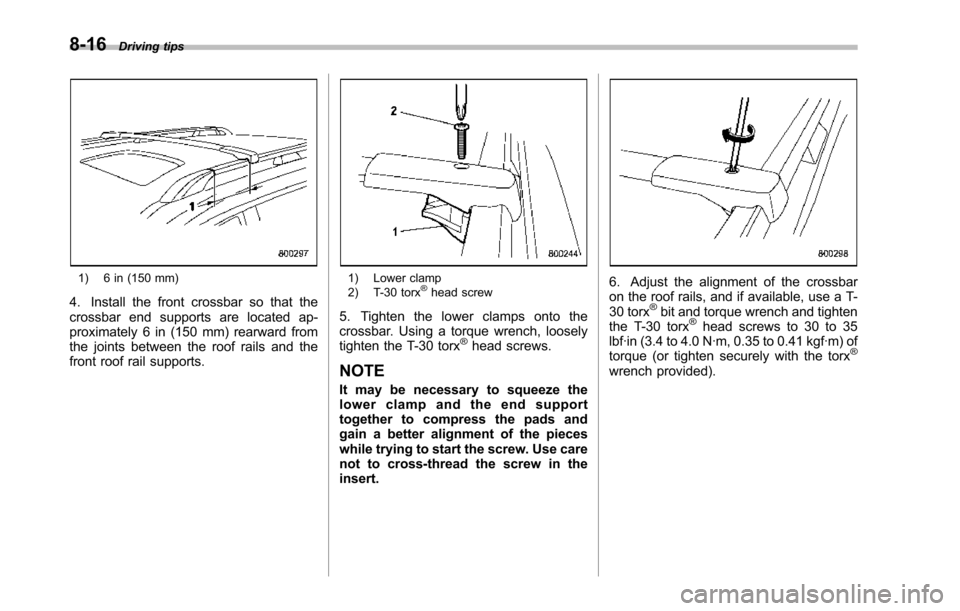
1) 6 in (150 mm)
4. Install the front crossbar so that thecrossbar end supports are located ap-proximately 6 in (150 mm) rearward fromthe joints between the roof rails and thefront roof rail supports.
1) Lower clamp2) T-30 torx®head screw
5. Tighten the lower clamps onto thecrossbar. Using a torque wrench, looselytighten the T-30 torx®head screws.
NOTE
It may be necessary to squeeze thelower clamp and the end supporttogether to compress the pads andgaina better alignment of the pieceswhile trying to start the screw. Use carenot to cross-thread the screw in theinsert.
6. Adjust the alignment of the crossbaron the roof rails, and if available, use a T-30 torx®bit and torque wrench and tightenthe T-30 torx®headscrews to 30 to 35lbf·in (3.4 to 4.0 N·m, 0.35 to 0.41 kgf·m) oftorque (or tighten securely with the torx®
wrench provided).
Page 296 of 426
Rear crossbar:
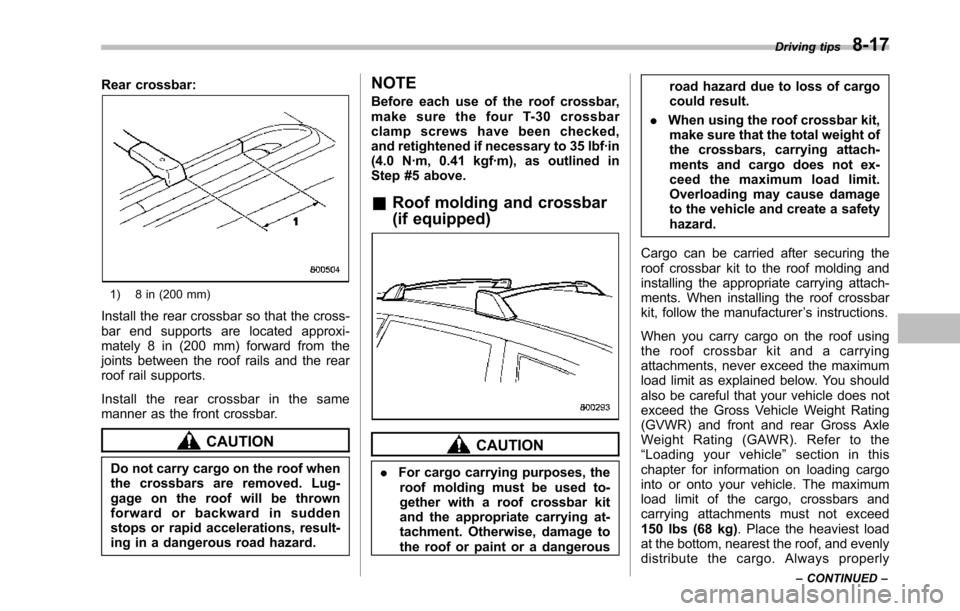
1) 8 in (200 mm)
Install the rear crossbar so that the cross-bar end supports are located approxi-mately 8 in (200 mm) forward from thejoints between the roof rails and the rearroof rail supports.
Install the rear crossbar in the samemanner as the front crossbar.
CAUTION
Do not carry cargo on the roof whenthe crossbars are removed. Lug-gage on the roof will be thrownforward or backward in suddenstops or rapid accelerations, result-ing in a dangerous road hazard.
NOTE
Before each use of the roof crossbar,make sure the four T-30 crossbarclamp screws have been checked,and retightened if necessary to 35 lbf·in(4.0 N·m, 0.41 kgf·m), as outlined inStep #5 above.
&Roof molding and crossbar
(if equipped)
CAUTION
.For cargo carrying purposes, theroofmolding must be used to-gether with a roof crossbar kitand the appropriate carrying at-tachment. Otherwise, damage tothe roof or paint or a dangerous
road hazard due to loss of cargocould result.
.When using the roof crossbar kit,make sure that the total weight ofthe crossbars, carrying attach-ments and cargo does not ex-ceed the maximum load limit.Overloading may cause damageto the vehicle and create a safetyhazard.
Cargo can be carried after securing theroof crossbar kit to the roof molding andinstalling the appropriate carrying attach-ments. When installing the roof crossbarkit, follow the manufacturer’s instructions.
When you carry cargo on the roof usingthe roof crossbar kit and a carryingattachments, never exceed the maximumload limit as explained below. You shouldalso be careful that your vehicle does notexceed the Gross Vehicle Weight Rating(GVWR) and front and rear Gross AxleWeight Rating (GAWR). Refer to the“Loading your vehicle”section in thischapter for information on loading cargointo or onto your vehicle. The maximumload limit of the cargo, crossbars andcarrying attachments must not exceed150 lbs (68 kg). Place the heaviest loadat the bottom, nearest the roof, and evenlydistribute the cargo. Always properly
Driving tips8-17
–CONTINUED–