2014 SUBARU TRIBECA ECU
[x] Cancel search: ECUPage 314 of 426
.Always turn off the engine beforeraising the flat tire off the groundusing the jack. Never swing orpush the vehicle supported withthe jack. The jack can come outof the jacking point due to a joltand this can result in a severeaccident.
1. Park on a hard, level surface, when-ever possible, then stop the engine.
2. Set the parking brake securely andshift in the“P”(Park) position.
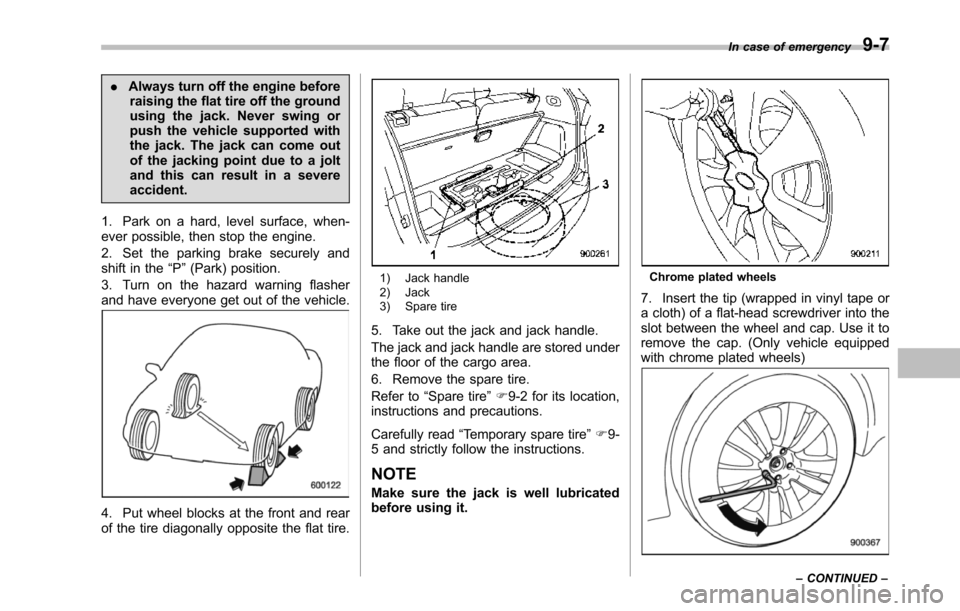
3. Turn on the hazard warning flasherandhave everyone get out of the vehicle.
4. Put wheel blocks at the front and rearof the tire diagonally opposite the flat tire.
1) Jack handle2) Jack3) Spare tire
5. Take out the jack and jack handle.
The jack and jack handle are stored underthe floor of the cargo area.
6. Remove the spare tire.
Refer to“Spare tire”F9-2 for its location,instructions andprecautions.
Carefully read“Temporary spare tire”F9-5 and strictly follow the instructions.
NOTE
Make sure the jack is well lubricatedbefore using it.
Chrome plated wheels
7. Insert the tip (wrapped in vinyl tape ora cloth) of a flat-head screwdriver into theslot between the wheel and cap. Use it toremove the cap. (Only vehicle equippedwith chrome plated wheels)
In case of emergency9-7
–CONTINUED–
Page 316 of 426
WARNING
Do not use oil or grease on thewheel studs or nuts when the sparetire is installed. This could cause thenuts to become loose and lead to anaccident.
15. Turn the jack handle counterclockwiseto lower the vehicle.
CAUTION
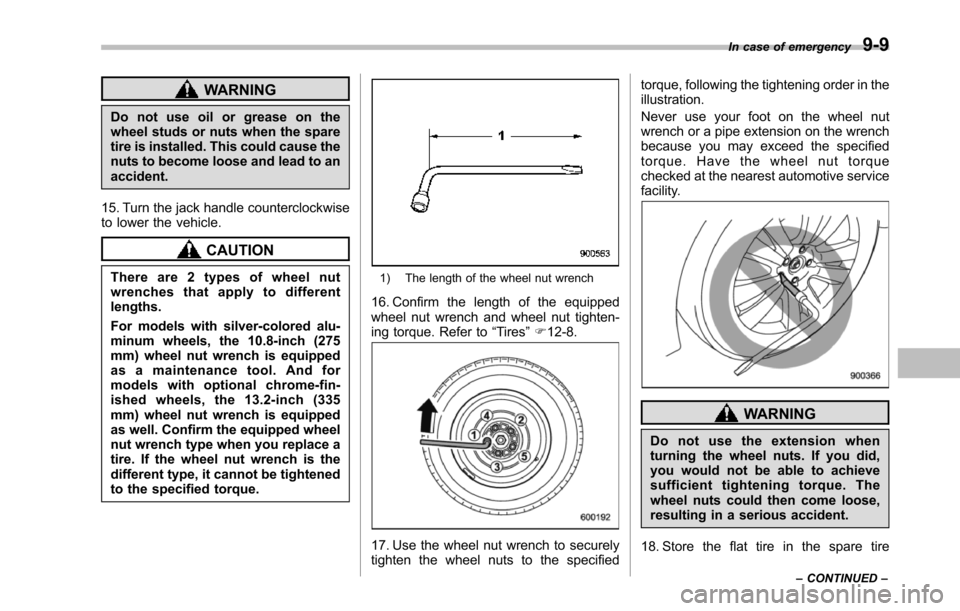
There are 2 types of wheel nutwrenches that apply to differentlengths.
For models with silver-colored alu-minumwheels, the 10.8-inch (275mm) wheel nut wrench is equippedas a maintenance tool. And formodels with optional chrome-fin-ished wheels, the 13.2-inch (335mm) wheel nut wrench is equippedas well. Confirm the equipped wheelnut wrench type when you replace atire. If the wheel nut wrench is thedifferent type, it cannot be tightenedto the specified torque.
1) The length of the wheel nut wrench
16. Confirm the length of the equippedwheel nut wrench and wheel nut tighten-ing torque. Refer to“Tires”F12-8.
17. Use the wheel nut wrench to securelytighten thewheel nuts to the specified
torque, following the tightening order in theillustration.
Never use your foot on the wheel nutwrench or a pipe extension on the wrenchbecause you may exceed the specifiedtorque. Have the wheel nut torquechecked at the nearest automotive servicefacility.
WARNING
Do not use the extension whenturning the wheel nuts. If you did,you would not be able to achievesufficient tightening torque. Thewheel nuts could then come loose,resulting in a serious accident.
18. Store the flat tire in the spare tire
In case of emergency9-9
–CONTINUED–
Page 322 of 426
&Towing and tie-down hooks
The towing hooks should be used only inan emergency (e.g., to free a stuck vehiclefrom mud, sand or snow).
CAUTION
.Use only the specified towinghooks and tie-down hooks. Neveruse suspension parts or otherparts of the body for towing ortie-down purposes.
.Never use the tie-down hookclosest to the muffler under thevehicle for towing purposes.
.To prevent deformation to thebumperand the towing hook, donot apply excessive lateral loadto the towing hooks.
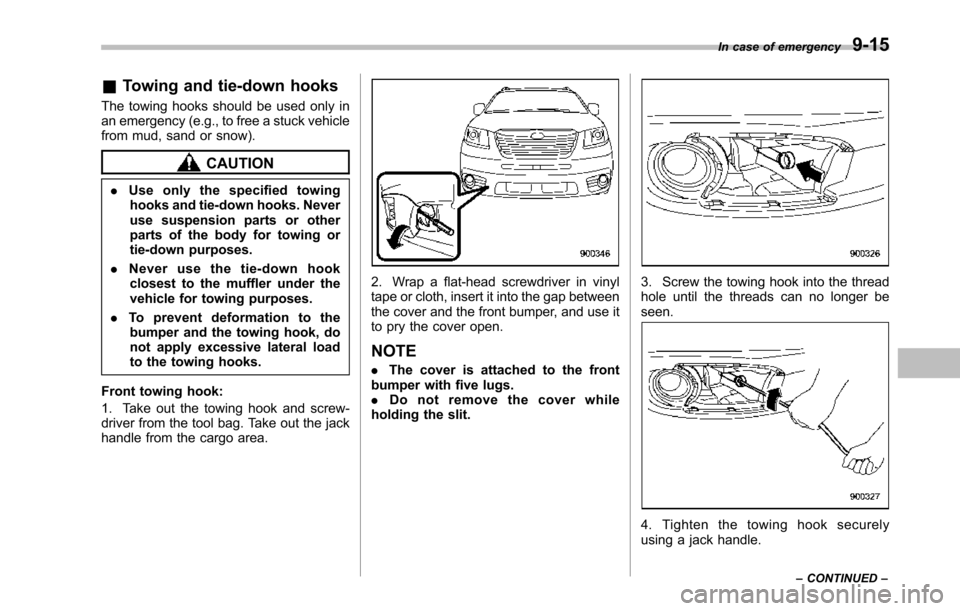
Front towing hook:
1. Take out the towing hook and screw-driver from the tool bag. Take out the jackhandle from the cargo area.
2. Wrap a flat-head screwdriver in vinyltape or cloth, insert it into the gap betweenthe cover and the front bumper, and use itto pry the cover open.
NOTE
.The cover is attached to the frontbumper with five lugs..Do not remove the cover whileholding the slit.
3. Screw the towing hook into the threadhole until the threads can no longer beseen.
4. Tighten the towing hook securelyusing a jack handle.
In case of emergency9-15
–CONTINUED–
Page 323 of 426
9-16In case of emergency
After towing, remove the towing hook fromthe vehicle and stow it in the tool bag.
Fit the towing hook cover on the bumper.
WARNING
.Do not use the towing hookexcept when towing your vehicle.
.Be sure to remove the towinghook after towing. Leaving thetowing hook mounted on thevehicle could interfere with prop-er operation of the SRS airbagsystem in a frontal collision.
Rear towing hook:
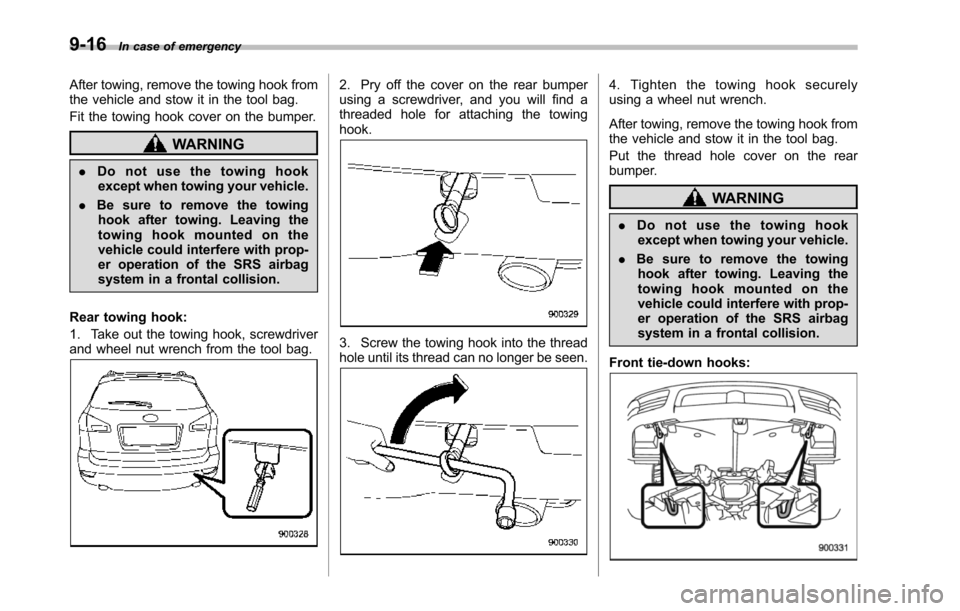
1. Take out the towing hook, screwdriverand wheel nut wrench from the tool bag.
2. Pry off the cover on the rear bumperusing a screwdriver, and you will find athreaded hole for attaching the towinghook.
3. Screw the towing hook into the threadhole until its thread can no longer be seen.
4. Tighten the towing hook securelyusing a wheel nut wrench.
After towing, remove the towing hook fromthe vehicle and stow it in the tool bag.
Put the thread hole cover on the rearbumper.
WARNING
.Do not use the towing hookexcept when towing your vehicle.
.Be sure to remove the towinghook after towing. Leaving thetowing hook mounted on thevehicle could interfere with prop-er operation of the SRS airbagsystem in a frontal collision.
Front tie-down hooks:
Page 324 of 426
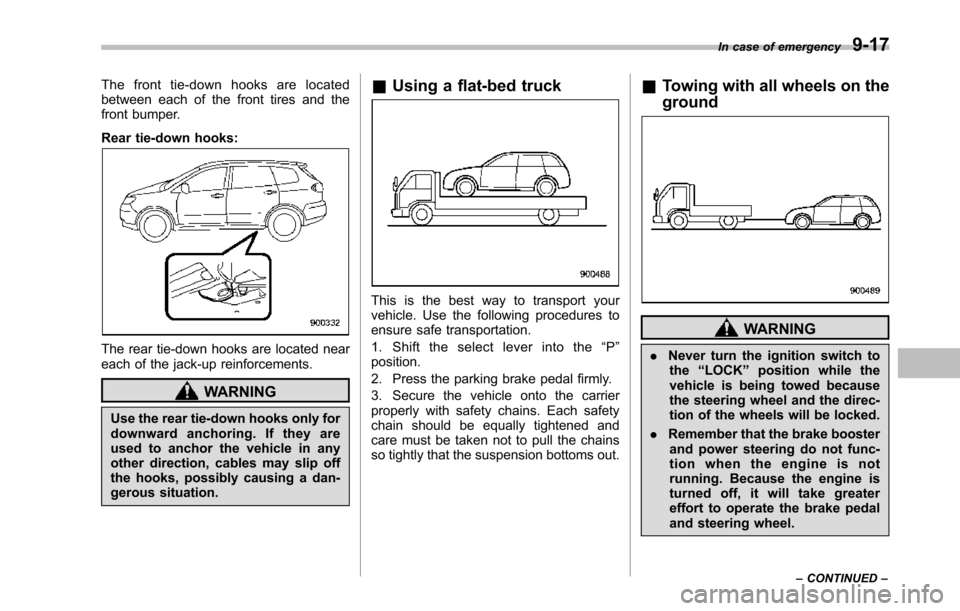
The front tie-down hooks are locatedbetween each of the front tires and thefront bumper.
Rear tie-down hooks:
The rear tie-down hooks are located neareach of the jack-up reinforcements.
WARNING
Use the rear tie-down hooks only fordownward anchoring. If they areused to anchor the vehicle in anyother direction, cables may slip offthe hooks,possibly causing a dan-gerous situation.
&Using a flat-bed truck
This is the best way to transport yourvehicle. Use the following procedures toensure safe transportation.
1. Shift the select lever into the“P”position.
2. Press the parking brake pedal firmly.
3. Secure the vehicle onto the carrierproperly with safety chains. Each safetychain should be equally tightened andcare must be taken not to pull the chainsso tightly that the suspension bottoms out.
&Towing with all wheels on the
ground
WARNING
.Never turn the ignition switch tothe“LOCK”position while thevehicle is being towed becausethe steeringwheel and the direc-tion of the wheels will be locked.
.Remember that the brake boosterand power steering do not func-tion when the engine is notrunning. Because the engine isturned off, it will take greatereffort to operate the brake pedaland steering wheel.
In case of emergency9-17
–CONTINUED–
Page 338 of 426
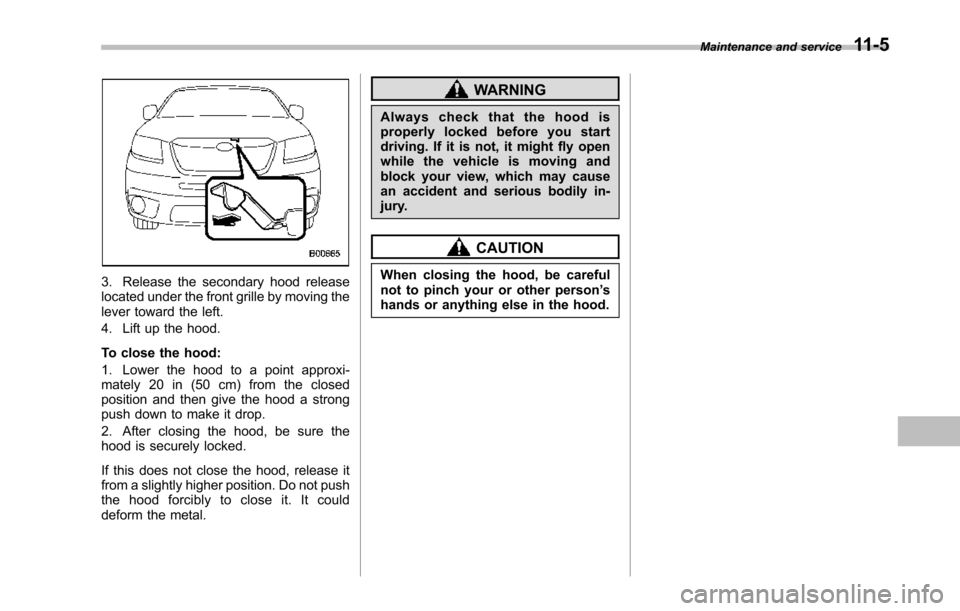
3. Release the secondary hood releaselocated under the front grille by moving thelever toward the left.
4. Lift up the hood.
To close the hood:
1. Lower the hood to a point approxi-mately 20 in (50 cm) from the closedposition and then give the hood a strongpush down to make it drop.
2. After closing the hood, be sure thehoodis securely locked.
If this does not close the hood, release itfrom a slightly higher position. Do not pushthe hood forcibly to close it. It coulddeform the metal.
WARNING
Always check that the hood isproperly locked before you startdriving. If it is not, it might fly openwhile the vehicle is moving andblock your view, which may causean accident and serious bodily in-jury.
CAUTION
When closing the hood, be carefulnot to pinch your or other person’shands or anything else in the hood.
Maintenance and service11-5
Page 341 of 426
11-8Maintenance and service
.Be careful not to spill engine oilwhen adding it. If oil touches theexhaust pipe, it may cause a badsmell, smoke, and/or a fire. Ifengine oil gets on the exhaustpipe, be sure to wipe it off.
If you check the oil level just after stoppingthe engine, wait a few minutes for the oil todrain back into the oil pan before checkingthe level.
To prevent overfilling the engine oil, do notadd any additional oil above the full levelwhen the engine is cold.
&Changing the oil and oil filter
CAUTION
.If you change your own oil, besure to drain all the oil from thefilter before disposal.
.Do not dispose of used engine oilby placing it in the trash, or bypouring it onto the ground, intosewers, or into any body of water.Check with your local govern-ment office for the proper dis-posal options available to you.
Change the oil and oil filter according tothe maintenance schedule in the“War-
ranty and Maintenance Booklet”.
The engine oil and oil filter must bechanged more frequently than listed inthe maintenance schedule when drivingon dusty roads, when short trips arefrequently made, or when driving inextremely cold weather.
1. Warm up the engine by letting theengine idle for approximately 10 minutesto ease draining the engine oil.
2. Park the vehicle on a level surface andstop the engine.
3. Remove the oil filler cap.
4. Drain out the engine oil by removingthe drain plug while the engine is stillwarm. The used oil should be drained intoan appropriate container and disposed ofproperly.
WARNING
Be careful not to burn yourself withhot engine oil.
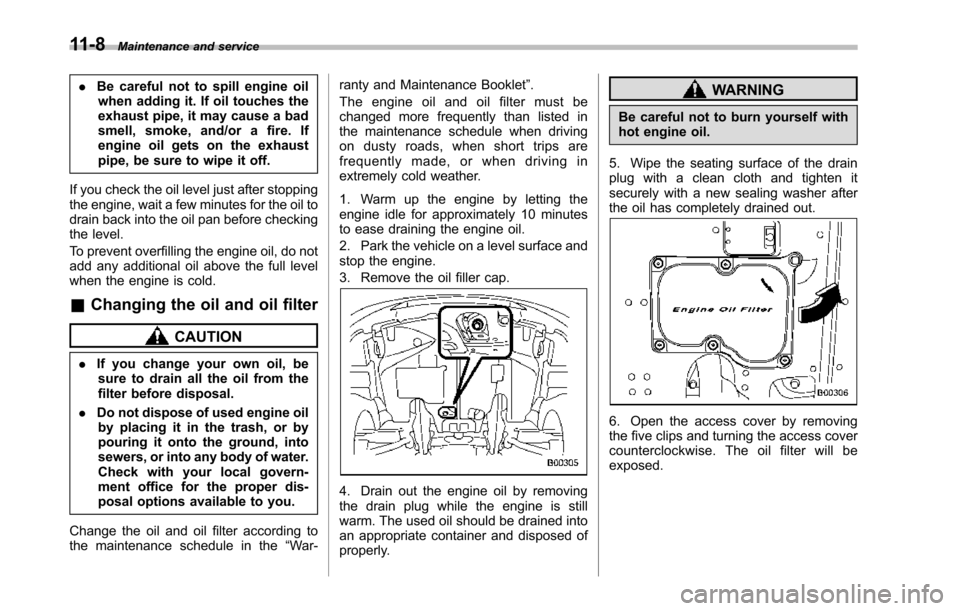
5. Wipe the seating surface of the drainplug with a clean cloth and tighten itsecurely with a new sealing washer afterthe oil has completely drained out.
6. Open the access cover by removingthe five clips and turning the access covercounterclockwise. The oil filter will beexposed.
Page 355 of 426

11-22Maintenance and service
not be functioning normally. In this event,go to a SUBARU dealer to have thesystem inspected as soon as possible.
While the vehicle is driven, friction be-tween tires and the road surface causesthe tires to warm up. After illumination ofthe low tire pressure warning light, anyincrease in the tire pressures caused byan increase in the outside air temperatureor by an increase in the temperature in thetires can cause the low tire pressurewarning light to turn off.
System resetting is necessary when thewheels are changed (for example, aswitch to snow tires) and new TPMSvalves are installed on the newly fittedwheels. Have this work performed by aSUBARU dealer following wheel replace-ment.
It may not be possible to install TPMSvalves on certain wheels that are on themarket. Therefore, if you change thewheels (for example, a switch to snowtires), use wheels that have the same partnumber as the standard-equipmentwheels. Without four operational TPMSvalve/sensors on the wheels, the TPMSwill not fully function and the warning lightin the instrument panel will illuminatesteadily after blinking for approximatelyone minute.
When a tire is replaced, adjustments arenecessary to ensure continued normaloperation of the tire pressure monitoringsystem. As with wheel replacement, there-fore, you should have the work performedby a SUBARU dealer.
WARNING
If the low tire pressure warning lightdoes not illuminate briefly after theignition switch is turned ON or thelight illuminates steadily after blink-ing for approximately one minute,you shouldhave your Tire PressureMonitoring System checked at aSUBARU dealer as soon as possi-ble.
If this light illuminates while driving,never brake suddenly and keepdriving straight ahead while gradu-ally reducing speed. Then slowlypull off the road to a safe place.Otherwise an accident involvingserious vehicle damage and seriouspersonal injury could occur.
If this light still illuminates whiledriving after adjusting the tire pres-sure, a tire may have significantdamage and a fast leak that causesthe tire to lose air rapidly. If you havea flat tire, replace it with a spare tire
as soon as possible.
When a spare tire is mounted or awheel rim is replaced without theoriginal pressure sensor/transmitterbeing transferred, the low tire pres-sure warning light will illuminatesteadily after blinking for approxi-mately one minute. This indicatesthe TPMS is unable to monitor allfour road wheels. Contact yourSUBARU dealer as soon as possiblefor tire and sensor replacement and/or system resetting. If the lightilluminates steadily after blinkingfor approximately one minute,promptly contact a SUBARU dealerto have the system inspected.
&Tire inspection
Checkon a daily basis that the tires arefree from serious damage, nails, andstones. At the same time, check the tiresfor abnormal wear.
Contact your SUBARU dealer immedi-ately if you find any problem.
NOTE
.When the wheels and tires strikecurbs or are subjected to harsh treat-ment as when the vehicle is driven on arough surface, they can suffer damage