2014 SUBARU TRIBECA ECU
[x] Cancel search: ECUPage 73 of 426
1-42Seat, seatbelt and SRS airbags
CAUTION
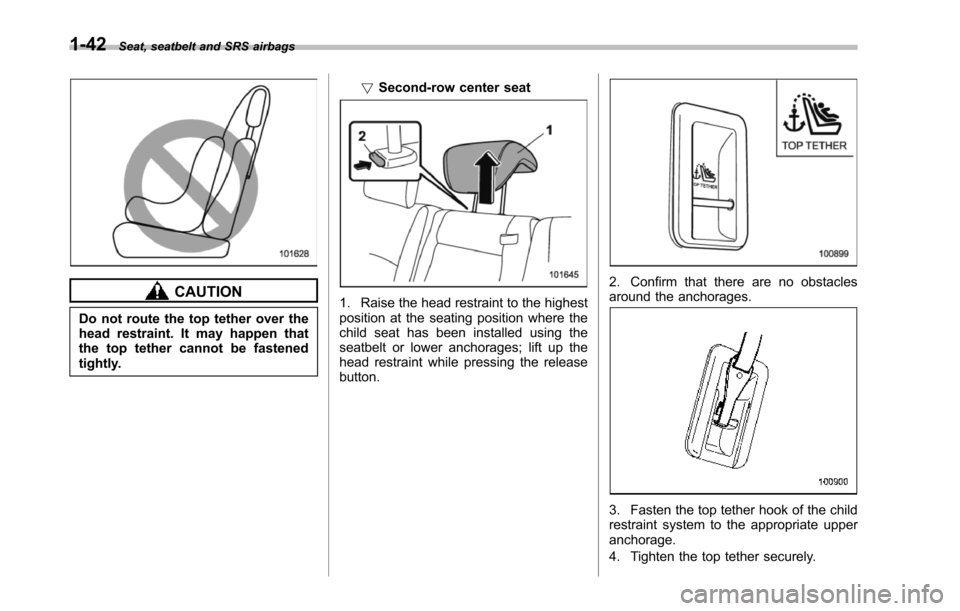
Do not route the top tether over thehead restraint. It may happen thatthe top tether cannot be fastenedtightly.
!Second-row center seat
1. Raise the head restraint to the highestposition at the seating position where thechild seat has been installed using theseatbelt or lower anchorages; lift up thehead restraint while pressing the releasebutton.
2. Confirm that there are no obstaclesaround the anchorages.
3. Fasten the top tether hook of the childrestraintsystem to the appropriate upperanchorage.
4. Tighten the top tether securely.
Page 74 of 426
CAUTION
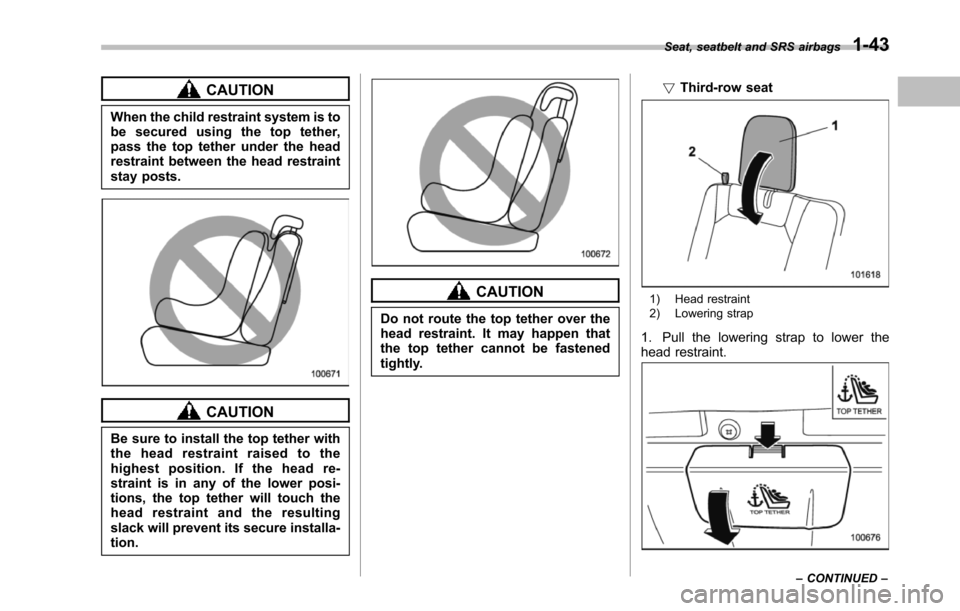
When the child restraint system is tobe secured using the top tether,pass the top tether under the headrestraint between the head restraintstay posts.
CAUTION
Be sure to install the top tether withthe head restraint raised to thehighest position. If the head re-straint is in any of the lower posi-tions, the top tether will touch thehead restraint and the resultingslack will prevent its secure installa-tion.
CAUTION
Do not route the top tether over thehead restraint. It may happen thatthe top tether cannot be fastenedtightly.
!Third-row seat
1) Head restraint2) Lowering strap
1. Pull the lowering strap to lower thehead restraint.
Seat, seatbelt and SRS airbags1-43
–CONTINUED–
Page 75 of 426
1-44Seat, seatbelt and SRS airbags
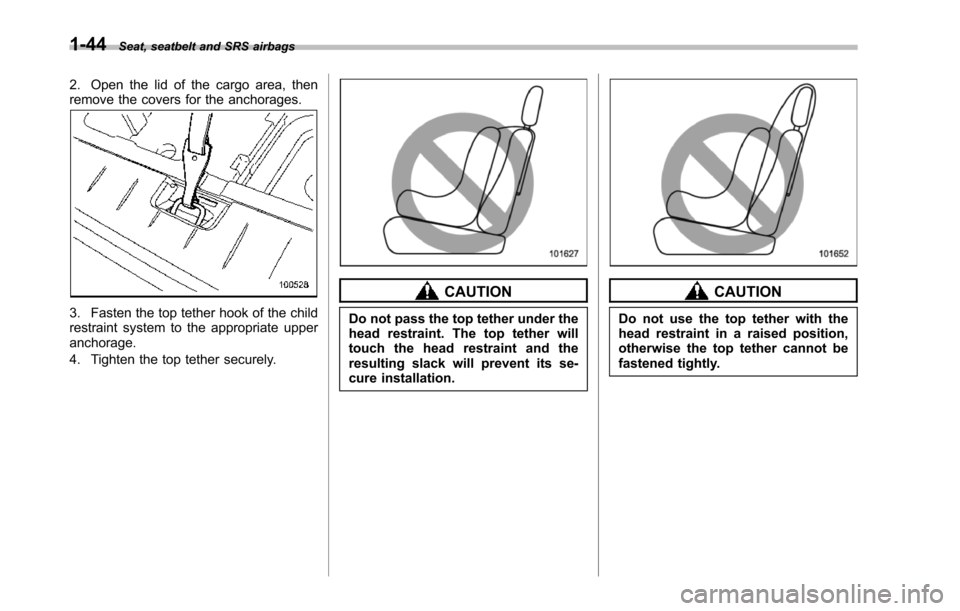
2. Open the lid of the cargo area, thenremove the covers for the anchorages.
3. Fasten the top tether hook of the childrestraint systemto the appropriate upperanchorage.
4. Tighten the top tether securely.
CAUTION
Do not pass the top tether under thehead restraint. The top tether willtouch the head restraint and theresulting slack will prevent its se-cure installation.
CAUTION
Do not use the top tether with thehead restraint in a raised position,otherwise the top tether cannot befastened tightly.
Page 77 of 426
1-46Seat, seatbelt and SRS airbags
refer to“Seatbelts”F1-17.
.Do not sit or lean unnecessarilyclose to the SRS airbag. Becausethe SRS airbag deploys withconsiderable speed–faster thanthe blink of an eye–and force toprotect in high speed collisions,the force of an airbag can injurean occupant whose body is tooclose to SRS airbag.
It is also important to wear yourseatbelt to help avoid injuriesthat can result when the SRSairbag contacts an occupant notin proper position such as onethrown forward during pre-acci-dent braking.
Even when properly positioned,there remainsa possibility thatan occupant may suffer minorinjury such as abrasions andbruises to the face or armsbecause of the SRS airbag de-ployment force.
.The SRS airbags deploy withconsiderable speed and force.Occupants who are out of properposition when the SRS airbagdeploys could suffer very seriousinjuries. Because the SRS airbagneeds enough space for deploy-
ment, the driver should alwayssit upright and well back in theseat as far from the steeringwheel as practical while stillmaintaining full vehicle controland the front passenger shouldmove the seat as far back aspossible and sit upright and wellback in the seat.
.Do not place any objects over ornear the SRS airbag cover orbetween you and the SRS airbag.If the SRS airbag deploys, thoseobjects could interfere with itsproper operation and could bepropelled inside the vehicle andcause injury.
WARNING
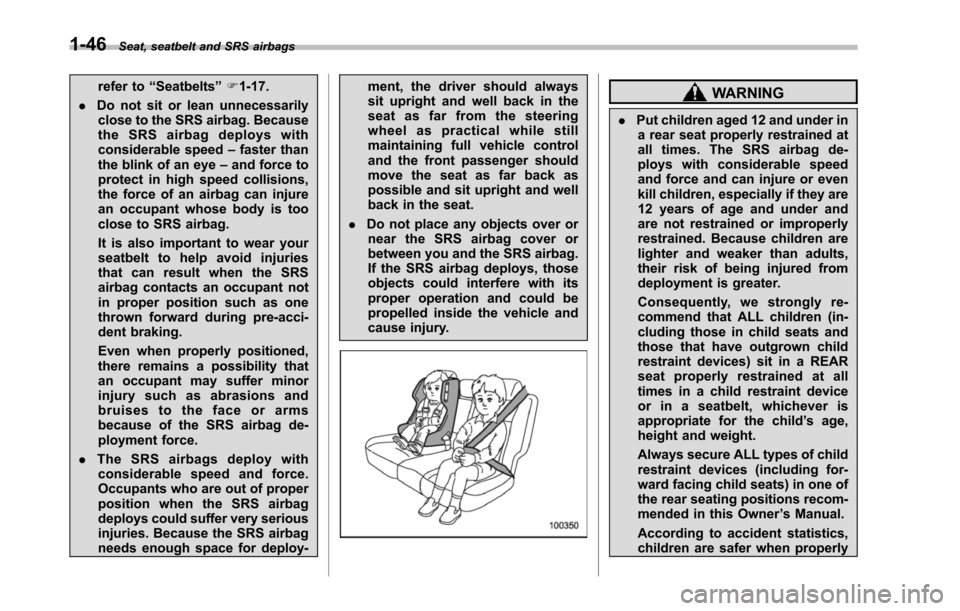
.Put children aged 12 and under ina rear seat properly restrained atall times. The SRS airbag de-ploys with considerable speedand force and can injure or evenkill children, especially if they are12 years of age and under andare not restrained or improperlyrestrained. Because children arelighter and weaker than adults,their risk of being injured fromdeployment is greater.
Consequently, we strongly re-commend that ALL children (in-cluding those in child seats andthose that have outgrown childrestraintdevices) sit in a REARseat properly restrained at alltimes in a child restraint deviceor in a seatbelt, whichever isappropriate for the child’s age,height and weight.
Always secure ALL types of childrestraint devices (including for-ward facing child seats) in one ofthe rear seating positions recom-mended in this Owner’s Manual.
According to accident statistics,children are safer when properly
Page 94 of 426

Ahands-freemicrophoneorother accessory in such a loca-tion could be propelled throughthe cabin with great force by thecurtain airbag, or it could preventcorrect deployment of the curtainairbag. In either case, the resultcould be serious injuries.
WARNING
Do not hang coat hangers or otherhard or pointed objects on the coathooks. If such items were hangingon the coat hooks during deploy-ment of the SRS curtain airbags,they could cause serious injuries bycoming off the coat hooks and beingthrown through the cabin or by
preventing deployment of the cur-tain airbags.
Before hanging clothing on the coathooks, make sure there are no sharpobjects in the pockets. Hang cloth-ing directly on the coat hooks with-out using hangers.
WARNING
Do not put any kind of cover orclothes or other objects over eitherfront seatback and do not attachlabels or stickers to the front seatsurface on or near the SRS sideairbag. They could prevent properdeployment of the SRS side airbag,reducingprotection available to the
front seat’s occupant.
!Operation
The SRS side airbag and SRS curtainairbag can function only when the ignitionswitch is in the“ON”position.
The driver’s and front passenger’s SRSside airbags and SRS curtain airbagsdeploy independently of each other be-cause each has its own impact sensor.Therefore, they may not both deploy in thesame accident. Also, the SRS side airbagand SRS curtain airbag deploys indepen-dently of the driver’s and front passen-ger’s SRS frontal airbags in the steeringwheel and instrument panel.
An impact sensor, which senses impactforce, is located in each of the left and
Seat, seatbelt and SRS airbags1-63
–CONTINUED–
Page 106 of 426
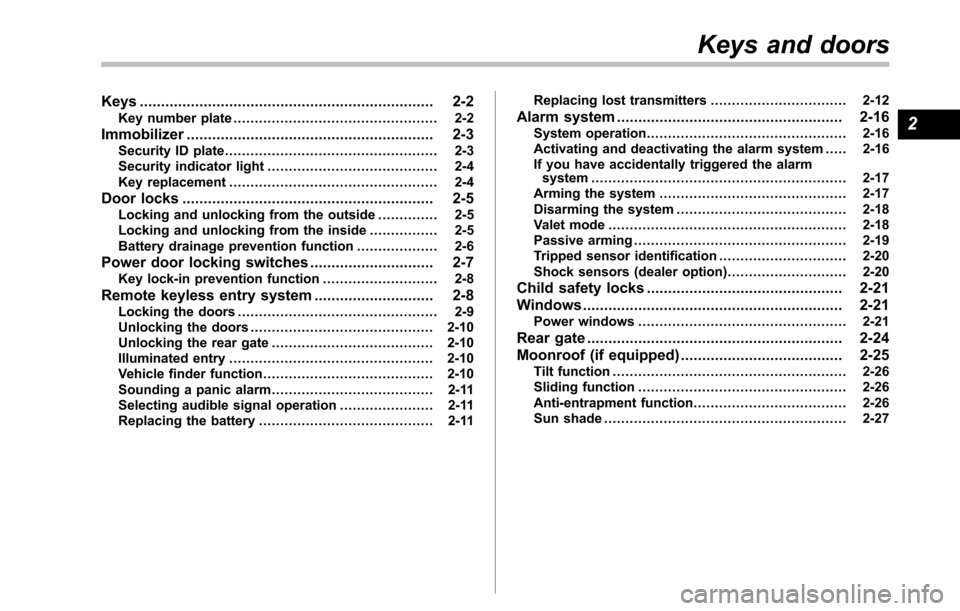
Keys..................................................................... 2-2Key number plate................................................ 2-2
Immobilizer.......................................................... 2-3Security ID plate.................................................. 2-3Security indicator light........................................ 2-4Key replacement................................................. 2-4
Door locks........................................................... 2-5Locking and unlocking from the outside .............. 2-5Locking and unlocking from the inside................ 2-5Batterydrainage prevention function................... 2-6
Power door locking switches............................. 2-7Key lock-in prevention function........................... 2-8
Remote keyless entry system............................ 2-8Locking the doors............................................... 2-9Unlocking the doors........................................... 2-10Unlocking the rear gate...................................... 2-10Illuminated entry................................................ 2-10Vehicle finder function........................................ 2-10Sounding a panic alarm...................................... 2-11Selecting audible signal operation...................... 2-11Replacing the battery......................................... 2-11
Replacing lost transmitters................................ 2-12
Alarm system..................................................... 2-16System operation............................................... 2-16Activating and deactivating the alarm system..... 2-16If you have accidentally triggered the alarmsystem............................................................ 2-17Arming the system............................................ 2-17Disarming the system........................................ 2-18Valet mode........................................................ 2-18Passive arming.................................................. 2-19Tripped sensor identification.............................. 2-20Shock sensors (dealer option)............................ 2-20
Child safety locks.............................................. 2-21
Windows............................................................. 2-21Power windows................................................. 2-21
Rear gate............................................................ 2-24
Moonroof (if equipped)...................................... 2-25Tilt function....................................................... 2-26Sliding function................................................. 2-26Anti-entrapment function.................................... 2-26Sun shade......................................................... 2-27
Keys and doors
2
Page 107 of 426
2-2Keys and doors
Keys
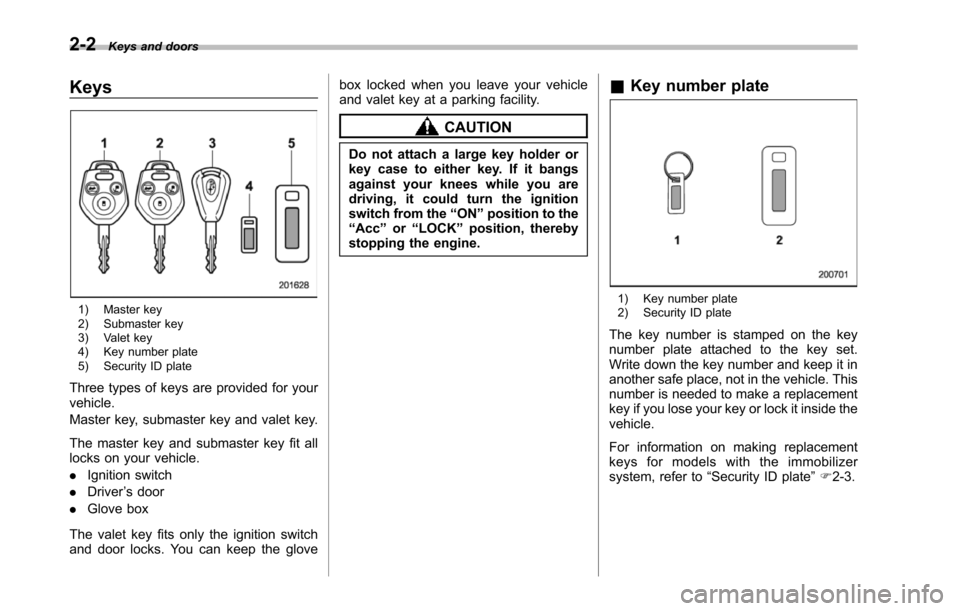
1) Master key2) Submaster key3) Valet key4) Key number plate5) Security ID plate
Three types of keys are provided for yourvehicle.
Master key, submaster key and valet key.
The masterkey and submaster key fit alllocks on your vehicle.
.Ignition switch
.Driver’s door
.Glove box
The valet key fits only the ignition switchand door locks. You can keep the glove
box locked when you leave your vehicleand valet key at a parking facility.
CAUTION
Do not attach a large key holder orkey case to either key. If it bangsagainst your knees while you aredriving, it could turn the ignitionswitch from the“ON”position to the“Acc”or“LOCK”position, therebystopping the engine.
&Key number plate
1) Key number plate2) Security ID plate
The key number is stamped on the keynumber plate attached to the key set.Writedown the key number and keep it inanother safe place, not in the vehicle. Thisnumber is needed to make a replacementkey if you lose your key or lock it inside thevehicle.
For information on making replacementkeys for models with the immobilizersystem, refer to“Security ID plate”F2-3.
Page 108 of 426
Immobilizer
CAUTION
FCC WARNING
Changes or modifications not ex-pressly approved by the party re-sponsible for compliance could voidthe user’s authority to operate theequipment.
The immobilizer system is designed toprevent an unauthorized person fromstarting the engine. Only keys registeredwith your vehicle’s immobilizer system canbe used to operate your vehicle. Even ifan unregistered key fits into the ignitionswitchand can be turned to the“START”position, the engine will automatically stopafter several seconds.
Each immobilizer key contains a trans-ponder in which the key’s ID code isstored. When a key is inserted into theignition switch and turned to the“ON”position, the transponder transmits thekey’s ID code to the immobilizer system’sreceiver. If the transmitted ID codematches the ID code registered in theimmobilizer system, the system allows theengine to be started. Since the ID code istransmitted and acted upon almost in-
stantly, the immobilizer system does notimpede normal starting of the engine.
If the engine does not start, pull out thekey once before trying again. Refer to“Ignition switch”F3-3.
This device complies with Part 15 ofthe FCC Rules and RSS-Gen of ICRules. Operation is subject to thefollowing two conditions: (1) this de-vice may not cause harmful interfer-ence, and (2) this device must acceptany interference received, includinginterference that may cause undesiredoperation.
CAUTION
.Do not place the key under directsunlight or anywhere it maybecomehot.
.Do not get the key wet. If the keygets wet, wipe it dry with a clothimmediately.
NOTE
To p r o t e c t y o u r v e h i c l e f r o m t h e f t ,please pay close attention to the fol-lowing security precautions.
.Never leaveyour vehicle unattendedwith its keys inside..Before leaving your vehicle, close all
windows and lock the doors and reargate..Do not leave spare keys or anyrecord of your key number in thevehicle.
&Security ID plate
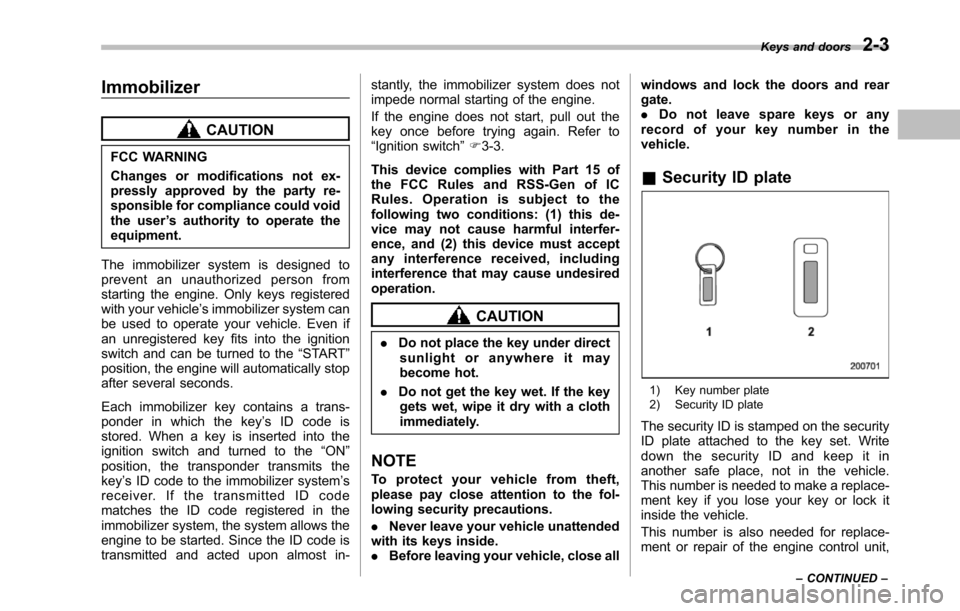
1) Key number plate2) Security ID plate
The security ID is stamped on the securityID plate attached to the key set. Writedown the security ID and keep it inanother safe place, not in the vehicle.This number is needed to make a replace-ment key if you lose your key or lock itinside the vehicle.
This number is also needed for replace-ment or repair of the engine control unit,
Keys and doors2-3
–CONTINUED–