2014 SUBARU TRIBECA check transmission fluid
[x] Cancel search: check transmission fluidPage 146 of 426
!If the light is blinking
If the light is blinking while driving, anengine misfire condition has been de-tected which may damage the emissioncontrol system.
To prevent serious damage to the emis-sion control system, you should do thefollowing.
.Reduce vehicle speed.
.Avoid hard acceleration.
.Avoid steepuphill grades.
.Reduce the amount of cargo, if possi-ble.
.Stop towing a trailer as soon aspossible.
The CHECK ENGINE warning light maystop blinking and illuminate steadily afterseveral drivingtrips. You should have yourvehicle checked by an authorizedSUBARU dealer immediately.
&Charge warning light
If this light illuminates when the engine isrunning, it may indicate that the chargingsystem is not working properly.
If the light illuminates while driving or doesnot turn off after the engine starts, stop theengine at the first safe opportunity andcheck the alternator belt. If the belt isloose, broken or if the belt is in good
condition but the light remains illuminated,contact your nearest SUBARU dealerimmediately.
&Oil pressure warning
light
CAUTION
Do not operate the engine with theoil pressure warning light illumi-nated. This may cause serious en-gine damage.
If this light illuminates when the engine isrunning, it may indicate that the engine oilpressureis low and the lubricating systemis not working properly.
If the light illuminates while driving or doesnot turnoff after the engine starts, stop theengine at the first safe opportunity andcheck the engine oil level. If the oil level islow, add oil immediately. If the engine oil isat the proper level but the light remainsilluminated, contact your nearestSUBARU dealer immediately.
&AT OIL TEMP warning
light
If this light illuminates when the engine isrunning, it may indicate that the automatictransmission fluid temperature is too hot.
If the light illuminates while driving, im-mediately stop the vehicle in a safe placeand let the engine idle until the warninglight turns off.
!Automatic transmission controlsystem warning
If the light flashes after the engine starts, itmay indicate that the automatic transmis-sion control system is not working prop-erly. Contact your nearest SUBARU deal-er for service immediately.
&Rear differential oil
temperature warning
light
CAUTION
If the R.DIFF TEMP warning lightilluminates, reduce vehicle speedand stop the vehicle in a safelocation as soon as possible. Con-tinuing to drive with this light illumi-nated may damage the rear differ-ential and other parts of the power-train.
If this light illuminates when the engine isrunning, it may indicate that the reardifferential oil temperature is too hot.
If the light illuminates while driving, reduce
Instruments and controls3-13
–CONTINUED–
Page 286 of 426
depth of the water and the bottom of thestream bed for firmness and ensure thatthe bed of the stream is flat. Drive slowlyand completely through the stream. Thewater should be shallow enough that itdoes not reach the vehicle’s undercar-riage. Water entering the engine air intakeor the exhaust pipe or water splashingonto electrical parts may damage yourvehicle and may cause it to stall. Neverattempt to drive through rushing water;regardless of its depth, it can wash awaythe ground from under your tires, resultingin possible loss of traction and evenvehicle rollover.
.Always check your brakes for effec-tiveness immediately after driving in sand,mud or water. Do this by driving slowlyand stepping on the brake pedal. Repeatthat process several times to dry out thebrake discsand brake pads.
.Do not drive or park over or nearflammable materials such as dry grass orfallen leaves,as they may burn easily. Theexhaust system is very hot while theengine is running and right after enginestops. This could create a fire hazard.
.After driving through tall grass, mud,rocks, sand, rivers, etc., check that thereis no grass, bush, paper, rags, stones,sand, etc. adhering to or trapped on theunderbody. Clear off any such matter from
the underbody. If the vehicle is used withthese materials trapped or adhering to theunderbody, a mechanical breakdown orfire could occur.
.Secure all cargo carried inside thevehicle and make certain that it is notpiled higher than the seatbacks. Duringsudden stops or jolts, unsecured cargocould be thrown around in the vehicle andcause injury. Do not pile heavy loads onthe roof. Those loads raise the vehicle’scenter of gravity and make it more proneto tip over.
.If you must rock the vehicle to free itfrom sand or mud, depress the acceleratorpedal slightly andmove the select leverback and forth between“D”and“R”repeatedly. Do not race the engine. Forthe best possible traction, avoid spinningthe wheels when trying to free the vehicle.
.When the road surface is extremelyslippery, you can obtain better traction bystarting the vehicle with the transmissionin 2nd than 1st.
.Never equip your vehicle with tireslarger than thosespecified in this manual.
.Wash the vehicle’s underbody after off-road driving. Suspension components areparticularly prone to dirt buildup, so theyneed to be washed thoroughly.
.Frequent driving of an AWD modelunder hard-driving conditions such as
rough roads or off roads will necessitatemore frequent replacement of engine oil,brake fluid and transmission oil than thatspecified in the maintenance scheduledescribed in the“Warranty and Mainte-nance Booklet”.
Remember that damage done to yourSUBARU while operating it off-road andnot using common sense precautionssuch as those listed above is not eligiblefor warranty coverage.
Driving tips8-7
Page 334 of 426

Maintenance schedule....................................... 11-3
Maintenance precautions................................... 11-3Before checking or servicing in the enginecompartment.................................................... 11-4When you do checking or servicing in the enginecompartment while the engine is running.......... 11-4
Engine hood....................................................... 11-4
Engine compartment overview.......................... 11-6
Engine oil............................................................ 11-7Checking the oil level......................................... 11-7Changing the oil and oil filter.............................. 11-8Recommendedgrade and viscosity.................... 11-9Synthetic oil....................................................... 11-9
Cooling system................................................ 11-10Hose and connections...................................... 11-10Engine coolant................................................. 11-11
Air cleaner element.......................................... 11-12Replacing the air cleaner element..................... 11-12
Spark plugs...................................................... 11-13Recommended spark plugs.............................. 11-13
Drive belts........................................................ 11-13
Automatic transmission fluid.......................... 11-14Checking the fluid level.................................... 11-14Recommended fluid......................................... 11-15
Front differential gear oil................................. 11-15Checking the oil level....................................... 11-15Recommended grade and viscosity.................. 11-16
Rear differential gear oil.................................. 11-16Recommended grade and viscosity.................. 11-16
Power steering fluid........................................ 11-16Checking the fluid level.................................... 11-16Recommended fluid......................................... 11-17
Brake fluid........................................................ 11-17Checking the fluid level.................................... 11-17Recommended brake fluid............................... 11-18
Brakebooster.................................................. 11-18
Brake pedal...................................................... 11-19Checking the brake pedal free play.................. 11-19Checking the brake pedal reserve distance....... 11-19
Replacement of brake pad and lining............ 11-19Breaking-in of new brake pads and linings....... 11-20
Parking brake stroke....................................... 11-20
Tires and wheels.............................................. 11-21Types of tires................................................... 11-21Tire pressure monitoring system (TPMS).......... 11-21Tire inspection................................................. 11-22Tire pressuresand wear.................................. 11-23Wheel balance................................................. 11-25Wear indicators............................................... 11-25Tire rotation direction mark.............................. 11-25Tire rotation..................................................... 11-26Tire replacement.............................................. 11-26Wheel replacement.......................................... 11-27
Aluminum wheels............................................ 11-27
Windshield washer fluid.................................. 11-28
Replacement of wiper blades......................... 11-29Windshield wiper blade assembly..................... 11-30Windshield wiper blade rubber ......................... 11-30Rear window wiper blade assembly.................. 11-31
Maintenance and service
11
Page 347 of 426
11-14Maintenance and service
Automatic transmission fluid
&Checking the fluid level
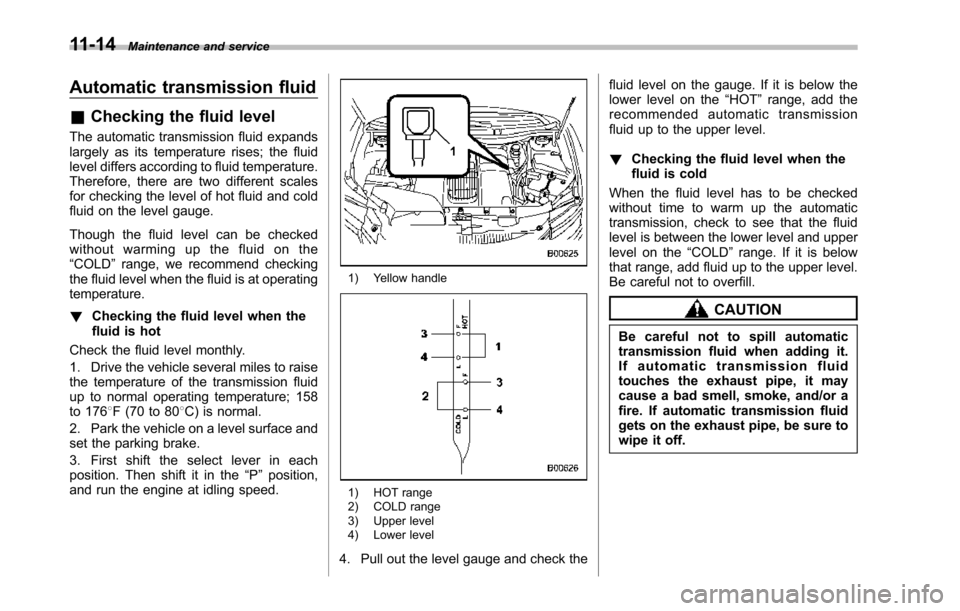
The automatic transmission fluid expandslargely as its temperature rises; the fluidlevel differs according to fluid temperature.Therefore, there are two different scalesfor checking the level of hot fluid and coldfluid on the level gauge.
Though the fluid level can be checkedwithout warming up the fluid on the“COLD”range, we recommend checkingthe fluid level when the fluid is at operatingtemperature.
!Checking the fluid level when thefluid is hot
Check the fluid level monthly.
1. Drive the vehicle several miles to raisethe temperature of the transmission fluidup to normal operating temperature; 158to 1768F (70 to 808C) is normal.
2. Park the vehicle on a level surface andset the parking brake.
3. First shift the select lever in eachposition. Then shift it in the“P”position,and run the engine at idling speed.
1) Yellow handle
1) HOT range2) COLD range3) Upper level4) Lower level
4. Pull out the level gauge and check the
fluid level on the gauge. If it is below thelower level on the“HOT”range, add therecommended automatic transmissionfluid up to the upper level.
!Checking the fluid level when thefluid is cold
When the fluid level has to be checkedwithout time to warm up the automatictransmission,check to see that the fluidlevel is between the lower level and upperlevel on the“COLD”range. If it is belowthat range, add fluid up to the upper level.Be careful not to overfill.
CAUTION
Be careful not to spill automatictransmission fluid when adding it.If automatic transmission fluidtouches the exhaust pipe, it maycause a bad smell, smoke, and/or afire. If automatic transmission fluidgets on the exhaust pipe, be sure towipe it off.
Page 348 of 426
&Recommended fluid
Refer to“Fluids”F12-7.
NOTE
Using any non-specified type of auto-matic transmission fluid could result indamage inside the transmission. Whenreplacingthe automatic transmissionfluid, be sure to use the specified type.
Front differential gear oil
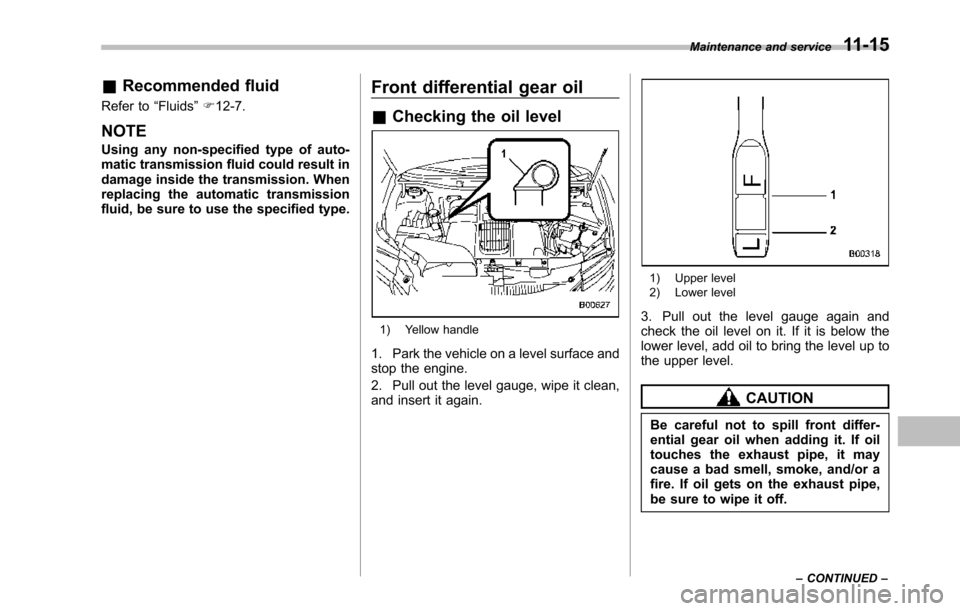
&Checking the oil level
1) Yellow handle
1. Park the vehicle on a level surface andstop the engine.
2. Pull out the level gauge, wipe it clean,and insert it again.
1) Upper level2) Lower level
3. Pull out the level gauge again andcheck theoil level on it. If it is below thelower level, add oil to bring the level up tothe upper level.
CAUTION
Be careful not to spill front differ-ential gear oil when adding it. If oiltouches the exhaust pipe, it maycause a bad smell, smoke, and/or afire. If oil gets on the exhaust pipe,be sure to wipe it off.
Maintenance and service11-15
–CONTINUED–
Page 412 of 426
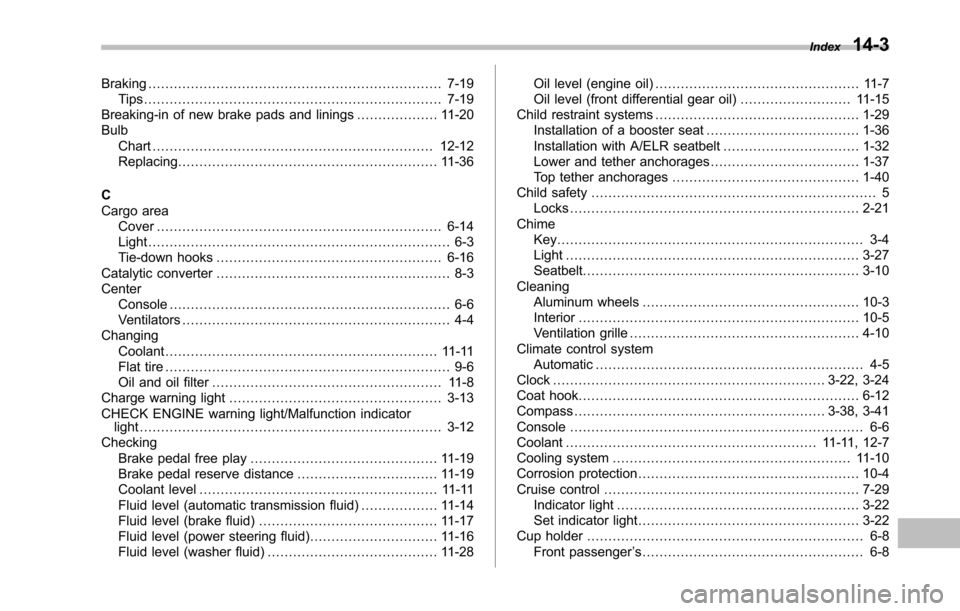
Braking..................................................................... 7-19Tips . . . . . . . . . . . . . . . . . . . . . . . . . . . . . . . . . . . . . . . . . . . . . . . . . . . . . . . . . . . . . . . . . . . . . . 7-19Breaking-in of new brake pads and linings................... 11-20BulbChart.................................................................. 12-12Replacing............................................................. 11-36
CCargo areaCover................................................................... 6-14Light....................................................................... 6-3Tie-down hooks..................................................... 6-16Catalytic converter....................................................... 8-3CenterConsole.................................................................. 6-6Ventilators............................................................... 4-4ChangingCoolant................................................................ 11-11Flat tire................................................................... 9-6Oil andoil filter...................................................... 11-8Charge warning light.................................................. 3-13CHECKENGINE warning light/Malfunction indicatorlight....................................................................... 3-12CheckingBrake pedal free play............................................ 11-19Brake pedal reserve distance................................. 11-19Coolant level........................................................ 11-11Fluid level (automatic transmission fluid).................. 11-14Fluid level (brake fluid).......................................... 11-17Fluidlevel (power steering fluid).............................. 11-16Fluid level (washer fluid)........................................ 11-28
Oil level (engine oil)................................................ 11-7Oil level (front differential gear oil).......................... 11-15Child restraint systems................................................ 1-29Installation of a booster seat.................................... 1-36Installation with A/ELR seatbelt ................................ 1-32Lower and tether anchorages................................... 1-37Top tether anchorages............................................ 1-40Child safety................................................................... 5Locks.................................................................... 2-21ChimeKey........................................................................ 3-4Light..................................................................... 3-27Seatbelt................................................................. 3-10CleaningAluminum wheels................................................... 10-3Interior.................................................................. 10-5Ventilation grille...................................................... 4-10Climate control systemAutomatic............................................................... 4-5Clock................................................................ 3-22, 3-24Coat hook.................................................................. 6-12Compass........................................................... 3-38, 3-41Console..................................................................... 6-6Coolant........................................................... 11-11, 12-7Cooling system........................................................ 11-10Corrosionprotection.................................................... 10-4Cruise control............................................................ 7-29Indicator light......................................................... 3-22Set indicator light.................................................... 3-22Cup holder................................................................. 6-8Front passenger’s.................................................... 6-8
Index14-3