2014 SUBARU TRIBECA ECU
[x] Cancel search: ECUPage 63 of 426
1-32Seat, seatbelt and SRS airbags
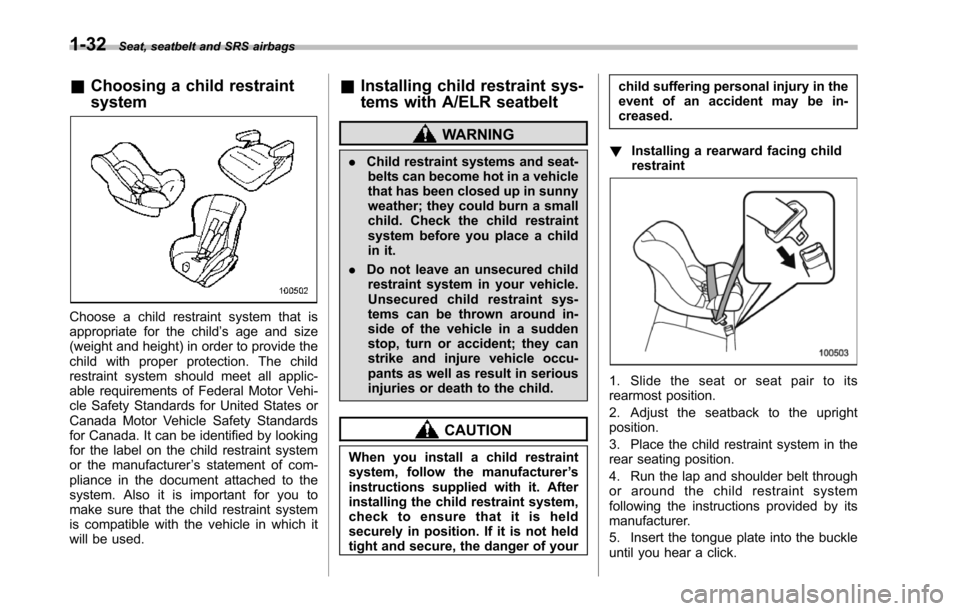
&Choosing a child restraint
system
Choose a child restraint system that isappropriate for the child’s age and size(weight and height) in order to provide thechild with proper protection. The childrestraint system should meet all applic-able requirements of Federal Motor Vehi-cle Safety Standards for United States orCanada Motor Vehicle Safety Standardsfor Canada. It can be identified by lookingfor the label on the child restraint systemor the manufacturer’s statement of com-pliance in the document attached to thesystem. Also it is important for you tomake sure thatthe child restraint systemis compatible with the vehicle in which itwill be used.
&Installing child restraint sys-
tems with A/ELR seatbelt
WARNING
.Child restraint systems and seat-belts can become hot in a vehiclethat has been closed up in sunnyweather; they could burn a smallchild. Check the child restraintsystem before you place a childin it.
.Do not leave an unsecured childrestraint system in your vehicle.Unsecured child restraint sys-tems can be thrown around in-side of the vehicle in a suddenstop, turn or accident; they canstrikeand injure vehicle occu-pants as well as result in seriousinjuries or death to the child.
CAUTION
When you install a child restraintsystem, follow the manufacturer’sinstructions supplied with it. Afterinstalling the child restraint system,check to ensure that it is heldsecurely in position. If it is not heldtight and secure, the danger of your
child suffering personal injury in theevent of an accident may be in-creased.
!Installing a rearward facing childrestraint
1. Slide the seat or seat pair to itsrearmost position.
2. Adjust the seatback to the uprightposition.
3. Place the child restraint system in therear seating position.
4. Run the lap and shoulder belt throughor around the child restraint systemfollowing the instructions provided by itsmanufacturer.
5. Insert the tongue plate into the buckleuntil you hear a click.
Page 64 of 426

6. Take up the slack in the lap belt.
7. Pull out the seatbelt fully from theretractor to change the retractor over fromthe Emergency Locking Retractor (ELR)to the Automatic Locking Retractor (ALR)mode. Then, allow the belt to rewind intothe retractor. As the belt is rewinding,clicks will be heard which indicate theretractor functions as ALR.
8. Push and pull the child restraintsystem forward and from side to side tocheck if it is firmly secured.
Sometimes a child restraint can be morefirmlysecured by pushing it down into theseat cushion and then tightening theseatbelt.
9. Pull at the shoulder portion of the beltto confirm that it cannot be pulled out (ALRproperly functioning).
10. To remove the child restraint system,press the release button on the seatbeltbuckle and allow the belt to retractcompletely. The belt will return to theELR mode.
WARNING
NEVER INSTALL A REARWARD FA-CING CHILD SEAT IN THE FRONTPA S S E N G E R’SSEAT.DOINGSORISKS SERIOUS INJURY OR DEATHTO THE CHILD BY PLACING THECHILD’S HEAD TOO CLOSE TO THESRS AIRBAG.
Seat, seatbelt and SRS airbags1-33
–CONTINUED–
Page 66 of 426
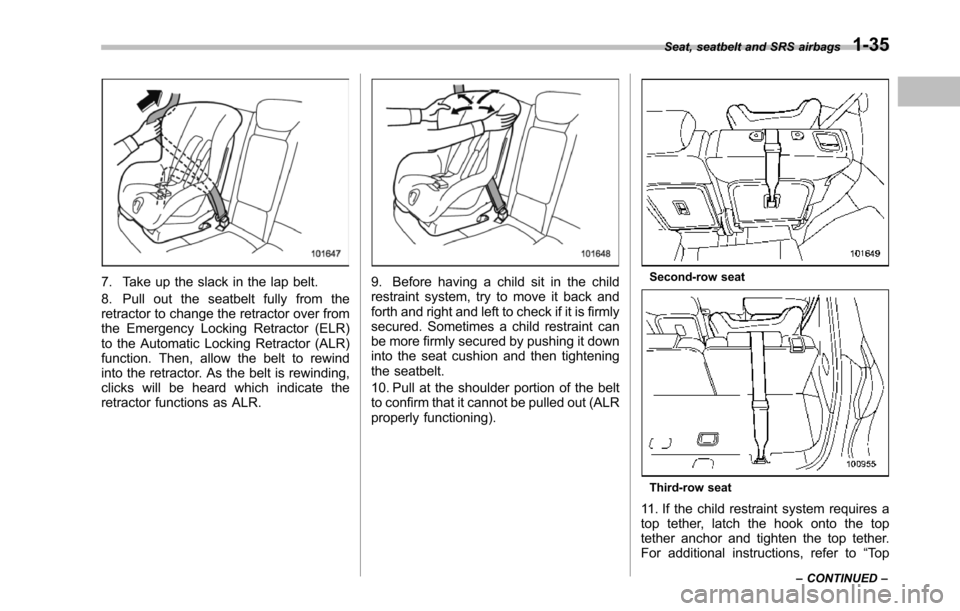
7. Take up the slack in the lap belt.
8. Pull out the seatbelt fully from theretractor to change the retractor over fromthe Emergency Locking Retractor (ELR)to the Automatic Locking Retractor (ALR)function. Then, allow the belt to rewindinto the retractor. As the belt is rewinding,clicks will be heard which indicate theretractor functions as ALR.
9. Before having a child sit in the childrestraint system, try to move it back andforth and right and left to check if it is firmlysecured. Sometimes a child restraint canbe more firmly secured by pushing it downinto the seat cushion and then tighteningtheseatbelt.
10. Pull at the shoulder portion of the beltto confirm that it cannot be pulled out (ALRproperly functioning).
Second-row seat
Third-row seat
11. If the child restraint system requires atop tether, latch the hook onto the toptether anchor and tighten the top tether.For additional instructions, refer to“To p
Seat, seatbelt and SRS airbags1-35
–CONTINUED–
Page 67 of 426
1-36Seat, seatbelt and SRS airbags
tether anchorages”F1-40.
12. To remove the child restraint system,press the release button on the seatbeltbuckle and allow the belt to retractcompletely. The belt will return to theELR mode.
NOTE
When the child restraint system is nolonger in use, remove it and restore theELR function of the retractor. Thatfunction is restored by allowing theseatbelt to retract fully.
&Installing a booster seat
WARNING
.Child restraint systems and seat-belts can become hot in a vehiclethat has been closed up in sunnyweather; they could burn a smallchild. Check the child restraintsystem before you place a childin it.
.Do not leave an unsecured childrestraint system in your vehicle.Unsecured child restraint sys-tems can be thrown around in-side of the vehicle in a suddenstop, turn or accident; they canstrike and injure vehicle occu-pants as well as result in seriousinjuriesor death to the child.
CAUTION
When you install a child restraintsystem, follow the manufacturer’sinstructions supplied with it. Afterinstalling the child restraint system,check to ensure that it is heldsecurely in position. If it is not heldtight and secure, the danger of yourchild suffering personal injury in theevent of an accident may be in-
creased.
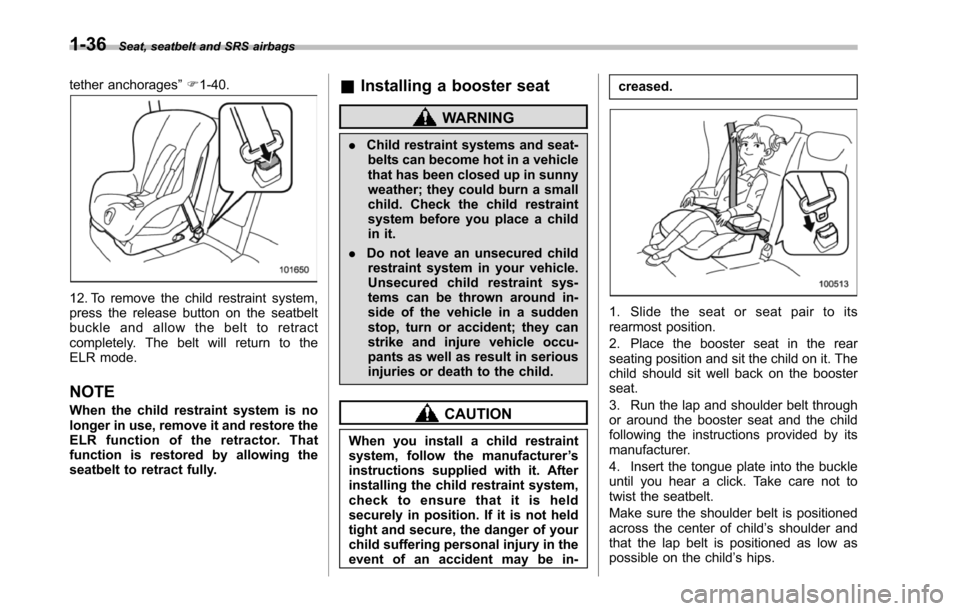
1. Slide the seat or seat pair to itsrearmost position.
2. Place the booster seat in the rearseating position and sit the child on it. Thechild should sit well back on the boosterseat.
3. Run the lap and shoulder belt throughor around the booster seat and the childfollowing the instructions provided by itsmanufacturer.
4. Insert the tongue plate into the buckleuntil you hear a click. Take care not totwist the seatbelt.
Make sure the shoulder belt is positionedacross the center of child’s shoulder andthat the lap belt is positioned as low aspossible on the child’s hips.
Page 68 of 426
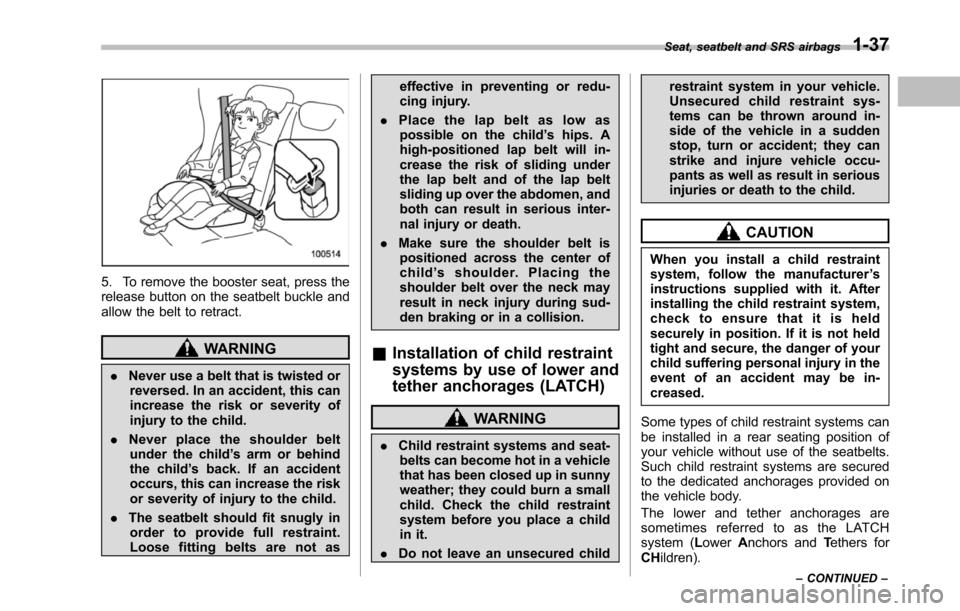
5. To remove the booster seat, press therelease button on the seatbelt buckle andallow the belt to retract.
WARNING
.Never use a belt that is twisted orreversed.In an accident, this canincrease the risk or severity ofinjury to the child.
.Never place the shoulder beltunder the child’s arm or behindthe child’s back. If an accidentoccurs, this can increase the riskor severity of injury to the child.
.The seatbelt should fit snugly inorder to provide full restraint.Loose fitting belts are not as
effective in preventing or redu-cing injury.
.Place the lap belt as low aspossible on the child’s hips. Ahigh-positioned lap belt will in-crease the risk of sliding underthe lap belt and of the lap beltsliding up over the abdomen, andboth can result in serious inter-nalinjury or death.
.Make sure the shoulder belt ispositioned across the center ofchild’sshoulder.Placingtheshoulder belt over the neck mayresult in neck injury during sud-den braking or in a collision.
&Installation of child restraint
systems by use of lower and
tether anchorages (LATCH)
WARNING
.Child restraint systems and seat-belts can become hot in a vehiclethat has been closed up in sunnyweather; they could burn a smallchild.Check the child restraintsystem before you place a childin it.
.Do not leave an unsecured child
restraint system in your vehicle.Unsecured child restraint sys-tems can be thrown around in-side of the vehicle in a suddenstop, turn or accident; they canstrike and injure vehicle occu-pants as well as result in seriousinjuries or death to the child.
CAUTION
When you install a child restraintsystem, follow the manufacturer’sinstructions supplied with it. Afterinstalling thechild restraint system,check to ensure that it is heldsecurely in position. If it is not heldtight and secure, the danger of yourchild suffering personal injury in theevent of an accident may be in-creased.
Some types of child restraint systems canbe installed in a rear seating position ofyour vehicle without use of the seatbelts.Such child restraint systems are securedto the dedicated anchorages provided onthe vehicle body.
The lower and tether anchorages aresometimes referred to as the LATCHsystem (LowerAnchors andTethers forCHildren).
Seat, seatbelt and SRS airbags1-37
–CONTINUED–
Page 70 of 426
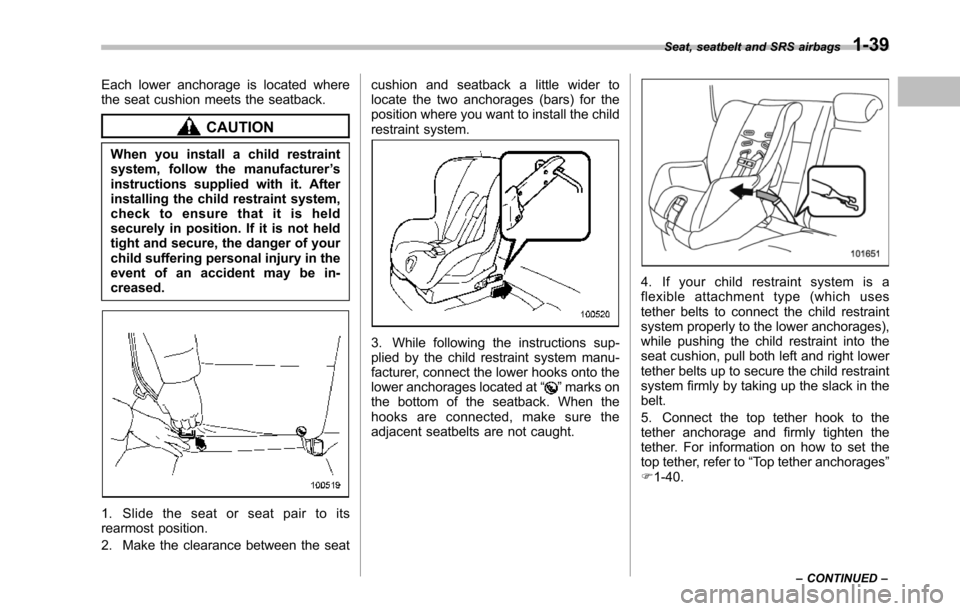
Each lower anchorage is located wherethe seat cushion meets the seatback.
CAUTION
When you install a child restraintsystem, follow the manufacturer’sinstructions supplied with it. Afterinstalling the child restraint system,check to ensure that it is heldsecurely in position. If it is not heldtight and secure, the danger of yourchild sufferingpersonal injury in theevent of an accident may be in-creased.
1. Slide the seat or seat pair to itsrearmost position.
2. Make the clearance between the seat
cushion and seatback a little wider tolocate the two anchorages (bars) for theposition where you want to install the childrestraint system.
3. While following the instructions sup-plied by the child restraint system manu-facturer, connect the lower hooks onto thelower anchorages located at“”marks onthe bottomof the seatback. When thehooks are connected, make sure theadjacent seatbelts are not caught.
4. If your child restraint system is aflexible attachment type (which usestether belts to connect the child restraintsystem properly to the lower anchorages),while pushing the child restraint into theseat cushion, pull both left and right lowertetherbelts up to secure the child restraintsystem firmly by taking up the slack in thebelt.
5. Connect the top tether hook to thetether anchorage and firmly tighten thetether. For information on how to set thetop tether, refer to“Top tether anchorages”F1-40.
Seat, seatbelt and SRS airbags1-39
–CONTINUED–
Page 71 of 426
1-40Seat, seatbelt and SRS airbags
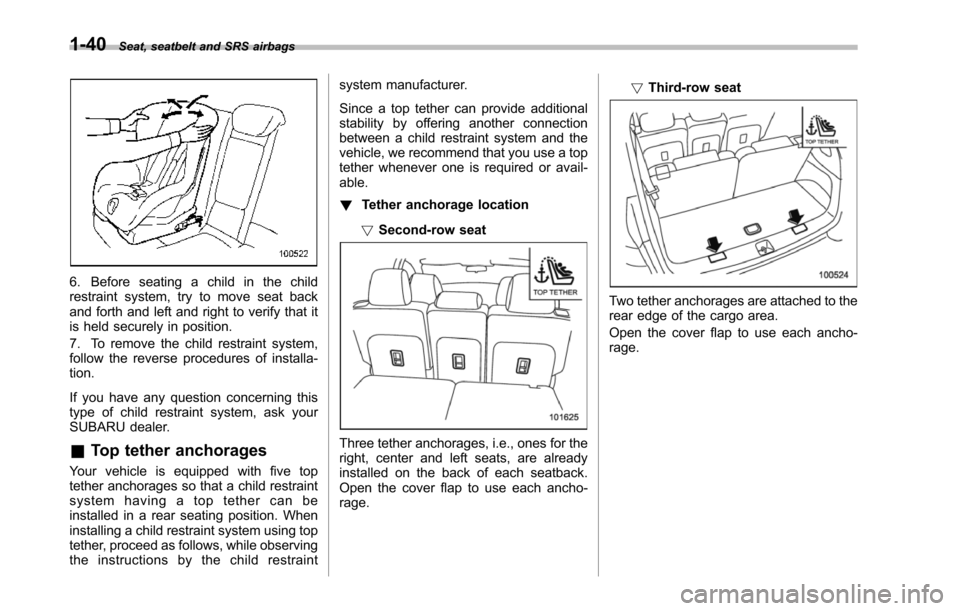
6. Before seating a child in the childrestraint system, try to move seat backand forth and left and right to verify that itis held securely in position.
7. To remove the child restraint system,follow the reverse procedures of installa-tion.
If you have any question concerning thistype of child restraint system, ask yourSUBARU dealer.
&Top tether anchorages
Your vehicle is equipped with five toptether anchorages so that a child restraintsystem having a top tether can beinstalled in a rear seating position. Wheninstalling a child restraint system using toptether, proceed as follows, while observingthe instructions by the child restraint
system manufacturer.
Since a top tether can provide additionalstability by offering another connectionbetween a child restraint system and thevehicle, we recommend that you use a toptether whenever one is required or avail-able.
!Tether anchorage location
!Second-row seat
Three tether anchorages, i.e., ones for theright, centerand left seats, are alreadyinstalled on the back of each seatback.Open the cover flap to use each ancho-rage.
!Third-row seat
Two tether anchorages are attached to therear edge of the cargo area.
Open the cover flap to use each ancho-rage.
Page 72 of 426
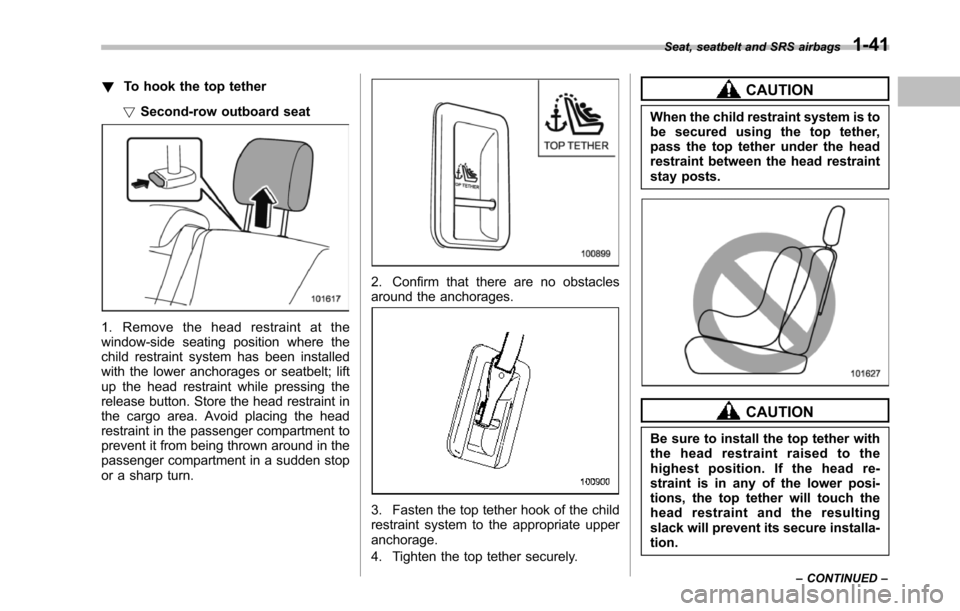
!To hook the top tether
!Second-row outboard seat
1. Remove the head restraint at thewindow-sideseating position where thechild restraint system has been installedwith the lower anchorages or seatbelt; liftup the head restraint while pressing therelease button. Store the head restraint inthe cargo area. Avoid placing the headrestraint in the passenger compartment toprevent it from being thrown around in thepassenger compartment in a sudden stopor a sharp turn.
2. Confirm that there are no obstaclesaround the anchorages.
3. Fasten the top tether hook of the childrestraint system to the appropriate upperanchorage.
4. Tighten the top tether securely.
CAUTION
When the child restraint system is tobe secured using the top tether,pass the top tether under the headrestraint between the head restraintstay posts.
CAUTION
Be sure to install the top tether withthe head restraint raised to thehighest position. If the head re-straint is in any of the lower posi-tions, the top tether will touch thehead restraint and the resultingslack will prevent its secure installa-tion.
Seat, seatbelt and SRS airbags1-41
–CONTINUED–