2014 NISSAN TEANA engine
[x] Cancel search: enginePage 2629 of 4801
REFRIGERANTHA-23
< PERIODIC MAINTENANCE >
C
D E
F
G H
J
K L
M A
B
HA
N
O P
6. Start the engine and set A/C control in the following conditions. • A/C switch ON
• Air flow: VENT (ventilation)
• Intake door position: Recirculation
• Temperature setting: Full cold
• Fan (blower) speed: Maximum speed set
7. Run the engine at approximately 1,500 rpm for 2 minutes or more.
8. Stop the engine. Check again for refrigerant leakage. Go to step 4. WARNING:
Be careful not to get burned when the engine is hot.
NOTE:
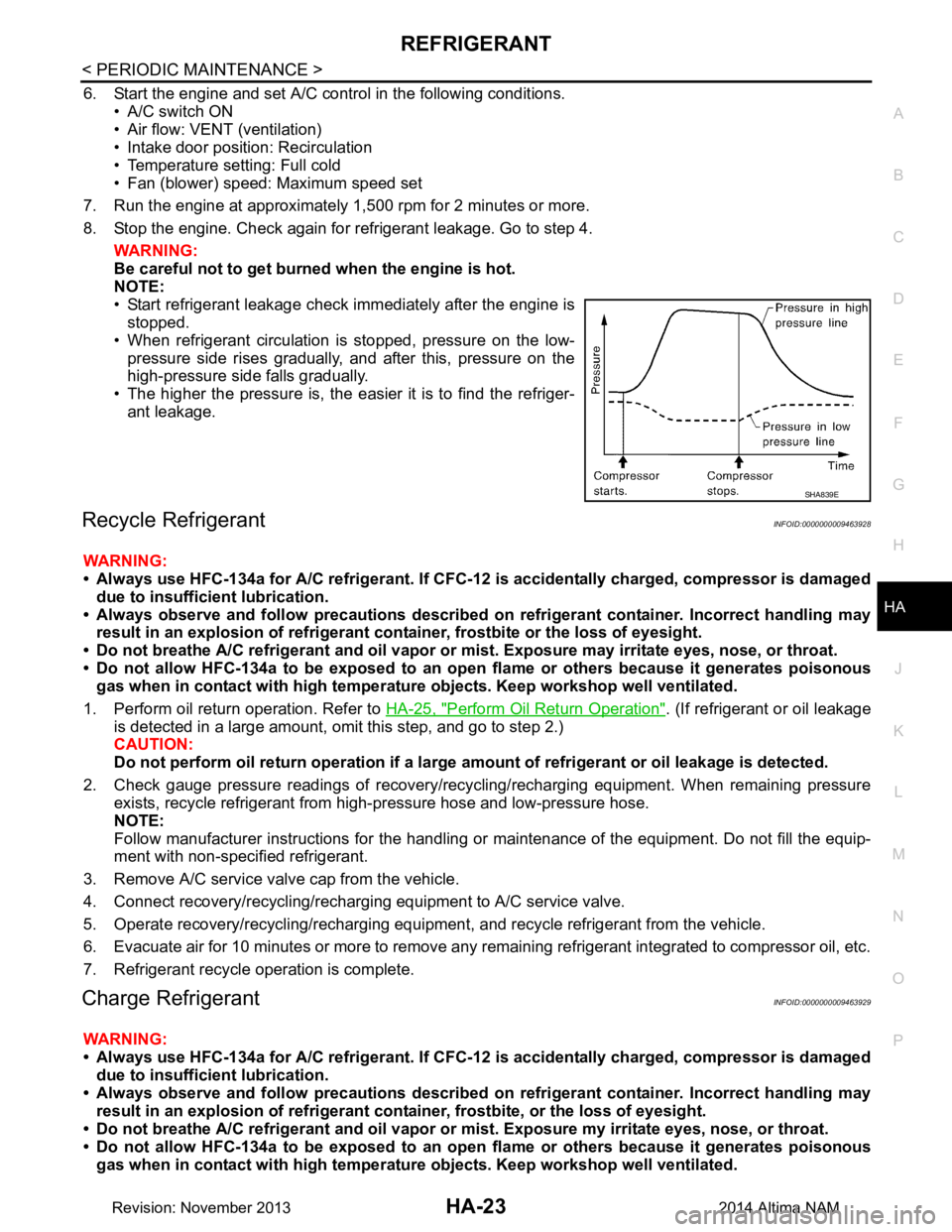
• Start refrigerant leakage check immediately after the engine is stopped.
• When refrigerant circulation is stopped, pressure on the low- pressure side rises gradually, and after this, pressure on the
high-pressure side falls gradually.
• The higher the pressure is, the easier it is to find the refriger-
ant leakage.
Recycle RefrigerantINFOID:0000000009463928
WARNING:
• Always use HFC-134a for A/C refrigerant. If CFC-12 is accidentally charged, compressor is damaged
due to insufficient lubrication.
• Always observe and follow precaution s described on refrigerant container. Incorrect handling may
result in an explosion of refrigerant co ntainer, frostbite or the loss of eyesight.
• Do not breathe A/C refrigerant and oil vapor or mi st. Exposure may irritate eyes, nose, or throat.
• Do not allow HFC-134a to be exposed to an open flame or others because it generates poisonous
gas when in contact with high temperatur e objects. Keep workshop well ventilated.
1. Perform oil return operation. Refer to HA-25, "Perform Oil Return Operation"
. (If refrigerant or oil leakage
is detected in a large amount, omit this step, and go to step 2.)
CAUTION:
Do not perform oil return operation if a large am ount of refrigerant or oil leakage is detected.
2. Check gauge pressure readings of recovery/recyc ling/recharging equipment. When remaining pressure
exists, recycle refrigerant from high-pressure hose and low-pressure hose.
NOTE:
Follow manufacturer instructions for the handling or maintenance of the equipment. Do not fill the equip-
ment with non-specified refrigerant.
3. Remove A/C service valve cap from the vehicle.
4. Connect recovery/recycling/recharging equipment to A/C service valve.
5. Operate recovery/recycling/recharging equipment , and recycle refrigerant from the vehicle.
6. Evacuate air for 10 minutes or more to remove any remaining refrigerant integrated to compressor oil, etc.
7. Refrigerant recycle operation is complete.
Charge RefrigerantINFOID:0000000009463929
WARNING:
• Always use HFC-134a for A/C refrigerant. If CFC-12 is accidentally charged, compressor is damaged
due to insufficient lubrication.
• Always observe and follow precaution s described on refrigerant container. Incorrect handling may
result in an explosion of refrigerant co ntainer, frostbite, or the loss of eyesight.
• Do not breathe A/C refrigerant and oil vapor or mi st. Exposure my irritate eyes, nose, or throat.
• Do not allow HFC-134a to be exposed to an open flame or others because it generates poisonous
gas when in contact with high temperatur e objects. Keep workshop well ventilated.
SHA839E
Revision: November 20132014 Altima NAM
Page 2631 of 4801
OIL
HA-25
< PERIODIC MAINTENANCE >
C
D E
F
G H
J
K L
M A
B
HA
N
O P
OIL
DescriptionINFOID:0000000009463930
MAINTENANCE OF OIL LEVEL
The compressor oil is circulating in the system together wi th the refrigerant. It is necessary to fill compressor
with oil when replacing A/C system parts or when a large amount of refrigerant leakage is detected. It is impor-
tant to always maintain oil level within the spec ified level, otherwise the following conditions may occur:
• Insufficient oil amount: Stuck compressor
• Excessive oil amount: Insufficient coo ling (caused by insufficient heat exchange)
InspectionINFOID:0000000009463931
If a compressor is malfunctioning (internal noise, insufficient cooling), check the compressor oil.
1.COMPRESSOR OIL JUDGMENT
1. Remove the compressor. Refer to HA-30, "COMPRESSOR : Removal and Installation"
.
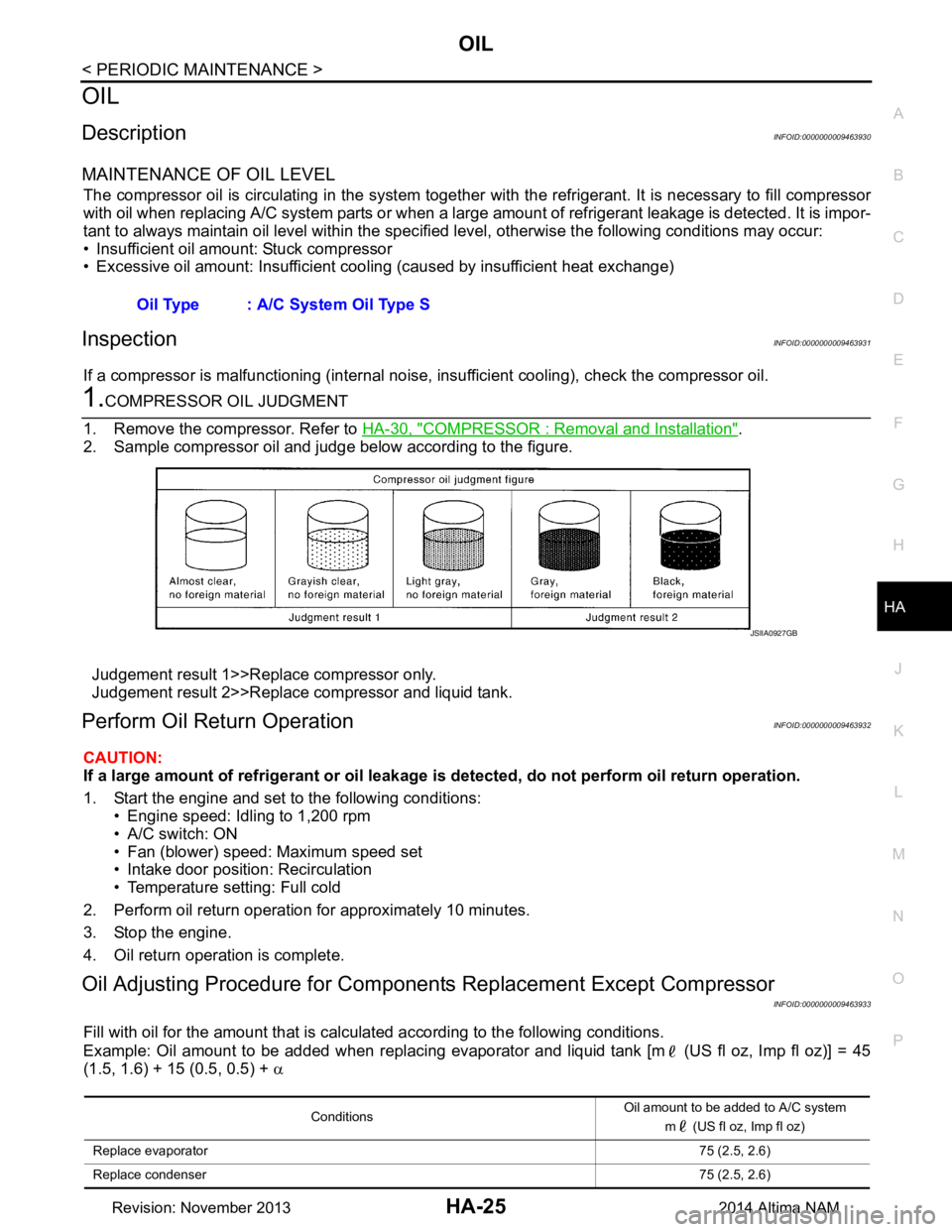
2. Sample compressor oil and judge below according to the figure.
Judgement result 1>>Replace compressor only.
Judgement result 2>>Replace compressor and liquid tank.
Perform Oil Return OperationINFOID:0000000009463932
CAUTION:
If a large amount of refrigerant or oil leakage is detected, do not perform oil return operation.
1. Start the engine and set to the following conditions: • Engine speed: Idling to 1,200 rpm
• A/C switch: ON
• Fan (blower) speed: Maximum speed set
• Intake door position: Recirculation
• Temperature setting: Full cold
2. Perform oil return operation for approximately 10 minutes.
3. Stop the engine.
4. Oil return operation is complete.
Oil Adjusting Procedure for Component s Replacement Except Compressor
INFOID:0000000009463933
Fill with oil for the amount that is calculated according to the following conditions.
Example: Oil amount to be added when replacing evaporator and liquid tank [m (US fl oz, Imp fl oz)] = 45
(1.5, 1.6) + 15 (0.5, 0.5) + α
Oil Type : A/C System Oil Type S
JSIIA0927GB
Conditions
Oil amount to be added to A/C system
m (US fl oz, Imp fl oz)
Replace evaporator 75 (2.5, 2.6)
Replace condenser 75 (2.5, 2.6)
Revision: November 20132014 Altima NAM
Page 2634 of 4801

HA-28
< PERIODIC MAINTENANCE >
PERFORMANCE TEST
PERFORMANCE TEST
InspectionINFOID:0000000009463935
INSPECTION PROCEDURE
1. Connect recovery/recycling/recharging equipment (for HFC-134a) or manifold gauge.
2. Start the engine, and set to the following condition.
Test condition
3. Maintain test condition until A/C system becomes stable. (Approximately 10 minutes)
4. Check that test results of “recirculating-to-disc harge air temperature” and “ambient air temperature-to-
operating pressure” are within the specified value.
5. When test results are within the spec ified value, inspection is complete.
If any of test result is out of the specifi ed value, perform diagnosis by gauge pressure. Refer to HA-17,
"Symptom Table".
RECIRCULATING-TO-DISCHARGE AIR TEMPERATURE TABLE
AMBIENT AIR TEMPERATURE-TO-OPERATING PRESSURE TABLE
Surrounding condition Indoors or in the shade (in a well-ventilated place)
Vehicle condition Door Closed
Door glass Full open
Hood Open
Engine speed Idle speed
A/C condition Temperature control switch or dial Full cold
A/C switch ON
Air outlet VENT (ventilation)
Intake door position Recirculation
Fan (blower) speed Maximum speed set
Inside air (Recirculating air) at blower assembly inlet Discharge air temperature from center ventilator
°C ( °F)
Relative humidity
% Air temperature
°C ( °F)
50 – 60 20 (68) 4.7 – 6.7 (40 – 44)
25 (77) 8.6 – 11.1 (47 – 52)
30 (86) 12.6 – 15.6 (55 – 60)
35 (95) 19.0 – 22.5 (66 – 73)
60 – 70 20 (68) 6.7 – 8.7 (44 – 48)
25 (77) 11.1 – 13.6 (52 – 56)
30 (86) 15.6 – 18.6 (60 – 65)
35 (95) 22.5 – 26.0 (73 – 79)
Revision: November 20132014 Altima NAM
Page 2647 of 4801
HEATING AND COOLING UNIT ASSEMBLYHA-41
< REMOVAL AND INSTALLATION >
C
D E
F
G H
J
K L
M A
B
HA
N
O P
HEATING AND COOLING UNIT ASSEMB LY : Removal and InstallationINFOID:0000000009463949
REMOVAL
1. Discharge the refrigerant. Refer to HA-23, "Recycle Refrigerant".
2. Drain the cooling system. Refer to CO-12, "Changing Engine Coolant"
.
3. Remove the instrument panel assembly. Refer to IP-15, "Removal and Installation"
.
4. Remove the steering column. Refer to ST-33, "Removal and Installation"
.
5. Remove the strut tower brace. Refer to FSU-19, "Exploded View"
.
6. Disconnect the low-pressure pipe from the expansion valve. CAUTION:
Cap or wrap the joint of the pipe with suitable ma terial such as vinyl tape to avoid the entry of air.
7. Disconnect the high-pressure pi pe from the expansion valve.
8. Disconnect the heater hoses from the heater core pipes.
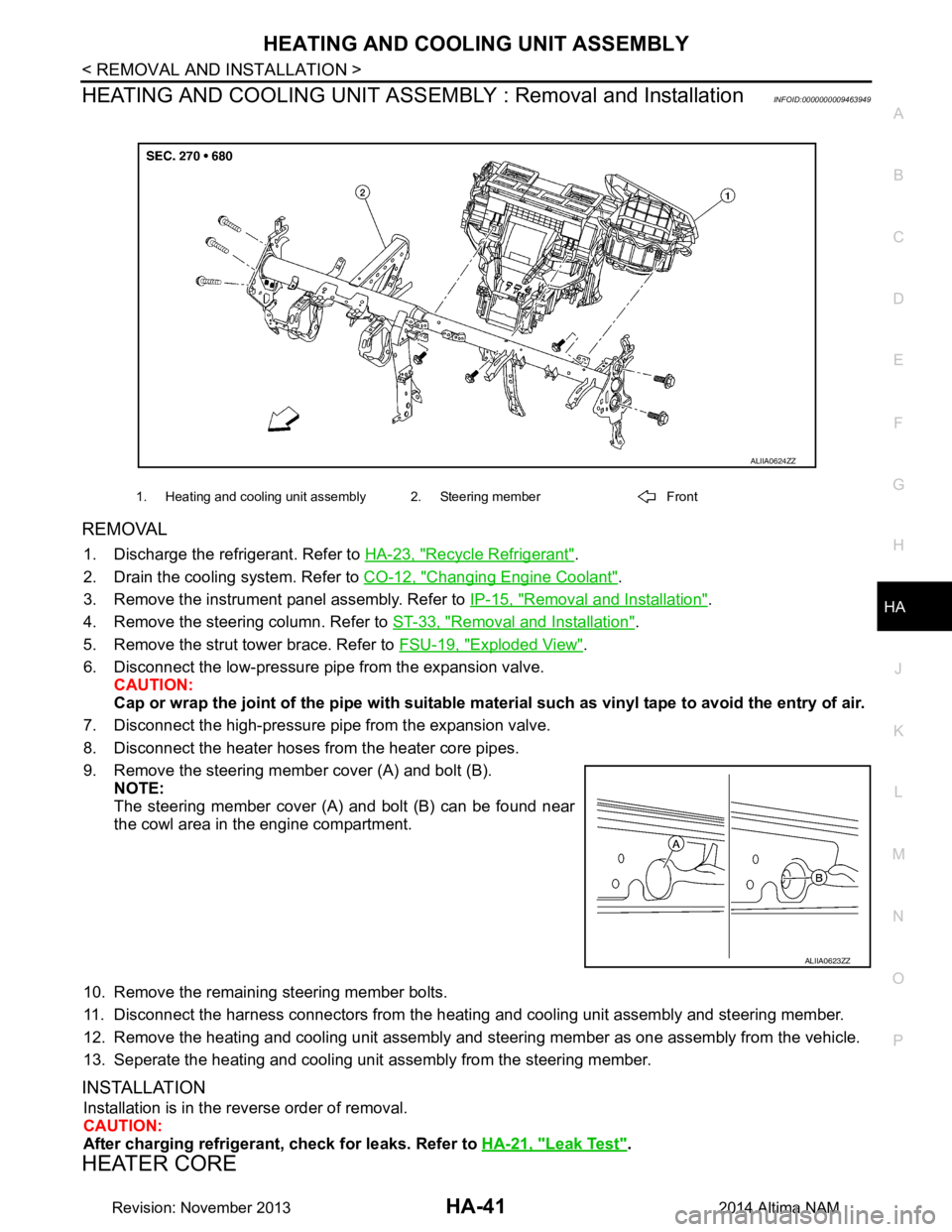
9. Remove the steering member cover (A) and bolt (B). NOTE:
The steering member cover (A) and bolt (B) can be found near
the cowl area in the engine compartment.
10. Remove the remaining steering member bolts.
11. Disconnect the harness connectors from the heati ng and cooling unit assembly and steering member.
12. Remove the heating and cooling unit assembly and steering member as one assembly from the vehicle.
13. Seperate the heating and cooling unit assembly from the steering member.
INSTALLATION
Installation is in the reverse order of removal.
CAUTION:
After charging refrigerant, check for leaks. Refer to HA-21, "Leak Test"
.
HEATER CORE
1. Heating and cooling unit assembly 2. Steering member Front
ALIIA0624ZZ
ALIIA0623ZZ
Revision: November 20132014 Altima NAM
Page 2654 of 4801
![NISSAN TEANA 2014 Service Manual
PRECAUTIONSHAC-5
< PRECAUTION > [AUTOMATIC AIR CONDITIONER]
C
D E
F
G H
J
K L
M A
B
HAC
N
O P
PRECAUTION
PRECAUTIONS
Precaution for Supplemental Restraint System (SRS) "AIR BAG" and "SEAT BELT
PR](/manual-img/5/57390/w960_57390-2653.png "NISSAN TEANA 2014 Service Manual
PRECAUTIONSHAC-5
< PRECAUTION > [AUTOMATIC AIR CONDITIONER]
C
D E
F
G H
J
K L
M A
B
HAC
N
O P
PRECAUTION
PRECAUTIONS
Precaution for Supplemental Restraint System (SRS) \"AIR BAG\" and \"SEAT BELT
PR")
PRECAUTIONSHAC-5
< PRECAUTION > [AUTOMATIC AIR CONDITIONER]
C
D E
F
G H
J
K L
M A
B
HAC
N
O P
PRECAUTION
PRECAUTIONS
Precaution for Supplemental Restraint System (SRS) "AIR BAG" and "SEAT BELT
PRE-TENSIONER"
INFOID:0000000009951773
The Supplemental Restraint System such as “A IR BAG” and “SEAT BELT PRE-TENSIONER”, used along
with a front seat belt, helps to reduce the risk or severi ty of injury to the driver and front passenger for certain
types of collision. Information necessary to service t he system safely is included in the SR and SB section of
this Service Manual.
WARNING:
• To avoid rendering the SRS inoper ative, which could increase the risk of personal injury or death in
the event of a collision which would result in air bag inflation, all maintenance must be performed by
an authorized NISSAN/INFINITI dealer.
• Improper maintenance, including in correct removal and installation of the SRS, can lead to personal
injury caused by unintentional act ivation of the system. For removal of Spiral Cable and Air Bag
Module, see the SR section.
• Do not use electrical test equipm ent on any circuit related to the SRS unless instructed to in this
Service Manual. SRS wiring harnesses can be identi fied by yellow and/or orange harnesses or har-
ness connectors.
PRECAUTIONS WHEN USING POWER TOOLS (AIR OR ELECTRIC) AND HAMMERS
WARNING:
• When working near the Airbag Diagnosis Sensor Un it or other Airbag System sensors with the Igni-
tion ON or engine running, DO NOT use air or el ectric power tools or strike near the sensor(s) with a
hammer. Heavy vibration could activate the sensor( s) and deploy the air bag(s), possibly causing
serious injury.
• When using air or electric power tools or hammers , always switch the Ignition OFF, disconnect the
battery and wait at least three mi nutes before performing any service.
Precaution for WorkINFOID:0000000009463086
• When removing or disassembling each component, be ca reful not to damage or deform it. If a component
may be subject to interference, be sure to protect it with a shop cloth.
• When removing (disengaging) components with a screwdriver or similar tool, be sure to wrap the component with a shop cloth or vinyl tape to protect it.
• Protect the removed parts with a shop cloth and prevent them from being dropped.
• Replace a deformed or damaged clip.
• If a part is specified as a non-reusabl e part, always replace it with a new one.
• Be sure to tighten bolts and nuts securely to the specified torque.
• After installation is complete, be sure to check that each part works properly.
• Follow the steps below to clean components:
- Water soluble dirt:
• Dip a soft cloth into lukewarm water, wring the water out of the cloth and wipe the dirty area.
• Then rub with a soft, dry cloth.
-Oily dirt:
• Dip a soft cloth into lukewarm water with mild detergent (concentration: within 2 to 3%) and wipe the dirty area.
• Then dip a cloth into fresh water, wring the water out of the cloth and wipe the detergent off.
• Then rub with a soft, dry cloth.
- Do not use organic solvent such as thinner, benzene, alcohol or gasoline.
- For genuine leather seats, use a genuine leather seat cleaner.
Working with HFC-134a (R-134a)INFOID:0000000009463087
WARNING:
• CFC-12 (R-12) refrigerant and HFC-134a (R-134a) refr igerant are not compatible. If the refrigerants
are mixed compressor failure is likely to occur. Refer to HA-25, "Inspection"
. To determine the purity
of HFC-134a (R-134a) in the vehicle and recovery tank, use Refrigerant Recovery/Recycling Recharg-
ing equipment and Refrigerant Identifier.
Revision: November 20132014 Altima NAMRevision: November 20132014 Altima NAM
Page 2660 of 4801
![NISSAN TEANA 2014 Service Manual
COMPONENT PARTSHAC-11
< SYSTEM DESCRIPTION > [AUTOMATIC AIR CONDITIONER]
C
D E
F
G H
J
K L
M A
B
HAC
N
O P
Air mix door motor RH The air mix door controls the mix of hot or cold air that enters th](/manual-img/5/57390/w960_57390-2659.png "NISSAN TEANA 2014 Service Manual
COMPONENT PARTSHAC-11
< SYSTEM DESCRIPTION > [AUTOMATIC AIR CONDITIONER]
C
D E
F
G H
J
K L
M A
B
HAC
N
O P
Air mix door motor RH The air mix door controls the mix of hot or cold air that enters th")
COMPONENT PARTSHAC-11
< SYSTEM DESCRIPTION > [AUTOMATIC AIR CONDITIONER]
C
D E
F
G H
J
K L
M A
B
HAC
N
O P
Air mix door motor RH The air mix door controls the mix of hot or cold air that enters the ventilation system. It is controlled
by the A/C auto amp. based on the position of the temperature dial. The air mix door motor RH re-
ceives position commands from the A/C auto amp. and reports actual door position back via an LCU
(Local Control Unit) installed inside the motor. Commands and responses are sent across the LIN (Lo-
cal Interconnect Network) to each motor simultaneously, with each motor having its own unique ad-
dress, thereby only responding to requests sent to its specific address. The LCU reads the door
position from a Position Balanced Resistor (PBR), also part of the motor, and returns that information
to the A/C auto amp. The LCU switches the polarity of the circuits connected to the DC motor to drive
the motor forward or backward as requested by the A/C auto amp. If the air mix door moves to a po-
sition less than 5% or more than 95% of its expected or allowed positions, the A/C auto amp. will set
a DTC.
Ambient sensor The ambient sensor measures the temperature of the air surrounding the vehicle. The sensor uses a
thermistor which is sensitive to the change in temperature. The electrical resistance of the thermistor
decreases as temperature increases.
BCM The BCM receives the fan ON and A/C ON signals from the A/C auto amp. and sends a compressor
ON request to the ECM.
Blower motor The blower motor varies the speed at which the air flows through the ventilation system.
ECM The ECM sends a compressor ON request to the IPDM E/R based on the status of engine operation
and load as well as refrigerant pressure information. If all the conditions are met for A/C operation,
the ECM transmits the compressor ON request to the IPDM E/R. The ECM shares the refrigerant
pressure sensor signal, engine RPM, and engine coolant temperature with the A/C auto amp. via
CAN communication line.
Front blower motor relay The front blower motor relay controls the flow of current to fuse 17 and 27 in the Fuse Block (J/B).
The relay is connected directly to ground, and is energized when the ignition switch is in the ON or
START position.
Fuse Block (J/B) Located in the passenger compartment, behind the left lower IP, the Fuse Block (J/B) contains the
front blower motor relay and several fuses required for the air conditioner control system.
Intake door motor The intake door motor controls the position of the intake door. Fresh air is allowed to enter the cabin
in one position, and recirculated inside air is allowed to enter in the other position. At times the A/C
auto amp. may command partial fresh or recirculation based on evaporator or coolant temperatures.
The intake door motor receives position commands from the A/C auto amp. and reports actual door
position back via an LCU (Local Control Unit) installed inside the motor. Commands and responses
are sent across the LIN (Local Interconnect Network) to each motor simultaneously, with each motor
having its own unique address, thereby only responding to requests sent to its specific address. The
LCU reads the door position from a Position Balanced Resistor (PBR), also part of the motor, and re-
turns that information to the A/C auto amp. The LCU switches the polarity of the circuits connected to
the DC motor to drive the motor forward or backward as requested by the A/C auto amp. If the recir-
culation door moves to a position less than 5% or more than 95% of its expected or allowed positions,
the A/C auto amp. will set a DTC.
Intake sensor The intake sensor measures the temperature of the front evaporator fins. The sensor uses a ther-
mistor which is sensitive to the change in temperature. The electrical resistance of the thermistor de-
creases as temperature increases.
In-vehicle sensor In-vehicle sensor measures temperature of intake air that flows through aspirator to passenger room.
The sensor uses a thermistor which is sensitive to the change in temperature. The electrical resis-
tance of the thermistor decreases as temperature increases.
IPDM E/R Refer to PCS-6, "RELAY CONTROL SYSTEM : System Description"
.
Mode door motor The mode door controls the direction the conditioned air passes through the ventilation system.
Through a series of levers and gears, the mode door controls the defrost door, the foot door, and the
vent door. There are 5 preset positions: VENT, B/L, FOOT, D/F, and DEF. The FOOT position can be
set to allow some airflow through to the defroster vent, or to completely block the defroster vent using
the CONSULT. The mode door motor receives position commands from the A/C auto amp. and re-
ports actual door position back via an LCU (Local Control Unit) installed inside the motor. Commands
and responses are sent across the LIN (Local Interconnect Network) to each motor simultaneously,
with each motor having its own unique address, thereby only responding to requests sent to its spe-
cific address. The LCU reads the door position from a Position Balanced Resistor (PBR), also part of
the motor, and returns that information to the A/C auto amp. The LCU switches the polarity of the cir-
cuits connected to the DC motor to drive the motor forward or backward as requested by the A/C auto
amp. The mode door has 5 expected positions and, therefore, can set up to 5 DTCs if the expected
position is not reported back to the A/C auto amp.
Component Description
Revision: November 20132014 Altima NAMRevision: November 20132014 Altima NAM
Page 2664 of 4801
![NISSAN TEANA 2014 Service Manual
SYSTEMHAC-15
< SYSTEM DESCRIPTION > [AUTOMATIC AIR CONDITIONER]
C
D E
F
G H
J
K L
M A
B
HAC
N
O P
• When air outlet is VENT or B/L, the minimum air flow is changed depending on sunload.
STARTING](/manual-img/5/57390/w960_57390-2663.png "NISSAN TEANA 2014 Service Manual
SYSTEMHAC-15
< SYSTEM DESCRIPTION > [AUTOMATIC AIR CONDITIONER]
C
D E
F
G H
J
K L
M A
B
HAC
N
O P
• When air outlet is VENT or B/L, the minimum air flow is changed depending on sunload.
STARTING")
SYSTEMHAC-15
< SYSTEM DESCRIPTION > [AUTOMATIC AIR CONDITIONER]
C
D E
F
G H
J
K L
M A
B
HAC
N
O P
• When air outlet is VENT or B/L, the minimum air flow is changed depending on sunload.
STARTING AIR FLOW CONTROL
• When blower motor is activated, A/C auto amp. graduallyincreases duty ratio of blower motor control signal to prevent a
sudden increase in discharge air flow.
• It takes approximately 8 seconds for air flow to reach HI from LOW.
LOW COOLANT TEMPERATURE STARTING CONTROL
If the engine coolant temperature is 56 °C (133 °F) or less, to prevent
a cold discharged air flow, A/C auto amp. suspends blower motor
activation for a maximum of 150 seconds depending on target air
mix door opening angle. After this, blower motor control signal is
increased gradually, and blower motor is activated.
HIGH IN-VEHICLE TEMPERATURE STARTING CONTROL
When front evaporator fin temperature is high [intake sensor value is 35°C (95 °F) or more], to prevent a hot
discharged air flow, A/C auto amp. suspends blower moto r activation for approximately 3 seconds so that front
evaporator is cooled by refrigerant.
FAN SPEED CONTROL AT DOOR MOTOR OPERATION
When mode door motor is activated while air flow is more than the specified value, A/C auto amp. reduces fan
speed temporarily so that mode door moves smoothly.
Air Inlet ControlINFOID:0000000009463096
The intake door is automatically controlled by the temperature set-
ting, ambient temperature, in-vehicle temperature, intake tempera-
ture, amount of sunload and ON/OFF operation of the compressor.
Intake door automatic control selects FRE, 20% FRE, or REC
depending on a target air mix door opening angle, based on in-vehi-
cle temperature, ambient temperature, and sunload.
JMIIA0735GB
JMIIA0736GB
JMIIA0737GB
JMIIA0732GB
Revision: November 20132014 Altima NAMRevision: November 20132014 Altima NAM
Page 2665 of 4801
![NISSAN TEANA 2014 Service Manual
HAC-16
< SYSTEM DESCRIPTION >[AUTOMATIC AIR CONDITIONER]
SYSTEM
Air Outlet Control
INFOID:0000000009463097
• While air outlet is in automatic control, A/C auto amp. selects the mode door position d](/manual-img/5/57390/w960_57390-2664.png "NISSAN TEANA 2014 Service Manual
HAC-16
< SYSTEM DESCRIPTION >[AUTOMATIC AIR CONDITIONER]
SYSTEM
Air Outlet Control
INFOID:0000000009463097
• While air outlet is in automatic control, A/C auto amp. selects the mode door position d")
HAC-16
< SYSTEM DESCRIPTION >[AUTOMATIC AIR CONDITIONER]
SYSTEM
Air Outlet Control
INFOID:0000000009463097
• While air outlet is in automatic control, A/C auto amp. selects the mode door position depending on a target air mix door angle and
outlet air temperature calculated from sunload.
• If ambient temperature is excessively low, D/F is selected to pre- vent windshield fogging when air outlet is set to FOOT.
Compressor ControlINFOID:0000000009463098
DESCRIPTION
• When the compressor activation condition is satisfied whil e blower motor is activated, A/C auto amp. trans-
mits A/C ON signal and blower fan ON signal to ECM via CAN communication.
• ECM judges that the compressor can be activated depending on the state of each sensor (refrigerant pres-
sure sensor signal and others) and transmits A/C comp ressor request signal to IPDM E/R via CAN commu-
nication.
• IPDM E/R turns A/C relay ON and activate s the compressor depending on request from ECM.
COMPRESSOR PROTECTION CONTROL AT PRESSURE MALFUNCTION
When high-pressure side value that is detected by refrigerant pressure sensor is as per the following state,
ECM requests IPDM E/R to turn A/C relay OFF and stops the compressor.
• 3.12 MPa (31.82 kg/cm
2, 452.4 psi) or more (When the engine speed is less than 1,500 rpm)
• 2.74 MPa (27.95 kg/cm
2, 397.3 psi) or more (When the engine speed is 1,500 rpm or more)
• 0.14 MPa (1.43 kg/cm
2, 20.3 psi) or less
COMPRESSOR OIL CIRCULATION CONTROL
When the engine starts while the engine coolant temperature is 56 °C (133 °F) or less, ECM activates the com-
pressor for approximately 6 seconds and circulates the compressor lubricant once.
LOW TEMPERATURE PROTECTION CONTROL
• When intake sensor detects that front evaporator fin temperature is 2.5 °C (37 °F) or less, A/C auto amp. requests ECM to turn com-
pressor OFF, and stops the compressor.
• When the front evaporator fin temperature returns to 5.0 °C (41 °F)
or more, the compressor is activated.
OPERATING RATE CONTROL
When set temperature is other than fully cold or air out let is “VENT”, “B/L” or “FOOT” A/C auto amp. controls
the compressor activation depending on ambient temperature.
AIR CONDITIONING CUT CONTROL
When set engine is running is excessively high load conditi on, ECM requests IPDM E/R to turn A/C relay OFF,
and stops the compressor. Refer to EC-56, "AIR CONDITIONING CUT CONT ROL : System Description (with
automatic air conditioner)" (QR25DE) or EC-573, "AIR CONDITIONING CUT CONTROL : System Descrip-
tion" (VQ35DE) for details.
JMIIA0730GB
JMIIA0742GB
Revision: November 20132014 Altima NAMRevision: November 20132014 Altima NAM