2014 MITSUBISHI OUTLANDER SPORT light
[x] Cancel search: lightPage 225 of 388
Lane Departure Warning (LDW)*7-62 Starting and driving
7
E00635901023
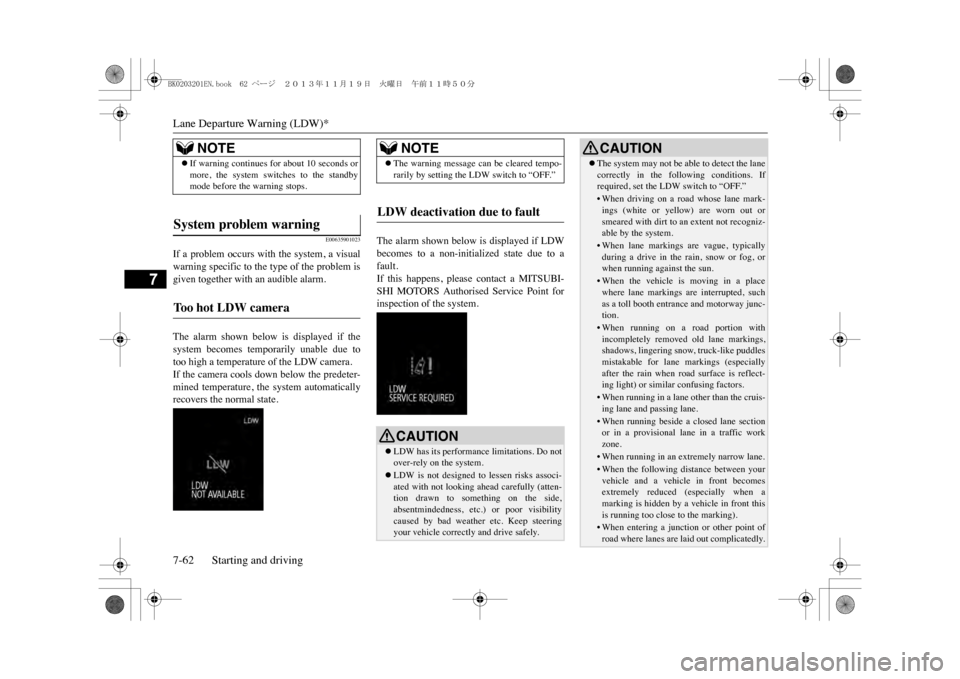
If a problem occurs with the system, a visualwarning specific to the type of the problem isgiven together with an audible alarm.The alarm shown below is displayed if thesystem becomes temporarily unable due totoo high a temperature of the LDW camera.If the camera cools down below the predeter-mined temperature, the system automaticallyrecovers the normal state.
The alarm shown below is displayed if LDWbecomes to a non-initialized state due to afault.If this happens, please contact a MITSUBI-SHI MOTORS Authorised Service Point forinspection of the system.
NOTE
zIf warning continues
for about 10 seconds or
more, the system switches to the standbymode before the warning stops.
System problem warning
To o h o t L D W c a m e r a
NOTE
zThe warning message can be cleared tempo-rarily by setting the LDW switch to “OFF.”
LDW deactivation due to fault
CAUTIONzLDW has its performance limitations. Do notover-rely on the system.zLDW is not designed to
lessen risks associ-
ated with not looking ah
ead carefully (atten-
tion drawn to something on the side,absentmindedness, etc.) or poor visibilitycaused by bad weather etc. Keep steeringyour vehicle correctly and drive safely.
zThe system may not be able to detect the lanecorrectly in the following conditions. Ifrequired, set the LDW switch to “OFF.”•When driving on a road whose lane mark-ings (white or yellow) are worn out orsmeared with dirt to an extent not recogniz-able by the system.•When lane markings are vague, typicallyduring a drive in the rain, snow or fog, orwhen running against the sun.•When the vehicle is moving in a placewhere lane markings are interrupted, suchas a toll booth entrance and motorway junc-tion.•When running on a road portion withincompletely removed old lane markings,shadows, lingering snow, truck-like puddlesmistakable for lane markings (especiallyafter the rain when road surface is reflect-ing light) or simila
r confusing factors.
•When running in a lane other than the cruis-ing lane and
passing lane.
•When running beside a closed lane sectionor in a provisional lane in a traffic workzone.•When running in an extremely narrow lane.•When the following distance between yourvehicle and a vehicle in front becomesextremely reduced (especially when amarking is hidden by a vehicle in front thisis running too close to the marking).•When entering a juncti
on or other point of
road where lanes are laid out complicatedly.CAUTION
BK0203201EN.book 62 ページ 2013年11月19日 火曜日 午前11時50分
Page 226 of 388
Reversing sensor system*
Starting and driving 7-63
7
E00615500374
This system operates when you are backingthe vehicle. It uses corner and back sensors todetect an obstacle and the information screenin the multi information display and thebuzzer to inform you of the approximate dis-tance to the obstacle.
E00615601473
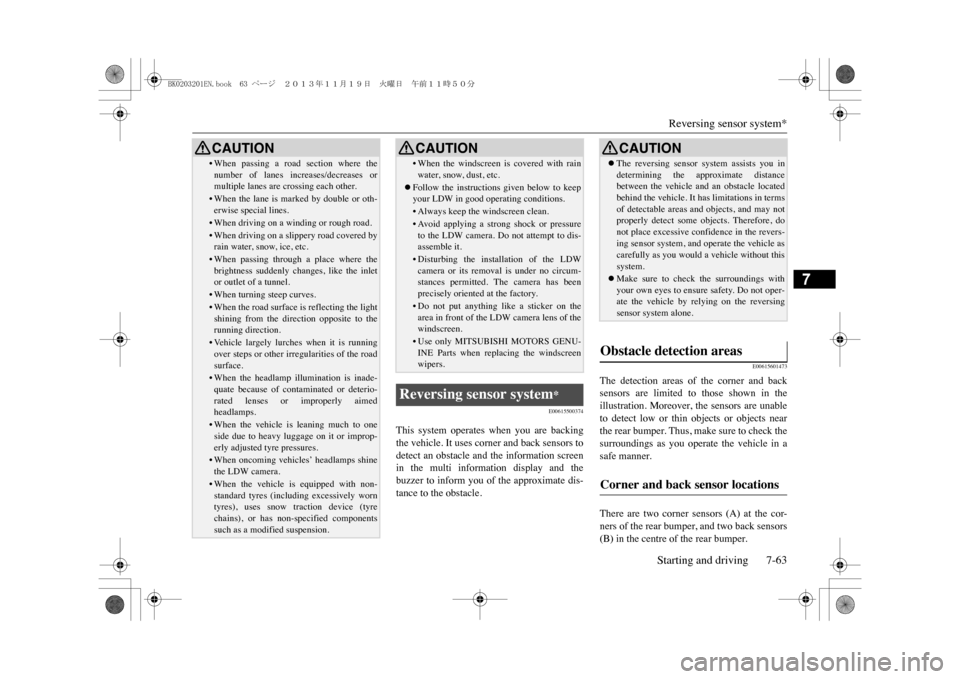
The detection areas of the corner and backsensors are limited to those shown in theillustration. Moreover, the sensors are unableto detect low or thin objects or objects nearthe rear bumper. Thus, make sure to check thesurroundings as you operate the vehicle in asafe manner.There are two corner sensors (A) at the cor-ners of the rear bumper, and two back sensors(B) in the centre of the rear bumper.
•When passing a road section where thenumber of lanes increases/decreases ormultiple lanes are crossing each other.•When the lane is marked by double or oth-erwise special lines.•When driving on a winding or rough road.•When driving on a sli
ppery road covered by
rain water, snow, ice, etc.•When passing through a place where thebrightness suddenly ch
anges, like the inlet
or outlet of a tunnel.•When turning steep curves.•When the road surface is reflecting the lightshining from the direction opposite to therunning direction.•Vehicle largely lurches when it is runningover steps or other irregularities of the roadsurface.•When the headlamp illumination is inade-quate because of contaminated or deterio-rated lenses or improperly aimedheadlamps.•When the vehicle is leaning much to oneside due to heavy l
uggage on it or improp-
erly adjusted tyre pressures.•When oncoming vehicl
es’ headlamps shine
the LDW camera.•When the vehicle is equipped with non-standard tyres (incl
uding excessively worn
tyres), uses snow tr
action device (tyre
chains), or has non-specified componentssuch as a modified suspension.CAUTION
•When the windscreen is covered with rainwater, snow, dust, etc.
zFollow the instructions given below to keepyour LDW in good operating conditions. •Always keep the windscreen clean.•Avoid applying a str
ong shock or pressure
to the LDW camera. Do not attempt to dis-assemble it.•Disturbing the installation of the LDWcamera or its removal is under no circum-stances permitted. The camera has beenprecisely oriented at the factory.• Do not put anything like a sticker on thearea in front of the LDW camera lens of thewindscreen.•Use only MITSUBISHI MOTORS GENU-INE Parts when replacing the windscreenwipers.
Reversing sensor system
*
CAUTION
CAUTIONzThe reversing sensor system assists you indetermining the approximate distancebetween the vehicle and an obstacle locatedbehind the vehicle. It has limitations in termsof detectable areas and objects, and may notproperly detect some objects. Therefore, donot place excessive confidence in the revers-ing sensor system, and operate the vehicle ascarefully as you would
a vehicle without this
system.zMake sure to check the surroundings withyour own eyes to ensure safety. Do not oper-ate the vehicle by relying on the reversingsensor system alone.
Obstacle detection areas
Corner and back sensor locations
BK0203201EN.book 63 ページ 2013年11月19日 火曜日 午前11時50分
Page 231 of 388
Rear-view camera*7-68 Starting and driving
7
When you place the select position is the “R”position with the operation mode in ON, theview behind the vehicle will automaticallyappear on the screen of the Mitsubishi MultiCommunication System (MMCS) or the DIS-PLAY AUDIO. When you move the selectorlever to any other position, the screen willreturn to its original indication.
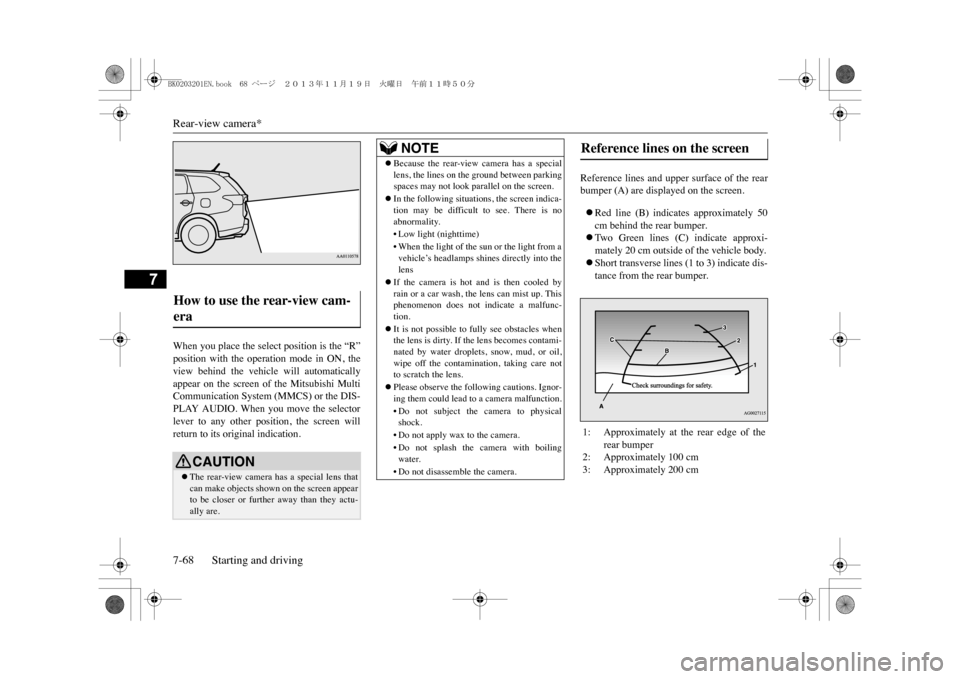
Reference lines and upper surface of the rearbumper (A) are displayed on the screen. zRed line (B) indicates approximately 50cm behind the rear bumper.zTw o G r e e n l i n e s ( C ) i n d i c a t e a p p r o x i -mately 20 cm outside of the vehicle body.zShort transverse lines (1 to 3) indicate dis-tance from the rear bumper.
How to use the rear-view cam-era
CAUTIONzThe rear-view camera has a special lens thatcan make objects show
n on the screen appear
to be closer or further away than they actu-ally are.
NOTE
zBecause the rear-view camera has a speciallens, the lines on the
ground between parking
spaces may not look parallel on the screen.zIn the following situations, the screen indica-tion may be difficult to see. There is noabnormality.•Low light (nighttime)•When the light of the sun or the light from avehicle’s headlamps shin
es directly into the
lens
zIf the camera is hot and is then cooled byrain or a car wash, the lens can mist up. Thisphenomenon does not i
ndicate a malfunc-
tion.zIt is not possible to
fully see obstacles when
the lens is dirty. If the lens becomes contami-nated by water droplets, snow, mud, or oil,wipe off the contamination, taking care notto scratch the lens.zPlease observe the following cautions. Ignor-ing them could lead to a camera malfunction.•Do not subject the camera to physicalshock.•Do not apply wax to the camera.•Do not splash the camera with boilingwater.•Do not disassemble the camera.
Reference lines on the screen
1: Approximately at the rear edge of the
rear bumper
2: Approximately 100 cm3: Approximately 200 cm
BK0203201EN.book 68 ページ 2013年11月19日 火曜日 午前11時50分
Page 234 of 388
Towing caravans and trailersStarting and driving 7-71
7
E00610401405
Yo u r v e h i c l e h a s q u a l i t i e s w h i c h m a k e i t w e l lsuited for normal towing operations provideda few recommendations are observed. Theseare primarily concerne
d with the prevention
of overloading of the vehicle and with theselection of the proper equipment. If theseprecautions are taken and driving habits areregulated accordingly, the effects of towingtrailers and caravans can be minimized.It should be noted that damage to the vehiclecaused directly or indirectly by operatingunder conditions outside the limits set out onthis page will void the warranty, relative tosuch damage.
The legal authorities require that a trailer orcaravan be fitted with stop, tail and turn sig-nal lamps. An electrical kit can be fitted byyour authorized MITSUBISHI MOTORSdealer which meets legal requirements andcan be left on your vehicle permanently. Itmay be necessary to fit additional rear visionmirrors to both sides of your vehicle to giveclear vision past your trailer or caravan.Ensure that your trailer or caravan complieswith the regulations of the particular State inwhich you are travelling, e. g. lighting, safetychains, brakes, mass, etc. Check that yourtowbar tongue does not obscure your vehi-cle’s number plate when the trailer or caravanis disconnected. If it does, remove the tongueensuring that it is refitted securely when refit-ted.
The maximum payload of the towing vehicledoes not exceed the requirements of eachmaximum mass described in the “Vehiclemass”. See “Specifications” for the payloadinformation.Having established compliance with the Stateregulations for permissible towing loads and
To w i n g c a r a v a n s a n d t r a i l -ers
WA R N I N GzWhen connecting the trailer with ElectricTr a i l e r B r a k e ( E T B )
, use MITSUBISHI
MOTORS GENUINE ETB harness.zIf using an ETB harness other than MIT-SUBISHI MOTORS GENUINE parts, anunexpected reduction in drive force mayoccur when using the manual trailerbrake override which co
uld lead to insta-
bility and increase the risk of an accident.
CAUTIONzMITSUBISHI MOTORS recommends theuse of MITSUBISHI MOTORS towingequipment where it is available. No recom-mendation is made as to the make of equip-ment which may be used if MITSUBISHIMOTORS equipment is not available.zThe loads specified apply only if a MITSUB-ISHI MOTORS GENUINE Parts Tow Barand other specified equipment is used.
State re gulations
Permissible towing load and requirements
CAUTIONzThe trailer brake and towing hitch require-ments as specified are minimum require-ments only and MITSUBISHI MOTORSrecommend that a trailer brake and a loaddistributing hitch is used whenever you aretowing, to improve
stopping distance and
towing stability.When using a load distributing hitch the loadon the trailer tyres increases. Do not exceedthe trailer tyre load rating.With all towing operations it is important tolimit the towing vehicle payload as noted.Failure to do so may result in exceeding themaximum load rating of the tyres. This rat-ing is marked on the tyre placard and mayalso be displayed on
the tyre sidewall.
Setting up for towing
BK0203201EN.book 71 ページ 2013年11月19日 火曜日 午前11時50分
Page 235 of 388
Towing caravans and trailers7-72 Starting and driving
7
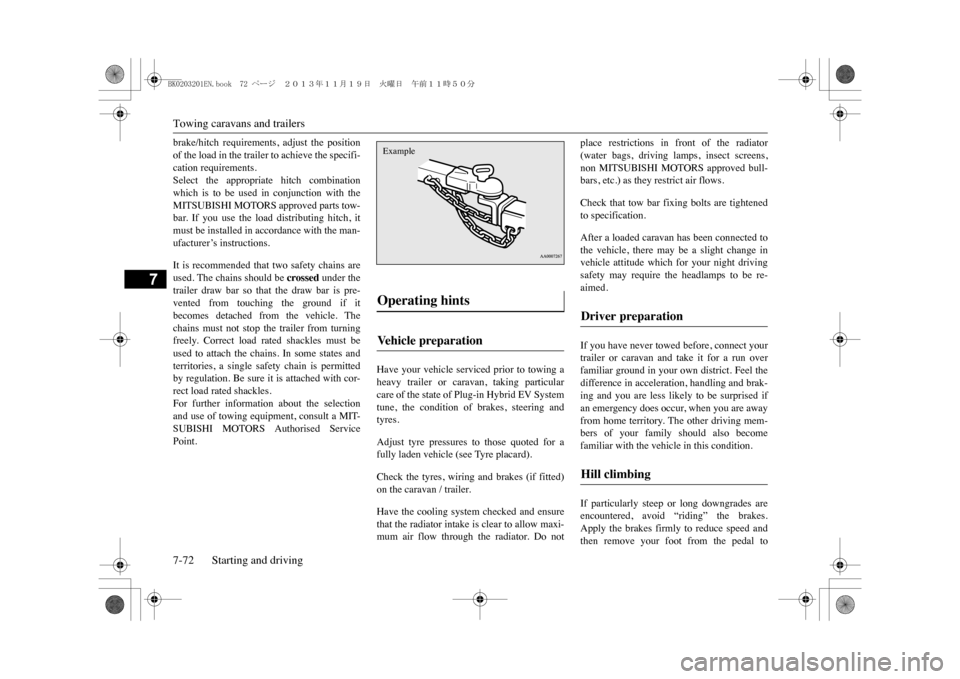
brake/hitch requirements, adjust the positionof the load in the trailer to achieve the specifi-cation requirements.Select the appropriate hitch combinationwhich is to be used in conjunction with theMITSUBISHI MOTORS approved parts tow-bar. If you use the load distributing hitch, itmust be installed in accordance with the man-ufacturer’s instructions.It is recommended that two safety chains areused. The chains should be
crossed
under the
trailer draw bar so that the draw bar is pre-vented from touching the ground if itbecomes detached from the vehicle. Thechains must not stop the trailer from turningfreely. Correct load rated shackles must beused to attach the chains. In some states andterritories, a single safety chain is permittedby regulation. Be sure it is attached with cor-rect load rated shackles.For further information about the selectionand use of towing equipment, consult a MIT-SUBISHI MOTORS Authorised ServicePoint.
Have your vehicle serviced prior to towing aheavy trailer or caravan, taking particularcare of the state of Plug-in Hybrid EV Systemtune, the condition of brakes, steering andtyres.Adjust tyre pressures to those quoted for afully laden vehicle (see Tyre placard).Check the tyres, wiring and brakes (if fitted)on the caravan / trailer.Have the cooling system checked and ensurethat the radiator intake is clear to allow maxi-mum air flow through the radiator. Do not
place restrictions in front of the radiator(water bags, driving lamps, insect screens,non MITSUBISHI MOTORS approved bull-bars, etc.) as they restrict air flows.Check that tow bar fixing bolts are tightenedto specification.After a loaded caravan has been connected tothe vehicle, there may be a slight change invehicle attitude which for your night drivingsafety may require the headlamps to be re-aimed.If you have never towed before, connect yourtrailer or caravan and take it for a run overfamiliar ground in your own district. Feel thedifference in acceleration, handling and brak-ing and you are less likely to be surprised ifan emergency does occur, when you are awayfrom home territory. The other driving mem-bers of your family should also becomefamiliar with the vehicle in this condition.If particularly steep or long downgrades areencountered, avoid “riding” the brakes.Apply the brakes firmly to reduce speed andthen remove your foot from the pedal to
Operating hints Ve h i c l e p r e p a r a t i o n Example
Driver preparation Hill climbing
BK0203201EN.book 72 ページ 2013年11月19日 火曜日 午前11時50分
Page 253 of 388
Handling of Discs8-16 For pleasant driving
8
zFingerprints or other marks on the readsurface of the disc may result in its con-tent being more difficult to read. Whenholding the disc, grip both edges, or oneedge and the centre hole, in order that theread surface is not touched.zDo not affix paper or stickers, or other-wise damage the disc.zDo not forcefully insert a disc if another isalready within the device. This can resultin damage to discs, or malfunction.zPeriodically clean the read surface of thedisc. When cleaning, do not wipe in a cir-cular motion. Instead, wipe gently out-wards from the centre of the disc to theouter edge.zNew discs may have burring around theouter edge or in the hole in the centre.Ensure you check for these. If there areburrs, these may lead to faulty operation,therefore ensure these are removed.zWhen not using discs, ensure these arekept in cases, and stored out of direct sun-light.
zIf discs are not going to be used for a longperiod of time, remove these from theproduct.
In cold environments such as in mid-winterwhen the interior of the vehicle is cold, turn-ing the heater on and immediately trying touse the product may cause condensation(water droplets) to form on the disc and inter-nal optical components, and this may preventthe product from operating correctly.In these conditions, remove the disc, and waita short time before use.Actions such as unauthorised reproduction,broadcast, public performance, or rental ofdiscs that comprise other than personal useare prohibited by law.
E00736001035
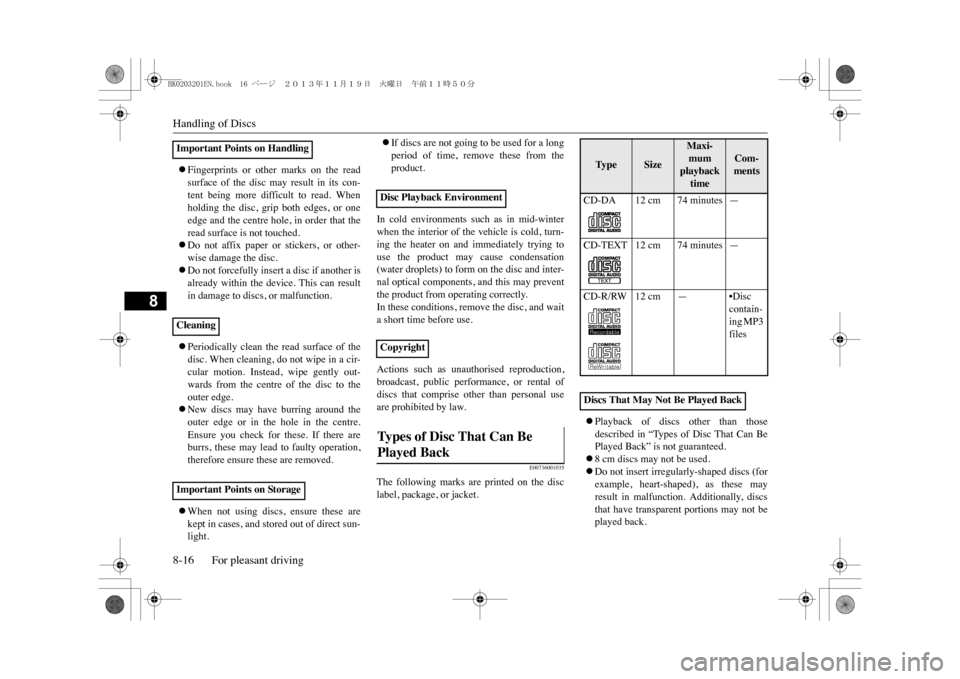
The following marks are printed on the disclabel, package, or jacket.
zPlayback of discs other than thosedescribed in “Types of Disc That Can BePlayed Back” is not guaranteed.z8 cm discs may not be used.zDo not insert irregularly-shaped discs (forexample, heart-shaped), as these mayresult in malfunction. Additionally, discsthat have transparent portions may not beplayed back.
Important Points on HandlingCleaningImportant Points on Storage
Disc Playback EnvironmentCopyrightTy p e s o f D i s c T h a t C a n B e Played Back
Ty p e
Size
Maxi-mum playback time
Com-ments
CD-DA 12 cm 74 minutes —CD-TEXT 12 cm 74 minutes —CD-R/RW 12 cm — •Disc
contain-ing MP3 files
Discs That May Not Be Played Back
BK0203201EN.book 16 ページ 2013年11月19日 火曜日 午前11時50分
Page 258 of 388
Important Points on Safety for the Customer
For pleasant driving 8-21
8
E00737000035
This product features a number of pictorialindications as well as points concerning han-dling so that you can use the product cor-rectly and in a safe manner, as well as preventinjury or damage to yourself, other users, orproperty.
Supported tag information
AAC tags or ID3 tagsTitle, Artist name, Album name
Maximum number of characters that can be indicated on
the display
64 characters
Important Points on Safety for the Customer
WA R N I N GzThe driver should not pay close attentionto the display while driving.This may prevent the driver lookingwhere they are going, and cause an acci-dent.
Item
Details
zThe driver should not perform compli-cated operations while driving.Performing complicated operations whiledriving may prevent the driver lookingwhere they are going, and cause an acci-dent.Therefore stop the vehicle in a safe loca-tion before performing such operations.zDo not use during malfunctions, such aswhen no sound is audible.This may lead to acci
dent, fire, or electric
shock.zEnsure water or other foreign objects donot enter the product.This may lead to smoking, fire, electricshock, or malfunction.zDo not insert foreign objects into the discslot.This may lead to fire, electric shock, ormalfunction.zIn the event of abnormalities occurringwhen foreign objects or water enter theproduct, resulting in smoke or a strangesmell, immediately st
op using the product,
and consult a MITSUBISHI MOTORSAuthorised Service Point.Continuing to use the product may resultin accident, fire,
or electric shock.
zDo not disassemble or modify the product.This may lead to malfunction, fire, or elec-tric shock.WA R N I N G
zDuring thunderstorms, do not touch theantenna or the front panel.This may lead to electrical shock fromlightning.CAUTIONzDo not block ventilati
on holes or heat sinks
on the product.Blocking ventilation holes or heat sinks mayprevent heat from escaping from within theproduct, leading to fire or malfunction.zDo not turn the volume up to the extent thatyou cannot hear sounds from outside thevehicle while driving.Driving without being able to hear soundsfrom outside the vehicle may result in anaccident.zDo not insert your hand or fingers into thedisc slot.This may result in injury.WA R N I N G
BK0203201EN.book 21 ページ 2013年11月19日 火曜日 午前11時50分
Page 303 of 388
Accessory socket8-66 For pleasant driving
8
E00711602516
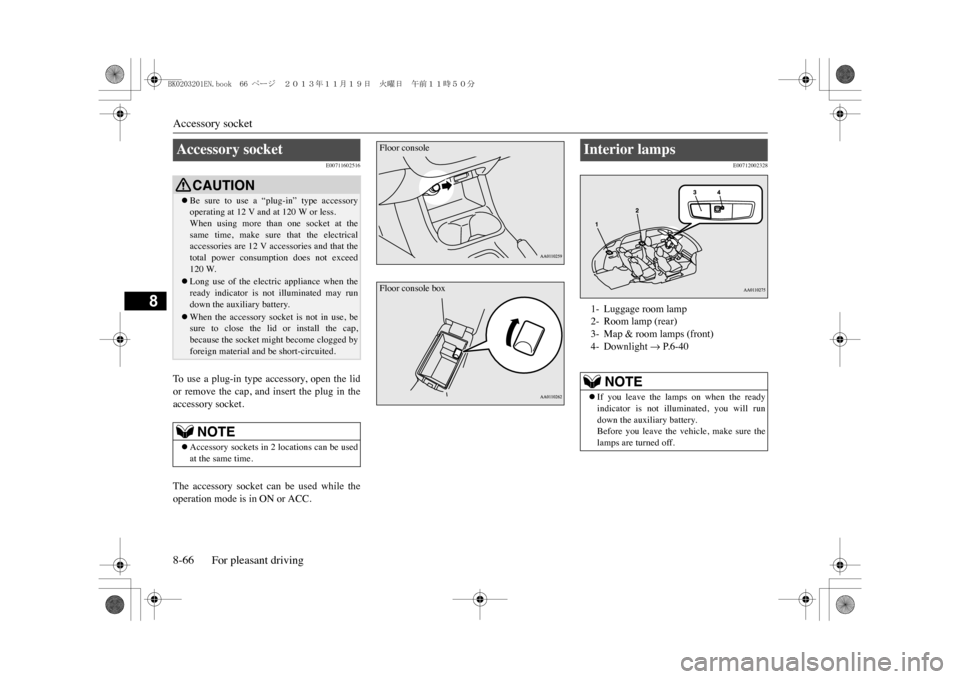
To u s e a p l u g - i n t y p e a c c e s s o r y, o p e n t h e l i dor remove the cap, and insert the plug in theaccessory socket.The accessory socket can be used while theoperation mode is in ON or ACC.
E00712002328
Accessory socket
CAUTIONzBe sure to use a “plug-in” type accessoryoperating at 12 V and
at 120 W or less.
When using more than one socket at thesame time, make sure that the electricalaccessories are 12 V accessories and that thetotal power consumption does not exceed120 W.zLong use of the electric appliance when theready indicator is not illuminated may rundown the auxiliary battery.zWhen the accessory socket is not in use, besure to close the lid or install the cap,because the socket might become clogged byforeign material and
be short-circuited.
NOTE
zAccessory sockets in 2 locations can be usedat the same time.
Floor consoleFloor console box
Interior lamps 1- Luggage room lamp2- Room lamp (rear)3- Map & room lamps (front)4- Downlight
m P.6-40
NOTE
zIf you leave the lamps on when the readyindicator is not illuminated, you will rundown the auxiliary battery.Before you leave the vehicle, make sure thelamps are turned off.
BK0203201EN.book 66 ページ 2013年11月19日 火曜日 午前11時50分