2014 MERCEDES-BENZ S-Class stop start
[x] Cancel search: stop startPage 34 of 434

Dashboard
Function Page
0043
Steering wheel paddle
shifters
183
0044
Combination switch 140
0087
Horn
0085
Instrument cluster 33
0083
DIRECT SELECT lever 179
0084
Overhead control panel 39
006B
Control panel for:
00CA
Lowering the rear
seat head restraints 123
0094
Extending/retracting
the rear roller sunblind 325
0073
PASSENGER AIR BAG
OFF indicator lamp 63
Setting the brightness of
the instrument cluster
lighting and the COMAND
display 006C
Ignition lock 171
Start/Stop button
171 Function Page
006D
Climate control systems 152
006E
Adjusts the steering wheel 127
Steering wheel heating 128
006F
Cruise control lever 200
0070
Electric parking brake 192
0071
Diagnostics connection 26
0072
Opens the hood 348
0073
Light switch 138
0074
Control panel for:
Activating Steering Assist 210
Switching on Active Lane
Keeping Assist 243
Deactivating PARKTRONIC 218
Switching on 360° camera 230
Activating Night View
Assist 23632
Dashboa
rdAt a glance
Page 39 of 434

Center console
Function Page
0043
Switches COMAND on/off
(see the separate operating
instructions)
0044
Adjusts the volume/mute
(see the separate operating
instructions)
0087
00A7
ECO start/stop
function 177
0085
Telephone keypad (see the
separate operating
instructions) 0083
00CC
Sets the vehicle level 214,
216 0084
Adjusts the suspension
settings 214,
216 006B
00C9
Selects the drive
program/program selector
button 182
00CD
Selects the drive
program/program selector
button (AMG vehicles) 182 Function Page
006C
Back button (see the
separate operating
instructions)
006D
Seat adjustment button
(see the separate operating
instructions)
006E
Navigation button (see the
separate operating
instructions)
006F
Radio button (see the
separate operating
instructions)
0070
002F
Hazard warning
lamps 140
0071
Media button (see the
separate operating
instructions)
0072
Telephone, address book
and Internet button (see
separate operating
instructions) Center console
37At a glance
Page 46 of 434

Useful information
i This Operator's Manual describes all
models and all standard and optional
equipment of your vehicle available at the
time of publication of the Operator's
Manual. Country-specific differences are
possible. Please note that your vehicle may
not be equipped with all features
described. This also applies to safety-
related systems and functions.
i Read the information on qualified
specialist workshops: (Y page 27).Panic alarm
X
To activate: press0033button 0043for at
least one second.
An alarm sounds and the exterior lighting
flashes.
X To deactivate: press0033button 0043
again.
or
X Press the Start/Stop button.
The SmartKey must be in the vehicle. Occupant safety
Important safety notes
G
WARNING
Modifications to the restraint systems could
result in them not functioning properly any more. The restraint systems could then no
longer protect vehicle occupants as they are
designed to do and could fail in the event of
an accident or activate unexpectedly, for
example. There is an increased risk of injury.
Never modify parts of the restraint systems.
Do not attempt to modify the wiring as well as
electronic components or their software.
If it is necessary to modify an air bag system
to accommodate a person with disabilities,
contact an authorized Mercedes-Benz center.
USA only: for further information contact our
Customer Assistance Center at
1-800-FOR-MERCedes (1800-367-6372).
In this section, you will learn the most
important facts about the restraint system
components of the vehicle.
The restraint system consists of:
R Seat belts
R Child restraint systems
R LATCH-type (ISOFIX) child seat securing
system
Additional protection is provided by:
R SRS (Supplemental Restraint System)
R PRE-SAFE ®
R Air bag system components with:
-PASSENGER AIR BAG OFF indicator lamp
- Front-passenger seat with Occupant
Classification System (OCS)
Although the systems are independent, their
protective functions work in conjunction with
each other. Not all air bags are deployed in
an accident.
i For information on infants and children
traveling with you in the vehicle as well as
restraint systems for infants and children,
see "Children in the vehicle"
(Y page 63). 44
Occupant safetySafety
Page 56 of 434

necessary repair work carried out at a
qualified specialist workshop.
For safety reasons, Mercedes-Benz
recommends that you only use seat
accessories that have been approved by
Mercedes-Benz.
Both the driver and the front passenger
should always observe the PASSENGER AIR
BAG OFF indicator lamp as an indication of
whether or not the front passenger is
positioned correctly. Observe also the air bag
display messages that can be displayed in the
instrument cluster (Y page 279).
If the driver's air bag deploys, this does not
mean that the front-passenger front air bag
will also deploy.
The OCS may have detected that the seat:
R is empty or occupied by the weight of a
typical child up to twelve months old,
seated in a child restraint system.
R is occupied by a small individual, such as a
young teenager or a small adult.
R is occupied by a child in a child restraint
system whose weight is greater than that
of a typical twelve month old child.
These are examples of when the OCS
deactivates the front-passenger front air bag.
Deactivation takes place although the
collision fulfills the criteria for deploying the
driver's air bag.
For further information, see "Air bag display
messages" (Y page 279).
System self-test G
WARNING
If the 00730074indicator lamp does not
illuminate, the system is not functioning. You
must contact an authorized Mercedes-Benz
Center before seating any child on the front
passenger seat. G
WARNING
Never place anything between seat cushion
and child seat (e.g. a pillow), since it reduces the effectiveness of the OCS. The underside
and rear side child restraint system must be
placed entirely on the seat cushion and the
backrest of the front-passenger seat
backrest.
If necessary, adjust the tilt of the passenger
seat backrest.
An incorrectly mounted child seat could cause
injuries to the child in case of an accident,
instead of increasing protection for the child.
Follow the manufacturer's instructions for
installation of child restraint systems.
The PASSENGER AIR BAG OFF indicator lamp
lights up:
R if the Start/Stop button is pressed once or
twice
or
R if you turn the SmartKey in the ignition lock
to position 1or 2
R if an adult is seated properly on the front-
passenger seat and the OCS classifies the
occupant as an adult
The PASSENGER AIR BAG OFF indicator lamp
goes out again after approximately six
seconds.
If the seat is not occupied and the OCS
detects that the front-passenger seat is
empty, the PASSENGER AIR BAG OFF
indicator lamp will continue to light up. The
PASSENGER AIR BAG OFF indicator lamp will
not go out.
For more information about the OCS, see
"Problems with the Occupant Classification
System" (Y page 55). 54
Occupant safetySafety
Page 63 of 434
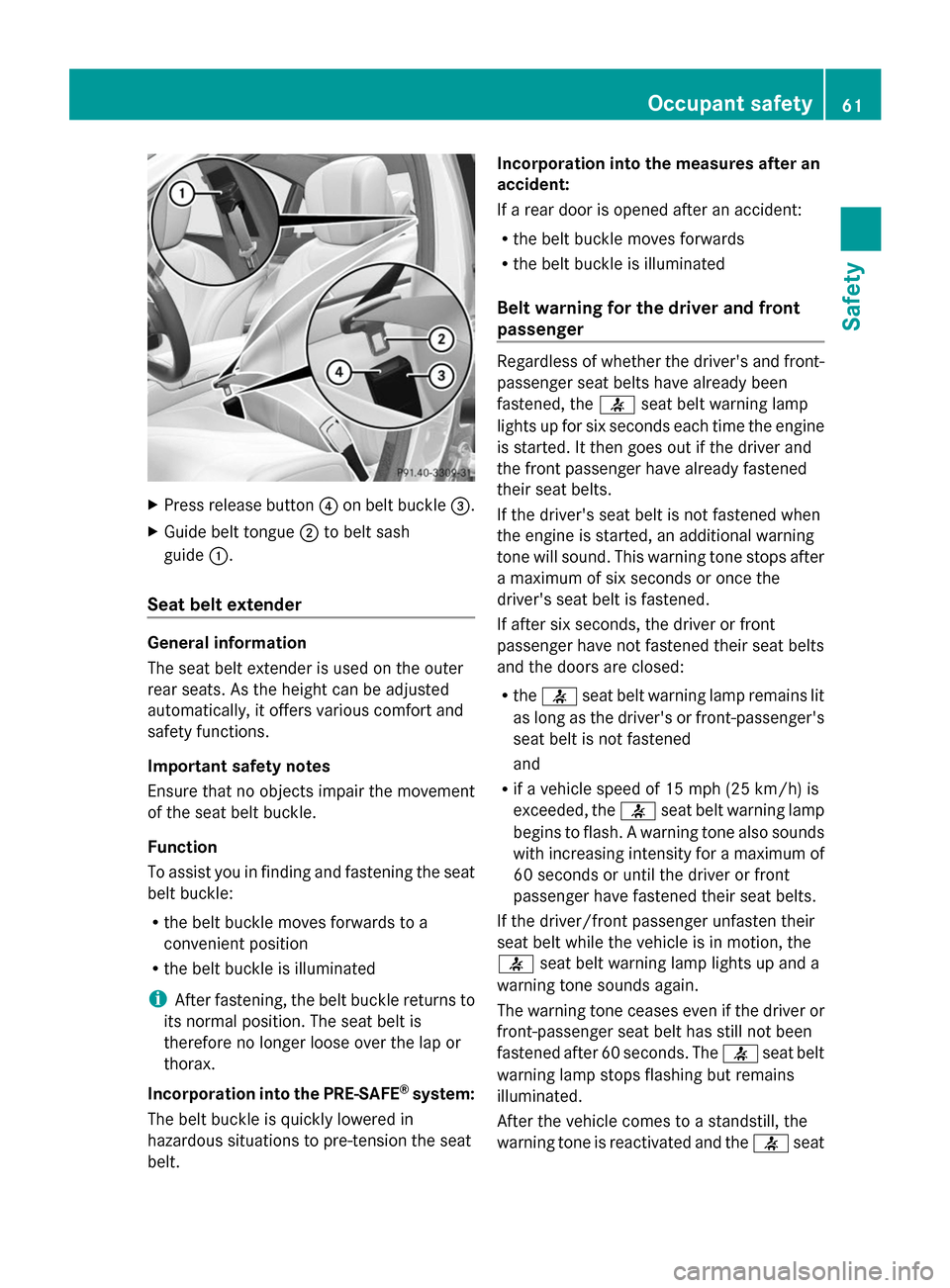
X
Press release button 0085on belt buckle 0087.
X Guide belt tongue 0044to belt sash
guide 0043.
Seat belt extender General information
The seat belt extender is used on the outer
rear seats. As the height can be adjusted
automatically, it offers various comfort and
safety functions.
Important safety notes
Ensure that no objects impair the movement
of the seat belt buckle.
Function
To assist you in finding and fastening the seat
belt buckle:
R the belt buckle moves forwards to a
convenient position
R the belt buckle is illuminated
i After fastening, the belt buckle returns to
its normal position. The seat belt is
therefore no longer loose over the lap or
thorax.
Incorporation into the PRE-SAFE ®
system:
The belt buckle is quickly lowered in
hazardous situations to pre-tension the seat
belt. Incorporation into the measures after an
accident:
If a rear door is opened after an accident:
R
the belt buckle moves forwards
R the belt buckle is illuminated
Belt warning for the driver and front
passenger Regardless of whether the driver's and front-
passenger seat belts have already been
fastened, the
0076seat belt warning lamp
lights up for six seconds each time the engine
is started. It then goes out if the driver and
the front passenger have already fastened
their seat belts.
If the driver's seat belt is not fastened when
the engine is started, an additional warning
tone will sound. This warning tone stops after
a maximum of six seconds or once the
driver's seat belt is fastened.
If after six seconds, the driver or front
passenger have not fastened their seat belts
and the doors are closed:
R the 0076 seat belt warning lamp remains lit
as long as the driver's or front-passenger's
seat belt is not fastened
and
R if a vehicle speed of 15 mph (25 km/h) is
exceeded, the 0076seat belt warning lamp
begins to flash. A warning tone also sounds
with increasing intensity for a maximum of
60 seconds or until the driver or front
passenger have fastened their seat belts.
If the driver/front passenger unfasten their
seat belt while the vehicle is in motion, the
0076 seat belt warning lamp lights up and a
warning tone sounds again.
The warning tone ceases even if the driver or
front-passenger seat belt has still not been
fastened after 60 seconds. The 0076seat belt
warning lamp stops flashing but remains
illuminated.
After the vehicle comes to a standstill, the
warning tone is reactivated and the 0076seat Occupant safety
61Safety Z
Page 76 of 434

Thus, the distance warning function cannot
provide a warning in all critical situations.
There is a risk of an accident.
Always pay careful attention to the traffic
situation and be ready to brake. G
WARNING
The distance warning function cannot always
clearly identify objects and complex traffic
situations.
In such cases, the distance warning function
may:
R give an unnecessary warning
R not give a warning
There is a risk of an accident.
Always pay careful attention to the traffic
situation and do not rely solely on the distance
warning function.
In particular, the detection of obstacles can
be impaired if:
R dirt on the sensors or anything else
covering the sensors
R there is snow or heavy rain
R there is interference by other radar sources
R there are strong radar reflections, for
example in parking garages
R a narrow vehicle traveling in front, e.g. a
motorbike
R a vehicle traveling in front on a different line
relative to the center of your vehicle
R new vehicles or after the COLLISION
PREVENTION ASSIST system has been
serviced
Observe the notes in the section on
breaking-in (Y page 170).
Following damage to the front end of the
vehicle, have the configuration and operation
of the radar sensor checked at a qualified
specialist workshop. This also applies to
collisions at low speeds where there is no
visible damage to the front of the vehicle. Function
X
To activate/deactivate: activate or
deactivate the distance warning function in
the on-board computer (Y page 261).
If the distance warning function is not
activated, the 00D4symbol appears in the
assistance graphics display.
The distance warning function can help you
to minimize the risk of a front-end collision
with a vehicle ahead or reduce the effects of
such a collision. If the distance warning
function detects that there is a risk of a
collision, you will be warned visually and
acoustically. The distance warning function
cannot prevent a collision without your
intervention.
Starting at a speed of around 4 mph
(7 km/h), the distance warning function
warns you if you rapidly approach a vehicle in
front. An intermittent warning tone will then
sound and the 00BAdistance warning lamp
will light up in the instrument cluster.
X Brake immediately in order to increase the
distance from the vehicle in front.
or
X Take evasive action, provided it is safe to
do so.
Due to the nature of the system, particularly
complicated but non-critical driving
conditions may also cause the system to
display a warning.
With the help of the radar sensor system, the
distance warning function can detect
obstacles that are in the path of your vehicle
for an extended period of time.
From a speed of around 40 mph (70 km/h),
the distance warning function can also react
to stationary obstacles, such as stopped or
parked vehicles.
If you approach an obstacle and the distance
warning function detects a risk of a collision,
the system will initially alert you both visually
and acoustically. 74
Driving safety systemsSafety
Page 79 of 434

ECO start/stop function
The ECO start/stop function switches the
engine off automatically when the vehicle
stops moving. The engine starts
automatically when the driver wants to pull
away again. ESP ®
remains in its previously
selected status. Example:if ESP®
was
deactivated before the engine was switched
off, ESP ®
remains deactivated when the
engine is switched on again.
Deactivating/activating ESP ®Important safety notes
i
Observe the "Important safety notes"
section (Y page 70).
You can select between the following states
of ESP ®
:
R ESP ®
is activated.
R ESP ®
is deactivated. G
WARNING
If you deactivate ESP ®
, ESP ®
no longer
stabilizes the vehicle. There is an increased
risk of skidding and an accident.
Only deactivate ESP ®
in the situations
described in the following.
It may be best to deactivate ESP ®
in the
following situations:
R when using snow chains
R in deep snow
R on sand or gravel
i Activate ESP ®
as soon as the situations
described above no longer apply. ESP ®
will
otherwise not be able to stabilize the
vehicle if the vehicle starts to skid or a
wheel starts to spin.
! Avoid spinning the driven wheels for an
extended period with ESP ®
deactivated.
You could otherwise damage the drivetrain. Deactivating/activating ESP
®
You can deactivate or activate ESP ®
via the
on-board computer.
X To deactivate:(Y page 77).
The 00BB ESP®
OFF warning lamp in the
instrument cluster lights up.
X To activate: (Ypage 77).
The 00BB ESP®
OFF warning lamp in the
instrument cluster goes out.
Characteristics when ESP ®
is deactivated
If ESP ®
is deactivated and one or more wheels
start to spin, the 00E5ESP®
warning lamp in
the instrument cluster flashes. In such
situations, ESP ®
will not stabilize the vehicle.
If you deactivate ESP ®
:
R ESP ®
no longer improves driving stability.
R engine torque is no longer limited and the
drive wheels are able to spin.
The spinning of the wheels results in a
cutting action for better traction on loose
surfaces.
R traction control is still activated.
R ESP ®
still provides support when you
brake.
Crosswind driving assistance General information
Vehicles with MAGIC BODY CONTROL:
information on stabilizing the vehicle in the
event of crosswind (Y
page 213).
Strong crosswinds can cause your vehicle to
deviate from a straight course. The crosswind
driving assistance function integrated into
ESP ®
significantly reduces these effects.
ESP ®
intervenes automatically according to
the direction and intensity of the crosswinds
affecting your vehicle.
ESP stabilities the vehicle with braking
interventions to assist you in keeping the
vehicle in the lane.
Crosswind driving assistance is active at
vehicle speeds above 50 mph (80 km/h) Driving safety systems
77Safety Z
Page 83 of 434

charged, the immobilizer may be faulty.
Contact an authorized Mercedes-Benz
Center or call 1-800-FOR-MERCede s(in the
USA) or 1-800-387-010 0(in Canada). ATA (anti-theft alarm system)
X
To arm: lock the vehicle with the SmartKey
or KEYLESS-GO.
Indicator lamp 0043flashes. The alarm
system is armed after approximately
15 seconds.
X To disarm: unlock the vehicle with the
SmartKey or KEYLESS-GO.
or
X Insert the SmartKey into the ignition lock.
A visual and audible alarm is triggered if the
alarm system is armed and you open:
R a door
R the vehicle with the mechanical key
R the trunk lid
R the hood
X To turn the alarm off with the
SmartKey: press the0036or0037 button
on the SmartKey.
The alarm is switched off.
or
X Remove the Start/Stop button from the
ignition lock.
X Insert the SmartKey into the ignition lock.
The alarm is switched off. X
To stop the alarm using KEYLESS-GO:
grasp the outside door handle. The
SmartKey must be outside the vehicle.
The alarm is switched off.
or
X Press the Start/Stop button on the
dashboard. The SmartKey must be inside
the vehicle.
The alarm is switched off.
The alarm is not switched off, even if you
close the open door that triggered it, for
example.
i If the alarm stays on for more than
30 seconds, the mbrace emergency call
system automatically sends a message to
the Customer Assistance Center. This is
done either by text message or data
connection. The emergency call system
sends the message or data provided that:
R you have subscribed to the mbrace
service.
R the mbrace service has been activated
properly.
R the necessary mobile phone network is
available. Theft deterrent locking system
81Safety Z