2014 MERCEDES-BENZ B-CLASS SPORTS fuel filter
[x] Cancel search: fuel filterPage 153 of 360
!
Overfilling the fuel tank could damage the
fuel system.
! Take care not to spill any fuel on painted
surfaces. You could otherwise damage the
paintwork.
! Use afilter when refueling from afuel can.
Otherwise, the fuel lines and/or injection
system could be blocked by particles from
the fuel can.
Do not get into the vehicle againd uringthe
refuelin gprocess. Otherwise, electrostatic
charge could build up again.
If you overfill th efuel tank, fuel could spray
out when th efuel pump nozzle is removed.
Fo rfurther information on fuel and fuel quality
(Y page 348). Refueling
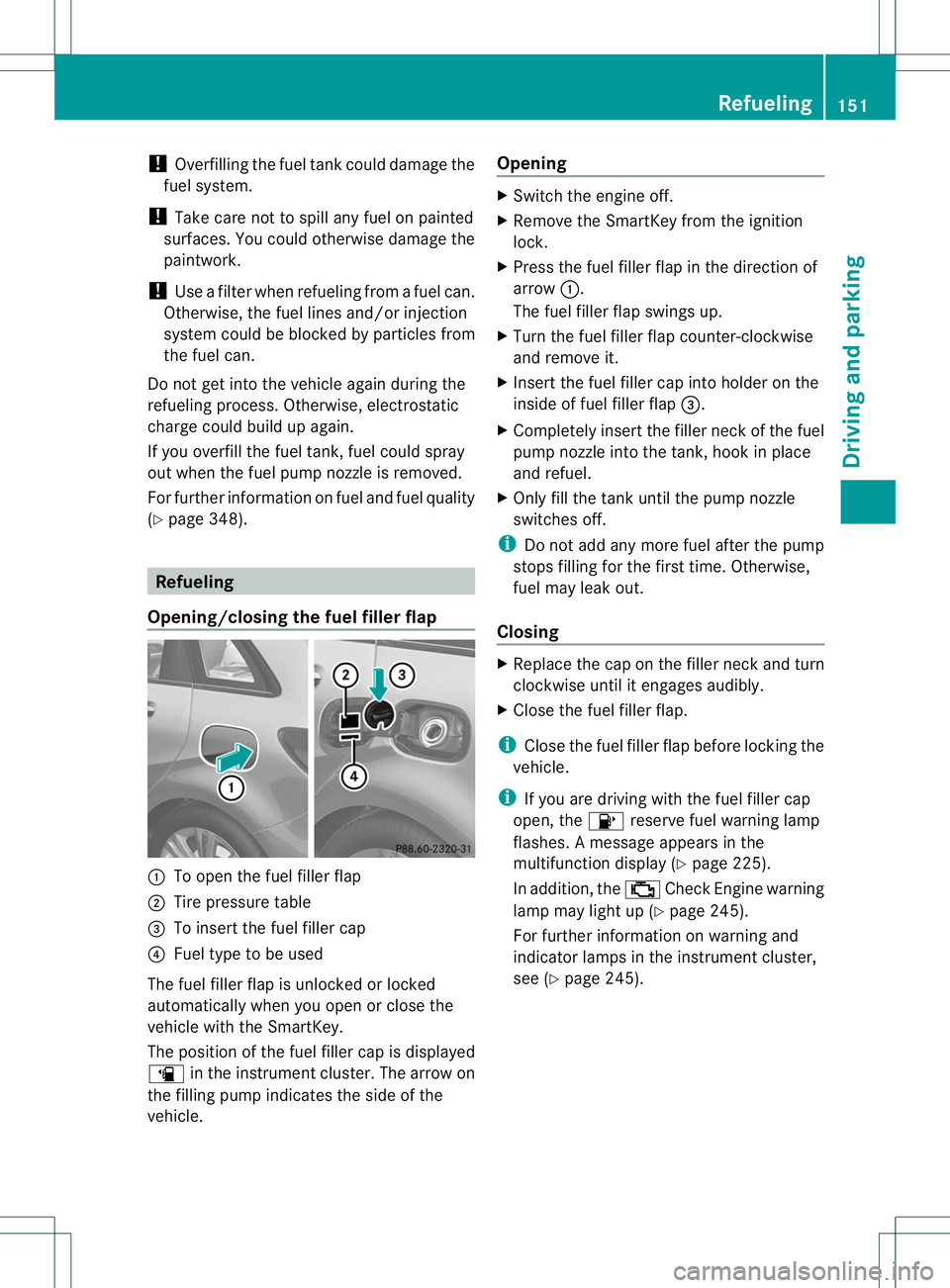
Opening/closing th efuelfiller flap 001A
To open th efuel filler flap
0010 Tirep ressur etable
0023 To insert th efuel filler cap
0021 Fuel typ etobeu sed
The fuel filler flap is unlocked or locked
automatically when you open or close the
vehicl ewitht he SmartKey.
The position of th efuel filler cap is displayed
0007 in theinstrumen tcluster .The arrow on
the filling pump indicates the side of the
vehicle. Opening X
Switch the engine off.
X Remove the SmartKey from the ignition
lock.
X Press the fuel filler flap in the direction of
arrow 001A.
The fuel filler flap swings up.
X Turn the fuel filler flap counter-clockwise
and remove it.
X Insert the fuel filler cap into holder on the
inside of fuel filler flap 0023.
X Completely insert the filler neck of the fuel
pump nozzle into the tank,h ook in place
and refuel.
X Only fill the tank until the pump nozzle
switches off.
i Do not add any more fuel after the pump
stops filling for the first time. Otherwise,
fuel may leak out.
Closing X
Replace the cap on the filler neck and turn
clockwise until it engages audibly.
X Close the fuel filler flap.
i Close the fuel filler flap before locking the
vehicle.
i If you are driving with the fuel filler cap
open, the 0007reserve fuel warning lamp
flashes. Amessage appears in the
multifunction display (Y page 225).
In addition, the 000ACheck Engine warning
lamp may light up (Y page 245).
For further information on warning and
indicator lamps in the instrument cluster,
see (Y page 245). Refueling
151Driving and parking Z
Page 351 of 360
R
M30 (gasoline with 30% methanol)
R M85 (gasoline with 85% methanol)
R M100 (100% methanol)
R Gasoline with metalliferous additives
R Diesel
Do not mix such fuels with the fuel
recommended for your vehicle. Do not use
additives. This can otherwise lead to engine
damage. This does not include cleaning
additives for the removal and prevention of
residue build-up. gasoline may only be
mixed with cleaning additives
recommended by Mercedes-Benz; see
"Additives". You can obtain further
information from any authorized Mercedes-
Benz Center.
! To ensure the longevity and full
performance of the engine, only premium-
grade unleaded gasoline must be used.
If standard premium-grade unleaded
gasoline is unavailable and unleaded
gasoline of alower grade is used for
refueling, observe the following
precautions:
R only fill the fuel tank to half full with
regular unleaded gasoline and fill the rest
with premium-grade unleaded gasoline
as soon as possible.
R do not drive at the maximum speed.
R avoid sudden acceleration and engine
speeds above 3000 rpm.
R never refuel using fuel with an octane
number lower than 87. Otherwise,
engine failure could occur.
Using mixtures of methanol and ethanol is not
permitted. E10 fuel or E15 fuel (unleaded
gasoline with 10% or 15% ethanol) can be
used.
You will usually find information about the fuel
grade on the pump. If you cannot find the
label on the pump, ask the staff for
assistance.
i For further information ,consult a
qualified specialist workshop or on the Internet at http://www.mbusa.com (USA
only).
Information on refueling (Y page 150).
Additives
! Operating the engine with fuel additives
added later can lead to engine failure. Do
not mix fuel additives with fuel. This does
not include additives for the removal and
prevention of residue buildup. gasoline
must only be mixed with additives
recommended by Mercedes-Benz. Comply
with the instructions for use on the product
label.M ore information about
recommended additives can be obtained
from any authorized Mercedes-Benz
Center.
Mercedes-Benz recommends that you use
fuel brands that have the additives.
The quality of the fuel available in some
countries may not be sufficient .Residue
could build up as aresult. In such cases, and
in consultation with an authorized Mercedes-
BenzC enter, the gasoline may be mixed with
the cleanin gadditive recommended by
Mercedes-Benz( part no. A000989254512).
You must observe the notes and mixin gratios
specified on the container. Engine oil
General notes !
Never use engin eoil or an oil filter of a
specification other than is necessary to
fulfill the prescribed servic eintervals. Do
not change the engine oi loroilfilter in
order to achieve longe rreplacement
intervals than those prescribed. You could
otherwise cause engin edamage or damage
to the exhaust gas aftertreatment.
Follow the instructions in the service
interval display regarding the oil change.
Otherwise, you may damage the engin eand
the exhaust gas aftertreatment. Service products and filling capacities
349Technical data Z
Page 352 of 360
When handling engine oil, observe the
important safety notes on service products
(Y page 347).
The engine oils are matched to the
performance of Mercedes-Benz engines and
service intervals. You should therefore only
use engine oils and oil filters that are
approved for vehicles with maintenance
systems.
For alist of approved engine oils and oil filters,
consult an authorized Mercedes-Benz
Center .Orvisit the website
http://bevo.mercedes-benz.com.
The table shows which engine oils have been
approved for your vehicle. Model Engine
model MB
Approval B2
50 270 229.5
i
MB approval is indicated on the oil
containers.
Filling capacities The following values refer to an oil change
includin
gthe oil filter. Model Capacity
B2
50 5.9 US qt
(5.6 l) Additives
!
Do no tuse any additives in the engine oil.
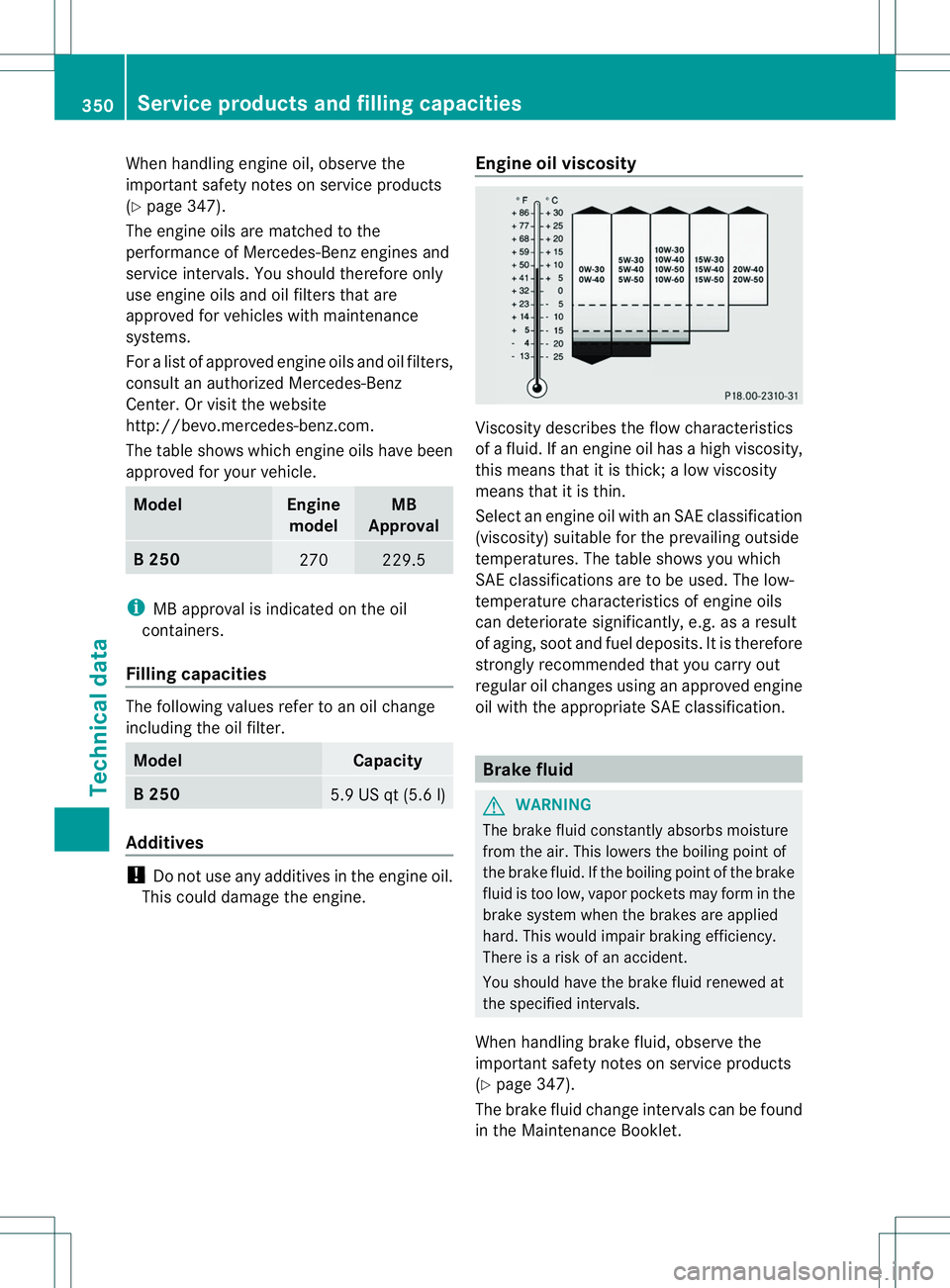
This could damage the engine. Engineo
il viscosity Viscosity describes the flow characteristics
of
afluid. If an engine oil has ahigh viscosity,
this means that it is thick; alow viscosity
means that it is thin.
Select an engine oil with an SAE classification
(viscosity) suitablef or the prevailing outside
temperatures. The table shows you which
SAE classifications are to be used. The low-
temperature characteristics of engine oils
can deteriorate significantly, e.g. as aresult
of aging, soot and fuel deposits. It is therefore
strongly recommended that you carry out
regularo il changes using an approved engine
oil with the appropriate SA Eclassification. Brake fluid
G
WARNING
The brak efluid constantly absorb smoisture
fro mt he air. This lowers the boiling point of
the brake fluid. If the boiling point of the brake
fluid is too low, vapor pockets may form in the
brake system when the brakes are applied
hard. This would impair braking efficiency.
There is arisk of an accident.
You should have the brake fluid renewed at
the specified intervals.
When handling brake fluid, observe the
important safety notes on service products
(Y page 347).
The brake fluid change intervals can be found
in the MaintenanceB ooklet.350
Service products and fillingc
apacitiesTechnical data