2013 VOLKSWAGEN TOUAREG Engine
[x] Cancel search: EnginePage 357 of 440
Power steering
Power steering automatically adjusts to driving speed, steering torque, and the steering angle of the
wheels. Power steering works only when the engine is running.
If power steering is reduced or lost completely, it will be much harder to steer and control the vehicle.
Counter-steering assistance
Counter-steering assistance is part of Electronic Stability Control (ESC). This feature makes it easier
for the driver to control the vehicle in difficult situations. For example, if you have to brake hard on a
surface that provides uneven traction, the vehicle could pull to the right or left. ESC detects this
situation and helps the driver counter-steer with additional steering power ⇒ .
.WARNING
The counter-steering assistance in ESC can do no more than help the driver steer in difficult
situations. The driver must still control the vehicle. The vehicle does not steer by itself with
this feature!
.NOTICE
If the ignition is off, the steering column lock will engage and the vehicle cannot be steered.
For this reason, you must leave the ignition on when going through an automatic CAR wash,
for example, so that the wheels will still steer.
Page 360 of 440
.WARNING
When powered by the electric motor, the vehicle makes much less noise, both when idling
and driving, than when it is running on the internal combustion engine. It is much harder or
even impossible for the drivers of other vehicles and above all for cyclists, pedestrians, and
children to hear the vehicle when it is running on electrical power.
x Pedestrians and others can be struck and seriously injured because they cannot hear the
vehicle and tell that it is getting close to them, for instance when you are parking, backing
up, or driving in a low-speed zone where there is likely to be pedestrian traffic.
x Always watch out for pedestrians, especially small children, cyclists, and others who may
not hear the vehicle or realize that it is about to move or will cross their path of travel.
x Always be especially CAReful in residential areas, school zones, and other places where
the speed of motor vehicles is restricted and pedestrians may be at greater risk,
x Make sure the ignition and the hybrid drive system have both been turned off before
leaving the vehicle.
.WARNING
Never leave the vehicle when hybrid drive system indicator lights are still lit. The vehicle can
move if the accelerator is depressed even though the combustion engine has been stopped.
This can cause accidents and severe or lethal injuries.
x Make sure the transmission is in Park (P) before you get out of the vehicle.
.WARNING
Never support the vehicle with cinder blocks, bricks, or other objects to inspect it. The
vehicle could slip or move suddenly and cause an accident with serious personal injury.
.WARNING
Never let the hybrid battery get wet. Liquids and other fluids can cause short circuits,
electrical shock, burns, and explosions.
x Never CARry large amounts of liquids or other fluids in the luggage compartment.
x Always make sure that any containers with liquids and other fluids are properly secured
and tightly closed to prevent leakage during normal driving as well as hard cornering,
braking, and other vehicle maneuvers. Leaking liquids can get into the cover of the high-
voltage battery and the high-voltage cable connections. This can damage the electrical
system and the high-voltage battery.
.Never drive until the fuel tank is completely empty. There may not always be enough charge in
the high-voltage battery to get to the next gas station.
Warning and indicator lights
Page 361 of 440
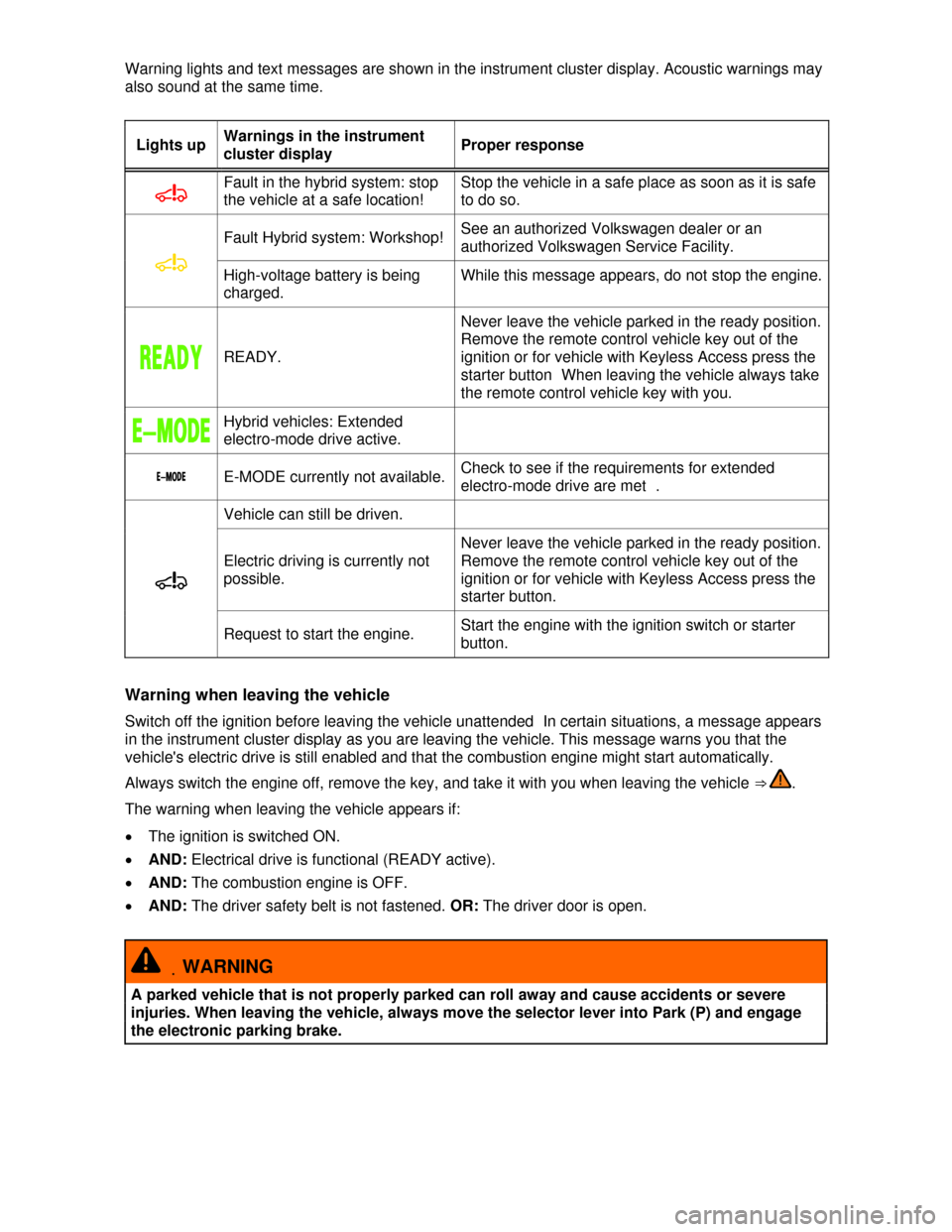
Warning lights and text messages are shown in the instrument cluster display. Acoustic warnings may
also sound at the same time.
Lights up Warnings in the instrument
cluster display Proper response
∋ Fault in the hybrid system: stop
the vehicle at a safe location!
Stop the vehicle in a safe place as soon as it is safe
to do so.
∋
Fault Hybrid system: Workshop! See an authorized Volkswagen dealer or an
authorized Volkswagen Service Facility.
High-voltage battery is being
charged.
While this message appears, do not stop the engine.
2%!$9 READY.
Never leave the vehicle parked in the ready position.
Remove the remote control vehicle key out of the
ignition or for vehicle with Keyless Access press the
starter button When leaving the vehicle always take
the remote control vehicle key with you.
%
Page 363 of 440

Driving
situations Requirements and conditions Vehicle behavior
– CAReful use of E-MODE button
⇒ fig. 251.
The high-voltage battery discharges quickly
with the E-MODE button switched on. This
can increase fuel consumption since driving
in electric mode is preferred in this case,
even though the combustion engine would
be more efficient.
Driving on
country roads
and highways.
– Conscious easing off of the
accelerator, to enable longer sailing
distance.
By easing off the accelerator, the
combustion engine is automatically
switched off and de-clutched. The vehicle
glides without engine power.
- Reducing speed by easing off the
accelerator early and not by
braking.
Sailing possible. Reduction of speed this
way is more fuel-efficient than through
braking.
- Avoid speeds of over about 160
km/h (99 mph).
Efficient sailing is possible with a speed of
about 160 km/h (99 mph) .
- CAReful selection of gear (S).
Sporty driving style with activated sport
programme increases fuel consumption.
Efficient sailing in sport programme with
combustion engine automatically switched
off is possible with a speed of about 70
km/h (43 mph).
Driving in cold
months.
- Do not warm up the combustion
engine by running it with the
vehicle stationary.
The temperature of the combustion engine
increases very slowly, but fuel consumption
increases considerably.
– CAReful use of heating for
windshield and the rear window,
outside mirror, seat and steering
wheel.
This prevents energy from being lost and
saves energy for the electric motor.
- Never leave the vehicle in a
garage over night.
This prevents the high-voltage battery and
the vehicle interior from cooling down too
much. The optimal temperature of the high-
voltage battery is reached quicker at the
beginning of the journey and the
combustion engine can be switched off
quicker when the vehicle interior is
sufficiently heated.
Page 365 of 440

Use the following indicators to tell when the vehicle is being powered electrically:
x Tachometer for the combustion engine shows zero engine revolutions.
x Instrument cluster display.
x Infotainment System screen.
Extended electro-mode drive (E-Mode)
By pressing the E-MODE button ⇒ fig. 251, the driver can extend the normal limits of electrical motor
drive so that the electric motor powers the vehicle whenever possible (given the battery charge level
and the way you are driving). In this mode, the vehicle is propelled by the electric motor as much as
possible.
Extended electro-mode drive can be activated only if all of the following conditions apply:
x The high-voltage battery must have an adequate charge.
x The driver must accelerate gently.
x The speed must be low.
If extended electro-mode drive is not possible, a message appears in the instrument cluster display.
Die activation of the extended electro-mode drive will be indicated by the symbol %
Page 366 of 440
could be used for reducing fuel consumption with a foresighted driving style. Even in this case, the rev
counter in the instrument cluster displays zero engine speed (0 engine revolutions).
Brake energy regeneration (Recuperation/charge)
When the vehicle brakes, the electrical energy is generated by the electric motor, which works as an
alternator and charges the high-voltage battery. The same thing occurs while the vehicle is coasting to
a stop or driving downhill.
Energy regeneration is shown in the instrument cluster display or on the Infotainment System screen.
The combustion engine may be switched off automatically in this situation. The instrument cluster
tachometer will show zero engine speed (zero engine revolutions).
Automatic starting - combustion engine
The combustion engine is started automatically in a number of situations.
x Engine temperature is too low.
x Catalytic converter temperature is too low.
x High-voltage battery being charged at high rate when decelerating. The high-voltage battery
cannot absorb any more energy and for this reason the electric motor cannot brake the vehicle. The
combustion engine comes on to help slow the vehicle down (engine brake).
x Engine hood is open.
x Leaving the vehicle when the electric motor is still “live”. The status of the electric motor is not
always obvious, particularly when the combustion engine is not running. The combustion engine will
therefore start if the driver's safety belt is unlatched or the driver's door is opened when the
transmission is in Park (P) or Neutral (N) .
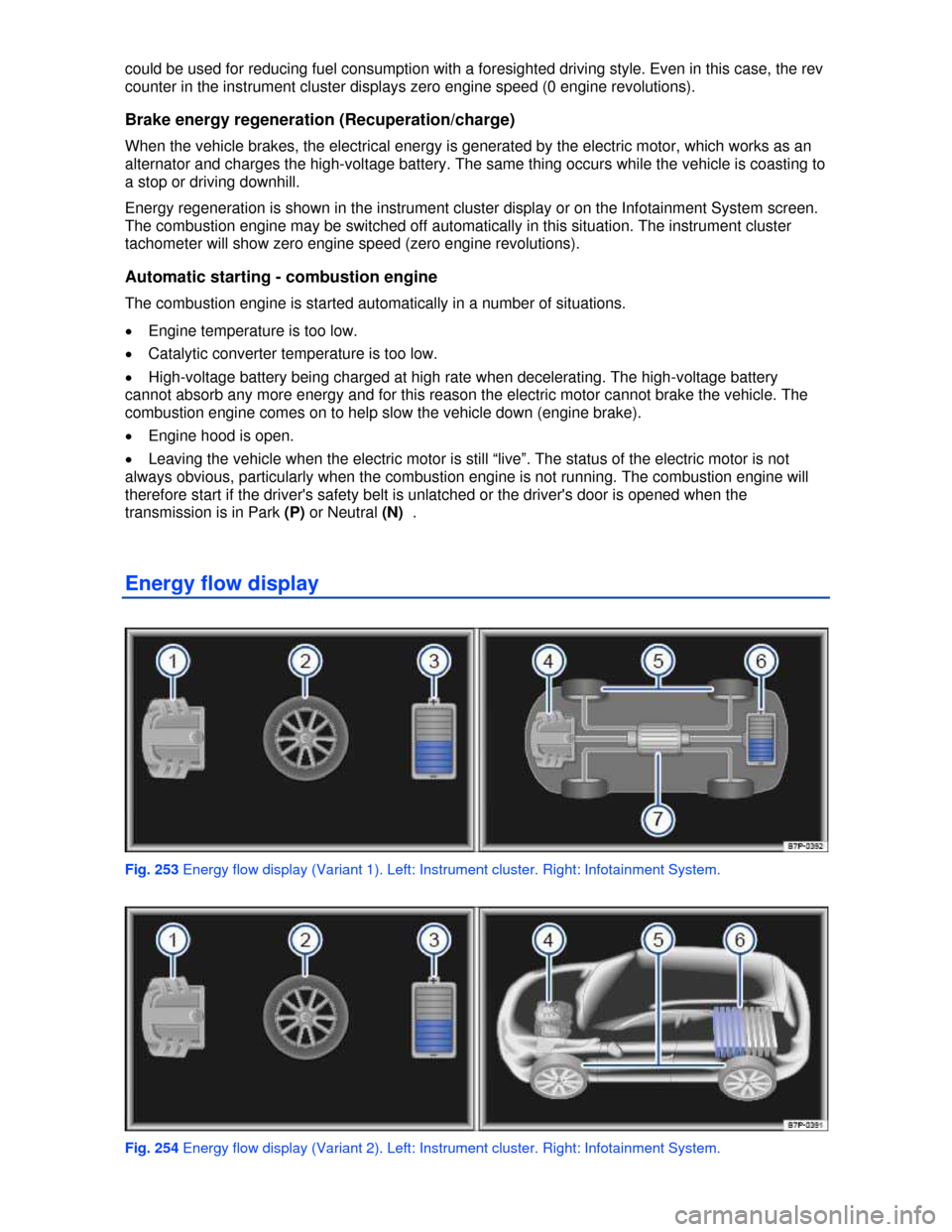
Energy flow display
Fig. 253 Energy flow display (Variant 1). Left: Instrument cluster. Right: Infotainment System.
Fig. 254 Energy flow display (Variant 2). Left: Instrument cluster. Right: Infotainment System.
Page 368 of 440
The high-voltage battery is under the luggage compartment floor ⇒ fig. 255.
Cooling the high-voltage battery
There are ventilation slots under the rear seat bench that provide the high-voltage battery with cool
air. The ventilation area under the rear seat bench ⇒ fig. 256 must not be blocked or covered ⇒ .
Maintenance of the high-voltage battery
Other than taking the vehicle in for scheduled maintenance to an authorized Volkswagen dealer or an
authorized Volkswagen Service Facility that is qualified to do work on hybrid vehicles, there is nothing
that the vehicle driver has to do to maintain the high-voltage battery.
The maintenance connection for the high-voltage battery is under the luggage compartment floor
under an orange cover. This connection is only for scheduled maintenance, which must be performed
only by specially trained service technicians. There is no need to remove the connector at any time
when the vehicle is being used ⇒ .
.WARNING
The high-voltage hybrid electrical system is dangerous and can cause burns, other serious
personal injuries, electrocution and death.
x Never open, service, repair, or disconnect the high-voltage hybrid battery.
x Never touch or let jewelry or other metal objects contact high-voltage cables or the high-
voltage battery and battery poles, especially if the cables, battery, or battery poles have been
damaged in a crash or in some other way.
x Always have work on the hybrid electrical system and on systems that could be indirectly
affected by it done by qualified, trained technicians, who have the know-how, experience,
documentation, and tools to do the work safely.
.WARNING
Failure to heed warning lights and instrument cluster text messages can cause the vehicle to
break down in traffic and result in a collision and serious personal injury.
x Never ignore warning lights or text WARNINGS.
x Always stop the vehicle as soon as it is safe to do so.
.NOTICE
x Failure to heed warning lights or text WARNINGS can result in vehicle damage.
x If the 12 Volt battery is disconnected or dead or has been replaced, there is a possibility
that the combustion engine will not automatically switch off when the vehicle is powered by
the electric motor. If this situation persists for several days, take the vehicle to an authorized
Volkswagen dealer or an authorized Volkswagen Service Facility that is qualified to do work on
hybrid vehicles.
x Never transport water or other liquids or fluids in open containers, such as an aquarium. If
liquid is spilled in the luggage compartment, this can cause short circuits or damage the high-
voltage battery.
.NOTICE
Never block or cover the cooling air vents for the high-voltage hybrid battery under the rear
seat. Blocking or covering these vents can damage the high-voltage battery.
Page 369 of 440
.NOTICE
If the vehicle is not used for a longer period, the high-voltage battery will run down. To keep
the high-voltage battery in good condition, the vehicle needs to be driven at least every 2
months for at least 30 minutes or 15 miles (20 km).
x If the high-voltage battery is dead, the gasoline engine will not start. Contact an authorized
Volkswagen dealer, an authorized Volkswagen Service Facility, or another qualified workshop
for assistance.
Special considerations for hybrid vehicles
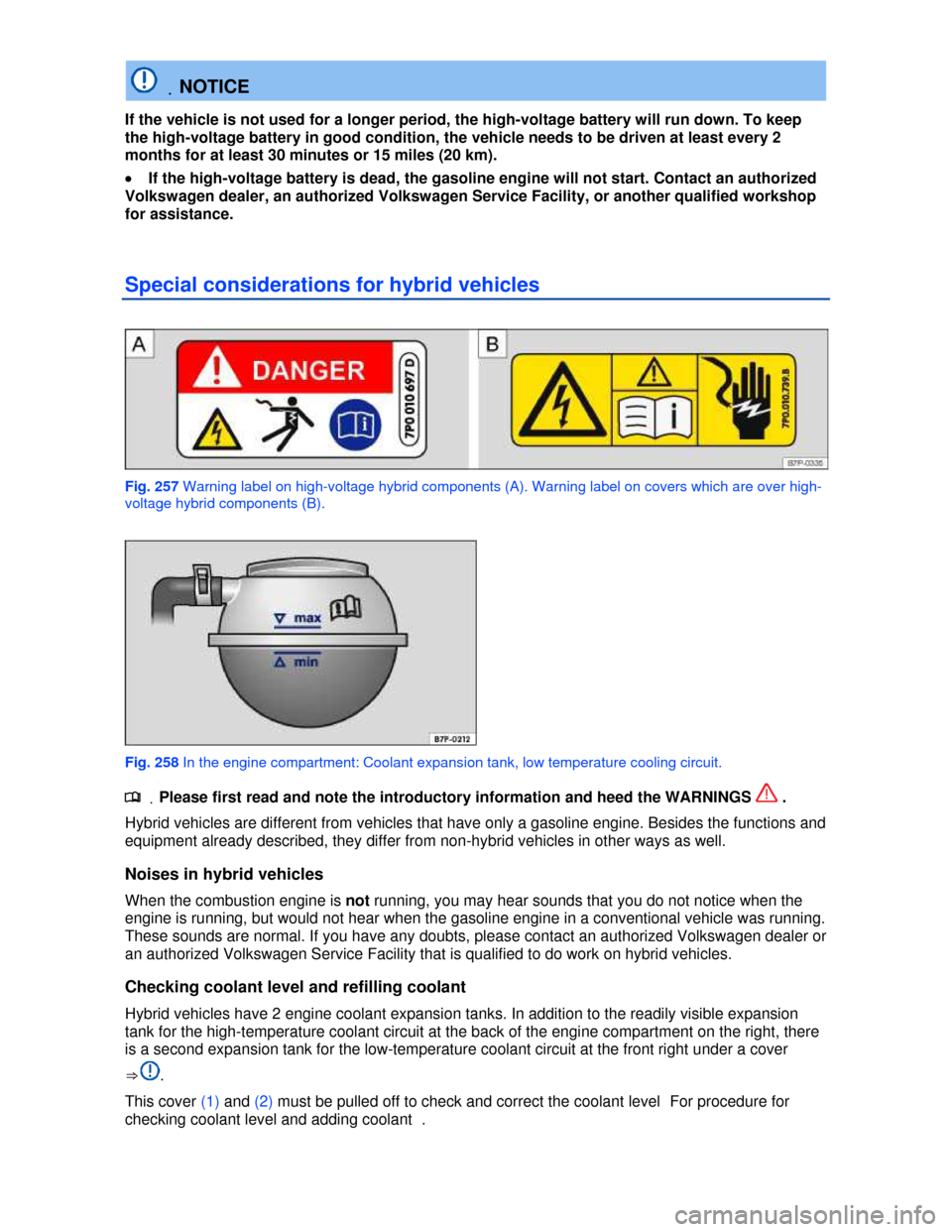
Fig. 257 Warning label on high-voltage hybrid components (A). Warning label on covers which are over high-
voltage hybrid components (B).
Fig. 258 In the engine compartment: Coolant expansion tank, low temperature cooling circuit.
.