2013 Lancia Voyager service
[x] Cancel search: servicePage 294 of 360
4. Raise the vehicle by turning the
jack screw to the right, using the
swivel wrench. Raise the vehicle only
until the tire just clears the surface
and enough clearance is obtained to
install the spare tire. Minimum tire lift
provides maximum stability.WARNING!
Raising the vehicle higher than nec-
essary can make the vehicle less
stable. It could slip off the jack and
hurt someone near it. Raise the ve-
hicle only enough to remove the
tire.
5. Remove the wheel lug nuts, for
vehicles with wheel covers, remove
the cover from the wheel by hand. Do
not pry the wheel cover off. Then pull
the wheel off the hub.
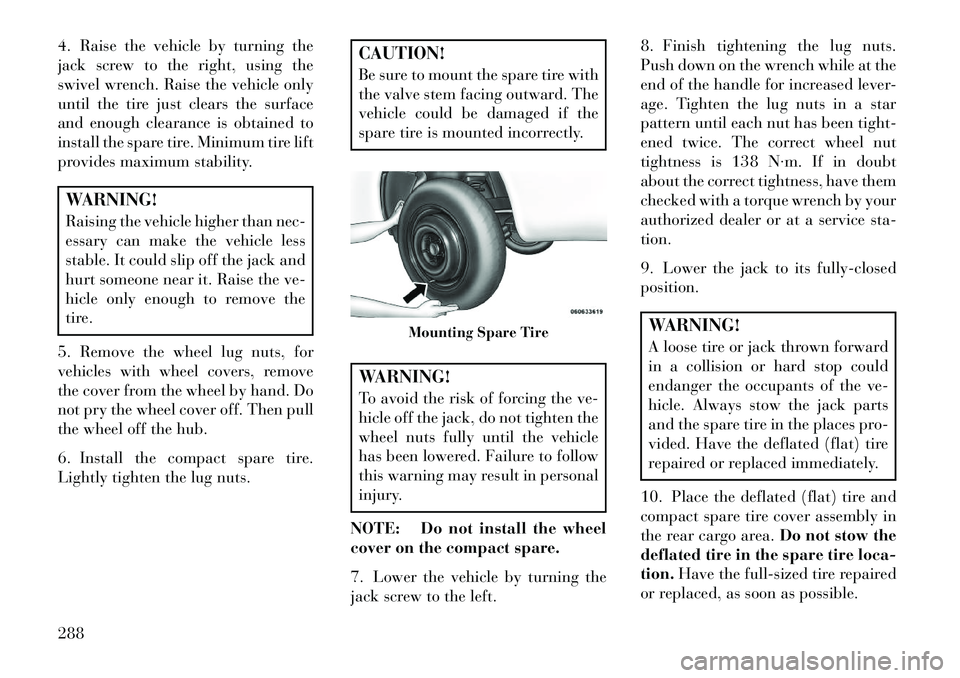
6. Install the compact spare tire.
Lightly tighten the lug nuts.
CAUTION!
Be sure to mount the spare tire with
the valve stem facing outward. The
vehicle could be damaged if the
spare tire is mounted incorrectly.WARNING!
To avoid the risk of forcing the ve-
hicle off the jack, do not tighten the
wheel nuts fully until the vehicle
has been lowered. Failure to follow
this warning may result in personal
injury.
NOTE: Do not install the wheel
cover on the compact spare.
7. Lower the vehicle by turning the
jack screw to the left. 8. Finish tightening the lug nuts.
Push down on the wrench while at the
end of the handle for increased lever-
age. Tighten the lug nuts in a star
pattern until each nut has been tight-
ened twice. The correct wheel nut
tightness is 138 N·m. If in doubt
about the correct tightness, have them
checked with a torque wrench by your
authorized dealer or at a service sta-
tion.
9. Lower the jack to its fully-closed
position.
WARNING!
A loose tire or jack thrown forward
in a collision or hard stop could
endanger the occupants of the ve-
hicle. Always stow the jack parts
and the spare tire in the places pro-
vided. Have the deflated (flat) tire
repaired or replaced immediately.
10. Place the deflated (flat) tire and
compact spare tire cover assembly in
the rear cargo area. Do not stow the
deflated tire in the spare tire loca-
tion. Have the full-sized tire repaired
or replaced, as soon as possible.
Mounting Spare Tire
288
Page 296 of 360
5. Continue to rotate the nut to the
right until you hear the winch mecha-
nism click three times. It cannot be
overtightened. Check under the ve-
hicle to ensure the compact spare tire/
cover assembly is positioned correctly
against the underside of the vehicle.CAUTION!
The winch mechanism is designed
specifically to stow a compact spare
tire only. Do not attempt to use the
winch to stow the full size flat tire,
or any other full-size tire. Vehicle
damage may result.
ROAD TIRE
INSTALLATION
Vehicles Equipped With Wheel
Covers
1. Mount the road tire on the axle.
2. To ease the installation process for
steel wheels with wheel covers, install
two lug nuts on the mounting studs
which are on each side of the valve
stem. Install the lug nuts with the cone
shaped end of the nut toward the
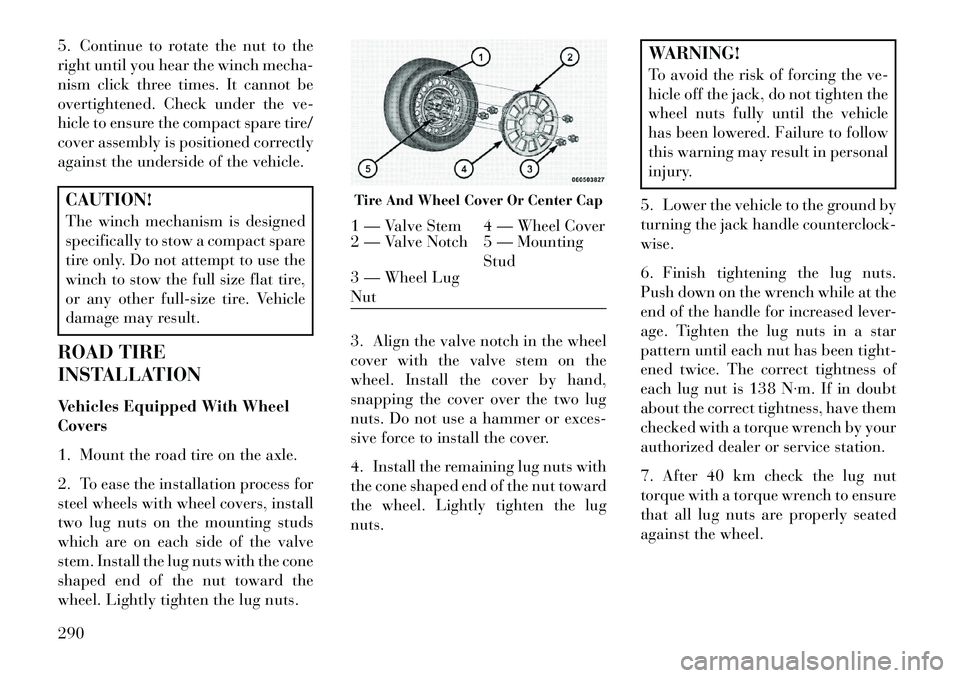
wheel. Lightly tighten the lug nuts. 3. Align the valve notch in the wheel
cover with the valve stem on the
wheel. Install the cover by hand,
snapping the cover over the two lug
nuts. Do not use a hammer or exces-
sive force to install the cover.
4. Install the remaining lug nuts with
the cone shaped end of the nut toward
the wheel. Lightly tighten the lug
nuts.
WARNING!
To avoid the risk of forcing the ve-
hicle off the jack, do not tighten the
wheel nuts fully until the vehicle
has been lowered. Failure to follow
this warning may result in personal
injury.
5. Lower the vehicle to the ground by
turning the jack handle counterclock-
wise.
6. Finish tightening the lug nuts.
Push down on the wrench while at the
end of the handle for increased lever-
age. Tighten the lug nuts in a star
pattern until each nut has been tight-
ened twice. The correct tightness of
each lug nut is 138 N·m. If in doubt
about the correct tightness, have them
checked with a torque wrench by your
authorized dealer or service station.
7. After 40 km check the lug nut
torque with a torque wrench to ensure
that all lug nuts are properly seated
against the wheel.
Tire And Wheel Cover Or Center Cap1 — Valve Stem 4 — Wheel Cover
2 — Valve Notch 5 — Mounting Stud
3 — Wheel Lug
Nut
290
Page 297 of 360

Vehicles Without Wheel Covers
1. Mount the road tire on the axle.
2.
Install the remaining lug nuts with
the cone shaped end of the nut toward
the wheel. Lightly tighten the lug nuts.WARNING!
To avoid the risk of forcing the ve-
hicle off the jack, do not tighten the
wheel nuts fully until the vehicle
has been lowered. Failure to follow
this warning may result in personal
injury.
3. Lower the vehicle to the ground by
turning the jack handle counterclock-
wise.
4. Finish tightening the lug nuts.
Push down on the wrench while at the
end of the handle for increased lever-
age. Tighten the lug nuts in a star
pattern until each nut has been tight-
ened twice. The correct tightness of
each lug nut is 138 N·m. If in doubt
about the correct tightness, have them
checked with a torque wrench by your
authorized dealer or service station. 5. After 40 km check the lug nut
torque with a torque wrench to ensure
that all lug nuts are properly seated
against the wheel.
JUMP-STARTING
If your vehicle has a discharged bat-
tery it can be jump-started using a set
of jumper cables and a battery in an-
other vehicle or by using a portable
battery booster pack. Jump-starting
can be dangerous if done improperly
so please follow the procedures in this
section carefully.
NOTE: When using a portable
battery booster pack follow the
manufacturer’s operating instruc-
tions and precautions.
CAUTION!
Do not use a portable battery
booster pack or any other booster
source with a system voltage
greater than 12 Volts or damage to
the battery, starter motor, alterna-
tor or electrical system may occur.
WARNING!
Do not attempt jump-starting if the
battery is frozen. It could rupture or
explode and cause personal injury.
PREPARATIONS FOR
JUMP-START
The battery in your vehicle is located
on the left side of the engine compart-
ment.
Positive Battery Post
291
Page 301 of 360

TOWING A DISABLED VEHICLE
NOTE: This section describes procedures for towing a disabled vehicle using a commercial wrecker service.Towing ConditionWheels OFF the GroundALL MODELS
Flat Tow NONEIf transmission is operable:
Transmission inNEUTRAL
40 km/h maxspeed
24 km maxdistance
Wheel lift or Dolly Tow
Rear
Front OK
Flatbed ALLBEST METHOD
Proper towing or lifting equipment is
required to prevent damage to your
vehicle. Use only tow bars and other
equipment designed for this purpose,
following equipment manufacturer’s
instructions. Use of safety chains is
mandatory. Attach a tow bar or other
towing device to main structural
members of the vehicle, not to bum-
pers or associated brackets. State and
local laws regarding vehicles under
tow must be observed.
If you must use the accessories (wip-
ers, defrosters, etc.) while being
towed, the ignition must be in the
ON/RUN position, not the ACC posi-
tion. If the key fob is unavailable, or the
battery is discharged, see "Shift Lever
Override" in "What To Do In Emer-
gencies" for instructions on shifting
the automatic transmission out of
PARK for towing.
CAUTION!
Do not use sling type equipment
when towing. Damage to the fas-
cia will occur.
When securing the vehicle to a flatbed truck, do not attach to
front or rear suspension compo-
nents. Damage to your vehicle
may result from improper towing.
(Continued)
CAUTION!(Continued)
Do not push or tow this vehicle with another vehicle as damage to
the bumper fascia and transmis-
sion may result.
The manufacturer recommends tow-
ing your vehicle with all four wheels
OFF the ground using a flatbed. If
flatbed equipment is not available,
and the transmission is operable, the
vehicle may be flat towed (with all
four wheels on the ground) under the
following conditions:
The transmission must be in NEU- TRAL.
295
Page 307 of 360

ONBOARD DIAGNOSTIC
SYSTEM — OBD II
Your vehicle is equipped with a so-
phisticated onboard diagnostic sys-
tem called OBD II. This system moni-
tors the performance of the emissions,
engine, and automatic transmission
control systems. When these systems
are operating properly, your vehicle
will provide excellent performance
and fuel economy, as well as engine
emissions well within current govern-
ment regulations.
If any of these systems require service,
the OBD II system will turn on the
“Malfunction Indicator Light (MIL).”
It will also store diagnostic codes and
other information to assist your ser-
vice technician in making repairs. Al-
though your vehicle will usually be
drivable and not need towing, see
your authorized dealer for service as
soon as possible.
CAUTION!
Prolonged driving with the MILon could cause further damage to
the emission control system. It
could also affect fuel economy
and driveability. The vehicle
must be serviced before any emis-
sions tests can be performed.
If the MIL is flashing while the engine is running, severe catalytic
converter damage and power loss
will soon occur. Immediate ser-
vice is required.
REPLACEMENT PARTS
Use of genuine parts for normal/
scheduled maintenance and repairs is
highly recommended to ensure the de-
signed performance. Damage or fail-
ures caused by the use of parts which
are not quality-equivalent to genuine
parts for maintenance and repairs will
not be covered by the manufacturer’s
warranty. MAINTENANCE
PROCEDURES
The pages that follow contain the
re-
quired maintenance services deter-
mined by the engineers who designed
your vehicle.
Besides those maintenance items
specified in the fixed maintenance
schedule, there are other components
which may require servicing or re-
placement in the future.
CAUTION!
Failure to properly maintain your vehicle or perform repairs and
service when necessary could re-
sult in more costly repairs, dam-
age to other components or nega-
tively impact vehicle
performance. Immediately have
potential malfunctions examined
by an authorized dealership or
qualified repair center.
(Continued)
301
Page 310 of 360

Engine Air Cleaner Filter
Selection
The quality of replacement engine air
cleaner filters varies considerably.
Only high quality filters should be
used to assure most efficient service.
LANCIA engine air cleaner filters are
a high quality filter and are recom-
mended.
INTERVENTION
REGENERATION
STRATEGY – 2.8L DIESEL
ENGINE
This vehicle is equipped with a state-
of-the-art engine and exhaust system
containing a diesel particulate filter.
The engine and exhaust after-
treatment system work together to
meet the Emission standards. The
system manages engine combustion to
allow the exhaust system’s catalyst to
trap and burn Particulate Matter
(PM) pollutants with no input or in-
teraction on your part.Refer to “Electronic Vehicle Informa-
tion Center (EVIC)” in “Understand-
ing Your Instrument Panel” for fur-
ther information.
EXHAUST SYSTEM
The best protection against carbon
monoxide entry into the vehicle body
is a properly maintained engine ex-
haust system.
Whenever a change is noticed in the
sound of the exhaust system, when
exhaust fumes can be detected inside
the vehicle, or when the underside or
rear of the vehicle is damaged, have a
competent mechanic inspect the com-
plete exhaust system and adjacent
body areas for broken, damaged, de-
teriorated, or mispositioned parts.
Open seams or loose connections
could permit exhaust fumes to seep
into the passenger compartment. In
addition, have the exhaust system in-
spected each time the vehicle is raised
for lubrication or oil change. Replace
as required.
WARNING!
Exhaust gases can injure or kill.
They contain carbon monoxide
(CO), which is colorless and odor-
less. Breathing it can make you un-
conscious and can eventually poi-
son you. To avoid breathing CO,
refer to “Safety Tips/Exhaust Gas”
in “Things To Know Before Start-
ing Your Vehicle” for further infor-
mation.CAUTION!
The catalytic converter requires the
use of unleaded fuel only. Leaded
gasoline will destroy the effective-
ness of the catalyst as an emissions
control device and may seriously
reduce engine performance and
cause serious damage to the engine.
Under normal operating conditions,
the catalytic converter will not require
maintenance. However, it is impor-
tant to keep the engine properly tuned
to assure proper catalyst operation
and prevent possible catalyst damage.
304
Page 311 of 360
CAUTION!
Damage to the catalytic converter
can result if your vehicle is not kept
in proper operating condition. In
the event of engine malfunction,
particularly involving engine mis-
fire or other apparent loss of perfor-
mance, have your vehicle serviced
promptly. Continued operation of
your vehicle with a severe malfunc-
tion could cause the converter to
overheat, resulting in possible dam-
age to the converter and the vehicle.
NOTE: Intentional tampering
with emissions control systems can
result in civil penalties being as-
sessed against you.WARNING!
A hot exhaust system can start a fire
if you park over materials that can
burn. Such materials might be
grass or leaves coming into contact
with your exhaust system. Do not
park or operate your vehicle in ar-
eas where your exhaust system can
contact anything that can burn. In unusual situations involving
grossly malfunctioning engine opera-
tion, a scorching odor may indicate
severe and abnormal catalyst over-
heating. If this occurs, the vehicle
should be stopped, the engine shut
OFF and the vehicle allowed to cool.
Thereafter, service, including a
tune-up to manufacturer's specifica-
tions, should be obtained immedi-
ately.
To minimize the possibility of catalyst
damage:
Do not shut OFF the engine or in-
terrupt the ignition when the trans-
mission is in gear and the vehicle is
in motion.
Do not try to start the engine by pushing or towing the vehicle.
Do not idle the engine with any spark plug wires disconnected or
removed, such as when diagnostic
testing, or for prolonged periods
during very rough idling or mal-
functioning operating conditions. MAINTENANCE-FREE
BATTERY
The top of the maintenance-free bat-
tery is permanently sealed. You will
never have to add water, nor is peri-
odic maintenance required.
WARNING!
Battery fluid is a corrosive acid
solution and can burn or even
blind you. Do not allow battery
fluid to contact your eyes, skin, or
clothing. Do not lean over a bat-
tery when attaching clamps. If
acid splashes in eyes or on skin,
flush the area immediately with
large amounts of water.
Battery gas is flammable and ex- plosive. Keep flame or sparks
away from the battery. Do not use
a booster battery or any other
booster source with an output
greater than 12 Volts. Do not al-
low cable clamps to touch each
other.
(Continued)
305
Page 312 of 360

WARNING!(Continued)
Battery posts, terminals, and re- lated accessories contain lead and
lead compounds. Wash hands af-
ter handling.CAUTION!
It is essential when replacing thecables on the battery that the
positive cable is attached to the
positive post and the negative
cable is attached to the negative
post. Battery posts are marked
positive (+) and negative (-) and
are identified on the battery case.
Cable clamps should be tight on
the terminal posts and free of cor-
rosion.
If a “fast charger” is used while
the battery is in the vehicle, dis-
connect both vehicle battery
cables before connecting the
charger to the battery. Do not use
a “fast charger” to provide start-
ing voltage. AIR CONDITIONER
MAINTENANCE
For best possible performance, your
air conditioner should be checked and
serviced by an authorized dealer at
the start of each warm season. This
service should include cleaning of the
condenser fins and a system perfor-
mance check. Drive belt tension
should also be checked at this time.
CAUTION!
Do not use chemical flushes in your
air conditioning system as the
chemicals can damage your air
conditioning components. Such
damage is not covered by the New
Vehicle Limited Warranty.
WARNING!
Use only refrigerants and com-
pressor lubricants approved by
the manufacturer for your air
conditioning system. Some unap-
proved refrigerants are flam-
mable and can explode, injuring
you. Other unapproved refriger-
ants or lubricants can cause the
system to fail, requiring costly re-
pairs.
The air conditioning system con- tains refrigerant under high pres-
sure. To avoid risk of personal
injury or damage to the system,
adding refrigerant or any repair
requiring lines to be disconnected
should be done by an experienced
repairman.
306