Page 283 of 386
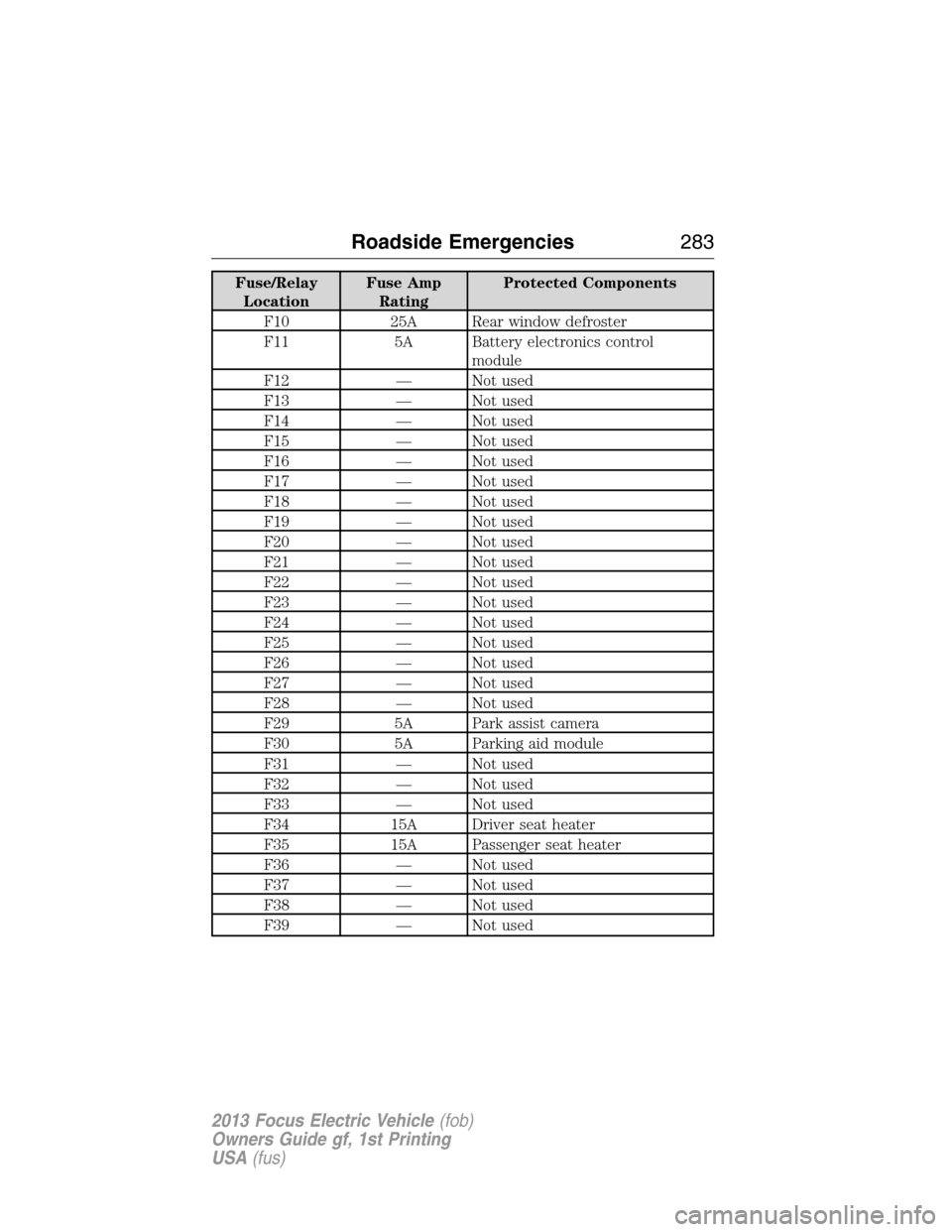
Fuse/Relay
LocationFuse Amp
RatingProtected Components
F10 25A Rear window defroster
F11 5A Battery electronics control
module
F12 — Not used
F13 — Not used
F14 — Not used
F15 — Not used
F16 — Not used
F17 — Not used
F18 — Not used
F19 — Not used
F20 — Not used
F21 — Not used
F22 — Not used
F23 — Not used
F24 — Not used
F25 — Not used
F26 — Not used
F27 — Not used
F28 — Not used
F29 5A Park assist camera
F30 5A Parking aid module
F31 — Not used
F32 — Not used
F33 — Not used
F34 15A Driver seat heater
F35 15A Passenger seat heater
F36 — Not used
F37 — Not used
F38 — Not used
F39 — Not used
Roadside Emergencies283
2013 Focus Electric Vehicle(fob)
Owners Guide gf, 1st Printing
USA(fus)
Page 287 of 386
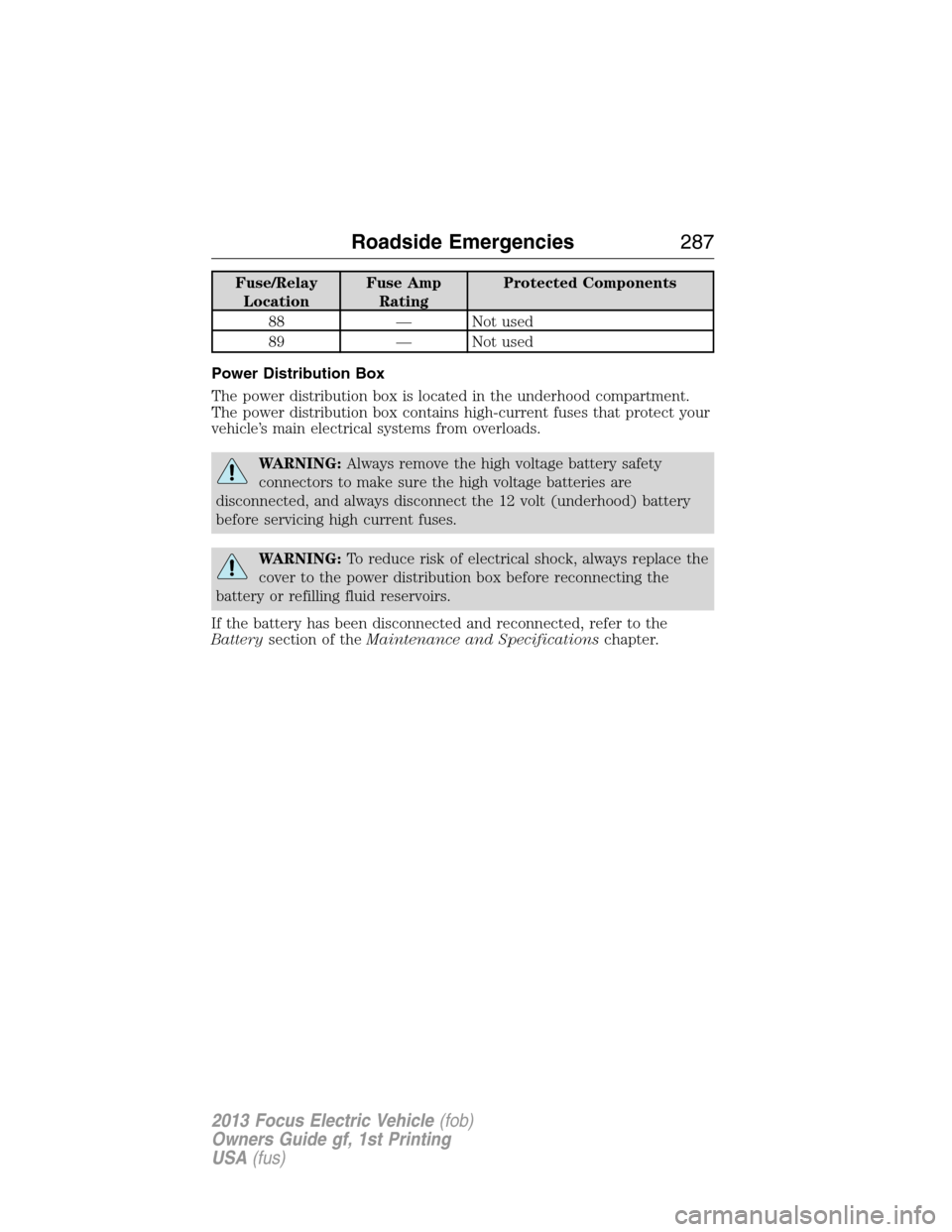
Fuse/Relay
LocationFuse Amp
RatingProtected Components
88 — Not used
89 — Not used
Power Distribution Box
The power distribution box is located in the underhood compartment.
The power distribution box contains high-current fuses that protect your
vehicle’s main electrical systems from overloads.
WARNING:Always remove the high voltage battery safety
connectors to make sure the high voltage batteries are
disconnected, and always disconnect the 12 volt (underhood) battery
before servicing high current fuses.
WARNING:To reduce risk of electrical shock, always replace the
cover to the power distribution box before reconnecting the
battery or refilling fluid reservoirs.
If the battery has been disconnected and reconnected, refer to the
Batterysection of theMaintenance and Specificationschapter.
Roadside Emergencies287
2013 Focus Electric Vehicle(fob)
Owners Guide gf, 1st Printing
USA(fus)
Page 289 of 386
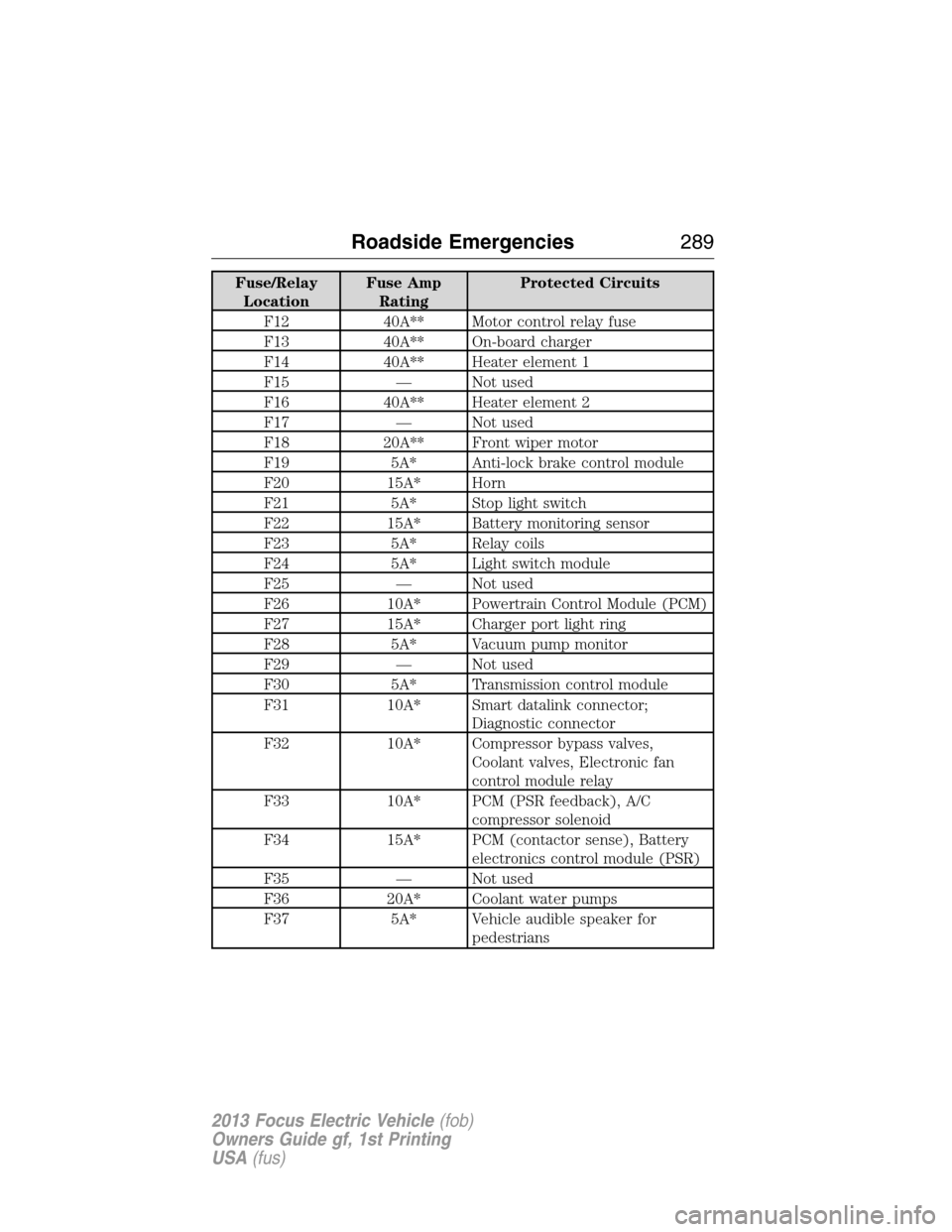
Fuse/Relay
LocationFuse Amp
RatingProtected Circuits
F12 40A** Motor control relay fuse
F13 40A** On-board charger
F14 40A** Heater element 1
F15 — Not used
F16 40A** Heater element 2
F17 — Not used
F18 20A** Front wiper motor
F19 5A* Anti-lock brake control module
F20 15A* Horn
F21 5A* Stop light switch
F22 15A* Battery monitoring sensor
F23 5A* Relay coils
F24 5A* Light switch module
F25 — Not used
F26 10A* Powertrain Control Module (PCM)
F27 15A* Charger port light ring
F28 5A* Vacuum pump monitor
F29 — Not used
F30 5A* Transmission control module
F31 10A* Smart datalink connector;
Diagnostic connector
F32 10A* Compressor bypass valves,
Coolant valves, Electronic fan
control module relay
F33 10A* PCM (PSR feedback), A/C
compressor solenoid
F34 15A* PCM (contactor sense), Battery
electronics control module (PSR)
F35 — Not used
F36 20A* Coolant water pumps
F37 5A* Vehicle audible speaker for
pedestrians
Roadside Emergencies289
2013 Focus Electric Vehicle(fob)
Owners Guide gf, 1st Printing
USA(fus)
Page 295 of 386
•Periodically monitor tire inflation pressure in the affected tire; if the
tire is losing pressure, have the vehicle towed.
•Read the information in theTips for use of the temporary mobility
kitsection to ensure safe operation of the temporary mobility kit and
your vehicle.
Tips for use of the Temporary Mobility Kit
Read the following list of tips to ensure safe operation of the temporary
mobility kit:
•Before operating the temporary mobility kit, make sure your vehicle is
safely off the road and away from moving traffic. Turn on the hazard
lights.
•Always set the parking brake to ensure the vehicle doesn’t move
unexpectedly.
•Do not remove any foreign objects, such as nails or screws, from the
tire.
•When using the temporary mobility kit, leave the motor running so the
compressor doesn’t drain the vehicle’s battery.
•Do not allow the compressor to operate continuously for more than
15 minutes; this will help prevent the compressor from overheating.
•Never leave the temporary mobility kit unattended when it is
operating.
•Sealant compound contains latex. Make sure that you use the
non-latex gloves provided to avoid an allergic reaction.
•Keep the temporary mobility kit away from children.
•Only use the temporary mobility kit when the ambient temperature is
between -22°F (–30°C) and 158°F (70°C).
•Only use the sealing compound before the use by date. The use by
date is on the lower right hand corner of the label located on the
sealant canister (bottle).Note:Check the use by date regularly and
replace the canister after four years.
•Do not store the temporary mobility kit unsecured inside the
passenger compartment of the vehicle as it may cause injury during a
sudden stop or collision. Always store the kit in its original location.
•After sealant use, the TPMS sensor and valve stem on the wheel must
be replaced by an authorized Ford dealer.
•When inflating a tire or other objects, use the black air hose only. Do
not use the transparent hose which is designed for sealant application
only.
Roadside Emergencies295
2013 Focus Electric Vehicle(fob)
Owners Guide gf, 1st Printing
USA(fus)
Page 303 of 386
JUMP STARTING THE VEHICLE (12 VOLT BATTERY ONLY)
WARNING:Batteries contain sulfuric acid which can burn skin,
eyes and clothing, if contacted.
Note:This procedure is only for the low voltage, 12 volt underhood
battery only. Do not attempt to jump start your high-voltage battery.
Do not attempt to push-start your automatic transmission vehicle.
Automatic transmissions do not have push-start capability. Attempting to
push-start a vehicle with an automatic transmission may cause
transmission damage.
Preparing Your Vehicle
Note:Your vehicle has a 12 volt battery that is easily accessible under
the hood. The 12 volt battery controls the switches and contacts that
engage the high voltage battery.The high-voltage battery cannot be
jumped with a standard 12 volt battery.If your high voltage battery
does not accept a regular charge, your vehicle must be towed to your
authorized dealership.
1.Use only a 12 volt supply to start your vehicle.
2. Do not disconnect the battery of the disabled vehicle as this could
damage the vehicle’s electrical system.
3. Park the booster vehicle close to the hood of the disabled vehicle
making sure the two vehiclesdo nottouch. Set the parking brake on
both vehicles. Stay clear of the motor cooling fan and other moving parts
on both vehicles.
4. Check all battery terminals and remove any excessive corrosion before
you attach the battery cables. Ensure that vent caps are tight and level.
5. Turn the heater fan on in both vehicles to protect from any electrical
surges. Turn all other accessories off.
Roadside Emergencies303
2013 Focus Electric Vehicle(fob)
Owners Guide gf, 1st Printing
USA(fus)
Page 304 of 386
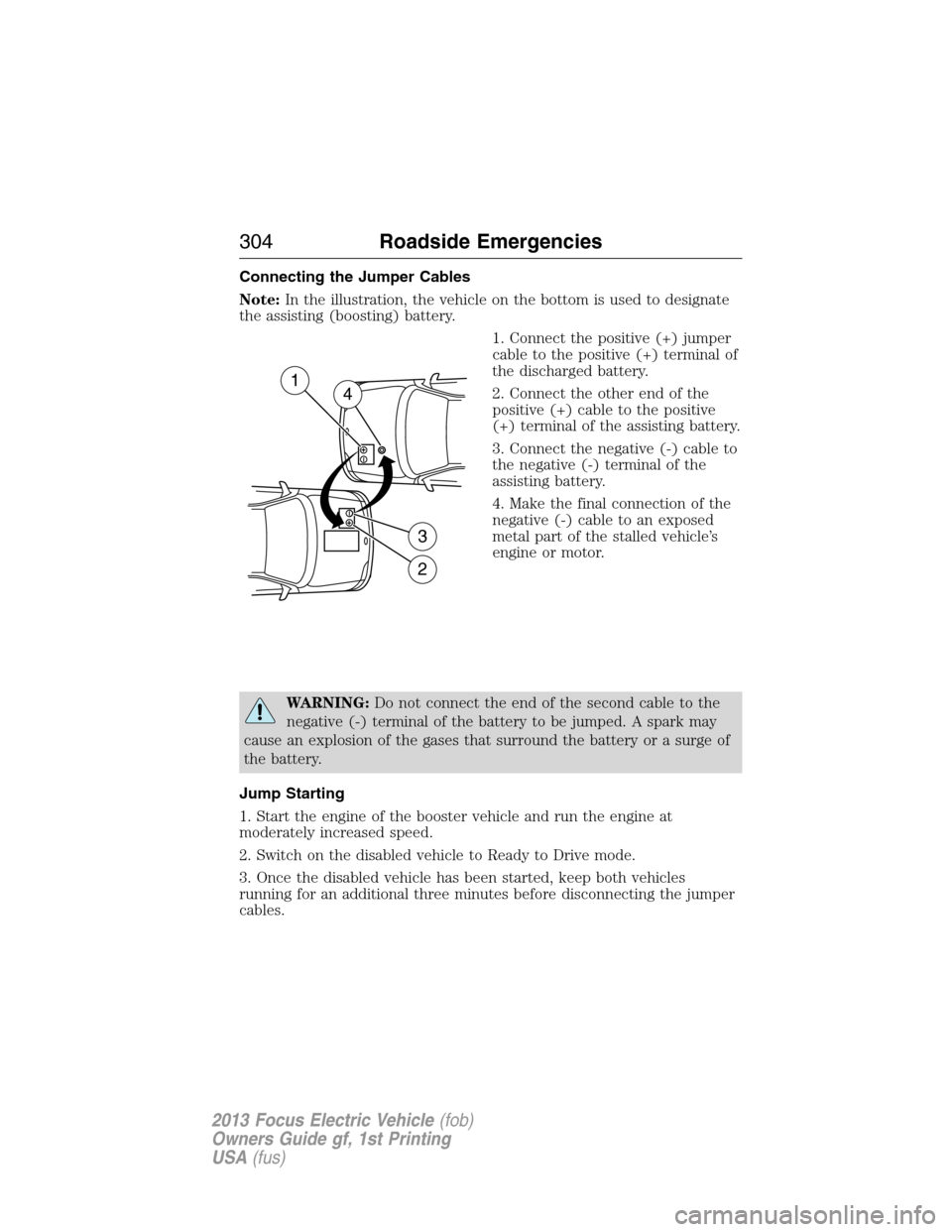
Connecting the Jumper Cables
Note:In the illustration, the vehicle on the bottom is used to designate
the assisting (boosting) battery.
1. Connect the positive (+) jumper
cable to the positive (+) terminal of
the discharged battery.
2. Connect the other end of the
positive (+) cable to the positive
(+) terminal of the assisting battery.
3. Connect the negative (-) cable to
the negative (-) terminal of the
assisting battery.
4. Make the final connection of the
negative (-) cable to an exposed
metal part of the stalled vehicle’s
engine or motor.
WARNING:Do not connect the end of the second cable to the
negative (-) terminal of the battery to be jumped. A spark may
cause an explosion of the gases that surround the battery or a surge of
the battery.
Jump Starting
1. Start the engine of the booster vehicle and run the engine at
moderately increased speed.
2. Switch on the disabled vehicle to Ready to Drive mode.
3. Once the disabled vehicle has been started, keep both vehicles
running for an additional three minutes before disconnecting the jumper
cables.
+–
+–
2
3
14
304Roadside Emergencies
2013 Focus Electric Vehicle(fob)
Owners Guide gf, 1st Printing
USA(fus)
Page 305 of 386
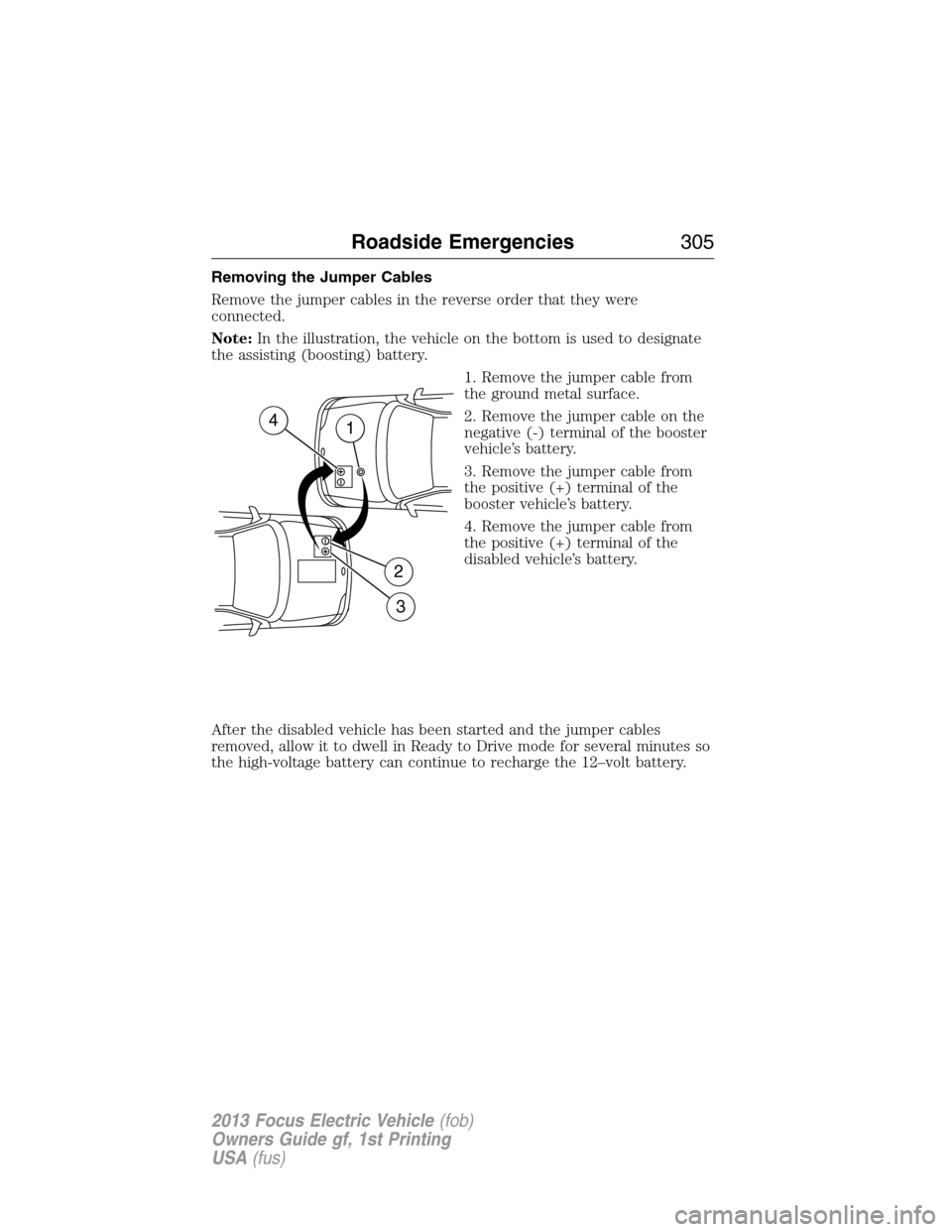
Removing the Jumper Cables
Remove the jumper cables in the reverse order that they were
connected.
Note:In the illustration, the vehicle on the bottom is used to designate
the assisting (boosting) battery.
1. Remove the jumper cable from
the ground metal surface.
2. Remove the jumper cable on the
negative (-) terminal of the booster
vehicle’s battery.
3. Remove the jumper cable from
the positive (+) terminal of the
booster vehicle’s battery.
4. Remove the jumper cable from
the positive (+) terminal of the
disabled vehicle’s battery.
After the disabled vehicle has been started and the jumper cables
removed, allow it to dwell in Ready to Drive mode for several minutes so
the high-voltage battery can continue to recharge the 12–volt battery.
+–
+–
DA
B
C
4D1
2
3
Roadside Emergencies305
2013 Focus Electric Vehicle(fob)
Owners Guide gf, 1st Printing
USA(fus)
Page 307 of 386
Emergency Towing
In case of a roadside emergency with a disabled vehicle (without access
to wheel dollies, car hauling trailer, or flatbed transport vehicle) your
vehicle (regardless of transmission powertrain configuration) can be flat
towed (all wheels on the ground) under the following conditions:
•Vehicle is facing forward so that it is being towed in a forward
direction.
•Place the transmission in N (Neutral). Refer toBrake-shift interlock
in theDrivingchapter for specific instructions if you cannot move the
gear shift lever into N (Neutral).
•Maximum speed is not to exceed 35 mph (56 km/h).
•Maximum distance is 50 miles (80 km).
IMPORTANT ELECTRIC VEHICLE AND HYBRID-ELECTRIC
VEHICLE CONSIDERATIONS
Guidance for Ford Motor Company Electric and Hybrid-Electric
Vehicles Equipped With High-Voltage Batteries (Vehicle
Owner/Operator/General Public)
In the event of damage or fire involving an electric vehicle (EV) or
hybrid-electric vehicle (HEV):
•Always assume the high-voltage battery and associated components
are energized and fully charged.
•Exposed electrical components, wires, and high-voltage batteries
present potential high-voltage shock hazards.
•Venting/off-gassing high-voltage battery vapors are potentially toxic
and flammable.
•Physical damage to the vehicle or high-voltage battery may result in
immediate or delayed release of toxic and/or flammable gases and fire.
Vehicle information and general safety practices:
•Know the make and model of your vehicle.
•Review the Owner’s Manual and become familiar with your vehicle’s
safety information and recommended safety practices.
•Do not attempt to repair damaged electric and hybrid-electric vehicles
yourself. Contact an authorized Ford Dealer or vehicle manufacturer
representative for service.
Roadside Emergencies307
2013 Focus Electric Vehicle(fob)
Owners Guide gf, 1st Printing
USA(fus)