2012 FORD FOCUS ELECTRIC lock
[x] Cancel search: lockPage 188 of 380
When to use the automatic locking mode
This mode should be usedany timea child safety seat, except a
booster, is installed in passenger front or rear seating positions. Children
12 years old and under should be properly restrained in a rear seating
position whenever possible. Refer to Safety restraints for childrenor
Safety seats for children later in this chapter.
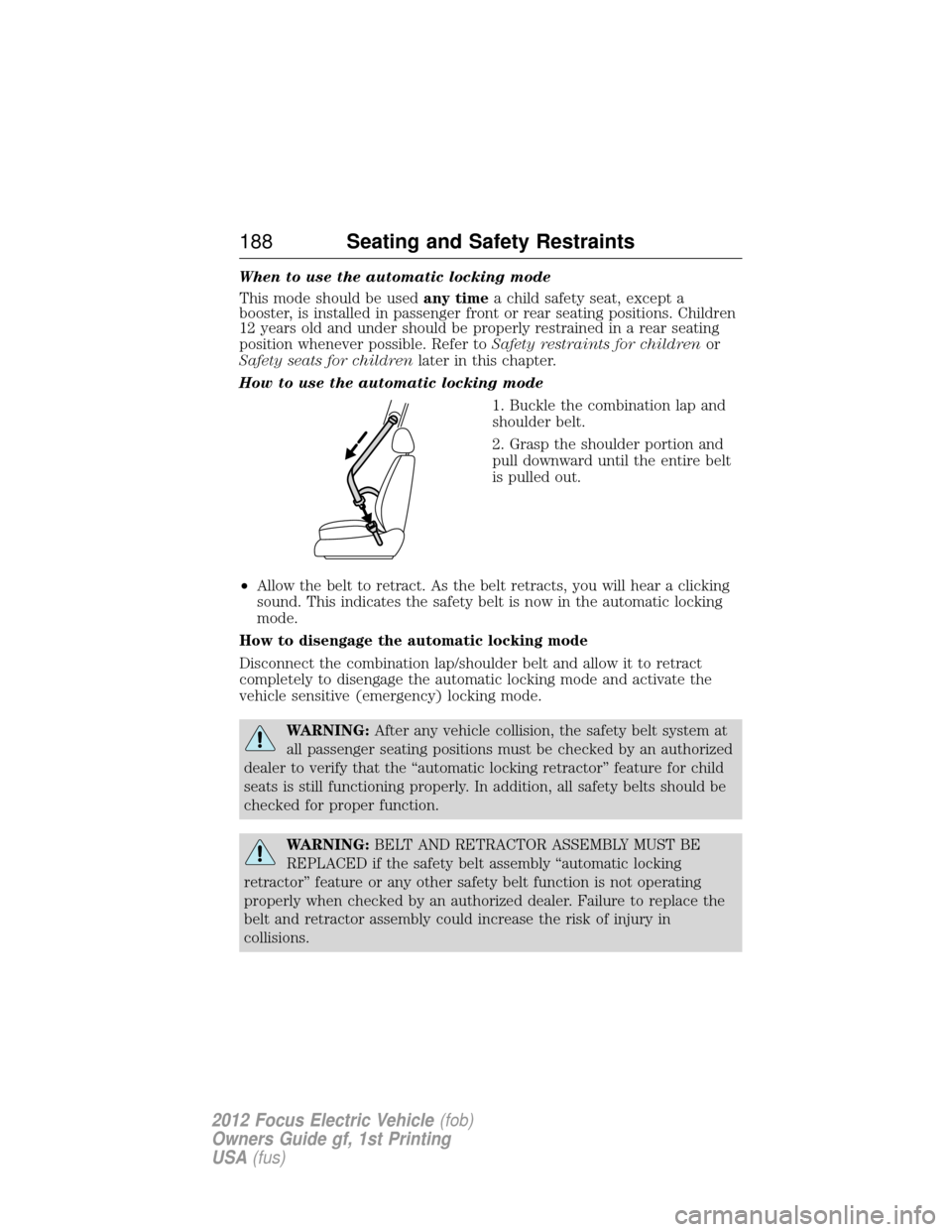
How to use the automatic locking mode 1. Buckle the combination lap and
shoulder belt.
2. Grasp the shoulder portion and
pull downward until the entire belt
is pulled out.
• Allow the belt to retract. As the belt retracts, you will hear a clicking
sound. This indicates the safety belt is now in the automatic locking
mode.
How to disengage the automatic locking mode
Disconnect the combination lap/shoulder belt and allow it to retract
completely to disengage the automatic locking mode and activate the
vehicle sensitive (emergency) locking mode.
WARNING: After any vehicle collision, the safety belt system at
all passenger seating positions must be checked by an authorized
dealer to verify that the “automatic locking retractor” feature for child
seats is still functioning properly. In addition, all safety belts should be
checked for proper function.
WARNING: BELT AND RETRACTOR ASSEMBLY MUST BE
REPLACED if the safety belt assembly “automatic locking
retractor” feature or any other safety belt function is not operating
properly when checked by an authorized dealer. Failure to replace the
belt and retractor assembly could increase the risk of injury in
collisions.
188 Seating and Safety Restraints
2012 Focus Electric Vehicle (fob)
Owners Guide gf, 1st Printing
USA (fus)
Page 189 of 380
Safety belt extension assembly
If the safety belt is too short when fully extended, a safety belt extension
assembly can be obtained from an authorized dealer.
Use only extensions manufactured by the same supplier as the safety
belt. Manufacturer identification is located at the end of the webbing on
the label. Also, use the safety belt extension only if the safety belt is too
short for you when fully extended.
WARNING:Do not use extensions to change the fit of the
shoulder belt across the torso.
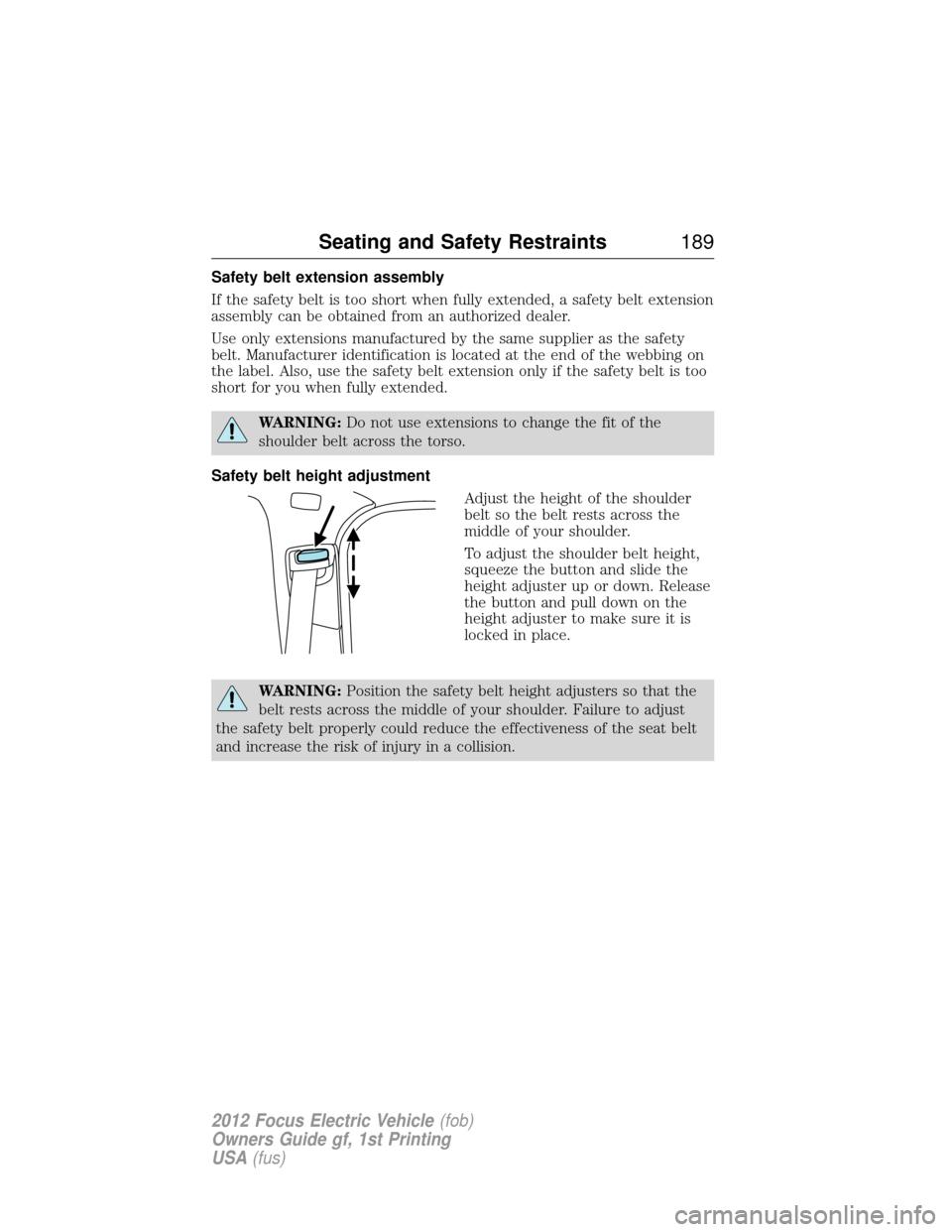
Safety belt height adjustment Adjust the height of the shoulder
belt so the belt rests across the
middle of your shoulder.
To adjust the shoulder belt height,
squeeze the button and slide the
height adjuster up or down. Release
the button and pull down on the
height adjuster to make sure it is
locked in place.
WARNING:Position the safety belt height adjusters so that the
belt rests across the middle of your shoulder. Failure to adjust
the safety belt properly could reduce the effectiveness of the seat belt
and increase the risk of injury in a collision.
Seating and Safety Restraints 189
2012 Focus Electric Vehicle(fob)
Owners Guide gf, 1st Printing
USA (fus)
Page 213 of 380
Installing child safety seats with combination lap and shoulder belts
Check to make sure the child seat is properly secured before each use.
Children 12 and under should be properly restrained in a rear seating
position whenever possible. If all children cannot be seated and
restrained properly in a rear seating position, properly restrain the
largest child in the front seat.
When installing a child safety seat with combination lap/shoulder belts:
•Use the correct safety belt buckle for that seating position.
•
Insert the belt tongue into the proper buckle until you hear a snap and
feel it latch. Make sure the tongue is securely fastened in the buckle.
• Keep the buckle release button pointing up and away from the safety
seat, with the tongue between the child seat and the release button,
to prevent accidental unbuckling.
• Place vehicle seat back in upright position.
• Put the safety belt in the automatic locking mode. Refer to Step 5
below. This vehicle does not require the use of a locking clip.
WARNING: Depending on where you secure a child restraint,
and depending on the child restraint design, you may block
access to certain safety belt buckle assemblies and/or LATCH lower
anchors, rendering those features potentially unusable. To avoid risk of
injury, occupants should only use seating positions where they are able
to be properly restrained.
Perform the following steps when installing the child seat with
combination lap/shoulder belts:
Note: Although the child seat illustrated is a forward facing child seat,
the steps are the same for installing a rear facing child seat.
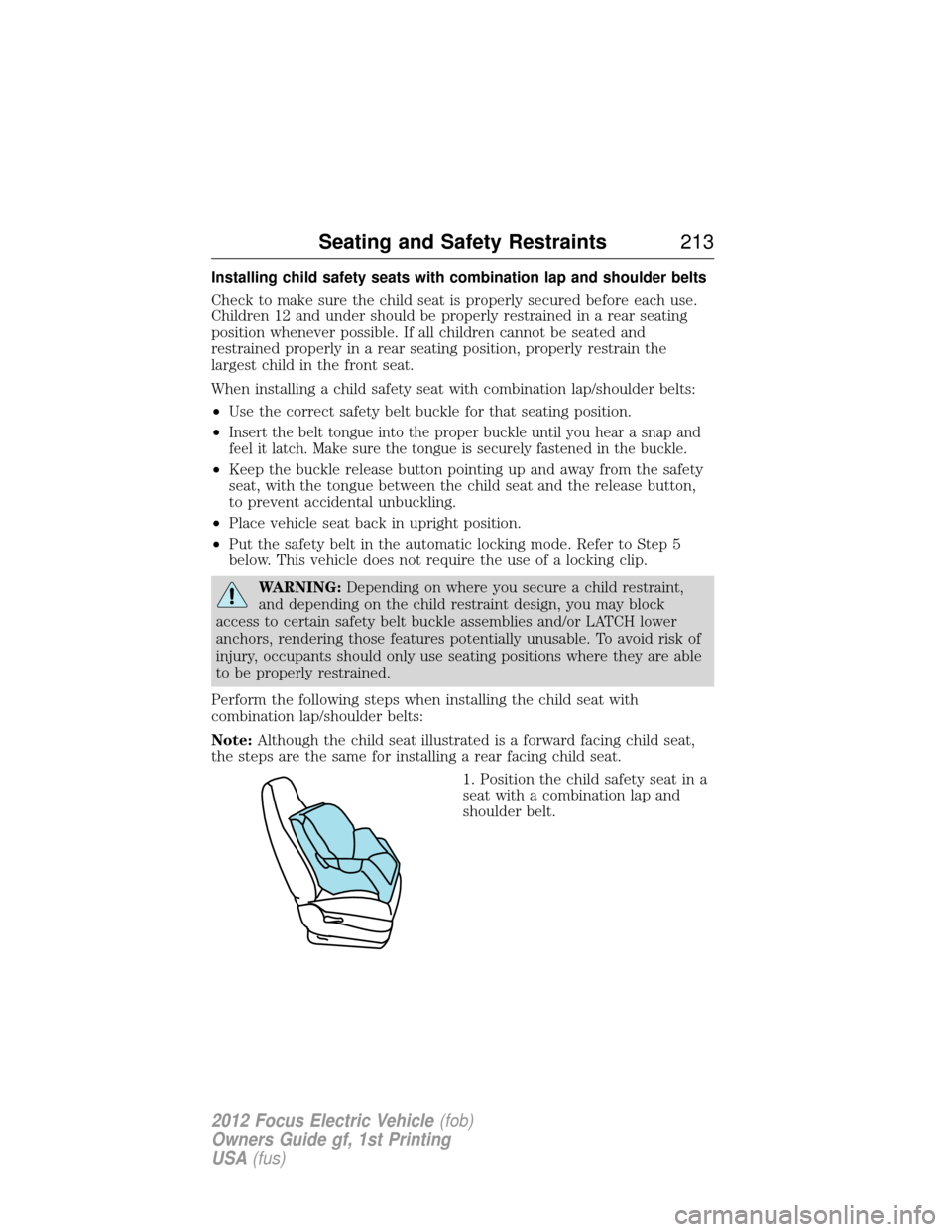
1. Position the child safety seat in a
seat with a combination lap and
shoulder belt.
Seating and Safety Restraints 213
2012 Focus Electric Vehicle(fob)
Owners Guide gf, 1st Printing
USA (fus)
Page 215 of 380
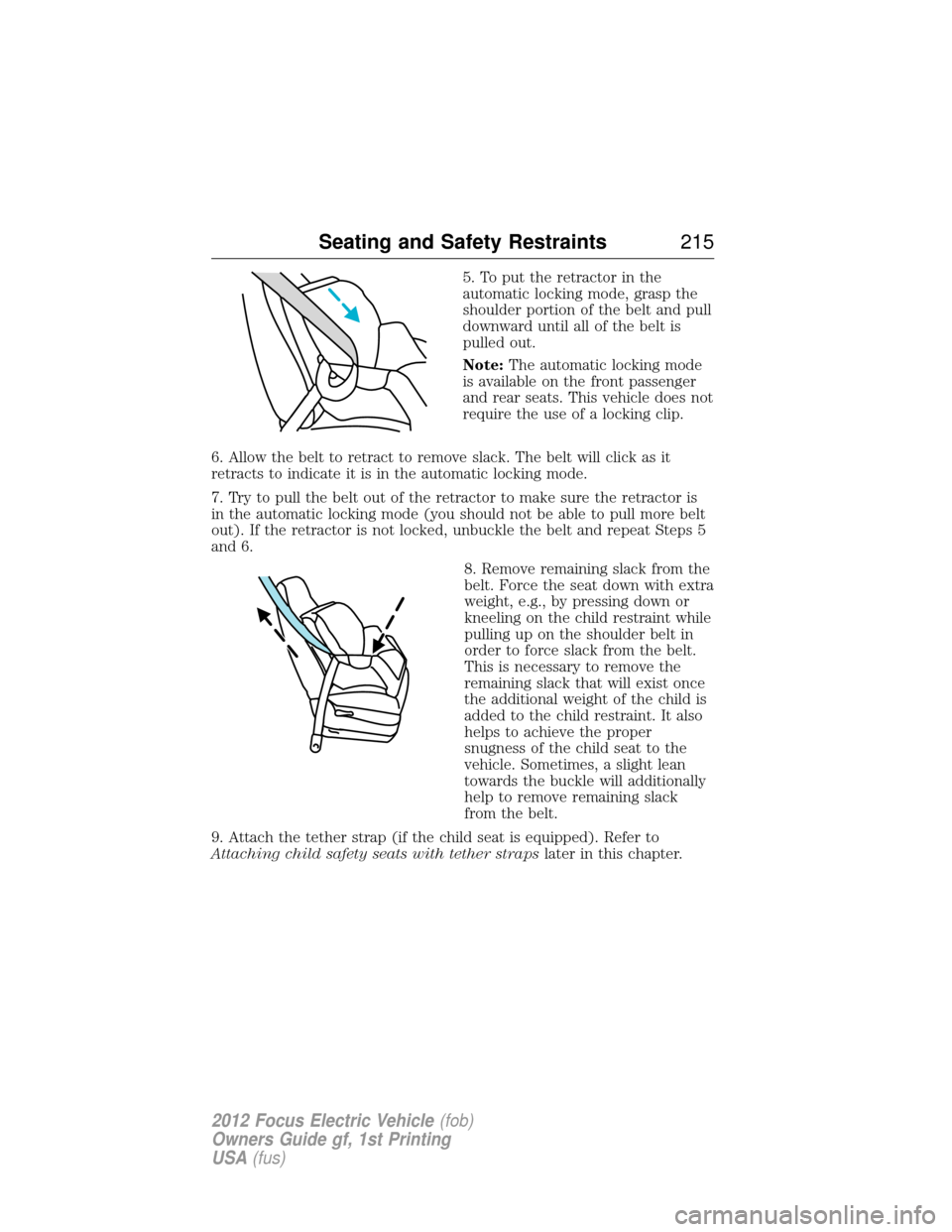
5. To put the retractor in the
automatic locking mode, grasp the
shoulder portion of the belt and pull
downward until all of the belt is
pulled out.
Note:The automatic locking mode
is available on the front passenger
and rear seats. This vehicle does not
require the use of a locking clip.
6. Allow the belt to retract to remove slack. The belt will click as it
retracts to indicate it is in the automatic locking mode.
7. Try to pull the belt out of the retractor to make sure the retractor is
in the automatic locking mode (you should not be able to pull more belt
out). If the retractor is not locked, unbuckle the belt and repeat Steps 5
and 6. 8. Remove remaining slack from the
belt. Force the seat down with extra
weight, e.g., by pressing down or
kneeling on the child restraint while
pulling up on the shoulder belt in
order to force slack from the belt.
This is necessary to remove the
remaining slack that will exist once
the additional weight of the child is
added to the child restraint. It also
helps to achieve the proper
snugness of the child seat to the
vehicle. Sometimes, a slight lean
towards the buckle will additionally
help to remove remaining slack
from the belt.
9. Attach the tether strap (if the child seat is equipped). Refer to
Attaching child safety seats with tether straps later in this chapter.
Seating and Safety Restraints215
2012 Focus Electric Vehicle(fob)
Owners Guide gf, 1st Printing
USA (fus)
Page 217 of 380
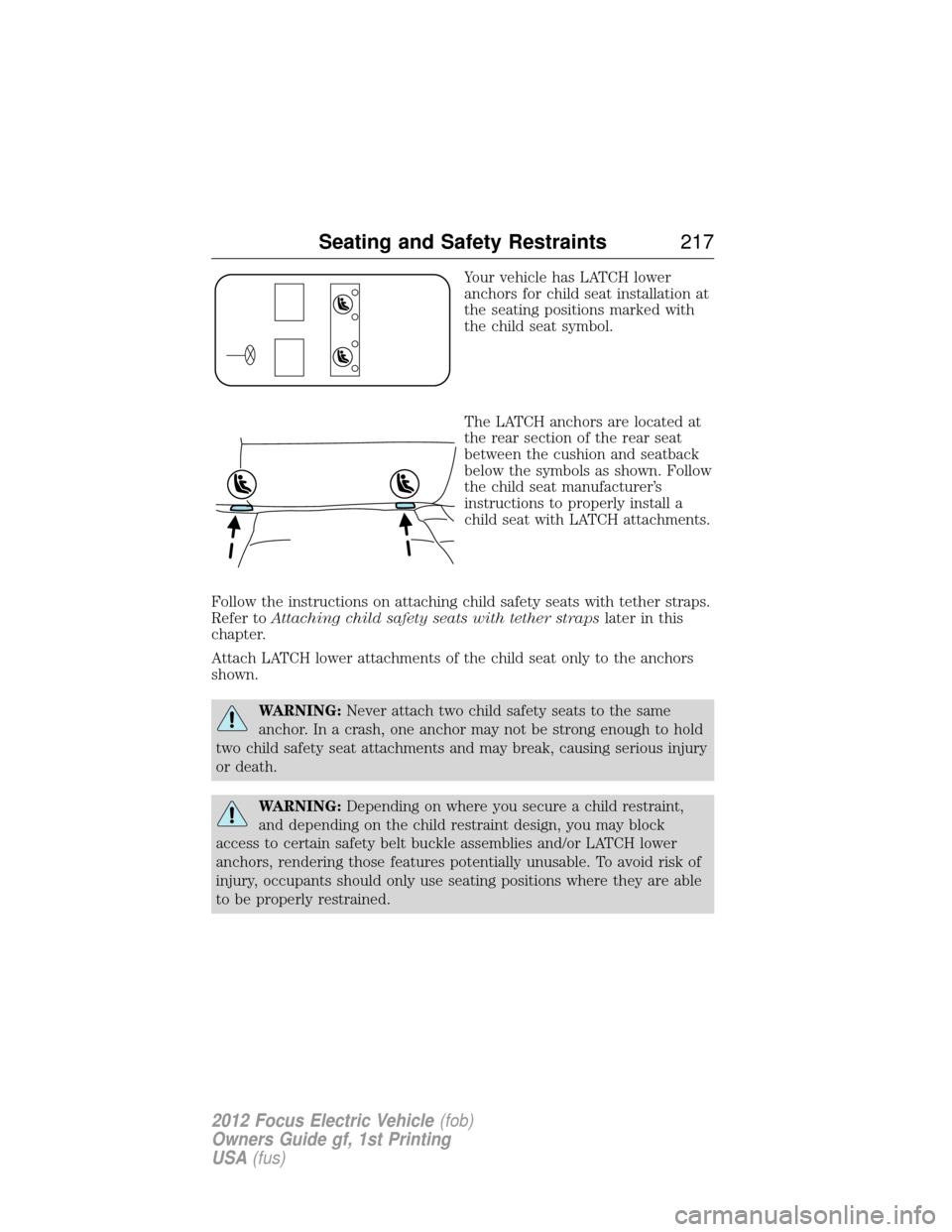
Your vehicle has LATCH lower
anchors for child seat installation at
the seating positions marked with
the child seat symbol.
The LATCH anchors are located at
the rear section of the rear seat
between the cushion and seatback
below the symbols as shown. Follow
the child seat manufacturer’s
instructions to properly install a
child seat with LATCH attachments.
Follow the instructions on attaching child safety seats with tether straps.
Refer to Attaching child safety seats with tether straps later in this
chapter.
Attach LATCH lower attachments of the child seat only to the anchors
shown.
WARNING: Never attach two child safety seats to the same
anchor. In a crash, one anchor may not be strong enough to hold
two child safety seat attachments and may break, causing serious injury
or death.
WARNING: Depending on where you secure a child restraint,
and depending on the child restraint design, you may block
access to certain safety belt buckle assemblies and/or LATCH lower
anchors, rendering those features potentially unusable. To avoid risk of
injury, occupants should only use seating positions where they are able
to be properly restrained.
Seating and Safety Restraints 217
2012 Focus Electric Vehicle(fob)
Owners Guide gf, 1st Printing
USA (fus)
Page 256 of 380
Four-wheel anti-lock brake system (ABS)
Your vehicle is equipped with an anti-lock braking system (ABS). This
system helps you maintain steering control during emergency stops by
keeping the brakes from locking. Noise from the ABS pump motor and
brake pedal pulsation may be observed during ABS braking and the
brake pedal may suddenly travel a little farther as soon as ABS braking is
done and normal brake operation resumes. These are normal
characteristics of the ABS and should be no reason for concern.
Using ABS
When hard braking is required, apply continuous force on the brake
pedal. Do not pump the brake pedal since this will reduce the
effectiveness of the ABS and will increase your vehicle’s stopping
distance. The ABS will be activated immediately, allowing you to retain
steering control during hard braking and on slippery surfaces. However,
the ABS does not decrease stopping distance.
Brake assist
The brake assist system provides full braking force during panic braking
situations. It detects a rapid application of the brake pedal and uses the
ABS system to achieve maximum braking pressure. Once a panic brake
application is detected, the system will remain activated as long as the
brake pedal is pressed or ABS is engaged. The system is deactivated by
either releasing the brake pedal or coming to a complete stop. When the
system activates, noise from the ABS pump motor and brake pedal
pulsation may be observed; this is normal.
ABS warning lampThe ABS lamp in the instrument cluster momentarily
illuminates when the ignition is turned on. If the light does not
illuminate during start up, remains on or flashes, the ABS may
be disabled and may need to be serviced.
Even when the ABS is disabled, normal braking is still effective.
(If your BRAKE warning lamp illuminates with the parking
brake released, have your brake system serviced immediately.)
Regenerative braking system
Your vehicle uses a feature known as regenerative braking. This is used
to simulate the engine braking of an internal combustion engine and
assist the standard brake system while recovering some of the energy of
motion and storing it in the battery to improve fuel economy. The
standard brake system is designed to fully stop the car if regenerative
256 Driving
2012 Focus Electric Vehicle (fob)
Owners Guide gf, 1st Printing
USA (fus)
Page 257 of 380
braking is not available. During regenerative braking, the motor is spun
as a generator to create electrical current. This recharges the battery
and slows the vehicle. In effect, once the accelerator pedal is released,
the motor changes from an energy user to an energy producer.
When the accelerator pedal is released or the brake pedal is applied, the
brake controller automatically detects the amount of deceleration
requested and optimizes how much of the deceleration will be produced
by regenerative braking. The remaining portion is generated by standard
friction braking. When the battery is almost fully charged, the amount of
regenerative braking is limited to avoid overcharging, and the requested
deceleration is produced by standard friction braking alone.
Regenerative braking does not take the place of the standard friction
brakes; it only assists them. Regenerative braking has also been designed
to interact with the anti-lock brake system. Regenerative braking is
disabled when the anti-lock brake system is activated or the battery is
fully charged.
Brake Over Accelerator
In the event the accelerator pedal becomes stuck or entrapped, apply
steady and firm pressure to the brake pedal to slow the vehicle and
reduce motor power. If you experience this condition, apply the brakes
and bring your vehicle to a safe stop. Turn the motor off, shift to P
(Park) and apply the parking brake, and then inspect the accelerator
pedal for any interferences. If none are found and the condition persists,
have your vehicle towed to the nearest authorized dealer.
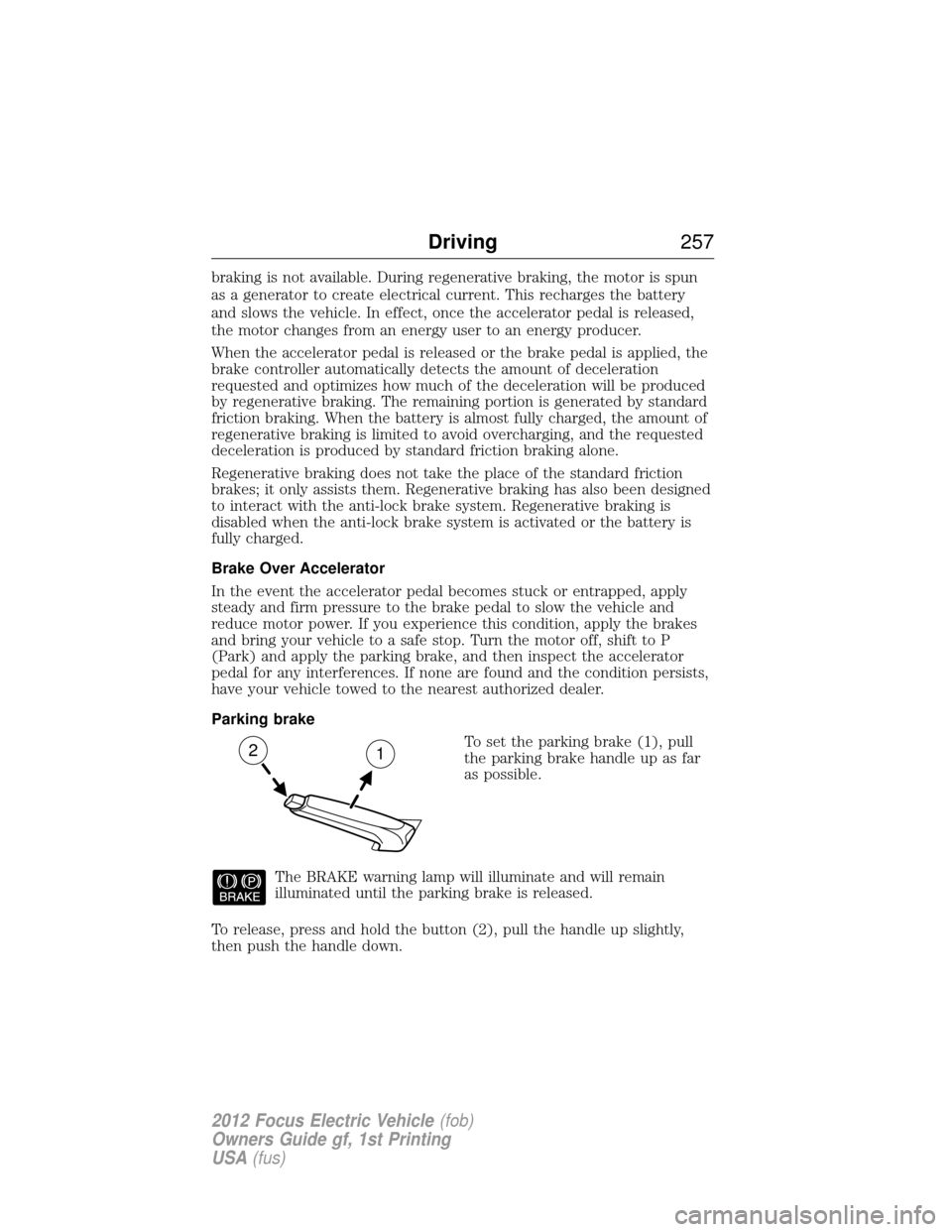
Parking brakeTo set the parking brake (1), pull
the parking brake handle up as far
as possible.
The BRAKE warning lamp will illuminate and will remain
illuminated until the parking brake is released.
To release, press and hold the button (2), pull the handle up slightly,
then push the handle down.
12
Driving 257
2012 Focus Electric Vehicle (fob)
Owners Guide gf, 1st Printing
USA (fus)
Page 260 of 380
Traction control system (TCS)
Traction control is a driver aid feature that helps your vehicle maintain
traction of the wheels, typically when driving on slippery and/or hilly
road surfaces, by detecting and controlling wheel spin.
Excessive wheel spin is controlled in two ways, which may work
separately or in tandem, motor traction control and brake traction
control. Motor traction control works to limit drive-wheel spin by
momentarily reducing motor power. Brake traction control works to limit
wheel spin by momentarily applying the brakes to the wheel that is
slipping. Traction control is most active at low speeds.
During TCS events, the stability control light in the instrument cluster
will flash.
If the TCS is activated excessively in a short period of time, the braking
portion of the system may become temporarily disabled to allow the
brakes to cool down. In this situation, TCS will use only motor power
reduction or transfer to help control the wheels from over-spinning.
When the brakes have cooled down, the system will regain all features.
Anti-lock braking, and ESC are not affected by this condition and will
continue to function during the cool-down period.
Electronic stability control (ESC)
Electronic stability control (ESC) may enhance your vehicle’s directional
stability during adverse maneuvers, for example when cornering severely
or avoiding objects in the roadway. ESC operates by applying brakes to
one or more of the wheels individually and, if necessary, reducing power
if the system detects that the vehicle is about to skid or slide laterally.
During ESC events, the stability control light in the instrument cluster
will flash.
Certain adverse driving maneuvers may activate the ESC system, which
include but are not limited to:
•Taking a turn too fast
• Maneuvering quickly to avoid an accident, pedestrian or obstacle
• Driving over a patch of ice or other slippery surfaces
• Changing lanes on a snow-rutted road
• Entering a snow-free road from a snow-covered side street, or vice
versa
• Entering a paved road from a gravel road, or vice versa
260 Driving
2012 Focus Electric Vehicle (fob)
Owners Guide gf, 1st Printing
USA (fus)