Page 680 of 5598

REPAIRING HIGH STRENGTH STEELBRM-5
< PRECAUTION >
C
DE
F
G H
I
J
L
M A
B
BRM
N
O P
The repair of reinforcements (such as side members) by heat- ing is not recommended, because it may weaken the compo-
nent. When heating is unavoidable, never heat HSS parts
above 550 °C (1,022 °F).
Verify heating temperature with a thermometer.
(Crayon-type and other similar type thermometer are appropri-
ate.)
When straightening body panels, use caution in pul ling any HSS panel. Because HSS is very strong,
pulling may cause deformation in adjacent sections of the body. In this case, increase the number of
measuring points, and carefully pull the HSS panel.
When cutting HSS panels, avoid gas (torch) cutting if possible.
Instead, use a saw to avoid weakening surrounding areas due
to heat. If gas (torch) cutting is unavoidable, allow a minimum
margin of 50 mm (1.97 in).
When welding HSS panels, use spot welding whenever possi- ble in order to minimize weakening surrounding areas due to
heat.
If spot welding is impossible, use MIG. welding. Do not use
gas (torch) for welding because it is inferior in welding
strength.
Spot welding on HSS panels is harder than that of an ordinary steel panel.
Therefore, when cutting spot welds on a HSS panel, use a low
speed high torque drill (1,000 to 1,200 rpm) to increase drill bit
durability and facilitate the operation.
PIIA0115E
PIIA0117E
PIIA0144E
PIIA0145E
Revision: 2010 May2011 QX56
Page 682 of 5598

REPAIRING MATERIALBRM-7
< PREPARATION >
C
DE
F
G H
I
J
L
M A
B
BRM
N
O P
PREPARATION
REPAIRING MATERIAL
Foam RepairINFOID:0000000006248486
During factory body assembly, foam insulators are installed in certain body panels and locations around the
vehicle. Use the following procedure(s) to r eplace any factory-installed foam insulators.
URETHANE FOAM APPLICATIONS
Use commercially available Urethane foam for sealant (foam material) repair of material used on vehicle.
Read instructions on product for fill procedures.
Example of foaming agent filling operation procedure
1. Fill procedures after installation of service part.
a. Eliminate foam material remaining on vehicle side.
b. Clean area after eliminating form insulator and foam material.
c. Install service part.
d. Insert nozzle into hole near fill area and fill foam ma terial or fill enough to close gap with the service part.
2. Fill procedures before installation of service part.
a. Eliminate foam material remaining on vehicle side.
b. Clean area after eliminating foam insulator and foam material.
c. Fill foam material on wheelhouse outer side. 3M™
Automix™ Flexible Foam 08463 or equiva-
lent
1. Urethane foam
A. Nozzle insert hole
: Vehicle front
JSKIA0129GB
Revision: 2010 May2011 QX56
Page 690 of 5598
CORROSION PROTECTIONBRM-15
< REMOVAL AND INSTALLATION >
C
DE
F
G H
I
J
L
M A
B
BRM
N
O P
REMOVAL AND INSTALLATION
CORROSION PROTECTION
DescriptionINFOID:0000000006248490
To provide improved corrosion prevention, the follo wing anti-corrosive measures have been implemented in
NISSAN production plants. When repairing or replacing body panels, it is necessary to use the same anti-cor-
rosive measures.
Anti-Corrosive Precoated Steel (Galvannealed Steel)
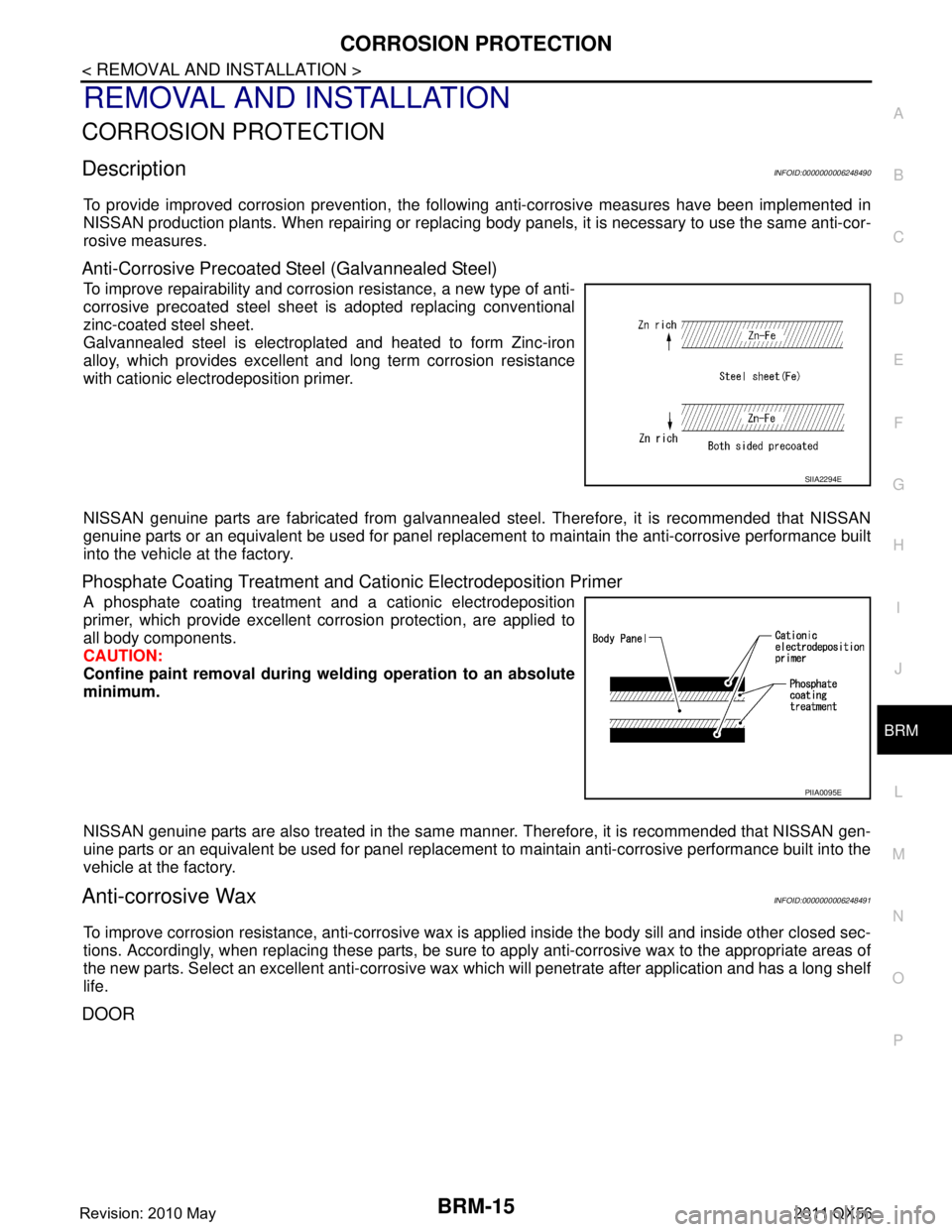
To improve repairability and corrosi on resistance, a new type of anti-
corrosive precoated steel sheet is adopted replacing conventional
zinc-coated steel sheet.
Galvannealed steel is electroplated and heated to form Zinc-iron
alloy, which provides excellent and long term corrosion resistance
with cationic electrodeposition primer.
NISSAN genuine parts are fabricated from galvannealed steel. Therefore, it is recommended that NISSAN
genuine parts or an equivalent be used for panel replacem ent to maintain the anti-corrosive performance built
into the vehicle at the factory.
Phosphate Coating Treatment and Cationic Electrodeposition Primer
A phosphate coating treatment and a cationic electrodeposition
primer, which provide excellent corrosion protection, are applied to
all body components.
CAUTION:
Confine paint removal during we lding operation to an absolute
minimum.
NISSAN genuine parts are also treated in the same manner. Therefore, it is recommended that NISSAN gen-
uine parts or an equivalent be used for panel replacement to maintain anti-corrosive performance built into the
vehicle at the factory.
Anti-corrosive WaxINFOID:0000000006248491
To improve corrosion resistance, anti-corrosive wax is applied inside the body sill and inside other closed sec-
tions. Accordingly, when replacing these parts, be sure to apply anti-corrosive wax to the appropriate areas of
the new parts. Select an excellent anti-corrosive wax which will penetrate after application and has a long shelf
life.
DOOR
SIIA2294E
PIIA0095E
Revision: 2010 May2011 QX56
Page 693 of 5598
BRM-18
< REMOVAL AND INSTALLATION >
CORROSION PROTECTION
Body Sealing
INFOID:0000000006248494
The following figure shows the areas that are sealed at the factory. Sealant that is applied to these areas
should be smooth and free from cuts or gaps. Care s hould be taken not to apply an excess amount of sealant
and not to allow other unaffected parts to come into contact with the sealant.
: Stone guard coated portions
JSKIA1942ZZ
Revision: 2010 May2011 QX56
Page 699 of 5598

BRM-24
< REMOVAL AND INSTALLATION >
REPLACEMENT OPERATIONS
REPLACEMENT OPERATIONS
DescriptionINFOID:0000000006248496
This section is prepared for technicians who have attained a high level of skill and experience in repairingcollision-damaged vehicles and also use modern serv ice tools and equipment. Persons unfamiliar with body
repair techniques should not attempt to repair collision-damaged vehicles by using this section.
Technicians are also encouraged to read the Body Repair Manual (Fundamentals) in order to ensure that the
original functions and quality of the vehicle are ma intained. The Body Repair Manual (Fundamentals) con-
tains additional information, including cautions and warnings, that are not including in this manual. Techni-
cians should refer to both manuals to ensure proper repair.
Please note that this information is prepared for worldwide usage, and as such, certain procedures might not apply in some regions or countries.
The symbols used in this section fo r welding operations are shown below.
Symbol marks Description
2-spot welds
3-spot welds
MIG plug weld For 3 panels plug weld method
MIG seam weld / Point weld
JSKIA0049ZZ
JSKIA0053ZZ
JSKIA0050ZZ
JSKIA0051ZZ
JSKIA0054ZZ
JSKIA0055ZZ
JSKIA0052ZZJSKIA0056ZZ
Revision: 2010 May2011 QX56
Page 723 of 5598
BRM-48
< SERVICE DATA AND SPECIFICATIONS (SDS)
BODY ALIGNMENT
SERVICE DATA AND SPECIFICATIONS (SDS)
BODY ALIGNMENT
Body Center MarksINFOID:0000000006248507
A mark is placed on each part of the body to indicate the vehicle center. When repairing the vehicle frame
(members, pillars, etc.) damaged by an accident which it enables more accurate and effective repair by using
these marks together with body alignment specifications.
Unit: mm (in)
DescriptionINFOID:0000000006248508
All dimensions indicated in the figures are actual.
When using a tracking gauge, adjust both pointers to equal length. Then check the pointers and gauge itself
to make sure there is no free play.
: Vehicle front
Points Portion Marks
A Upper dash Hole 7 ×12 (0.28 ×0.47)
B Cowl top Embossment
C Rear roof Indent
JSKIA1895ZZ
Revision: 2010 May2011 QX56
Page 724 of 5598
BODY ALIGNMENTBRM-49
< SERVICE DATA AND SPECIFICATIONS (SDS)
C
DE
F
G H
I
J
L
M A
B
BRM
N
O P
When a measuring tape is used, check to be su re there is no elongation, twisting or bending.
Measurements should be taken at the center of the mounting holes.
An asterisk (*) following the value at the measuring poi nt indicates that the measuring point on the other side
is symmetrically the same value.
The coordinates of the measurement points are the distances measured from the standard line of ″X ″, ″Y ″
and ″Z ″.
″Z ″: Imaginary base line [300 mm (11.81 in) below datum line ( ″0Z ″ at design plan)]
Engine CompartmentINFOID:0000000006248509
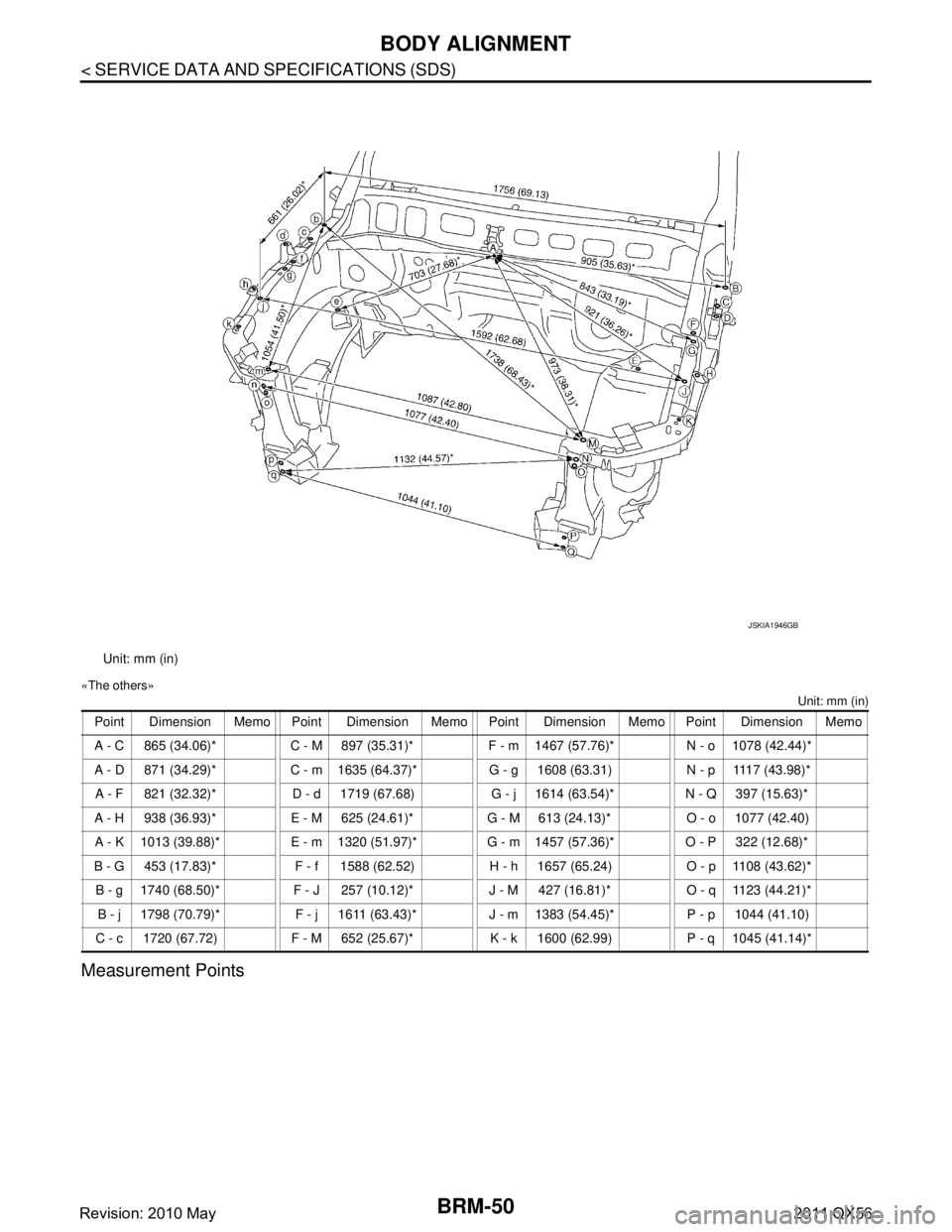
Measurement
Dimensions marked with ″*″ indicate symmetrically identical dimensions on both the right and left hand of the
vehicle.
1. Vehicle center 2. Front axle center 3. Imaginary base line
JSKIA0073GB
Revision: 2010 May2011 QX56
Page 725 of 5598
BRM-50
< SERVICE DATA AND SPECIFICATIONS (SDS)
BODY ALIGNMENT
«The others»Unit: mm (in)
Measurement Points
Unit: mm (in)
Point Dimension Memo Point Dimension Memo Point Dimension Memo Point Dimension Memo
A - C 865 (34.06)* C - M 897 (35.31)* F - m 1467 (57.76)* N - o 1078 (42.44)*
A - D 871 (34.29)* C - m 1635 (64.37)* G - g 1608 (63.31) N - p 1117 (43.98)* A - F 821 (32.32)* D - d 1719 (67.68) G - j 1614 (63.54)* N - Q 397 (15.63)*
A - H 938 (36.93)* E - M 625 (24.61)* G - M 613 (24.13)* O - o 1077 (42.40)
A - K 1013 (39.88)* E - m 1320 (51.97)* G - m 1457 (57.36)* O - P 322 (12.68)*
B - G 453 (17.83)* F - f 1588 (62.52) H - h 1657 (65.24) O - p 1108 (43.62)* B - g 1740 (68.50)* F - J 257 (10.12)* J - M 427 (16.81)* O - q 1123 (44.21)*
B - j 1798 (70.79)* F - j 1611 (63.43)* J - m 1383 (54.45)* P - p 1044 (41.10)
C - c 1720 (67.72) F - M 652 (25.67)* K - k 1600 (62.99) P - q 1045 (41.14)*
JSKIA1946GB
Revision: 2010 May2011 QX56