Page 2707 of 3039
For instance, the crumple zones absorb the bulk of the impact energy. If any unprofessional repair techniques or
methods are used in these areas then this can pose a fundamental threat to vehicle safety.
Hidden damage
As well as looking at external indicators like flaked off paint, it is vital to check for hidden body damage or deformation
that is not visible from the outside. Large attached parts like bumpers and inner fenders often need to be removed to
allow accurate assessment of damage to underlying body parts.
Gap dimensions
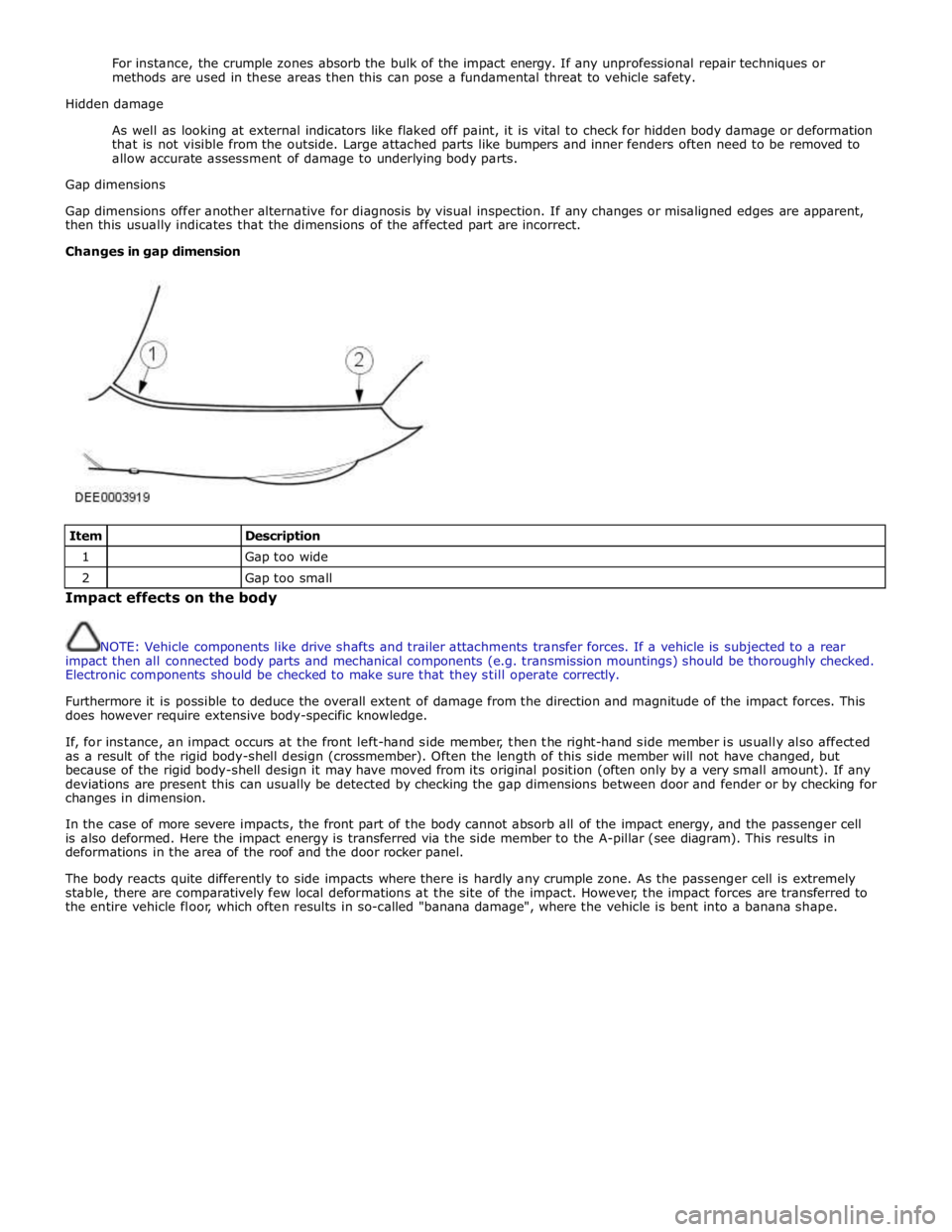
Gap dimensions offer another alternative for diagnosis by visual inspection. If any changes or misaligned edges are apparent,
then this usually indicates that the dimensions of the affected part are incorrect.
Changes in gap dimension
Item
Description 1
Gap too wide 2
Gap too small Impact effects on the body
NOTE: Vehicle components like drive shafts and trailer attachments transfer forces. If a vehicle is subjected to a rear
impact then all connected body parts and mechanical components (e.g. transmission mountings) should be thoroughly checked.
Electronic components should be checked to make sure that they still operate correctly.
Furthermore it is possible to deduce the overall extent of damage from the direction and magnitude of the impact forces. This
does however require extensive body-specific knowledge.
If, for instance, an impact occurs at the front left-hand side member, then the right-hand side member is usually also affected
as a result of the rigid body-shell design (crossmember). Often the length of this side member will not have changed, but
because of the rigid body-shell design it may have moved from its original position (often only by a very small amount). If any
deviations are present this can usually be detected by checking the gap dimensions between door and fender or by checking for
changes in dimension.
In the case of more severe impacts, the front part of the body cannot absorb all of the impact energy, and the passenger cell
is also deformed. Here the impact energy is transferred via the side member to the A-pillar (see diagram). This results in
deformations in the area of the roof and the door rocker panel.
The body reacts quite differently to side impacts where there is hardly any crumple zone. As the passenger cell is extremely
stable, there are comparatively few local deformations at the site of the impact. However, the impact forces are transferred to
the entire vehicle floor, which often results in so-called "banana damage", where the vehicle is bent into a banana shape.
Page 2712 of 3039
NOTE: Any attached body parts that require accurate alignment and fitting must be incorporated in this step; for
instance bumpers, seals, headlamps, rear lamps and lock assembly components. If this is not done carefully it may
result in water leaks, wind noises and substantial follow-on work.
Make sure that edges line up with adjacent parts and check that gaps are consistent (compare left and right-hand
sides). Make sure that the shape of the vehicle is retained.
Secure the new part
NOTE: The need for subsequent follow-on work can be significantly reduced if aligning and tack-welding are carried
out with due care.
Depending on accessibility the following methods for securing are available:
- Grip pliers (set of).
- Screw clamp (set of).
- Self-tapping screws.
- Tack welds.
Use a staking tool or a screwdriver to Make sure that the edges of sectional replacements of profiled parts line up. The
edge is then tack welded to Make sure that it lines up.
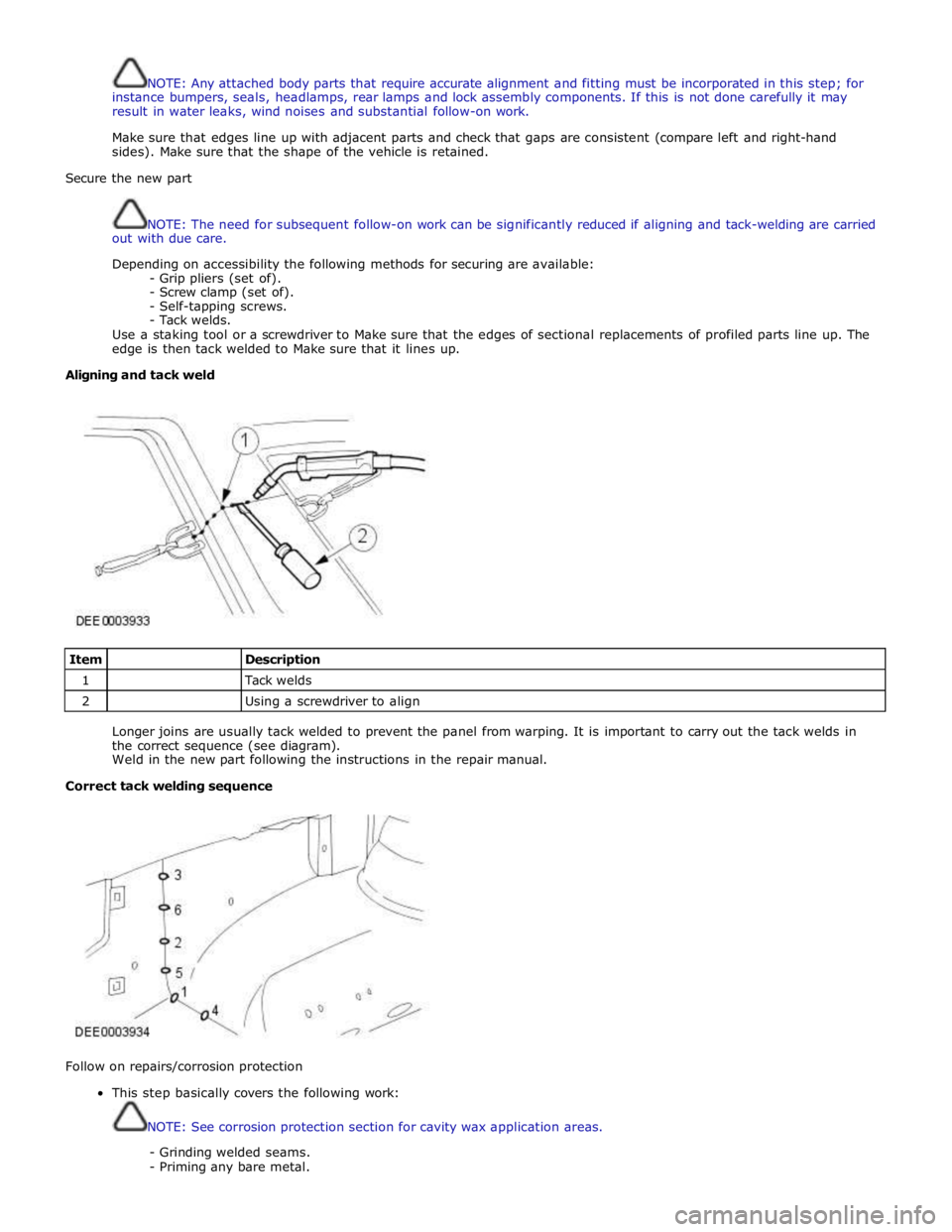
Aligning and tack weld
Item
Description 1
Tack welds 2
Using a screwdriver to align
Longer joins are usually tack welded to prevent the panel from warping. It is important to carry out the tack welds in
the correct sequence (see diagram).
Weld in the new part following the instructions in the repair manual.
Correct tack welding sequence
Follow on repairs/corrosion protection
This step basically covers the following work:
NOTE: See corrosion protection section for cavity wax application areas.
- Grinding welded seams.
- Priming any bare metal.
Page 2739 of 3039
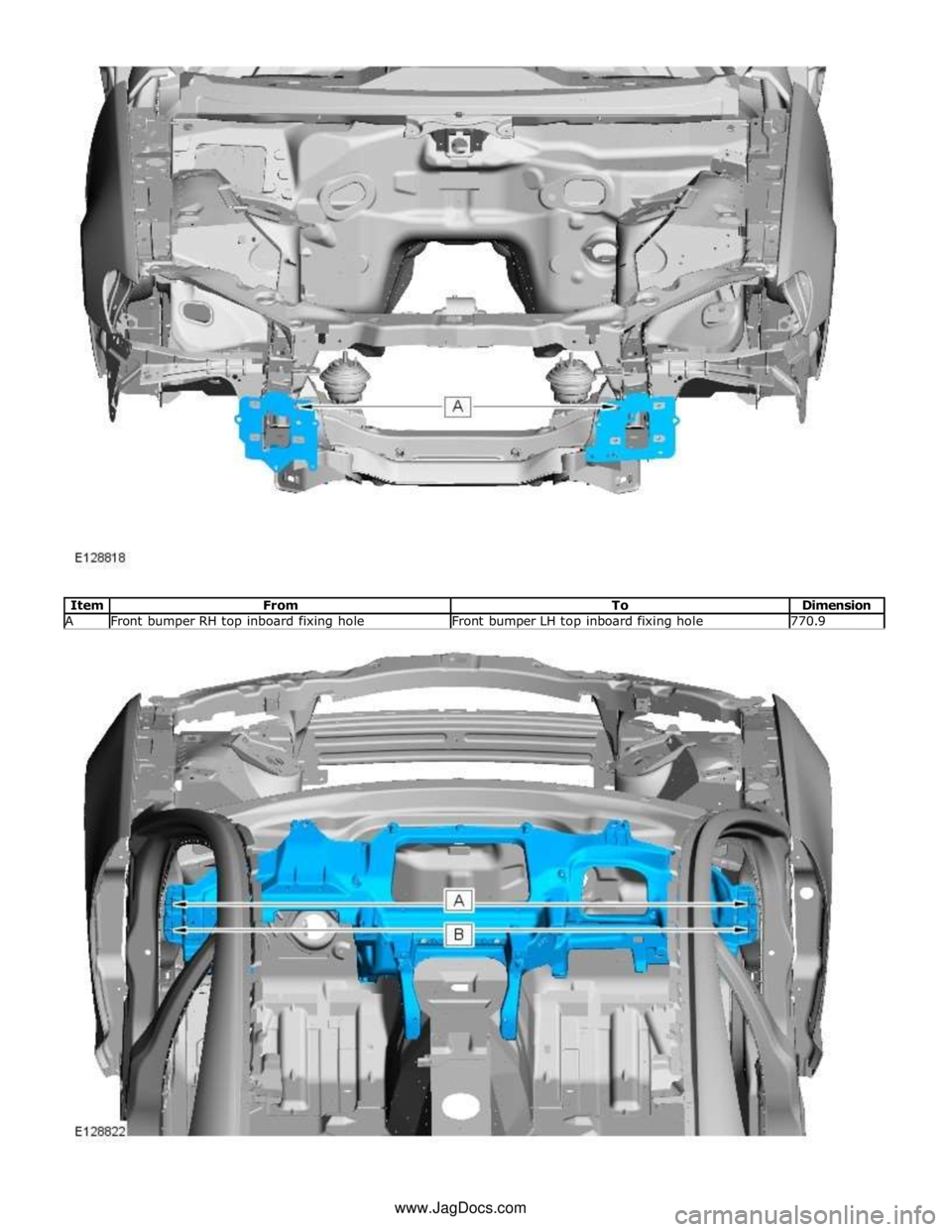
Item From To Dimension A Front bumper RH top inboard fixing hole Front bumper LH top inboard fixing hole 770.9 www.JagDocs.com
Page 2743 of 3039
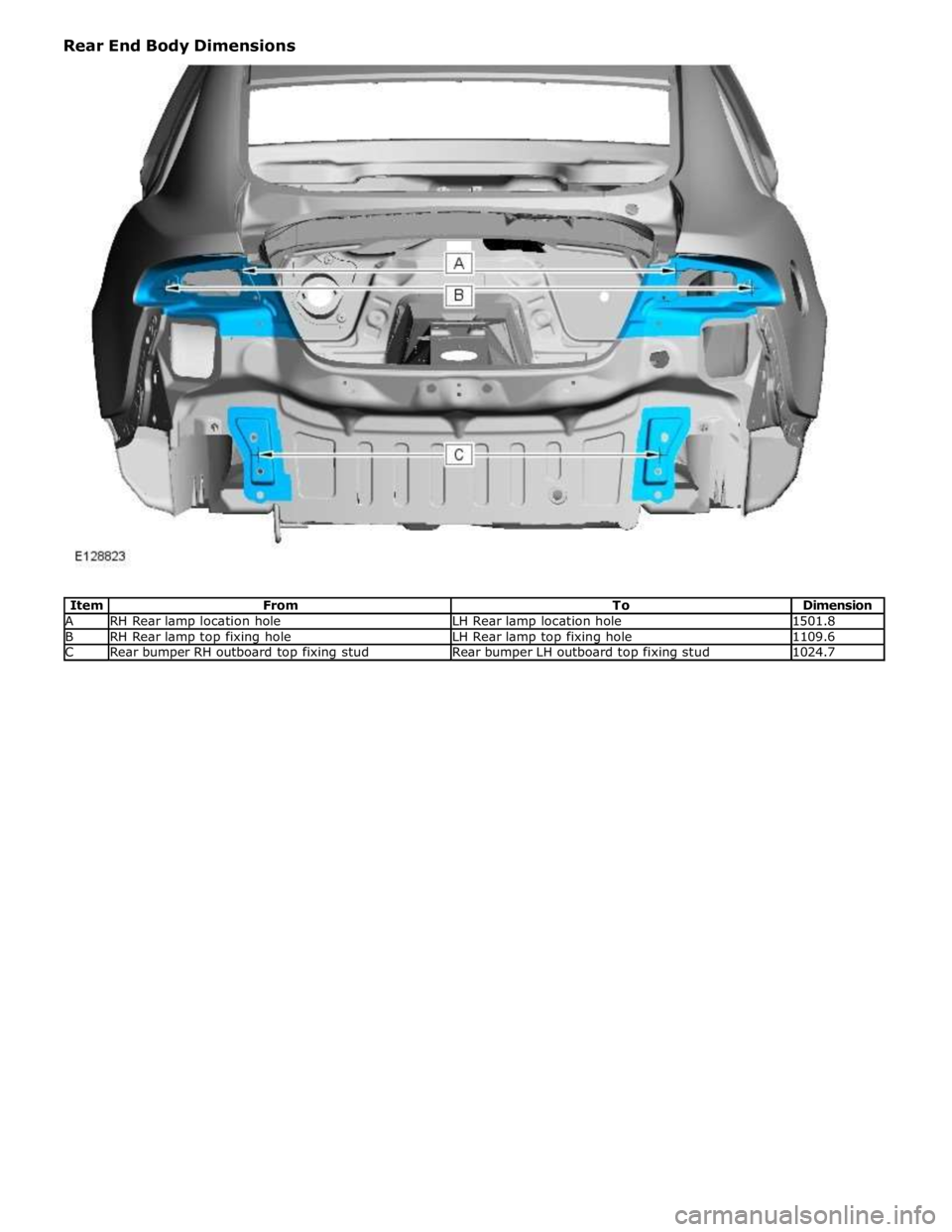
A RH Rear lamp location hole LH Rear lamp location hole 1501.8 B RH Rear lamp top fixing hole LH Rear lamp top fixing hole 1109.6 C Rear bumper RH outboard top fixing stud Rear bumper LH outboard top fixing stud 1024.7
Page 2747 of 3039
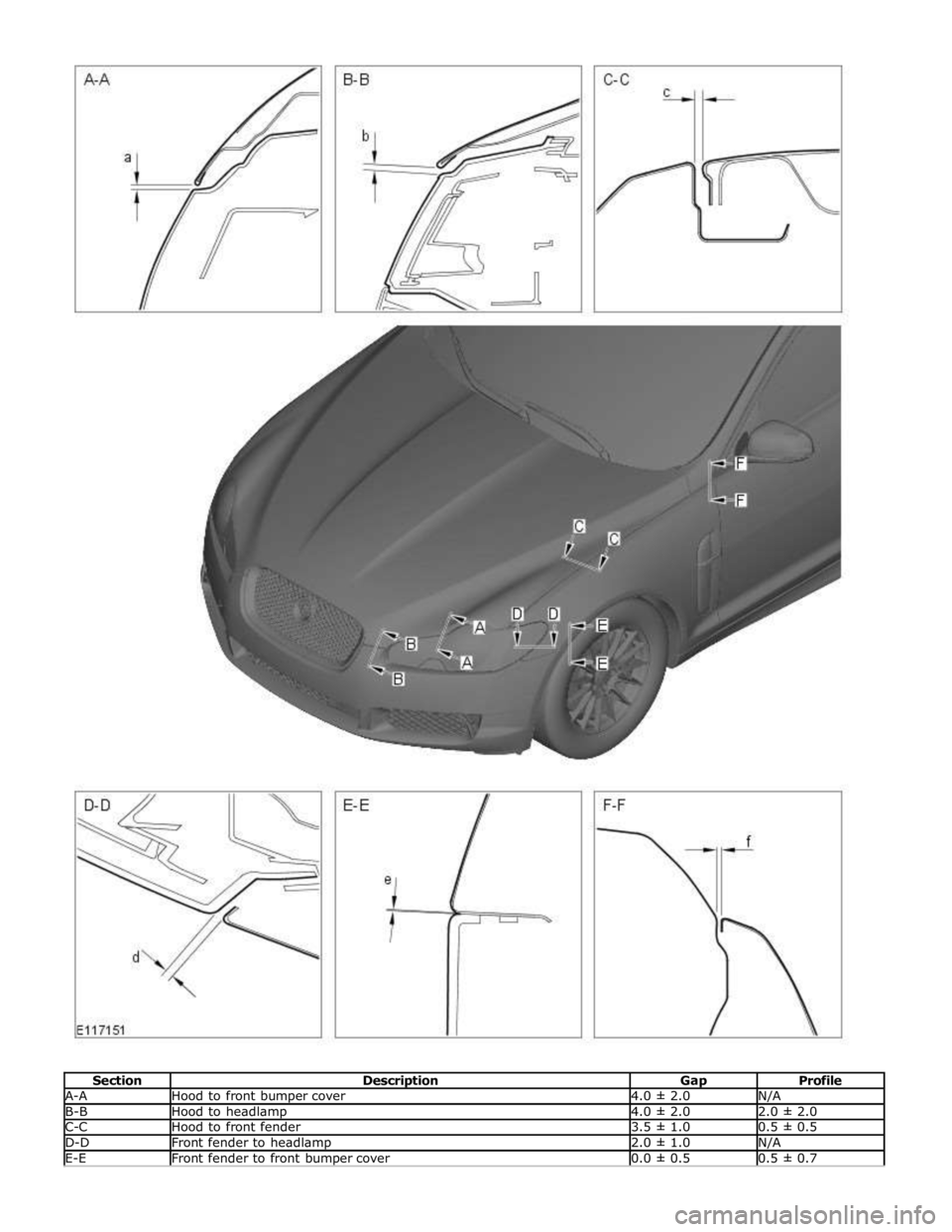
A-A Hood to front bumper cover 4.0 ± 2.0 N/A B-B Hood to headlamp 4.0 ± 2.0 2.0 ± 2.0 C-C Hood to front fender 3.5 ± 1.0 0.5 ± 0.5 D-D Front fender to headlamp 2.0 ± 1.0 N/A E-E Front fender to front bumper cover 0.0 ± 0.5 0.5 ± 0.7
Page 2748 of 3039
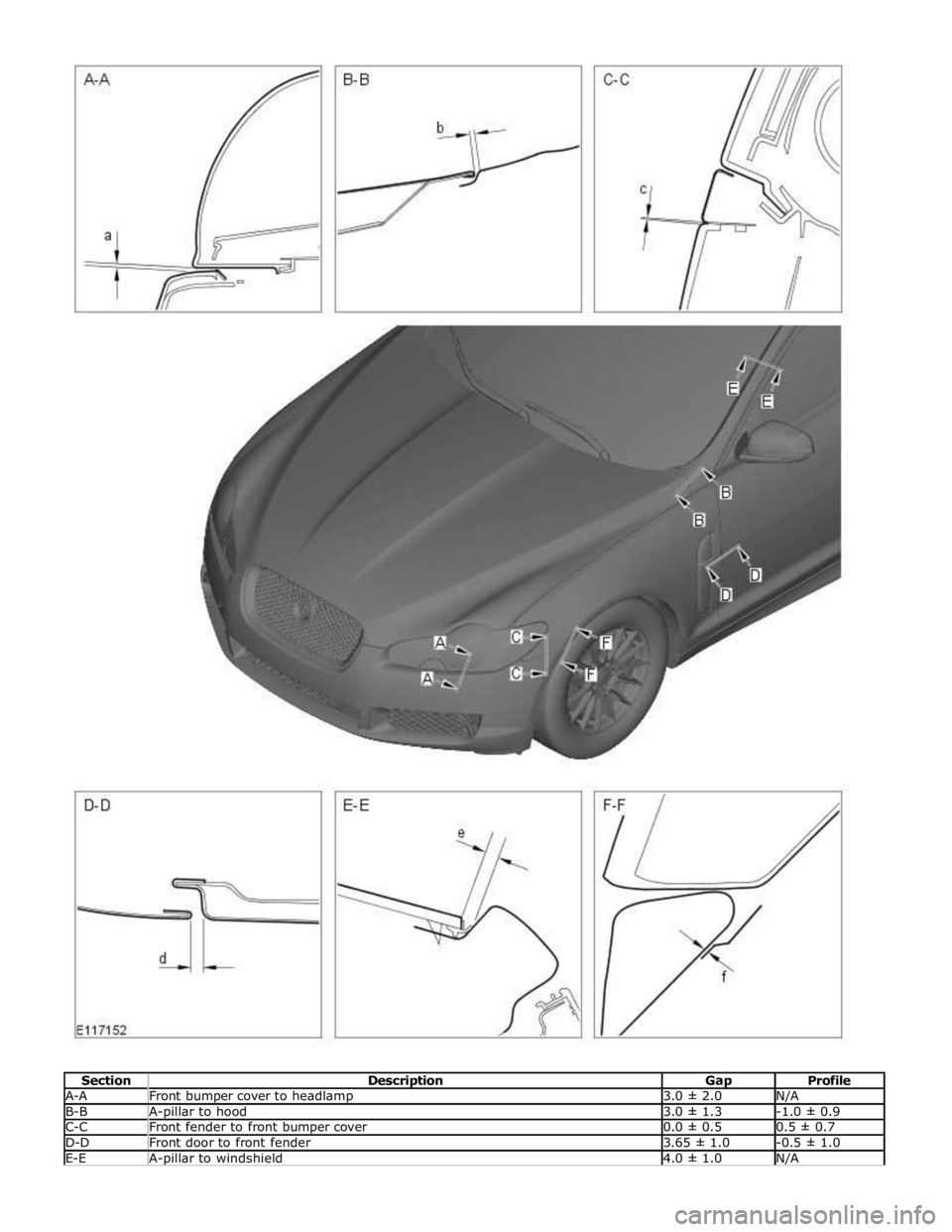
A-A Front bumper cover to headlamp 3.0 ± 2.0 N/A B-B A-pillar to hood 3.0 ± 1.3 -1.0 ± 0.9 C-C Front fender to front bumper cover 0.0 ± 0.5 0.5 ± 0.7 D-D Front door to front fender 3.65 ± 1.0 -0.5 ± 1.0 E-E A-pillar to windshield 4.0 ± 1.0 N/A
Page 2749 of 3039
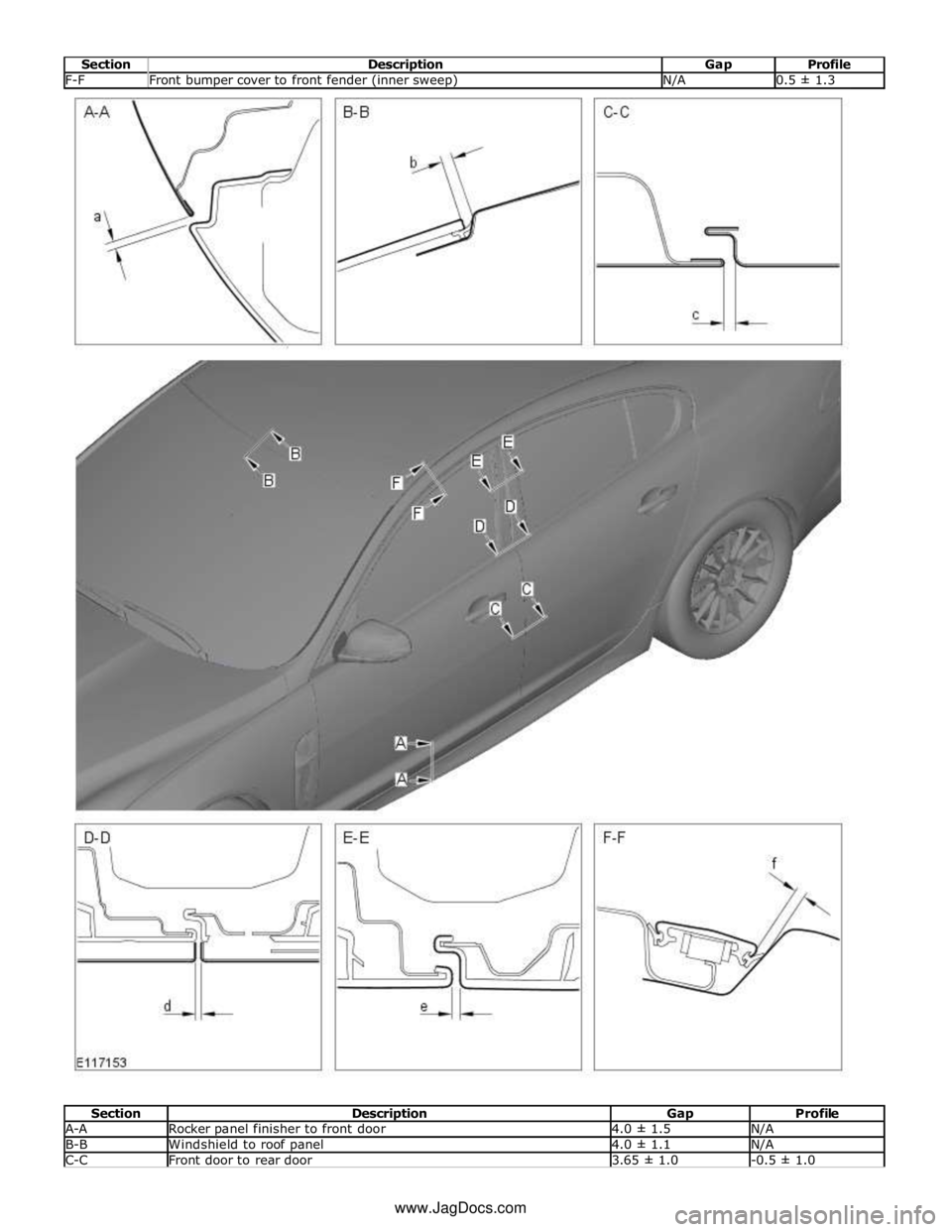
Section Description Gap Profile F-F Front bumper cover to front fender (inner sweep) N/A 0.5 ± 1.3
Section Description Gap Profile A-A Rocker panel finisher to front door 4.0 ± 1.5 N/A B-B Windshield to roof panel 4.0 ± 1.1 N/A C-C Front door to rear door 3.65 ± 1.0 -0.5 ± 1.0 www.JagDocs.com
Page 2752 of 3039
B-B Rear lamp to rear bumper cover 2.0 ± 0.9 -2.0 ± 1.5 C-C Rear lamp to rear quarter upper 2.0 ± 0.9 -2.0 ± 1.5 D-D Luggage compartment lid to rear bumper cover 6.0 ± 1.7 N/A E-E Luggage compartment lid to quarter panel 3.5 ± 1.1 0.5 ± 0.5 F-F Rear lamp to rear bumper cover 2.0 ± 0.8 -2.0 ± 1.8