2010 CHEVROLET IMPALA lock
[x] Cancel search: lockPage 253 of 432

Winter DrivingDriving on Snow or IceDrive carefully when there is snow or ice between the
tires and the road, creating less traction or grip. Wet ice
can occur at about 0°C (32°F) when freezing rain
begins to fall, resulting in even less traction. Avoid
driving on wet ice or in freezing rain until roads can be
treated with salt or sand.
Drive with caution, whatever the condition. Accelerate
gently so traction is not lost. Accelerating too quickly
causes the wheels to spin and makes the surface under
the tires slick, so there is even less traction.
Try not to break the fragile traction. If you accelerate too
fast, the drive wheels will spin and polish the surface
under the tires even more.If the vehicle has theTraction Control System (TCS) on
page 5-7, it improves the ability to accelerate on
slippery roads, but slow down and adjust your driving to
the road conditions. When driving through deep snow,
turn off the traction control system to help maintain
vehicle motion at lower speeds.
TheAntilock Brake System (ABS) on page 5-5improves
vehicle stability during hard stops on a slippery roads,
but apply the brakes sooner than when on dry
pavement.
Allow greater following distance on any slippery road
and watch for slippery spots. Icy patches can occur on
otherwise clear roads in shaded areas. The surface
of a curve or an overpass can remain icy when
the surrounding roads are clear. Avoid sudden steering
maneuvers and braking while on ice.
Turn off cruise control, if equipped, on slippery surfaces.
5-17
Page 254 of 432
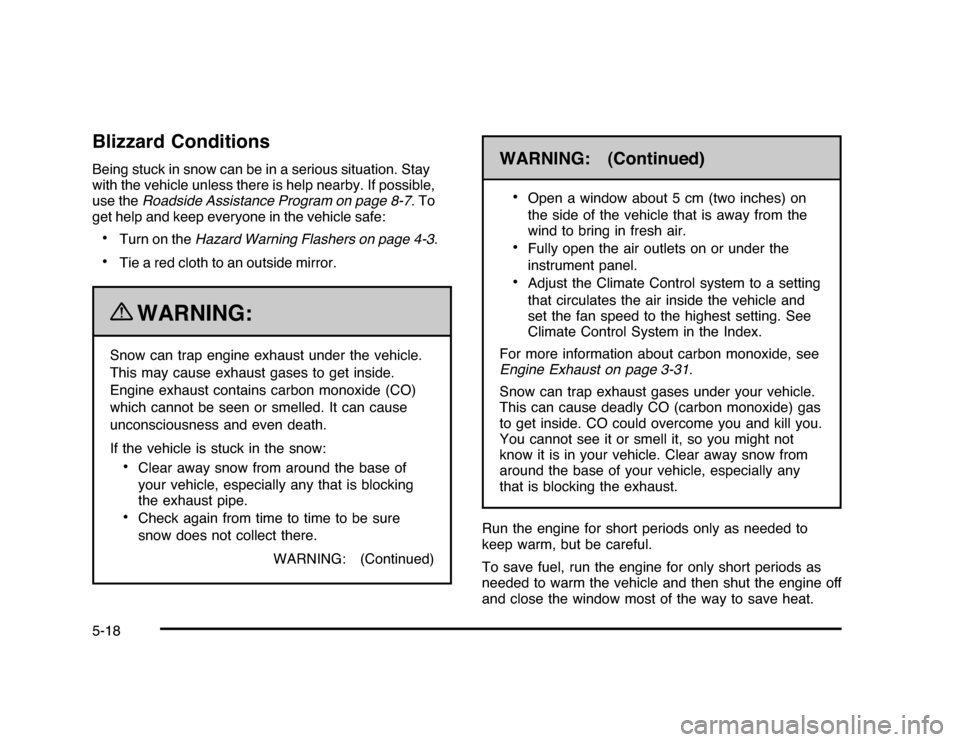
Blizzard ConditionsBeing stuck in snow can be in a serious situation. Stay
with the vehicle unless there is help nearby. If possible,
use theRoadside Assistance Program on page 8-7.To
get help and keep everyone in the vehicle safe:•
Turn on theHazard Warning Flashers on page 4-3.
•
Tie a red cloth to an outside mirror.{
WARNING:
Snow can trap engine exhaust under the vehicle.
This may cause exhaust gases to get inside.
Engine exhaust contains carbon monoxide (CO)
which cannot be seen or smelled. It can cause
unconsciousness and even death.
If the vehicle is stuck in the snow:
•
Clear away snow from around the base of
your vehicle, especially any that is blocking
the exhaust pipe.
•
Check again from time to time to be sure
snow does not collect there.
WARNING: (Continued)
WARNING: (Continued)
•
Open a window about 5 cm (two inches) on
the side of the vehicle that is away from the
wind to bring in fresh air.
•
Fully open the air outlets on or under the
instrument panel.
•
Adjust the Climate Control system to a setting
that circulates the air inside the vehicle and
set the fan speed to the highest setting. See
Climate Control System in the Index.
For more information about carbon monoxide, see
Engine Exhaust on page 3-31.
Snow can trap exhaust gases under your vehicle.
This can cause deadly CO (carbon monoxide) gas
to get inside. CO could overcome you and kill you.
You cannot see it or smell it, so you might not
know it is in your vehicle. Clear away snow from
around the base of your vehicle, especially any
that is blocking the exhaust.
Run the engine for short periods only as needed to
keep warm, but be careful.
To save fuel, run the engine for only short periods as
needed to warm the vehicle and then shut the engine off
and close the window most of the way to save heat.
5-18
Page 257 of 432

Tire and Loading Information LabelA vehicle specific Tire and Loading Information
label is attached to the vehicle’s center pillar
(B-pillar). With the driver door open, you will find the
label attached below the door lock post (striker).The Tire and Loading Information label lists the
number of occupant seating positions (A), and the
maximum vehicle capacity weight (B) in kilograms
and pounds. The vehicle capacity weight includes
the weight of all occupants, cargo, and all
nonfactory-installed options.
The Tire and Loading Information label also lists the
tire size of the original equipment tires (C) and the
recommended cold tire inflation pressures (D). For
more information on tires and inflation, seeTires on
page 6-51andInflation - Tire Pressure on
page 6-59.
There is also important loading information on the
Certification label. It tells you the Gross Vehicle
Weight Rating (GVWR) and the Gross Axle Weight
Rating (GAWR) for the front and rear axle, see
“Certification Label” later in this section.
Label Example
5-21
Page 263 of 432

Dinghy TowingNotice:If the vehicle is towed with all four wheels
on the ground, the drivetrain components could
be damaged. The repairs would not be covered by
the vehicle warranty. Do not tow the vehicle with all
four wheels on the ground.
The vehicle was not designed to be towed with all four
wheels on the ground. If the vehicle must be towed,
a dolly should be used. See “Dolly Towing” that follows
for more information.
Dolly TowingUse the following procedure to dolly tow the vehicle
from the front:
1. Attach the dolly to the tow vehicle following the
dolly manufacturer’s instructions.
2. Drive the front wheels onto the dolly.
3. Shift the transmission to P (Park).
4. Firmly set the parking brake.
5. Use an adequate clamping device designed for
towing to ensure that the front wheels are locked
into the straight position.
5-27
Page 264 of 432

6. Secure the vehicle to the dolly following the
manufacturer’s instructions.
7. Release the parking brake only after the vehicle
being towed is firmly attached to the towing
vehicle.
8. Turn the ignition to LOCK/OFF and remove the key.Towing a Trailer
{
WARNING:
The driver can lose control when pulling a trailer if
the correct equipment is not used or the vehicle is
not driven properly. For example, if the trailer is
too heavy, the brakes may not work well — or
even at all. The driver and passengers could be
seriously injured. The vehicle may also be
damaged; the resulting repairs would not be
covered by the vehicle warranty. Pull a trailer only
if all the steps in this section have been followed.
Ask your dealer/retailer for advice and information
about towing a trailer with the vehicle.Notice:Pulling a trailer improperly can damage the
vehicle and result in costly repairs not covered
by the vehicle warranty. To pull a trailer correctly,
follow the advice in this section and see your
dealer/retailer for important information about
towing a trailer with the vehicle.
The vehicle can tow a trailer if it is equipped with the
proper trailer towing equipment. To identify the trailering
capacity of the vehicle, read the information in “Weight of
the Trailer” that appears later in this section. Trailering is
different than just driving the vehicle by itself. Trailering
means changes in handling, acceleration, braking,
durability and fuel economy. Successful, safe trailering
takes correct equipment, and it has to be used properly.
The following information has many time-tested,
important trailering tips and safety rules. Many of these
are important for the safety of the driver and the
passengers. So please read this section carefully before
pulling a trailer.
Load-pulling components such as the engine,
transmission, axles, wheel assemblies and tires are
forced to work harder against the drag of the added
weight. The engine is required to operate at relatively
higher speeds and under greater loads, generating extra
heat. The trailer also adds considerably to wind
resistance, increasing the pulling requirements.
5-28
Page 267 of 432

Total Weight on the Vehicle’s TiresBe sure the vehicle’s tires are inflated to the upper limit
for cold tires. These numbers can be found on the
Certification/Tire label. SeeLoading the Vehicle on
page 5-20. Make sure not to go over the GVW limit for the
vehicle, including the weight of the trailer tongue.HitchesIt is important to have the correct hitch equipment.
Crosswinds, large trucks going by and rough roads are
a few reasons why the right hitch is needed. Here
are some rules to follow:•
The rear bumper on the vehicle is not intended for
hitches. Do not attach rental hitches or other
bumper-type hitches to it. Use only a frame-mounted
hitch that does not attach to the bumper.
•
Will any holes be made in the body of the vehicle
when the trailer hitch is installed? If there are, then
be sure to seal the holes later when the hitch is
removed. If the holes are not sealed, dirt, water, and
deadly carbon monoxide (CO) from the exhaust can
get into the vehicle. SeeEngine Exhaust on
page 3-31in the Index for more information.
Safety ChainsAlways attach chains between the vehicle and the
trailer. Cross the safety chains under the tongue of the
trailer to help prevent the tongue from contacting
the road if it becomes separated from the hitch.
Instructions about safety chains may be provided by the
hitch manufacturer or by the trailer manufacturer.
Follow the manufacturer’s recommendation for attaching
safety chains and do not attach them to the bumper.
Always leave just enough slack so the rig can turn.
Never allow safety chains to drag on the ground.Trailer BrakesBecause the vehicle has antilock brakes, do not try to
tap into the vehicle’s hydraulic brake system. If you
do, both brake systems will not work well, or at all.
Does your trailer have its own brakes? Be sure to read
and follow the instructions for the trailer brakes so
you will be able to install, adjust and maintain them
properly.
5-31
Page 272 of 432

Tire Pressure Monitor System.........................6-60
Tire Pressure Monitor Operation.....................6-62
Tire Inspection and Rotation . ..........................6-65
When It Is Time for New Tires.......................6-67
Buying New Tires.........................................6-68
Different Size Tires and Wheels......................6-69
Uniform Tire Quality Grading..........................6-70
Wheel Alignment and Tire Balance..................6-71
Wheel Replacement......................................6-71
Tire Chains . . . ...............................................6-73
If a Tire Goes Flat........................................6-74
Changing a Flat Tire.....................................6-75
Removing the Spare Tire and Tools................6-76
Removing the Flat Tire and Installing the
Spare Tire................................................6-77
Storing a Flat or Spare Tire and Tools................6-83
Compact Spare Tire......................................6-86
Appearance Care............................................6-87
Interior Cleaning...........................................6-87
Fabric/Carpet . ..............................................6-88
Leather.......................................................6-89
Instrument Panel, Vinyl, and Other Plastic
Surfaces . . . ...............................................6-90
Care of Safety Belts......................................6-90Weatherstrips...............................................6-90
Washing Your Vehicle...................................6-91
Cleaning Exterior Lamps/Lenses . . ...................6-91
Finish Care..................................................6-92
Windshield and Wiper Blades.........................6-92
Aluminum Wheels.........................................6-93
Tires...........................................................6-93
Sheet Metal Damage.....................................6-94
Finish Damage.............................................6-94
Underbody Maintenance................................6-94
Chemical Paint Spotting.................................6-94
Vehicle Identification......................................6-95
Vehicle Identification Number (VIN).................6-95
Service Parts Identification Label . . ...................6-95
Electrical System............................................6-95
Add-On Electrical Equipment..........................6-95
Headlamp Wiring..........................................6-96
Windshield Wiper Fuses................................6-96
Power Windows and Other Power Options.......6-96
Fuses and Circuit Breakers . . . . . .......................6-96
Instrument Panel Fuse Block..........................6-96
Underhood Fuse Block..................................6-97
Capacities and Specifications........................6-100
Section 6 Service and Appearance Care
6-2
Page 273 of 432

ServiceFor service and parts needs, visit your dealer/retailer.
You will receive genuine GM parts and GM-trained and
supported service people.
Genuine GM parts have one of these marks:
Accessories and ModificationsWhen non-dealer/non-retailer accessories are added to
the vehicle, they can affect vehicle performance and
safety, including such things as airbags, braking, stability,
ride and handling, emissions systems, aerodynamics,
durability, and electronic systems like antilock brakes,
traction control, and stability control. Some of these
accessories could even cause malfunction or damage
not covered by the vehicle warranty.
Damage to vehicle components resulting from the
installation or use of non-GM certified parts, including
control module modifications, is not covered under
the terms of the vehicle warranty and may affect
remaining warranty coverage for affected parts.
GM Accessories are designed to complement and
function with other systems on the vehicle. Your GM
dealer/retailer can accessorize the vehicle using
genuine GM Accessories. When you go to your GM
dealer/retailer and ask for GM Accessories, you
will know that GM-trained and supported service
technicians will perform the work using genuine GM
Accessories.
Also, seeAdding Equipment to Your Airbag-Equipped
Vehicle on page 2-73.
6-3