Page 347 of 432
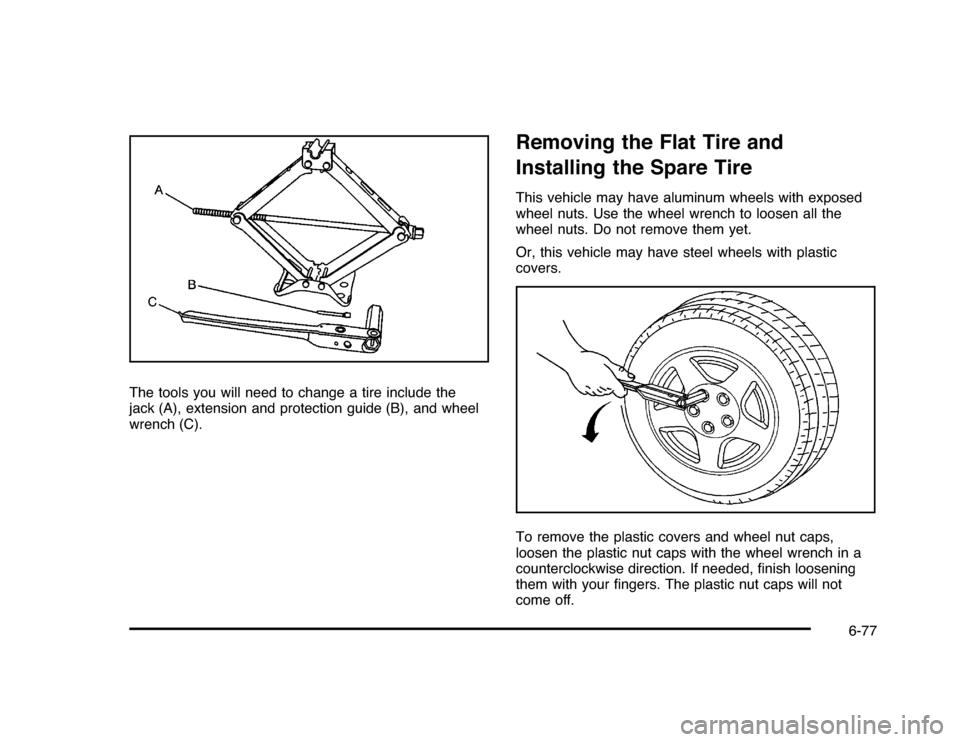
The tools you will need to change a tire include the
jack (A), extension and protection guide (B), and wheel
wrench (C).
Removing the Flat Tire and
Installing the Spare TireThis vehicle may have aluminum wheels with exposed
wheel nuts. Use the wheel wrench to loosen all the
wheel nuts. Do not remove them yet.
Or, this vehicle may have steel wheels with plastic
covers.
To remove the plastic covers and wheel nut caps,
loosen the plastic nut caps with the wheel wrench in a
counterclockwise direction. If needed, finish loosening
them with your fingers. The plastic nut caps will not
come off.
6-77
Page 348 of 432
If needed, use the flat end of the wheel wrench and pry
along the edge of the cover until it comes off. The edge of
the wheel cover could be sharp, so do not try to remove it
with your bare hands. Do not drop the cover or lay it face
down, as it could become scratched or damaged. Store
the wheel cover in the trunk until the flat tire is repaired or
replaced.
Once you have removed the wheel cover, use the
following procedure to remove the flat tire and install the
spare tire.
1. Do a safety check before proceeding. SeeChanging
a Flat Tire on page 6-75
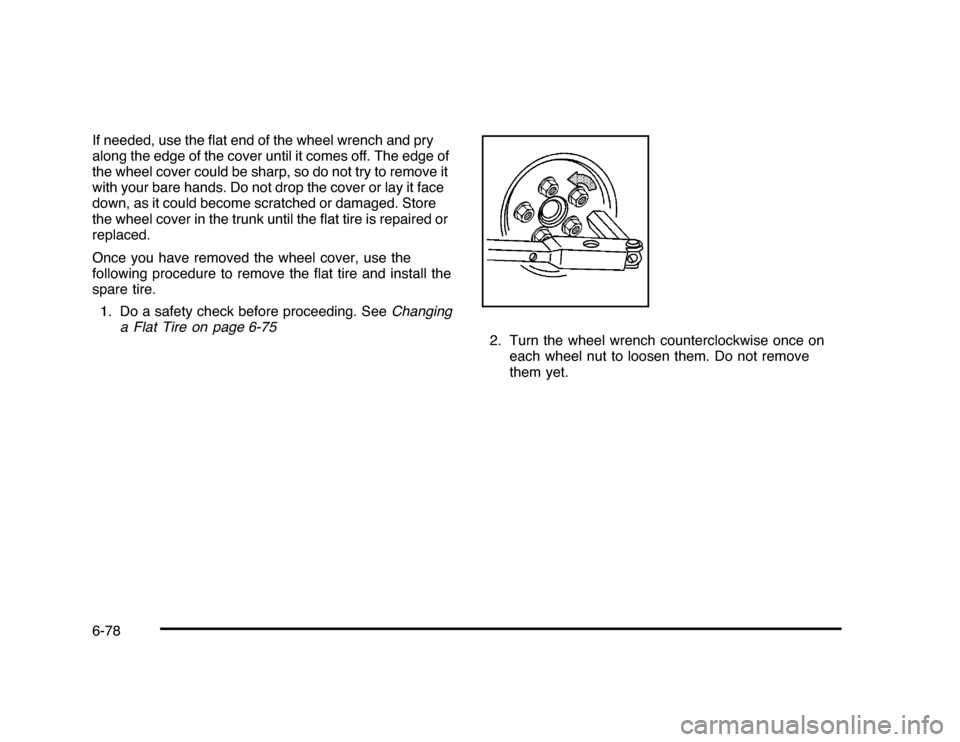
2. Turn the wheel wrench counterclockwise once on
each wheel nut to loosen them. Do not remove
them yet.6-78
Page 350 of 432
{
WARNING:
Lifting a vehicle and getting under it to do
maintenance or repairs is dangerous without the
appropriate safety equipment and training. If a jack
is provided with the vehicle, it is designed only for
changing a flat tire. If it is used for anything else,
you or others could be badly injured or killed if the
vehicle slips off the jack. If a jack is provided with
the vehicle, only use it for changing a flat tire.
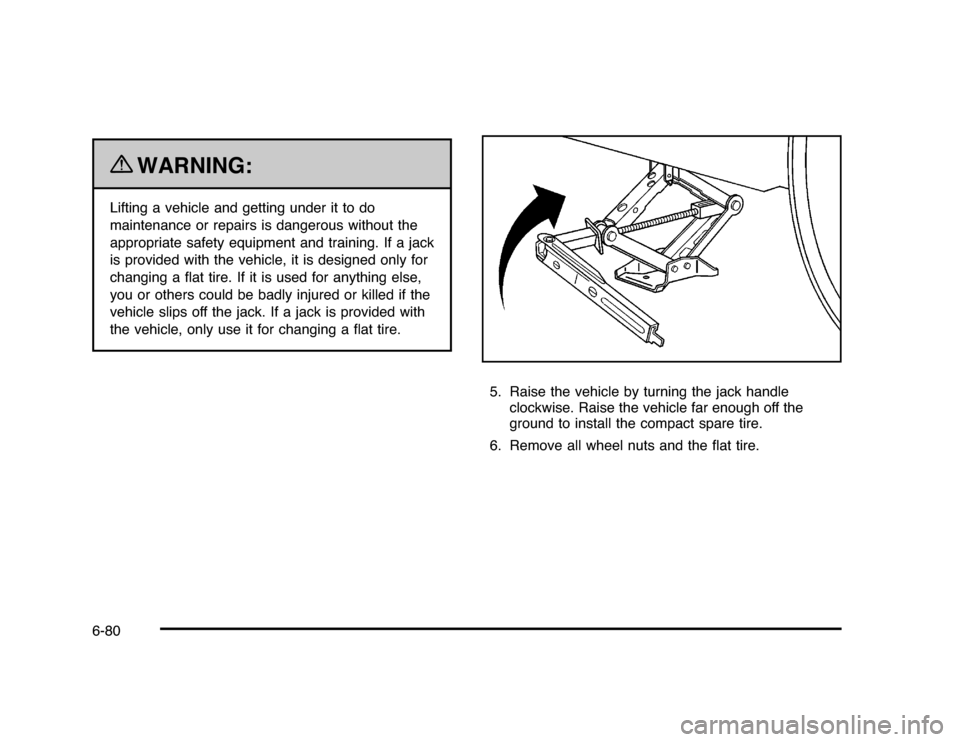
5. Raise the vehicle by turning the jack handle
clockwise. Raise the vehicle far enough off the
ground to install the compact spare tire.
6. Remove all wheel nuts and the flat tire.
6-80
Page 351 of 432
{
WARNING:
Rust or dirt on a wheel, or on the parts to which it is
fastened, can make wheel nuts become loose after
time. The wheel could come off and cause an
accident. When changing a wheel, remove any rust
or dirt from places where the wheel attaches to the
vehicle. In an emergency, use a cloth or a paper
towel to do this; but be sure to use a scraper or wire
brush later, if needed, to get all the rust or dirt off.
SeeChanging a Flat Tire on page 6-75.
7. Remove any rust or dirt
from the wheel bolts,
mounting surfaces, and
spare wheel.
8. Install the compact spare tire.
{
WARNING:
Never use oil or grease on bolts or nuts because
the nuts might come loose. The vehicle’s wheel
could fall off, causing a crash.
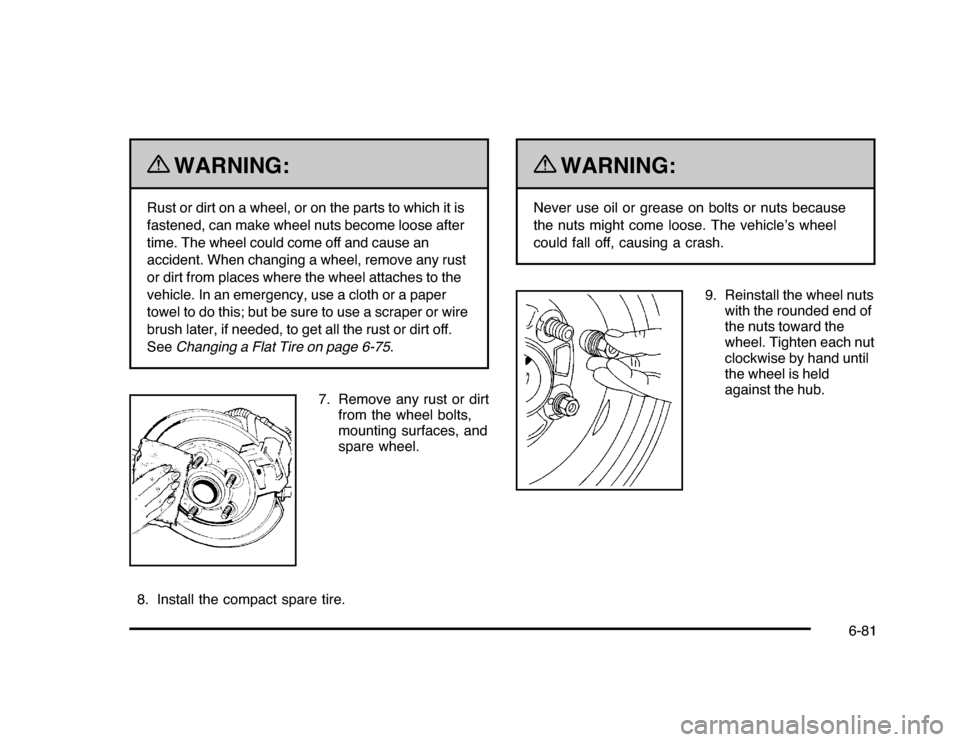
9. Reinstall the wheel nuts
with the rounded end of
the nuts toward the
wheel. Tighten each nut
clockwise by hand until
the wheel is held
against the hub.
6-81
Page 352 of 432
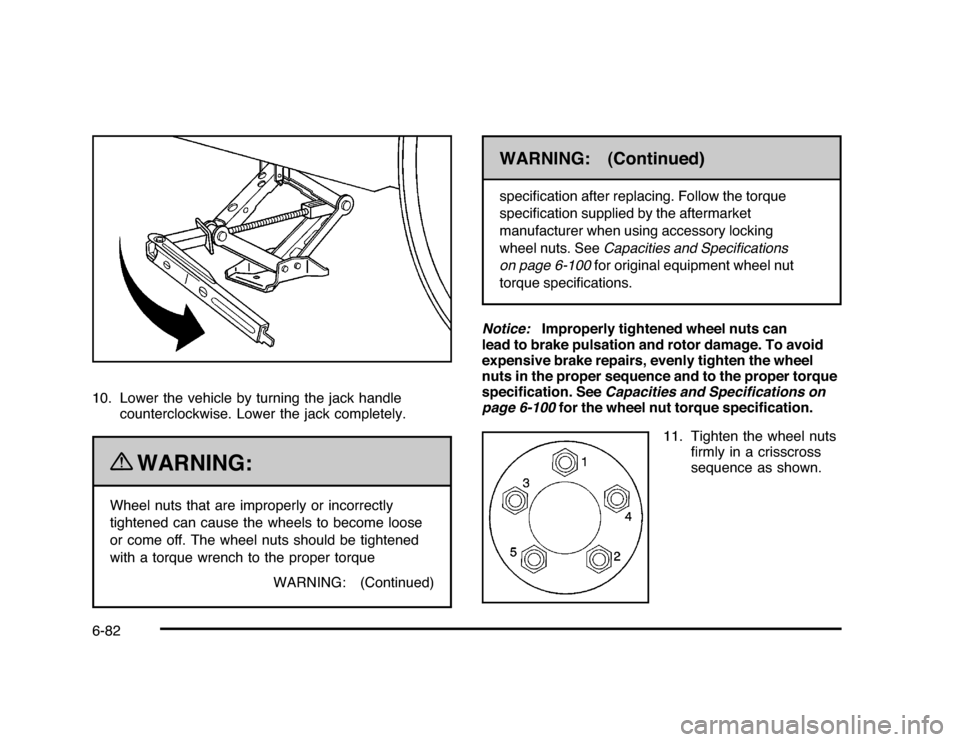
10. Lower the vehicle by turning the jack handle
counterclockwise. Lower the jack completely.
{
WARNING:
Wheel nuts that are improperly or incorrectly
tightened can cause the wheels to become loose
or come off. The wheel nuts should be tightened
with a torque wrench to the proper torque
WARNING: (Continued)
WARNING: (Continued)specification after replacing. Follow the torque
specification supplied by the aftermarket
manufacturer when using accessory locking
wheel nuts. SeeCapacities and Specifications
on page 6-100for original equipment wheel nut
torque specifications.
Notice:Improperly tightened wheel nuts can
lead to brake pulsation and rotor damage. To avoid
expensive brake repairs, evenly tighten the wheel
nuts in the proper sequence and to the proper torque
specification. SeeCapacities and Specifications on
page 6-100for the wheel nut torque specification.
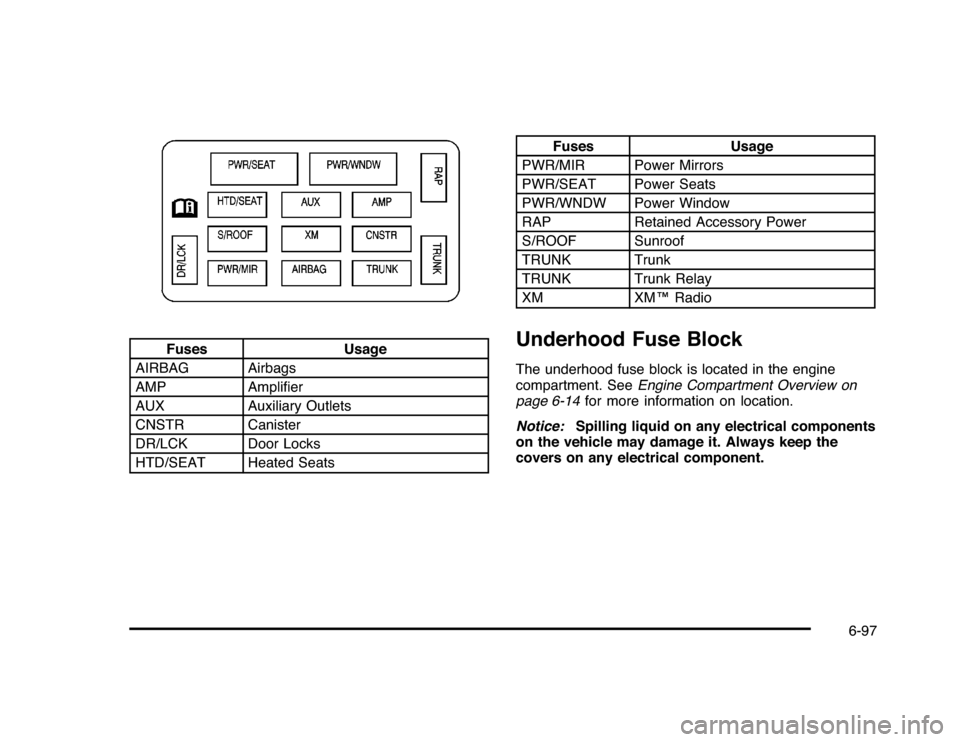
11. Tighten the wheel nuts
firmly in a crisscross
sequence as shown.
6-82
Page 366 of 432
Headlamp WiringThe headlamp wiring is protected by fuses in the fuse
block. An electrical overload will cause the lamps to turn
off. If this happens, have the headlamp wiring checked
right away.Windshield Wiper FusesThe windshield wiper motor is protected by a fuse. If the
motor overheats due to heavy snow, etc., the wiper
will stop until the motor cools. If the overload is caused
by some electrical problem, have it fixed.Power Windows and Other Power
OptionsCircuit breakers in the instrument panel fuse panel
protect the power windows and other power accessories.
When the current load is too heavy, the circuit breaker
opens and closes, protecting the circuit until the
problem is fixed.Fuses and Circuit BreakersThe wiring circuits in the vehicle are protected from
short circuits by a combination of fuses and circuit
breakers. This greatly reduces the chance of fires
caused by electrical problems.Look at the silver-colored band inside the fuse. If the
band is broken or melted, replace the fuse. Be sure you
replace a bad fuse with a new one of the identical
size and rating.
Instrument Panel Fuse BlockThe fuse block is located on the passenger side of
the vehicle in the carpet molding. Remove the fuse
block door to access the fuses.
6-96
Page 367 of 432
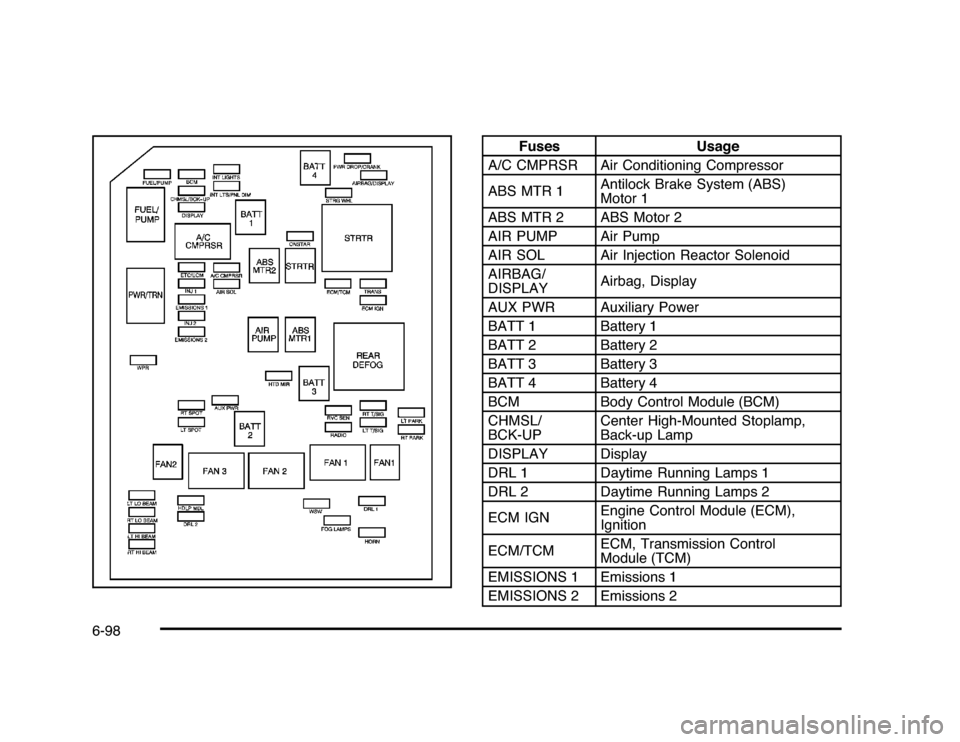
Fuses Usage
AIRBAG Airbags
AMP Amplifier
AUX Auxiliary Outlets
CNSTR Canister
DR/LCK Door Locks
HTD/SEAT Heated Seats
Fuses Usage
PWR/MIR Power Mirrors
PWR/SEAT Power Seats
PWR/WNDW Power Window
RAP Retained Accessory Power
S/ROOF Sunroof
TRUNK Trunk
TRUNK Trunk Relay
XM XM™ Radio
Underhood Fuse BlockThe underhood fuse block is located in the engine
compartment. SeeEngine Compartment Overview on
page 6-14for more information on location.
Notice:Spilling liquid on any electrical components
on the vehicle may damage it. Always keep the
covers on any electrical component.
6-97
Page 368 of 432
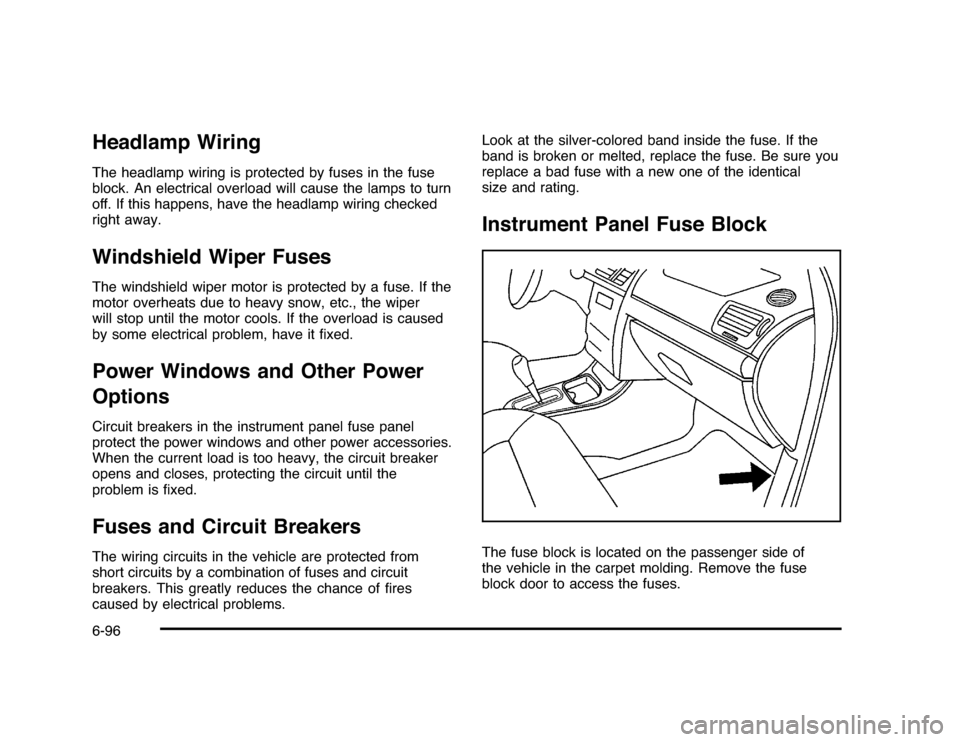
Fuses Usage
A/C CMPRSR Air Conditioning Compressor
ABS MTR 1Antilock Brake System (ABS)
Motor 1
ABS MTR 2 ABS Motor 2
AIR PUMP Air Pump
AIR SOL Air Injection Reactor Solenoid
AIRBAG/
DISPLAYAirbag, Display
AUX PWR Auxiliary Power
BATT 1 Battery 1
BATT 2 Battery 2
BATT 3 Battery 3
BATT 4 Battery 4
BCM Body Control Module (BCM)
CHMSL/
BCK-UPCenter High-Mounted Stoplamp,
Back-up Lamp
DISPLAY Display
DRL 1 Daytime Running Lamps 1
DRL 2 Daytime Running Lamps 2
ECM IGNEngine Control Module (ECM),
Ignition
ECM/TCMECM, Transmission Control
Module (TCM)
EMISSIONS 1 Emissions 1
EMISSIONS 2 Emissions 2
6-98