Page 385 of 472
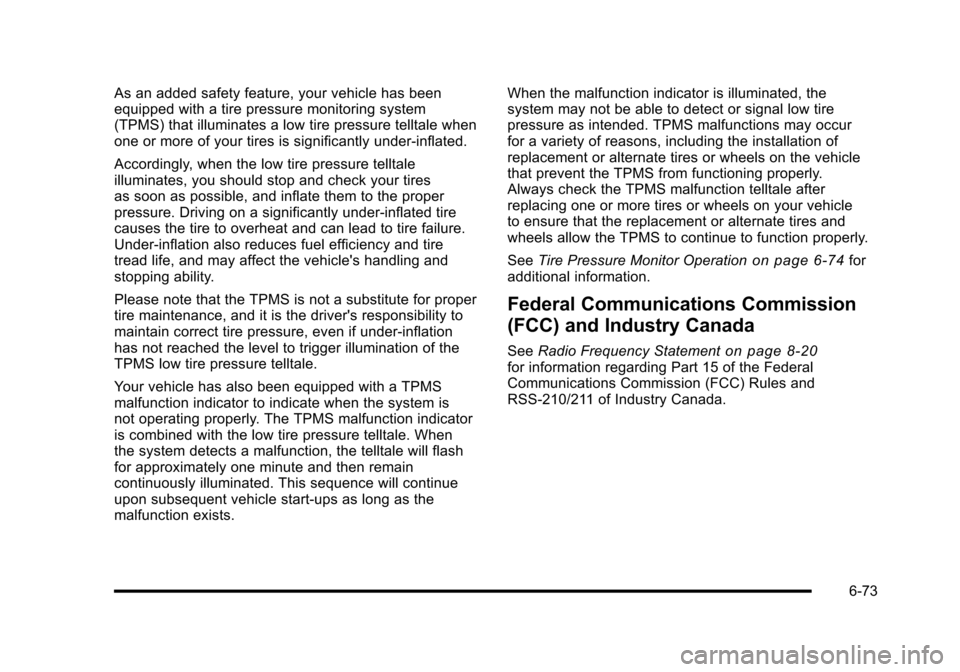
As an added safety feature, your vehicle has been
equipped with a tire pressure monitoring system
(TPMS) that illuminates a low tire pressure telltale when
one or more of your tires is significantly under‐inflated.
Accordingly, when the low tire pressure telltale
illuminates, you should stop and check your tires
as soon as possible, and inflate them to the proper
pressure. Driving on a significantly under‐inflated tire
causes the tire to overheat and can lead to tire failure.
Under‐inflation also reduces fuel efficiency and tire
tread life, and may affect the vehicle's handling and
stopping ability.
Please note that the TPMS is not a substitute for proper
tire maintenance, and it is the driver's responsibility to
maintain correct tire pressure, even if under‐inflation
has not reached the level to trigger illumination of the
TPMS low tire pressure telltale.
Your vehicle has also been equipped with a TPMS
malfunction indicator to indicate when the system is
not operating properly. The TPMS malfunction indicator
is combined with the low tire pressure telltale. When
the system detects a malfunction, the telltale will flash
for approximately one minute and then remain
continuously illuminated. This sequence will continue
upon subsequent vehicle start‐ups as long as the
malfunction exists. When the malfunction indicator is illuminated, the
system may not be able to detect or signal low tire
pressure as intended. TPMS malfunctions may occur
for a variety of reasons, including the installation of
replacement or alternate tires or wheels on the vehicle
that prevent the TPMS from functioning properly.
Always check the TPMS malfunction telltale after
replacing one or more tires or wheels on your vehicle
to ensure that the replacement or alternate tires and
wheels allow the TPMS to continue to function properly.
See
Tire Pressure Monitor Operation
on page 6‑74for
additional information.
Federal Communications Commission
(FCC) and Industry Canada
See Radio Frequency Statementon page 8‑20for information regarding Part 15 of the Federal
Communications Commission (FCC) Rules and
RSS-210/211 of Industry Canada.
6-73
Page 410 of 472
cleaners with acid, or abrasive cleaning brushes on
them because they could damage the surface. Do not
use chrome polish on aluminum wheels.
Notice: Using chrome polish on aluminum wheels
could damage the wheels. The repairs would not be
covered by the vehicle warranty. Use chrome polish
on chrome wheels only.
Use chrome polish only on chrome-plated wheels, but
avoid any painted surface of the wheel, and buff off
immediately after application.
Notice: Driving the vehicle through an automatic
car wash that has silicone carbide tire cleaning
brushes, could damage the aluminum or
chrome-plated wheels. The repairs would not be
covered by the vehicle warranty. Never drive a
vehicle that has aluminum or chrome-plated wheels
through an automatic car wash that uses silicone
carbide tire cleaning brushes.
Tires
To clean the tires, use a stiff brush with tire cleaner.
Notice: Using petroleum-based tire dressing
products on the vehicle may damage the paint finish
and/or tires. When applying a tire dressing, always
wipe off any overspray from all painted surfaces on
the vehicle.
Finish Damage
Any stone chips, fractures or deep scratches in the
finish should be repaired right away. Bare metal will
corrode quickly and may develop into major repair
expense.
Minor chips and scratches can be repaired with
touch-up materials available from your dealer/retailer.
Larger areas of finish damage can be corrected in your
dealer's/retailer's body and paint shop.
Underbody Maintenance
Chemicals used for ice and snow removal and dust
control can collect on the underbody. If these are
not removed, corrosion and rust can develop on the
underbody parts such as fuel lines, frame, floor pan,
and exhaust system even though they have corrosion
protection.
At least every spring, flush these materials from the
underbody with plain water. Clean any areas where
mud and debris can collect. Dirt packed in close areas
of the frame should be loosened before being flushed.
Your dealer/retailer or an underbody car washing
system can do this.
6-98
Page 413 of 472
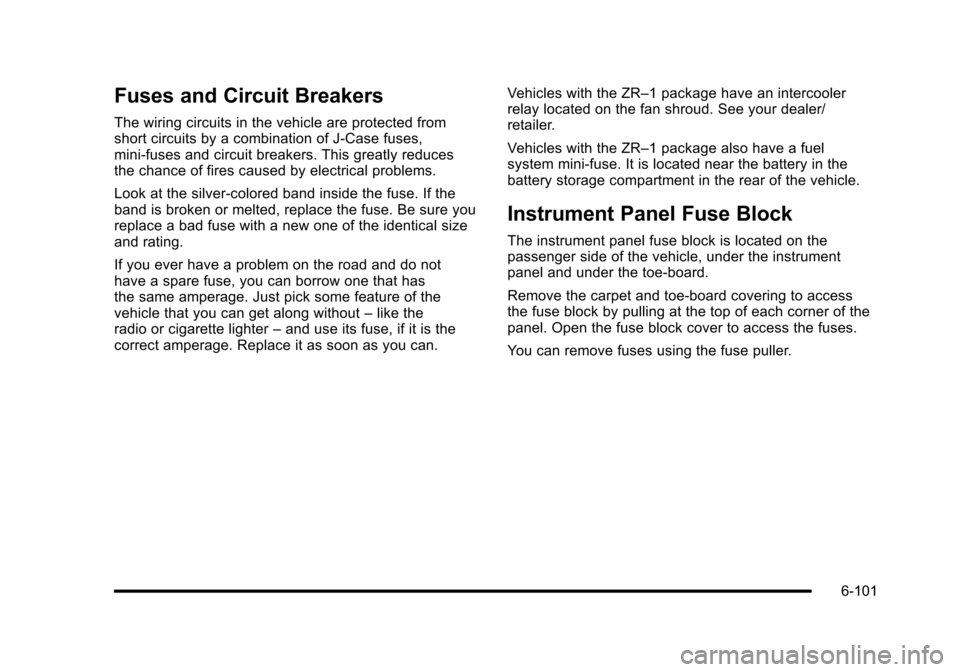
Fuses and Circuit Breakers
The wiring circuits in the vehicle are protected from
short circuits by a combination of J-Case fuses,
mini-fuses and circuit breakers. This greatly reduces
the chance of fires caused by electrical problems.
Look at the silver-colored band inside the fuse. If the
band is broken or melted, replace the fuse. Be sure you
replace a bad fuse with a new one of the identical size
and rating.
If you ever have a problem on the road and do not
have a spare fuse, you can borrow one that has
the same amperage. Just pick some feature of the
vehicle that you can get along without –like the
radio or cigarette lighter –and use its fuse, if it is the
correct amperage. Replace it as soon as you can. Vehicles with the ZR–1 package have an intercooler
relay located on the fan shroud. See your dealer/
retailer.
Vehicles with the ZR–1 package also have a fuel
system mini-fuse. It is located near the battery in the
battery storage compartment in the rear of the vehicle.
Instrument Panel Fuse Block
The instrument panel fuse block is located on the
passenger side of the vehicle, under the instrument
panel and under the toe-board.
Remove the carpet and toe-board covering to access
the fuse block by pulling at the top of each corner of the
panel. Open the fuse block cover to access the fuses.
You can remove fuses using the fuse puller.
6-101
Page 415 of 472
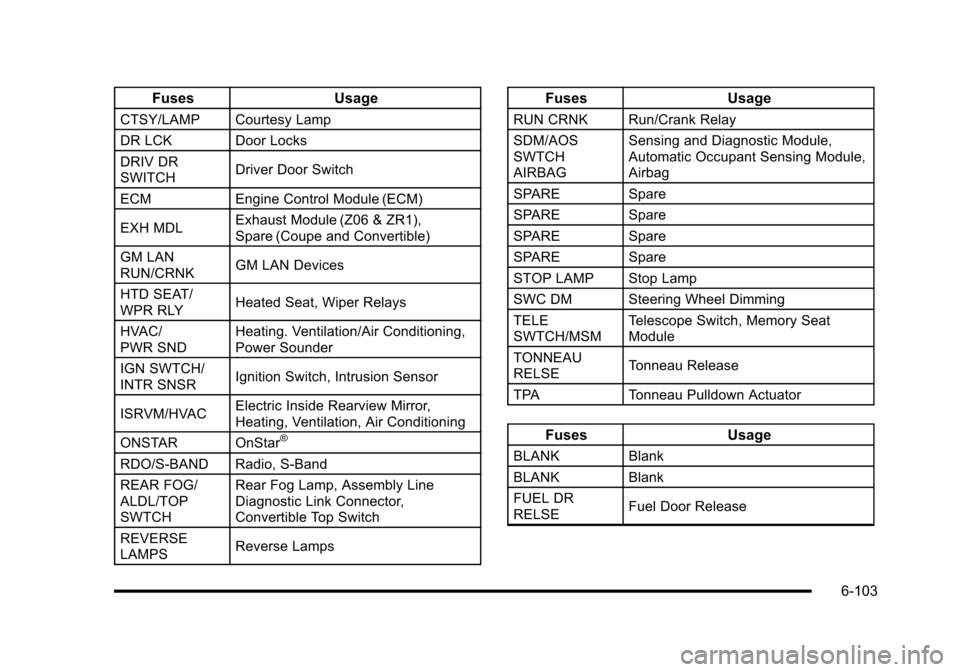
FusesUsage
CTSY/LAMP Courtesy Lamp
DR LCKDoor Locks
DRIV DR
SWITCH Driver Door Switch
ECM Engine Control Module (ECM)
EXH MDL Exhaust Module (Z06 & ZR1),
Spare (Coupe and Convertible)
GM LAN
RUN/CRNK GM LAN Devices
HTD SEAT/
WPR RLY Heated Seat, Wiper Relays
HVAC/
PWR SND Heating. Ventilation/Air Conditioning,
Power Sounder
IGN SWTCH/
INTR SNSR Ignition Switch, Intrusion Sensor
ISRVM/HVAC Electric Inside Rearview Mirror,
Heating, Ventilation, Air Conditioning
ONSTAR OnStar
®
RDO/S‐BAND Radio, S‐Band
REAR FOG/
ALDL/TOP
SWTCH Rear Fog Lamp, Assembly Line
Diagnostic Link Connector,
Convertible Top Switch
REVERSE
LAMPS Reverse Lamps
Fuses
Usage
RUN CRNK Run/Crank Relay
SDM/AOS
SWTCH
AIRBAG Sensing and Diagnostic Module,
Automatic Occupant Sensing Module,
Airbag
SPARE Spare
SPARE Spare
SPARE Spare
SPARE Spare
STOP LAMP Stop Lamp
SWC DM Steering Wheel Dimming
TELE
SWTCH/MSM Telescope Switch, Memory Seat
Module
TONNEAU
RELSE Tonneau Release
TPA Tonneau Pulldown Actuator
Fuses Usage
BLANKBlank
BLANK Blank
FUEL DR
RELSE Fuel Door Release
6-103
Page 416 of 472
FusesUsage
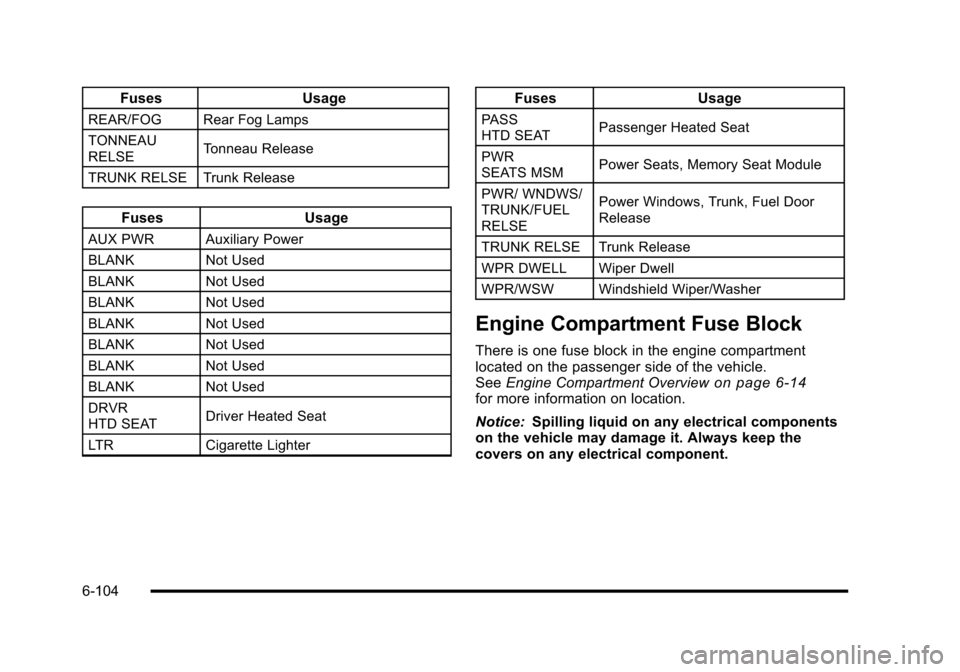
REAR/FOG Rear Fog Lamps
TONNEAU
RELSE Tonneau Release
TRUNK RELSE Trunk Release
Fuses Usage
AUX PWRAuxiliary Power
BLANK Not Used
BLANK Not Used
BLANK Not Used
BLANK Not Used
BLANK Not Used
BLANK Not Used
BLANK Not Used
DRVR
HTD SEAT Driver Heated Seat
LTR Cigarette Lighter
Fuses Usage
PASS
HTD SEAT Passenger Heated Seat
PWR
SEATS MSM Power Seats, Memory Seat Module
PWR/ WNDWS/
TRUNK/FUEL
RELSE Power Windows, Trunk, Fuel Door
Release
TRUNK RELSE Trunk Release
WPR DWELL Wiper Dwell
WPR/WSW Windshield Wiper/Washer
Engine Compartment Fuse Block
There is one fuse block in the engine compartment
located on the passenger side of the vehicle.
See Engine Compartment Overview
on page 6‑14for more information on location.
Notice: Spilling liquid on any electrical components
on the vehicle may damage it. Always keep the
covers on any electrical component.
6-104
Page 417 of 472
For ZR1 models, the Fuel System fuse is located at the
battery. Fuse Usage
1 Transmission Control Module/
Transmission
2 Horn, Alternator Sense
Fuse Usage
3 Antilock Braking System (ABS)/Real
Time Damping
4 Wiper
5 Stoplamps/Back-Up Lamps
6-105
Page 418 of 472
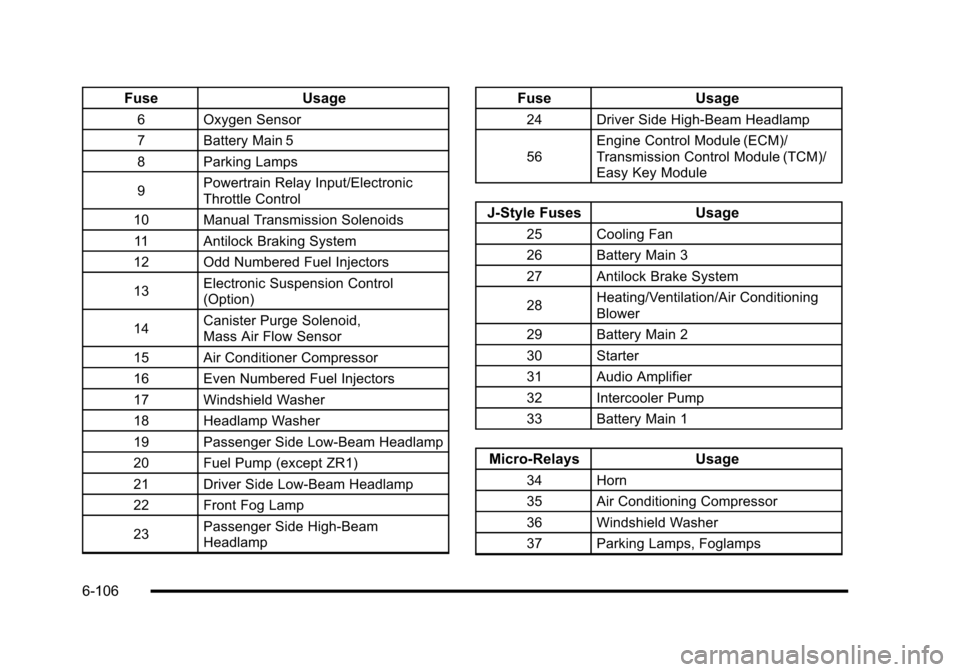
FuseUsage
6Oxygen Sensor
7 Battery Main 5
8 Parking Lamps
9 Powertrain Relay Input/Electronic
Throttle Control
10 Manual Transmission Solenoids
11 Antilock Braking System
12 Odd Numbered Fuel Injectors
13 Electronic Suspension Control
(Option)
14 Canister Purge Solenoid,
Mass Air Flow Sensor
15 Air Conditioner Compressor
16 Even Numbered Fuel Injectors
17 Windshield Washer
18 Headlamp Washer
19 Passenger Side Low-Beam Headlamp
20 Fuel Pump (except ZR1)
21 Driver Side Low-Beam Headlamp
22 Front Fog Lamp
23 Passenger Side High-Beam
Headlamp
Fuse
Usage
24Driver Side High-Beam Headlamp
56 Engine Control Module (ECM)/
Transmission Control Module (TCM)/
Easy Key Module
J-Style Fuses
Usage
25Cooling Fan
26 Battery Main 3
27 Antilock Brake System
28 Heating/Ventilation/Air Conditioning
Blower
29 Battery Main 2
30 Starter
31 Audio Amplifier
32 Intercooler Pump
33 Battery Main 1
Micro-Relays Usage
34Horn
35 Air Conditioning Compressor
36 Windshield Washer
37 Parking Lamps, Foglamps
6-106
Page 419 of 472
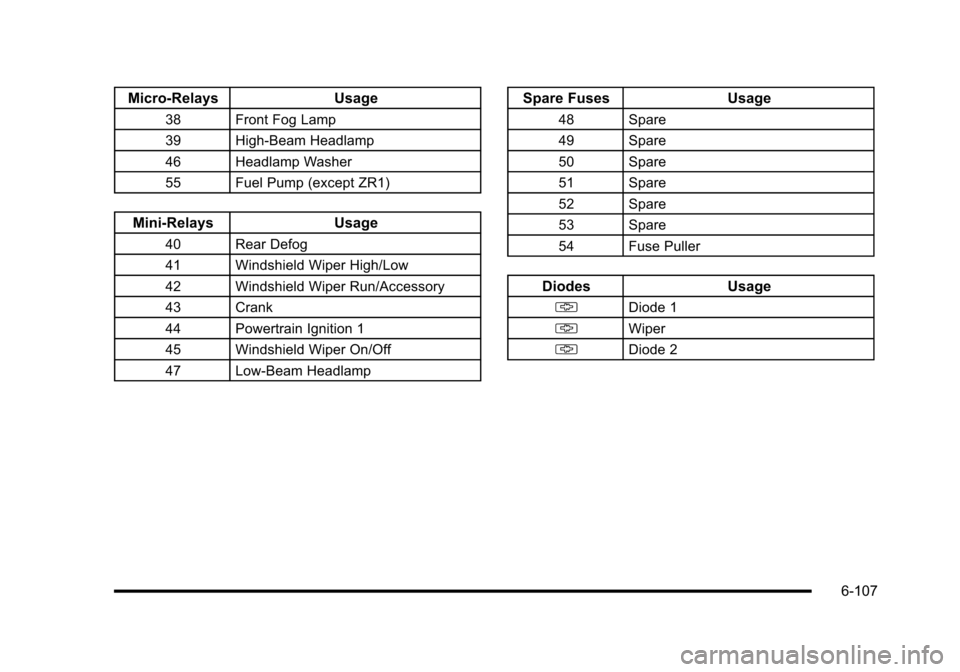
Micro-RelaysUsage
38Front Fog Lamp
39 High-Beam Headlamp
46 Headlamp Washer
55 Fuel Pump (except ZR1)
Mini-Relays Usage
40Rear Defog
41 Windshield Wiper High/Low
42 Windshield Wiper Run/Accessory
43 Crank
44 Powertrain Ignition 1
45 Windshield Wiper On/Off
47 Low-Beam Headlamp
Spare Fuses Usage
48Spare
49 Spare
50 Spare
51 Spare
52 Spare
53 Spare
54 Fuse Puller
Diodes Usage
§ Diode 1
§ Wiper
§ Diode 2
6-107