2009 SUBARU TRIBECA air suspension
[x] Cancel search: air suspensionPage 544 of 2453

LI-11
Headlight Assembly
LIGHTING SYSTEM
10.Headlight Assembly
A: REMOVAL
1) Disconnect the ground cable from battery.
2) Remove the air intake duct.
3) Remove the engine front cover.
4) Disengage the three clips, and then turn over the
mud guard.
5) Remove the three bolts securing the headlight
assembly from the lower side of vehicle.
6) Remove the two bolts and then remove the
headlight assembly.
7) Disconnect the connector and then detach the
rear headlight assembly.
B: INSTALLATION
Install in the reverse order of removal.
C: ADJUSTMENT
1. HEADLIGHT AIMING
NOTE:
Aiming of this headlight can be adjusted only in the
vertical direction. It cannot be adjusted in the hori-
zontal direction.
CAUTION:
Turn off the light before adjusting the headlight
beam level. If it is necessary to inspect the
beam level, do not turn on the lamp for more
than two minutes.
NOTE:
Before checking the headlight beam level, be sure
of the following:
•Check the area around the headlight for any
scratches, damage or other type of deformation.
•Make sure that the vehicle is parked on a level
surface.
•Make sure that the inflation pressure of tires are
correct.
•Check that the vehicle fuel tank is full.
1) Bounce the vehicle several times to normalize
the suspension.
2) Make certain that someone is seated in the driv-
er's seat.
IN-02134
CO-02176
LI-00503
LI-00504
Page 749 of 2453
BR-35
Brake Pipe
BRAKE
13.Brake Pipe
A: REMOVAL
NOTE:
The airbag system wiring harness is routed near
the center brake pipe.
CAUTION:
•All airbag system wiring harness and con-
nectors are colored yellow. Do not use electri-
cal test equipment on these circuits.
•Be careful not to damage the airbag system
wiring harness when servicing the center brake
pipe.
•When removing the brake pipe, do not bend.
B: INSTALLATION
NOTE:
The airbag system wiring harness is routed near
the center brake pipe.
CAUTION:
•All airbag system wiring harness and con-
nectors are colored yellow. Do not use electri-
cal test equipment on these circuits.
•Be careful not to damage the airbag system
wiring harness when servicing the center brake
pipe.
•When installing the brake pipe, do not bend.
•After installing the brake pipe and hose, per-
form air bleed.
•After installing the brake hoses, make sure
that they do not contact the tires or suspension
assembly, etc.
Brake pipe tightening torque:
15 N·m (1.5 kgf-m, 10.8 ft-lb)
C: INSPECTION
Make sure there are no cracks, breakage or dam-
age on hoses. Check the joint for fluid leakage. If
any cracks, breakage, damage or fluid leakage is
found, repair or replace the pipes.
NOTE:
Use a mirror when inspecting back sides and other
locations which are hard to see.
Page 868 of 2453

FS-20
Front Strut
FRONT SUSPENSION
C: DISASSEMBLY
1) Using a coil spring compressor, compress the
coil spring.
2) Using the ST, remove the self–locking nut.
ST 20399AG000 STRUT MOUNT SOCKET
3) Remove the strut mount, spacer and upper
spring seat from strut.
4) Gradually decrease the compression force of
compressor, and remove the coil spring.
5) Remove the dust cover and helper spring.
D: ASSEMBLY
1) Before installing the coil spring, strut mount, etc.
on strut, check for the presence of air in the damp-
ening force generating mechanism of the strut
since air prevents proper dampening force produc-
tion.
2) Checking for presence of air
(1) Place the strut vertically with the piston rod
facing up.
(2) Move the piston rod to the center of its entire
stroke.
(3) While holding the piston rod end with fin-
gers, move the rod up and down.
(4) If the piston rod moves more than 10 mm
(0.39 in) in the former step, purge air from the
strut.
3) Air purging procedure
(1) Place the strut vertically with the piston rod
facing up.
(2) Fully extend the piston rod.
(3) With the piston rod fully extended, place the
piston rod side down. The strut must stand ver-
tically.
(4) Fully retract the piston rod.
(5) Repeat 3 or 4 times from the step (1).
NOTE:
After purging air from the strut, be sure to place the
strut with the piston rod facing up. If the strut is laid
down for any reason, check for the entry of air in ac-
cordance with “Checking for presence of air”
4) Using a coil spring compressor, compress the
coil spring.
NOTE:
Make sure that the vertical install direction of the
coil spring is as shown in the figure.
5) Set the coil spring correctly so that its end face
seats well in the spring seat as shown in the figure.
6) Install the helper and dust cover to the piston
rod.
FS-00040
FS-00041
ST
(1) Place the flat end on the top side.
(2) Identification paint
(1) Coil spring end face
FS-00216
(2)
(1)
FS-00043
(1)
Page 869 of 2453
FS-21
Front Strut
FRONT SUSPENSION
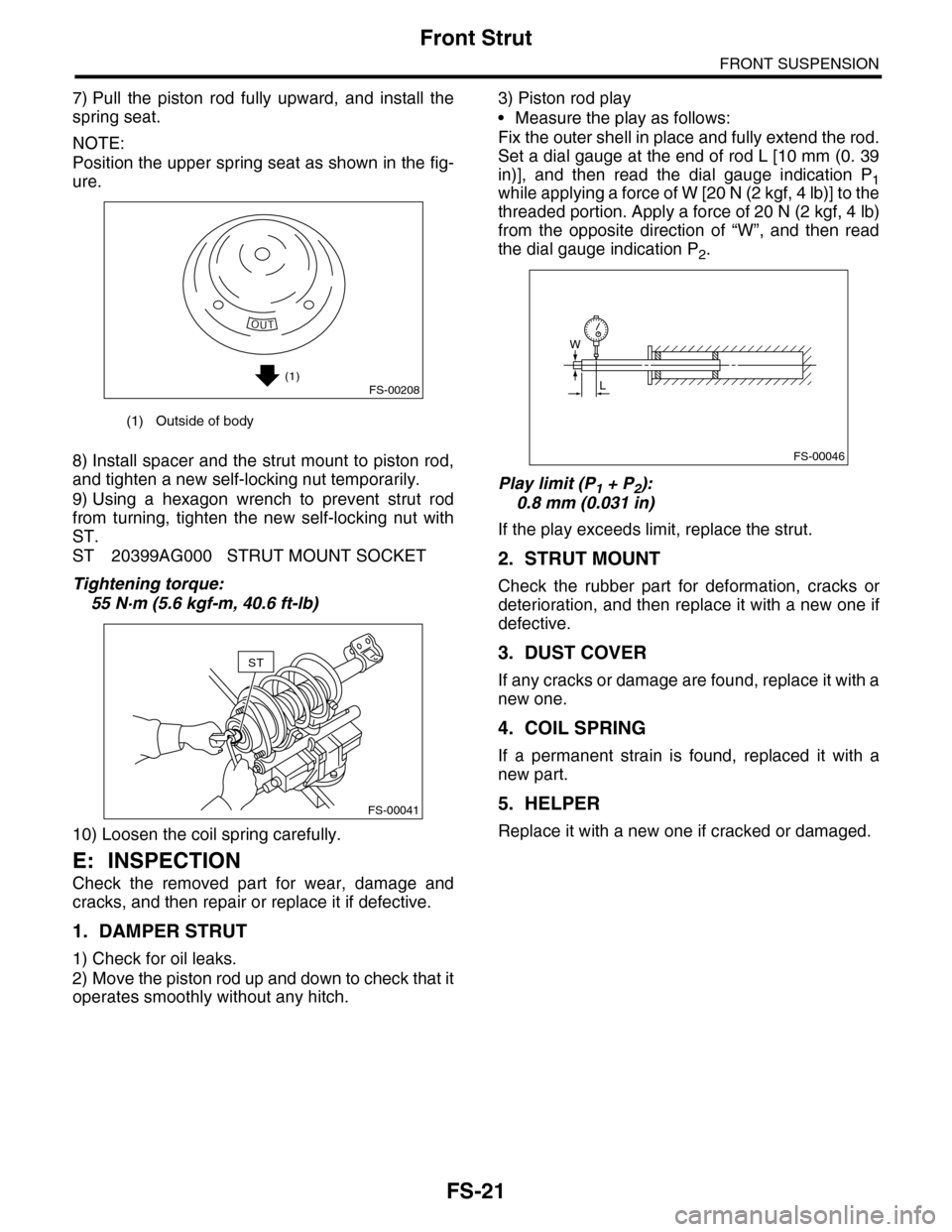
7) Pull the piston rod fully upward, and install the
spring seat.
NOTE:
Position the upper spring seat as shown in the fig-
ure.
8) Install spacer and the strut mount to piston rod,
and tighten a new self-locking nut temporarily.
9) Using a hexagon wrench to prevent strut rod
from turning, tighten the new self-locking nut with
ST.
ST 20399AG000 STRUT MOUNT SOCKET
Tightening torque:
55 N·m (5.6 kgf-m, 40.6 ft-lb)
10) Loosen the coil spring carefully.
E: INSPECTION
Check the removed part for wear, damage and
cracks, and then repair or replace it if defective.
1. DAMPER STRUT
1) Check for oil leaks.
2) Move the piston rod up and down to check that it
operates smoothly without any hitch.
3) Piston rod play
•Measure the play as follows:
Fix the outer shell in place and fully extend the rod.
Set a dial gauge at the end of rod L [10 mm (0. 39
in)], and then read the dial gauge indication P1while applying a force of W [20 N (2 kgf, 4 lb)] to the
threaded portion. Apply a force of 20 N (2 kgf, 4 lb)
from the opposite direction of “W”, and then read
the dial gauge indication P2.
Play limit (P1 + P2):
0.8 mm (0.031 in)
If the play exceeds limit, replace the strut.
2. STRUT MOUNT
Check the rubber part for deformation, cracks or
deterioration, and then replace it with a new one if
defective.
3. DUST COVER
If any cracks or damage are found, replace it with a
new one.
4. COIL SPRING
If a permanent strain is found, replaced it with a
new part.
5. HELPER
Replace it with a new one if cracked or damaged.
(1) Outside of body
(1)FS-00208
FS-00041
ST
FS-00046
W
L
Page 871 of 2453

FS-23
Front Crossmember
FRONT SUSPENSION
8. Front Crossmember
A: REMOVAL
1) Lift-up the vehicle, and then remove the front
wheels.
2) Remove the front exhaust pipe.
3) Remove the front crossmember support plate.
4) Remove the front stabilizer.
5) Disconnect the tie-rod end from housing.
6) Remove the front arm.
7) Remove the nuts attaching the engine mount
cushion rubber to crossmember.
8) Remove the steering universal joint.
9) Disconnect the power steering hose from steer-
ing gearbox.
10) Lift the engine approx. 10 mm (0.39 in) using
the chain block.
11) Support the crossmember with a jack, remove
the bolts securing crossmember to body, and then
gradually lower the crossmember with steering
gearbox as a unit.
CAUTION:
When removing the crossmember downward,
be careful that the tie-rod end does not interfere
with drive shaft boot.
B: INSTALLATION
1) Install in the reverse order of removal.
NOTE:
•Use a new bolt and self-locking nut. For parts
which are not reusable, refer to “COMPONENT”.
•Always tighten the stabilizer bushing in the state
where the vehicle is at curb weight and the wheels
are in full contact with the ground.
Tightening torque:
Crossmember to body:
95 N·m (9.7 kgf-m, 70.1 ft-lb)
Engine mounting to Crossmember:
85 N·m (8.7 kgf-m, 62.7 ft-lb)
Front arm to Crossmember:
95 N·m (9.7 kgf-m, 70.1 ft-lb)
Front arm to Support plate:
145 N·m (14.8 kgf-m, 106.9 ft-lb)
Support plate to Body:
150 N·m (15.3 kgf-m, 110.6 ft-lb)
Tie–rod end to housing:
27.0 N·m (2.75 kgf-m, 19.9 ft-lb)
After tightening to the specified torque, tighten the
castle nut further but within 60° until the hole in the
ball stud is aligned with a slot in castle nut
Universal joint:
24 N·m (2.4 kgf-m, 17.4 ft-lb)
Stabilizer clamp
25 N·m (2.5 kgf-m, 18.1 ft-lb)
Stabilizer link:
60 N·m (6.1 kgf-m, 44.3 ft-lb)
Power steering hose to Steering gearbox:
15 N·m (1.5 kgf-m, 11 ft-lb)
2) Purge air from the power steering system.
3) Inspect the wheel alignment and adjust if neces-
sary.
C: INSPECTION
Check the crossmember for wear, damage or
cracks, and then repair or replace if faulty.
FS-00209
FS-00119
Page 929 of 2453

PS-49
General Diagnostic Table
POWER ASSISTED SYSTEM (POWER STEERING)
10.General Diagnostic Table
A: INSPECTION
*1 If the tires or wheels are wider than standard, the load to the power steering system is increased. Accordingly, in a condition,
for example before fluid warms-up, relief valve may work before reaching maximum turning angle. In this case, steering effort
may be heavy. When the measured hydraulic pressure is normal, there is no abnormal thing. *2 In cold weather, flow resistance will increase due to the cold hydraulic fluid, and steering effort will be heavier. After warming-up en-
gine, turn the steering wheel from stop to stop several times to warm-up fluid. If steering effort reduces normally, function is normal. *3 I n c o l d w e a t h e r o r w i t h i n s u f f i c i e n t w a r m – u p o f t h e e n g i n e , s t e e r i n g e f f o r t m a y b e h e a v y d u e t o e x c e s s i v e d r o p o f i d l e r p m w h en
turning the steering wheel. In this case, start the vehicle with increasing engine speed than usual. If steering effort reduces nor-
mally, function is normal.
Tr o u b l e P o s s i b l e c a u s e C o r r e c t i v e a c t i o n
•Steering effort is heavy in all
ranges.
•Steering effort is heavy at
stand still.
•Steering wheel vibrates
when turning.
1. Pulley belt
•Unequal length of pulley belts
•Contact with oil or grease
•Looseness or damage of the pulley belt
•Poor uniformity of the pulley belt cross section
•Pulley belt touches to pulley bottom
•Poor revolution of pulleys (except oil pump pulley)
•Poor revolution of oil pump pulley
Adjust or replace.
2. Tire and wheel
•Improper tire out of specifications*1
•Improper wheel out of specifications*1
•Tires not properly inflated
Replace or reinflate.
3. Fluid
•Low fluid level
•Air entry in fluid
•Entry of dust in the fluid
•Fluid deterioration
•Inadequate warm–up of fluid *2
Refill, bleed air,
replace or instruct cus-
tomer.
4. Idle speed
•Lower idle speed
•Excessive drop of idle speed at start or when turning the steering
wheel *3
Adjust or instruct cus-
tomer.
5. Measure the hydraulic pressure.
Replace the problem
parts.
6. Measure the steering wheel effort.
•Vehicle leads to one side or
the other.
•Returning force of steering
wheel to center is poor.
•Steering wheel vibrates
when turning.
1. Fluid line
•Folded hose
•Flattened pipe
Correct or replace.
2. Tire and wheel
•Flat tire
•Mixed use of different tires
•Mixed use of different wheels
•Abnormal wear of tire
•Unequal tread remaining
•Unequal pressure of tire
Adjust, fix or replace.
3. Front alignment
•Improper or unequal caster
•Improper or unequal toe–in
•Loose suspension connections
Adjust or retighten.
4. Others
•Damaged joint assembly
•Unbalanced height
•Unbalanced weight
Replace, adjust or
instruct customer.
5. Measure the steering wheel effort.
Page 930 of 2453

PS-50
General Diagnostic Table
POWER ASSISTED SYSTEM (POWER STEERING)
1. NOISE & VIBRATION
CAUTION:
Do not keep the relief valve operated over five seconds at any time or inner parts of the oil pump may
be damaged due to rapid increase of fluid temperature.
NOTE:
•A screeching noise may be heard immediately after the engine start in extremely cold conditions. In this
case, if the noise goes off during warm-up there is no abnormal function in the system. This is due to the fluid
characteristics in extremely cold condition.
•The oil pump normally makes a small whining noise due to its mechanism. Even if a noise is heard when
steering wheel is turned at stand still, there is no abnormal function in the system provided that the noise
eliminates when the vehicle is driving.
•When turning the steering wheel with the brake applied when the vehicle is parked, a screeching noise
may be generated by the brake disc and pads. This is not a fault in the steering system.
•There may be a small vibration around the steering devices when turning the steering wheel at standstill,
even though the component parts are operating properly.
Hydraulic systems are likely to generate this kind of vibration as well as working noise and fluid noise be-
cause of combined conditions, i.e., road surface and tire surface, engine speed and turning speed of steering
wheel, fluid temperature and braking condition.
These conditions do not indicate a problem in the system.
Confirm vibration for an AT model, by applying the parking brake on a concrete surface, shifting into the “D”
range, and turning the steering wheel repeatedly from slow to rapid, step by step.
Tr o u b l e P o s s i b l e c a u s e C o r r e c t i v e a c t i o n
Hiss noise (continuous)
While engine is running.
Relief valve emits operating sound when steering wheel is
completely turned in either direction. (Do not keep this
condition over five seconds.)
Normal
Relief valve emits operating sound when steering wheel is
not turned. This means that the relief valve is defective. Replace the oil pump.
Rattling noise (intermittent)
While engine is running.
Interference with adjacent parts
Check the clearance.
Correct if necessary.
Loosened installation of oil pump, oil tank, pump bracket,
gearbox or crossmemberRetighten.
Loose oil pump pulley or other pulley(s) Retighten.
Looseness of linkage, play of steering, improper tightening
(looseness) of suspension joint or steering columnRetighten or replace.
Sound generates from the inside of gearbox or oil pump.Replace faulty parts in the gear-
box or oil pump.
Knocking
When turning steering wheel in
both directions with small angle
repeatedly at engine ON or OFF.
Excessive backlash
Loosened lock nut for adjusting backlashAdjust and retighten.
Insufficient tightening or play in the tie–rod or tie–rod end Retighten or replace.
Grinding noise (continuous)
While engine is running.
Air in vane pump
Inspect and retighten the fluid
line connection.
Refill the fluid and vent air.
Va n e p u m p s e i z i n g R e p l a c e t h e o i l p u m p.
Oil pump pulley bearing seized Replace the oil pump.
Folded hose, flattened pipe Replace.
Squeal, squeak (intermittent or
continuous)
While engine is running.
Improper adjustment of pulley belt
Damaged or over tensioned pulley belt
Unequal length of pulley belts
Adjust or replace.
(Replace two belts as a set.)
Runout or dirty V–groove surface of oil pump pulley Clean or replace.
Page 931 of 2453

PS-51
General Diagnostic Table
POWER ASSISTED SYSTEM (POWER STEERING)
Sizzling noise (continuous)
While engine is running.
Fluid aeration
Fix the faulty part causing aera-
tion.
Replace the fluid and vent air.
Damaged pipe of gearbox Replace the pipe.
Fa u lt y i n si de of h os e o r pi p e
Flattened hose or pipeRepair or replace.
Abnormal inside of oil tank Replace.
Removed oil tank cap Install cap.
Whistle (continuous)
While engine is running.Fa u lt y p i pe of g ea r b ox o r fa ul t y h os eReplace the faulty parts of the
gearbox or the hose.
Whine or growl (intermittent or
continuous)
While engine is running with/
without steering turned.
Looseness of oil pump, oil pump bracket attachment Retighten.
Fa u lt in s id e o f oi l p u mp o r h os e
Replace the oil pump or hose, if
the noise can be heard when
vehicle is running as well as
being stopped.
To r q u e c o n v e r t e r g r o w l , a i r c o n d i t i o n e r c o m p r e s s i o n g r o w lRemove the power steering pul-
ley belt and check.
Grinding noise (continuous)
While engine is running with the
steering turned.
Fa u lt in s id e o f ge a rb oxReplace the faulty parts of gear-
box.
Fa u lt y s t ee r i ng sh af t b ea r i ng A pp l y gr ea s e o r r e p la ce.
Occurs when turning the steering wheel with brakes (ser-
vice or parking) applied.
If the noise goes off when brake
is released, it is normal.
Vibration
While engine is running with/
without steering turned.
Engine speed is too low. Adjust, and notify customer.
Air in vane pumpRepair faulty part
Ve n t a i r.
Damaged valve in oil pump or gearboxReplace the faulty parts in gear-
box and oil pump.
Excessive play in steering, looseness of suspension parts Retighten.
Tr o u b l e P o s s i b l e c a u s e C o r r e c t i v e a c t i o n