2009 SUBARU TRIBECA wheel
[x] Cancel search: wheelPage 859 of 2453

FS-11
Wheel Alignment
FRONT SUSPENSION
•ADJUSTMENT
When adjusting, adjust it to the following value.
Toe-in:
2±1.5 mm (0.08±0.06 in)
1) Loosen the self-locking nut on the inner side of the front lateral link.
NOTE:
When loosening or tightening the adjusting bolt, hold the bolt head and turn the self–locking nut.
2) Turn the adjusting bolt until toe–in is within the specification.
NOTE:
When the left and right wheels are adjusted for toe–in at the same time, moving one mark on the scale chang-
es toe–in by approx. 3 mm (0.12 in).
3) Attach and tighten a new self–locking nut.
Tightening torque:
120 N·m (12.2 kgf-m, 88.5 ft-lb)
(1) Adjusting bolt
(2) Front lateral link
FS-00199
(1)
(2)
To i n c r e a s e t o e – i n :
Rotate the left side clockwise. Rotate the right side counterclockwise.
To d e c r e a s e t o e – i n :
Rotate the left side counterclockwise. Rotate the right side clockwise.
FS-00018FS-00019
FS-00019FS-00018
Page 860 of 2453
FS-12
Wheel Alignment
FRONT SUSPENSION
7. THRUST ANGLE
•INSPECTION
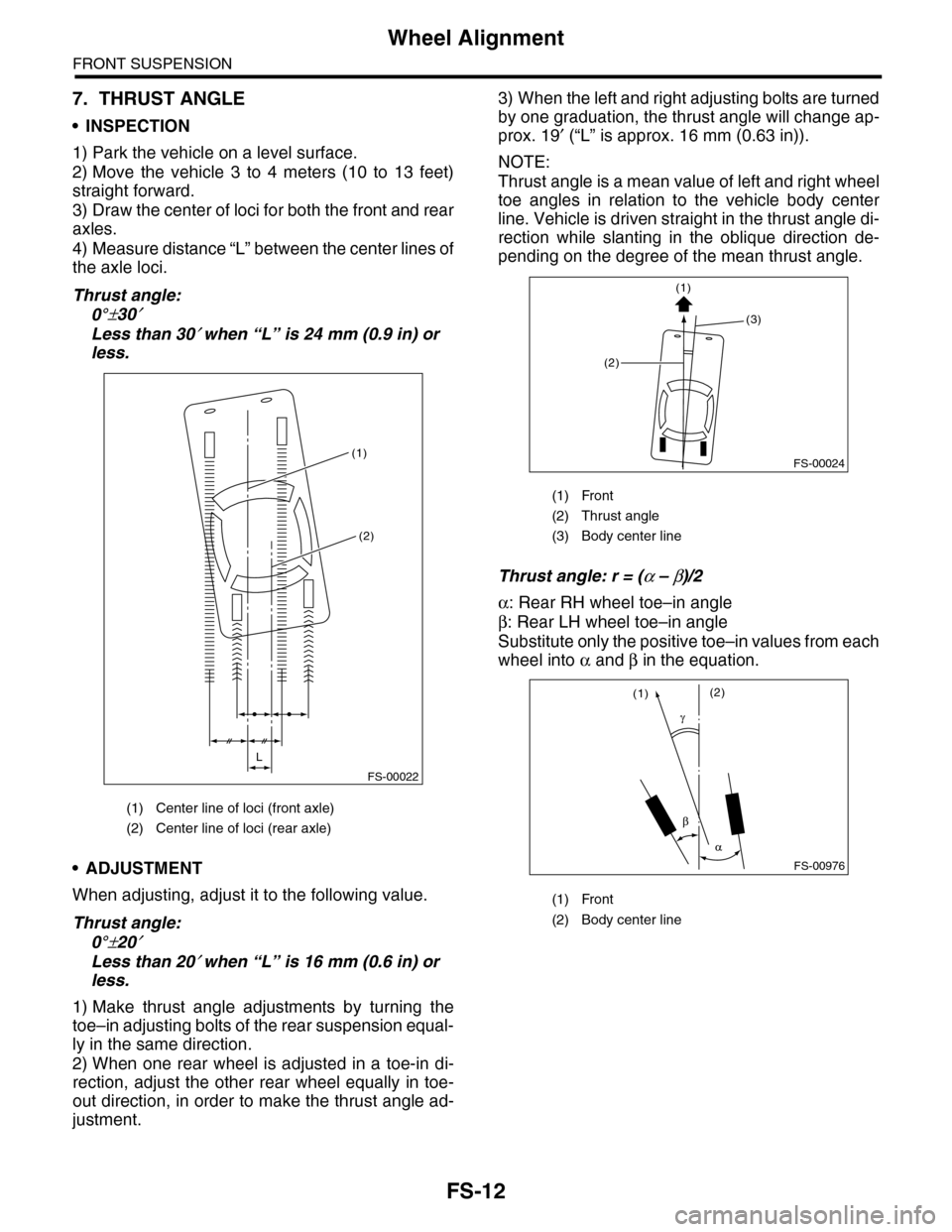
1) Park the vehicle on a level surface.
2) Move the vehicle 3 to 4 meters (10 to 13 feet)
straight forward.
3) Draw the center of loci for both the front and rear
axles.
4) Measure distance “L” between the center lines of
the axle loci.
Thrust angle:
0°±30′
Less than 30′ when “L” is 24 mm (0.9 in) or
less.
•ADJUSTMENT
When adjusting, adjust it to the following value.
Thrust angle:
0°±20′
Less than 20′ when “L” is 16 mm (0.6 in) or
less.
1) Make thrust angle adjustments by turning the
toe–in adjusting bolts of the rear suspension equal-
ly in the same direction.
2) When one rear wheel is adjusted in a toe-in di-
rection, adjust the other rear wheel equally in toe-
out direction, in order to make the thrust angle ad-
justment.
3) When the left and right adjusting bolts are turned
by one graduation, the thrust angle will change ap-
prox. 19′ (“L” is approx. 16 mm (0.63 in)).
NOTE:
Thrust angle is a mean value of left and right wheel
toe angles in relation to the vehicle body center
line. Vehicle is driven straight in the thrust angle di-
rection while slanting in the oblique direction de-
pending on the degree of the mean thrust angle.
Thrust angle: r = (α – β)/2
α: Rear RH wheel toe–in angle
β: Rear LH wheel toe–in angle
Substitute only the positive toe–in values from each
wheel into α and β in the equation.
(1) Center line of loci (front axle)
(2) Center line of loci (rear axle)
(1)
(2)
L
FS-00022
(1) Front
(2) Thrust angle
(3) Body center line
(1) Front
(2) Body center line
FS-00024
(2)
(3)
(1)
FS-00976
(1)(2)
Page 862 of 2453

FS-14
Front Stabilizer
FRONT SUSPENSION
4. Front Stabilizer
A: REMOVAL
1) Lift-up the vehicle, and then remove the front
wheels.
2) Remove the front under cover.
3) Remove the front crossmember support plate.
4) Remove the stabilizer link.
5) Remove the stabilizer link.
B: INSTALLATION
Install in the reverse order of removal.
NOTE:
•Use a new flange nut (with WAX).
•Install so that the paint mark on the stabilizer is
on the left side of the vehicle.
•Install the stabilizer bushing (front crossmember
side) while aligning it with the paint mark on stabi-
lizer.
Tightening torque:
Stabilizer link:
60 N·m (6.1 kgf-m, 44.3 ft-lb)
Stabilizer clamp
25 N·m (2.5 kgf-m, 18.1 ft-lb)
C: INSPECTION
1) Check the bushing for cracks, fatigue or dam-
age.
2) Check the stabilizer link for damage.
FS-00214
FS-00202
Page 863 of 2453

FS-15
Front Ball Joint
FRONT SUSPENSION
5. Front Ball Joint
A: REMOVAL
1) Lift-up the vehicle, and remove the front wheels.
2) Remove the both sides of stabilizer bracket.
3) Pull out the pin from ball stud, remove the castle
nut, and extract the ball stud from front arm.
4) Remove the bolt installing ball joint to housing.
5) Extract the ball joint from housing.
B: INSTALLATION
1) Insert the ball joint into housing.
Tightening torque (Bolt):
50 N·m (5.1 kgf-m, 36.9 ft-lb)
CAUTION:
Do not apply grease to the tapered portion of
ball stud.
2) Install the ball joint into front arm.
Tightening torque (castle nut):
Front arm
45 N·m (4.6 kgf-m, 33.2 ft-lb)
3) Retighten the castle nut further up to 60° until the
hole in the ball stud is aligned with a slot in castle
nut. Then, insert a new cotter pin and bend it
around the castle nut.
4) Install the stabilizer bracket.
Tightening torque:
25 N·m (2.5 kgf-m, 18.1 ft-lb)
5) Install the front wheels.
C: INSPECTION
1) Measure the play of the ball joint using the fol-
lowing procedures. Replace with a new part if the
play exceeds specification.
(1) With 980 N (100 kgf, 220 lb) loaded in direc-
tion shown in the figure, measure the length
21.
(2) With 980 N (100 kgf, 220lb) loaded in direc-
tion shown in the figure, measure the length
22.
(3) Determine free play using the following for-
mula.
S = 22 – 21(4) Replace with a new part if the play exceeds
specification.
FRONT BALL JOINT
Specification for replacement S:
Less than 0.3 mm (0.012 in)
2) If the play is within specification, visually check
the dust cover.
3) Remove the ball joint and cover, and check for
wear, damage or cracks. If any damage is found,
replace the corresponding part.
4) If the dust cover is damaged, replace with a new
ball joint.
FS-00202
FS-00115
FS-00035
FS-00036
Page 864 of 2453
FS-16
Front Arm
FRONT SUSPENSION
6. Front Arm
A: REMOVAL
1) Lift-up the vehicle, and then remove the front
wheels.
2) Remove the front crossmember support plate.
3) Remove the front stabilizer.
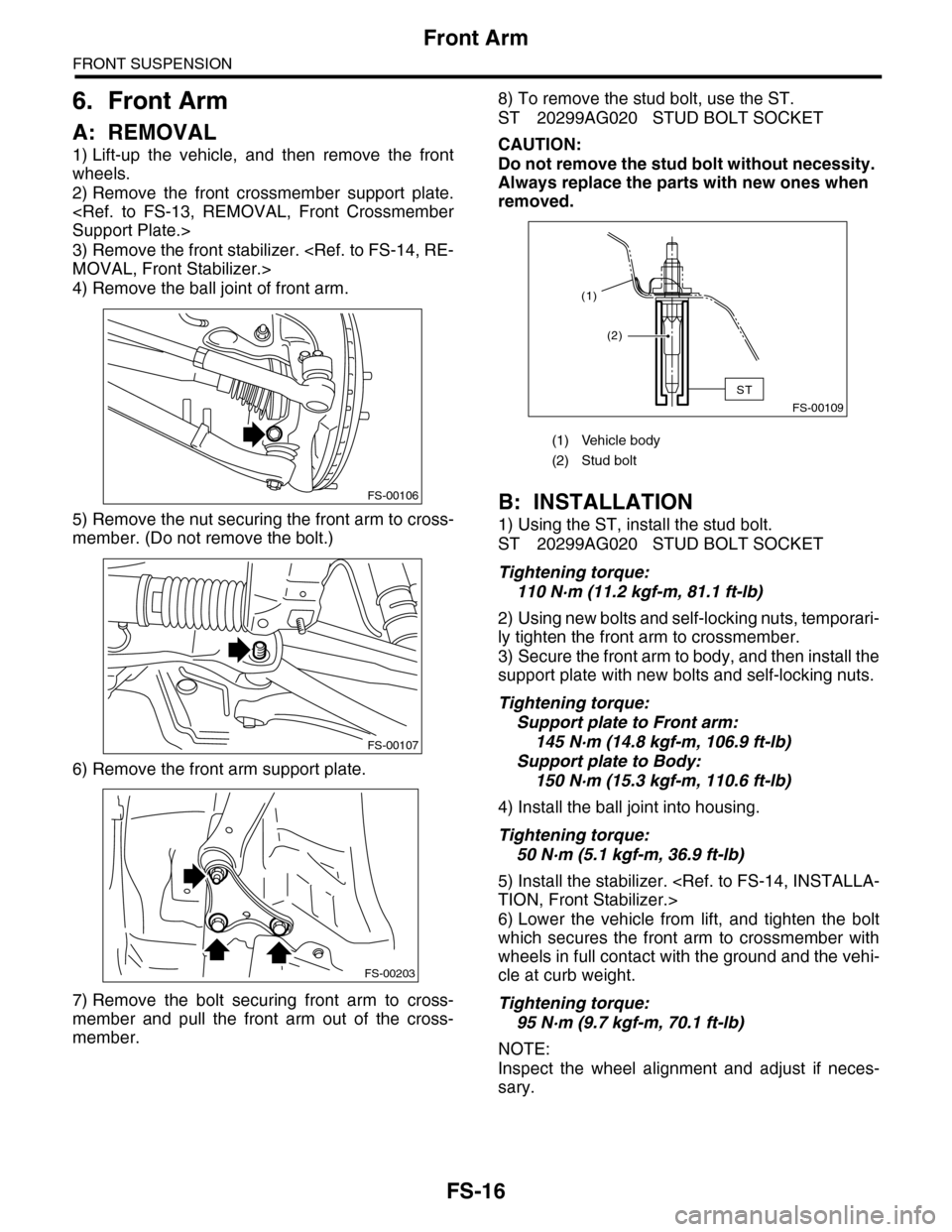
4) Remove the ball joint of front arm.
5) Remove the nut securing the front arm to cross-
member. (Do not remove the bolt.)
6) Remove the front arm support plate.
7) Remove the bolt securing front arm to cross-
member and pull the front arm out of the cross-
member.
8) To remove the stud bolt, use the ST.
ST 20299AG020 STUD BOLT SOCKET
CAUTION:
Do not remove the stud bolt without necessity.
Always replace the parts with new ones when
removed.
B: INSTALLATION
1) Using the ST, install the stud bolt.
ST 20299AG020 STUD BOLT SOCKET
Tightening torque:
110 N·m (11.2 kgf-m, 81.1 ft-lb)
2) Using new bolts and self-locking nuts, temporari-
ly tighten the front arm to crossmember.
3) Secure the front arm to body, and then install the
support plate with new bolts and self-locking nuts.
Tightening torque:
Support plate to Front arm:
145 N·m (14.8 kgf-m, 106.9 ft-lb)
Support plate to Body:
150 N·m (15.3 kgf-m, 110.6 ft-lb)
4) Install the ball joint into housing.
Tightening torque:
50 N·m (5.1 kgf-m, 36.9 ft-lb)
5) Install the stabilizer.
6) Lower the vehicle from lift, and tighten the bolt
which secures the front arm to crossmember with
wheels in full contact with the ground and the vehi-
cle at curb weight.
Tightening torque:
95 N·m (9.7 kgf-m, 70.1 ft-lb)
NOTE:
Inspect the wheel alignment and adjust if neces-
sary.
FS-00106
FS-00107
FS-00203
(1) Vehicle body
(2) Stud bolt
FS-00109
(2)
(1)
ST
Page 867 of 2453

FS-19
Front Strut
FRONT SUSPENSION
7. Front Strut
A: REMOVAL
1) Lift-up the vehicle, and then remove the front
wheels.
2) Place an alignment mark on the camber adjust-
ing bolt and strut.
3) Remove the bolt securing the brake hose from
the strut.
4) Remove the clip securing the ABS wheel speed
sensor harness.
5) Remove the two bolts securing the housing to
the strut.
NOTE:
While holding the head of the adjusting bolt, loosen
the self–locking nut.
6) Remove the three nuts securing strut mount to
body.
B: INSTALLATION
1) Install the strut mount at the upper side of strut to
body, and tighten it with new self-locking nuts.
Tightening torque:
20 N·m (2.0 kgf-m, 14.5 ft-lb)
2) Align alignment marks on the camber adjusting
bolt and strut.
Using new self–locking nuts, install the strut to the
housing.
NOTE:
While holding the head of adjusting bolt, tighten the
self–locking nut.
Tightening torque:
175 N·m (17.9 kgf-m, 129 ft-lb)
3) Secure the ABS wheel speed sensor harness to
the strut.
4) Install the bolts which secure the brake hose to
the strut.
Tightening torque:
33 N·m (3.4 kgf-m, 24.3 ft-lb)
5) Install the front wheels.
NOTE:
Inspect the wheel alignment and adjust if neces-
sary.
FS-00037
FS-00206
FS-00207
Page 871 of 2453

FS-23
Front Crossmember
FRONT SUSPENSION
8. Front Crossmember
A: REMOVAL
1) Lift-up the vehicle, and then remove the front
wheels.
2) Remove the front exhaust pipe.
3) Remove the front crossmember support plate.
4) Remove the front stabilizer.
5) Disconnect the tie-rod end from housing.
6) Remove the front arm.
7) Remove the nuts attaching the engine mount
cushion rubber to crossmember.
8) Remove the steering universal joint.
9) Disconnect the power steering hose from steer-
ing gearbox.
10) Lift the engine approx. 10 mm (0.39 in) using
the chain block.
11) Support the crossmember with a jack, remove
the bolts securing crossmember to body, and then
gradually lower the crossmember with steering
gearbox as a unit.
CAUTION:
When removing the crossmember downward,
be careful that the tie-rod end does not interfere
with drive shaft boot.
B: INSTALLATION
1) Install in the reverse order of removal.
NOTE:
•Use a new bolt and self-locking nut. For parts
which are not reusable, refer to “COMPONENT”.
•Always tighten the stabilizer bushing in the state
where the vehicle is at curb weight and the wheels
are in full contact with the ground.
Tightening torque:
Crossmember to body:
95 N·m (9.7 kgf-m, 70.1 ft-lb)
Engine mounting to Crossmember:
85 N·m (8.7 kgf-m, 62.7 ft-lb)
Front arm to Crossmember:
95 N·m (9.7 kgf-m, 70.1 ft-lb)
Front arm to Support plate:
145 N·m (14.8 kgf-m, 106.9 ft-lb)
Support plate to Body:
150 N·m (15.3 kgf-m, 110.6 ft-lb)
Tie–rod end to housing:
27.0 N·m (2.75 kgf-m, 19.9 ft-lb)
After tightening to the specified torque, tighten the
castle nut further but within 60° until the hole in the
ball stud is aligned with a slot in castle nut
Universal joint:
24 N·m (2.4 kgf-m, 17.4 ft-lb)
Stabilizer clamp
25 N·m (2.5 kgf-m, 18.1 ft-lb)
Stabilizer link:
60 N·m (6.1 kgf-m, 44.3 ft-lb)
Power steering hose to Steering gearbox:
15 N·m (1.5 kgf-m, 11 ft-lb)
2) Purge air from the power steering system.
3) Inspect the wheel alignment and adjust if neces-
sary.
C: INSPECTION
Check the crossmember for wear, damage or
cracks, and then repair or replace if faulty.
FS-00209
FS-00119
Page 872 of 2453
FS-24
General Diagnostic Table
FRONT SUSPENSION
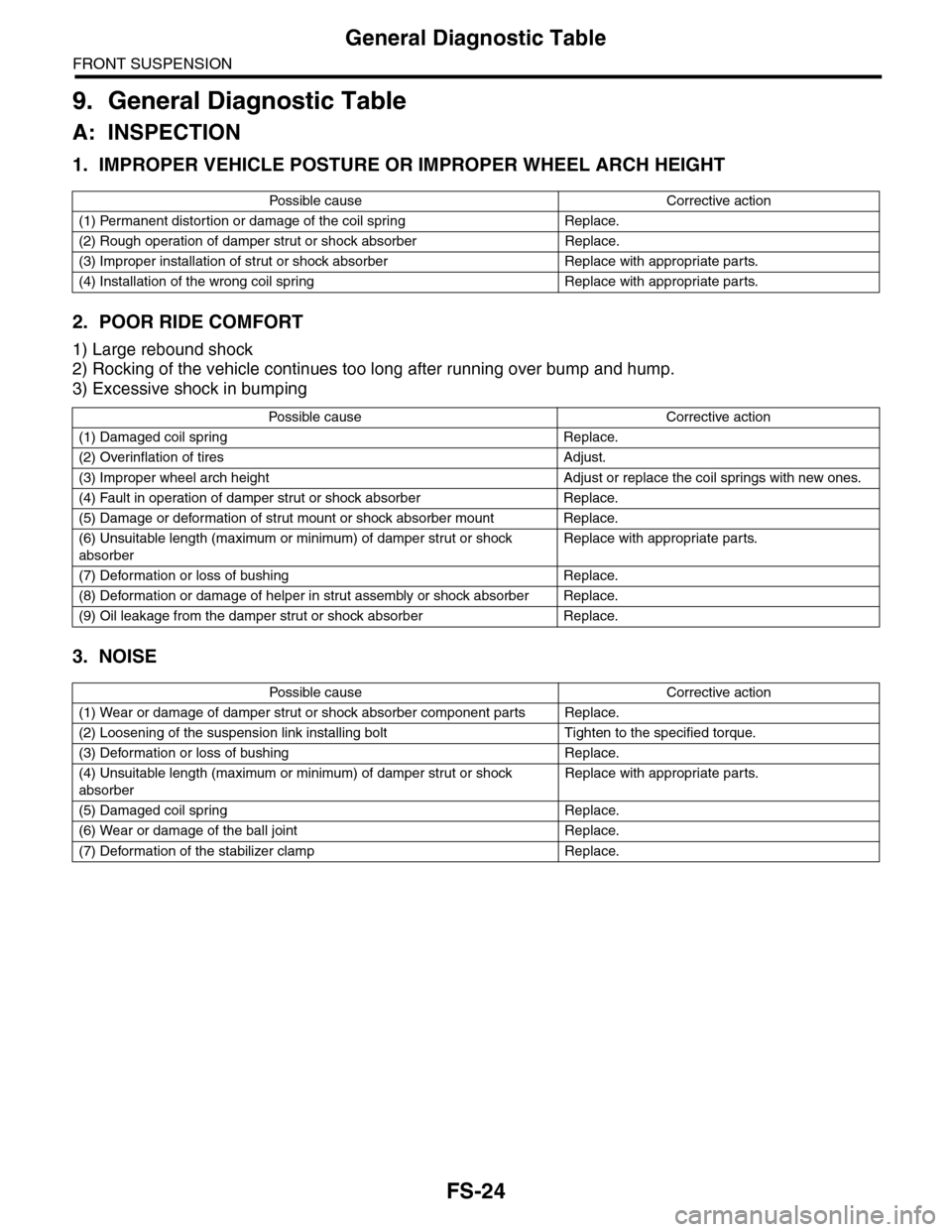
9. General Diagnostic Table
A: INSPECTION
1. IMPROPER VEHICLE POSTURE OR IMPROPER WHEEL ARCH HEIGHT
2. POOR RIDE COMFORT
1) Large rebound shock
2) Rocking of the vehicle continues too long after running over bump and hump.
3) Excessive shock in bumping
3. NOISE
Po ss ibl e c a us e C o r r e ct ive ac ti o n
(1) Permanent distortion or damage of the coil spring Replace.
(2) Rough operation of damper strut or shock absorber Replace.
(3) Improper installation of strut or shock absorber Replace with appropriate parts.
(4) Installation of the wrong coil spring Replace with appropriate parts.
Po ss ibl e ca us e C or r e ct i ve a ct io n
(1) Damaged coil spring Replace.
(2) Overinflation of tires Adjust.
(3) Improper wheel arch height Adjust or replace the coil springs with new ones.
(4) Fault in operation of damper strut or shock absorber Replace.
(5) Damage or deformation of strut mount or shock absorber mount Replace.
(6) Unsuitable length (maximum or minimum) of damper strut or shock
absorber
Replace with appropriate parts.
(7) Deformation or loss of bushing Replace.
(8) Deformation or damage of helper in strut assembly or shock absorber Replace.
(9) Oil leakage from the damper strut or shock absorber Replace.
Po ss ibl e c a us e C o r r e ct ive ac ti o n
(1) Wear or damage of damper strut or shock absorber component parts Replace.
(2) Loosening of the suspension link installing bolt Tighten to the specified torque.
(3) Deformation or loss of bushing Replace.
(4) Unsuitable length (maximum or minimum) of damper strut or shock
absorber
Replace with appropriate parts.
(5) Damaged coil spring Replace.
(6) Wear or damage of the ball joint Replace.
(7) Deformation of the stabilizer clamp Replace.