2009 SUBARU TRIBECA wheel
[x] Cancel search: wheelPage 736 of 2453

BR-22
Rear Disc Brake Assembly
BRAKE
7. Rear Disc Brake Assembly
A: REMOVAL
CAUTION:
Do not allow brake fluid to come in contact with
vehicle body. If it does, wash off with water and
wipe away completely.
1) Lift-up the vehicle, and then remove the rear
wheels.
2) Disconnect the brake hose from caliper body as-
sembly.
3) Remove the caliper lower bolt.
4) Raise the caliper body, and then move it toward
vehicle center to separate it from the support.
5) Remove the support from housing.
NOTE:
Remove the support only when replacing the rotor
or support. It need not be removed when servicing
the caliper body assembly.
6) Remove mud and foreign matter from the caliper
body assembly and support.
CAUTION:
Be careful not to allow foreign matter to enter
the brake hose connector.
B: INSTALLATION
1) Install the support to the housing.
Tightening torque:
66 N·m (6.7 kgf-m, 48.7 ft-lb)
2) Apply a thin coat of Molykote M7439 to the pad
clip.
3) Apply a thin coat of Molykote AS880N (Part No.
K0777YA010) to the contact surface between the
pad and shim.
4) Install the pad to support.
5) Install the caliper body to the support.
Tightening torque:
27 N·m (2.8 kgf-m, 19.9 ft-lb)
6) Connect the brake hose using a new brake hose
gasket.
Tightening torque:
18 N·m (1.8 kgf-m, 13.0 ft-lb)
7) Bleed air from the brake system.
C: DISASSEMBLY
1) Remove the piston boot.
2) Place a wooden block in the caliper body as
shown in the figure to prevent the piston from jump-
ing out and being damaged.
3) Gradually apply compressed air via the brake
hose installation hole to push the piston out.
BR-00498
BR-00345
(1) Place a wood block of 30 mm (1.18 in) width.
BR-00041
(1)BR-00042
Page 744 of 2453

BR-30
Brake Fluid
BRAKE
10.Brake Fluid
A: INSPECTION
1) Check that the brake fluid level is between “MIN”
and “MAX”. If out of the specified range, refill or
drain fluid. If the fluid level is close to “MIN”, check
the brake pad for wear and refill the fluid.
2) Check the fluid for discoloration. If the fluid color
has changed excessively, drain the fluid and refill
with new fluid.
B: REPLACEMENT
CAUTION:
•Do not let brake fluid come into contact with
the painted surface of the vehicle body. Wash
away with water immediately and wipe off if it is
spilled by accident.
•Avoid mixing brake fluids of different brands
to prevent fluid performance from degrading.
•Be careful not to allow dirt or dust to enter the
reservoir tank.
NOTE:
•During the operation, keep the reservoir tank
filled with brake fluid to eliminate entry of air.
•Operate the brake pedal slowly.
•For convenience and safety, perform work with 2
people.
•The required amount of brake fluid is approxi-
mately 600 m2 (20 US fl oz, 21 Imp fl oz) for entire
brake system.
1) Lift-up the vehicle and set rigid racks at the spec-
ified locations, or keep the vehicle lifted.
2) Remove both the front and rear wheels.
3) Drain brake fluid from the reservoir tank.
4) Refill the reservoir tank with the recommended
brake fluid.
Recommended brake fluid:
Refer to the specification.
Perform the same procedure as for bleeding the
brake line, until new brake fluid comes out from vi-
nyl tube.
NOTE:
Perform the brake fluid replacement starting in or-
der from the farthest wheel cylinder from the mas-
ter cylinder.
Page 745 of 2453

BR-31
Air Bleeding
BRAKE
11.Air Bleeding
A: PROCEDURE
CAUTION:
•Do not let brake fluid come into contact with
the painted surface of the vehicle body. Wash
away with water immediately and wipe off if it is
spilled by accident.
•Avoid mixing brake fluids of different brands
to prevent fluid performance from degrading.
•Be careful not to allow dirt or dust to enter the
reservoir tank.
1. MASTER CYLINDER
NOTE:
•When the master cylinder is disassembled or the
reservoir tank is empty, bleed the master cylinder.
•If bleeding of the master cylinder is not neces-
sary, omit the following procedures, and perform
bleeding of the brake line.
1) Fill the reservoir tank of the master cylinder with
brake fluid.
NOTE:
While bleeding air, keep the reservoir tank filled
with brake fluid to prevent entry of air.
2) Disconnect the brake line at primary and sec-
ondary sides.
3) Wrap the master cylinder with a plastic bag.
4) Depress the brake pedal slowly and hold it.
5) Plug the outlet plug with your finger, and then re-
lease the brake pedal.
6) Repeat the step 4) and 5) several times.
7) Remove the plastic bag.
8) Install the brake pipe to the master cylinder.
Tightening torque:
19 N·m (1.9 kgf-m, 14.0 ft-lb)
9) Bleed air from the brake line.
2. BRAKE LINE
1) When the master cylinder is disassembled or the
reservoir tank is empty, bleed the master cylinder
before bleeding the brake line.
ing.>
2) Fill the reservoir tank of the master cylinder with
brake fluid.
NOTE:
While bleeding air, keep the reservoir tank filled
with brake fluid to prevent entry of air.
3) Attach one end of the vinyl tube to the air bleeder
and the other end to the brake fluid container.
4) Depress the brake pedal several times, and
keep it pressed.
5) Loosen the air bleeder screw to drain brake fluid.
Tighten the air bleeder quickly, and release the
brake pedal.
6) Repeat the steps 4) to 5) until there are no more
air bubbles in the vinyl tube.
7) Repeat the steps from 2) to 6) above to bleed air
from each wheel.
NOTE:
Perform the operation in the order from closest
wheel cylinder to the master cylinder.
8) Securely tighten the air bleeder screws.
Tightening torque:
8 N·m (0.8 kgf-m, 5.8 ft-lb)
9) Check that there are no brake fluid leaks in the
entire system.
BR-00090
BR-00091
BR-00087
Page 746 of 2453

BR-32
Air Bleeding
BRAKE
10) Check the pedal stroke.
Run the engine at idle after warming up the engine,
and depress the brake pedal with a force of 500 N
(51 kgf, 112 lb). Measure the distance between the
brake pedal and steering wheel. Release the pedal,
and measure the distance between pedal and
steering wheel again.
Specification of pedal stroke:
When depressing the pedal with a force of
500 N (51 kgf, 112 lb).
Less than 115 mm (4.53 in)
11) If the distance is more than specification, there
is a possibility of air being caught in the brake line.
Bleed the brake line of all air until the pedal stroke
meets the specification.
12) Operate the hydraulic control unit in the se-
quence control mode.
13) Check the pedal stroke again.
14) If the distance is more than specification, there
is a possibility of air being caught in the hydraulic
unit. Repeat above steps 2) to 9) until the pedal
stroke meets the specification.
15) Fill brake fluid up to the “MAX” level of the res-
ervoir tank.
16) Test run the vehicle and ensure that the brakes
operate normally.
(1) Steering wheel
(2) Toe board
(1)
(2)
BR-00094
1
2
21
Page 748 of 2453
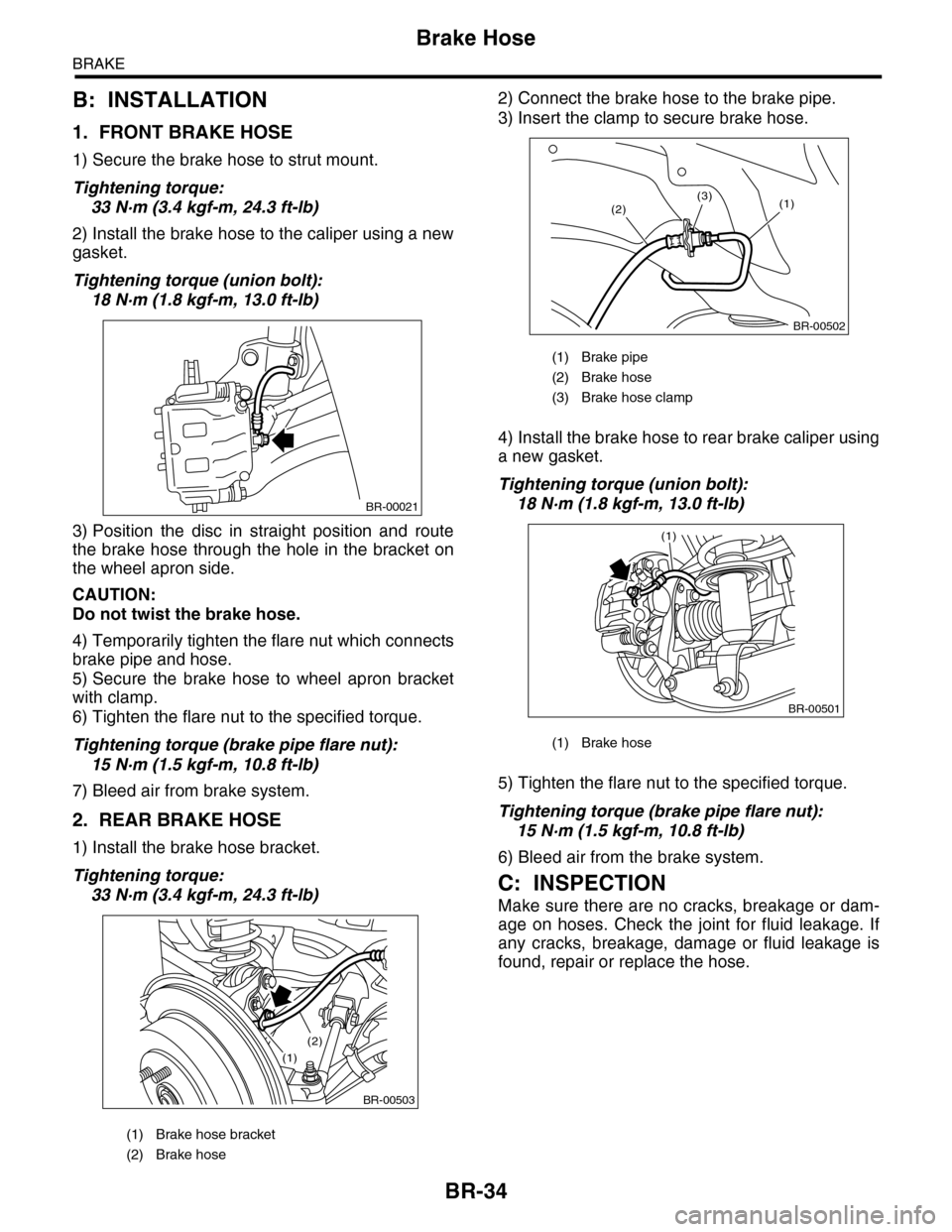
BR-34
Brake Hose
BRAKE
B: INSTALLATION
1. FRONT BRAKE HOSE
1) Secure the brake hose to strut mount.
Tightening torque:
33 N·m (3.4 kgf-m, 24.3 ft-lb)
2) Install the brake hose to the caliper using a new
gasket.
Tightening torque (union bolt):
18 N·m (1.8 kgf-m, 13.0 ft-lb)
3) Position the disc in straight position and route
the brake hose through the hole in the bracket on
the wheel apron side.
CAUTION:
Do not twist the brake hose.
4) Temporarily tighten the flare nut which connects
brake pipe and hose.
5) Secure the brake hose to wheel apron bracket
with clamp.
6) Tighten the flare nut to the specified torque.
Tightening torque (brake pipe flare nut):
15 N·m (1.5 kgf-m, 10.8 ft-lb)
7) Bleed air from brake system.
2. REAR BRAKE HOSE
1) Install the brake hose bracket.
Tightening torque:
33 N·m (3.4 kgf-m, 24.3 ft-lb)
2) Connect the brake hose to the brake pipe.
3) Insert the clamp to secure brake hose.
4) Install the brake hose to rear brake caliper using
a new gasket.
Tightening torque (union bolt):
18 N·m (1.8 kgf-m, 13.0 ft-lb)
5) Tighten the flare nut to the specified torque.
Tightening torque (brake pipe flare nut):
15 N·m (1.5 kgf-m, 10.8 ft-lb)
6) Bleed air from the brake system.
C: INSPECTION
Make sure there are no cracks, breakage or dam-
age on hoses. Check the joint for fluid leakage. If
any cracks, breakage, damage or fluid leakage is
found, repair or replace the hose.
(1) Brake hose bracket
(2) Brake hose
BR-00021
BR-00503
(1)
(2)
(1) Brake pipe
(2) Brake hose
(3) Brake hose clamp
(1) Brake hose
BR-00502
(1)(2)(3)
BR-00501
(1)
Page 755 of 2453

BR-41
General Diagnostic Table
BRAKE
18.General Diagnostic Table
A: INSPECTION
Trouble and possible causeCorrective action
1. Insufficient braking
performance
(1) Fluid leakage from the hydraulic mechanism Correct or replace. (cup, piston seal, piston
boot, master cylinder piston kit, pipe or
hose)
(2) Entry of air into the hydraulic mechanism Bleed air.
(3) Wear, deteriorated surface material, water or fluid on
lining
Replace, grind or clean.
(4) Improper operation of master cylinder, disc caliper,
brake booster or check valve
Correct or replace.
2. Unstable or uneven
braking
(1) Fluid on lining or rotor Correct the cause of fluid leakage, and
clean or replace.
(2) Rotor defective Repair or replace the rotor.
(3) Improper lining contact, deteriorated surface, deterio-
rated or wear lining material
Repair by grinding, or replace.
(4) Deformed back plate Repair or replace.
(5) Over inflation of tires Adjust air pressure.
(6) Defective wheel alignment Adjust alignment.
(7) Loose back plate or suppor t installation bolt Tighten to the specified torque.
(8) Faulty wheel bearing Replace.
(9) Defective hydraulic system Replace the cylinder, brake pipe or hose.
(10) Unstable effect of parking brake Check, adjust or replace the rear brake and
cable system.
3. Excessive pedal
stroke
(1) Entry of air into the hydraulic mechanism Bleed air.
(2) Excessive play in the master cylinder push rod Adjust.
(3) Fluid leakage from the hydraulic mechanism Correct or replace. (cup, piston seal, piston
boot, master cylinder piston kit, pipe or
hose)
(4) Improper lining contact or worn lining Correct or replace.
4. Brake dragging or
improper brake
return
(1) Insufficient pedal play Adjust play.
(2) Improper master cylinder return Clean or replace the cylinder.
(3) Clogged hydraulic system Replace.
(4) Improper return or adjustment of parking brake Repair or adjust.
(5) Weakened spring tension or breakage of shoe return
spring
Replace the spring.
(6) Improper disc caliper operation Correct or replace.
(7) Faulty wheel bearing Replace.
Brake noise (1)
(creaking sound)
(1) Hardened or deteriorated brake pad Replace the pad.
(2) Worn brake pad Replace the pad.
(3) Loose back plate or suppor t installation bolt Tighten to the specified torque.
(4) Loose wheel bearing Tighten to the specified torque.
(5) Dir ty rotor Clean the rotor, or clean and replace brake
assembly.
6. Brake noise (2)
(hissing sound)
(1) Worn brake pad Replace the pad.
(2) Improperly installed pad Correct or replace the pad.
(3) Loose or bent rotor Retighten or replace.
7. Brake noise (3)
(click sound)
Excessively worn pad or suppor t Replace the pad or the suppor t.
Page 760 of 2453

BVC(diag)-5
General Description
BRAKE VACUUM CONTROL (BVC) (DIAGNOSTICS)
3. General Description
A: CAUTION
1. SRS AIRBAG SYSTEM
Airbag system wiring harness is routed near the ABS wheel speed sensor and VDCCM&H/U.
CAUTION:
•All airbag system wiring harness and connectors are colored yellow. Do not use the electrical test
equipment on these circuits.
•Be careful not to damage the airbag system wiring harness.
B: INSPECTION
Before performing diagnosis, check the following items which might affect the brake vacuum control.
1. BATTERY
Measure the battery voltage and check electrolyte.
Standard voltage: 12 V or more
Specific gravity: 1.260 or more
2. BRAKE VACUUM HOSE
Make sure the brake vacuum hose is not cracked or loose.
C: PREPARATION TOOL
1. SPECIAL TOOL
2. GENERAL TOOL
ILLUSTRATION TOOL NUMBER DESCRIPTION REMARKS
18482AA010 CARTRIDGE Troubleshooting for the electrical system.
22771AA030 SUBARU SELECT
MONITOR KIT
Tr o u b l e s h o o t i n g f o r t h e e l e c t r i c a l s y s t e m .
TOOL NAME REMARKS
Circuit tester Used for measuring resistance, voltage and current.
Oscilloscope Used for measuring the sensor.
ST18482AA010
ST22771AA030
Page 814 of 2453

DI-30
Rear Differential Front Oil Seal
DIFFERENTIALS
5. Rear Differential Front Oil
Seal
A: INSPECTION
Make sure that there is no leakage from front oil
seal portion. If there is any leakage replace the oil
seal and inspect the propeller shaft.
B: REPLACEMENT
1) Release the parking brake.
2) Remove the oil drain plug, and drain gear oil.
3) Install the oil drain plug.
NOTE:
Use a new metal gasket.
Tightening torque:
29 N·m (3.0 kgf-m, 21.7 ft-lb)
4) Jack-up the rear wheel and support the body
with rigid racks.
5) Remove the rear exhaust pipe and muffler.
6) Remove the heat shield cover.
7) Remove the propeller shaft.
8) Remove the self-locking nut while holding the
companion flange with ST.
ST 498427200 FLANGE WRENCH
9) Extract the companion flange using ST.
ST 399703600 PULLER ASSY
10) Remove the oil seal using ST or screwdriver.
ST 398527700 PULLER ASSY
11) Install a new oil seal with ST.
ST 498447120 OIL SEAL INSTALLER
(A) Filler plug
(B) Drain plug
(A)
DI-00357
(B)
AT-03243
DI-00194
ST
DI-00196
ST
DI-00197
ST
DI-00292
ST