2009 SUBARU TRIBECA manual transmission
[x] Cancel search: manual transmissionPage 2235 of 2453
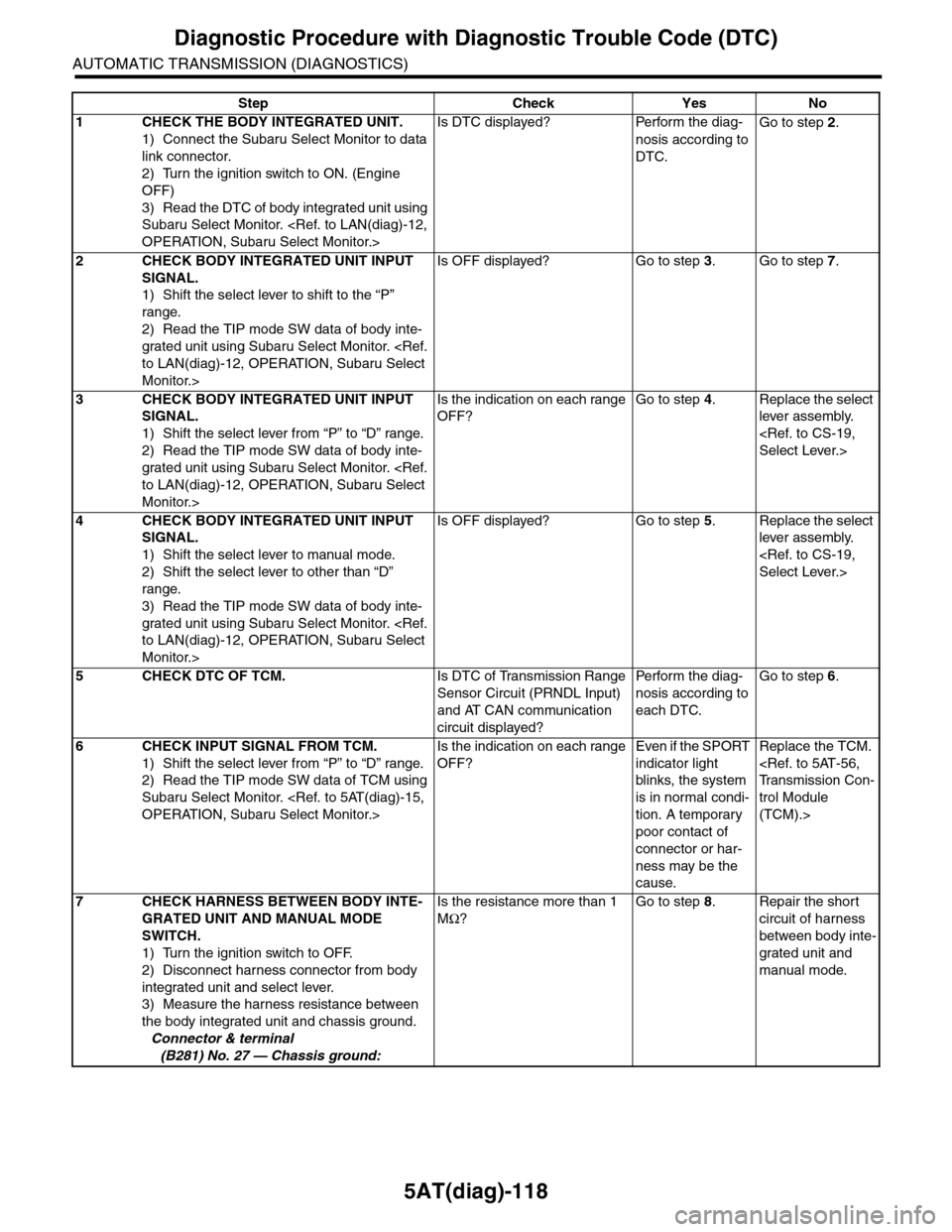
5AT(diag)-118
Diagnostic Procedure with Diagnostic Trouble Code (DTC)
AUTOMATIC TRANSMISSION (DIAGNOSTICS)
Step Check Yes No
1CHECK THE BODY INTEGRATED UNIT.
1) Connect the Subaru Select Monitor to data
link connector.
2) Turn the ignition switch to ON. (Engine
OFF)
3) Read the DTC of body integrated unit using
Subaru Select Monitor.
Is DTC displayed? Perform the diag-
nosis according to
DTC.
Go to step 2.
2CHECK BODY INTEGRATED UNIT INPUT
SIGNAL.
1) Shift the select lever to shift to the “P”
range.
2) Read the TIP mode SW data of body inte-
grated unit using Subaru Select Monitor.
Monitor.>
Is OFF displayed? Go to step 3.Go to step 7.
3CHECK BODY INTEGRATED UNIT INPUT
SIGNAL.
1) Shift the select lever from “P” to “D” range.
2) Read the TIP mode SW data of body inte-
grated unit using Subaru Select Monitor.
Monitor.>
Is the indication on each range
OFF?
Go to step 4.Replace the select
lever assembly.
4CHECK BODY INTEGRATED UNIT INPUT
SIGNAL.
1) Shift the select lever to manual mode.
2) Shift the select lever to other than “D”
range.
3) Read the TIP mode SW data of body inte-
grated unit using Subaru Select Monitor.
Monitor.>
Is OFF displayed? Go to step 5.Replace the select
lever assembly.
5CHECK DTC OF TCM.Is DTC of Transmission Range
Sensor Circuit (PRNDL Input)
and AT CAN communication
circuit displayed?
Pe r for m t h e d ia g -
nosis according to
each DTC.
Go to step 6.
6CHECK INPUT SIGNAL FROM TCM.
1) Shift the select lever from “P” to “D” range.
2) Read the TIP mode SW data of TCM using
Subaru Select Monitor.
Is the indication on each range
OFF?
Even if the SPORT
indicator light
blinks, the system
is in normal condi-
tion. A temporary
poor contact of
connector or har-
ness may be the
cause.
Replace the TCM.
trol Module
(TCM).>
7CHECK HARNESS BETWEEN BODY INTE-
GRATED UNIT AND MANUAL MODE
SWITCH.
1) Turn the ignition switch to OFF.
2) Disconnect harness connector from body
integrated unit and select lever.
3) Measure the harness resistance between
the body integrated unit and chassis ground.
Connector & terminal
(B281) No. 27 — Chassis ground:
Is the resistance more than 1
MΩ?
Go to step 8.Repair the short
circuit of harness
between body inte-
grated unit and
manual mode.
Page 2236 of 2453
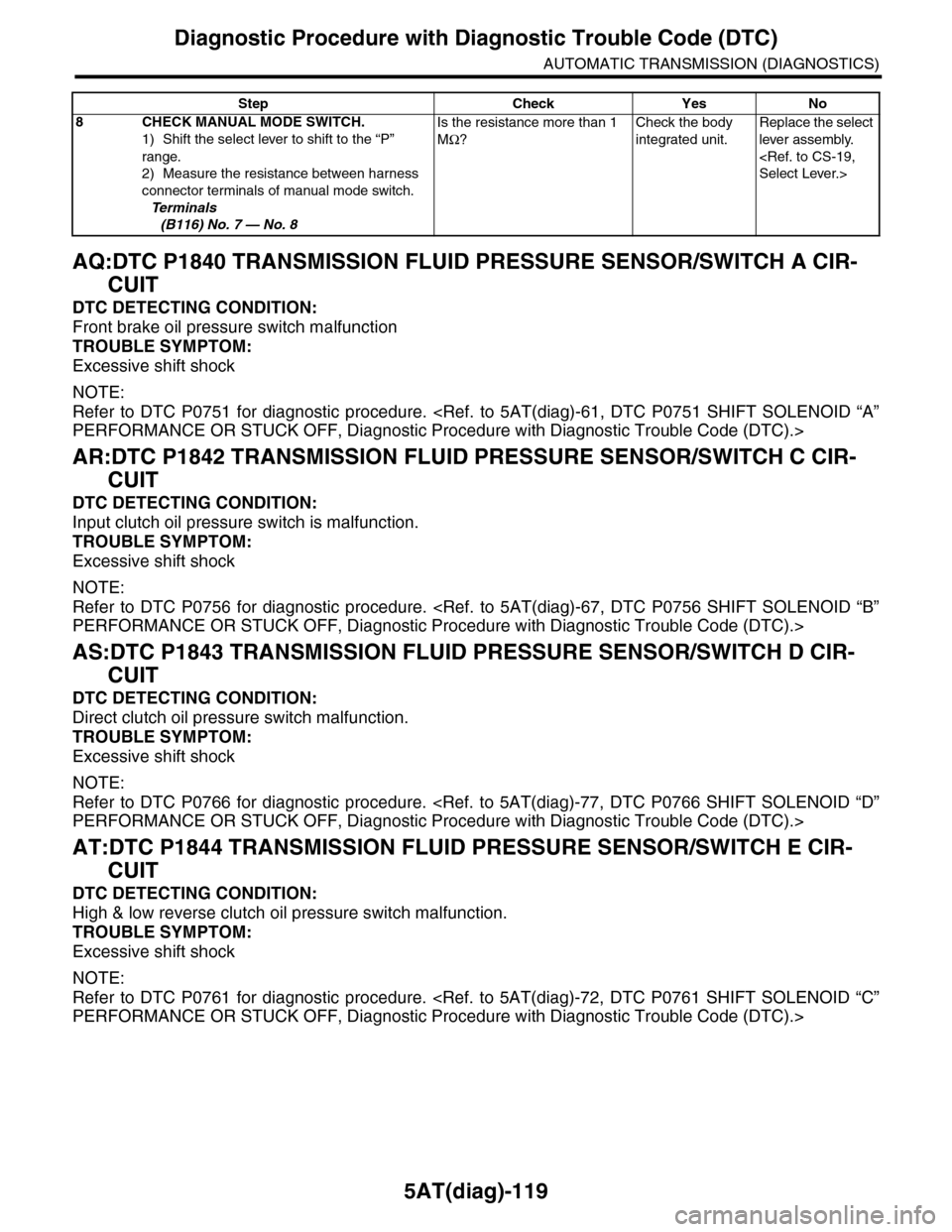
5AT(diag)-119
Diagnostic Procedure with Diagnostic Trouble Code (DTC)
AUTOMATIC TRANSMISSION (DIAGNOSTICS)
AQ:DTC P1840 TRANSMISSION FLUID PRESSURE SENSOR/SWITCH A CIR-
CUIT
DTC DETECTING CONDITION:
Front brake oil pressure switch malfunction
TROUBLE SYMPTOM:
Excessive shift shock
NOTE:
Refer to DTC P0751 for diagnostic procedure.
AR:DTC P1842 TRANSMISSION FLUID PRESSURE SENSOR/SWITCH C CIR-
CUIT
DTC DETECTING CONDITION:
Input clutch oil pressure switch is malfunction.
TROUBLE SYMPTOM:
Excessive shift shock
NOTE:
Refer to DTC P0756 for diagnostic procedure.
AS:DTC P1843 TRANSMISSION FLUID PRESSURE SENSOR/SWITCH D CIR-
CUIT
DTC DETECTING CONDITION:
Direct clutch oil pressure switch malfunction.
TROUBLE SYMPTOM:
Excessive shift shock
NOTE:
Refer to DTC P0766 for diagnostic procedure.
AT:DTC P1844 TRANSMISSION FLUID PRESSURE SENSOR/SWITCH E CIR-
CUIT
DTC DETECTING CONDITION:
High & low reverse clutch oil pressure switch malfunction.
TROUBLE SYMPTOM:
Excessive shift shock
NOTE:
Refer to DTC P0761 for diagnostic procedure.
8CHECK MANUAL MODE SWITCH.
1) Shift the select lever to shift to the “P”
range.
2) Measure the resistance between harness
connector terminals of manual mode switch.
Te r m i n a l s
(B116) No. 7 — No. 8
Is the resistance more than 1
MΩ?
Check the body
integrated unit.
Replace the select
lever assembly.
Step Check Yes No
Page 2237 of 2453
5AT(diag)-120
Diagnostic Procedure without Diagnostic Trouble Code (DTC)
AUTOMATIC TRANSMISSION (DIAGNOSTICS)
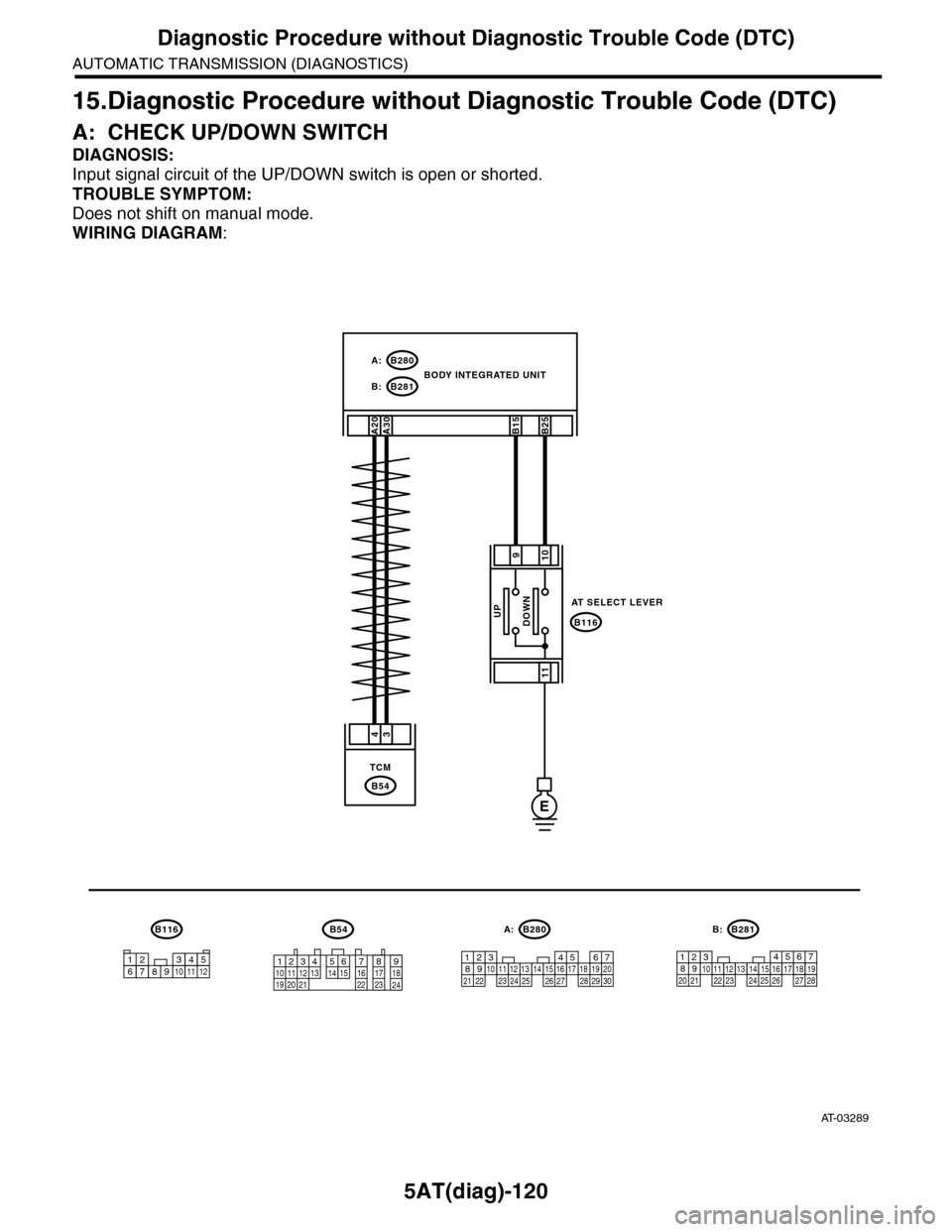
15.Diagnostic Procedure without Diagnostic Trouble Code (DTC)
A: CHECK UP/DOWN SWITCH
DIAGNOSIS:
Input signal circuit of the UP/DOWN switch is open or shorted.
TROUBLE SYMPTOM:
Does not shift on manual mode.
WIRING DIAGRAM:
AT-03289
B54
TCM
43
A20A30
910
11
B15B25
E
B280
B281B:
A:
B116
B54
12789563410 11 1219 20 2113 14 15 16 17 18222324
B280
5467821931022 231112131415242526 2716171828 29192021 30
A:B281
567821943102422 23 25111213141526 27281617181920 21
B:
AT S E L E C T L E V E R
BODY INTEGRATED UNIT
B116
1523467891011 12
UPDOWN
Page 2238 of 2453
5AT(diag)-121
Diagnostic Procedure without Diagnostic Trouble Code (DTC)
AUTOMATIC TRANSMISSION (DIAGNOSTICS)
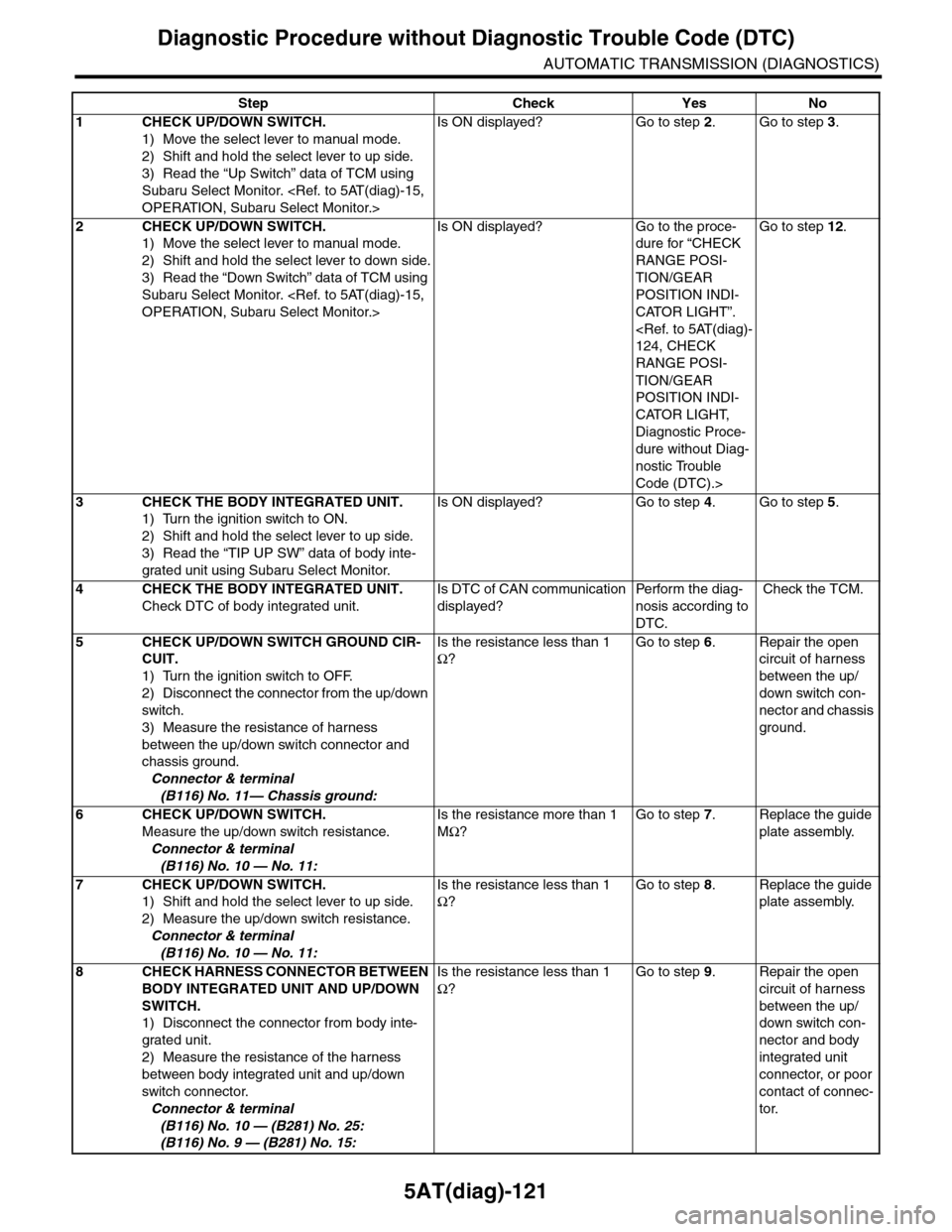
Step Check Yes No
1CHECK UP/DOWN SWITCH.
1) Move the select lever to manual mode.
2) Shift and hold the select lever to up side.
3) Read the “Up Switch” data of TCM using
Subaru Select Monitor.
Is ON displayed? Go to step 2.Go to step 3.
2CHECK UP/DOWN SWITCH.
1) Move the select lever to manual mode.
2) Shift and hold the select lever to down side.
3) Read the “Down Switch” data of TCM using
Subaru Select Monitor.
Is ON displayed? Go to the proce-
dure for “CHECK
RANGE POSI-
TION/GEAR
POSITION INDI-
CATOR LIGHT”.
RANGE POSI-
TION/GEAR
POSITION INDI-
CATOR LIGHT,
Diagnostic Proce-
dure without Diag-
nostic Trouble
Code (DTC).>
Go to step 12.
3CHECK THE BODY INTEGRATED UNIT.
1) Turn the ignition switch to ON.
2) Shift and hold the select lever to up side.
3) Read the “TIP UP SW” data of body inte-
grated unit using Subaru Select Monitor.
Is ON displayed? Go to step 4.Go to step 5.
4CHECK THE BODY INTEGRATED UNIT.
Check DTC of body integrated unit.
Is DTC of CAN communication
displayed?
Pe r for m t h e d ia g -
nosis according to
DTC.
Check the TCM.
5CHECK UP/DOWN SWITCH GROUND CIR-
CUIT.
1) Turn the ignition switch to OFF.
2) Disconnect the connector from the up/down
switch.
3) Measure the resistance of harness
between the up/down switch connector and
chassis ground.
Connector & terminal
(B116) No. 11— Chassis ground:
Is the resistance less than 1
Ω?
Go to step 6.Repair the open
circuit of harness
between the up/
down switch con-
nector and chassis
ground.
6CHECK UP/DOWN SWITCH.
Measure the up/down switch resistance.
Connector & terminal
(B116) No. 10 — No. 11:
Is the resistance more than 1
MΩ?
Go to step 7.Replace the guide
plate assembly.
7CHECK UP/DOWN SWITCH.
1) Shift and hold the select lever to up side.
2) Measure the up/down switch resistance.
Connector & terminal
(B116) No. 10 — No. 11:
Is the resistance less than 1
Ω?
Go to step 8.Replace the guide
plate assembly.
8CHECK HARNESS CONNECTOR BETWEEN
BODY INTEGRATED UNIT AND UP/DOWN
SWITCH.
1) Disconnect the connector from body inte-
grated unit.
2) Measure the resistance of the harness
between body integrated unit and up/down
switch connector.
Connector & terminal
(B116) No. 10 — (B281) No. 25:
(B116) No. 9 — (B281) No. 15:
Is the resistance less than 1
Ω?
Go to step 9.Repair the open
circuit of harness
between the up/
down switch con-
nector and body
integrated unit
connector, or poor
contact of connec-
tor.
Page 2242 of 2453
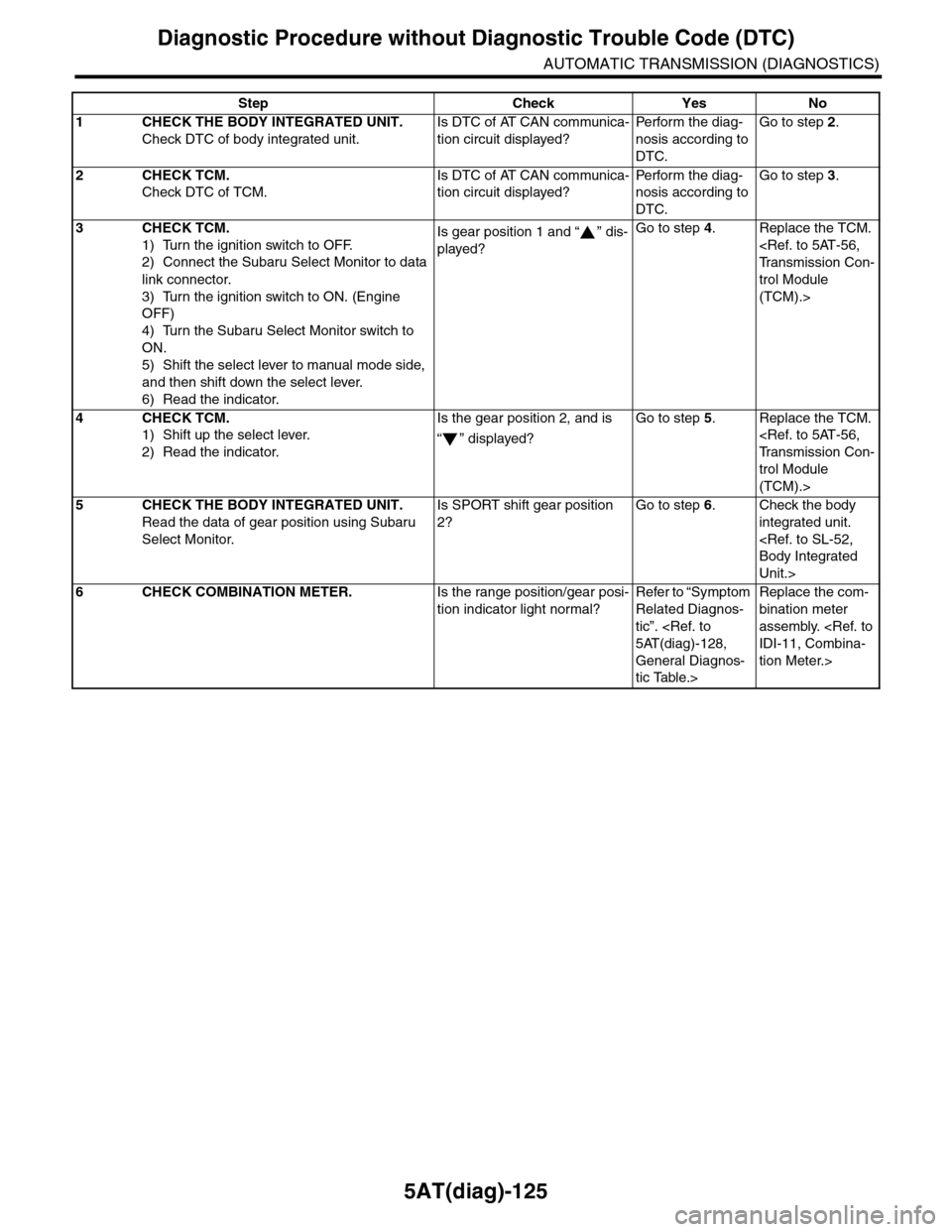
5AT(diag)-125
Diagnostic Procedure without Diagnostic Trouble Code (DTC)
AUTOMATIC TRANSMISSION (DIAGNOSTICS)
Step Check Yes No
1CHECK THE BODY INTEGRATED UNIT.
Check DTC of body integrated unit.
Is DTC of AT CAN communica-
tion circuit displayed?
Pe r for m t h e d ia g -
nosis according to
DTC.
Go to step 2.
2CHECK TCM.
Check DTC of TCM.
Is DTC of AT CAN communica-
tion circuit displayed?
Pe r for m t h e d ia g -
nosis according to
DTC.
Go to step 3.
3CHECK TCM.
1) Turn the ignition switch to OFF.
2) Connect the Subaru Select Monitor to data
link connector.
3) Turn the ignition switch to ON. (Engine
OFF)
4) Turn the Subaru Select Monitor switch to
ON.
5) Shift the select lever to manual mode side,
and then shift down the select lever.
6) Read the indicator.
Is gear position 1 and “ ” dis-
played?
Go to step 4.Replace the TCM.
trol Module
(TCM).>
4CHECK TCM.
1) Shift up the select lever.
2) Read the indicator.
Is the gear position 2, and is
“” displayed?
Go to step 5.Replace the TCM.
trol Module
(TCM).>
5CHECK THE BODY INTEGRATED UNIT.
Read the data of gear position using Subaru
Select Monitor.
Is SPORT shift gear position
2?
Go to step 6.Check the body
integrated unit.
Unit.>
6CHECK COMBINATION METER.Is the range position/gear posi-
tion indicator light normal?
Refer to “Symptom
Related Diagnos-
tic”.
General Diagnos-
tic Table.>
Replace the com-
bination meter
assembly.
tion Meter.>
Page 2245 of 2453
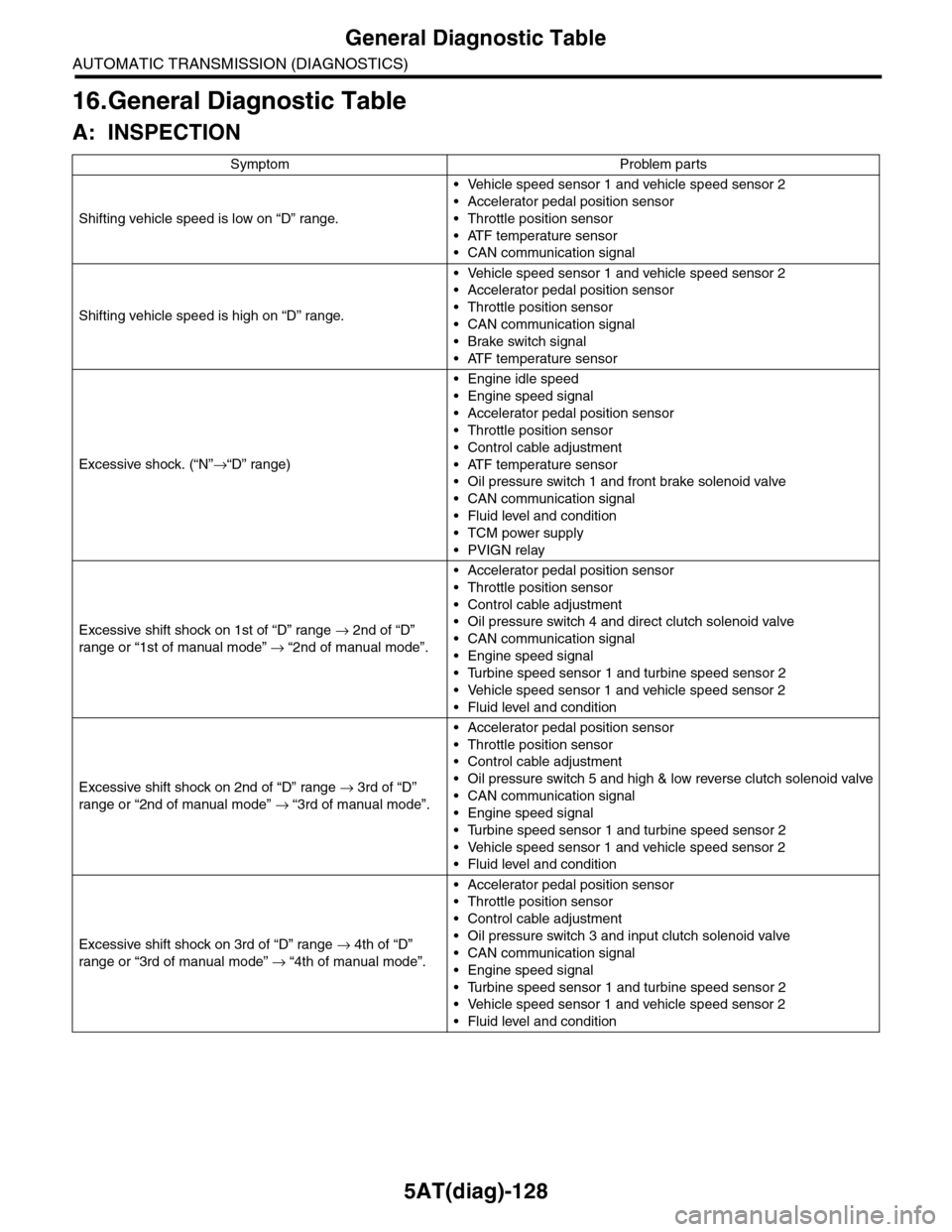
5AT(diag)-128
General Diagnostic Table
AUTOMATIC TRANSMISSION (DIAGNOSTICS)
16.General Diagnostic Table
A: INSPECTION
Symptom Problem parts
Shifting vehicle speed is low on “D” range.
•Vehicle speed sensor 1 and vehicle speed sensor 2
•Accelerator pedal position sensor
•Throttle position sensor
•ATF temperature sensor
•CAN communication signal
Shifting vehicle speed is high on “D” range.
•Vehicle speed sensor 1 and vehicle speed sensor 2
•Accelerator pedal position sensor
•Throttle position sensor
•CAN communication signal
•Brake switch signal
•ATF temperature sensor
Excessive shock. (“N”→“D” range)
•Engine idle speed
•Engine speed signal
•Accelerator pedal position sensor
•Throttle position sensor
•Control cable adjustment
•ATF temperature sensor
•Oil pressure switch 1 and front brake solenoid valve
•CAN communication signal
•Fluid level and condition
•TCM power supply
•PVIGN relay
Excessive shift shock on 1st of “D” range → 2nd of “D”
range or “1st of manual mode” → “2nd of manual mode”.
•Accelerator pedal position sensor
•Throttle position sensor
•Control cable adjustment
•Oil pressure switch 4 and direct clutch solenoid valve
•CAN communication signal
•Engine speed signal
•Turbine speed sensor 1 and turbine speed sensor 2
•Vehicle speed sensor 1 and vehicle speed sensor 2
•Fluid level and condition
Excessive shift shock on 2nd of “D” range → 3rd of “D”
range or “2nd of manual mode” → “3rd of manual mode”.
•Accelerator pedal position sensor
•Throttle position sensor
•Control cable adjustment
•Oil pressure switch 5 and high & low reverse clutch solenoid valve
•CAN communication signal
•Engine speed signal
•Turbine speed sensor 1 and turbine speed sensor 2
•Vehicle speed sensor 1 and vehicle speed sensor 2
•Fluid level and condition
Excessive shift shock on 3rd of “D” range → 4th of “D”
range or “3rd of manual mode” → “4th of manual mode”.
•Accelerator pedal position sensor
•Throttle position sensor
•Control cable adjustment
•Oil pressure switch 3 and input clutch solenoid valve
•CAN communication signal
•Engine speed signal
•Turbine speed sensor 1 and turbine speed sensor 2
•Vehicle speed sensor 1 and vehicle speed sensor 2
•Fluid level and condition
Page 2246 of 2453
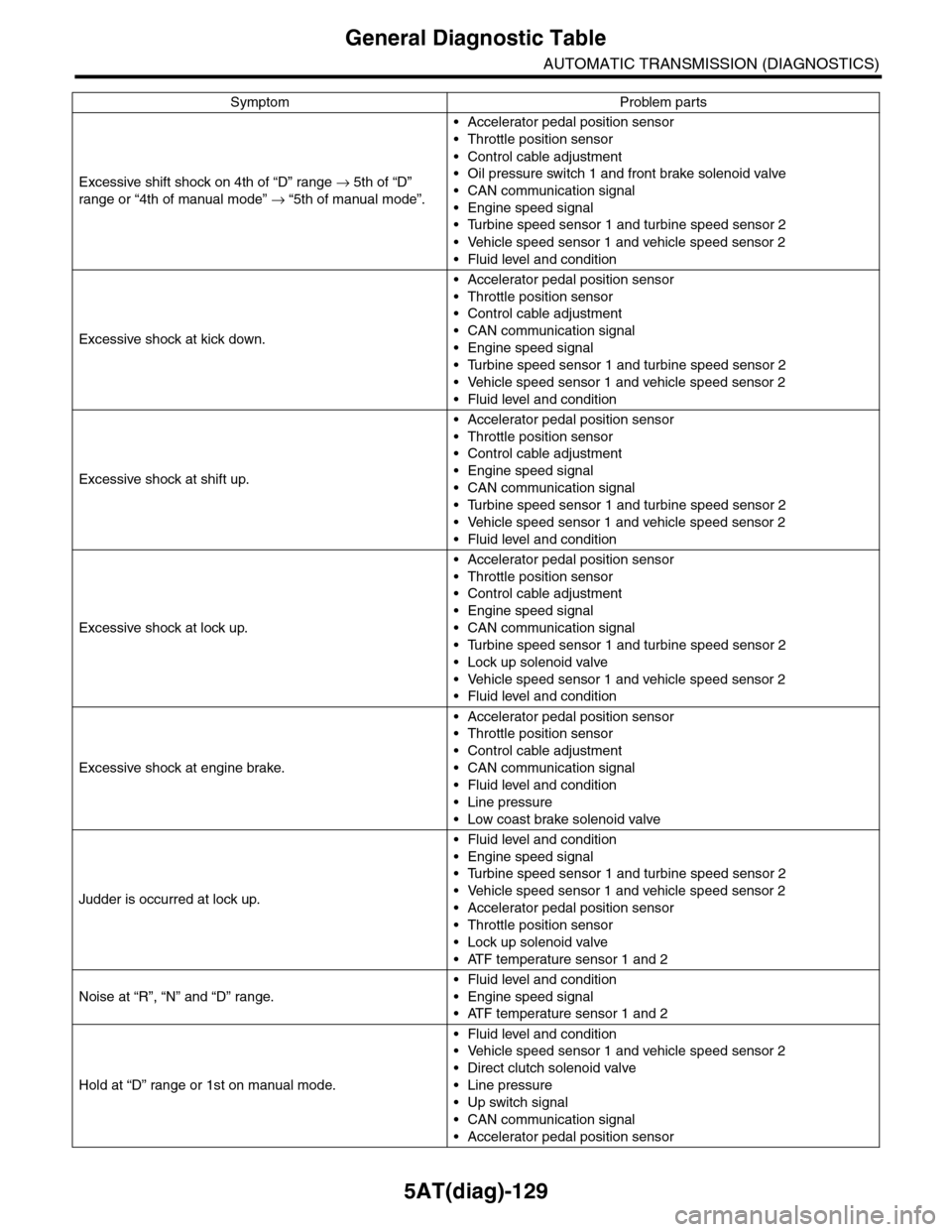
5AT(diag)-129
General Diagnostic Table
AUTOMATIC TRANSMISSION (DIAGNOSTICS)
Excessive shift shock on 4th of “D” range → 5th of “D”
range or “4th of manual mode” → “5th of manual mode”.
•Accelerator pedal position sensor
•Throttle position sensor
•Control cable adjustment
•Oil pressure switch 1 and front brake solenoid valve
•CAN communication signal
•Engine speed signal
•Turbine speed sensor 1 and turbine speed sensor 2
•Vehicle speed sensor 1 and vehicle speed sensor 2
•Fluid level and condition
Excessive shock at kick down.
•Accelerator pedal position sensor
•Throttle position sensor
•Control cable adjustment
•CAN communication signal
•Engine speed signal
•Turbine speed sensor 1 and turbine speed sensor 2
•Vehicle speed sensor 1 and vehicle speed sensor 2
•Fluid level and condition
Excessive shock at shift up.
•Accelerator pedal position sensor
•Throttle position sensor
•Control cable adjustment
•Engine speed signal
•CAN communication signal
•Turbine speed sensor 1 and turbine speed sensor 2
•Vehicle speed sensor 1 and vehicle speed sensor 2
•Fluid level and condition
Excessive shock at lock up.
•Accelerator pedal position sensor
•Throttle position sensor
•Control cable adjustment
•Engine speed signal
•CAN communication signal
•Turbine speed sensor 1 and turbine speed sensor 2
•Lock up solenoid valve
•Vehicle speed sensor 1 and vehicle speed sensor 2
•Fluid level and condition
Excessive shock at engine brake.
•Accelerator pedal position sensor
•Throttle position sensor
•Control cable adjustment
•CAN communication signal
•Fluid level and condition
•Line pressure
•Low coast brake solenoid valve
Judder is occurred at lock up.
•Fluid level and condition
•Engine speed signal
•Turbine speed sensor 1 and turbine speed sensor 2
•Vehicle speed sensor 1 and vehicle speed sensor 2
•Accelerator pedal position sensor
•Throttle position sensor
•Lock up solenoid valve
•ATF temperature sensor 1 and 2
Noise at “R”, “N” and “D” range.
•Fluid level and condition
•Engine speed signal
•ATF temperature sensor 1 and 2
Hold at “D” range or 1st on manual mode.
•Fluid level and condition
•Vehicle speed sensor 1 and vehicle speed sensor 2
•Direct clutch solenoid valve
•Line pressure
•Up switch signal
•CAN communication signal
•Accelerator pedal position sensor
Symptom Problem parts
Page 2247 of 2453
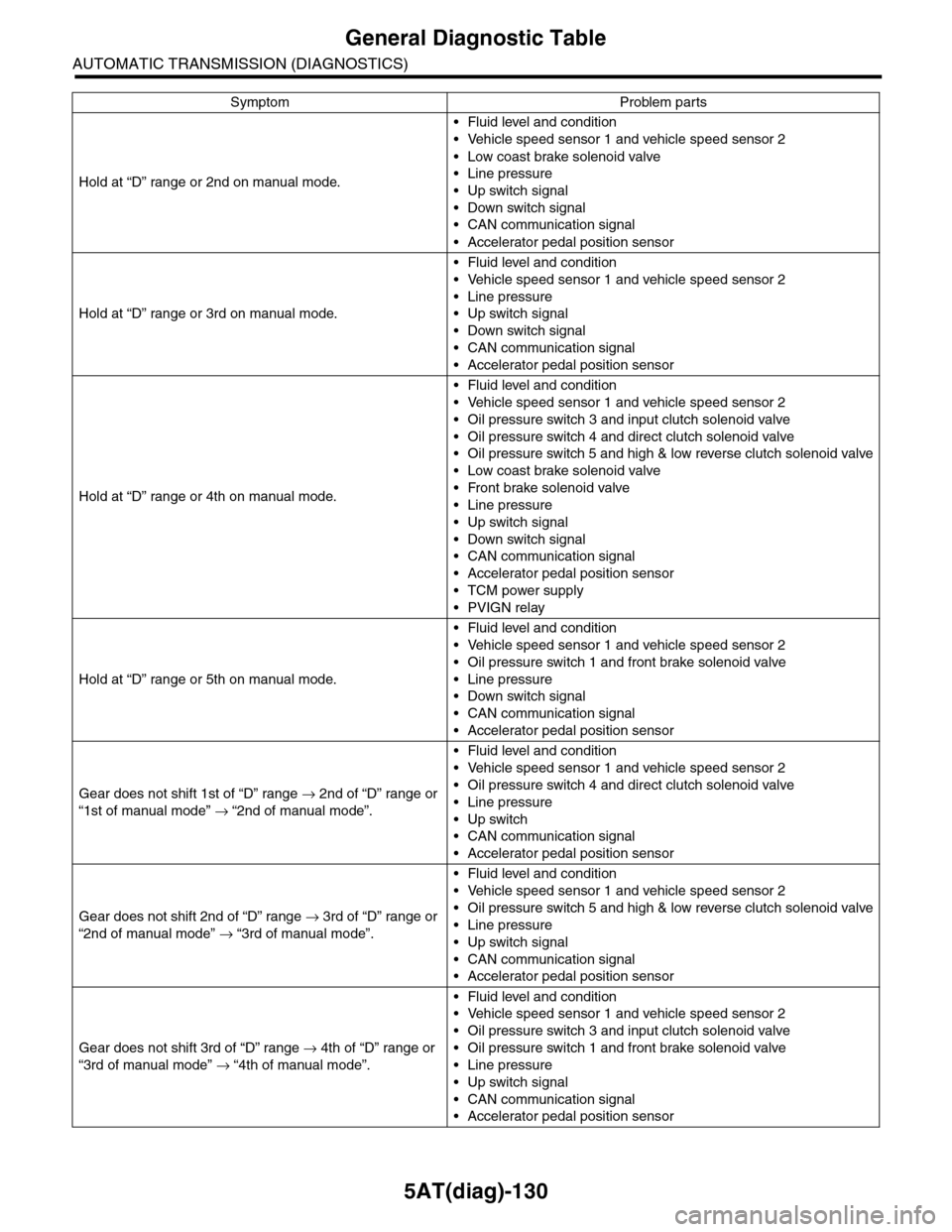
5AT(diag)-130
General Diagnostic Table
AUTOMATIC TRANSMISSION (DIAGNOSTICS)
Hold at “D” range or 2nd on manual mode.
•Fluid level and condition
•Vehicle speed sensor 1 and vehicle speed sensor 2
•Low coast brake solenoid valve
•Line pressure
•Up switch signal
•Down switch signal
•CAN communication signal
•Accelerator pedal position sensor
Hold at “D” range or 3rd on manual mode.
•Fluid level and condition
•Vehicle speed sensor 1 and vehicle speed sensor 2
•Line pressure
•Up switch signal
•Down switch signal
•CAN communication signal
•Accelerator pedal position sensor
Hold at “D” range or 4th on manual mode.
•Fluid level and condition
•Vehicle speed sensor 1 and vehicle speed sensor 2
•Oil pressure switch 3 and input clutch solenoid valve
•Oil pressure switch 4 and direct clutch solenoid valve
•Oil pressure switch 5 and high & low reverse clutch solenoid valve
•Low coast brake solenoid valve
•Front brake solenoid valve
•Line pressure
•Up switch signal
•Down switch signal
•CAN communication signal
•Accelerator pedal position sensor
•TCM power supply
•PVIGN relay
Hold at “D” range or 5th on manual mode.
•Fluid level and condition
•Vehicle speed sensor 1 and vehicle speed sensor 2
•Oil pressure switch 1 and front brake solenoid valve
•Line pressure
•Down switch signal
•CAN communication signal
•Accelerator pedal position sensor
Gear does not shift 1st of “D” range → 2nd of “D” range or
“1st of manual mode” → “2nd of manual mode”.
•Fluid level and condition
•Vehicle speed sensor 1 and vehicle speed sensor 2
•Oil pressure switch 4 and direct clutch solenoid valve
•Line pressure
•Up switch
•CAN communication signal
•Accelerator pedal position sensor
Gear does not shift 2nd of “D” range → 3rd of “D” range or
“2nd of manual mode” → “3rd of manual mode”.
•Fluid level and condition
•Vehicle speed sensor 1 and vehicle speed sensor 2
•Oil pressure switch 5 and high & low reverse clutch solenoid valve
•Line pressure
•Up switch signal
•CAN communication signal
•Accelerator pedal position sensor
Gear does not shift 3rd of “D” range → 4th of “D” range or
“3rd of manual mode” → “4th of manual mode”.
•Fluid level and condition
•Vehicle speed sensor 1 and vehicle speed sensor 2
•Oil pressure switch 3 and input clutch solenoid valve
•Oil pressure switch 1 and front brake solenoid valve
•Line pressure
•Up switch signal
•CAN communication signal
•Accelerator pedal position sensor
Symptom Problem parts