Page 540 of 2453
LI-7
Stop Light System
LIGHTING SYSTEM
6. Stop Light System
A: WIRING DIAGRAM
1. STOP LIGHT
System.>
B: INSPECTION
1. STOP LIGHT SWITCH
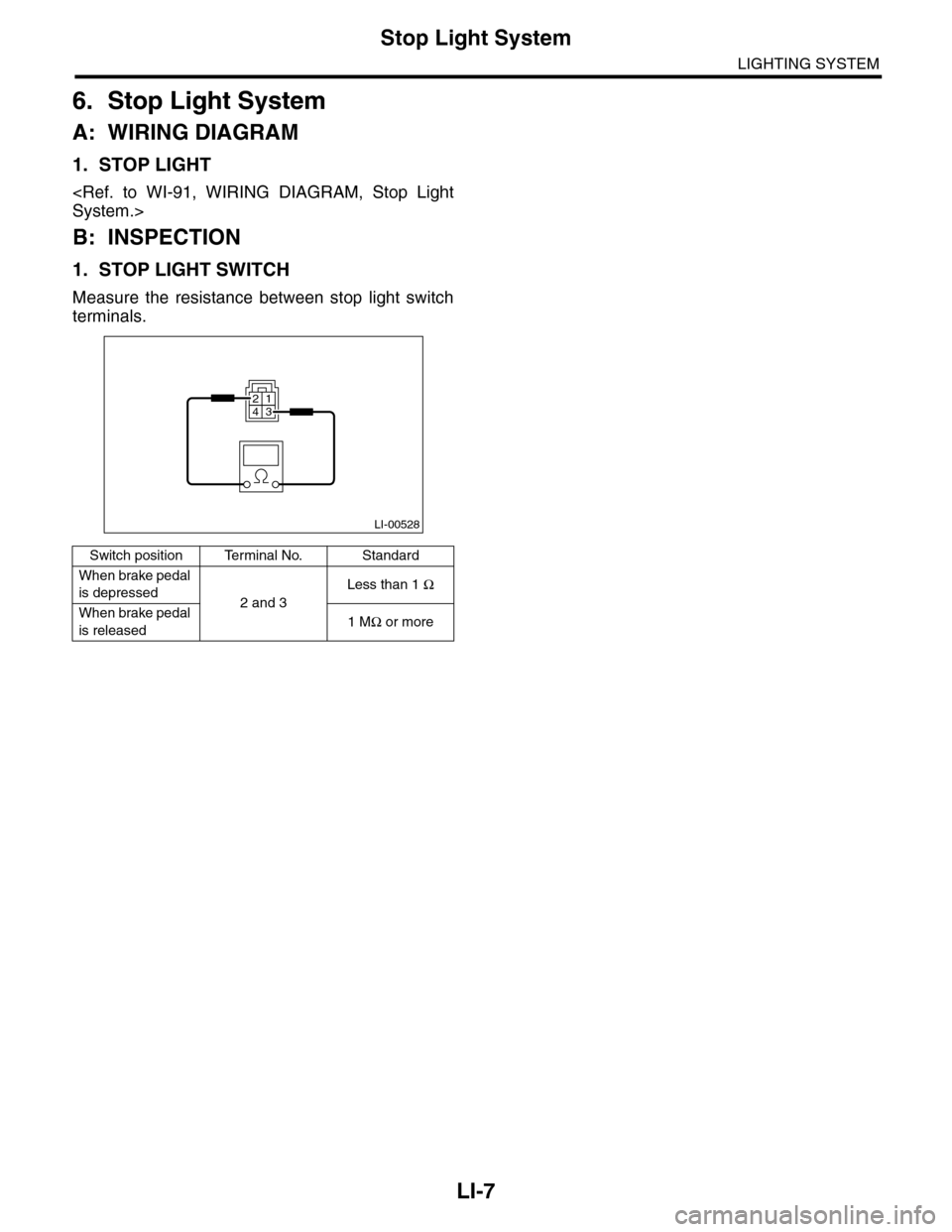
Measure the resistance between stop light switch
terminals.
Switch position Terminal No. Standard
When brake pedal
is depressed2 and 3
Less than 1 Ω
When brake pedal
is released1 MΩ or more
LI-00528
3412
Page 723 of 2453
BR-9
General Description
BRAKE
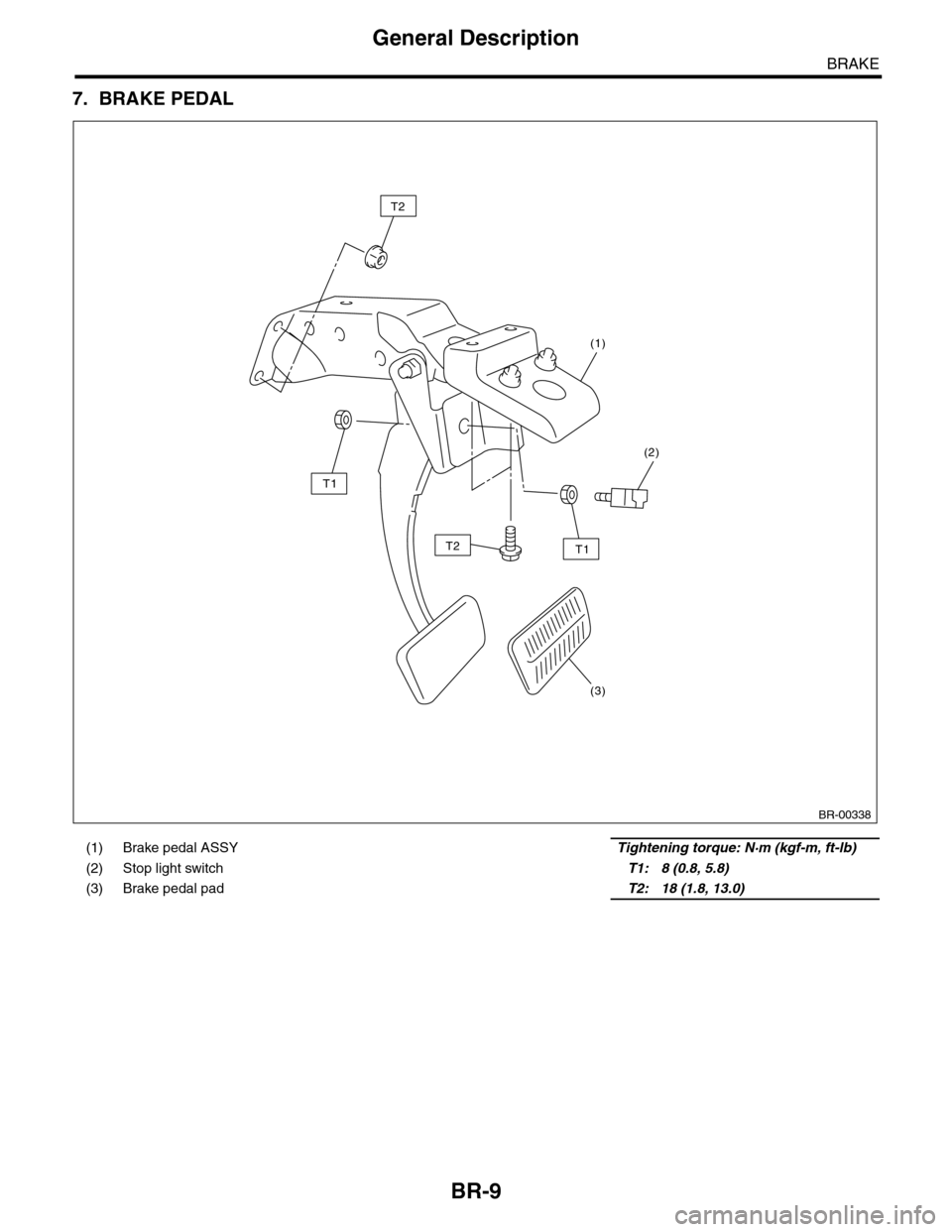
7. BRAKE PEDAL
(1) Brake pedal ASSY Tightening torque: N·m (kgf-m, ft-lb)
(2) Stop light switch T1: 8 (0.8, 5.8)
(3) Brake pedal pad T2: 18 (1.8, 13.0)
BR-00338
T2
T1
T2T1
(1)
(2)
(3)
Page 741 of 2453
BR-27
Brake Booster
BRAKE
B: INSTALLATION
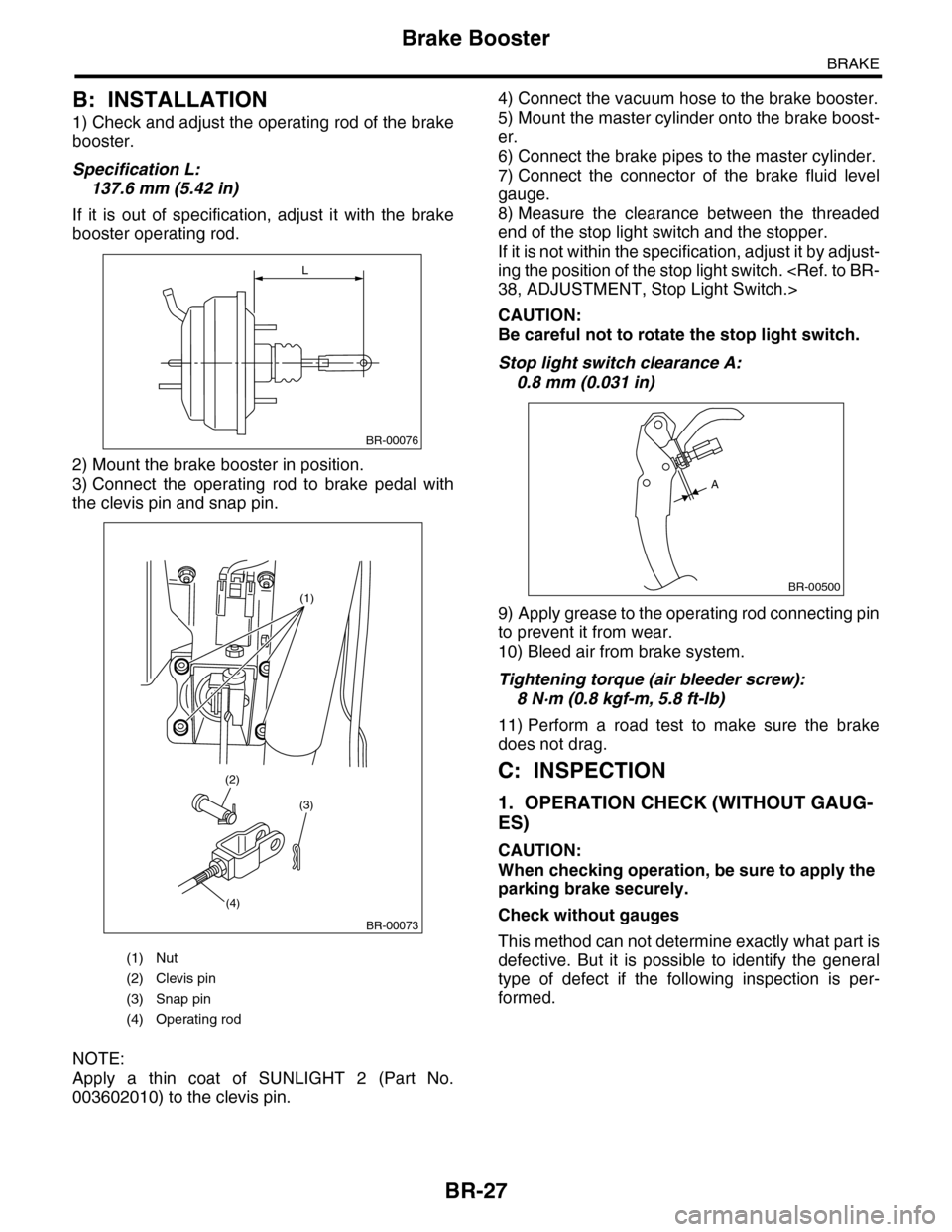
1) Check and adjust the operating rod of the brake
booster.
Specification L:
137.6 mm (5.42 in)
If it is out of specification, adjust it with the brake
booster operating rod.
2) Mount the brake booster in position.
3) Connect the operating rod to brake pedal with
the clevis pin and snap pin.
NOTE:
Apply a thin coat of SUNLIGHT 2 (Part No.
003602010) to the clevis pin.
4) Connect the vacuum hose to the brake booster.
5) Mount the master cylinder onto the brake boost-
er.
6) Connect the brake pipes to the master cylinder.
7) Connect the connector of the brake fluid level
gauge.
8) Measure the clearance between the threaded
end of the stop light switch and the stopper.
If it is not within the specification, adjust it by adjust-
ing the position of the stop light switch.
38, ADJUSTMENT, Stop Light Switch.>
CAUTION:
Be careful not to rotate the stop light switch.
Stop light switch clearance A:
0.8 mm (0.031 in)
9) Apply grease to the operating rod connecting pin
to prevent it from wear.
10) Bleed air from brake system.
Tightening torque (air bleeder screw):
8 N·m (0.8 kgf-m, 5.8 ft-lb)
11) Perform a road test to make sure the brake
does not drag.
C: INSPECTION
1. OPERATION CHECK (WITHOUT GAUG-
ES)
CAUTION:
When checking operation, be sure to apply the
parking brake securely.
Check without gauges
This method can not determine exactly what part is
defective. But it is possible to identify the general
type of defect if the following inspection is per-
formed.
(1) Nut
(2) Clevis pin
(3) Snap pin
(4) Operating rod
L
BR-00076
(1)
(3)
(4)
(2)
BR-00073
BR-00500
A
Page 750 of 2453
BR-36
Brake Pedal
BRAKE
14.Brake Pedal
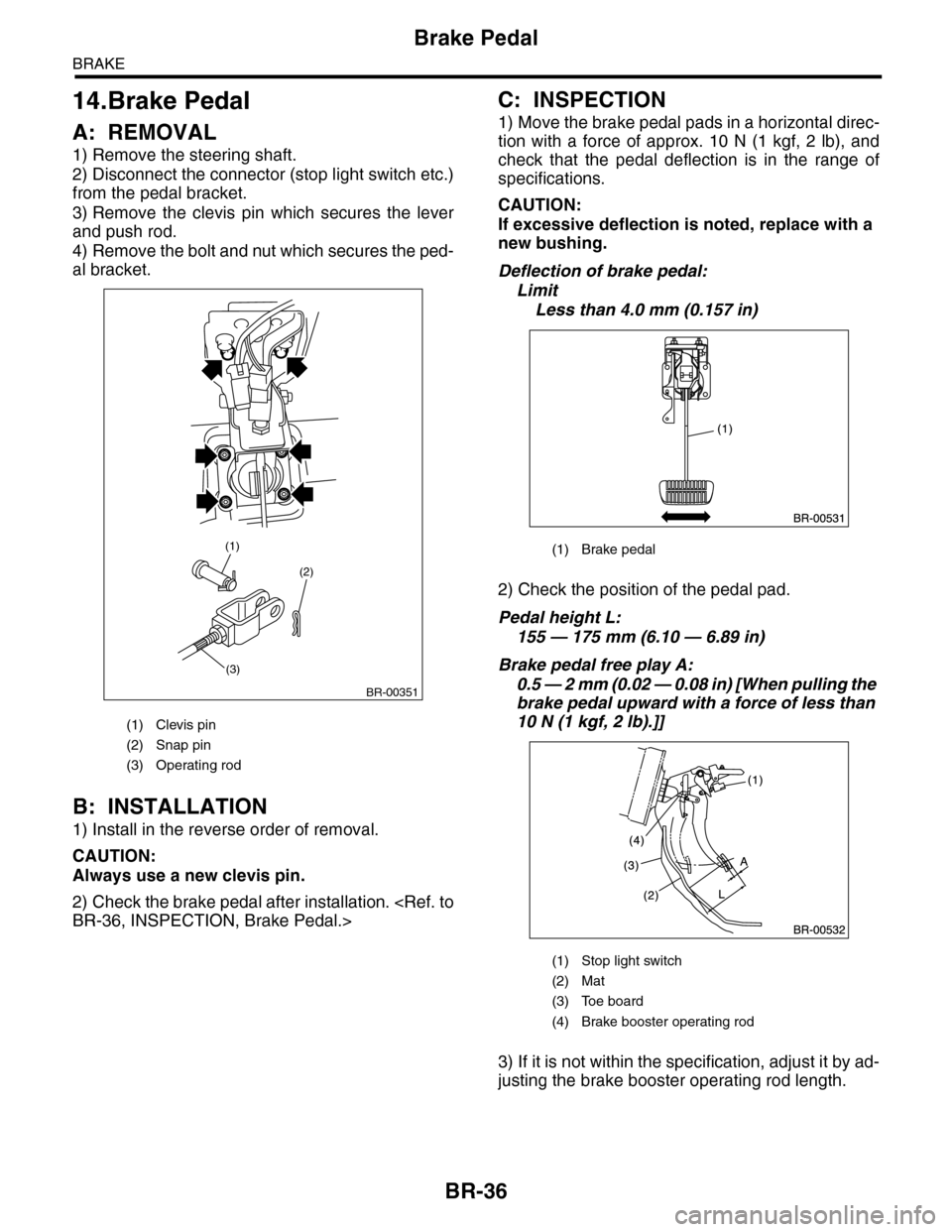
A: REMOVAL
1) Remove the steering shaft.
2) Disconnect the connector (stop light switch etc.)
from the pedal bracket.
3) Remove the clevis pin which secures the lever
and push rod.
4) Remove the bolt and nut which secures the ped-
al bracket.
B: INSTALLATION
1) Install in the reverse order of removal.
CAUTION:
Always use a new clevis pin.
2) Check the brake pedal after installation.
BR-36, INSPECTION, Brake Pedal.>
C: INSPECTION
1) Move the brake pedal pads in a horizontal direc-
tion with a force of approx. 10 N (1 kgf, 2 lb), and
check that the pedal deflection is in the range of
specifications.
CAUTION:
If excessive deflection is noted, replace with a
new bushing.
Deflection of brake pedal:
Limit
Less than 4.0 mm (0.157 in)
2) Check the position of the pedal pad.
Pedal height L:
155 — 175 mm (6.10 — 6.89 in)
Brake pedal free play A:
0.5 — 2 mm (0.02 — 0.08 in) [When pulling the
brake pedal upward with a force of less than
10 N (1 kgf, 2 lb).]]
3) If it is not within the specification, adjust it by ad-
justing the brake booster operating rod length.
(1) Clevis pin
(2) Snap pin
(3) Operating rod
(2)
(3)
(1)
BR-00351
(1) Brake pedal
(1) Stop light switch
(2) Mat
(3) Toe board
(4) Brake booster operating rod
Page 751 of 2453
BR-37
Stop Light Switch
BRAKE
15.Stop Light Switch
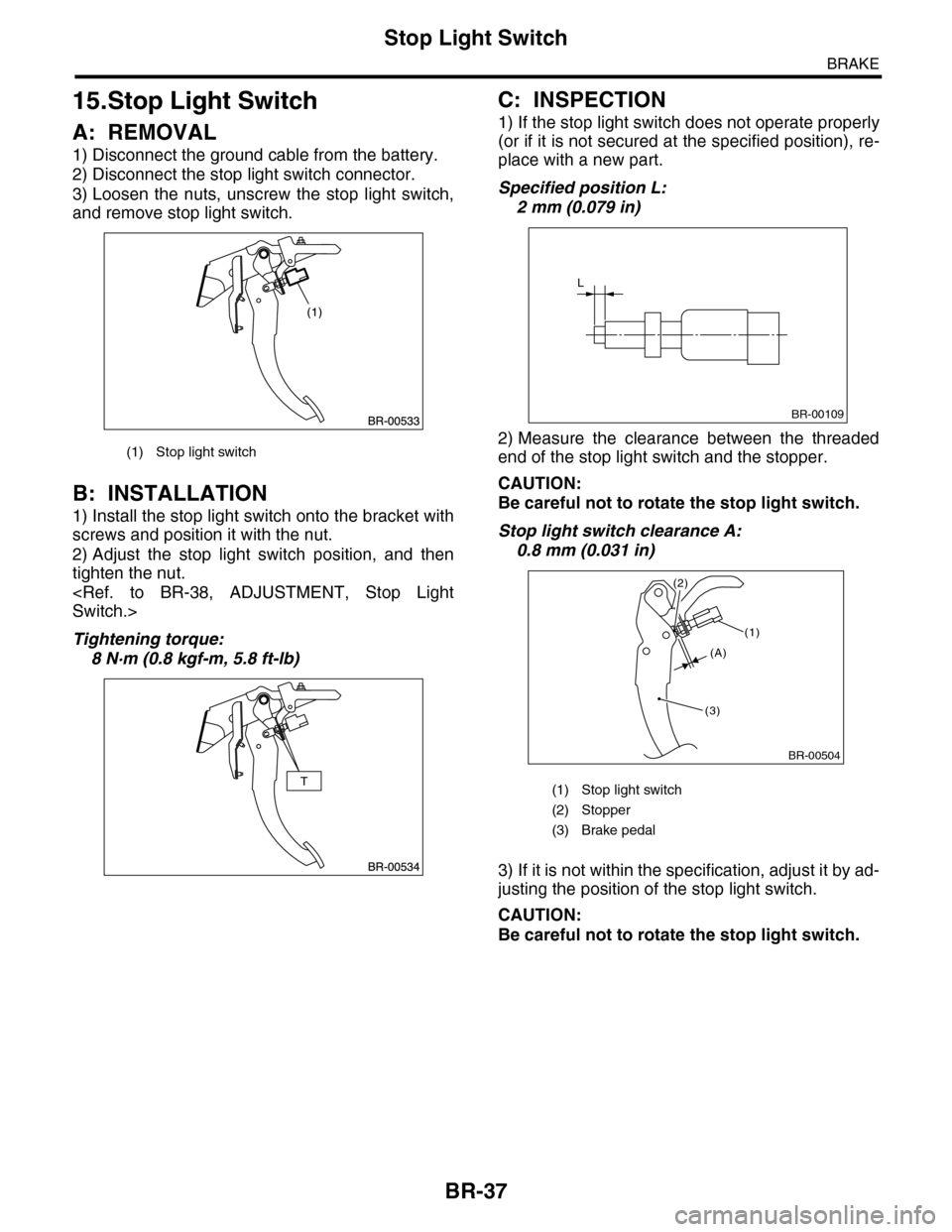
A: REMOVAL
1) Disconnect the ground cable from the battery.
2) Disconnect the stop light switch connector.
3) Loosen the nuts, unscrew the stop light switch,
and remove stop light switch.
B: INSTALLATION
1) Install the stop light switch onto the bracket with
screws and position it with the nut.
2) Adjust the stop light switch position, and then
tighten the nut.
Switch.>
Tightening torque:
8 N·m (0.8 kgf-m, 5.8 ft-lb)
C: INSPECTION
1) If the stop light switch does not operate properly
(or if it is not secured at the specified position), re-
place with a new part.
Specified position L:
2 mm (0.079 in)
2) Measure the clearance between the threaded
end of the stop light switch and the stopper.
CAUTION:
Be careful not to rotate the stop light switch.
Stop light switch clearance A:
0.8 mm (0.031 in)
3) If it is not within the specification, adjust it by ad-
justing the position of the stop light switch.
CAUTION:
Be careful not to rotate the stop light switch.
(1) Stop light switch
(1) Stop light switch
(2) Stopper
(3) Brake pedal
L
BR-00109
BR-00504
(1)
(3)
(2)
(A)
Page 752 of 2453
BR-38
Stop Light Switch
BRAKE
D: ADJUSTMENT
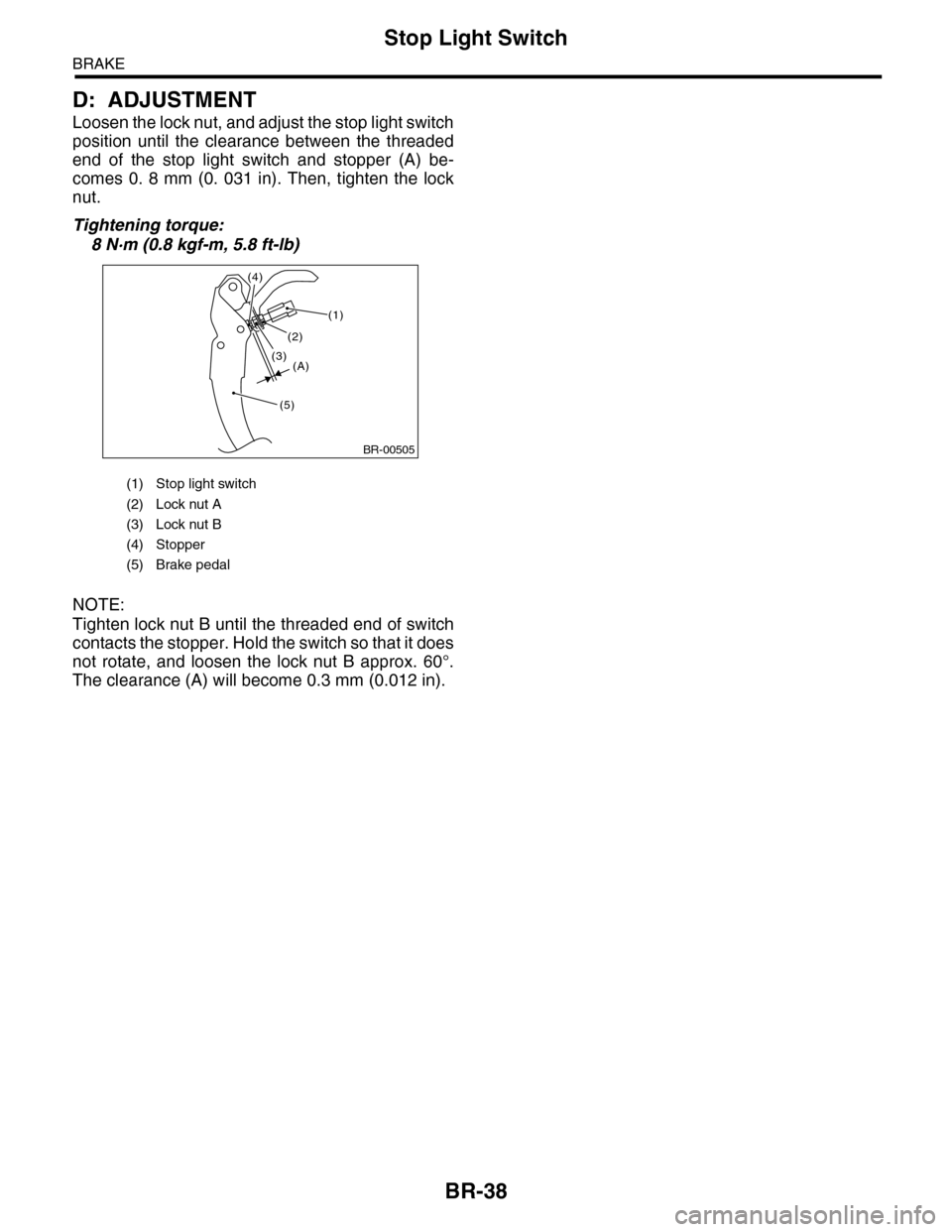
Loosen the lock nut, and adjust the stop light switch
position until the clearance between the threaded
end of the stop light switch and stopper (A) be-
comes 0. 8 mm (0. 031 in). Then, tighten the lock
nut.
Tightening torque:
8 N·m (0.8 kgf-m, 5.8 ft-lb)
NOTE:
Tighten lock nut B until the threaded end of switch
contacts the stopper. Hold the switch so that it does
not rotate, and loosen the lock nut B approx. 60°.
The clearance (A) will become 0.3 mm (0.012 in).
(1) Stop light switch
(2) Lock nut A
(3) Lock nut B
(4) Stopper
(5) Brake pedal
BR-00505
(1)
(5)
(4)
(A)(3)
(2)
Page 879 of 2453
PB-8
Parking Brake Assembly (Rear Disc Brake)
PARKING BRAKE
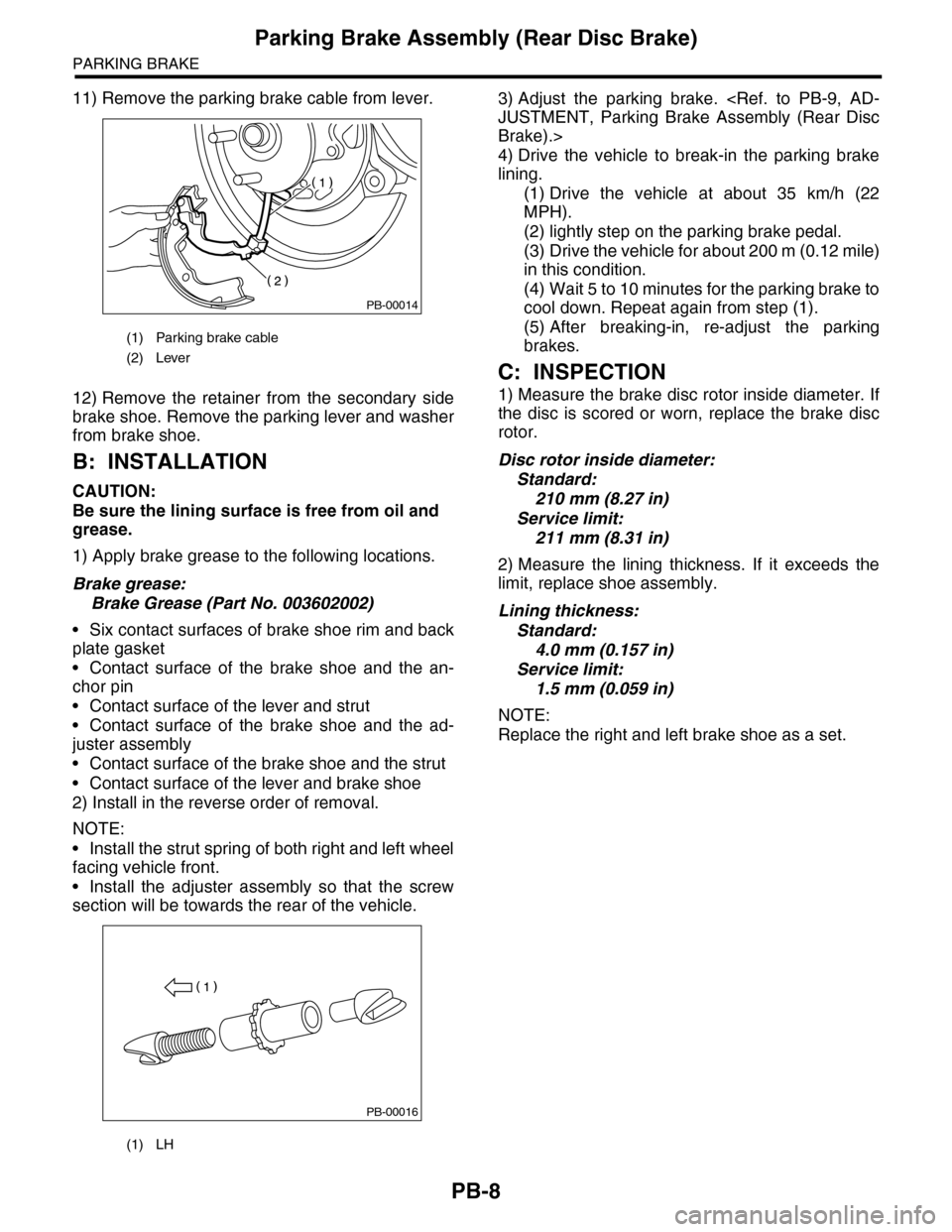
11) Remove the parking brake cable from lever.
12) Remove the retainer from the secondary side
brake shoe. Remove the parking lever and washer
from brake shoe.
B: INSTALLATION
CAUTION:
Be sure the lining surface is free from oil and
grease.
1) Apply brake grease to the following locations.
Brake grease:
Brake Grease (Part No. 003602002)
•Six contact surfaces of brake shoe rim and back
plate gasket
•Contact surface of the brake shoe and the an-
chor pin
•Contact surface of the lever and strut
•Contact surface of the brake shoe and the ad-
juster assembly
•Contact surface of the brake shoe and the strut
•Contact surface of the lever and brake shoe
2) Install in the reverse order of removal.
NOTE:
•Install the strut spring of both right and left wheel
facing vehicle front.
•Install the adjuster assembly so that the screw
section will be towards the rear of the vehicle.
3) Adjust the parking brake.
JUSTMENT, Parking Brake Assembly (Rear Disc
Brake).>
4) Drive the vehicle to break-in the parking brake
lining.
(1) Drive the vehicle at about 35 km/h (22
MPH).
(2) lightly step on the parking brake pedal.
(3) Drive the vehicle for about 200 m (0.12 mile)
in this condition.
(4) Wait 5 to 10 minutes for the parking brake to
cool down. Repeat again from step (1).
(5) After breaking-in, re-adjust the parking
brakes.
C: INSPECTION
1) Measure the brake disc rotor inside diameter. If
the disc is scored or worn, replace the brake disc
rotor.
Disc rotor inside diameter:
Standard:
210 mm (8.27 in)
Service limit:
211 mm (8.31 in)
2) Measure the lining thickness. If it exceeds the
limit, replace shoe assembly.
Lining thickness:
Standard:
4.0 mm (0.157 in)
Service limit:
1.5 mm (0.059 in)
NOTE:
Replace the right and left brake shoe as a set.
(1) Parking brake cable
(2) Lever
(1) LH
PB-00014
PB-00016
Page 919 of 2453

PS-39
Pipe Assembly
POWER ASSISTED SYSTEM (POWER STEERING)
C: INSPECTION
Check all disassembled parts for wear, damage or other problems. Repair or replace the defective parts as
necessary.
CAUTION:
Although the surface layer materials of rubber hoses have excellent weathering resistance, heat re-
sistance and resistance for low temperature brittleness, they are likely to be damaged chemically by
brake fluid, battery electrolyte, engine oil and automatic transmission fluid and their service lives are
to be very shortened. Wipe off hoses immediately if any of these come into contact with the hoses.
Since resistances for heat or low temperature brittleness are gradually declining according to time
accumulation of hot or cold conditions for the hoses and their service lives are shortening accord-
ingly, it is necessary to perform careful inspection frequently when the vehicle is used in hot weather
areas, cold weather areas and a driving condition in which many steering operations are required in
short time.
Particularly continuous work of relief valve over 5 seconds causes to reduce service lives of the hos-
es, the oil pump, the fluid, etc. due to over heat.
Par t Maintenance par ts Corrective action
Pipe
•O–ring fitting surface damage
•Nut damage
•Pipe damage
Replace with a new part.
Clamp • Loose clamps Replace with a new part.
Hose
•Flare surface damage
•Flare nut damage
•Outer surface cracks
•Outer surface wear
•Clip damage
•End coupling or adapter for deformation
Replace with a new part.
Tr o u b l e P o s s i b l e c a u s e C o r r e c t i v e a c t i o n
Pressure hose burst
Excessive holding time of relief status Instruct customers.
Malfunction of the relief valve Replace the oil pump.
Poor cold character istic of fluid R eplace fluid.
Disconnection of the return
hose
Improper connection Repair.
Loosening of the clip Retighten.
Poor cold character istic of fluid R eplace fluid.
Fluid slightly leaking out of
hose
Wrong layout, tensioned Replace the hose.
Excessive play of engine due to deterioration of
engine mounting rubberReplace the parts if defective.
Improper stop position of pitching stopper Replace the parts if defective.
Crack on hose
Excessive holding time of relief statusReplace.
Instruct customers.
Excessive tightening torque for return hose clip Replace.
Power steer ing fluid, engine oil, electrolyte adhere
on the hose surface
Replace.
Be careful during service work.
To o m a n y u s e s i n e x t r e m e l y c o l d w e a t h e rReplace.
Instruct customers.