Page 1681 of 2453
GD(H6DO)-69
Diagnostic Trouble Code (DTC) Detecting Criteria
GENERAL DESCRIPTION
AN:DTC P0134 O2 SENSOR CIRCUIT NO ACTIVITY DETECTED (BANK 1 SEN-
SOR 1)
1. OUTLINE OF DIAGNOSIS
Detect open circuits of the sensor.
Judge as NG when the impedance of the element is large.
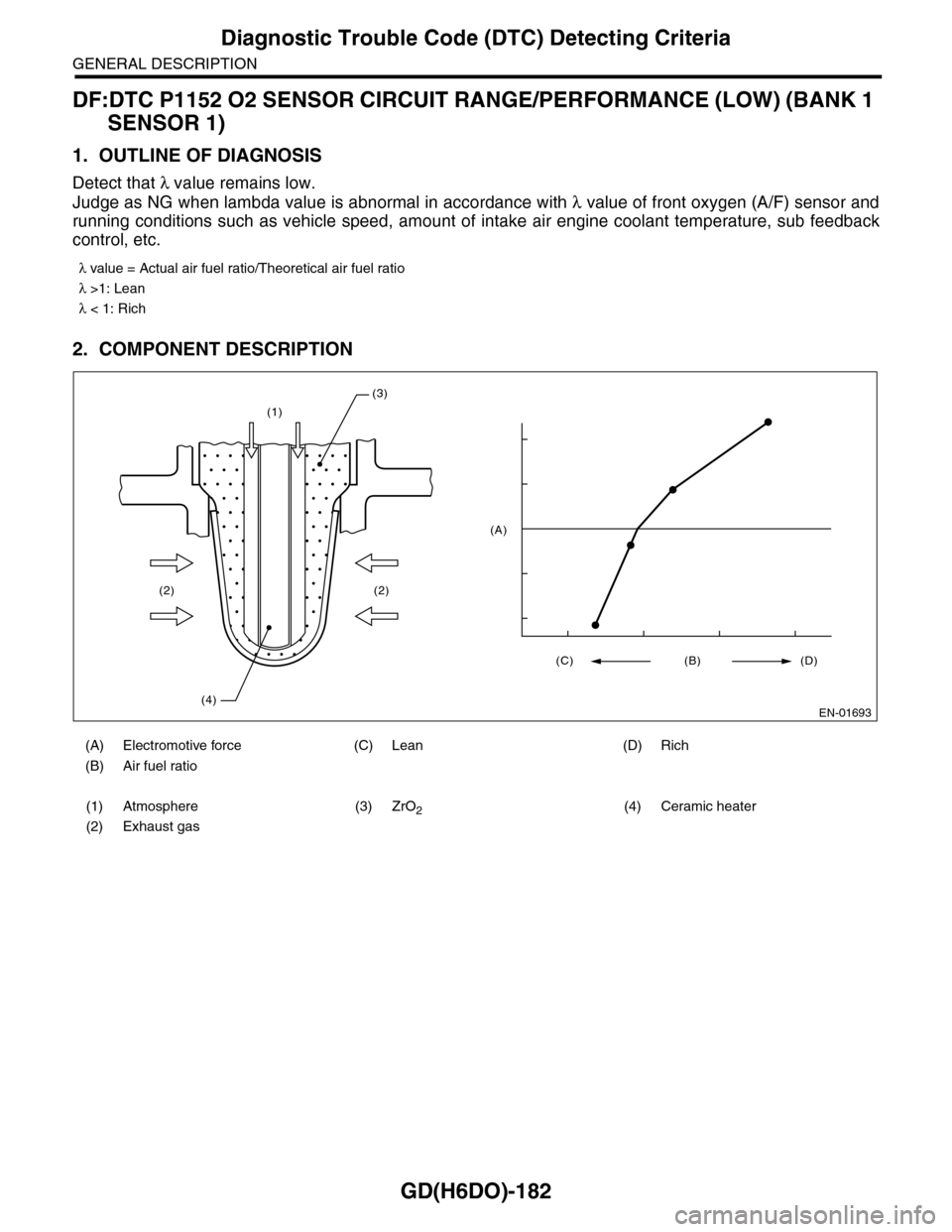
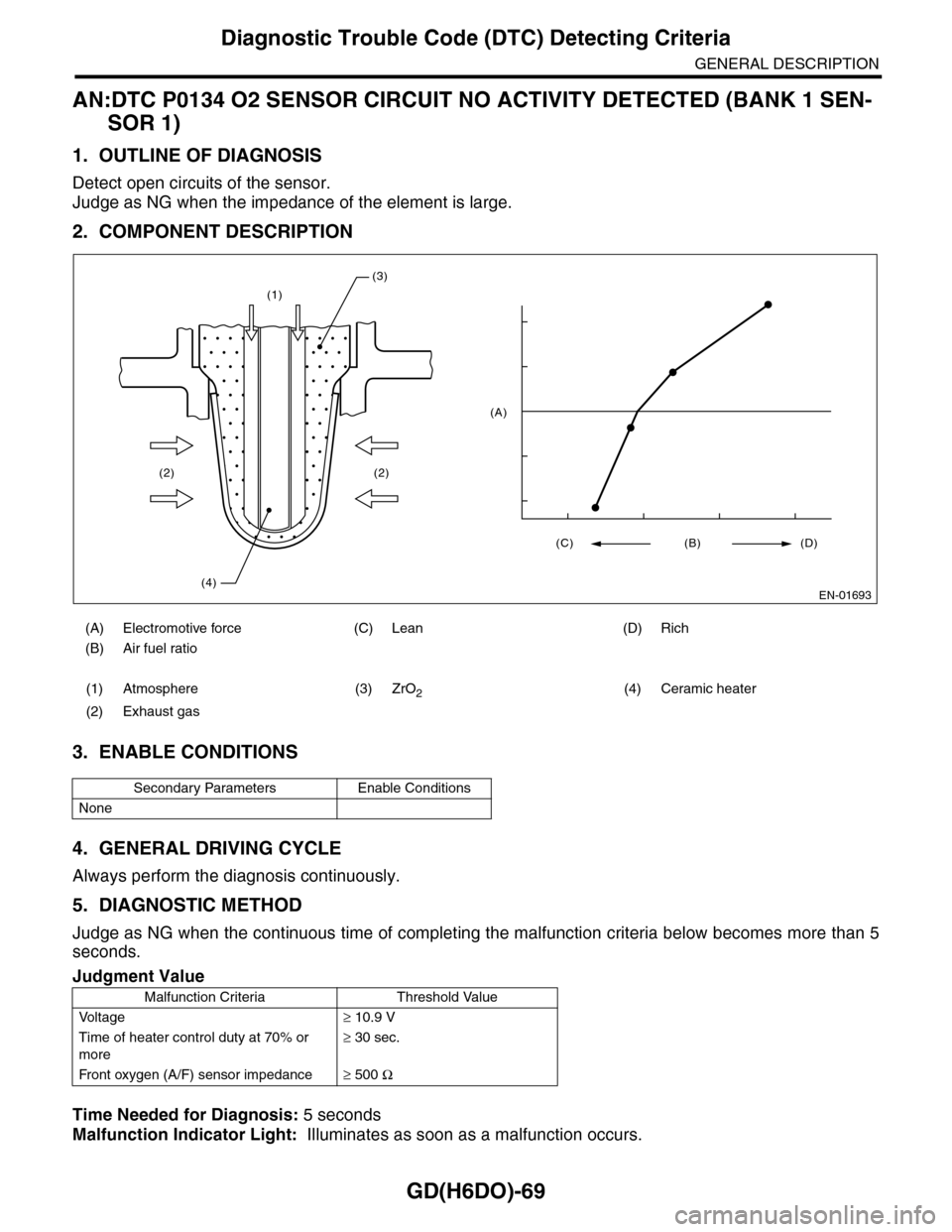
2. COMPONENT DESCRIPTION
3. ENABLE CONDITIONS
4. GENERAL DRIVING CYCLE
Always perform the diagnosis continuously.
5. DIAGNOSTIC METHOD
Judge as NG when the continuous time of completing the malfunction criteria below becomes more than 5
seconds.
Time Needed for Diagnosis: 5 seconds
Malfunction Indicator Light: Illuminates as soon as a malfunction occurs.
(A) Electromotive force (C) Lean (D) Rich
(B) Air fuel ratio
(1) Atmosphere (3) ZrO2(4) Ceramic heater
(2) Exhaust gas
Secondary Parameters Enable Conditions
None
Judgment Value
Malfunction Criteria Threshold Value
Vo l t a g e≥ 10.9 V
Time of heater control duty at 70% or
more
≥ 30 sec.
Fr o nt ox yg e n ( A / F) s en so r im pe d an c e≥ 500 Ω
(1)
(2)
(4)
(2)
(3)
EN-01693
(C) (B) (D)
(A)
Page 1684 of 2453
GD(H6DO)-72
Diagnostic Trouble Code (DTC) Detecting Criteria
GENERAL DESCRIPTION
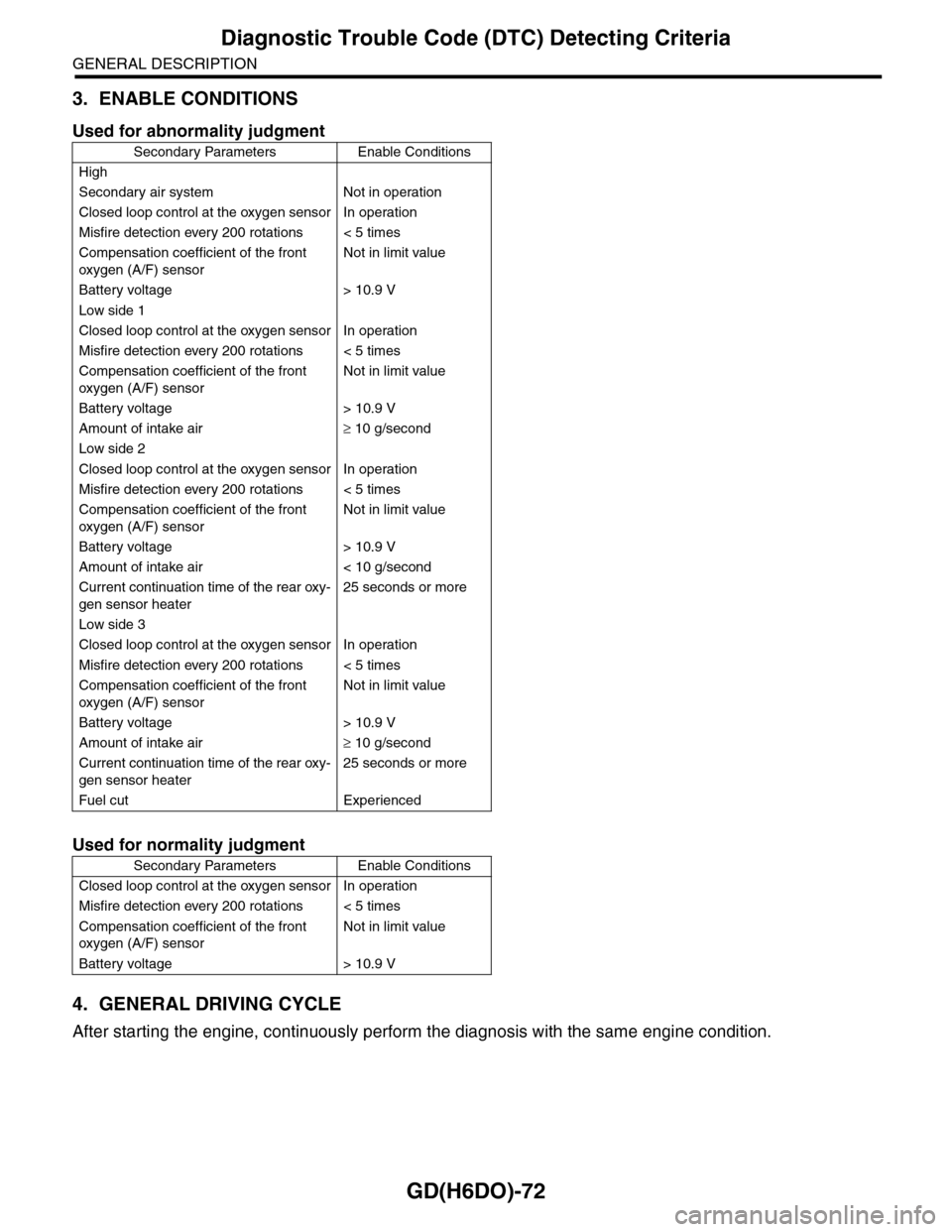
3. ENABLE CONDITIONS
4. GENERAL DRIVING CYCLE
After starting the engine, continuously perform the diagnosis with the same engine condition.
Used for abnormality judgment
Secondary Parameters Enable Conditions
High
Secondary air system Not in operation
Closed loop control at the oxygen sensor In operation
Misfire detection every 200 rotations < 5 times
Compensation coefficient of the front
oxygen (A/F) sensor
Not in limit value
Battery voltage > 10.9 V
Low side 1
Closed loop control at the oxygen sensor In operation
Misfire detection every 200 rotations < 5 times
Compensation coefficient of the front
oxygen (A/F) sensor
Not in limit value
Battery voltage > 10.9 V
Amount of intake air≥ 10 g/second
Low side 2
Closed loop control at the oxygen sensor In operation
Misfire detection every 200 rotations < 5 times
Compensation coefficient of the front
oxygen (A/F) sensor
Not in limit value
Battery voltage > 10.9 V
Amount of intake air < 10 g/second
Current continuation time of the rear oxy-
gen sensor heater
25 seconds or more
Low side 3
Closed loop control at the oxygen sensor In operation
Misfire detection every 200 rotations < 5 times
Compensation coefficient of the front
oxygen (A/F) sensor
Not in limit value
Battery voltage > 10.9 V
Amount of intake air≥ 10 g/second
Current continuation time of the rear oxy-
gen sensor heater
25 seconds or more
Fuel cut Experienced
Used for normality judgment
Secondary Parameters Enable Conditions
Closed loop control at the oxygen sensor In operation
Misfire detection every 200 rotations < 5 times
Compensation coefficient of the front
oxygen (A/F) sensor
Not in limit value
Battery voltage > 10.9 V
Page 1687 of 2453
GD(H6DO)-75
Diagnostic Trouble Code (DTC) Detecting Criteria
GENERAL DESCRIPTION
AQ:DTC P0139 O2 SENSOR CIRCUIT SLOW RESPONSE (BANK 1 SENSOR 2)
1. OUTLINE OF DIAGNOSIS
Detect the slow response of the oxygen sensor.
Judge as NG if either the rich to lean response diagnosis or lean to rich response diagnosis is NG, and Judge
as OK if both are OK.
[Rich → Lean diagnosis response]
1. Measure the response time for oxygen sensor output changes when the A/F ratio changes to rich to lean.
If the measured response time is larger than the threshold value, it is NG. If it is smaller, it is OK.
2. Judge as NG when the oxygen sensor voltage is large (rich) when recovering from a deceleration fuel cut.
[Lean → Rich diagnosis response]
1. Measure the response time for oxygen sensor output changes when the A/F ratio changes to lean to rich.
If the measured response time is larger than the threshold value, it is NG.
2. Judge as NG when the oxygen sensor voltage remains small when recovering from a deceleration fuel cut.
Diagnostic method
Measure the response time of the output change of the oxygen sensor when the A/F ratio changes to rich to
lean. And Judge as NG when the measured response time is larger than the threshold value.
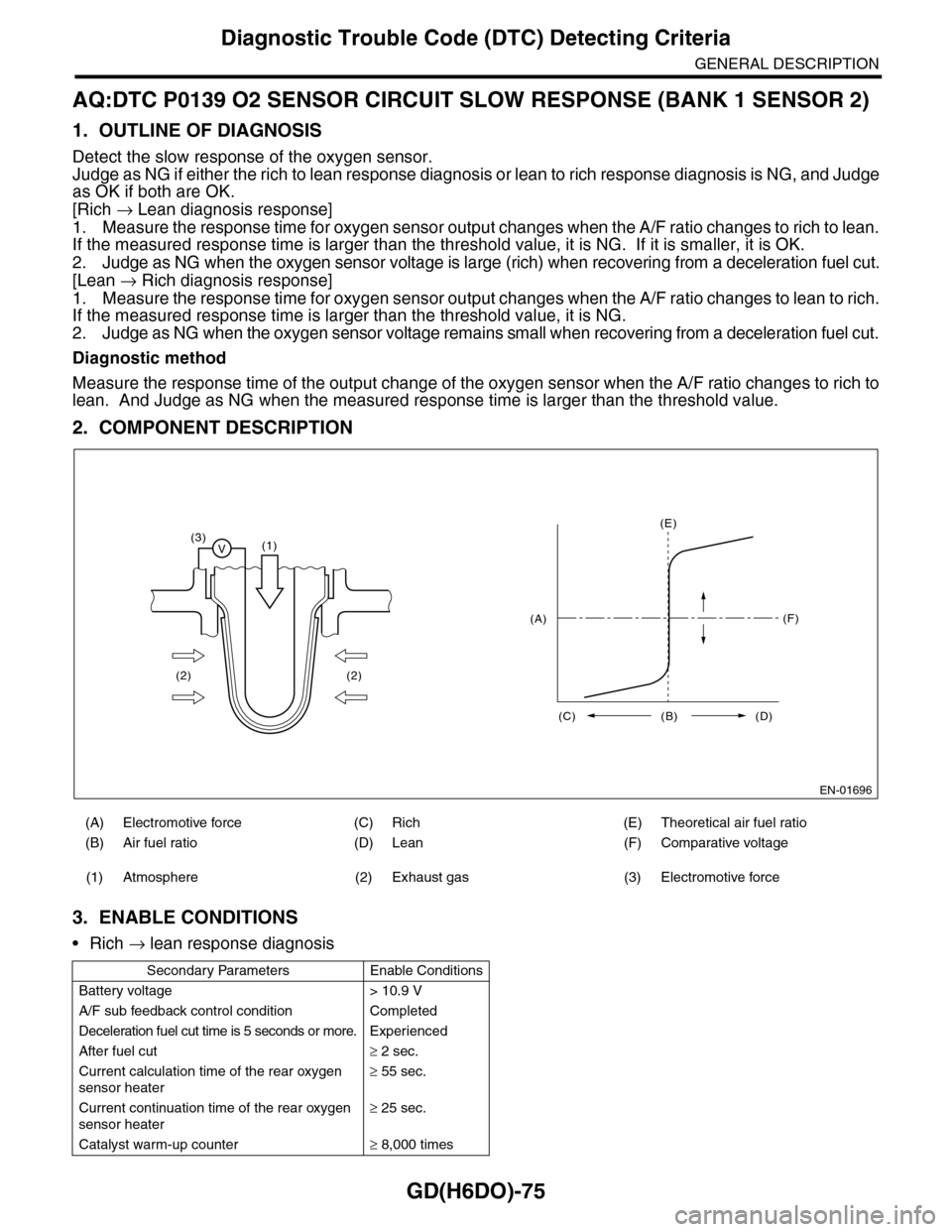
2. COMPONENT DESCRIPTION
3. ENABLE CONDITIONS
•Rich → lean response diagnosis
(A) Electromotive force (C) Rich (E) Theoretical air fuel ratio
(B) Air fuel ratio (D) Lean (F) Comparative voltage
(1) Atmosphere (2) Exhaust gas (3) Electromotive force
Secondary Parameters Enable Conditions
Battery voltage > 10.9 V
A/F sub feedback control condition Completed
Deceleration fuel cut time is 5 seconds or more. Experienced
After fuel cut≥ 2 sec.
Current calculation time of the rear oxygen
sensor heater
≥ 55 sec.
Current continuation time of the rear oxygen
sensor heater
≥ 25 sec.
Catalyst warm-up counter≥ 8,000 times
EN-01696
(3)V(1)
(2) (2)
(E)
(F)
(C) (B) (D)
(A)
Page 1794 of 2453
GD(H6DO)-182
Diagnostic Trouble Code (DTC) Detecting Criteria
GENERAL DESCRIPTION
DF:DTC P1152 O2 SENSOR CIRCUIT RANGE/PERFORMANCE (LOW) (BANK 1
SENSOR 1)
1. OUTLINE OF DIAGNOSIS
Detect that λ value remains low.
Judge as NG when lambda value is abnormal in accordance with λ value of front oxygen (A/F) sensor and
running conditions such as vehicle speed, amount of intake air engine coolant temperature, sub feedback
control, etc.
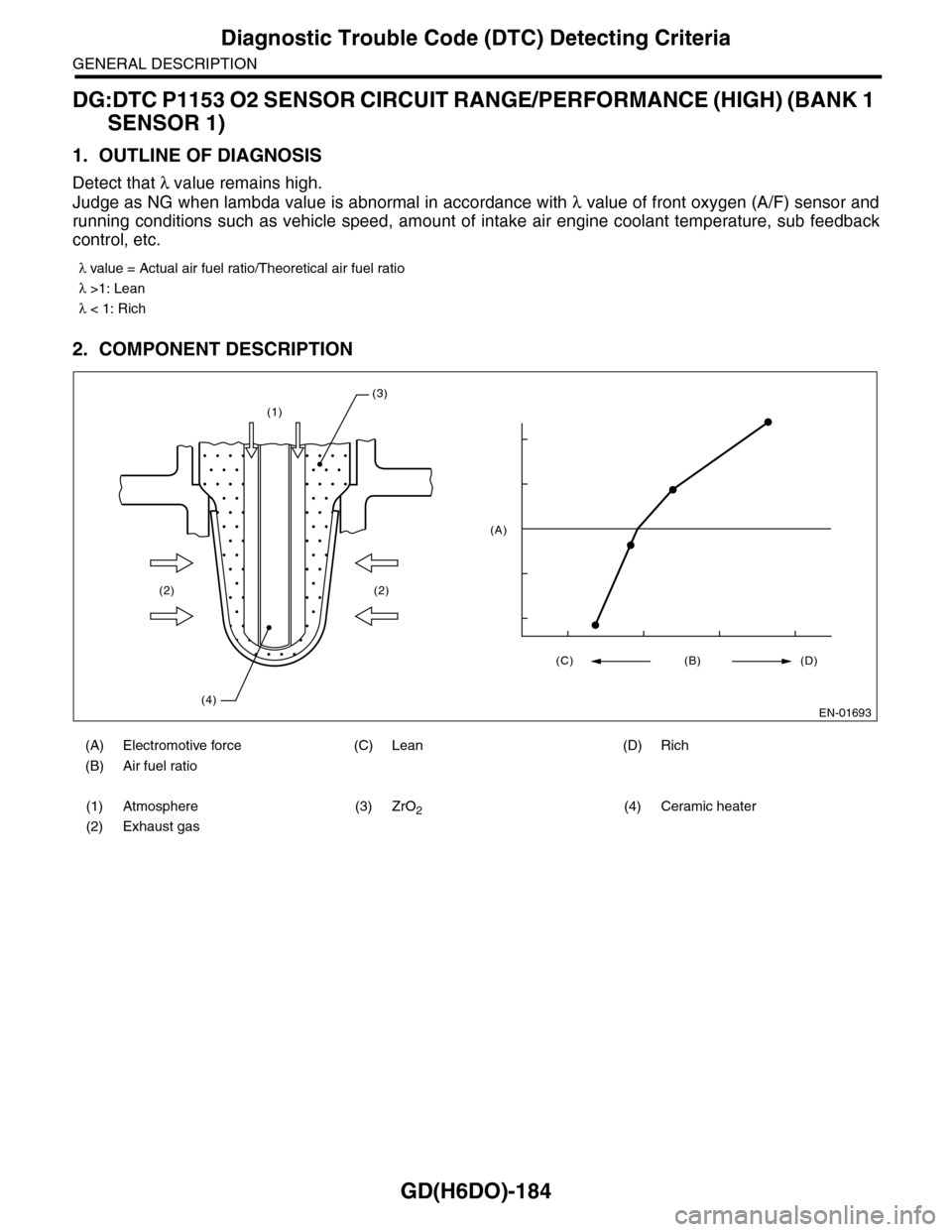
2. COMPONENT DESCRIPTION
λ value = Actual air fuel ratio/Theoretical air fuel ratio
λ >1: Lean
λ < 1: Rich
(A) Electromotive force (C) Lean (D) Rich
(B) Air fuel ratio
(1) Atmosphere (3) ZrO2(4) Ceramic heater
(2) Exhaust gas
(1)
(2)
(4)
(2)
(3)
EN-01693
(C) (B) (D)
(A)
Page 1796 of 2453
GD(H6DO)-184
Diagnostic Trouble Code (DTC) Detecting Criteria
GENERAL DESCRIPTION
DG:DTC P1153 O2 SENSOR CIRCUIT RANGE/PERFORMANCE (HIGH) (BANK 1
SENSOR 1)
1. OUTLINE OF DIAGNOSIS
Detect that λ value remains high.
Judge as NG when lambda value is abnormal in accordance with λ value of front oxygen (A/F) sensor and
running conditions such as vehicle speed, amount of intake air engine coolant temperature, sub feedback
control, etc.
2. COMPONENT DESCRIPTION
λ value = Actual air fuel ratio/Theoretical air fuel ratio
λ >1: Lean
λ < 1: Rich
(A) Electromotive force (C) Lean (D) Rich
(B) Air fuel ratio
(1) Atmosphere (3) ZrO2(4) Ceramic heater
(2) Exhaust gas
(1)
(2)
(4)
(2)
(3)
EN-01693
(C) (B) (D)
(A)
Page 1888 of 2453
ME(H6DO)-22
Idle Speed
MECHANICAL
3. Idle Speed
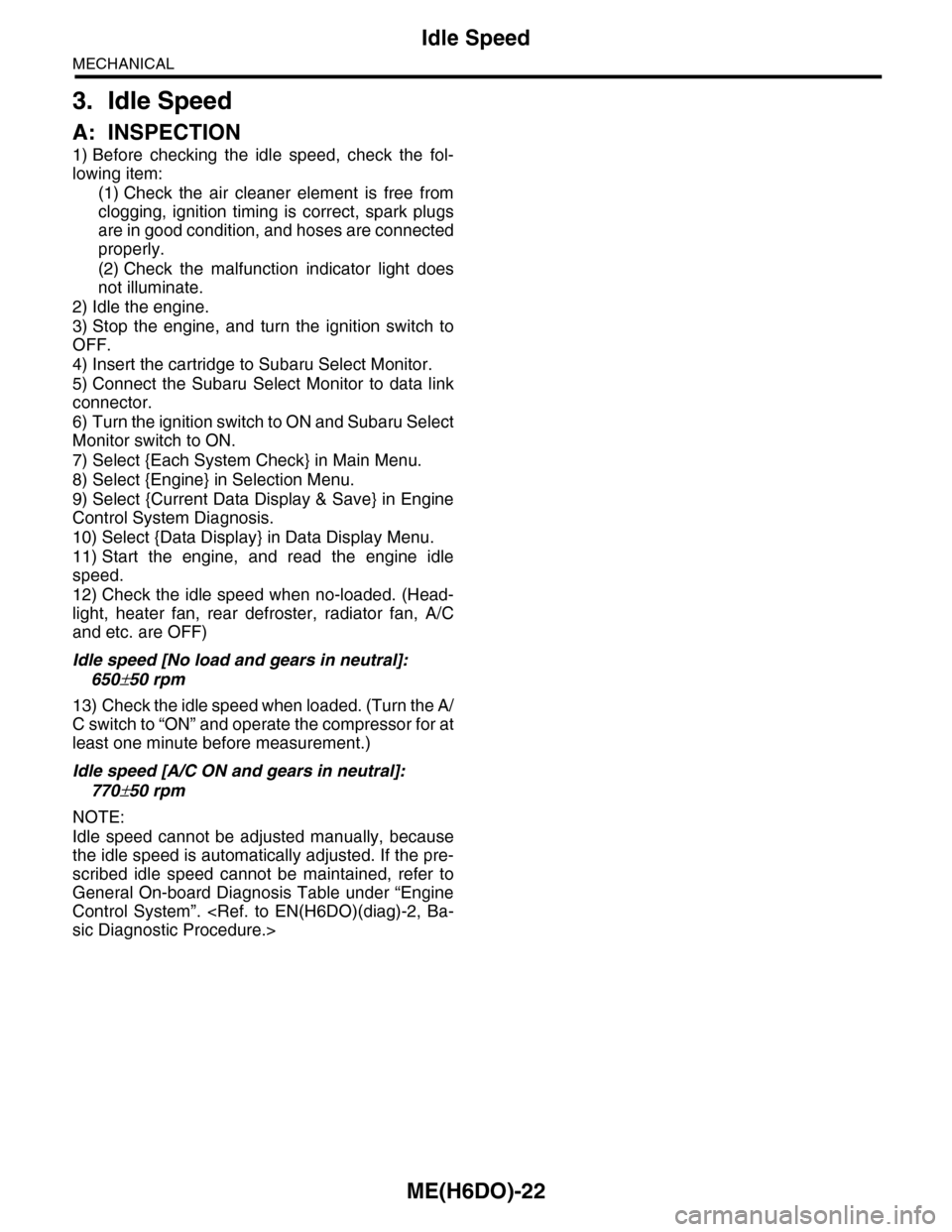
A: INSPECTION
1) Before checking the idle speed, check the fol-
lowing item:
(1) Check the air cleaner element is free from
clogging, ignition timing is correct, spark plugs
are in good condition, and hoses are connected
properly.
(2) Check the malfunction indicator light does
not illuminate.
2) Idle the engine.
3) Stop the engine, and turn the ignition switch to
OFF.
4) Insert the cartridge to Subaru Select Monitor.
5) Connect the Subaru Select Monitor to data link
connector.
6) Turn the ignition switch to ON and Subaru Select
Monitor switch to ON.
7) Select {Each System Check} in Main Menu.
8) Select {Engine} in Selection Menu.
9) Select {Current Data Display & Save} in Engine
Control System Diagnosis.
10) Select {Data Display} in Data Display Menu.
11) Start the engine, and read the engine idle
speed.
12) Check the idle speed when no-loaded. (Head-
light, heater fan, rear defroster, radiator fan, A/C
and etc. are OFF)
Idle speed [No load and gears in neutral]:
650±50 rpm
13) Check the idle speed when loaded. (Turn the A/
C switch to “ON” and operate the compressor for at
least one minute before measurement.)
Idle speed [A/C ON and gears in neutral]:
770±50 rpm
NOTE:
Idle speed cannot be adjusted manually, because
the idle speed is automatically adjusted. If the pre-
scribed idle speed cannot be maintained, refer to
General On-board Diagnosis Table under “Engine
Control System”.
sic Diagnostic Procedure.>
Page 1899 of 2453
ME(H6DO)-33
Engine Assembly
MECHANICAL
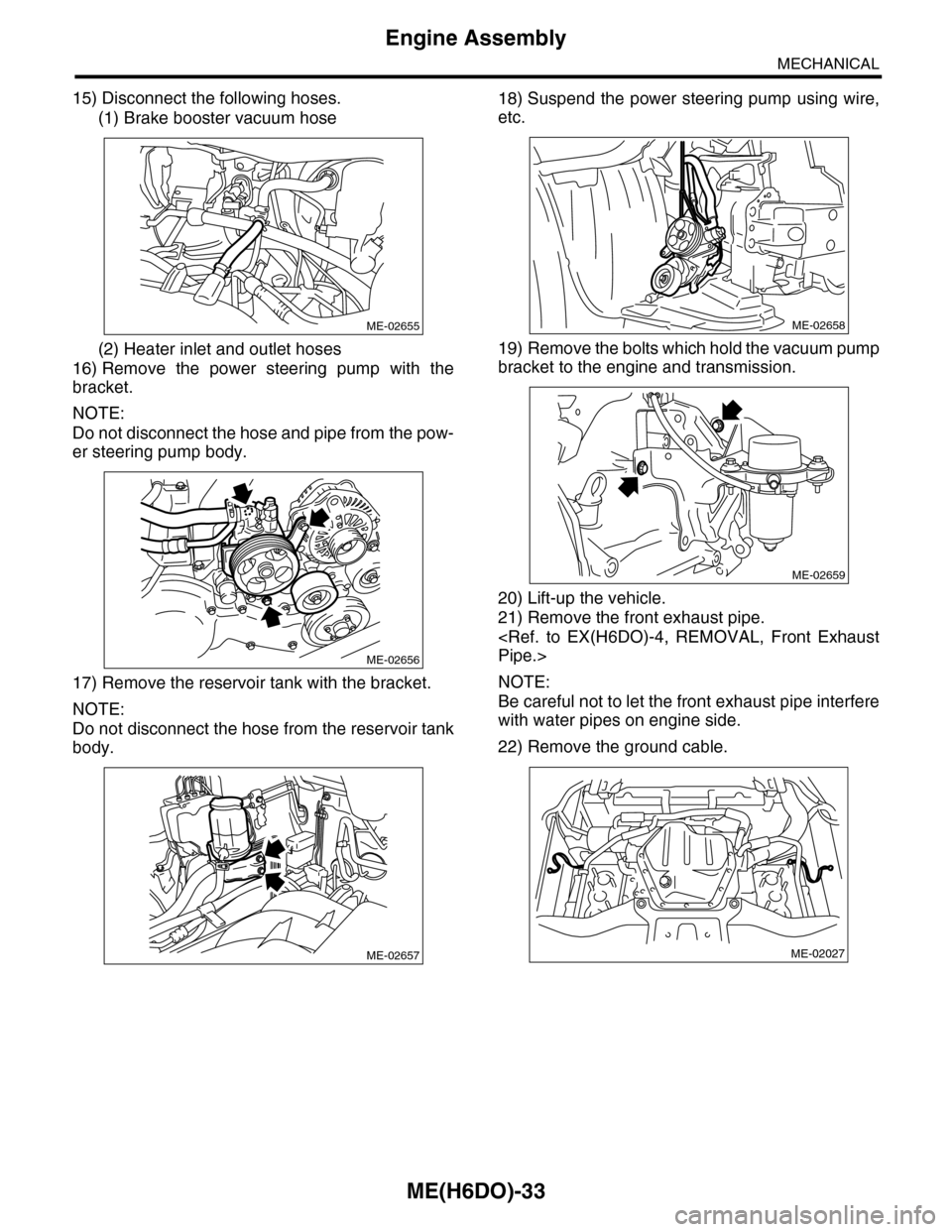
15) Disconnect the following hoses.
(1) Brake booster vacuum hose
(2) Heater inlet and outlet hoses
16) Remove the power steering pump with the
bracket.
NOTE:
Do not disconnect the hose and pipe from the pow-
er steering pump body.
17) Remove the reservoir tank with the bracket.
NOTE:
Do not disconnect the hose from the reservoir tank
body.
18) Suspend the power steering pump using wire,
etc.
19) Remove the bolts which hold the vacuum pump
bracket to the engine and transmission.
20) Lift-up the vehicle.
21) Remove the front exhaust pipe.
Pipe.>
NOTE:
Be careful not to let the front exhaust pipe interfere
with water pipes on engine side.
22) Remove the ground cable.
ME-02655
ME-02656
ME-02657
ME-02658
ME-02659
ME-02027
Page 1904 of 2453
ME(H6DO)-38
Engine Assembly
MECHANICAL
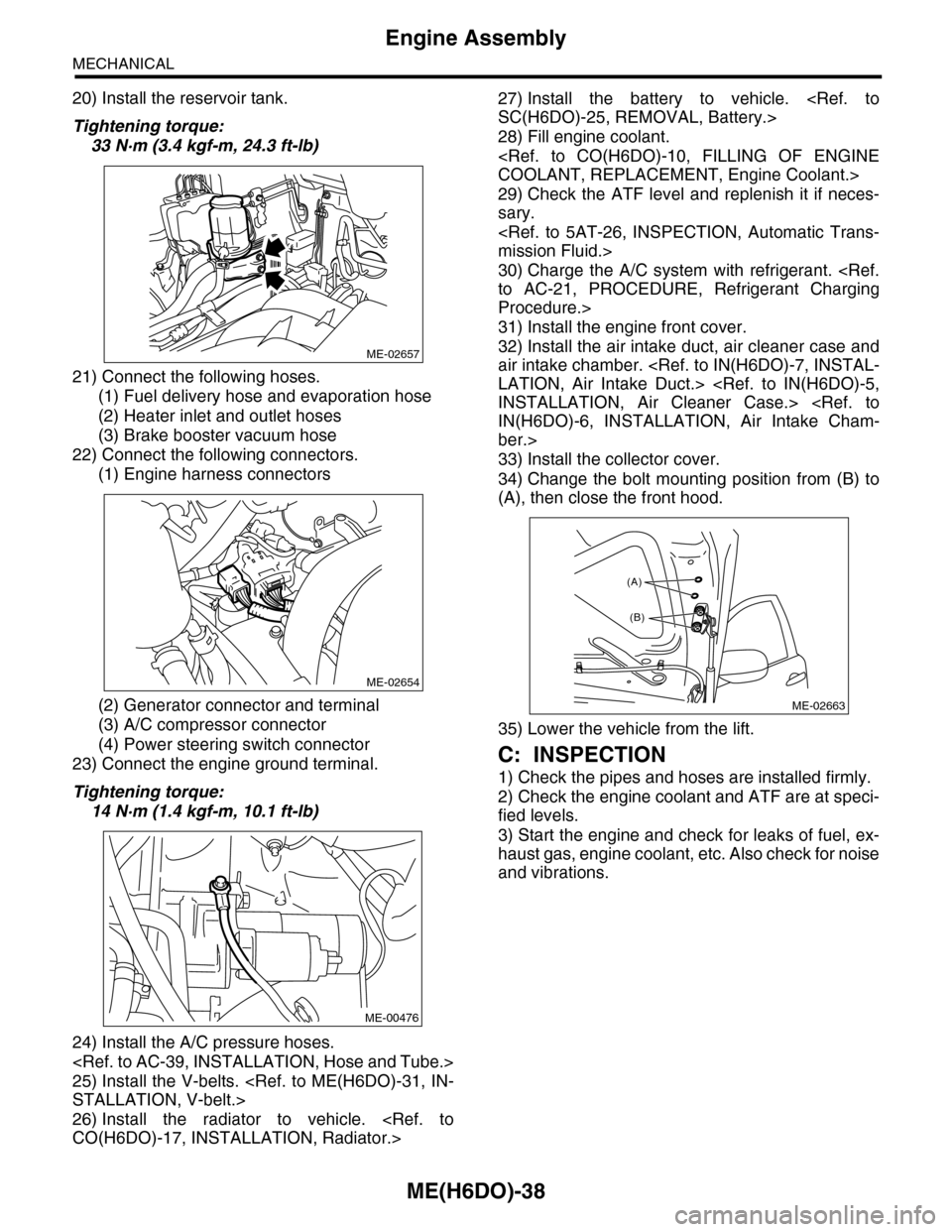
20) Install the reservoir tank.
Tightening torque:
33 N·m (3.4 kgf-m, 24.3 ft-lb)
21) Connect the following hoses.
(1) Fuel delivery hose and evaporation hose
(2) Heater inlet and outlet hoses
(3) Brake booster vacuum hose
22) Connect the following connectors.
(1) Engine harness connectors
(2) Generator connector and terminal
(3) A/C compressor connector
(4) Power steering switch connector
23) Connect the engine ground terminal.
Tightening torque:
14 N·m (1.4 kgf-m, 10.1 ft-lb)
24) Install the A/C pressure hoses.
25) Install the V-belts.
STALLATION, V-belt.>
26) Install the radiator to vehicle.
CO(H6DO)-17, INSTALLATION, Radiator.>
27) Install the battery to vehicle.
SC(H6DO)-25, REMOVAL, Battery.>
28) Fill engine coolant.
COOLANT, REPLACEMENT, Engine Coolant.>
29) Check the ATF level and replenish it if neces-
sary.
mission Fluid.>
30) Charge the A/C system with refrigerant.
to AC-21, PROCEDURE, Refrigerant Charging
Procedure.>
31) Install the engine front cover.
32) Install the air intake duct, air cleaner case and
air intake chamber.
LATION, Air Intake Duct.>
INSTALLATION, Air Cleaner Case.>
IN(H6DO)-6, INSTALLATION, Air Intake Cham-
ber.>
33) Install the collector cover.
34) Change the bolt mounting position from (B) to
(A), then close the front hood.
35) Lower the vehicle from the lift.
C: INSPECTION
1) Check the pipes and hoses are installed firmly.
2) Check the engine coolant and ATF are at speci-
fied levels.
3) Start the engine and check for leaks of fuel, ex-
haust gas, engine coolant, etc. Also check for noise
and vibrations.
ME-02657
ME-02654
ME-00476
ME-02663
(A)
(B)