2009 SUBARU TRIBECA steering
[x] Cancel search: steeringPage 914 of 2453
PS-34
Steering Gearbox
POWER ASSISTED SYSTEM (POWER STEERING)
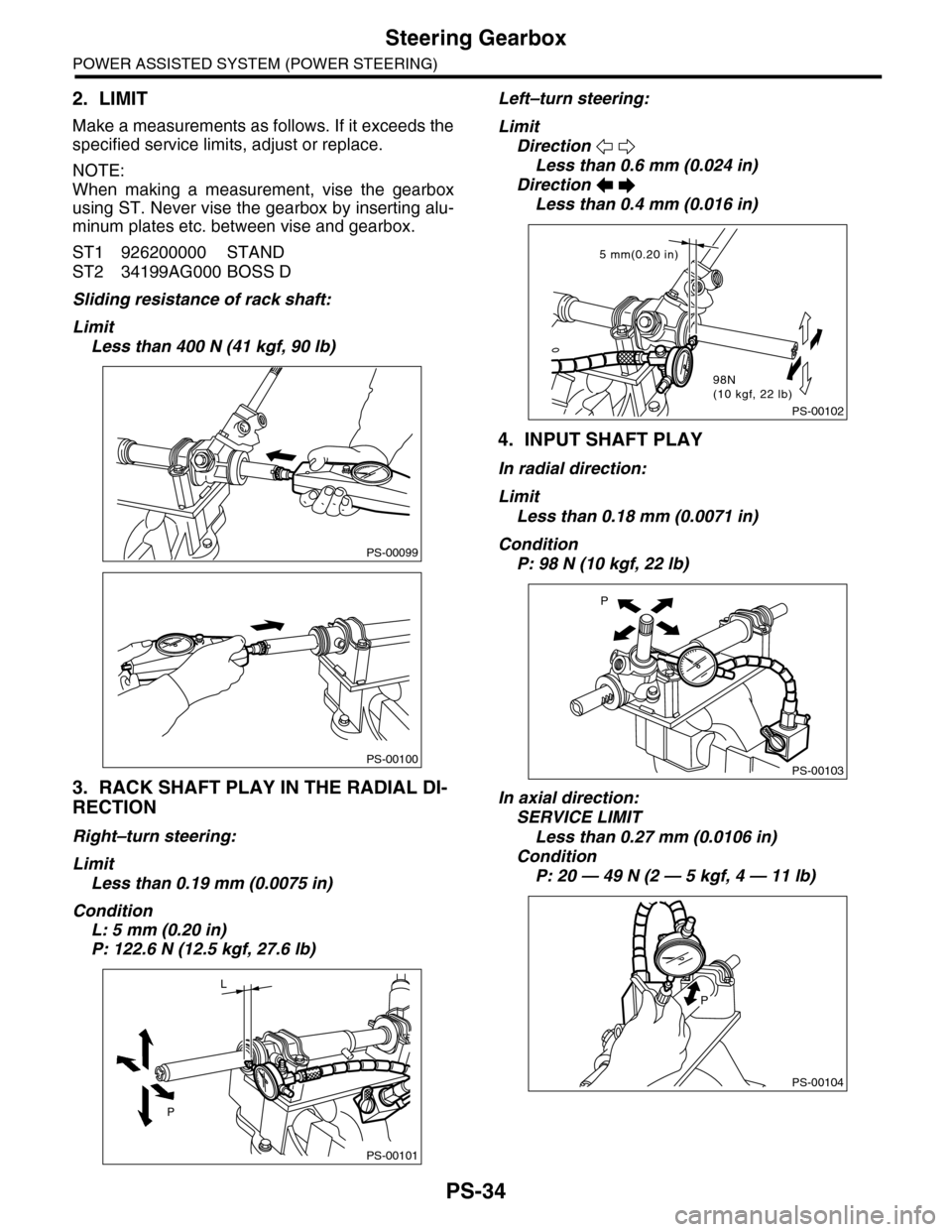
2. LIMIT
Make a measurements as follows. If it exceeds the
specified service limits, adjust or replace.
NOTE:
When making a measurement, vise the gearbox
using ST. Never vise the gearbox by inserting alu-
minum plates etc. between vise and gearbox.
ST1 926200000 STAND
ST2 34199AG000 BOSS D
Sliding resistance of rack shaft:
Limit
Less than 400 N (41 kgf, 90 lb)
3. RACK SHAFT PLAY IN THE RADIAL DI-
RECTION
Right–turn steering:
Limit
Less than 0.19 mm (0.0075 in)
Condition
L: 5 mm (0.20 in)
P: 122.6 N (12.5 kgf, 27.6 lb)
Left–turn steering:
Limit
Direction
Less than 0.6 mm (0.024 in)
Direction
Less than 0.4 mm (0.016 in)
4. INPUT SHAFT PLAY
In radial direction:
Limit
Less than 0.18 mm (0.0071 in)
Condition
P: 98 N (10 kgf, 22 lb)
In axial direction:
SERVICE LIMIT
Less than 0.27 mm (0.0106 in)
Condition
P: 20 — 49 N (2 — 5 kgf, 4 — 11 lb)
PS-00099
PS-00100
PS-00101
P
L
PS-00102
5 mm(0.20 in)
98N(10 kgf, 22 lb)
PS-00103
P
PS-00104
P
Page 915 of 2453

PS-35
Steering Gearbox
POWER ASSISTED SYSTEM (POWER STEERING)
5. TURNING RESISTANCE OF GEARBOX
Using the ST, measure the gearbox turning resis-
tance.
ST 34099PA100 SPANNER
Service limit:
Maximum allowable resistance:
10.5 N (1.1 kgf, 2.4 lb) or less
Difference between right and left turning re-
sistance:
20% or less
6. OIL LEAKAGE
PS-00105
(1) Power cylinder (3) Rack piston (5) Input shaft
(2) Cylinder (4) Rack axle (6) Valve housing
PS-00622
(4) (3) (2)
(5)
(6)
cd
a
b
(1)
fggd
e
Page 916 of 2453

PS-36
Steering Gearbox
POWER ASSISTED SYSTEM (POWER STEERING)
1) Lift-up the vehicle.
2) If a fluid leak is found, clean the fluid completely
from the suspect area, and turn the steering wheel
approx. 30 to 40 times to the left and right from lock
to lock, with the engine running, and check again
for leaks immediately, and also after a few hours
have passed.
3) Cause and solution for oil leakage from “a”
The oil seal is damaged. Replace the valve assem-
bly with a new one.
4) Cause and solution for oil leakage from “b”.
The torsion bar O–ring is damaged. Replace the
valve assembly with a new one.
5) Cause and solution for oil leakage from “c”.
The oil seal is damaged. Replace the valve assem-
bly or oil seal with a new one.
6) Cause and solution for oil leakage from “d”.
The pipe is damaged. Replace the faulty pipe or O-
ring.
7) Cause and solution for oil leakage from “g”.
The hose is damaged. Replace the hose with a
new one.
8) If leak is other than a, b, c, d or g, or if oil is leak-
ing from gearbox, move the right and left boots to-
ward tie-rod end side, respectively, with the
gearbox mounted to the vehicle, and remove fluid
from surrounding portions. Then, turn the steering
wheel from lock to lock about thirty to forty times
with the engine running, and make comparison of
the leaked portion immediately after and several
hours after this operation.
(1) Leakage from “e”
The cylinder seal is damaged. Replace the rack
bushing with a new one.
(2) Leakage from “f”
There are two possible causes. Perform the fol-
lowing step first. Remove the pipe assembly B
from the valve housing, and close the circuit us-
ing ST.
ST 926420000 PLUG
Turn the steering wheel from lock to lock ap-
prox. 30 to 40 times with the engine running,
then inspect the leaked portion immediately af-
ter and several hours after this operation.
•If leakage from “f” is noted again:
The oil seal of pinion & valve assembly is dam-
aged. Replace the pinion & valve assembly with a
new one. Or replace the oil seal and the parts that
are damaged during disassembly with new ones.
•If oil stops leaking from “f”:
The oil seal of rack housing is damaged. Replace
the oil seal and parts that are damaged during dis-
assembly with new ones.
F: ADJUSTMENT
1) Adjust the front toe.
Standard of front toe:
IN 3 — OUT 3 mm (IN 0.12 — OUT 0.12 in)
2) Adjust the steering angle of the wheels.
Specification of steering angle:
3) If the steering wheel spokes are not horizontal
when wheels are set in the straight ahead position,
or error is more than 5° on the periphery of the
steering wheel, correctly re-install the steering
wheel.
4) If the steering wheel spokes are not horizontal
with vehicle set in the straight ahead position after
this adjustment, correct it by turning the right and
left tie–rods in the opposite direction from each oth-
er by the same angle.
(1) Lock nut
Inner wheel 37.0°±1.5°
Outer wheel 32.0°±1.5°
(1) Within 5°
PS-00107
PS-00513
(1)
Page 917 of 2453
PS-37
Pipe Assembly
POWER ASSISTED SYSTEM (POWER STEERING)
6. Pipe Assembly
A: REMOVAL
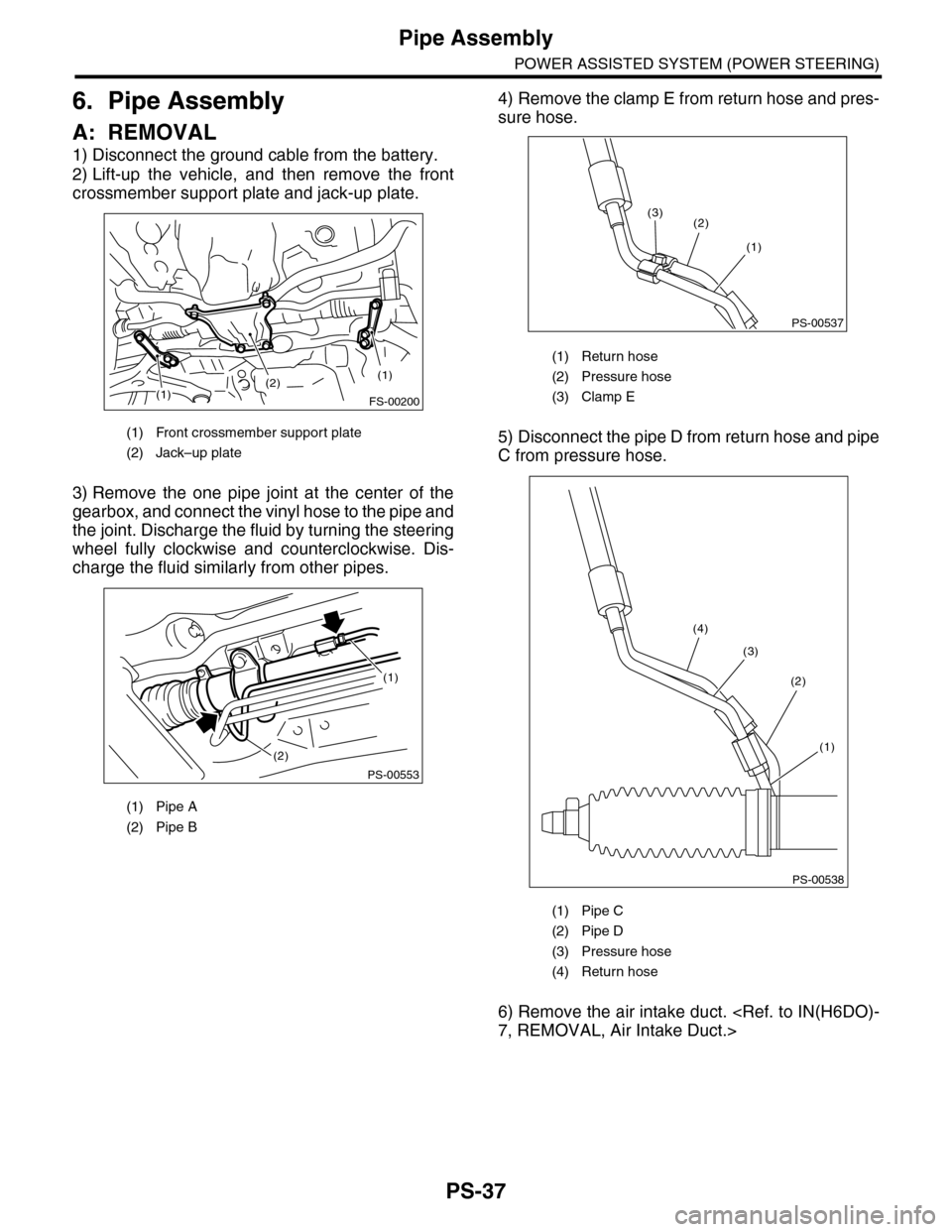
1) Disconnect the ground cable from the battery.
2) Lift-up the vehicle, and then remove the front
crossmember support plate and jack-up plate.
3) Remove the one pipe joint at the center of the
gearbox, and connect the vinyl hose to the pipe and
the joint. Discharge the fluid by turning the steering
wheel fully clockwise and counterclockwise. Dis-
charge the fluid similarly from other pipes.
4) Remove the clamp E from return hose and pres-
sure hose.
5) Disconnect the pipe D from return hose and pipe
C from pressure hose.
6) Remove the air intake duct.
(1) Front crossmember support plate
(2) Jack–up plate
(1) Pipe A
(2) Pipe B
(2)(1)
(1)
FS-00200
(2)
PS-00553
(1)
(1) Return hose
(2) Pressure hose
(3) Clamp E
(1) Pipe C
(2) Pipe D
(3) Pressure hose
(4) Return hose
PS-00537
(3)
(1)
(2)
PS-00538
(4)
(3)
(2)
(1)
Page 918 of 2453

PS-38
Pipe Assembly
POWER ASSISTED SYSTEM (POWER STEERING)
7) Disconnect the suction hose and pressure hose
from oil pump.
8) Disconnect the suction hose and return hose
from the reservoir tank.
9) Remove the oil cooler pipe.
10) Remove the hose bracket and take out the
hose assembly from vehicle.
B: INSTALLATION
1) Install in the reverse order of removal.
Tightening torque:
2) Fill with the specified fluid.
CAUTION:
Never start the engine before feeding the fluid
otherwise the vane pump might be seized.
3) Finally, check the clearance between pipes or
hoses as shown in the figure indicated in “General
Diagnostic Table”.
nostic Table.>
(1) Suction hose
(2) Pressure hose
(1) Reservoir tank
(2) Suction hose
(3) Return hose
PS-00736
(1)
(2)
PS-00737(3)
(2)
(1)
(1) Hose ASSY
(2) Hose bracket
PS-00738
PS-00739
(2)
(1)
Page 919 of 2453

PS-39
Pipe Assembly
POWER ASSISTED SYSTEM (POWER STEERING)
C: INSPECTION
Check all disassembled parts for wear, damage or other problems. Repair or replace the defective parts as
necessary.
CAUTION:
Although the surface layer materials of rubber hoses have excellent weathering resistance, heat re-
sistance and resistance for low temperature brittleness, they are likely to be damaged chemically by
brake fluid, battery electrolyte, engine oil and automatic transmission fluid and their service lives are
to be very shortened. Wipe off hoses immediately if any of these come into contact with the hoses.
Since resistances for heat or low temperature brittleness are gradually declining according to time
accumulation of hot or cold conditions for the hoses and their service lives are shortening accord-
ingly, it is necessary to perform careful inspection frequently when the vehicle is used in hot weather
areas, cold weather areas and a driving condition in which many steering operations are required in
short time.
Particularly continuous work of relief valve over 5 seconds causes to reduce service lives of the hos-
es, the oil pump, the fluid, etc. due to over heat.
Par t Maintenance par ts Corrective action
Pipe
•O–ring fitting surface damage
•Nut damage
•Pipe damage
Replace with a new part.
Clamp • Loose clamps Replace with a new part.
Hose
•Flare surface damage
•Flare nut damage
•Outer surface cracks
•Outer surface wear
•Clip damage
•End coupling or adapter for deformation
Replace with a new part.
Tr o u b l e P o s s i b l e c a u s e C o r r e c t i v e a c t i o n
Pressure hose burst
Excessive holding time of relief status Instruct customers.
Malfunction of the relief valve Replace the oil pump.
Poor cold character istic of fluid R eplace fluid.
Disconnection of the return
hose
Improper connection Repair.
Loosening of the clip Retighten.
Poor cold character istic of fluid R eplace fluid.
Fluid slightly leaking out of
hose
Wrong layout, tensioned Replace the hose.
Excessive play of engine due to deterioration of
engine mounting rubberReplace the parts if defective.
Improper stop position of pitching stopper Replace the parts if defective.
Crack on hose
Excessive holding time of relief statusReplace.
Instruct customers.
Excessive tightening torque for return hose clip Replace.
Power steer ing fluid, engine oil, electrolyte adhere
on the hose surface
Replace.
Be careful during service work.
To o m a n y u s e s i n e x t r e m e l y c o l d w e a t h e rReplace.
Instruct customers.
Page 920 of 2453
PS-40
Pipe Assembly
POWER ASSISTED SYSTEM (POWER STEERING)
NOTE:
There are conditions in which a fluid leak is diagnosed, but is not actually leaking. This is because the fluid
spilt during the last maintenance was not completely wiped off. Be sure to wipe off spilt fluid thoroughly after
maintenance.
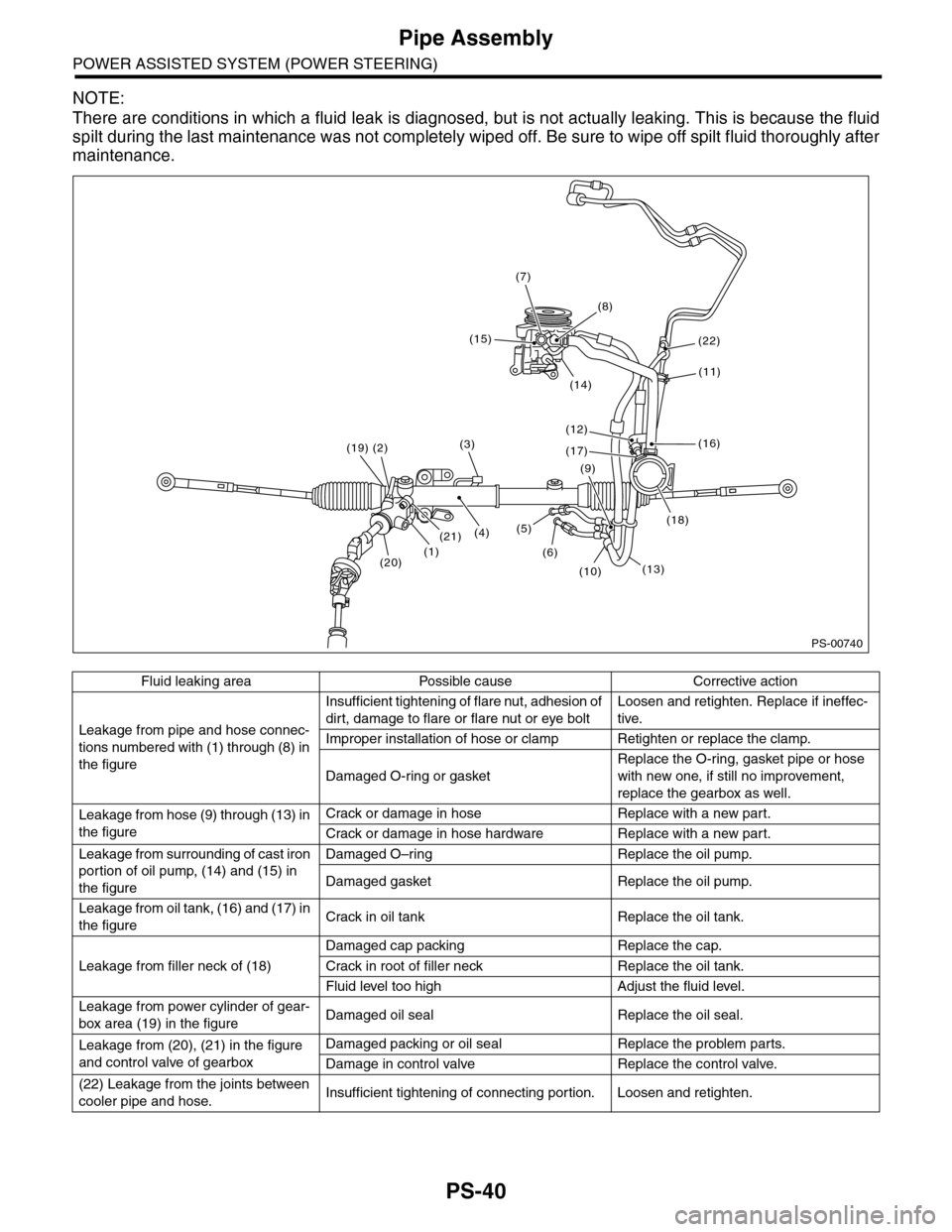
Fluid leaking area Possible cause Corrective action
Leakage from pipe and hose connec-
tions numbered with (1) through (8) in
the figure
Insufficient tightening of flare nut, adhesion of
dirt, damage to flare or flare nut or eye bolt
Loosen and retighten. Replace if ineffec-
tive.
Improper installation of hose or clamp Retighten or replace the clamp.
Damaged O-ring or gasket
Replace the O-ring, gasket pipe or hose
with new one, if still no improvement,
replace the gearbox as well.
Leakage from hose (9) through (13) in
the figure
Crack or damage in hose Replace with a new part.
Crack or damage in hose hardware Replace with a new part.
Leakage from surrounding of cast iron
portion of oil pump, (14) and (15) in
the figure
Damaged O–ring Replace the oil pump.
Damaged gasket Replace the oil pump.
Leakage from oil tank, (16) and (17) in
the figureCrack in oil tank Replace the oil tank.
Leakage from filler neck of (18)
Damaged cap packing Replace the cap.
Crack in root of filler neck Replace the oil tank.
Fluid level too high Adjust the fluid level.
Leakage from power cylinder of gear-
box area (19) in the figureDamaged oil seal Replace the oil seal.
Leakage from (20), (21) in the figure
and control valve of gearbox
Damaged packing or oil seal Replace the problem parts.
Damage in control valve Replace the control valve.
(22) Leakage from the joints between
cooler pipe and hose.Insufficient tightening of connecting portion. Loosen and retighten.
PS-00740
(1)
(19)
(4)
(2)
(7)
(20)
(3)
(21)
(15)
(8)
(14)
(12)
(17)
(9)
(5)
(6)
(10)(13)
(18)
(16)
(11)
(22)
Page 921 of 2453
PS-41
Oil Pump
POWER ASSISTED SYSTEM (POWER STEERING)
7. Oil Pump
A: REMOVAL
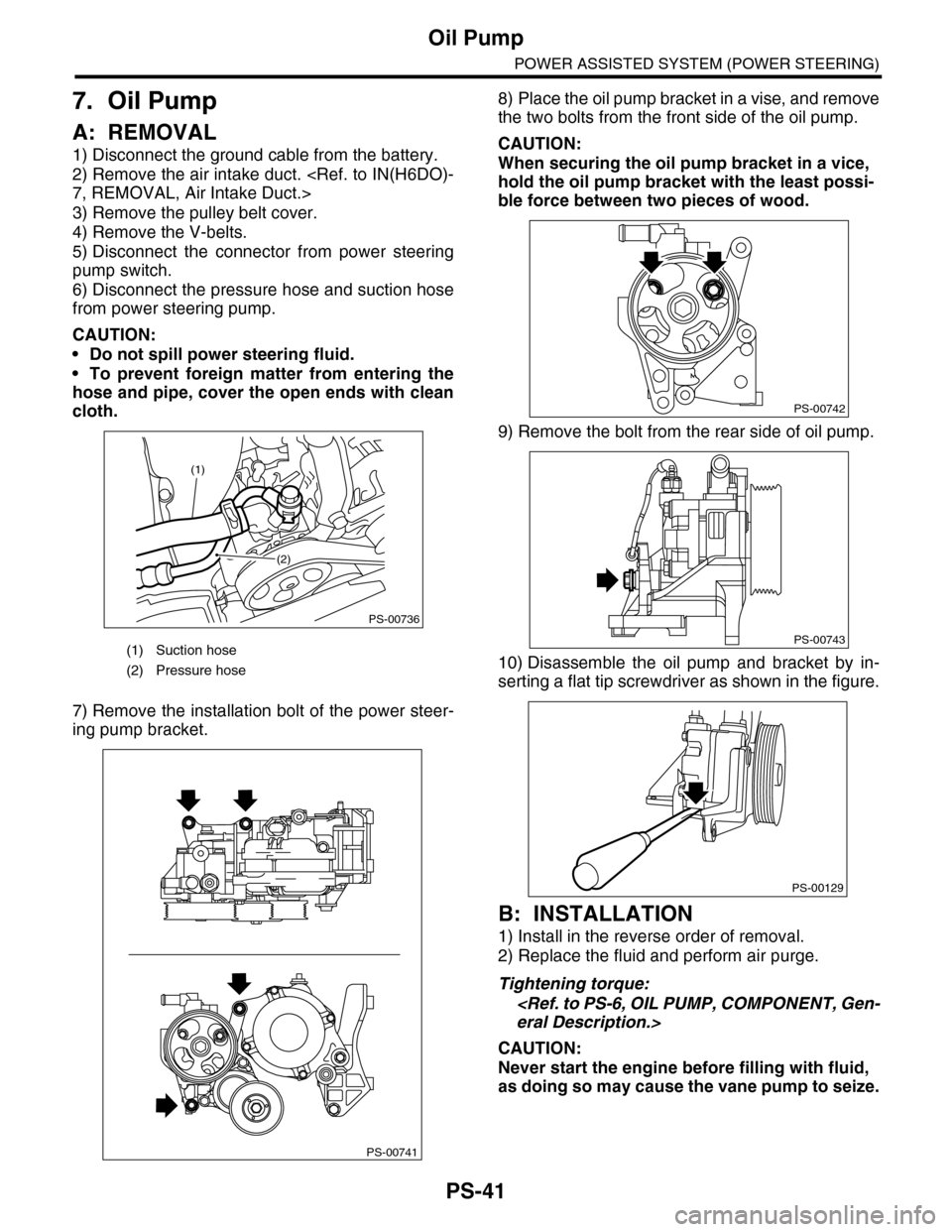
1) Disconnect the ground cable from the battery.
2) Remove the air intake duct.
3) Remove the pulley belt cover.
4) Remove the V-belts.
5) Disconnect the connector from power steering
pump switch.
6) Disconnect the pressure hose and suction hose
from power steering pump.
CAUTION:
•Do not spill power steering fluid.
•To prevent foreign matter from entering the
hose and pipe, cover the open ends with clean
cloth.
7) Remove the installation bolt of the power steer-
ing pump bracket.
8) Place the oil pump bracket in a vise, and remove
the two bolts from the front side of the oil pump.
CAUTION:
When securing the oil pump bracket in a vice,
hold the oil pump bracket with the least possi-
ble force between two pieces of wood.
9) Remove the bolt from the rear side of oil pump.
10) Disassemble the oil pump and bracket by in-
serting a flat tip screwdriver as shown in the figure.
B: INSTALLATION
1) Install in the reverse order of removal.
2) Replace the fluid and perform air purge.
Tightening torque:
CAUTION:
Never start the engine before filling with fluid,
as doing so may cause the vane pump to seize.
(1) Suction hose
(2) Pressure hose
PS-00736
(1)
(2)
PS-00741
PS-00742
PS-00743
PS-00129