Page 267 of 494
Normal Starting
Normal Starting of either a cold or a warm engine does
not require pumping or depressing the accelerator pedal.
Simply turn the ignition switch to the “START” position
and release when the engine starts. If the engine fails to
start within 15 seconds, turn the ignition switch to the
“LOCK” position, wait 10 to 15 seconds, then repeat the
normal starting procedure.WARNING!
Do not attempt to push or tow your vehicle to get it
started. Vehicles equipped with an automatic trans-
axle cannot be started this way. Unburned fuel could
enter the catalytic converter and once the engine has
started, ignite and damage the converter and vehicle.
If the vehicle has a discharged battery, booster cables
may be used to obtain a start from another vehicle.
This type of start can be dangerous if done improp-
erly, so follow the procedure carefully. See section 6
of this manual for jump starting instructions.
STARTING AND OPERATING 265
5
Page 268 of 494
Tip Start Feature — Automatic Transaxle Only
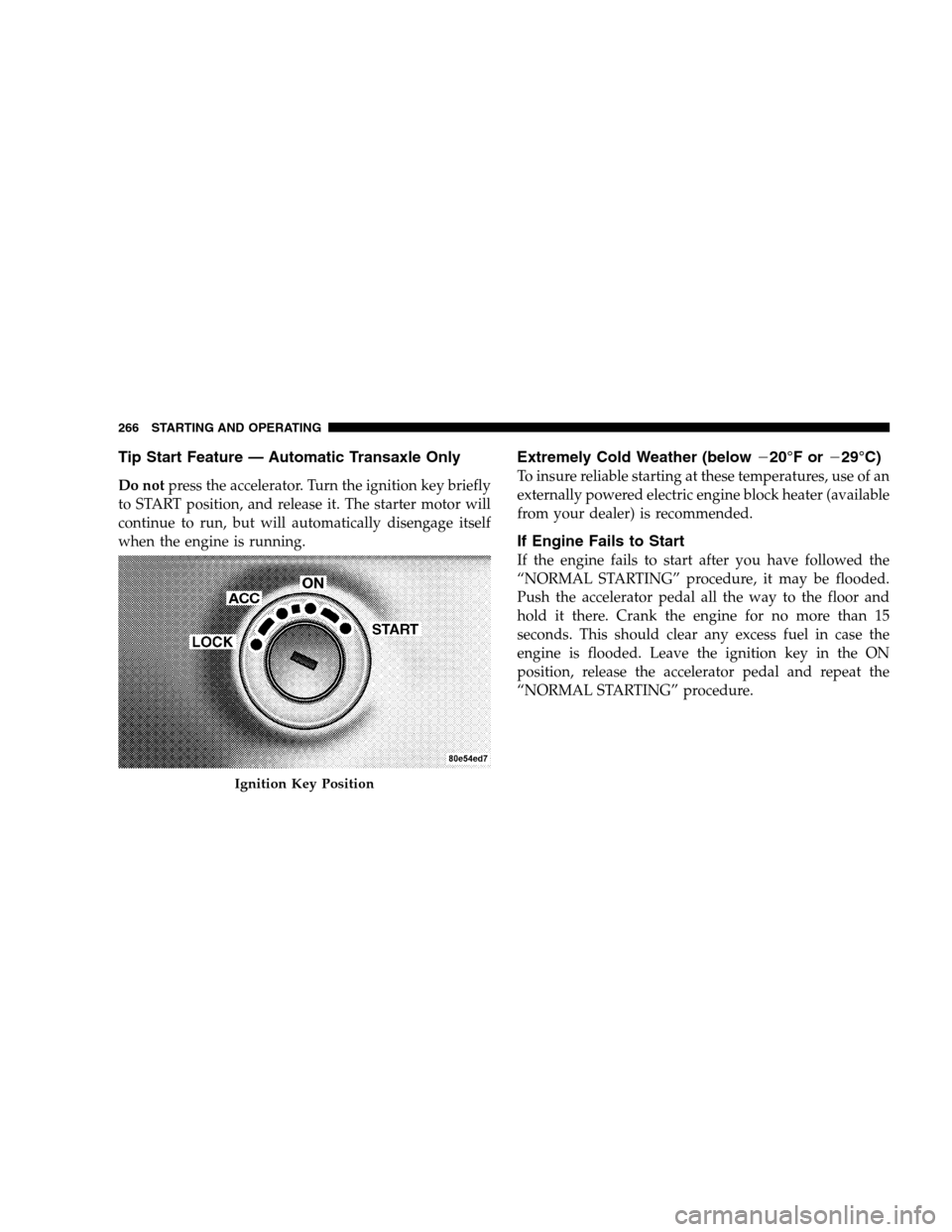
Do notpress the accelerator. Turn the ignition key briefly
to START position, and release it. The starter motor will
continue to run, but will automatically disengage itself
when the engine is running.
Extremely Cold Weather (below�20°F or�29°C)
To insure reliable starting at these temperatures, use of an
externally powered electric engine block heater (available
from your dealer) is recommended.
If Engine Fails to Start
If the engine fails to start after you have followed the
“NORMAL STARTING” procedure, it may be flooded.
Push the accelerator pedal all the way to the floor and
hold it there. Crank the engine for no more than 15
seconds. This should clear any excess fuel in case the
engine is flooded. Leave the ignition key in the ON
position, release the accelerator pedal and repeat the
“NORMAL STARTING” procedure.
Ignition Key Position
266 STARTING AND OPERATING
Page 269 of 494
WARNING!
Never pour fuel or other flammable liquid into the
throttle body air inlet opening in an attempt to start
the vehicle. This could result in flash fire causing
serious personal injury.
CAUTION!
To prevent damage to the starter, do not crank the
engine for more than 15 seconds at a time. Wait 10 to
15 seconds before trying again.
After Starting
The idle speed will automatically decrease as the engine
warms up.
Remote Start System — If Equipped
Remote start conveniently starts the engine from outside
the vehicle by using the Remote Keyless Entry (RKE) key
fob while maintaining security. The system has a targeted
range of 328 ft. (100 m). The vehicle must be locked, the
deck lid and hood closed and the transmission in Park in
order to start the engine using the Remote Start button on
the key fob.
NOTE:Remote start requires Automatic Transaxle
equipped vehicles.
STARTING AND OPERATING 267
5
Page 270 of 494

How To Use Remote Start
Toenter the Remote Start mode, depress the Remote
Start button twice on the key fob. The engine will start
and the vehicle will remain in the remote start mode for
a 15 minute cycle.Toexit the Remote Start mode, allow the
engine to run the cycle or depress the unlock
button to disarm the Vehicle Theft Security
Alarm and within one minute insert the key
into the ignition and turn the ignition to the RUN
position. The ignition must be in the RUN position in
order to drive the vehicle.
NOTE:The engine can be started two consecutive times
(two 15 minute cycles) by using the key fob. For a third
cycle, the key must be cycled to the ignition RUN
position and then repeat the start sequence.
To shut off the vehicle when it is in Remote Start mode,
press the remote start button once. In order to avoid
inadvertent shut downs, the one-time press to shut down
the vehicle will be disabled for two seconds after receipt
of a valid remote start request.
Remote Start
268 STARTING AND OPERATING
Page 271 of 494
NOTE:When the vehicle is in the Remote Start mode,
power window and sunroof operation are disabled for
security.
The following conditions must be met before the engine
will remote start:
•Automatic Transaxle in Park
•All doors are closed
•Hood is closed
•Hazard Switch is off
•Brake Switch is inactive
•Key is not in the ignition
•Battery is at an acceptable charge level
•Panic button on key fob is not depressed
ENGINE BLOCK HEATER — IF EQUIPPED
The engine block heater warms engine coolant and
permits quicker starts in cold weather. Connect the cord
to a standard 110-115 volt AC electrical outlet with a
grounded, three-wire extension cord.
The engine block heater cord is bundled under the hood
between the headlight assembly and the Totally Inte-
grated Power Module (Fuse Box) on the driver side of the
vehicle.
WARNING!
Remember to disconnect the cord before driving.
Damage to the 110-115 volt electrical cord could cause
electrocution.
STARTING AND OPERATING 269
5
Page 272 of 494
AUTOMATIC TRANSAXLECAUTION!
Damage to the transaxle may occur if the following
precautions are not observed:
•Shift the gear selector lever into PARK only after
the vehicle has come to a complete stop.
•Shift the gear selector lever into or out of RE-
VERSE only after the vehicle has come to a com-
plete stop and the engine is at idle speed.
•Do not shift the gear selector lever from RE-
VERSE, PARK, or NEUTRAL into any forward
gear when the engine is above idle speed.
•Before shifting the gear selector lever into any
gear, make sure your foot is firmly on the brake
pedal.Automatic Gear Selector Lever
270 STARTING AND OPERATING
Page 273 of 494
WARNING!
It is dangerous to shift the gear selector lever out of
PARK or NEUTRAL if the engine speed is higher
than idle speed. If your foot is not firmly on the
brake pedal, the vehicle could accelerate quickly
forward or in REVERSE. You could lose control of the
vehicle and hit someone or something. Only shift the
gear selector lever into gear when the engine is idling
normally and when your right foot is firmly on the
brake pedal.
WARNING!
Unintended movement of a vehicle could injure
those in and near the vehicle. As with all vehicles,
you should never exit a vehicle while the engine is
running. Before exiting a vehicle, you should always
shift the gear selector lever into PARK, remove the
key from the ignition, and apply the parking brake.
Once the key is removed from the ignition, the gear
selector lever is locked in the PARK position, secur-
ing the vehicle against unwanted movement. Further-
more, you should never leave children unattended
inside a vehicle.
STARTING AND OPERATING 271
5
Page 275 of 494

NOTE:If a malfunction occurs, the system will trap the
key in the ignition cylinder to warn you that this safety
feature is inoperable. The engine can be started and
stopped, but the key cannot be removed until you obtain
service.
ELECTRONICALLY CONTROLLED AUTOMATIC
TRANSAXLE
The electronically controlled transaxle provides a precise
shift schedule. The transaxle electronics are self-
calibrating; therefore, the first few shifts on a new vehicle
may be somewhat abrupt. This is a normal condition, and
precision shifts will develop within a few hundred miles.
GEAR RANGES
PARK
PARK supplements the parking brake by locking the
transaxle. The engine can be started in this range. Never
attempt to use PARK while vehicle is in motion. Apply
parking brake when leaving vehicle in this range.When parking on a flat surface, place the selector lever in
the PARK position first, and then apply the parking
brake.
When parking on a hill, it is important to set the parking
brake before placing the selector lever in PARK, other-
wise the load on the transaxle locking mechanism may
make it difficult to move the selector out of PARK. As an
added precaution, turn the front wheels toward the curb
on a downhill grade and away from the curb on an uphill
grade.
WARNING!
Never use PARK position on an Automatic Transaxle
as a substitute for the parking brake. Always apply
parking brake fully when parked to guard against
vehicle movement and possible injury or damage.
STARTING AND OPERATING 273
5