Page 295 of 494

Shallow Standing Water
Although your vehicle is capable of driving through
shallow standing water, consider the following Caution
and Warning before doing so.
CAUTION!
•Always check the depth of the standing water
before driving through it. Never drive through
standing water that is deeper than the bottom of
the tire rims mounted on the vehicle.
•Determine the condition of the road or the path
that is under water, and if there are any obstacles
in the way, before driving through the standing
water.
•Do not exceed 5 mph (8 km/h) when driving
through standing water. This will minimize wave
effects.
CAUTION!
•Driving through standing water may cause dam-
age to your vehicle’s drivetrain components. Al-
ways inspect your vehicle’s fluids (i.e., engine oil,
transmission, axle, etc.) for signs of contamination
(i.e., fluid that is milky or foamy in appearance)
after driving through standing water. Do not con-
tinue to operate the vehicle if any fluid appears
contaminated, as this may result in further dam-
age. Such damage is not covered by the New
Vehicle Limited Warranty.
•Getting water inside your vehicle’s engine can
cause it to lock up and stall out, and cause serious
internal damage to the engine. Such damage is not
covered by the New Vehicle Limited Warranty.
STARTING AND OPERATING 293
5
Page 296 of 494
WARNING!
•Driving through standing water limits your vehi-
cle’s traction capabilities. Do not exceed 5 mph (8
km/h) when driving through standing water.
•Driving through standing water limits your vehi-
cle’s braking capabilities, which increases stop-
ping distances. Therefore, after driving through
standing water, drive slowly and lightly press on
the brake pedal several times to dry the brakes.
•Getting water inside your vehicle’s engine can
cause it to lock up and stall out, and leave you
stranded.
•Failure to follow these warnings may result in
injuries that are serious or fatal to you, your
passengers, and others around you.
TIRE SAFETY INFORMATION
Tire Markings
NOTE:
•P (Passenger)-Metric tire sizing is based on U.S. design
standards. P-Metric tires have the letter “P” molded
into the sidewall preceding the size designation. Ex-
ample: P215/65R15 95H.
294 STARTING AND OPERATING
Page 309 of 494
Compact Spare Tire — If Equipped
The compact spare is for temporary emergency use with
radial tires. It is engineered to be used on your style
vehicle only. Since this tire has limited tread life, the
original tire should be repaired (or replaced) and rein-
stalled at the first opportunity.
WARNING!
Temporary use spare tires are for emergency use only.
With these tires, do not drive more than 50 mph (80
km/h). Temporary-use spare tires have limited tread
life. When the tread is worn to the tread wear
indicators, the temporary use spare tire needs to be
replaced. Be sure to follow the warnings which apply
to your spare. Failure to do so could result in spare
tire failure and loss of vehicle control.Do not install a wheel cover or attempt to mount a
conventional tire on the compact spare wheel, since the
wheel is designed specifically for the compact spare.
Do not install more than one compact spare tire/wheel
on the vehicle at any given time.
CAUTION!
Because of the reduced ground clearance, do not take
your vehicle through an automatic car wash with the
compact spare installed. Damage to the vehicle may
result.
Limited Use Spare — If Equipped
The limited use spare tire is for temporary emergency use
on your vehicle. This tire is identified by a limited use
spare tire warning label located on the limited use spare
tire and wheel assembly. This tire may look like the
STARTING AND OPERATING 307
5
Page 325 of 494
FUEL REQUIREMENTS
2.4L and 2.7L Engines
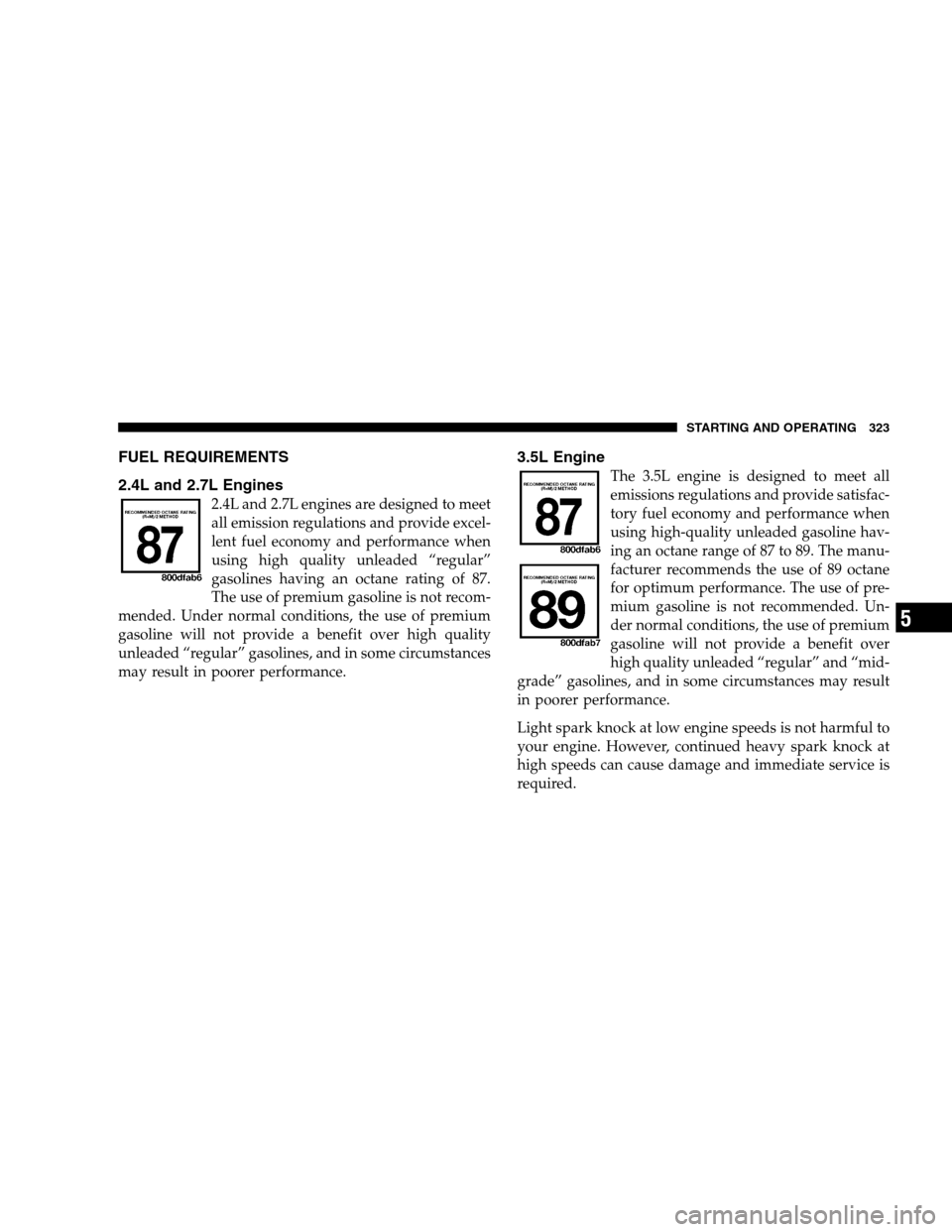
2.4L and 2.7L engines are designed to meet
all emission regulations and provide excel-
lent fuel economy and performance when
using high quality unleaded “regular”
gasolines having an octane rating of 87.
The use of premium gasoline is not recom-
mended. Under normal conditions, the use of premium
gasoline will not provide a benefit over high quality
unleaded “regular” gasolines, and in some circumstances
may result in poorer performance.
3.5L Engine
The 3.5L engine is designed to meet all
emissions regulations and provide satisfac-
tory fuel economy and performance when
using high-quality unleaded gasoline hav-
ing an octane range of 87 to 89. The manu-
facturer recommends the use of 89 octane
for optimum performance. The use of pre-
mium gasoline is not recommended. Un-
der normal conditions, the use of premium
gasoline will not provide a benefit over
high quality unleaded “regular” and “mid-
grade” gasolines, and in some circumstances may result
in poorer performance.
Light spark knock at low engine speeds is not harmful to
your engine. However, continued heavy spark knock at
high speeds can cause damage and immediate service is
required.
STARTING AND OPERATING 323
5
Page 326 of 494
Poor quality gasoline can cause problems such as hard
starting, stalling, and hesitations. If you experience these
symptoms, try another brand of gasoline (with the ap-
propriate octane rating for your engine) before consider-
ing service for the vehicle.
Over 40 automobile manufacturers around the world
have issued and endorsed consistent gasoline specifica-
tions (the World Wide Fuel Charter, WWFC) which
define fuel properties necessary to deliver enhanced
emissions, engine performance, and durability for your
vehicle. The manufacturer recommends the use of gaso-
lines that meet the WWFC specifications if they are
available.
Reformulated Gasoline
Many areas of the country require the use of cleaner
burning gasoline referred to as “Reformulated Gasoline.”Reformulated gasolines contain oxygenates, and are spe-
cifically blended to reduce vehicle emissions and im-
prove air quality.
The manufacturer supports the use of reformulated gaso-
lines. Properly blended reformulated gasolines will pro-
vide excellent performance and durability of engine and
fuel system components.
Gasoline/Oxygenate Blends
Some fuel suppliers blend unleaded gasoline with oxy-
genates such as 10% ethanol, MTBE, and ETBE. Oxygen-
ates are required in some areas of the country during the
winter months to reduce carbon monoxide emissions.
Fuels blended with these oxygenates may be used in
your vehicle.
324 STARTING AND OPERATING
Page 327 of 494
CAUTION!
For vehicles equipped with a 2.4L or 3.5L engine, DO
NOT use gasoline containing Methanol or E85 Etha-
nol. Use of these blends may result in starting and
driveability problems and may damage critical fuel
system components.
NOTE:The2.7L engineis now rated for E85 Ethanol
use(EXCEPT CALIFORNIA EMISSION STATES).Only
vehicles with the E-85 fuel filler door label can operate on
E-85. For more information, see “Flexible Fuel” in this
section.
Problems that result from using methanol/gasoline or
E85 Ethanol blends are not the responsibility of the
manufacturer. While MTBE is an oxygenate made from
Methanol, it does not have the negative effects of Metha-
nol.
MMT In Gasoline
MMT is a manganese containing metallic additive that is
blended into some gasoline to increase octane. Gasoline
blended with MMT provides no performance advantage
beyond gasoline of the same octane number without
MMT. Gasoline blended with MMT reduces spark plug
life and reduces emission system performance in some
vehicles. The manufacturer recommends that gasoline
without MMT be used in your vehicle. The MMT content
of gasoline may not be indicated on the gasoline pump,
therefore, you should ask your gasoline retailer whether
or not his/her gasoline contains MMT.
It is even more important to look for gasolines without
MMT in Canada, because MMT can be used at levels
higher than those allowed in the United States.
MMT is prohibited in Federal and California reformu-
lated gasolines.
STARTING AND OPERATING 325
5
Page 328 of 494
Materials Added to Fuel
All gasoline sold in the United States is required to
contain effective detergent additives. Use of additional
detergents or other additives is not needed under normal
conditions and they would result in additional cost.
Therefore, you should not have to add anything to the
fuel.
Fuel System Cautions
CAUTION!
Follow these guidelines to maintain your vehicle’s
performance:
•The use of leaded gas is prohibited by Federal law.
Using leaded gasoline can impair engine performance
and damage the emission control system.
•An out-of-tune engine, or certain fuel or ignition
malfunctions, can cause the catalytic converter to
overheat. If you notice a pungent burning odor or
some light smoke, your engine may be out of tune or
malfunctioning and may require immediate service.
Contact your dealer for service assistance.
•The use of fuel additives, which are now being sold as
octane enhancers is not recommended. Most of these
products contain high concentrations of methanol.
Fuel system damage or vehicle performance problems
resulting from the use of such fuels or additives is not
the responsibility of the manufacturer.
NOTE:Intentional tampering with emissions control
systems can result in civil penalties being assessed
against you.
326 STARTING AND OPERATING
Page 329 of 494
Carbon Monoxide Warnings
WARNING!
Carbon monoxide (CO) in exhaust gases is deadly.
Follow the precautions below to prevent carbon
monoxide poisoning:
•Do not inhale exhaust gases. They contain carbon
monoxide, a colorless and odorless gas, which can kill.
Never run the engine in a closed area, such as a
garage, and never sit in a parked vehicle with the
engine running for an extended period. If the vehicle is
stopped in an open area with the engine running for
more than a short period, adjust the ventilation system
to force fresh, outside air into the vehicle.
•Guard against carbon monoxide with proper mainte-
nance. Have the exhaust system inspected every time
the vehicle is raised. Have any abnormal conditions
repaired promptly. Until repaired, drive with all side
windows fully open.
•Keep the trunk closed when driving your vehicle to
prevent carbon monoxide and other poisonous ex-
haust gases from entering the vehicle.
STARTING AND OPERATING 327
5

