Page 368 of 494
6. If the vehicle is equipped with Sentry Key Immobi-
lizer, turn the ignition switch to the ON position for 3
seconds before moving the ignition switch to the START
position.7. Start the engine in the vehicle that has the booster
battery, let the engine idle a few minutes, and then start
the engine in the vehicle with the discharged battery.
8. When removing the jumper cables, reverse the se-
quence exactly. Be careful of the moving belts and fan.
9. Reinstall the protective cover over the remote jump-
start positive battery post.
WARNING!
During cold weather when temperatures are below
freezing point, electrolyte in a discharged battery
may freeze. Do not attempt jump-starting because
the battery could rupture or explode. The battery
temperature must be brought up above freezing
point before attempting jump-start.
Jump-Starting Location
366 WHAT TO DO IN EMERGENCIES
Page 370 of 494
WARNING!
Fast spinning tires can be dangerous. Forces gener-
ated by excessive wheel speeds may cause axle and
tire damage or failure. A tire could explode and
injure someone. Do not spin your vehicle’s wheels
faster than 30 mph (48 km/h) or for longer than 30
seconds continuously without stopping when you
are stuck, and don’t let anyone near a spinning
wheel, no matter what the speed.
CAUTION!
Racing the engine or spinning the wheels too fast
may lead to transaxle overheating and failure. It can
also damage the tires. Do not spin the wheels above
30 mph (48 km/h). Do not spin the wheels continu-
ously for more than 30 seconds.
TOWING A DISABLED VEHICLE
With The Ignition Key
Front Wheel Drive
Your vehicle may be towed (with all 4 wheels flat on the
ground), under the following conditions: The gear selec-
tor must be in NEUTRAL, the distance to be traveled
must not exceed 15 miles (25 km), and the towing speed
must not exceed 25 mph (40 km/h). Exceeding these
towing limits may cause a transaxle failure. If the trans-
axle is not operative, or if the vehicle is to be towed more
than 15 miles (25 km), the vehicle must be transported
either with a flat bed truck or with the front wheels off
the ground.
All Wheel Drive
Your All Wheel Drive vehicle must be transported on a
flat bed truck.
368 WHAT TO DO IN EMERGENCIES
Page 373 of 494
MAINTAINING YOUR VEHICLE
CONTENTS
�2.4L Gas Engine Compartment.............374
�2.7L Gas Engine Compartment.............375
�3.5L Engine Compartment................376
�Onboard Diagnostic System — OBD II........377
▫Loose Fuel Filler Cap Message............377
�Emissions Inspection And Maintenance
Programs............................378
�Replacement Parts......................379
�Authorized Dealer Service................380�Maintenance Procedures..................380
▫Engine Oil..........................380
▫Engine Oil Filter......................384
▫DriveBelt...........................384
▫Spark Plugs.........................385
▫Engine Air Cleaner Filter................385
▫Catalytic Converter....................385
▫Maintenance-Free Battery................387
▫Air Conditioner Maintenance.............388
7
Page 375 of 494
▫Tail/Stop Light, Rear Turn Signal Light,
Backup Light........................424
▫License Plate Light....................427
▫Center High-Mounted Stop Light (CHMSL) . . . 428�Fluids And Capacities...................429
�Fluids, Lubricants, And Genuine Parts........430
▫Engine.............................430
MAINTAINING YOUR VEHICLE 373
7
Page 376 of 494
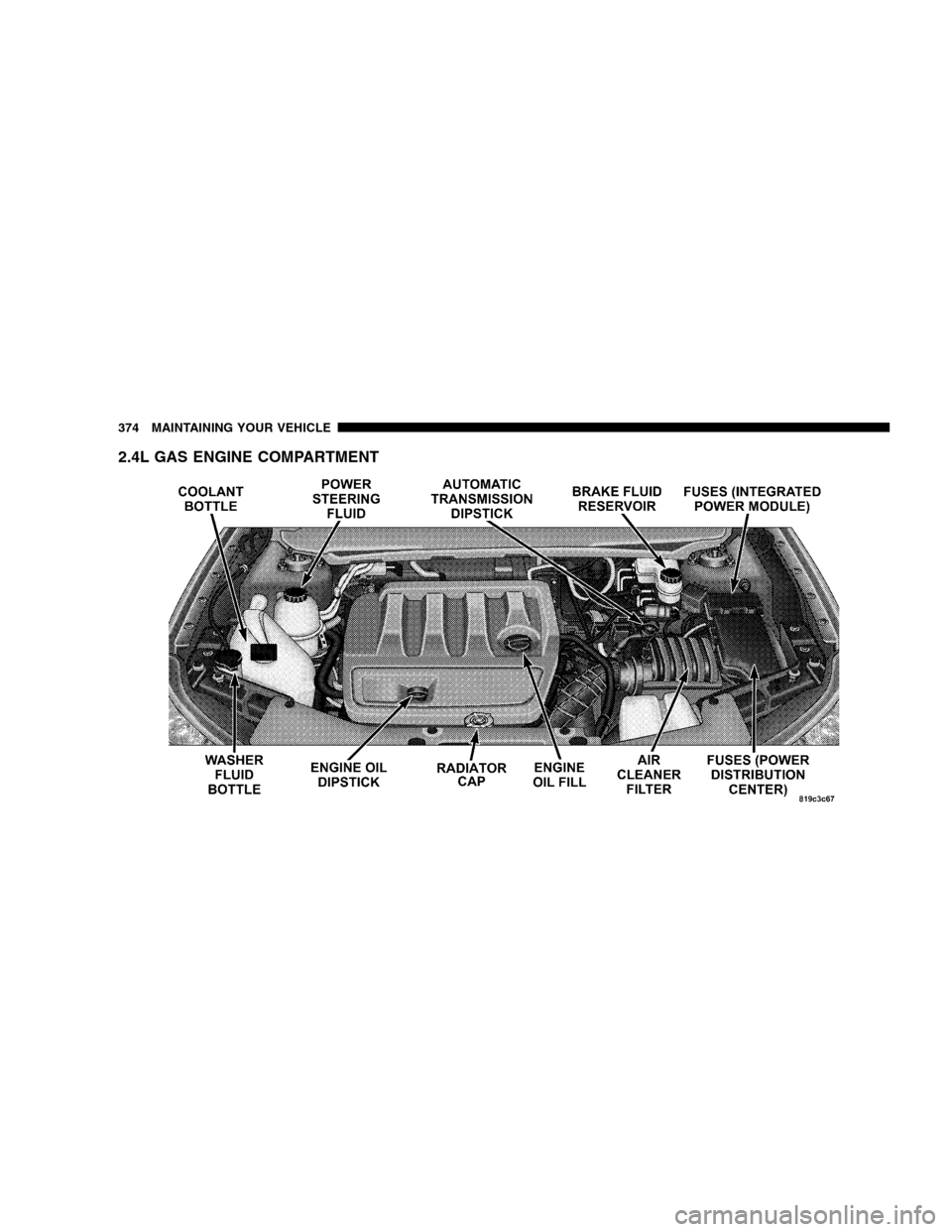
2.4L GAS ENGINE COMPARTMENT
374 MAINTAINING YOUR VEHICLE
Page 377 of 494
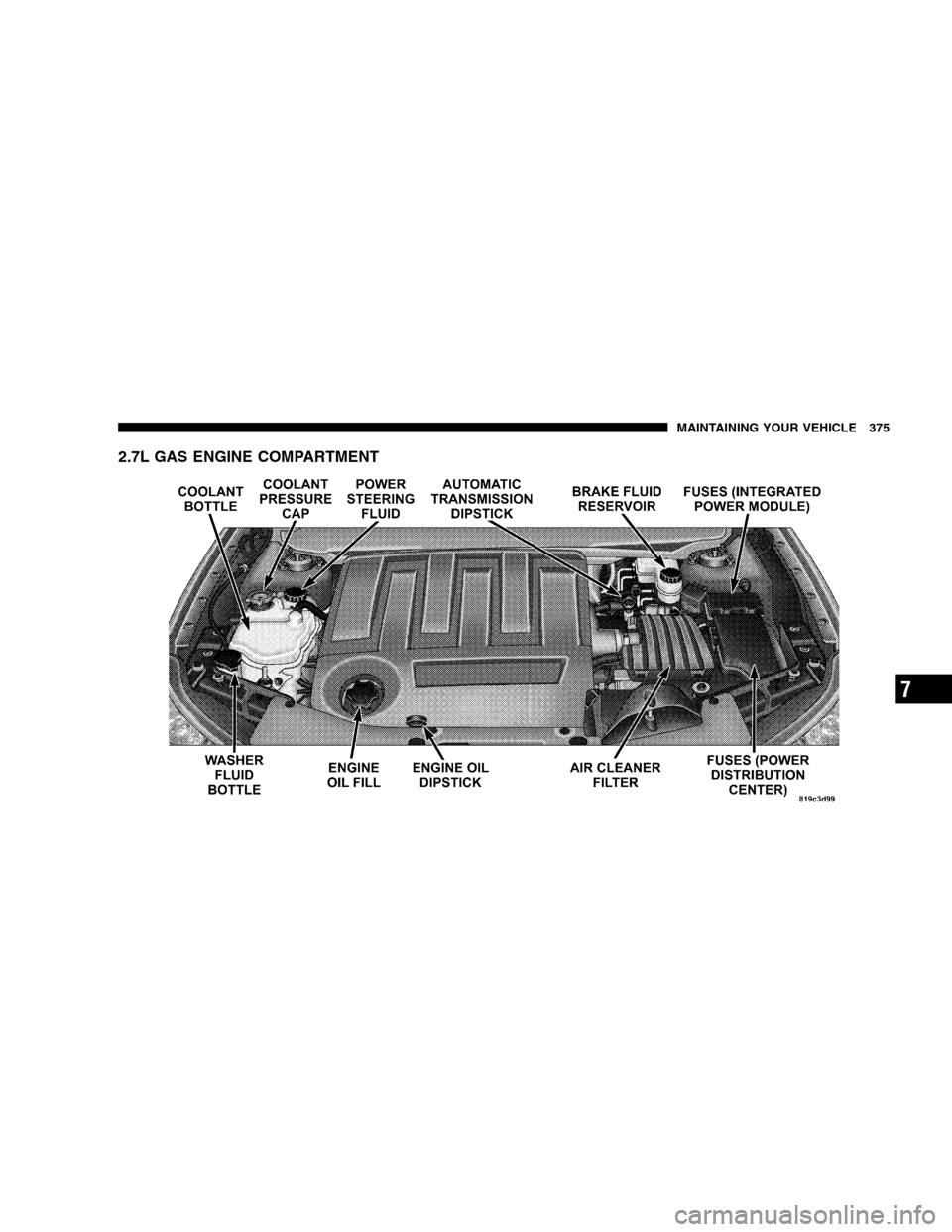
2.7L GAS ENGINE COMPARTMENT
MAINTAINING YOUR VEHICLE 375
7
Page 378 of 494
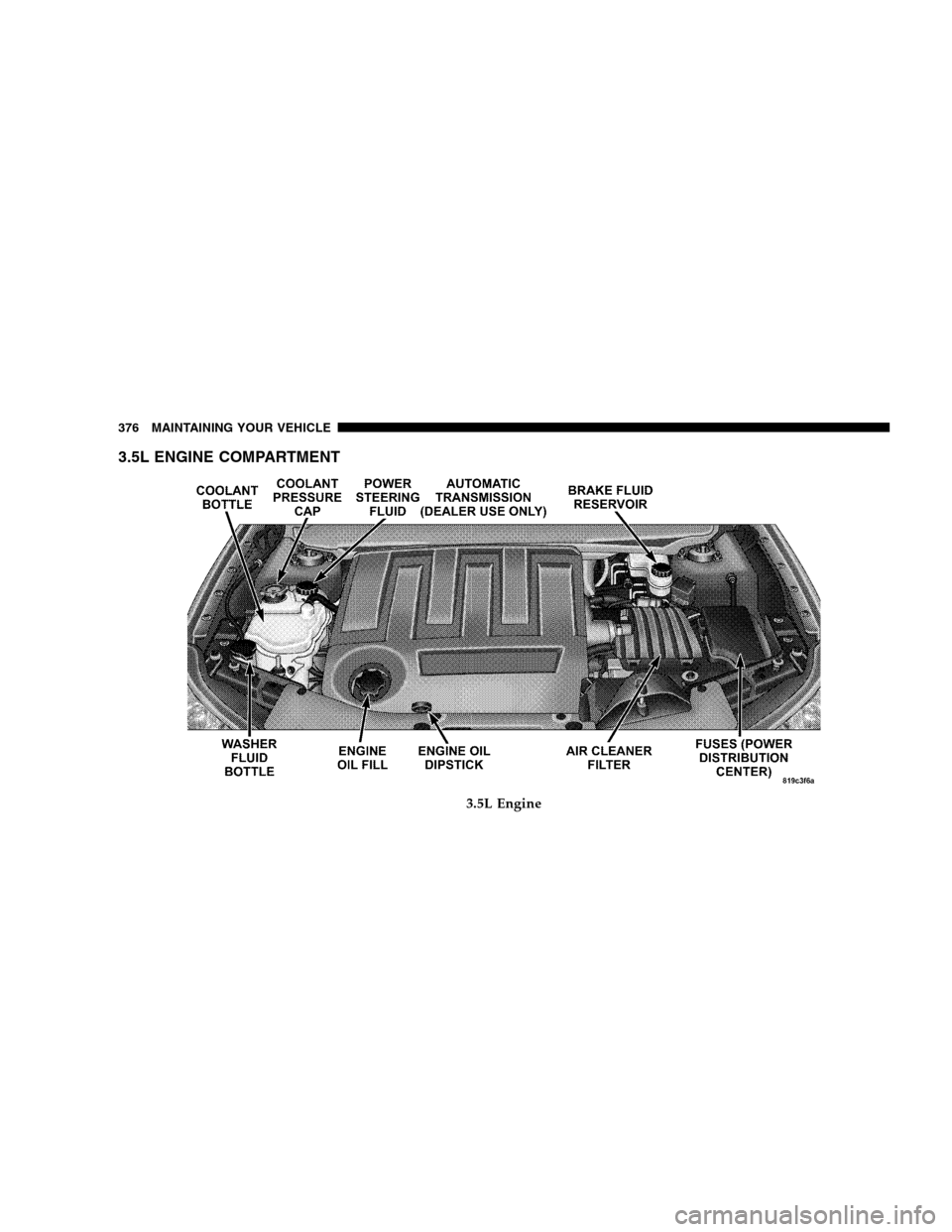
3.5L ENGINE COMPARTMENT
3.5L Engine
376 MAINTAINING YOUR VEHICLE
Page 379 of 494
ONBOARD DIAGNOSTIC SYSTEM — OBD II
Your vehicle is equipped with a sophisticated Onboard
Diagnostic system called OBD II. This system monitors
the performance of the emissions, engine, and automatic
transaxle control systems. When these systems are oper-
ating properly, your vehicle will provide excellent per-
formance and fuel economy, as well as engine emissions
well within current government regulations.
If any of these systems require service, the OBD II system
will turn on the Malfunction Indicator Light (MIL). It will
also store diagnostic codes and other information to
assist your service technician in making repairs. Al-
though your vehicle will usually be drivable and not
need towing, see your authorized dealer for service as
soon as possible.CAUTION!
•Prolonged driving with the MIL on could cause
further damage to the emission control system. It
could also affect fuel economy and drivability. The
vehicle must be serviced before any emissions
tests can be performed.
•If the MIL is flashing while the engine is running,
severe catalytic converter damage and power loss
will soon occur. Immediate service is required.
Loose Fuel Filler Cap Message
After fuel is added, the vehicle diagnostic system can
determine if the fuel filler cap is possibly loose or
improperly installed. A “gASCAP” message will be dis-
played in the instrument cluster. Tighten the gas cap until
a�clicking�sound is heard. This is an indication that the
gas cap is properly tightened. Press the Trip Odometer
MAINTAINING YOUR VEHICLE 377
7