2008 AUDI TT ROADSTER instrument cluster
[x] Cancel search: instrument clusterPage 150 of 316
___ A_ ir_ b_ a-g _ s_y _s_ t_ e_ m _________________________________________________ _
The airbag on the passenger side makes the front seat a potentially
dangerous place for a child to ride. The front seat is not the safest place for a child in a forward-facing child safety seat . It can be a very
dangerous place for an infant or a child in a rearward-facing seat.
The Advanced Airbag System in your vehicle has been certified to comply with the Requirements of United States Federal Motor
Vehicle Safety Standard 208 as applicable at the time your vehicle
was manufactured.
The Standard requires the front airbag on the passenger side to be
turned off ("suppressed") if a child up to about one year of age restrained in one of the rear -facing or forward -facing infant
restraints listed in Federal Motor Vehicle Safety Standard 208 with
which the Advanced Airbag System in your vehicle was certified has
been installed on the front passenger seat. For a listing of the child
restraints that were used to certify compliance with the US Safety
Standard =>
page 170.
The PASSENGER AIR BAG OFF light in the instrument panel tells you
when the front Advanced Airbag on the passenger side has been
turned off by the electronic control unit.
Each time you turn on the ignition, the
PASSENGER AIR BAG OFF
light will come on for a few seconds and:
• will stay on if the front passenger seat is not occupied,
• will stay on if there is a small child or child restraint on the front
passenger seat,
• will go off if the front passenger seat is occupied by an adult as
registered by the weight -sensing mat=>
page 157, "Monitoring the
Advanced Airbag System".
The
PASSENGER AIR BAG OFF light comes on when the control unit
detects a total weight on the front passenger seat that requires the
front airbag to be turned off.
If the total weight on the front passenger seat is more than that of
a typical 1 year-old child but less than the weight of a small adult,
the front airbag on the passenger side can deploy (the
PASSENGER
AIR BAG OFF
light does not come onl. If the PASSENGER AIR BAG OFF
light does not come on, the front airbag on the passenger side
has not been turned off by the electronic control unit and can
deploy if the control unit senses an impact that meets the condi
tions stored in its memory.
For example, the airbag may deploy if:
• a small child that is heavier than a typical 1 year-old child is on
the front passenger seat (regardless of whether the child is in one
of the child safety seats listed =>
page 170), or
• a child who has outgrown child restraints is on the front
passenger seat .
If the front passenger airbag is turned off, the
PASSENGER AIR BAG
OFF
light comes on in the instrument cluster and stays on .
The front airbag on the passenger side may
not deploy (the
PASSENGER AIR BAG OFF light does not illuminate and stay litl even
if a small adult or teenager, or a passenger who is not sitting upright
with their back against a non-reclined backrest with their feet on the
vehicle floor in front of the seat is on the front passenger seat
=> page 130, "Proper seating position for the driver".
If the front passenger airbag deploys , the Federal Standard requires
the airbag to meet the "low risk" deployment criteria to reduce the
risk of injury through interaction with the airbag. "Low risk" deploy
ment occurs in those crashes that take place at lower decelerations
as defined in the electronic control unit=>
page 157, "PASSENGER
AIR BAG OFF light".
Always remember, a child safety seat or infant carrier installed on
the front seat may be struck and knocked out of position by the rapidly inflating passenger's airbag in a frontal collision. The airbag
could greatly reduce the effectiveness of the child restraint and
even seriously injure the child during inflation.
For this reason, and because the back seat is the safest place for
children -when properly restrained according to their age and size
- we strongly recommend that children always sit in the back seat
=>
page 168, "Child Safety" . .,
Page 155 of 316
Airbag syst em -----------------=~-
& WARN ING (co ntinued)
• Make s ure th at the PA SSENGER AIR BAG OFF light come s on
a nd sta y s o n all the tim e whene ver the ign ition i s sw itched on . •
Advanced Airbag System components
The front passenger seat in your vehicle has a lot of very important
parts of the Advanced Airbag System in it. These parts inc lude the
weight -sensing mat, sensors, wiring, brackets, and more. The func
tion of the system in the front passenger seat is checked by the e lec
tronic contro l unit when the igni tion is on. The control unit monitors
the Advanced Airbag System and turns the airbag indicator light on
when a malfunction in the system components is detected . The
function of the airbag indicator light is described in greater detail
below. Because the front passenger seat contains important parts
of the Advanced Airbag System, you must take care to prevent it
from being damaged. Damage to the seat may prevent the
Advanced Airbag for the front passenger seat from doing its job in a crash.
T he front A dvance d Airb ag Syst em con sis ts of th e
following:
• Crash sensors in the front of the vehicle that measure vehicle
acceleration/dece leration to prov ide information to the Advanced
Airbag System about the severity of the crash .
• An electronic control unit, with integrated crash sensors for front
and side impacts. The control unit "decides" whether to fire the
front airbags based on the information received from the crash sensors. The contro l unit a lso "decides" whether the safety belt
pretensioners should be activated .
• A dual -stage Advanced Airbag with gas generator for the driver
inside the steering wheel hub .
• A dual -stage Advanced Airbag and gas generator inside the
instrument pane l for the front passenger .
Controls and equip
ment Safety first Vehicle operation
•
A weight -sensing mat under the upholstery padding of the front
passenger sea t cushion that measures the total weight on the seat .
The information registered is sent continuously to the e lectronic
control unit to regula te dep loyment of the front Advanced Airbag on
the passenger side.
• An airbag monitoring syste m and indica tor l ight in the instru
ment cluster=>
page 157.
• The PASSENGER AIR BAG OFF light comes on and stays on in the
center of the instrument panel=>
page 157, fig. 133 and tells you
when the front Advanced Airbag on the passenger side has been
turned off .
• A sensor be low the safety belt latch for the front seat passenger
to measure the tension on the safety belt . The tension on the safety
belt and the weight registered by the weight -se nsing mat help the
control unit "decide" whether the front airbag for the front
passenger sea t should be turned off o r not =>
page 147, "Child
restraints on the front seat -some important things to know" .
• A sensor in the safety belt latch for the dr iver and for the front
seat passenger that senses whether that safety be lt is latched or not
and t ransmits this information to the electronic control unit.
& WARNING
Damage to the front pa ssenger seat can prevent the front airbag
fr om worki ng properly .
• Improper repair or di sa ssembly of the front pa ssenger and
dri ver seat will prevent th e Adv an ced Airbag Sy stem from func
tioning properly.
• Rep air s to the front p assenger seat must b e perfor med by qu al
ified and properly tra ined work shop per sonnel .
• Never remo ve the fro nt pa ssenger or dr iver se at from the
v ehi cle.
• Nev er remove th e uphol stery from the fron t pass eng er seat.
• Never disas semble or r emove p arts from the seat or di sconne ct
wires from it . ..
Vehicle care Do-it-yourself service Technical data
Page 211 of 316
![AUDI TT ROADSTER 2008 Owners Manual _______________________________________________ C_l_e _a_ n_ in _____ g ___ a_n_ d ___ p_r _o _t_ e_ c_ t _i _o _ n __ lfll
•
[ i ] Tip s
Open Ve lcro fasteners on your cloth ing can d](/manual-img/6/57671/w960_57671-210.png "AUDI TT ROADSTER 2008 Owners Manual _______________________________________________ C_l_e _a_ n_ in _____ g ___ a_n_ d ___ p_r _o _t_ e_ c_ t _i _o _ n __ lfll
•
[ i ] Tip s
Open Ve lcro fasteners on your cloth ing can d")
_______________________________________________ C_l_e _a_ n_ in _____ g ___ a_n_ d ___ p_r _o _t_ e_ c_ t _i _o _ n __ lfll
•
[ i ] Tip s
Open Ve lcro fasteners on your cloth ing can damage the seat cover .
Please make sure that Ve lcro fasteners are closed .•
Plastic parts and instrument panel
Always use a c lean cloth moistened in clear water to clean these
areas . For persis tent dirt use an Audi approved
solvent -free plastic
cleaner/protectant.
& WARNING
Solvents can change the propertie s of some plastics and make it
harder for the airbag to deploy .
• Never clean the instrument p anel or the surface of Airbag
modules with cleanin g prod ucts that contain solvents .
• Products containing solvent s will make the surface of th is part
poro us.
• Serious injuries can re sult if pla stic parts come loo se when the
airbag is deployed .
• Alway s read and heed all WARNING S and the i nformation
~ page 200 .
0 Note
Cleaning agents containing solvents wil l attack the material and can
change the way it behaves. •
Instrument cluster glass
-Clean the g lass w ith a soft, damp cloth.
I n order to preserve the anti -glare properties of the instrument
c luster glass, it should o nly be cleaned wi th a so ft. dam p clot h.•
App lies to veh ic les: with nat ural leat her
Natural leather
Aud i m akes gre at effo rts to maint ain th e pr oper ties,
n atur al look and feel of interi or le ather.
Gener al
We offe r many d ifferent types of leathe r on our vehicles. Mo st are
different types of nappa leather , which has a smooth surface and
comes in various co lo rs.
The intensity o f the color determ ines the visua l characteristics and
appearance. If the surface of the leather has a typical natura l look,
then t he leather is a nappa lea ther that has bee n left in a re latively
natura l condition. This leather offers particu lar ly good comfort and
b reathes well. Fi ne veins, closed g ra ins, insect bites, skin folds, an d
subtle variations in co lor remain visib le. These characteristics
dem onstrate that the mater ial is natural.
Natura l nappa leather is not covered by a co lor finish . It is therefore
more sensitive to soil ing and wear, which is something you need to
consider if chi ldren, animals or other fac tors might prove to be
particularly hard on the leather.
By con trast, leather types that are covered by a colo red fin ish layer
are more durable. This has a positive effect on the leather's resis
tance to wea r and s oiling i n daily use . On the ot her hand, the typical
characteristics of natura l leather are barely or not apparent .
However, this does not mean that the leather itself is of inferior
qua lity .
Care and handling
Because of the exclusive nature of the types of leather that Audi
u ses and thei r unique p rope rties (suc h as sens it ivity to oi ls, g rease,
soi ling, etc .), you wi ll need to be somewhat careful w ith these
leathers, and a certain type of care is required. For example, dark .,.
Vehicle care I t •
Page 267 of 316
_______________________________________________ W_ h_ a _ t_d_ o_ l _d _o_ n_ o_ w_ ? _ __.1111
- Remove the "max. 50 mph" (80 km/h) sticker from the
sealant bottle and affix it to the instrument cluster in the
driver's view.
& WARNING
• Turn the hazard flashers on and set up the warning triangle if
you have a flat tire in moving traffic . In this way you protect your
self and other road users.
• Make sure that all passengers are in a safe place, out of the
danger zone (for example, behind a guard rail).
0 Note
Particular care is necessary if you are making a tire repair on a steep
incline.
[ i] Tips
Obey all laws. •
Applies to vehicles: with T ire Mobil ity System
Making a tire repair
Tire repair consists of the following sections.
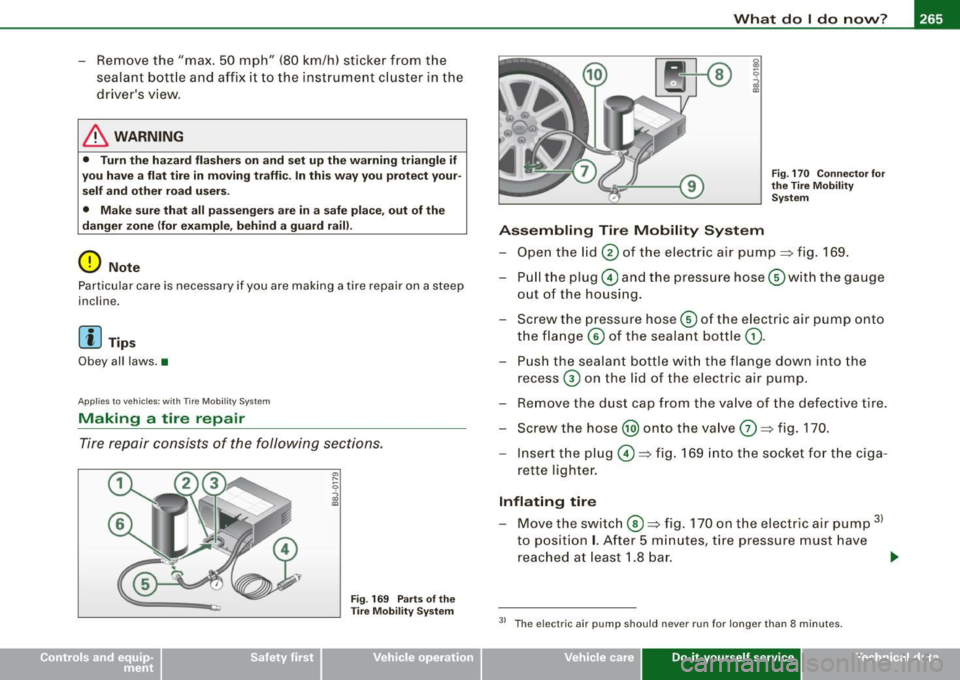
Fig. 169 Parts of the
Tire Mobility System Fig
. 170 Connector for
the Tire Mobility System
Assembling Tire Mobility System
- Open the lid 0 of the electric air pump~ fig. 169.
- Pull the plug© and the pressure hose G)with the gauge
out of the housing.
- Screw the pressure hose© of the electric air pump onto
the flange © of the sealant bottle
G).
- Push the sealant bottle with the flange down into the
recess
G) on the lid of the electric air pump.
- Remove the dust cap from the valve of the defective tire.
- Screw the hose @) onto the valve
G) ~ fig. 170.
- Insert the plug©~ fig. 169 into the socket for the ciga-
rette lighter.
Inflating tire
- Move the switch®~ fig. 170 on the electric air pump 31
to position I. After 5 minutes, tire pressure must have
reached at least 1.8 bar.
~
3> The e lectric air pump should never run for longer than 8 minutes.
Vehicle care Do-it-yourself service irechnical data
Page 276 of 316

llffl.,___F_ u_ s_ e_s _ a_n _ d_ b_ u_lb _ s _______________________________________________ _
The various electrical circuits are protected by fuses . The fuses are
clustered in a central ized unit. The unit is located behind the face
panel at the end of the instrument panel.
Two spare fuses and a sticker identifying the fuses are located on
the inside of the fuse box cover.
You are wel l advised to keep a supply of spare fuses in your vehicle .
Fuses with the proper ampere ratings are availab le at your autho
rized Audi dealer .
& WARNING
Never replace a fuse with one that has a higher amperage rating .
• A fuse with a too high amperage could damage the electrical
part and cause a fire.
0 Note
• On no account should fuses be repaired (e.g. patched up with tin
foil or wire) as this may cause serious damage elsewhere in the elec
trical circuit or cause fire.
• If a fuse blows repeatedly, do not keep replacing it. Instead, have
the cause for the repeated short circuit or overload tracked and
fixed. •
Fuse Location , Instrument Panel left
Fig. 180 Fuse carrier
behind the instrument
panel end face, cover
removed
Some of the equipment items listed are optional or only available on
certain model configurations .
Note that the following table is accurate at the time of going to
press and is subject to change. In the event of discrepancies , the
label on the inside of the cover always takes precedence.
The power seats are protected by circuit breakers , which automati
ca lly reset after a few seconds after the overload has been reme-
died. _,.
Page 277 of 316

Fuses and bulbs -
----------------
Equipment No. Equipment
Amps
Engine relay, fuel tank control unit, Airbag Off
16 A/C system (control unit) 10
1
light, light switch (switch illumination), diagnos-10
tic connector
17 Tire pressure monitoring system (control unit) 5
18
Not used
ABS, ASR, ESP, brake light switch
5 19
Not used
3 AFS headlight (left) 5
Not used
Oil level sensor (extended maintenance interval)
(WIV), tire pressure monitoring system, switch
21 Fuel injectors (gasoline engine) 10
4 for Electronic Stability Program (ESP), AFS head-5 Wind deflector (Roadster) 30
lights (control unit), A/C system (pressure sen -23 Horn 20 sorl, backup light switch
Automatic headlight range control, AFS head-
24 Transmission (control unit) 15
5
light (right)/ manual headlight range control, 5/10
25 Heater rear window Coupe/heated rear window 30/20
halogen headlights Roadster
Control unit for CAN data transfer (gateway),
26 Driver's side power window 30
6 electromechanical steering, automatic transmis-5
27 Passenger's side power window 30
sion shift gate
28 Not used
Acoustic Park Assist, automatic dipping interior
rear view mirror, garage door opener, heatable
29 Washer pump 15
7
windshield washer nozzles, washer pump, wind 5
30 Cigarette lighter 20
deflector relay (Roadster)
31 Starter 40
8
Haldex clutch 5 32 Steering column module 5
9
Control unit Audi magnetic ride 5 33
Instrument cluster 5
Airbag control unit 5 34 Radio navigation system, radio 15
1 1 Mass airflow sensor, crankcase heating 5/10
35
Audio amplifier 30
12 Door control unit (central locking driver/passen-10
36 Engine (control unit) 10 ger)
13 Diagnostic connector 10 37 CAN (Gateway) 5
Rain sensor, automatic transmission shift gate 5 38 Not used
15 Roof
light (interior lighting) 5 39 Not used
• Do-it
-yourself service
Page 307 of 316

______________________________________________ A_ l_,_ p _h_ a_ b_e _t_ic _ a _ l _in _ d_e _ x __ _
Heated
front seats (climate control) .... .... 104
rear window ...... ....... ..... ... 103
Heated outside mirrors ... .. .... .... .. 83
Heated seats .................. .... . 104
Seats ...... ...... .... ........ ... 104
Heated washer jets
Wiper and washer system . ......... 78
Heating .. .... ... .... .... ......... ... 98
High beam ...... ................. 69, 76
Warning/indicator lights ... ... .... .. 18
High voltage warning label ........... 288
Homelink® ... .. .... .... ........... 121
Homelink® universal remote control ... 121
Hood Opening .. ............... ... .... 219
Release lever .................... 219
Horn ......... ... .. .... .... ...... ... 11
How many airbags does my vehicle have? . .
153
How often should I check my tire pressures?
245
How safety belt tensioners work .... ... 144
Hydroplaning ........ .... .... .... ... 249
I
Igni tion key 106
Ignition lock ...... ...... .... ...... .. 106
Ignition lock positions ............... 106
Immobili zer ... ............. ..... ... . 14
Important things to do before driving .. 128
Controls and equip
ment Safety first
Improperly
worn safety belts ... .. ... .. 144 K
Indicator light
Airbag system ........ .... .... ... 157 Key .....
........ ........ ...... ... .. . 47
Audi magnetic ride ................ 17 Battery replacement ......
.... .... . 49
PASSENGER AIR BAG OFF ... ....... 157 Conven
ience opening and closing of pow-
Indicator lights .. ...... .... .... ...... 16
Infant seats ........ ...... ... .... ... 173
How do I properly insta ll an infant seat in
my vehicle? ....... ...... ....... 173
Safety instructions ......... ....... 173
Inside rearview mirror ......... ...... . 82
Installing child safety seats
Safety belts ...................... 177
Instrument cluster and controls . ...... . 12
Instrument panel
Illumination ......... ............. 74
Ins truments and controls
Genera l il lustration ................ 11
Interior lights ....... ..... ....... .... . 77 er top
... .... .... ... ............ 63
Convenience opening and closing of windows ............ .... ........ 58
Emergency key .. ...... ............ 47
Key replacement ......... .... ..... 47
Master key . ...... .... ...... .... .. 47
Valet key ... .. .... .... .... .... .... 47
Key less entry remote contro l .......... . 48
Kick-down Automatic transmission ........... 117
Knee airbags ........ ... .... ........ 161
Description . ...... .... ....... .... 161
How they work ................... 163
Important safety instructions ... .... 163
Luggage compartment .. ....... .... 77
L
J Launch Control Program ............. 117
Jump start location ........... ... .... 279
Jump starting ...................... 279
Jumper cables ... ..... ...... .... .... 279
Jump-starting . ........ .... ... .. .... 278 Leather ...
... .... ....... .... ...... . 209
Cleaning ...... .... ..... .. .... ... 210
Leaving -home-function ................ 73
Lifting jack ......................... 269
Lift ing vehicle .... .................. 283
Light sensor defective ........... ...... 36
Light sensor package Automatic headlight control .. ....... 70
Vehicle operation Vehicle care Do-it-yourself service Technical data