2008 AUDI TT ROADSTER trunk
[x] Cancel search: trunkPage 5 of 316

Knee airbags . . . . . . . . . . . . . . . . . . 161
Side airbags . . . . . . . • . . . . . . . . . . . 164
Child Safe ty . . . . . . . . . . . . . . . . . . . . 168
Important things to know . . . . . . . 168
Important safety instruct ions for
using child safety seats ........ .
Child safety seats .. ...... ..... .
Insta lling a ch ild safety seat .... .
Add it ional Information .... ... .. .
Vehicle operation ....... .
Intelligent technology ......... .
Notice about da ta recorded by
veh icle contro l modules ....... .
Electronic Stab ilizat ion Program
(ESP) ... ... ... ... .... .... .. ... .
Rear spoiler .................. .
Braking .................... .. .
El ectro -mechanical power assist .
Driving with your quattro® ..... .
Driving and environment .... . .
171
173
177
180
183
184
184
184
187
188
190
191
192
The first 1,000 miles (1,500 km) and
afterwards . . . . . . . . . . . . . . . . . . . . 192
Cata lytic converter . . . . . . . . . . . . . 193
Avoid damaging the vehicle . . . . . 194
Operate your vehicle economically
and minimize pollution ... .. ... . 194
Trailer towing . . . . . . . . . . . . . . . . . . 196
Vehicle care ..... ... ... ... .
C leaning and protection ...... .
General information
Care of exterior ............ .... .
Care of interior .. .. .. .... ... .. . .
Fue l supply and filling your fuel
tank .. ... ... ... ... ...... .... .. . .
Gasoline .... ...... ........•. ...
Fuel tank ..................... .
Checking and filling ...... ... .. .
Eng ine hood ... ........ ....... .
Engine compartment .......... .
Engine oil ........ ... ...... .... .
E ngine cooling system ......... .
Brake fluid ..... .. ... ... ...•. ...
Battery . ...... .. .. .......... .. .
W indshield/headlight washer
conta iner .. .... ... ... .. ... .. .. .
Tires and whee ls ...... ..... ... .
T ires . ............ ...... · ·, · · · ·
Run -flat tires ......... ... .... .. . 199
200
200
200
208
214
2 14
2 15
2 19
219
221
222
227
230
231
236
238
238
257
Table of contents
Do-it-yourself service .. . 261
What do I do now? . . . . . . . . . . . . . 262
Trunk escape handle . . . . . . . . . . . . 262
Veh icle tool kit . . . . . . . . . . . . . . . . . . 262
T ire repair . . . . . . . . . . . . . . . . . . . . . . 263
What should I be aware of when
changing a tire? . . . . . . . . . . . . . . . . 267
Fuses and bulbs ................ 273
Fuses . . . . . . . . . . . . . . . . . . . . . . . . . . 273
Bu lbs ......... .. ... .... ... ..... 277
Emergency situations . . . . . . . . . . 278
Genera l . . . . . . . . . . . . . . . . . . . . . . . . 278
Starting by pushing or towing . . . . 278
Starting with jumper cables . . . . . . 278
Use of jumper cables . . . . . . . . . . . . 279
Emergency towing with commercial
tow truck . . . . . . . . . . . . . . . . . . . . . . 281
Lif ting vehicle . . . . . . . . . . . . . . . . . . 283
Technical data
General information
287
288
Explanation of technical data 288
Vehic le identif ication . . . . . . . . . . . . 288
Vehicle care I I irechnical data
Page 26 of 316
Driver inf ormation sy ste m
Digital speedometer
Fig. 1 0 Dis play: Dig ital
s pe edom ete r
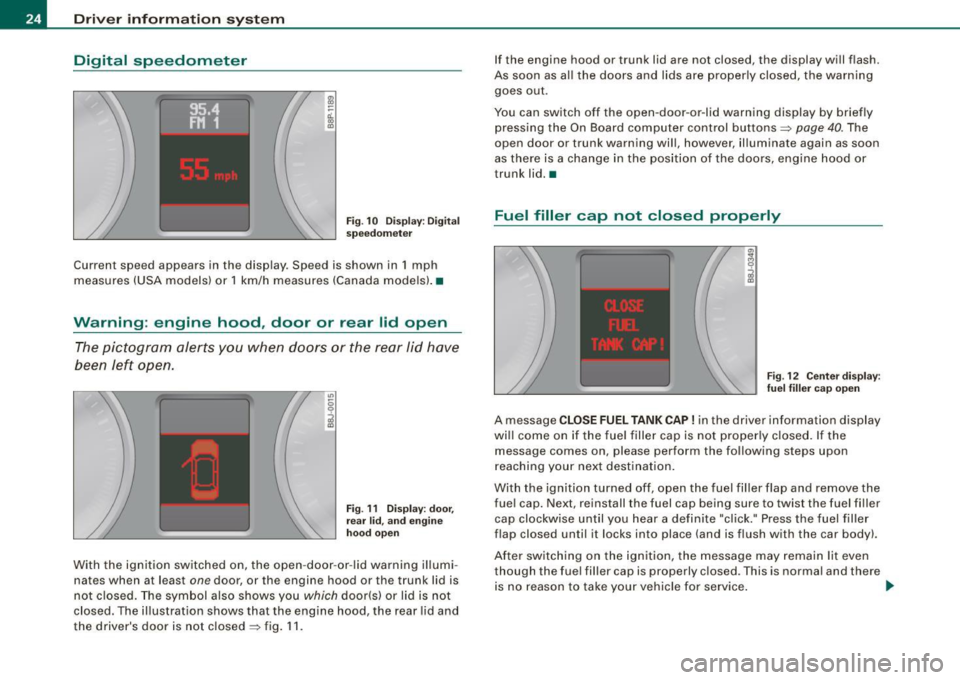
Current speed appears in the disp lay . Speed is shown in 1 mph
measures (USA models) or 1 km/h measures (Canada mode ls) .•
Warning : engine hood , door or rear lid open
The pictogram alerts you when doors or the rear lid have
been left open .
Fig . 11 D ispl ay: door,
re ar
lid , and en gine
h oo d open
With the ignition switched on, the open -door -or -lid warning illumi
nates when at least
one door, or the engine hood or the trunk lid is
not c losed. The symbol also shows you which door(s) or lid is not
closed. The illustration shows that the engine hood, the rear lid and
the driver's door is not closed=> fig . 11 . If the engine hood or trunk lid are not closed, the display will flash.
As soon as al l the doors and lids are proper ly closed, the warning
goes out .
You can switch off the open -door -or -lid warning display by brief ly
pressing the On Board computer control buttons=>
page 40. The
open door or trunk warning wil l, however, illuminate again as soon
as there is a change in the position of the doors, eng ine hood or
trunk lid. •
Fuel filler cap not closed properly
Fig. 12 C ente r dis play :
fu el fi ller cap op en
A message CLOSE FUEL TANK CAP ! in the driver informa tion display
wi ll come on if the fuel f iller cap is not proper ly closed. If the
message comes on, please perform the following steps upon
r eaching your next destination.
With the ignition turned off , open the fuel fil ler f lap and remove the
fue l cap. Next, reinstall the fuel cap being sure to twist the fuel fi ller
cap clockwise until you hear a definite "cl ick." Press the fuel filler
flap closed until it locks into place (and is flush with the car body) .
Af ter sw itch ing on the ign ition, the message may remain lit even
though the fuel filler cap is properly c losed. This is normal and there
is no reason to take your vehicle for service . _,,
Page 57 of 316

Rear lid/trunk lid
Opening and closing rear lid
You can open the rear lid from inside the vehicle using a
switch in the driver's door.
Opening the rear lid
Fig . 40 Driver's door:
remote rear lid release
-Press the center button e::5 on the master key or pull the
release button
C::5 in the dr iver's door=> fig. 40. The rear
lid is unlocked.
Opening rear lid
- Lift the rear lid.
Closing the rear lid
- Pull the rear lid down and allow it to drop gently=>& .
& WARNING
• After closing the rear lid, always pull up on it to make sure that
it is properly closed. Otherwise it could open suddenly when the
vehicle is moving.
Con tro ls and eq uip
ment
Opening and closing
& WARNING !continued)
• To help prevent poisonous exhaust gas from being drawn into
the vehicle, always keep the rear lid closed while driving. Never
transport objects larger than those which fit completely into the
luggage area, because then the rear lid cannot be fully closed.
• Never leave your vehicle unattended especially with the rear lid
left open. A child could crawl into the car through the luggage
compartment and pull the lid shut, becoming trapped and unable
to get out. To reduce the risk of personal injury, never let children
play in or around your vehicle . Always keep the rear lid as well as
the vehicle doors closed when not in use.
[ i] Tips
• If the rear lid is open or not properly locked when the ignition is
turned on, the door and rear lid warning~
page 24 appears in the
instrument cluster display.
• If the rear lid on a locked vehicle is unlocked with the m iddle
button
~ on the remote key, the rear lid is automatically locked
again immediately after closing . This is indicated by the turn signals
blinking. •
Vehicle care
I I irechnical data
Page 67 of 316

The folding top's emergency operation basically consists of the
following steps:
• Depressurize the hydraulic system for operating the folding top:
The hydraulic system pump must be depressurized.
• Unlock the covers : The covers must be manually unlocked and
positioned.
• Raise the folding top: The folding top must be manually lifted out
of its well and raised.
• Lock the folding top: The latches for the folding top must be
locked with the emergency lock key.
• Close the hydraulic system's emergency operation bolt: Turn the
emergency operation bolt=> fig. 54 to the right to close the
hydraulic system that operates the folding top.
& WARNING
• When raising the folding top, take care not to reach into the
linkage that operates the folding top or any of its other moving
parts. Otherwise, your hands may be trapped in the mechanism -
risk of injury!
• Never drive while the folding top is not properly secured . Other
wise, it may be pulled open by the wind. This can cause injuries and damage to the vehicle -danger of an accident!
[ i] Tips
Get a second person help you to close the folding top. It is much
easier to raise the folding top with the help of a second person. •
Controls and equip
ment
Folding top
Ap plies to vehi cles: with po wer fo ldin g top
Step 1: Depressurizing the hydraulic system
-
Fig. 54 Hydraulic
pump: Emergency
operation bolt in the
trunk
- Open the trunk lid. If the rear lid cannot be opened, an
emergency release is provided
=> page 56.
- Swing the luggage compartment floor upwards.
- Take out the screwdriver and the crank. The crank is
located under the electric air pump for the tire repair kit*
=> page 264, fig. 168.
-Insert the screwdriver through the slit in the carpeting
=> fig. 54.
-Turn the emergency operation bolt to the left to depres
surize the hydraulics that operate the folding top.•
I • •
Page 95 of 316
Luggage compartment
Applies to vehicles: with pass-through and removable ski bag
Pass-through with Ski Bag
Using the pass-through and the removable ski bag, you
can transport long objects (e.g. skis) neatly and without
damaging the interior.
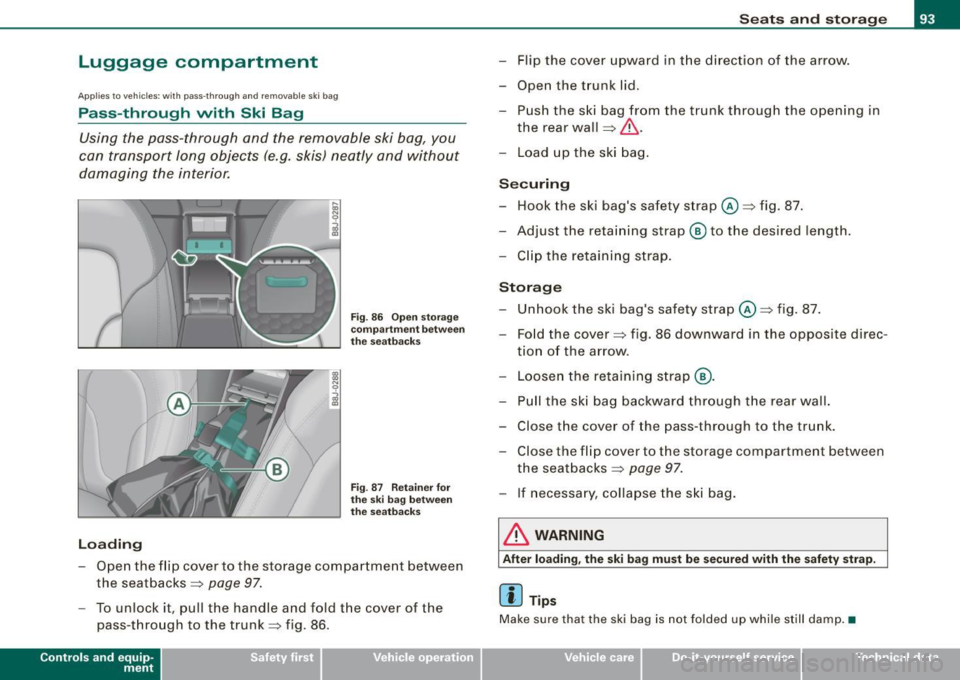
Loading
Fig . 86 Open storage
compartment between
the seatbacks
Fig . 87 Retainer for
the ski bag between
the seatbacks
-Open the flip cover to the storage compartment between
the seatbacks => page
97.
-To unlock it, pull the handle and fold the cover of the
pass -through to the trunk=> fig. 86.
Contro ls and eq uip
ment
Seats and storage
- Flip the cover upward in the direction of the arrow.
- Open the trunk lid.
- Push the ski bag from the trunk through the opening in
the rear wall
=> &, .
- Load up the ski bag.
Securing
Hook the ski bag's safety strap @=>fig. 87.
Adjust the retaining strap® to the desired length.
- Clip the retaining strap.
Storage
- Unhook the ski bag's safety strap@=> fig. 87.
- Fold the cover => fig. 86 downward in the opposite direc-
tion of the arrow .
- Loosen the retaining strap @.
Pull the ski bag backward through the rear wall.
- Close the cover of the pass-through to the trunk.
- Close the flip cover to the storage compartment between
the seatbacks => page
97.
- If necessary , collapse the ski bag.
& WARNING
After loading, the ski bag must be secured w ith the safety strap.
[ i] Tips
Mak e sure that the ski bag is not folded up while still damp. •
Vehicle care
I I irechnical data
Page 219 of 316

_____________________________________ F_ u_ e_l _s _u-= pc...:... p_ly =--- a_ n_ d_ f_ i_ ll _in -=: gc.. y -=--- o-u_ r_ fu_ e_l _t _a _n_ k __ fflllll
•
- Select a medium refuelling rate so that the nozzle
switches off automatically when the tank is full.
Putting the fuel cap back on
- After filling your tank, twist the fuel filler cap clockwise
until you hear a definite click.
- Close the fuel filler flap.
To avoid fuel spilling or evaporating from the fuel tank always close
fuel filler cap properly and completely. An improperly closed fuel
filler cap may also cause a message in the driver information system =>
page 24 or cause the MIL lamp=> page 26 to come on.
& WARNING
Improper refueling or handling of fuel can cause fire, explosion
and severe burns .
• Fuel is highly flammable and can cause severe burns and other
injuries.
• Failure to shut the engine off while refueling and/or to insert
the pump nozzle fully into the fuel filler neck could cause fuel to
spray out of filler neck or to overflow. Fuel spray and overflowing
fuel can cause a fire.
• Never use a cellular telephone while refueling . The electromag
netic radiation can cause sparks that can ignite fuel vapors and
cause a fire .
• Never get back into your vehicle while refueling. If in excep
tional circumstances you must get back in your vehicle while refu
eling, make certain that you close the door and touch metal to
discharge static electricity before touching the filler nozzle again.
Static electricity can cause sparks that can ignite fuel vapors
released during refueling.
• Never smoke or have an open flame anywhere in or near your
vehicle when refueling or filling a portable fuel container.
& WARNING (continued)
• For your safety, we strongly recommend that you do not travel
with a portable fuel container in your vehicle. The container, full or empty may leak and could cause a fire, especially in a crash .
• If, under exceptional circumstances, you must transport a
portable fuel container, please observe the following: -Never fill a portable fuel container while it is anywhere in or
on the vehicle (for example, in the luggage compartment, or on
the trunk). Static electricity can build up while filling and can ignite fuel vapors causing a fire.
- Always place a portable fuel container on the ground before
filling.
- Always keep the filler nozzle completely inside the portable
container before and during filling.
- If filling a portable container made of metal, the filler nozzle
must always be in contact with the container. This will help
prevent static electricity from discharging and cause a fire.
- Never spill fuel inside the vehicle or luggage compartment.
Fuel vapors are highly flammable.
- Always observe local and state/provincial laws regarding the
use, storage and transportation of fuel containers
- Make certain the fuel container meets industry standards
(ANSI / ASTM F852-86l.
(D Note
If any fuel has spilled onto the car, it should be removed immedi
ately to prevent damage to the paint.
<£> For the sake of the environment
As soon as the correctly operated nozzle switches off automatically
for the first time, the tank is full. Do not try to add more fuel because
fuel may spill out. In addition, the expansion space in the fuel tank ..,_
Vehicle care
I t •
Page 264 of 316
11111...__W_ h_ a _ t_d_ o_ l _d _o_ n_ o_ vv_ ? ______________________________________________ _
What do I do now?
Trunk escape handle
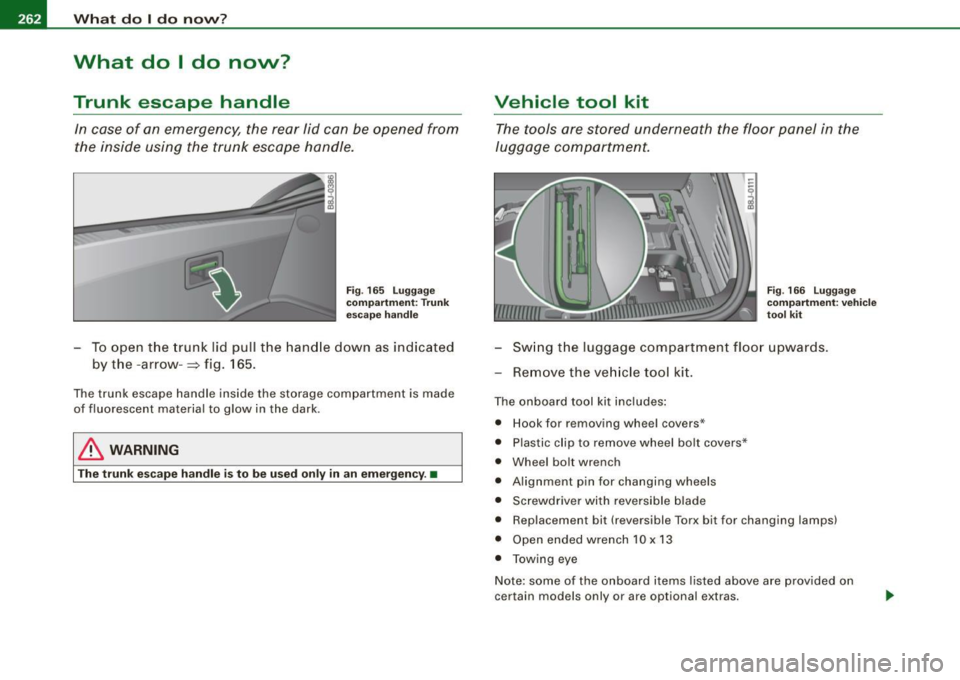
In case of an emergency, the rear lid can be opened from
the inside using the trunk escape handle.
F ig . 165 Lug gag e
co mp artm ent: T runk
escape handl e
- To open the trunk lid pull the hand le down as indicated
by t h e -arrow -~ fig. 165.
The trunk escape handle inside the storage compartment is made
of fluorescent materia l to glow in the dark.
& WARNING
The tr un k es cap e handl e is to b e use d onl y in an em ergen cy. •
Vehicle tool kit
The tools are st ored underneath the floor panel in the
luggage c ompartment.
Fi g. 16 6 Lugga ge
co mpa rtm ent : ve hic le
t o ol kit
- Sw ing the luggage compartment floo r upwards .
- Remove the ve hicle tool kit .
The onboard tool ki t includes:
• Hook for removing wheel covers *
• Plastic clip to remove wheel bolt covers*
• Wheel bolt wrench
• Alignment pin for changing wheels
• Screwdriver wi th reversible blade
• Replacement bit (r eve rsible Torx bit for changing lamps)
• Open ended wrench 10 x 13
• Towing eye
Note: some of the on board items listed above are prov ided on
certain models only or a re optional extras.
Page 308 of 316

__ _:._A..:.:l:.!: p :...:h..:.: a== b:..:e :...:t :.:..ic =-= a..:..l ..:.:in :..:..:: d:...:e :...:x-=-----------------------------------------------
Lights
Bi-Xenon headlights ... .... ...... .. 75
Coming-home/leaving-home-function 73
Emergency flasher . . . . . . . . . . . . . . . . 75
Front fog lights . . . . . . . . . . . . . . . . . . . 73
Headlights . . . . . . . . . . . . . . . . . . . . . . . 69
High beam . . . . . . . . . . . . . . . . . . . . 69, 76
High beam warning/indicator light ... 18
Instrument pane l illumination . ...... 74
Side marker lights . . . . . . . . . . . . . . . . . 69
Turn signals .. ..... ....... .... .... 76
Loading the luggage compartment 135
Locking Power locking switch . . . . . . . . . . . . . . 53
Rear lid/trunk lid .... .. ...... ... .. . 55
Remote control key . . . . . . . . . . . . . . . . 51
Using the key . .... .... .... ..... .. . 53
Luggage compartment Ligh t ........... .... .... ......... 77
Loading . . . . . . . . . . . . . . . . . . . . . . . . 135
Ski bag .. ... ..... .... .... ...... .. 93
Lumbar support ...... .... ........... 91
M
Maintenance ... .. ...... ...... .... .. 294
Malfunction Indicator Lamp (MIU 18 , 26
Manual folding top
closing ........ .... ..... ......... 61
Manual transmission ...... .... ...... 113
Maste r key . . . . . . . . . . . . . . . . . . . . . . . . . . 48
Battery replacement . . . . . . . . . . . . . . . 49
Menu button . . . . . . . . . . . . . . . . . . . . . . . . 28 Menu
display . . . . . . . . . . . . . . . . . . . . . . . . 27
Mileage Average .......... .... ....... .... 39
Instantaneous .. .... .. .... .... .... 39
Mirror Inside rearview mirror, manua l ...... 82
Mirrors Activa ting the digital compass . .... . 85
Anti-glare rearview mirror . ...... ... 82
Automatic d imming for the outs ide
mirrors .............. .... ..... .. 84
Automatically dimm ing inside mirror . 82
Manual glare dimming ... .... ...... 82
Outside mirrors .......... .... .... . 83
Monitoring the Advanced Airbag System
157
N
Natural leather 209
New tires and wh eels ... ... ... .... ... 249
NHTSA Contacting . . . . . . . . . . . . . . . . . . . . . . 136
Number of seats . . . . . . . . . . . . . . . . . . . . 137
0
Occupan t seating positions . . . . . . . . . . . 130
Octane rating .... .. . .. ... .... ... ... 214
Odometer . . . . . . . . . . . . . . . . . . . . . . . . . . . 14
Oil See Engine oil ....... ... .. ..... .. 222
Older children and safety belts . . . . . . . . 177 On-Board Diagnostic System (OBD)
Data Link Connec tor (DLC) . .... ..... 26
Electronic speed limiter ... ........ . 26
Malfunction Indicator Lamp (MIU .... 26
Open door or rear lid warning .. .... .... 24
Opening folding top
manually .. .... .... .... ...... ... .. 61
Operate your vehic le economically and mini-
mize pollution . ...... .... ..... .. 194
Optional equipment Marked with an asterisk .. ...... ..... 6
Outside mirrors ... ... .. .... .. ... .... . 83
Outside temperature display ... .... .. .. 23
Owner's manual How the Owner's Manual is organized . 6
p
Paint
Touch-up ......... .............. 205
Paint No. . . . ... ... .. .... .... .... ... 288
Parking ...... .... .... ........... .. . 108
Automatic transmission .... .... .. . 114
Parking brake . .. .. .. .... .... .... ... 108
Parking brake warn ing . ... .... .... ... . 30
Parking light
Defective . . . . . . . . . . . . . . . . . . . . . . . . . 36
Parking on a decline (downhil l) . ... .... 108
Parking on an incline (uphill) ...... .... 108
Parts replacement .... .... .... .... ... 296
PASSENGER AIR BAG OFF light .... .... 157
Passive safety system . . . . . . . . . . . . . . . 128