Page 722 of 1449
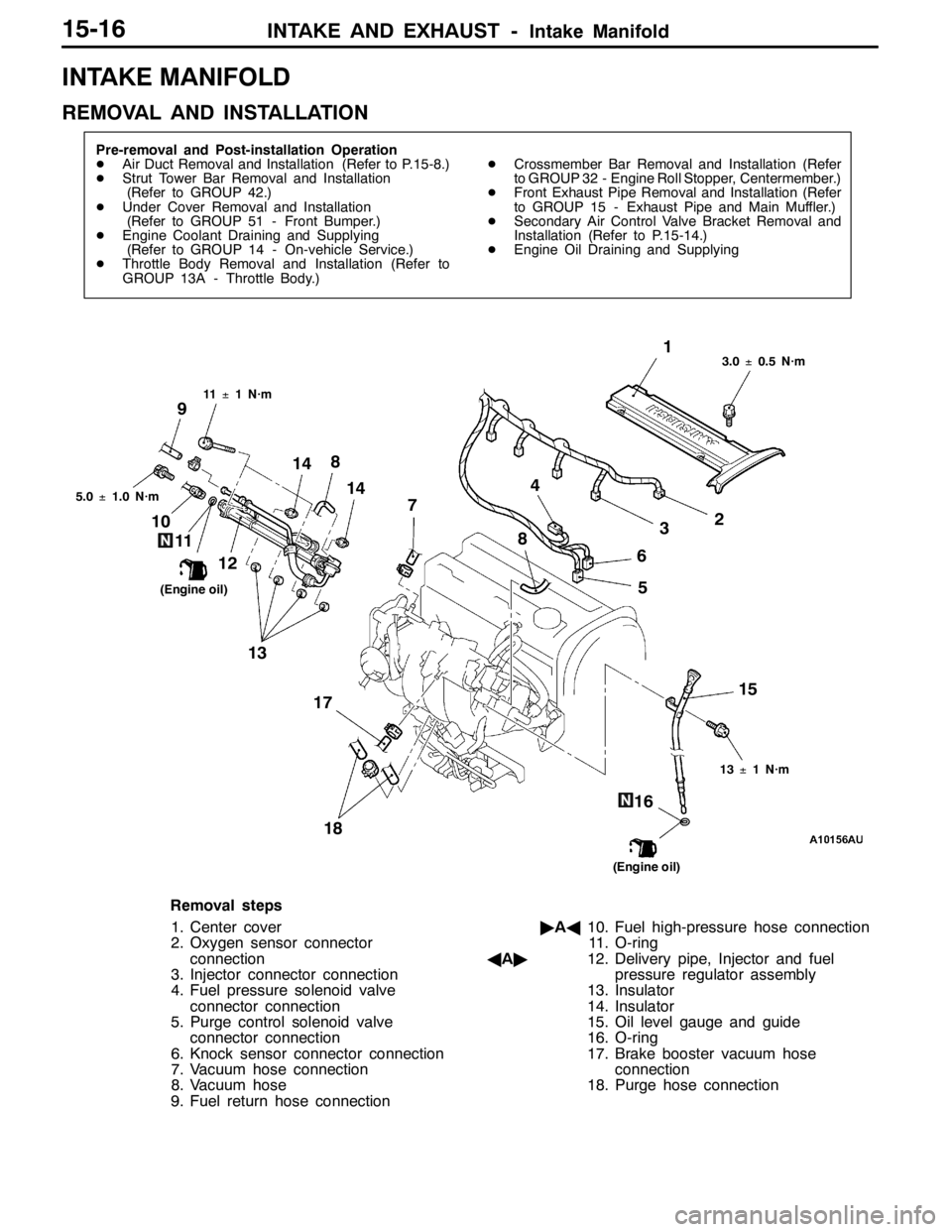
INTAKE AND EXHAUST -Intake Manifold15-16
INTAKE MANIFOLD
REMOVAL AND INSTALLATION
Pre-removal and Post-installation Operation
DAir Duct Removal and Installation (Refer to P.15-8.)
DStrut Tower Bar Removal and Installation
(Refer to GROUP 42.)
DUnder Cover Removal and Installation
(Refer to GROUP 51 - Front Bumper.)
DEngine Coolant Draining and Supplying
(Refer to GROUP 14 - On-vehicle Service.)
DThrottle Body Removal and Installation (Refer to
GROUP 13A - Throttle Body.)DCrossmember Bar Removal and Installation (Refer
to GROUP 32 - Engine Roll Stopper, Centermember.)
DFront Exhaust Pipe Removal and Installation (Refer
to GROUP 15 - Exhaust Pipe and Main Muffler.)
DSecondary Air Control Valve Bracket Removal and
Installation (Refer to P.15-14.)
DEngine Oil Draining and Supplying
1
2
3 4
5 6 7
8 10
11
1214
13
15
16 17
18
9
11±1 N·m3.0±0.5 N·m
13±1 N·m
(Engine oil)
(Engine oil) 5.0±1.0 N·m
14 8
Removal steps
1. Center cover
2. Oxygen sensor connector
connection
3. Injector connector connection
4. Fuel pressure solenoid valve
connector connection
5. Purge control solenoid valve
connector connection
6. Knock sensor connector connection
7. Vacuum hose connection
8. Vacuum hose
9. Fuel return hose connection"AA10. Fuel high-pressure hose connection
11. O-ring
AA"12. Delivery pipe, Injector and fuel
pressure regulator assembly
13. Insulator
14. Insulator
15. Oil level gauge and guide
16. O-ring
17. Brake booster vacuum hose
connection
18. Purge hose connection
Page 742 of 1449

ENGINE ELECTRICAL -Charging System16-10
EXAMPLES OF ABNORMAL WAVEFORMS
NOTE
1. The size of the waveform patterns differs largely, depending on the adjustment of the variable knob
on the analyzer.
2. Identification of abnormal waveforms is easier when there is a large output current (regulator is not
operating). (Waveforms can be observed when the headlamps are illuminated.)
3. Check the conditions of the charging warning lamp (illuminated/not illuminated). Also, check the charging
system totally.
Abnormal waveformsProblem
causeAbnormal waveformsProblem
cause
Example 1Open diodeExample 4Short in
stator coil
Example 2Short in diodeExample 5Open
supplementa-
ry diode
Example 3Broken wire
in stator coil
At this time, the charging warning lamp
is illuminated.
ALTERNATOR
REMOVAL AND INSTALLATION
Caution
If the vehicle is equipped with the Brembo disc brake, during maintenance, take care not to contact
the parts or tools to the caliper because the paint of caliper will be scratched.
Pre-removal and Post-installation Operation
DUnder Cover Removal and Installation (Refer to GROUP 51 - Front Bumper.)
DDrive Belt Tension Check (Refer to GROUP 11A - On-vehicle Service.)
DStrut Tower Bar Removal and Installation (Refer to GROUP 42.)
DCrossmember Bar Removal and Installation (Refer to GROUP 32 - Engine Roll Stopper, Centermember.)
DFront Exhaust Pipe Assembly Removal and Installation (Refer to GROUP 15.)
Page 854 of 1449
MANUAL TRANSMISSION - Transmission Control22A-46
TRANSMISSION CONTROL
REMOVAL AND INSTALLATION
Pre-removal Operation
DStrut Tower Bar Removal and Installation (Refer
to GROUP 42.)
DAir Cleaner Removal (Refer to GROUP 15.)
DBattery and Battery Tray Removal
DAir Pipe C, Air By-pass Hose, Air Hose D, Air Hose
E, and Air Hose A Removal (Refer to GROUP 15
- Intercooler.)Caution: SRS
Be careful not to subject the SRS-ECU to any
shocks during removal and installation of the
shift cable and select cable assembly.
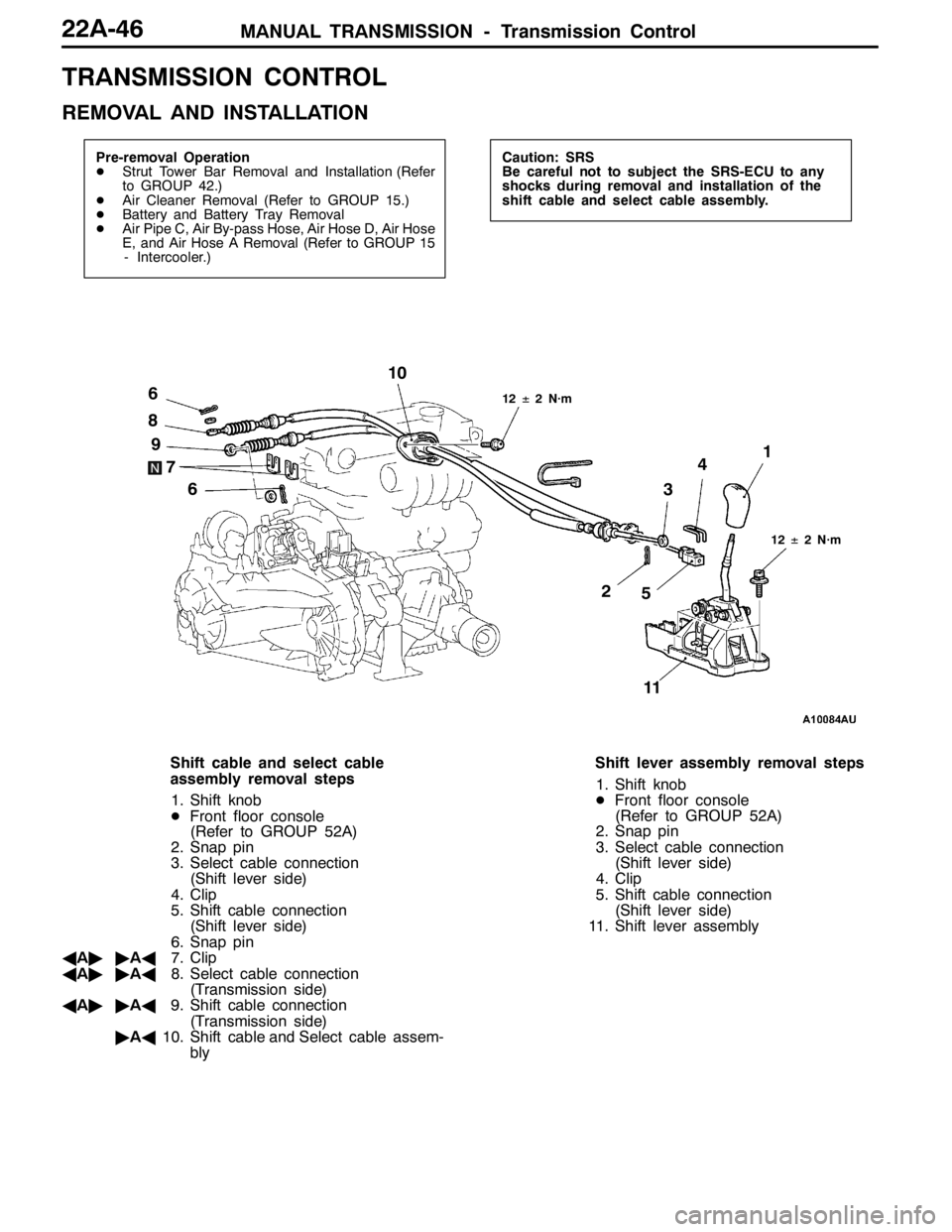
12±2 N·m
34
21
5 6
7 8
6 910
12±2 N·m
11
Shift cable and select cable
assembly removal steps
1. Shift knob
DFront floor console
(Refer to GROUP 52A)
2. Snap pin
3. Select cable connection
(Shift lever side)
4. Clip
5. Shift cable connection
(Shift lever side)
6. Snap pin
AA""AA7. Clip
AA""AA8. Select cable connection
(Transmission side)
AA""AA9. Shift cable connection
(Transmission side)
"AA10. Shift cable and Select cable assem-
blyShift lever assembly removal steps
1. Shift knob
DFront floor console
(Refer to GROUP 52A)
2. Snap pin
3. Select cable connection
(Shift lever side)
4. Clip
5. Shift cable connection
(Shift lever side)
11. Shift lever assembly
Page 857 of 1449
MANUAL TRANSMISSION - Transfer Assembly22A-49
TRANSFER ASSEMBLY
REMOVAL AND INSTALLATION
Pre-removal and Post-installation Operation
DUnder Cover Removal and Installation (Refer to GROUP 51 - Front Bumper.)
DSide Under Cover Removal and Installation
DTransmission Oil Draining and Supplying (Refer to P.22A-40.)
DTransfer Oil Draining and Supplying (Refer to P.22A-40.)
DEngine Coolant Draining and Supplying (Refer to GROUP 14 - On-vehicle Service.)
DCrossmember Bar Removal and Installation (Refer to GROUP 32 - Engine Roll Stopper, Centermember.)
DFront Exhaust Pipe Removal and Installation (Refer to GROUP 15 - Exhaust Pipe and Main Muffler.)
DBattery and Battery Tray Removal and Installation
DAir Cleaner, Air Intake Hose Removal and Installation (Refer to GROUP 15 - Air Cleaner.)
DSecondary Air Hose Removal and Installation (Refer to GROUP 15 - Secondary Air Control System.)
DStrut Tower Bar Removal and Installation (Refer to GROUP 42.)
DAir Hose E, Air By-pass Hose and Air By-pass Valve, Air Pipe C, Air Hose D, Air Pipe B, Air Hose A Removal and
Installation (Refer to GROUP 15 - Intercooler.)
DRadiator Removal and Installation (Refer to GROUP 14.)
DBleeding and Hydraulic Pressure Check (Refer to P.22A-42, 43)
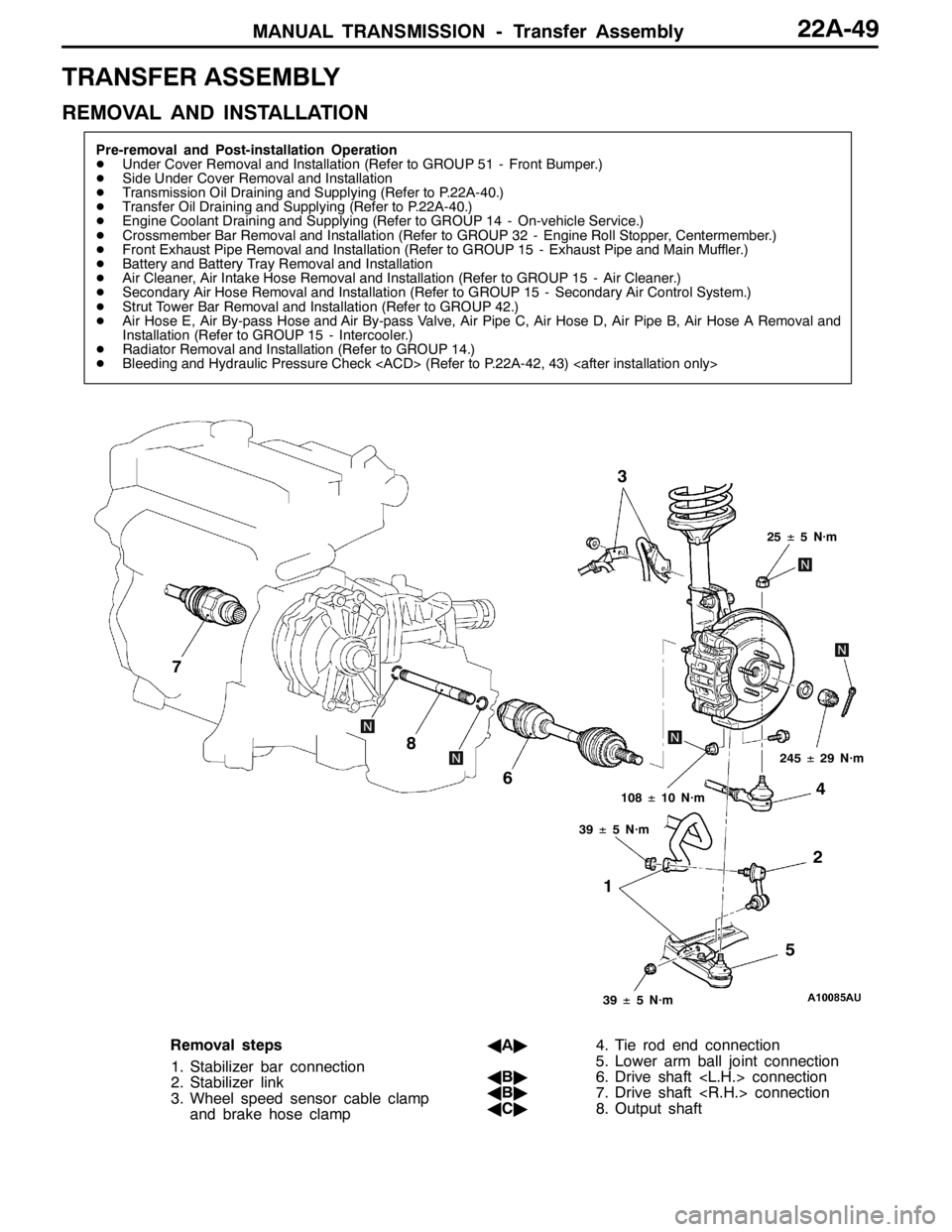
12 3
4
5 6 7
8
25±5 N·m
108±10 N·m
39±5 N·m
39±5 N·m
245±29 N·m
Removal steps
1. Stabilizer bar connection
2. Stabilizer link
3. Wheel speed sensor cable clamp
and brake hose clampAA"4. Tie rod end connection
5. Lower arm ball joint connection
AB"6. Drive shaft connection
AB"7. Drive shaft connection
AC"8. Output shaft
Page 859 of 1449
MANUAL TRANSMISSION - Transfer Assembly22A-51
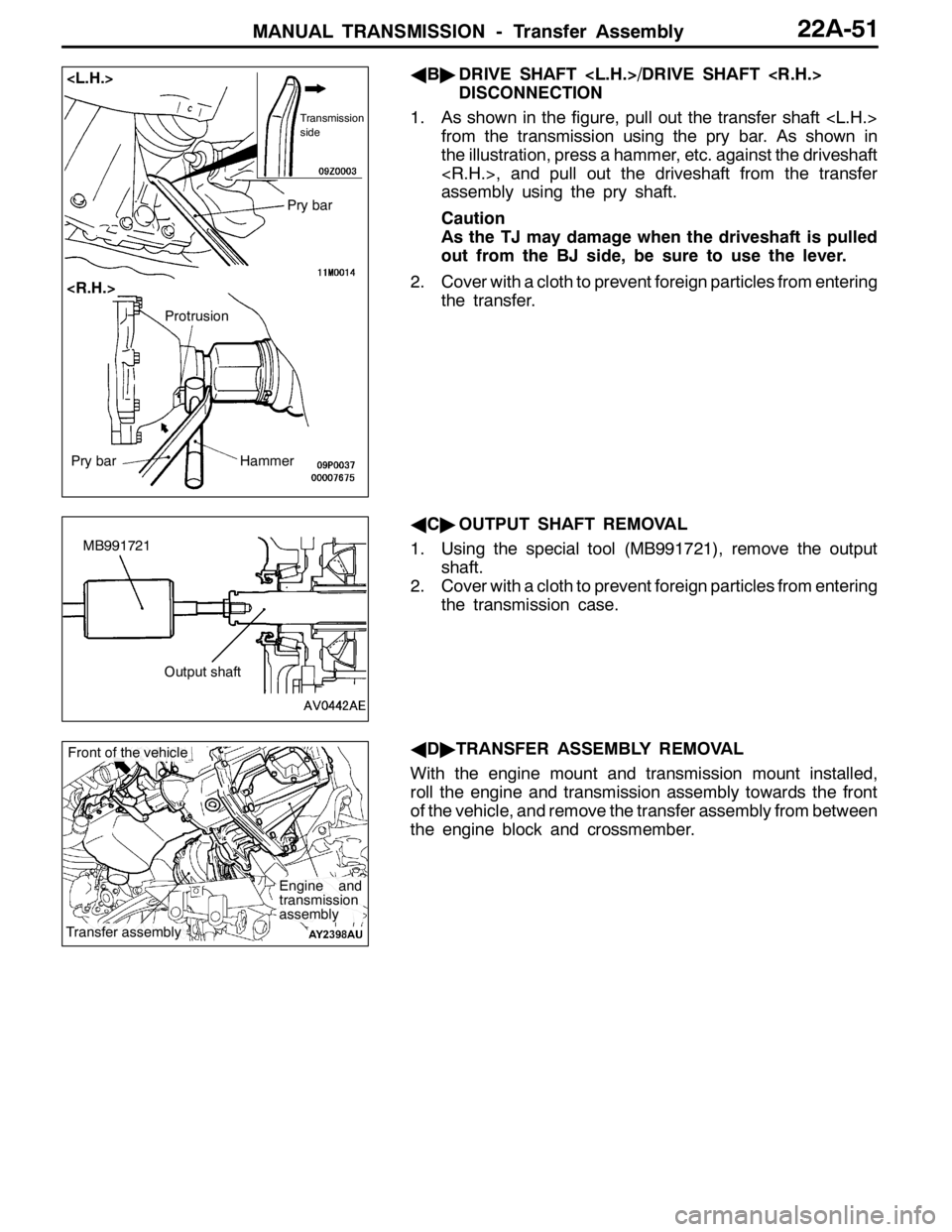
AB"DRIVE SHAFT /DRIVE SHAFT
DISCONNECTION
1. As shown in the figure, pull out the transfer shaft
from the transmission using the pry bar. As shown in
the illustration, press a hammer, etc. against the driveshaft
, and pull out the driveshaft from the transfer
assembly using the pry shaft.
Caution
As the TJ may damage when the driveshaft is pulled
out from the BJ side, be sure to use the lever.
2. Cover with a cloth to prevent foreign particles from entering
the transfer.
AC"OUTPUT SHAFT REMOVAL
1. Using the special tool (MB991721), remove the output
shaft.
2. Cover with a cloth to prevent foreign particles from entering
the transmission case.
AD"TRANSFER ASSEMBLY REMOVAL
With the engine mount and transmission mount installed,
roll the engine and transmission assembly towards the front
of the vehicle, and remove the transfer assembly from between
the engine block and crossmember.
Transmission
side
Pry bar
Pry barHammer
Protrusion
MB991721
Output shaft
Engine and
transmission
assembly
Transfer assembly
Front of the vehicle
Page 939 of 1449
FRONT AXLE -Drive Shaft26-11
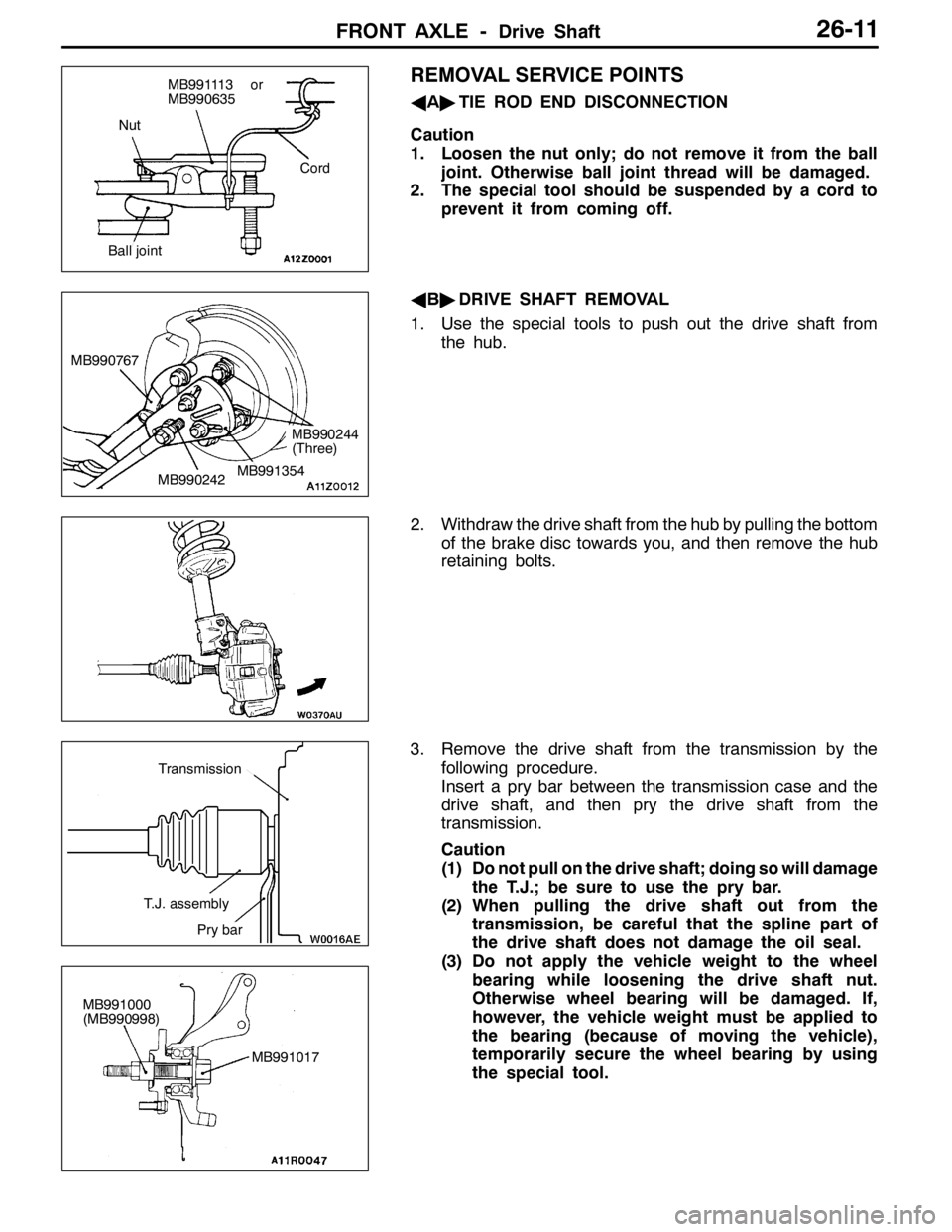
REMOVAL SERVICE POINTS
AA"TIE ROD END DISCONNECTION
Caution
1. Loosen the nut only; do not remove it from the ball
joint. Otherwise ball joint thread will be damaged.
2. The special tool should be suspended by a cord to
prevent it from coming off.
AB"DRIVE SHAFT REMOVAL
1. Use the special tools to push out the drive shaft from
the hub.
2. Withdraw the drive shaft from the hub by pulling the bottom
of the brake disc towards you, and then remove the hub
retaining bolts.
3. Remove the drive shaft from the transmission by the
following procedure.
Insert a pry bar between the transmission case and the
drive shaft, and then pry the drive shaft from the
transmission.
Caution
(1) Do not pull on the drive shaft; doing so will damage
the T.J.; be sure to use the pry bar.
(2) When pulling the drive shaft out from the
transmission, be careful that the spline part of
the drive shaft does not damage the oil seal.
(3) Do not apply the vehicle weight to the wheel
bearing while loosening the drive shaft nut.
Otherwise wheel bearing will be damaged. If,
however, the vehicle weight must be applied to
the bearing (because of moving the vehicle),
temporarily secure the wheel bearing by using
the special tool.
Nut
Cord
Ball joint
MB991113 or
MB990635
MB990242 MB990767MB991354
MB990244
(Three)
T.J. assembly
Pry bar
Transmission
MB991000
(MB990998)
MB991017
Page 1021 of 1449
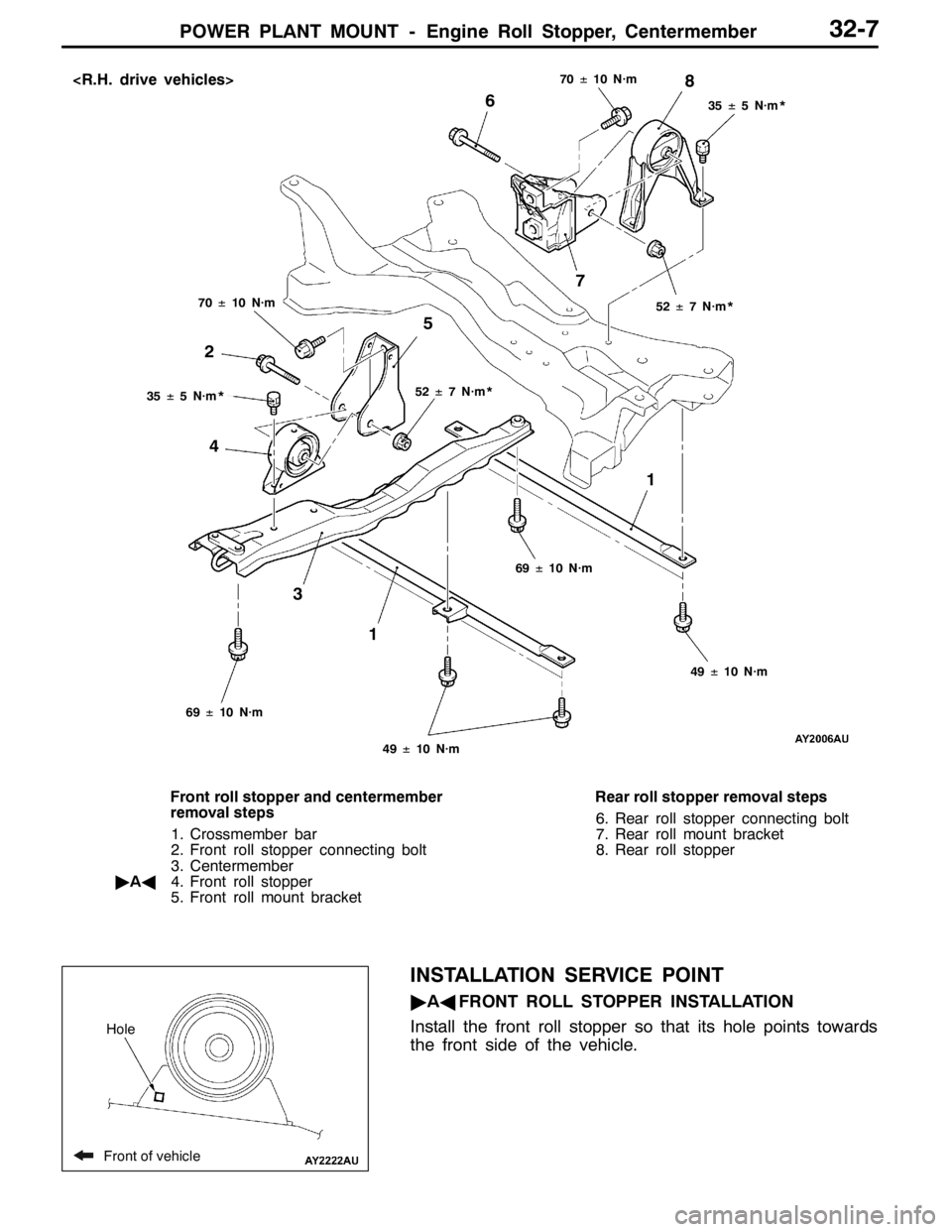
POWER PLANT MOUNT - Engine Roll Stopper, Centermember32-7
52±7 N·m*35±5 N·m*
69±10 N·m
49±10 N·m
52±7 N·m*
35±5 N·m*
70±10 N·m
1 2
3 456
1 78
70±10 N·m
69±10 N·m
49±10 N·m
Front roll stopper and centermember
removal steps
1. Crossmember bar
2. Front roll stopper connecting bolt
3. Centermember
"AA4. Front roll stopper
5. Front roll mount bracketRear roll stopper removal steps
6. Rear roll stopper connecting bolt
7. Rear roll mount bracket
8. Rear roll stopper
INSTALLATION SERVICE POINT
"AAFRONT ROLL STOPPER INSTALLATION
Install the front roll stopper so that its hole points towards
the front side of the vehicle.
Hole
Front of vehicle
Page 1030 of 1449
FRONT SUSPENSION -Special Tools/On-vehicle Service33A-4
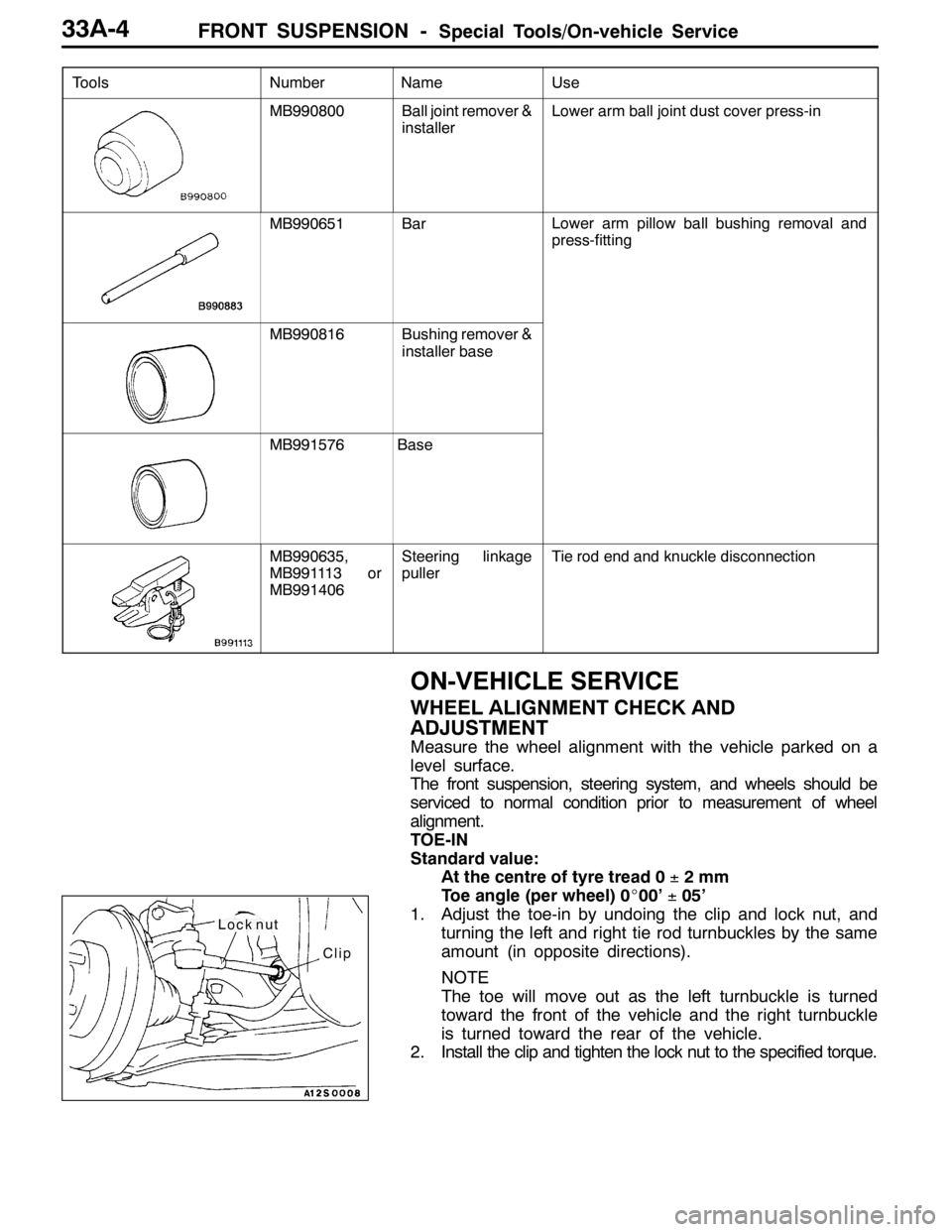
Tools UseName Number
MB990800Ball joint remover &
installerLower arm ball joint dust cover press-in
MB990651BarLower arm pillow ball bushing removal and
press-fitting
MB990816Bushing remover &
installer base
MB991576Base
MB990635,
MB991113 or
MB991406Steering linkage
pullerTie rod end and knuckle disconnection
ON-VEHICLE SERVICE
WHEEL ALIGNMENT CHECK AND
ADJUSTMENT
Measure the wheel alignment with the vehicle parked on a
level surface.
The front suspension, steering system, and wheels should be
serviced to normal condition prior to measurement of wheel
alignment.
TOE-IN
Standard value:
At the centre of tyre tread 0±2mm
Toe angle (per wheel) 0_00’±05’
1. Adjust the toe-in by undoing the clip and lock nut, and
turning the left and right tie rod turnbuckles by the same
amount (in opposite directions).
NOTE
The toe will move out as the left turnbuckle is turned
toward the front of the vehicle and the right turnbuckle
is turned toward the rear of the vehicle.
2. Install the clip and tighten the lock nut to the specified torque.
Clip
Lock nut