2007 MITSUBISHI LANCER EVOLUTION change time
[x] Cancel search: change timePage 1050 of 1449

BASIC BRAKE SYSTEM -On-vehicle Service35A-8
2. If the brake pedal play is not within the standard value,
check the following, and adjust or replace if necessary:
DExcessive play between the brake pedal and the clevis
pin, or between the clevis pin and the brake booster
operating rod
DBrake pedal height
DInstallation position of the stop lamp switch, etc.
CLEARANCE BETWEEN BRAKE PEDAL AND FLOOR
BOARD
1. Turn up the carpet etc. under the brake pedal.
2. Start the engine, depress the brake pedal with
approximately 500 N of force, and measure the clearance
between the brake pedal and the floorboard.
Standard value (C): 90 mm or more
3. If the clearance is outside the standard value, check for
air trapped in the brake line and thickness of the disc
brake pad and dragging in the parking brake.
Adjust and replace defective parts as required.
4. Return the carpet, etc.
BRAKE BOOSTER OPERATING TEST
For simple checking of the brake booster operation, carry
out the following tests:
1. Run the engine for one or two minutes, and then stop
it.
If the pedal depresses fully the first time but gradually
becomes higher when depressed succeeding times, the
booster is operating properly. If the pedal height remains
unchanged, the booster is defective.
2. With the engine stopped, step on the brake pedal several
times.
Then start the engine while the brake pedal is stepped
on.
If the pedal moves downward slightly, the booster is in
good condition. If there is no change, the booster is
defective.
3. With the engine running, step on the brake pedal and
then stop the engine.
Hold the pedal depressed for 30 seconds. If the pedal
height does not change, the booster is in good condition.
If the pedal rises, the booster is defective.
If the above three tests are okay, the booster performance
can be determined as good.
If one of the above three tests is not okay at least, the check
valve, vacuum hose, or booster will be defective.
C
Good No good
When engine is
stoppedWhen engine is
started
GoodNo good
Page 1055 of 1449
BASIC BRAKE SYSTEM -On-vehicle Service35A-13
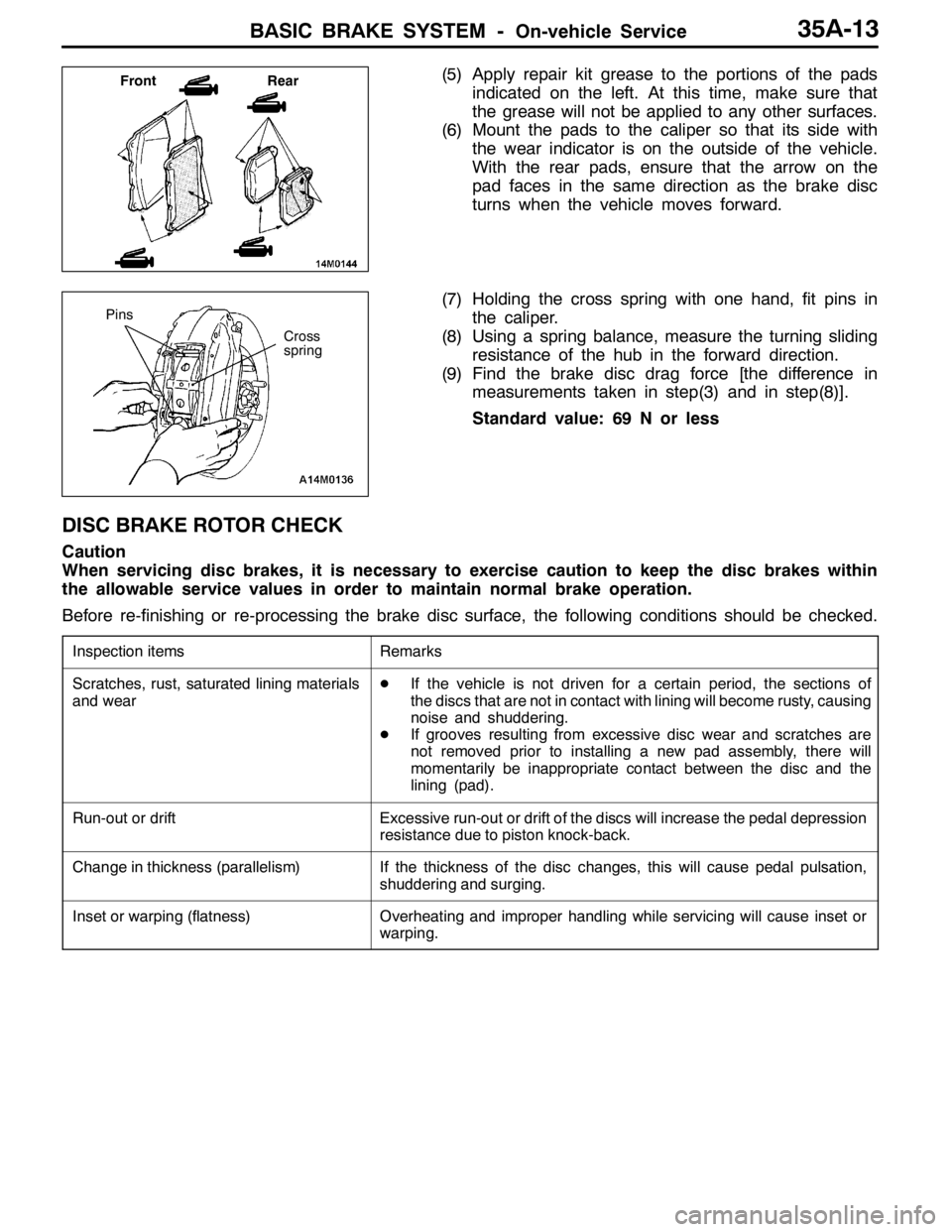
(5) Apply repair kit grease to the portions of the pads
indicated on the left. At this time, make sure that
the grease will not be applied to any other surfaces.
(6) Mount the pads to the caliper so that its side with
the wear indicator is on the outside of the vehicle.
With the rear pads, ensure that the arrow on the
pad faces in the same direction as the brake disc
turns when the vehicle moves forward.
(7) Holding the cross spring with one hand, fit pins in
the caliper.
(8) Using a spring balance, measure the turning sliding
resistance of the hub in the forward direction.
(9) Find the brake disc drag force [the difference in
measurements taken in step(3) and in step(8)].
Standard value: 69 N or less
DISC BRAKE ROTOR CHECK
Caution
When servicing disc brakes, it is necessary to exercise caution to keep the disc brakes within
the allowable service values in order to maintain normal brake operation.
Before re-finishing or re-processing the brake disc surface, the following conditions should be checked.
Inspection itemsRemarks
Scratches, rust, saturated lining materials
and wearDIf the vehicle is not driven for a certain period, the sections of
the discs that are not in contact with lining will become rusty, causing
noise and shuddering.
DIf grooves resulting from excessive disc wear and scratches are
not removed prior to installing a new pad assembly, there will
momentarily be inappropriate contact between the disc and the
lining (pad).
Run-out or driftExcessive run-out or drift of the discs will increase the pedal depression
resistance due to piston knock-back.
Change in thickness (parallelism)If the thickness of the disc changes, this will cause pedal pulsation,
shuddering and surging.
Inset or warping (flatness)Overheating and improper handling while servicing will cause inset or
warping.
Front Rear
Cross
spring
Pins
Page 1072 of 1449

ABS <4WD> -General Information35B-2
GENERAL INFORMATION
ABS has been adopted as optional equipment in
RS-IIto maintain directional stability and steering
performance during sudden braking or braking on
slippery road surfaces.
The ABS control method is a 4-sensor, 4-channel
method which provides independent control for all
wheels.
Following system for Lancer EVOLUTION-VII has
been modified from Lancer EVOLUTION-VI Tommi
Makinen Edition.DBy adding lateral G sensor, longitudinal G
sensor and steering wheel sensor, optimized
ABS control at the time of cornering.
DBy inputting parking brake switch signal to
ABS-ECU with pulling parking brake lever, ABS
control has been optimized.
DABS-ECU outputs ABS signal to 4WD-ECU.
DG sensor (lateral), steering wheel sensor and
parking brake switch have been added to the
diagnosis and service data.
DABS-ECU connector has been changed.
EBD CONTROL
In ABS, electronic control method is used by which
the rear wheel brake hydraulic pressure during
braking is regulated by rear wheel control solenoid
valves in accordance with the vehicle’s rate of
deceleration and the front and rear wheel slippage
which are calculated from the each wheel speed
sensor’s signal. EBD control is a control system
which provides a high level of control for both vehicle
braking force and vehicle stability. The system has
the following features:
DBecause the system provides the optimum rear
wheel braking force regardless of the vehicleladen condition and the condition of the road
surface, the system reduces the required pedal
depression force, particularly when the vehicle
is heavily laden or driving on road surfaces
with high frictional coefficients.
DBecause the duty placed on the front brakes
has been reduced, the increases in pad
temperature can be controlled to improve the
wear resistance characteristics of the pad,
during front brakes applying.
DControl valves such as the proportioning valve
are no longer required.
SPECIFICATIONS
ItemSpecifications
ABS control method4-sensor, 4-channel
No. of ABS rotor teethFront43
Rear43
ABS speed sensorTypeMagnet coil typep
Gap between sensor and rotor mm0.85
Page 1123 of 1449

STEERING -On-vehicle Service37A-9
POWER STEERING FLUID LEVEL CHECK
1. Park the vehicle on a flat, level surface, start the engine,
and then turn the steering wheel several times to raise
the temperature of the fluid to approximately 50 - 60_C.
2. With the engine running, turn the wheel all the way to
the left and right several times.
3. Check the fluid in the oil reservoir for foaming or milkiness.
Check the difference of the fluid level when the engine
is stopped, and while it is running. If the change of the
fluid level is 5 mm or more, air bleeding should be done.
POWER STEERING FLUID REPLACEMENT
1. Raise the front wheels on a jack, and then support them
with rigid racks.
2. Disconnect the return hose connection.
3. Connect a vinyl hose to the return hose, and drain the
oil into a container.
4. Disconnect the ignition coil connectors. (Refer to
GROUP16 - Ignition System.)
5. While operating the starting motor intermittently, turn the
steering wheel all the way to the left and right several
times to drain all of the fluid.
6. Connect the return hoses securely, and then secure it
with the clip.
7. Fill the oil reservoir with specified fluid up to the lower
position of the filter, and then bleed air.
Specified fluid:
Automatic transmission fluid DEXRONII
Caution
Do not use ATF-SPIIM and ATF-SPIII.
POWER STEERING SYSTEM BLEEDING
1. Jack up the vehicle and support the front wheels with
rigid racks.
2. Disconnect the ignition coil connectors. (Refer to
GROUP16 - Ignition System.)
3. Cranking the engine with the starter several times
intermittently (during 15 to 20 seconds), turn the steering
wheel left and right fully five or six times.
Caution
(1) During the bleeding, refill the fluid so that the
level never falls below the lower position of the
filter.
(2) Be sure to bleed air only while cranking. If the
bleeding is done with the engine running, the air
will be broken up and absorbed into the fluid.
4. Connect the ignition coil connectors and idle the engine.
5. Turn the steering wheel left and right fully until no bubbles
comes out in the oil reservoir.
6. See that the fluid is not milky and that the fluid level
is up to the specified position on the level gauge.
7. See that the fluid level changes little when the steering
wheel is turned left and right.
8. Check difference in fluid levels between the engine
stopped and running.
Fluid level change: Within 5 mm
While engine
runningWhile engine
stopped
Return hose
Vinyl hose
Page 1124 of 1449

STEERING -On-vehicle Service37A-10
9. If the level changes more than 5 mm, the air is badly
bled. So, bleed air again.
Caution
(1) If the fluid level rises suddenly after the engine
is stopped, the bleeding is incomplete.
(2) Incomplete bleeding causes abnormal noises
from the pump and the flow-control valve. This
could lessen the life of the pump and the other
parts.
OIL PUMP PRESSURE TEST
1. Disconnect the pressure hose from the oil pump, and
then connect the special tools.
2. Bleed the air, and then turn the steering wheel several
times while the vehicle is not moving so that the
temperature of the fluid rises to approximately 50 - 60_C.
3. Start the engine and idle it at 1,000±100 r/min.
4. Fully close the shut-off valve of the pressure gauge and
measure the oil pump relief pressure to confirm that it
is within the standard value range.
Standard value: 8.4 - 9.0 MPa
5. If the standard value is not met, the oil pump is defective.
So, replace the oil pump. Then, measure oil pressure
again.
6. With the pressure gauge shut - off valve fully open, check
the hydraulic pressure in unladen condition.
Standard value: 0.2 - 0.8 MPa
7. If the standard value is not met, the oil line or steering
gear is probably defective. So, repair and measure oil
pressure again.
8. Turn the steering wheel fully either left or right and check
the retention hydraulic pressure.
Standard value: 8.4 - 9.0 MPa
9. If the pressure is below the standard value, disassemble
and reassemble the steering gear. If above, replace the
oil pump. Then, measure oil pressure again.
10. Remove the special tools, and tighten the pressure hose
to the specified torque.
Tightening torque: 18±3 N·m
11. Bleed the system.
Fluid level change: Within 5 mm
While engine
runningWhile engine
stopped
Temperature
gaugePressure
gauge
(MB990662)Shut-off valve
Oil
pumpOil reservoir
Adapter
(MB990994)
Adapter
(MB990993)
Page 1205 of 1449

EXTERIOR -Windshield Wiper and Washer51-13
WINDSHIELD WIPER AND WASHER
SERVICE SPECIFICATIONS
ItemStandard value
Stopposition of the windshield wiper arm/blade assembly(distance between the edgeof34±5Stoppositionofthewindshieldwiperarm/bladeassembly(distancebetweentheedgeof
the wiper blade and the end of the deck garnish) mm
34±5
TROUBLESHOOTING
The windshield wiper-washer is controlled by the smart wiring system (SWS). Refer to Group 54B for
troubleshooting.
NOTE
If ETACS-ECU is faulty, the windshield wiper can be operable in LO mode only as the fail - safe function.
(Normally the windshield wiper is operable when the ignition switch is turned to the ACC position. When
the fail - safe function is enabled, it is operable only when the ignition switch is turned to the ON position.)
ON-VEHICLE SERVICE
WINDSHIELD INTERMITTENT WIPER
INSPECTIONS
(1) Check the change in the intermittent time of the wiper
operation by using the windshield intermittent wiper
volume.
(2) Carry out troubleshooting if any of them is faulty.
(Refer to Group 54B.)
Page 1348 of 1449
CHASSIS ELECTRICAL -Headlamp Assembly54A-28
HEADLAMP INTENSITY MEASUREMENT
1. Using a photometer, and following its manufacture’s
instruction manual.
2. Maintain an engine speed of 2,000 r/min., with the battery
in the charging condition
3. Set the headlamps to high beam
4. Measure the headlamp centre intensity (a point of H line
and V line) and check to be sure that the limit value
is satisfied.
Limit:
High beam 30,000 cd or more per one headlamp
NOTE
1. There may be special local regulations pertaining to
headlamp intensity, be sure to make any adjustments
necessary to satisfy such regulations.
2. If an illuminometer is used to make the measurements,
convert its values to photometer values by using the
following formula.
I=Er
2Where:
I=intensity (cd)
E=illumination (lux)
r=distance (m) from headlamps to illuminometer
Caution
1. On the headlamp not yet adjusted, perform aiming
with connector removed and the lamps switched off,
if applicable. In addition, care should be taken to
prevent a change of optical axis when connector is
reconnected.
2. Plastic outer lens are equipped with headlamps. When
lens surface is covered with materials for not
penetrating light, headlamp operation time should be
within 3 minutes. In addition, masking such as taping
should not be performed.
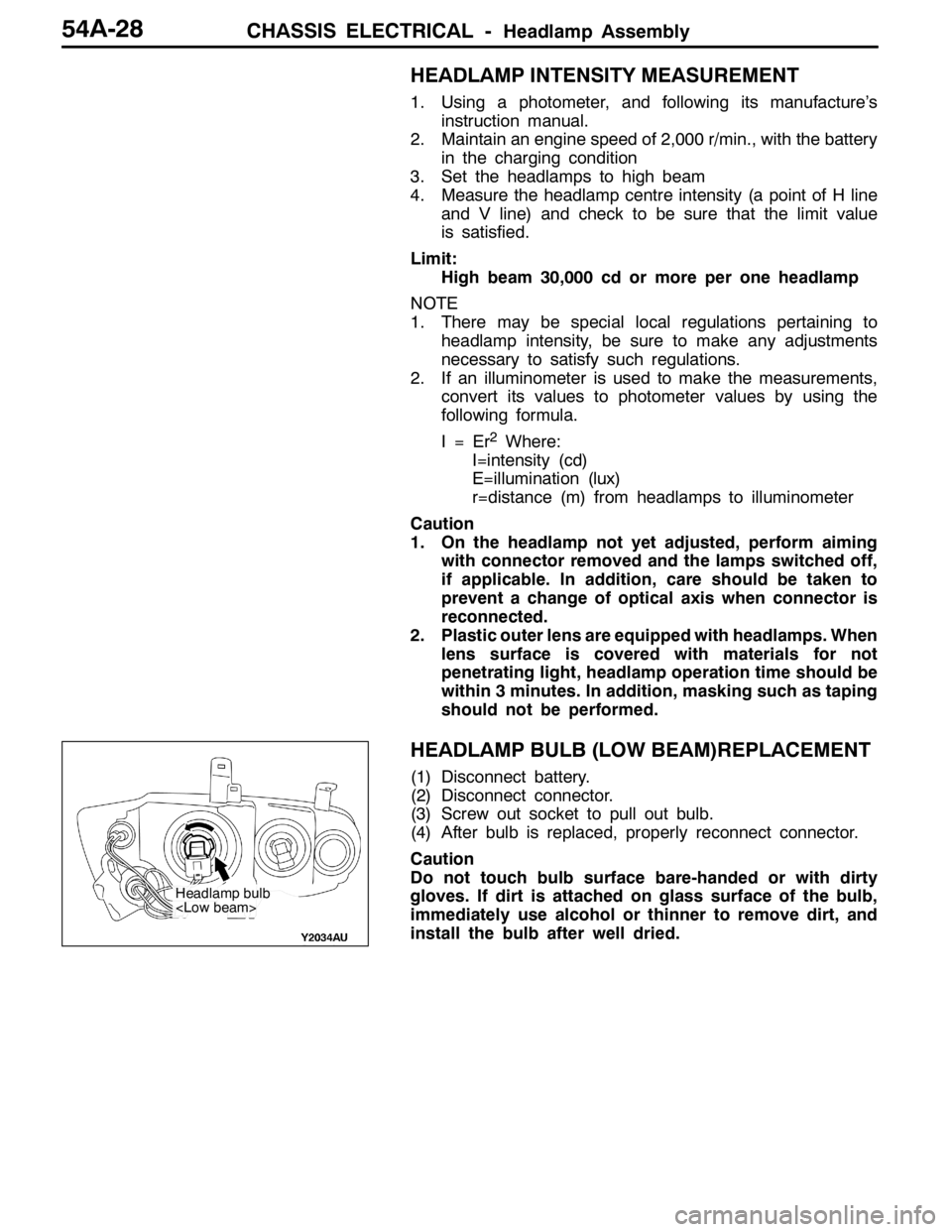
HEADLAMP BULB (LOW BEAM)REPLACEMENT
(1) Disconnect battery.
(2) Disconnect connector.
(3) Screw out socket to pull out bulb.
(4) After bulb is replaced, properly reconnect connector.
Caution
Do not touch bulb surface bare-handed or with dirty
gloves. If dirt is attached on glass surface of the bulb,
immediately use alcohol or thinner to remove dirt, and
install the bulb after well dried.
Headlamp bulb
Page 1399 of 1449

SWS -Troubleshooting54B-35
Terminal
No.Normal condition Checking requirements Check items
35Driver’s door lock actuator (locking
switch) inputWhen driver’s door lock locked0V
36Driver’s door lock actuator (unlocking
switch) inputWhen driver’s door lock unlocked0V
37, 38---
39Back-up lamp switch inputWhen shift lever in reverse positionSystem voltage
40---
51Diagnosis output/input check signal
outputDuring diagnosis output (when MUT-II
connected or diagnosis connector No. 1
grounded on the body.)0 - 12 V (pulse
signal)
When an input check is output0, 12 V (at input
signal change)
52Ignition switch (ACC) power supplyIgnition switch: ACCSystem voltage
53, 54---
55Hazard warning lamp switch inputHazard warning lamp switch: ON0V
56Earth (for sensors)Any time0V
57, 58---
59SWS communication lineAny time0 - 12 V (pulse
signal)
60---
61Battery power supplyAny timeSystem voltage
62---
63Vehicle speed signal inputWhen vehicle driven0 - 12 V (pulse
signal)
64 - 66---
67Diagnosis control inputWhen MUT-II connected0V
68SWS request signal outputAny time0 - 12 V (pulse
signal)
69Ignition key cylinder illumination lamp
outputWhen ignition key cylinder illumination
lamp ON2 V or below
70---
71 - 73---
74Rear fog lamp output