2007 KIA CARNIVAL air condition
[x] Cancel search: air conditionPage 736 of 1575

2007 > 2.7L V6 GASOLINE >
DESCRIPTION
PTC (Positive Temperature Coefficient) heater (A) is an electric heater using a PTC element as an auxiliary heating
device that supplements deficiency of interior heat source in highly effective diesel engine (U engine).
An electric heater heats up the interior by directly heating the air that passes through the heater.
PTC = positive Temperature Coefficient
The name itself implies that the element has a proportional resistance change sensitive to temperature. PTC heater is
installed at the exit or the backside of heater core.
OPERATION PRINCIPLE
ECM outputs a PTC on signal. Operate PTC from 1st setting to 3rd setting with an interval of 15 seconds.
Heat up the air, which passes through a heater core.
OPERATION CONDITION
Judge the condition by ambient temperature is below 5°C, coolant temperature is below 70°C, and battery voltage is
above 11V and engine RPM is above 700RPM.
Page 795 of 1575

2007 > 2.7L V6 GASOLINE >
General
The supplemental restraint system (SRS) is designed to supplement the seat belt to help reduce the risk or severity of
injury to the driver and passenger by activating and deploying the driver, passenger, side airbag and belt pretensioner
in certain frontal or side collisions.
The SRS (Airbag) consists of : a driver side airbag module located in the center of the steering wheel, which contains
the folded cushion and an inflator unit ; a passenger side airbag module located in the passenger side crash pad
contains the folded cushion assembled with inflator unit ; side airbag modules located in the driver and passenger seat
contain the folded cushion and an inflator unit ; curtain airbag modules located inside of the headliner which contains
folded cushions and inflator units. The impact sensing function of the SRSCM is carried out by electronic
accelerometer that continuously measure the vehicle's acceleration and delivers a corresponding signal through
amplifying and filtering circuitry to the microprocessor.
SRSCM (SRS Control Module)
SRSCM will detect front impact with front impact sensor, and side impact with side impact sensor, and determine
airbag module deployment.
1. DC/DC converter: DC/DC converter in power supply unit includes up/down transformer converter, and provide
ignition voltage for 2 front airbag ignition circuits and the internal operation voltage of the SRSCM. If the internal
operation voltage is below critical value setting, it will perform resetting.
2. Safety sensor: Safety sensor is located in airbag ignition circuit. Safety sensor will operate airbag circuit at any
deployment condition and release airbag circuit safely at normal driving condition. Safety sensor is a double contact
electro - mechanical switch that will close detecting deceleration above certain criteria.
3. Back up power supply: SRSCM has separate back up power supply, that will supply deployment energy instantly in
low voltage condition or upon power failure by front crash.
4. Self diagnosis: SRSCM will constantly monitor current SRS operation status and detect system failure while vehicle
power supply is on, system failure may be checked with trouble codes using scan tool. (Hi- Scan)
5. Airbag warning lamp on: Upon detecting error, the module will transmit signal to SRSCM indicator lamp located at
cluster. MIL lamp will indicate driver SRS error. Upon ignition key on, SRS lamp will turn on for about six seconds.
6. Trouble code registration: Upon error occurrence in system, SRSCM will store DTC corresponding to the error.
DTC can be cleared only by Hi - Scan. However, if an internal fault code is logged or if a crash is recorded the fault
clearing should not happen.
7. Self diagnostic connector: Data stored in SRSCM memory will be output to Hi - Scan or other external output
devices through connector located below driver side crash pad.
8. Once airbag is deployed, SRSCM should not be used again but replaced.
9. SRSCM will determine whether passenger put on seat belt by the signal from built- in switch in seat belt buckle, and
deploy front seat airbag at each set crash speed.
10. Side airbag deployment will be determined by SRSCM that will detect satellite sensor impact signal upon side
crash, irrespective to seat belt condition.
Page 797 of 1575

2007 > 2.7L V6 GASOLINE >
WARNING LAMP ACTIVATION
WARNING LAMP BEHAVIOR AFTER IGNITION ON
As soon as the operating voltage is applied to the SRSCM ignition input, the SRSCM activates the warning lamp for a
bulb check.
The lamp shall turn on for 6 seconds during the initialization phase and be turned off afterward. However, in order to
indicate the driver, the warning lamp shall turn on for 6 seconds and off for one second then on continuously after the
operating voltage is applied if any active fault exists. 1. Active fault or historical fault counter is greater or equal to 10
2.Normal or historical fault counter is less than 10
SRSCM INDEPENDENT WARNING LAMP ACTIVATION
There are certain fault conditions in which the SRSCM cannot function and thus cannot control the operation of the
standard warning lamp. In these cases, the standard warning lamp is directly activated by appropriate circuitry that
operates independently of the SRSCM. These cases are:
1. Loss of battery supply to the SRSCM : warning lamp turned on continuously.
2. Loss of internal operating voltage : warning lamp turned on continuously.
3. Loss of Microprocessor operation : warning lamp turned on continuously.
4. SRSCM not connected : warning lamp turned on continuously through the shorting bar.
PASSENGER AIRBAG DEACTIVATION (PAD) LAMP OPERATION
The SRSCM is designed with circuitry and software to drive a PAD lamp, which is used for depowered airbag system.
For the PAD indicator circuitry to function properly, both the SRSCM and PAD indicator are sourced from the same
ignition line. After ignition on, the PAD indicator will be turned on for 4 seconds and off for 3 seconds during the
initialization phase. Thereafter the lamp will be turned on as long as the PAD switch is in the disabled position.
PASSENGER RESTRAINTS ACTIVATION WITH PAD SWITCH
The PAD switch affects the activation of the front passenger airbag only and the switch is controlled manually. The
PAD switch will be functioned as follows:
PAD Switch status PAD LampPAB
Phase- up ON → OFF Enable
Enabled position OFFEnable
Disabled position ONDisable
Fault Based on PABEnable
Page 928 of 1575
2007 > 2.7L V6 GASOLINE >
DESCRIPTION
This specification applies to HCU(Hydraulic Control Unit) and ECU(Electronic Control Unit) of the HECU.(Hydraulic and
Electronic Control Unit)
This specification is for the wiring design and installation of ABS/TCS/ESC ECU.
This unit has the functions as follows.
a. Input of signal from Pressure sensor, Steering angle sensor, Yaw & Lateral G sensor, the wheel speed sensors
attached to each wheel.
b. Control of braking force / traction force/ yaw moment.
c. Failsafe function.
d. Self diagnosis function.
e. Interface with the external diagnosis tester.
Installation position : engine compartment a. Brake tube length from Master cylinder port to HECU inlet port should be max. 1m
b. The position should not be close to the engine block and not lower than the wheel.
OPERATION
The ECU shall be put into operation by switching on the operating voltage (IGN).
On completion of the initialization phase, the ECU shall be ready for operation.
In the operating condition, the ECU shall be ready, within the specified limits (voltage and temperature), to process the
signals offered by the various sensors and switches in accordance with the control algorithm defined by the software
and to control the hydraulic and electrical actuators.
Wheel Sensor signal processing
The ECU shall receive wheel speed signal from the four active wheel sensors.
The wheel signals are converted to voltage signal by the signal conditioning circuit after receiving current signal from
active wheel sensors and given as input to the MCU.
Solenoid Valve Control
When one side of the valve coil is connected to the positive voltage that is provided through the valve relay and the
other side is connected to the ground by the semiconductor circuit, the solenoid valve goes into operation.
The electrical function of the coils are always monitored by the valve test pulse under normal operation conditions.
Voltage limits
a.Overvoltage
When overvoltage is detected(above 16.8 V), the ECU switches off the valve relay and shuts down the system.
When voltage is returned to operating range, the system goes back to the normal condition after the initialization
phase.
b. Undervoltage
In the event of undervoltage(below 9.3 V), ABS control shall be inhibited and the warning lamp shall be turned on.
When voltage is returned to operating range, the warning lamp is switched off and ECU returns to normal operating
mode.
Pump Motor Checking
The ECU performs a pump motor test at a speed of 15km/h once after IGN is switched on.
Diagnostic Interface
Failures detected by the ECU are encoded on the ECU, stored in a EEPROM and read out by diagnostic equipment
when the ignition switch is turned on.
The diagnosis interface can also be used for testing the ECU during production of the ECU and for actuating the HCU
(Air - bleeding line or Roll and Brake Test line).
Warning Lamp module
Page 937 of 1575

c.Stop lamp switch circuit.
d. Check the hydraulic circuit for leakage.
Communication with Scan tool is not possible.
(Communication with any system is not possible) a.
Power source circuit
b. Diagnosis line
Communication with Scan tool is not possible.
(Communication with ABS only is not possible) a.
Power source circuit
b. Diagnosis line
c. HECU
When ignition key is turned ON (engine OFF), the ABS
warning lamp does not light up. a.
ABS warning lamp circuit
b. HECU
Even after the engine is started, the ABS warning lamp
remains ON. a.
ABS warning lamp circuit
b. HECU
During ABS operation, the brake pedal may vibrate or may not be able to be depressed. Such phenomena are
due to intermittent changes in hydraulic pressure inside the brake line to prevent the wheels from locking and is
not an abnormality.
DETECTING CONDITION
Trouble Symptoms Possible Cause
Brake operation varies depending on driving conditions and road
surface conditions, so diagnosis can be difficult.However if a normal
DTC is displayed, check the following probable cause. When the
problem is still occurring, replace the ABS control module. a.
Inoperative power source circuit
b. Inoperative wheel speed sensor circuit
c. Inoperative hydraulic circuit for leakage
d. Inoperative HECU
INSPECTION PROCEDURES
DTC INSPECTION
1. Connect the Scan Tool with the data link connector and turn the ignition switch ON.
2. Verify that the system is operating to specifications.
Is the system operating to specifications ?
▶ Check the power source circuit.
▶ Erase the DTC and recheck using Scan Tool.
CHECK THE POWER SOURCE CIRCUIT.
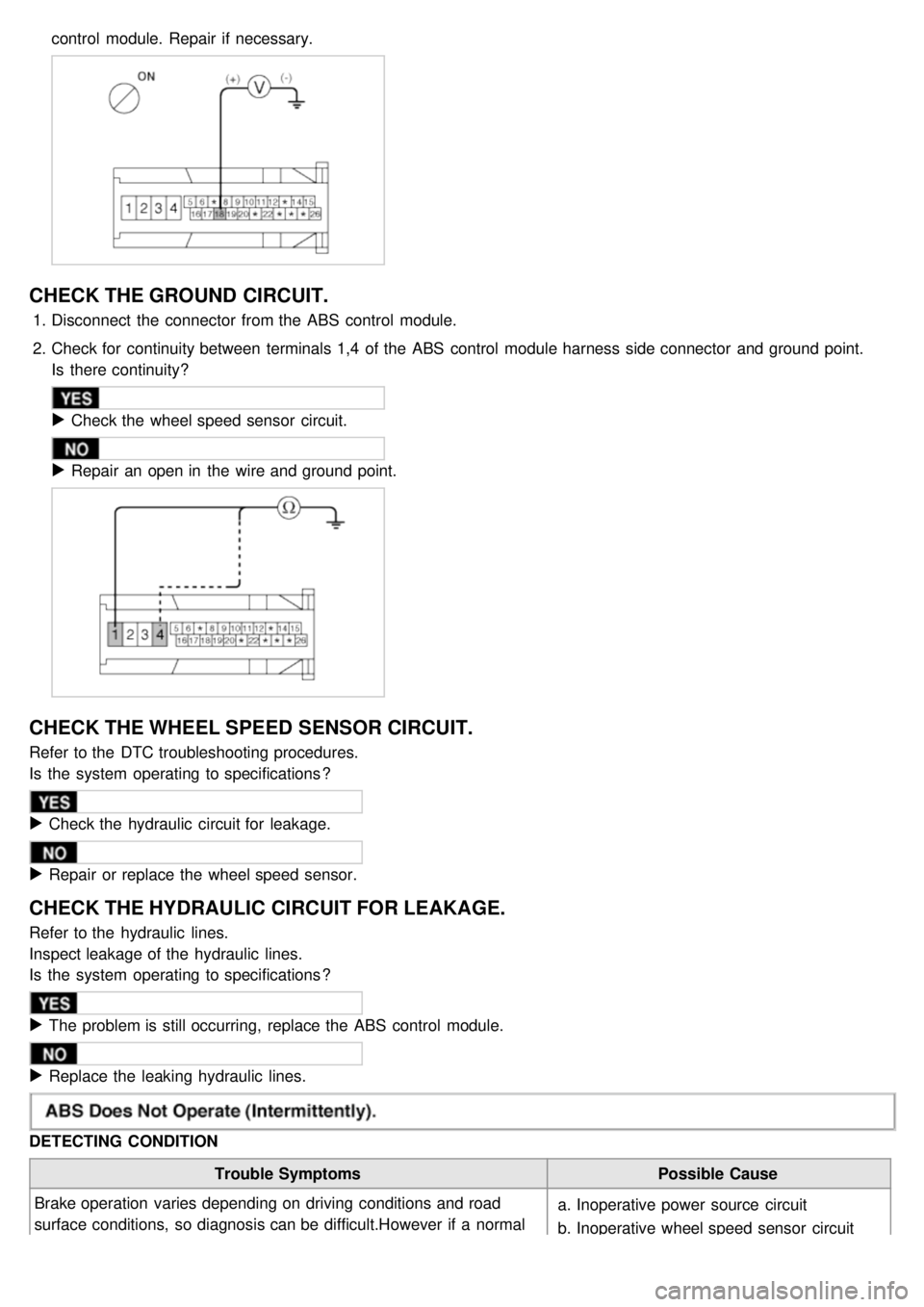
1. Disconnect the connector from the ABS control module.
2. Turn the ignition switch ON, measure the voltage between terminal 18 of the ABS control module harness side
connector and body ground.
Specification: approximately B+
Is the voltage within specification?
▶ Check the ground circuit.
▶ Check the harness or connector between the fuse (10A) in the engine compartment junction block and the ABS
control module. Repair if necessary.
Page 938 of 1575
control module. Repair if necessary.
CHECK THE GROUND CIRCUIT.
1.Disconnect the connector from the ABS control module.
2. Check for continuity between terminals 1,4 of the ABS control module harness side connector and ground point.
Is there continuity?
▶ Check the wheel speed sensor circuit.
▶ Repair an open in the wire and ground point.
CHECK THE WHEEL SPEED SENSOR CIRCUIT.
Refer to the DTC troubleshooting procedures.
Is the system operating to specifications ?
▶ Check the hydraulic circuit for leakage.
▶ Repair or replace the wheel speed sensor.
CHECK THE HYDRAULIC CIRCUIT FOR LEAKAGE.
Refer to the hydraulic lines.
Inspect leakage of the hydraulic lines.
Is the system operating to specifications ?
▶ The problem is still occurring, replace the ABS control module.
▶ Replace the leaking hydraulic lines.
DETECTING CONDITION
Trouble Symptoms Possible Cause
Brake operation varies depending on driving conditions and road
surface conditions, so diagnosis can be difficult.However if a normal
DTC is displayed, check the following probable cause. When the a.
Inoperative power source circuit
b. Inoperative wheel speed sensor circuit
Page 940 of 1575

▶ Replace the leaking hydraulic lines.
DETECTING CONDITION
Trouble Symptoms Possible Cause
Possible malfunction in the power supply system (including ground)
for the diagnosis line. a.
An open in the wire
b. Poor ground
c. Inoperative power source circuit
INSPECTION PROCEDURES
CHECK THE POWER SUPPLY CIRCUIT FOR THE DIAGNOSIS
Measure the voltage between terminal 9 of the data link connector and body ground.
Specification: approximately B+
Is voltage within specification?
▶ Check the ground circuit for the diagnosis.
▶ Repair an open in the wire. Check and replace fuse (15A) from the engine compartment junction block.
CHECK THE GROUND CIRCUIT FOR THE DIAGNOSIS
Check for continuity between terminal 5 of the data link connector and body ground.
Is there continuity?
▶ Repair an open in the wire between terminal 5 of the data link connector and ground point.
DETECTING CONDITION
Trouble Symptoms Possible Cause
When communication with Scan Tool is not possible, the cause may
be probably an open in the HECU power circuit or an open in the a.
An open in the wire
Page 942 of 1575

DETECTING CONDITIONTrouble Symptoms Possible Cause
When current flows in the HECU the ABS warning lamp turns from
ON to OFF as the initial check.Therefore if the lamp does not light up,
the cause may be an open in the lamp power supply circuit, a blown
bulb, an open in the both circuits between the ABS warning lamp and
the HECU, and the inoperative HECU. a.
Inoperative ABS warning lamp bulb
b. Blown No.2 fuse (10A) in the engine
compartment junction block
c. Inoperative ABS warning lamp module
d. Inoperative HECU
INSPECTION PROCEDURES
PROBLEM VERIFICATION
Disconnect the connector from the ABS control module and turn the ignition switch ON.
Does the ABS warning lamp light up?
▶ It is normal. Recheck the ABS control module.
▶ Check the power source for the ABS warning lamp.
CHECK THE POWER SOURCE FOR THE ABS WARNING LAMP
1. Disconnect the instrument cluster connector and turn the ignition switch ON.
2. Measure the voltage between terminal 8 of the cluster harness side connector and body ground.
Specification: approximately B+
Is voltage within specification?
▶ Repair bulb or instrument cluster assembly.
▶ Check for blown fuse.